
2M26 Builds a Shrine-Inspired Chicken Coop from Cypress, Cedar Bark, and Stone in Kyoto's Mountains
In Keihoku, north of Kyoto, a tiny timber pavilion for free-range chickens channels the joinery and spirit of Ise Grand Shrine.


A chicken coop should not make you rethink your assumptions about architecture. And yet here we are. In the mountain hamlet of Keihoku, on the north side of Kyoto city, the studio 2M26 has built what is essentially a miniature shrine for poultry: a cypress-framed, cedar-bark-roofed pavilion that borrows its structural logic from the Ise Grand Shrine and its material ethos from the folk houses that once dominated rural Japan. The project is called Niwatorigoya, and it is barely larger than a garden shed. Its ambitions, however, are enormous.
What makes Niwatorigoya genuinely compelling is not the novelty of a well-designed chicken coop, though that alone is unusual enough. It is the seriousness with which 2M26 treats the question of impermanence. The entire structure is assembled with traditional joinery, sits on loose stones rather than a poured foundation, and is made from materials that can decompose back into the forest floor. Every component, from the hand-harvested cedar bark shingles to the round cypress pillars, is designed for a finite life. The building does not fight entropy; it plans for it. That philosophical commitment, drawn from the Shikinen Sengu tradition of cyclically rebuilding Ise every twenty years, elevates a utilitarian outbuilding into something worth paying attention to.
A Pavilion Among Trees and Water

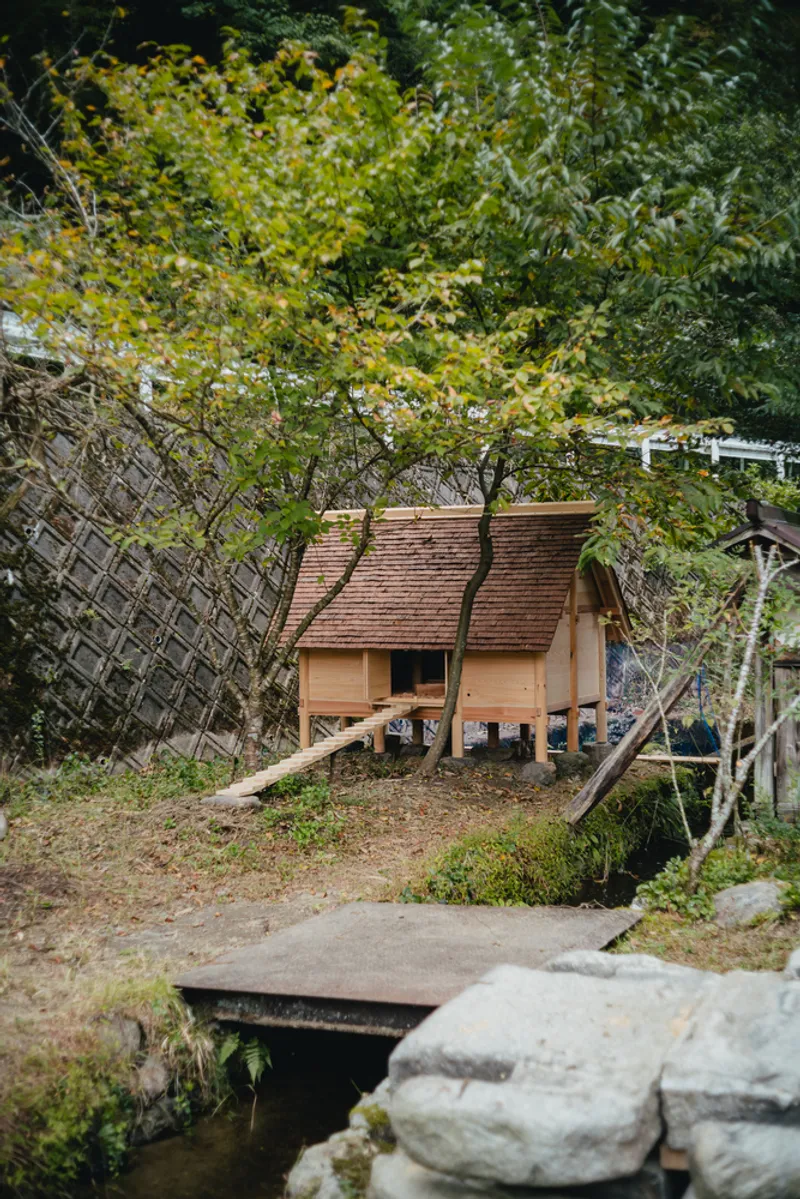
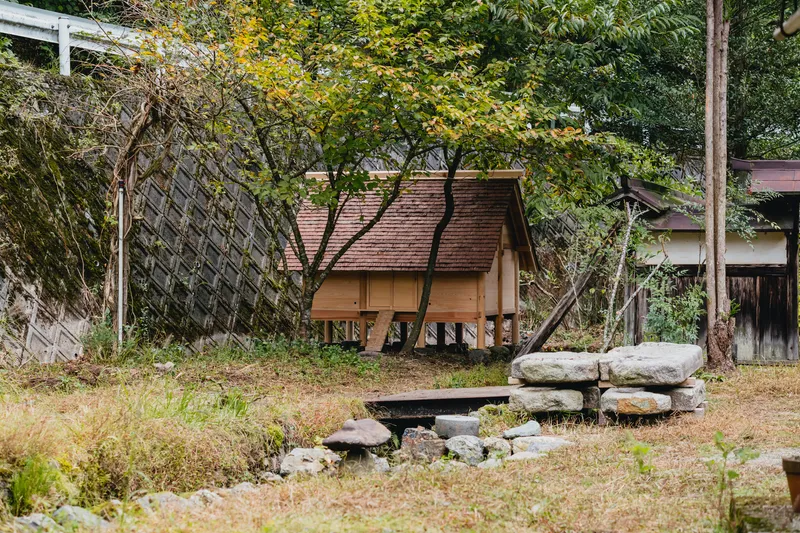
Niwatorigoya sits next to a thatched-roof dwelling in Keihoku, surrounded by moss-covered stones, deciduous trees, and a narrow stone-edged water channel. The structure does not impose itself on the landscape. Elevated on round log posts, it floats just above the ground plane, leaving the stone bed beneath it undisturbed. Its proportions, compact and vertical, recall the small subsidiary buildings found within Shinto shrine compounds rather than anything you would associate with livestock.
The choice of site is deliberate. Positioned near flowing water and mature trees, the coop benefits from natural shade in summer and wind protection from surrounding buildings and topography. Its scale and materiality allow it to read as part of the garden rather than an intrusion upon it. From certain angles, especially in autumn when the surrounding canopy thins, the cedar shingle roof and warm timber frame glow against a background of grey stone and green moss.
Cypress Framework and Traditional Joinery
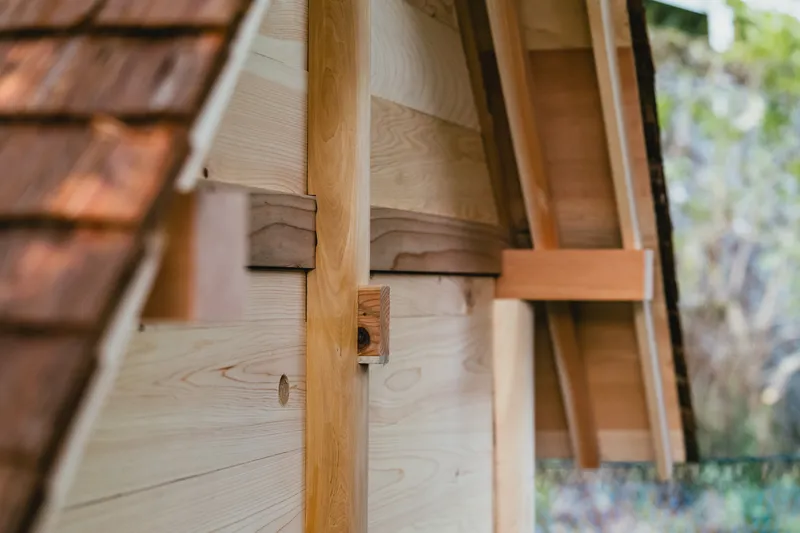

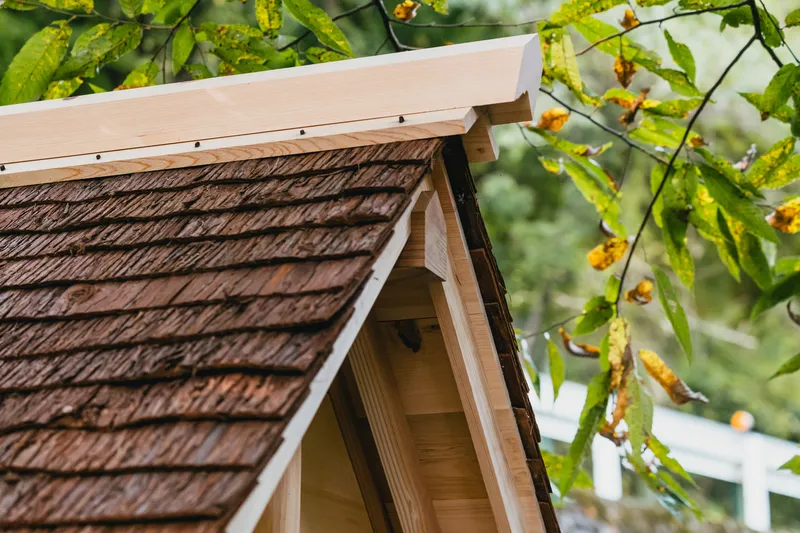
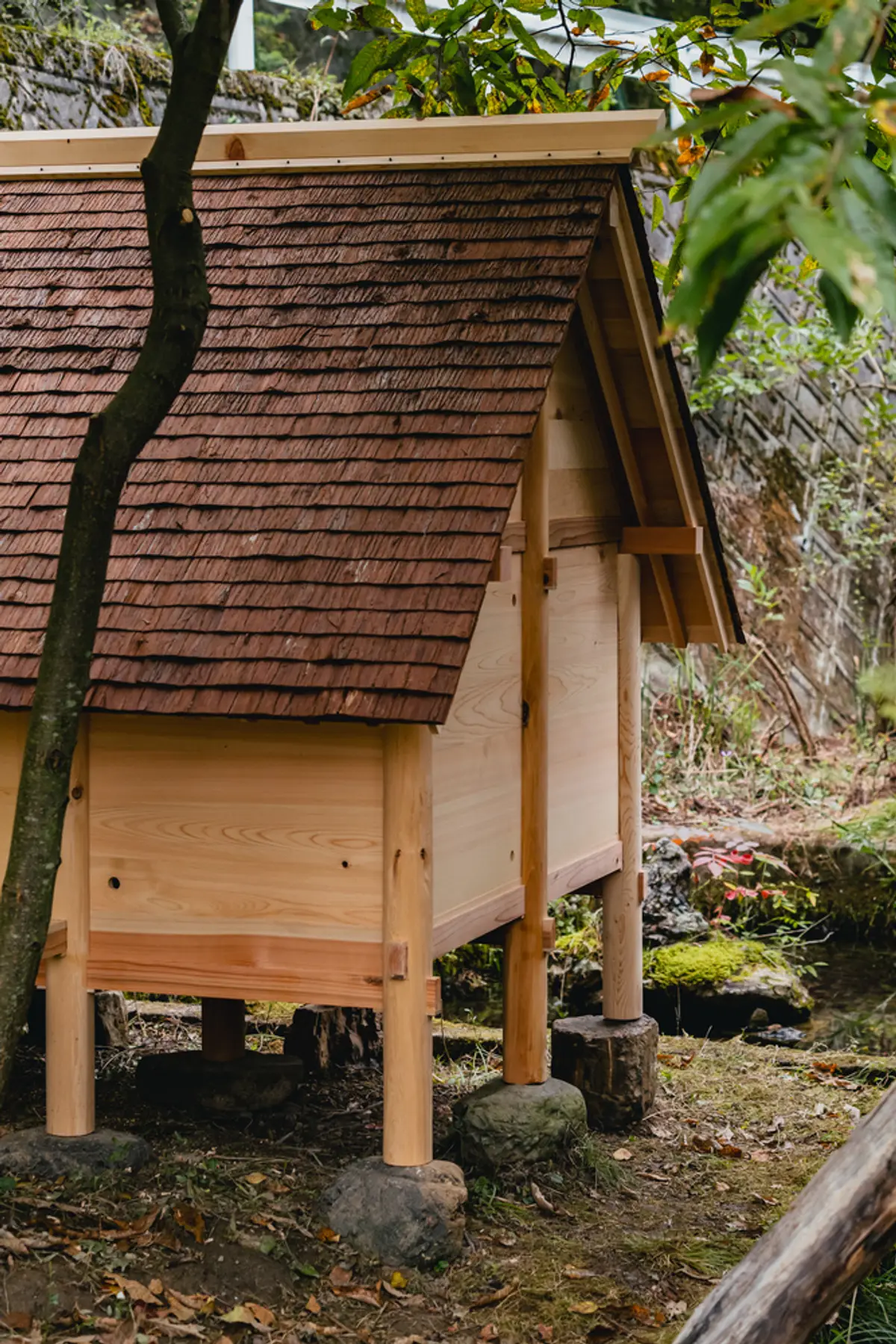
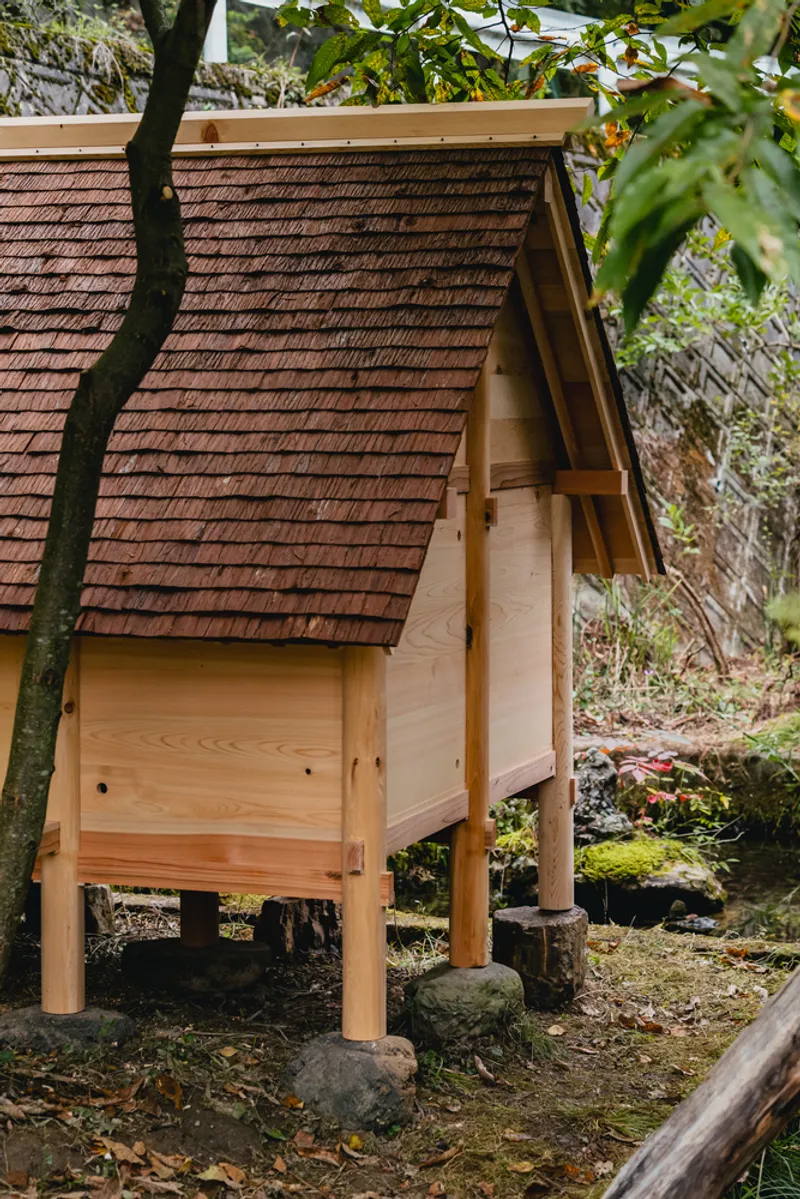
The structural system is a post-and-beam frame of cypress, twelve round pillars supporting a network of beams and rafters joined without nails. 2M26 drew directly on the joinery techniques used at Ise Grand Shrine, adapting them to a far smaller scale. The result is a skeleton that reads as both archaic and precise: hand-cut mortise-and-tenon connections lock members together with a snugness that machine-fabricated joints rarely achieve.
There is a practical rationale beyond craft for craft's sake. Because no fasteners are used, individual components can be removed and replaced without dismantling the whole. A damaged beam or a rotted post can be swapped out, extending the building's life incrementally. This is the same logic that has kept Ise standing, conceptually at least, for over a millennium. Applied to a chicken coop, it might seem like overkill. But it demonstrates a principle that contemporary construction has largely abandoned: the idea that a building can be repaired in parts rather than demolished as a whole.
Cedar Bark and the Roof as Material Story
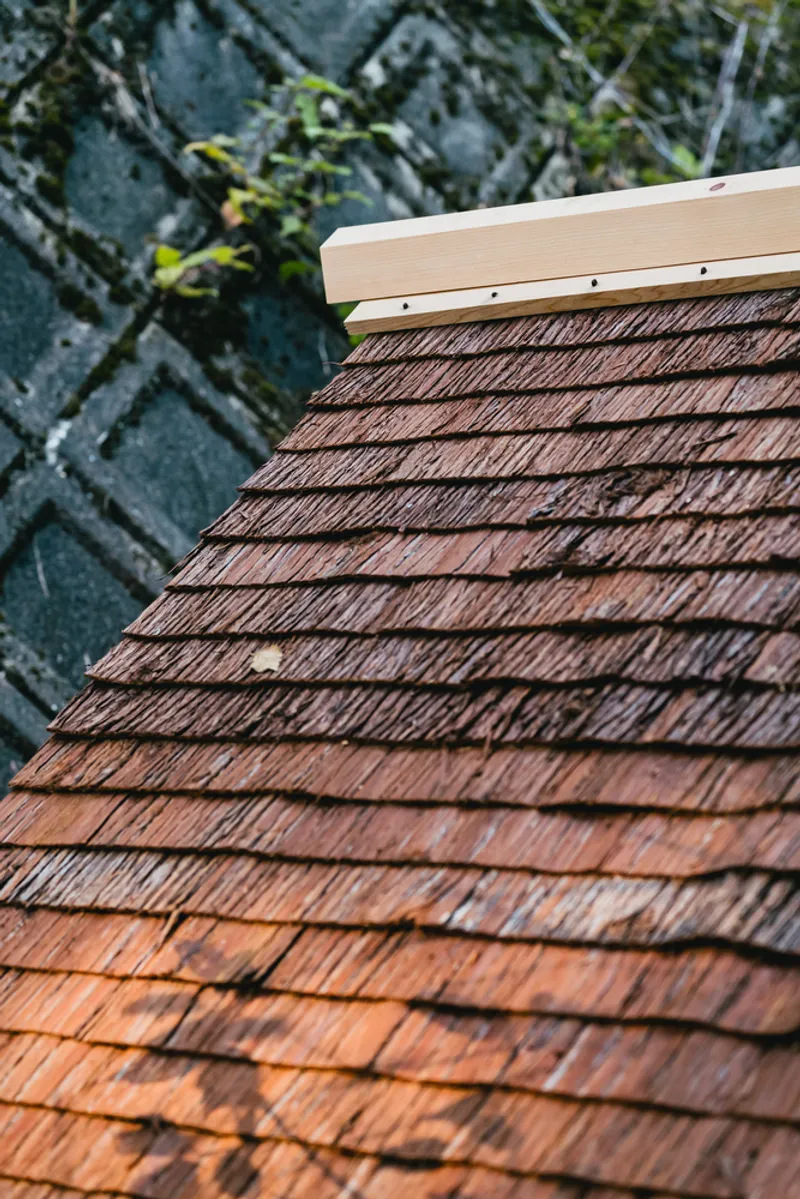

The roof is perhaps the most labor-intensive element of the entire project. Cedar bark, once a ubiquitous roofing material for outbuildings and folk houses across rural Japan, is harvested by hand during summer when the trees are full of sap. The bark sheets are then kept flat and dried for several months before installation. The process is slow, seasonal, and demands knowledge that is increasingly rare.
Visually, the cedar bark shingles give the roof a textured, layered quality that changes character as it weathers. Fresh shingles are a warm brown; over time, they grey and soften, blending with the stone walls and mossy ground of the surrounding courtyard. The gable end, with its exposed rafter tails and light timber fascia, shows the construction logic plainly. There is nothing hidden. The way the bark layers overlap, the way the rafters cantilever beyond the wall plane to form deep eaves: every detail is legible.
Stone Foundations and Zero-Impact Assembly

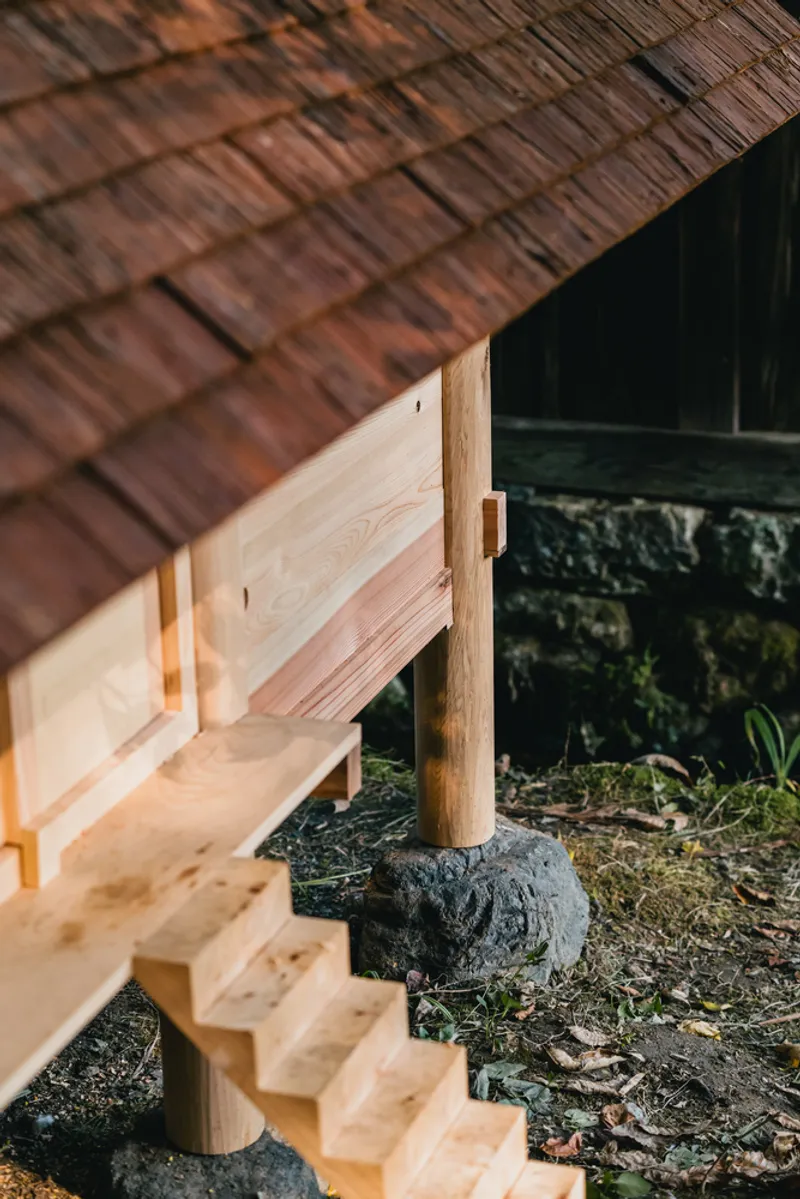
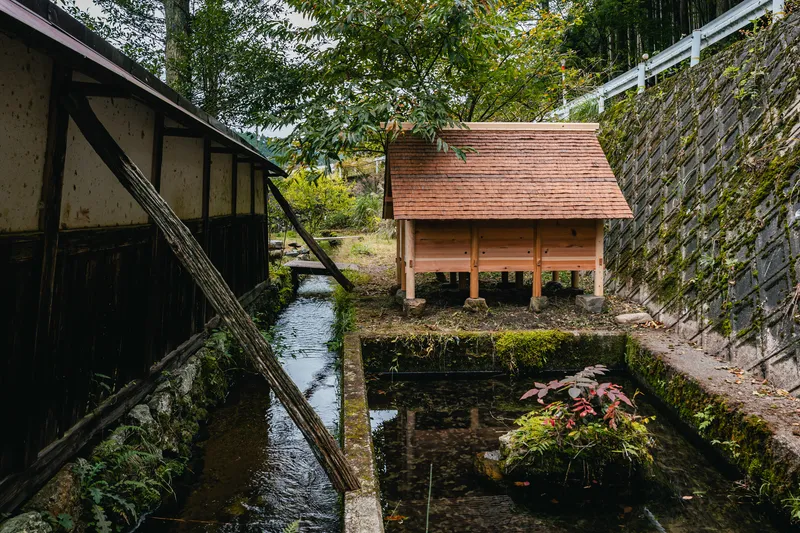
The coop sits on a bed of loose stones, a foundation strategy that predates concrete by centuries in Japan. Each round cypress post rests directly on a stone, transferring loads into the ground without any permanent bond. The building could, in theory, be lifted off its base and relocated. More importantly, when it eventually reaches the end of its useful life, every material, stone, cypress, cedar bark, can return to the soil without leaving a trace.
2M26 frames this as a "zero impact" approach to construction. It is a bold claim for any building, but the small scale and all-natural material palette of Niwatorigoya make it credible. No concrete was poured, no synthetic membranes installed, no petrochemical finishes applied. The structure exists within the material cycles of its site, drawing from the forest and eventually returning to it. The moss already creeping up the base stones suggests that nature is not waiting for an invitation.
Functional Details for the Flock
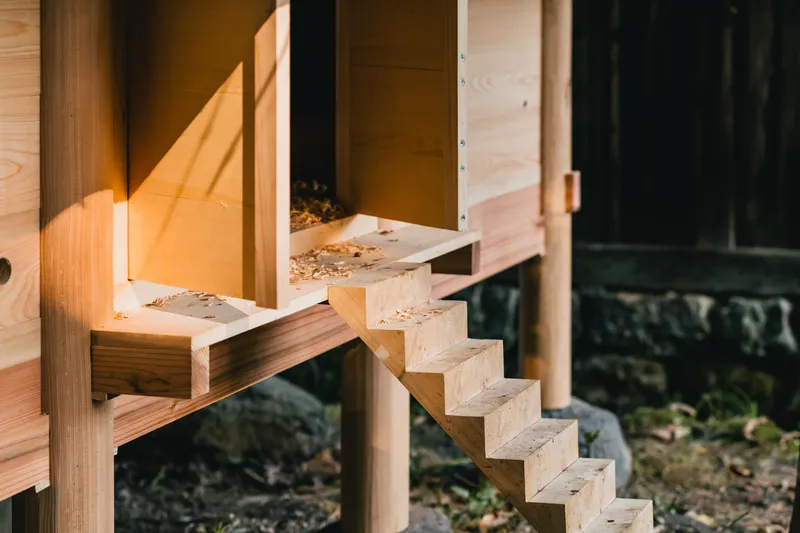
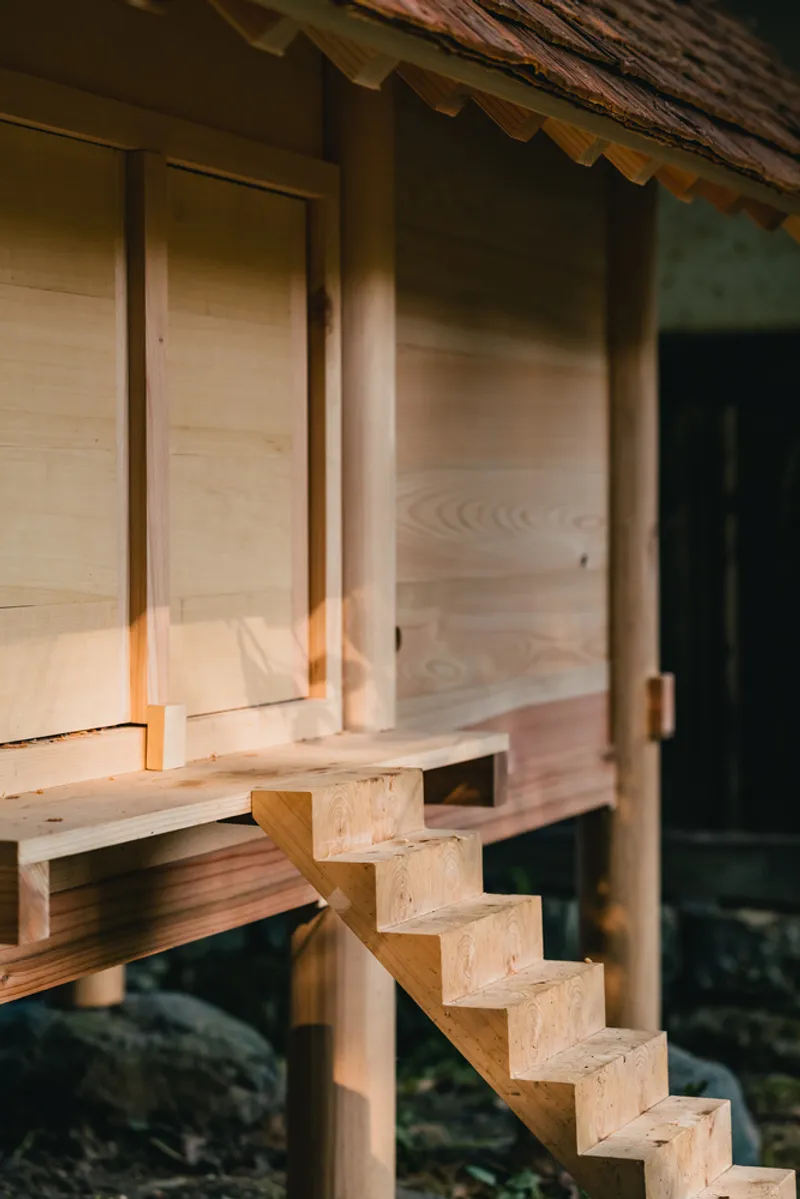
For all its architectural ambition, Niwatorigoya is still a working chicken coop, and 2M26 has thought carefully about what that requires. Wooden panels on all four sides slide open for ventilation and egg collection. A small staircase, carved from a single piece of wood, gives the chickens access to the elevated living chamber. Inside, beams double as roosting perches, and dedicated nesting boxes provide laying space. The raised floor keeps the flock safe from ground-level predators at night.
The sliding panels are the key functional move. They allow the owner to adjust airflow, control access, and reach into the interior without entering the coop. It is a solution borrowed from the fusuma and shoji traditions of Japanese domestic architecture, scaled down and simplified. The chickens, presumably, do not care about the architectural lineage. But the panels work exceptionally well for both human and animal occupants, which is the point.
Context: Thatched Roofs and Mountain Courtyards
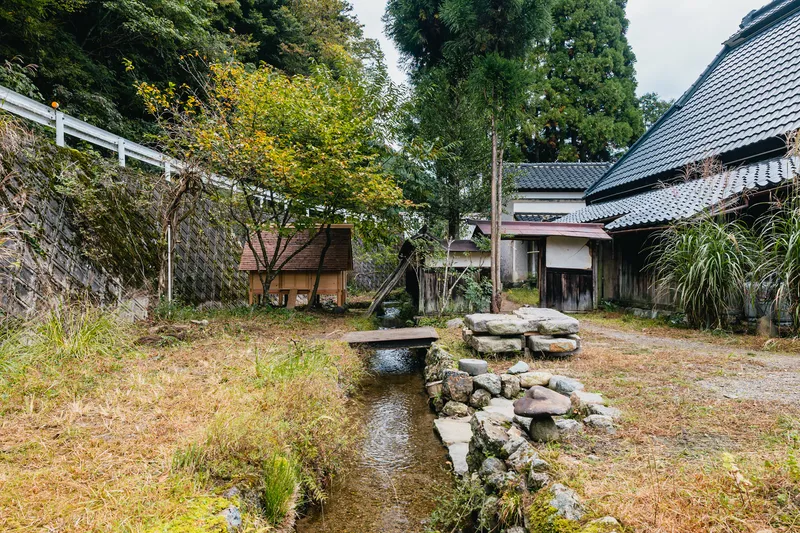
Keihoku is not suburban Kyoto. It is a mountainous, forested area where traditional building practices have persisted longer than in the lowland city. The coop's immediate neighbor is a thatched-roof dwelling, and the surrounding courtyard features stacked boulders, moss-covered canals, and tile-roofed outbuildings. Niwatorigoya does not mimic these older structures, but it speaks their language. The cedar bark roof, the stone base, and the exposed timber all belong to the same material vocabulary.
Placing a new structure in this context carries risk. Anything too contemporary would clash; anything too nostalgic would feel like a theme-park reproduction. 2M26 navigates the gap with restraint. The coop is clearly modern in its proportions and its crisp panel surfaces, but its materials and construction logic are old. The result is a building that looks like it has always been here, or at least like it could have been.
Plans and Drawings
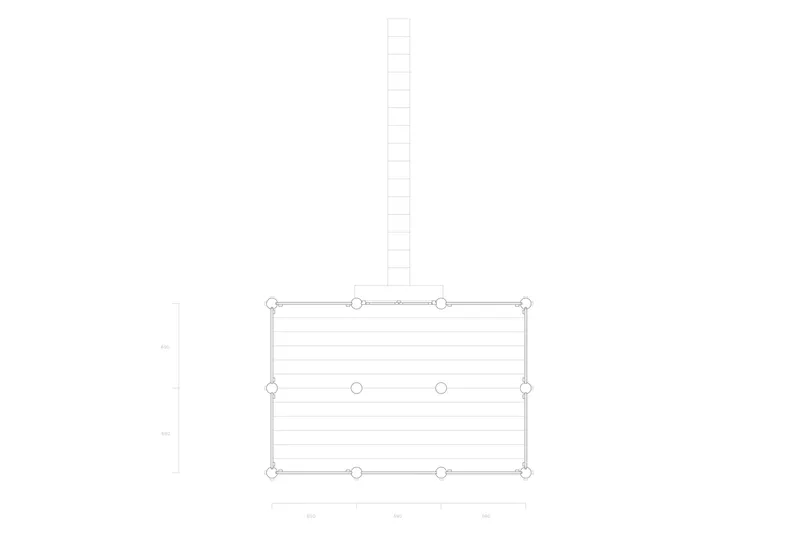


The floor plan reveals the extreme simplicity of the layout: a single rectangular volume organized around corner structural points. The section drawing shows how the gabled form sits on its sloped ground plane, the round columns lifting the habitable chamber well above grade. The entrance elevation illustrates the horizontal siding and central door opening, confirming the straightforward, symmetrical composition. These are not complex drawings, but they do not need to be. The project's sophistication lies in its construction details and material choices, not in geometric acrobatics.
Why This Project Matters
Niwatorigoya matters because it takes a building type that most architects would dismiss as beneath their attention and treats it with the same rigor, care, and philosophical depth that we normally reserve for houses or public buildings. The result is not merely a beautiful chicken coop. It is a working proof of concept for zero-impact construction using locally sourced natural materials and traditional joinery. If these techniques can produce a structure this refined at this scale, they can be applied more broadly.
More broadly, the project asks a question that contemporary architecture often avoids: what happens when a building dies? Most structures leave behind concrete rubble, steel rebar, and synthetic waste. Niwatorigoya will leave behind stone, bark, and wood. 2M26 has designed not just a building but a complete material lifecycle, from harvest to decay. That is a radical proposition in an industry addicted to permanence, and it is all the more persuasive for being demonstrated in a structure of absolute humility.
Niwatorigoya Chicken Coop by 2M26, Keihoku, Kyoto, Japan. Completed 2022. Photography by Yuki Okada.
About the Studio
Share Your Own Work on uni.xyz
If projects like this are the kind of work you want to make, uni.xyz is a place to publish your own, find collaborators, and enter design competitions.


Popular Articles
Popular articles from the community


Co-life: Sustainable Architecture for Age-Friendly Community Living
Co-life reimagines sustainable architecture for seniors through courtyards, rammed earth, shared gardens, and spaces designed for belonging.

The Musturak Paradise: Senior Living Architecture for a Connected Future in Temara, Morocco
The Musturak Paradise reimagines senior living architecture in Temara via private homes, social spaces, culture, community, and shared care.

The Ocean Hive: Sustainable Architecture for a Self-Sufficient Civilization at Sea
The Ocean Hive imagines sustainable architecture at sea, where modular habitats, algae, wave power and ocean waste sustain a growing colony.

Lunar Spiral: Space Architecture Shaped by the Mathematics of the Universe
Lunar Spiral reimagines space architecture through Fibonacci geometry, lunar regolith, levitating habitats, and self-sustaining Moon living.

Similar Reads
You might also enjoy these articles


Hodi-Mandai Geram
Project Function: Preservation and revitalization of the Intangible heritage and socio-spatial identity of the Hodi by Housing, Cultural Memory Center, Sacred Grove, landscape, local tourism economy


Olio Towers: A Mid-Rise for Performers That Fuses Housing, Rehearsal, and Stage
Located blocks from Houston's Theater District, this modular tower stacks living units around a central performance atrium.

Oasis: Modular Green Housing Carved into Dhaka's Urban Fabric
A shortlisted Plugin Housing entry reclaims unauthorized settlements in Dhaka with stepped concrete volumes, green roofs, and ventilation-driven design.

Black Hole: A Floating Megastructure for the Post-Physical Era
Emiliano Mazzarotto envisions a spherical, self-scaling arena where e-sports, digital hotels, and holographic stadiums replace traditional public space.

Explore Architecture Competitions
Discover active competitions in this discipline

Challenge to reimagine the Iron Throne

Photograph architecture without architects

Illustrate the lost glory of Angkor Wat - Render Challenge

Design challenge to reuse E-waste
Comments (0)
Please login or sign up to add comments
No comments yet. Be the first to comment!