

Jingyue Central Park: Transforming Idle Urban Land into Changchun’s Ecological Green Lung
Jingyue Central Park transforms idle land into a vibrant green lung with parametric design, layered public spaces, ecological landscapes, and community-driven activation.


SHUISHI Reimagines Public Space Through Urban Regeneration, Parametric Design, and Community-Centered Programming
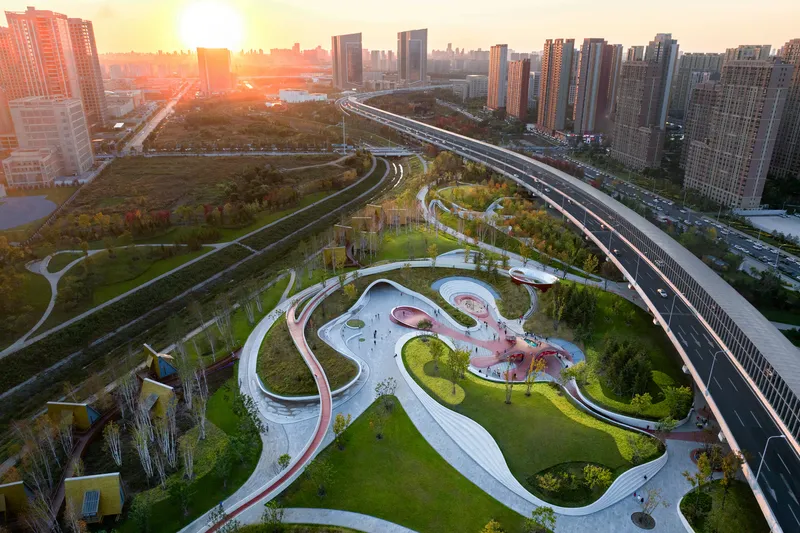
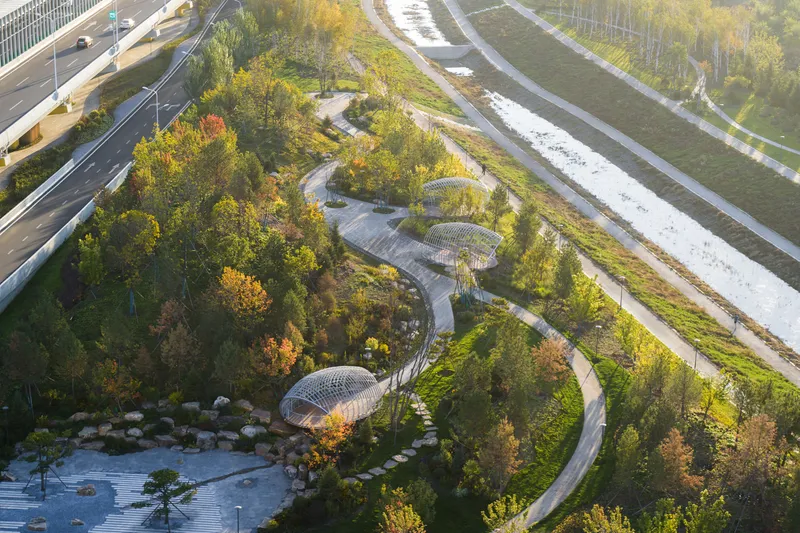
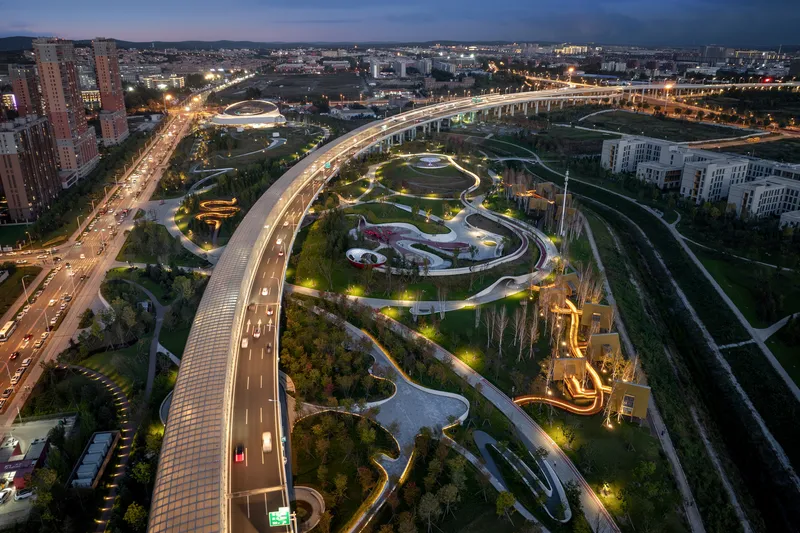
Jingyue Central Park in Changchun, China, is a landmark urban regeneration project by SHUISHI, converting 490,000 m² of formerly idle municipal land into a dynamic ecological park and civic hub. Positioned in the heart of the Jingyue High-tech Zone and surrounded by residential neighborhoods, schools, offices, and nine universities, the park now serves over 300,000 residents and thousands of students daily — reconnecting fragmented urban fabric and restoring nature to the city.
Once a site obstructed by construction debris, viaduct infrastructure, and disjointed developments, the area lacked connectivity and vitality. The transformation into Jingyue Central Park redefines the land as a vibrant “urban green lung,” creating a continuous landscape that integrates nature, public recreation, commercial opportunities, and ecological restoration.
Integrated EPCO Model: A Holistic Approach to Urban Regeneration
Commissioned by the Changchun Jingyue Management Committee and Jingfa Group, the project adopts a pioneering EPCO framework — integrating Engineering, Procurement, Construction, and Operation. The collaboration between SHUISHI and Shanghai Landscape Group ensures an optimized approach to cost, quality, and lifecycle performance.
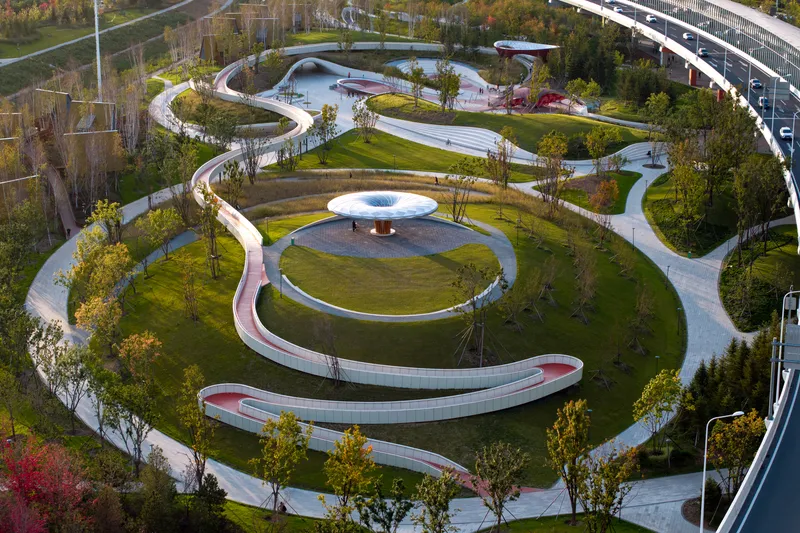
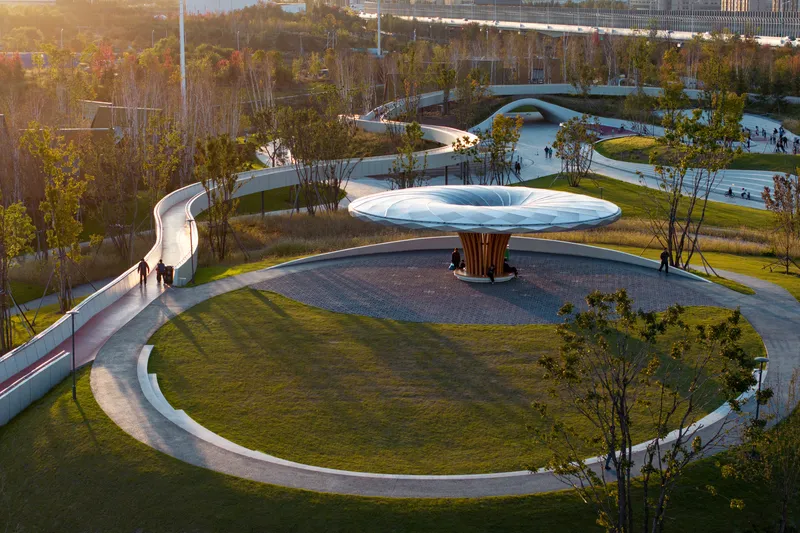
A unified architectural and landscape language reinforces harmony and coherence. From pathways to structural canopies, every element follows a consistent spatial logic, creating a seamless interplay between built form and landscape. The result is an immersive, accessible, and resilient public environment.
Parametric Innovation: Engineering Meets Natural Expression
Jingyue Central Park harnesses advanced computational tools to refine form, optimize performance, and support sustainable construction.
Key Parametric Strategies:
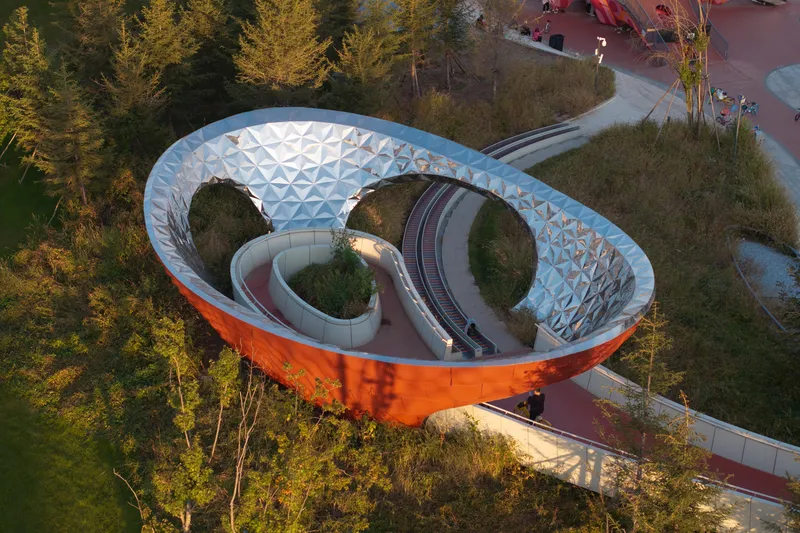
- Karamba for structural refinement of grid-shell lookout platforms, balancing steel-wood hybrid systems
- Branch-theory algorithms to generate naturalistic paving patterns
- Visual programming + Rhinoceros simulation to optimize playground forms and ensure structural safety
- Topology optimization for viaduct design, reducing supports and creating a lightweight, sculptural urban structure
These innovations bring fluidity, efficiency, and poetic expression to the park’s structures, demonstrating the role of digital technology in shaping contemporary public space.
Layered Mobility and Multi-Dimensional Experience
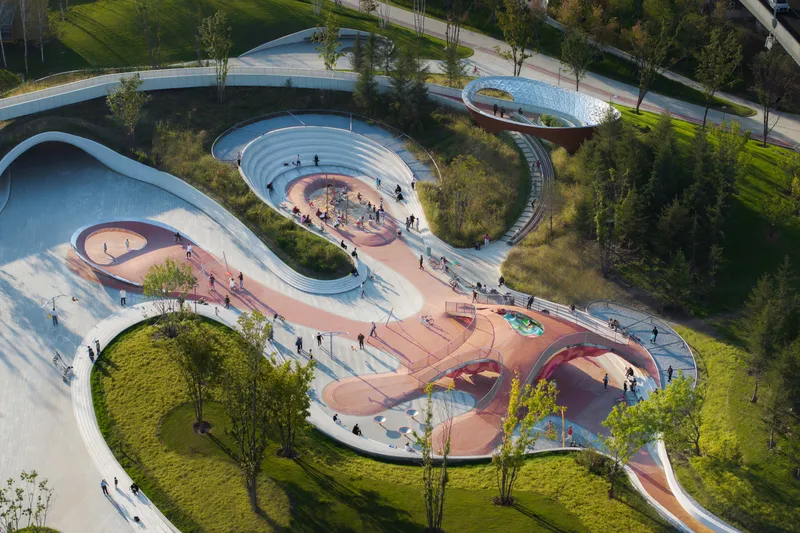
Responding to the site's elevation changes, the park introduces a stratified pedestrian circulation network, weaving bridges, trails, ramps, and viewing platforms into a continuous movement sequence. This system blurs boundaries between indoor and outdoor zones and encourages exploration through diverse experiences — from quiet green valleys to elevated observation decks and open civic plazas.
The flowing promenade system enhances accessibility and reinforces the park’s philosophy of social inclusivity and openness.

Ecological Urban Oasis: A Living Green Lung
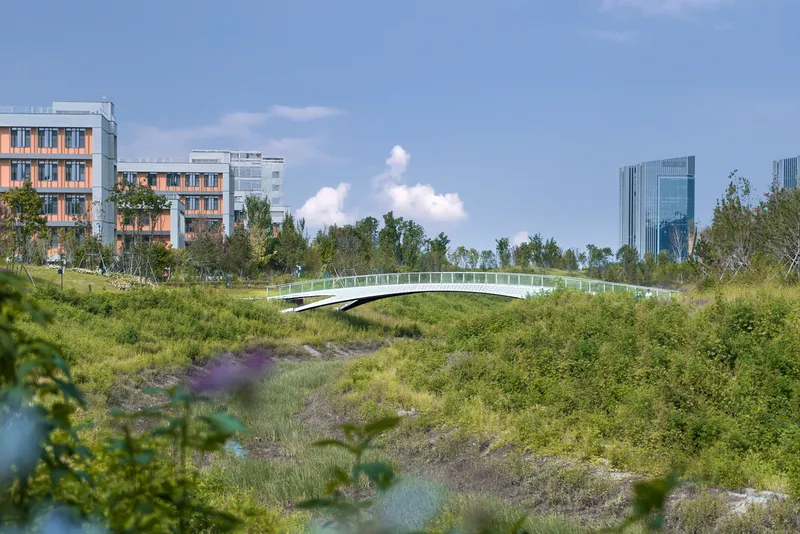
A rich planting strategy creates layered ecological zones, improving biodiversity and offering residents restorative connection to nature. Native vegetation, seasonal flora, and expansive green corridors enhance microclimate, absorb pollutants, and reinforce the park’s identity as a breathing system within dense urban fabric.
The result is not only a recreational amenity but a significant environmental asset elevating Changchun’s ecological resilience and livability.

Lifecycle-Driven Development and Sustainable Operation
From inception to construction and opening, the park integrates long-term operational strategy.
Program zoning supports financial sustainability:
- 9% public welfare spaces
- 18% semi-public areas
- 73% commercial-supporting functions
Anchors such as tech tenants (e.g., Baidu) and curated amenities generate revenue to offset operating costs. Parking facilities and service buildings are carefully integrated to ensure convenience and efficiency.
The project’s management model ensures that once stabilized, operations transition to local government and community teams — reinforcing ownership and long-term stewardship.
Community Activation and Youth Engagement
Public participation is central to the park’s vision. Under-viaduct spaces are reprogrammed into multifunctional recreation zones — including an inventive basketball court — turning underused infrastructure into vibrant social assets.
The park fosters partnerships with nearby universities, serving as a practice and research base for students in architecture, landscape architecture, urban planning, and environmental studies. Cultural events, youth programming, and creative initiatives further strengthen community identity and intergenerational engagement.
A Future-Forward Urban Landscape
Jingyue Central Park stands as a pivotal node in Changchun’s urban green network — enriching daily life, strengthening ecological systems, and catalyzing renewal across the district. More than a park, it is a strategic model for future-ready city building, where digital innovation meets nature-driven design and community empowerment.
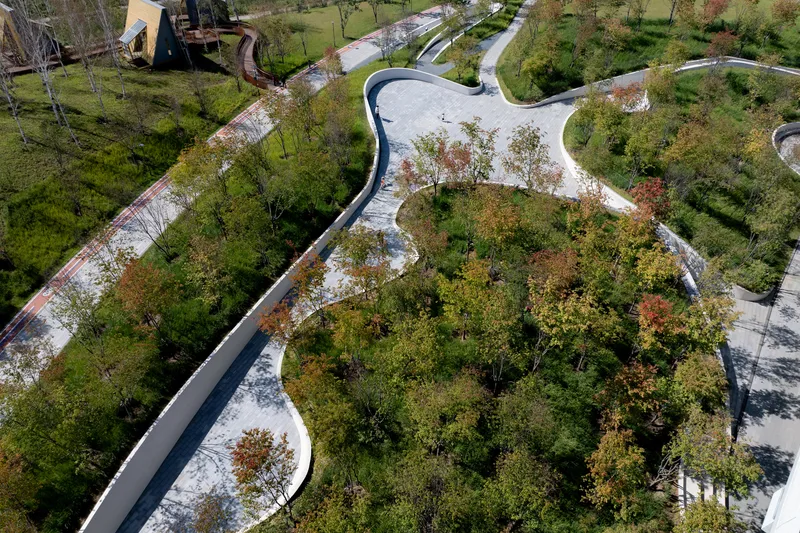
Through visionary planning and collaborative execution, SHUISHI has established a benchmark in sustainable public-realm development and urban resilience.
Jingyue Central Park by SHUISHI transforms idle land in Changchun into a major urban green lung, combining ecological restoration, parametric design, community spaces, and long-term financial sustainability in a pioneering EPCO model.

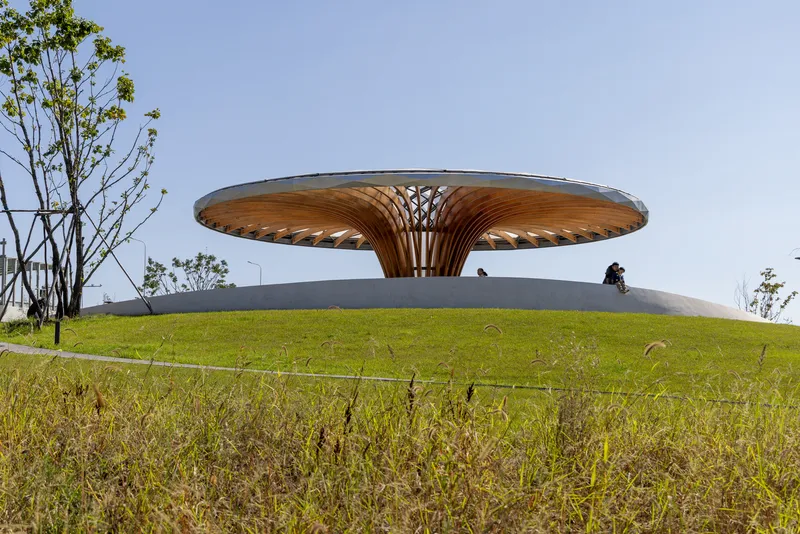
All photographs are works of Chill Shine, Li Kuan, Zhang Yikai, Wang Xiu


Popular Articles
Popular articles from the community


Cloaked Colonization: A Mobile Underwater Habitat That Moves Like a Fish
Micah Abaya's shortlisted EHC Pacific entry reimagines ocean settlement as a dispersed network of self-sustaining architectural organisms.

Singing Woman: An Opera House That Performs Before the Curtain Rises
Ovidiu Cristian Pavel's conceptual opera house translates Estonia's choral identity into a sculpted waterfront landmark facing the Baltic Sea.

Extended Shell: Retrofitting Kolkata's Balconies as Living Urban Thresholds
A modular retrofit system recovers the social and environmental intelligence of Kolkata's historic verandas for contemporary Park Street residents.

Faces of the Soviet Avant-Garde: Turning Moscow's Street Names into an Open-Air Museum
A network of sculptural installations across a Moscow residential district transforms forgotten architect names into spatial encounters with cultural memor

Similar Reads
You might also enjoy these articles


Hodi-Mandai Geram
Project Function: Preservation and revitalization of the Intangible heritage and socio-spatial identity of the Hodi by Housing, Cultural Memory Center, Sacred Grove, landscape, local tourism economy


Olio Towers: A Mid-Rise for Performers That Fuses Housing, Rehearsal, and Stage
Located blocks from Houston's Theater District, this modular tower stacks living units around a central performance atrium.

Oasis: Modular Green Housing Carved into Dhaka's Urban Fabric
A shortlisted Plugin Housing entry reclaims unauthorized settlements in Dhaka with stepped concrete volumes, green roofs, and ventilation-driven design.

Black Hole: A Floating Megastructure for the Post-Physical Era
Emiliano Mazzarotto envisions a spherical, self-scaling arena where e-sports, digital hotels, and holographic stadiums replace traditional public space.

Explore Urban Park Competitions
Discover active competitions in this discipline

Challenge to reimagine the Iron Throne

Photograph architecture without architects

Illustrate the lost glory of Angkor Wat - Render Challenge

Design challenge to reuse E-waste
Comments (0)
Please login or sign up to add comments
No comments yet. Be the first to comment!