

JSPA Design Wraps an Oatmeal Factory in Brick and Concrete to Build a World Apart in Rural China
In Ningwu's coal-mining landscape, a 9,400-square-meter production facility turns inward to create its own civic and natural environment.


Industrial architecture rarely aspires to anything beyond efficiency. A factory processes raw materials, moves products, and shelters workers, and most clients are satisfied if the building does those three things without leaking. So when JSPA Design, led by principals Johan Sarvan and Florent Buis, was asked to build an oatmeal processing plant in Ningwu, Shanxi province, the ambition could have stopped at a well-organized shed. Instead, the firm delivered a 9,400-square-meter building that treats production, public life, and worker housing as a single spatial narrative, wrapped in local grey brick and topped by a concrete volume that opens itself to the sky.
What makes this project genuinely interesting is its refusal to accept its surroundings at face value. Ningwu sits among coal mines, newly built industrial sheds, and dry, spare terrain. Rather than mirroring that landscape, JSPA designed an introverted building that generates its own microenvironment: gardens, water pools, patios, and colonnaded promenades that feel closer to a campus than a mill. The factory doesn't ignore the context; it acknowledges it and then quietly builds something better inside its own walls.
An Introverted Mass on an Open Plain
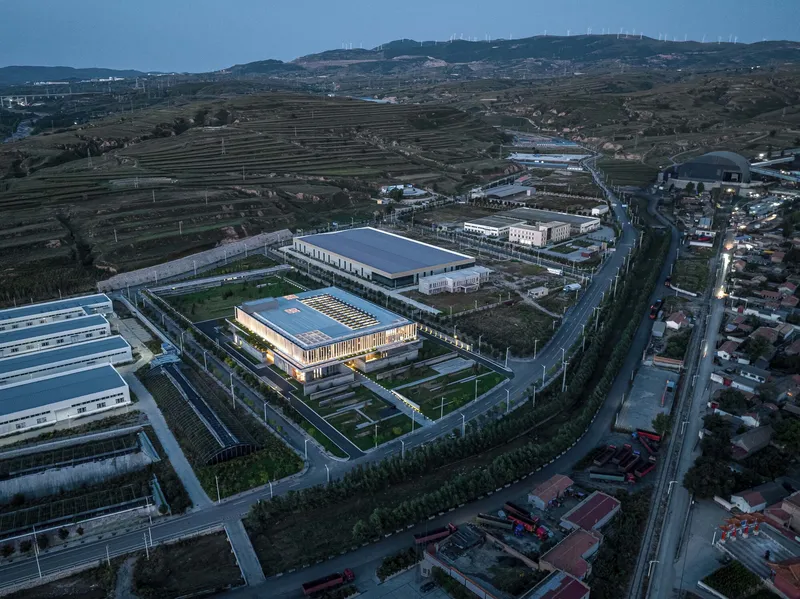
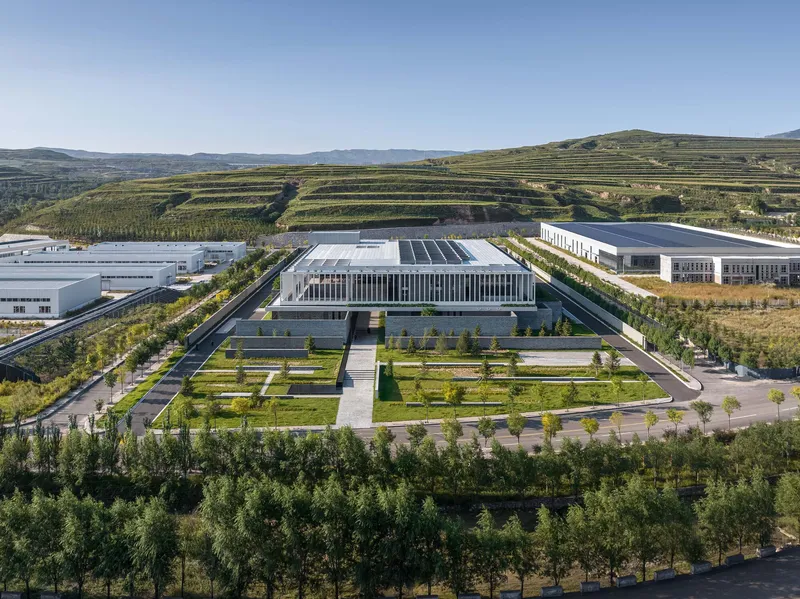
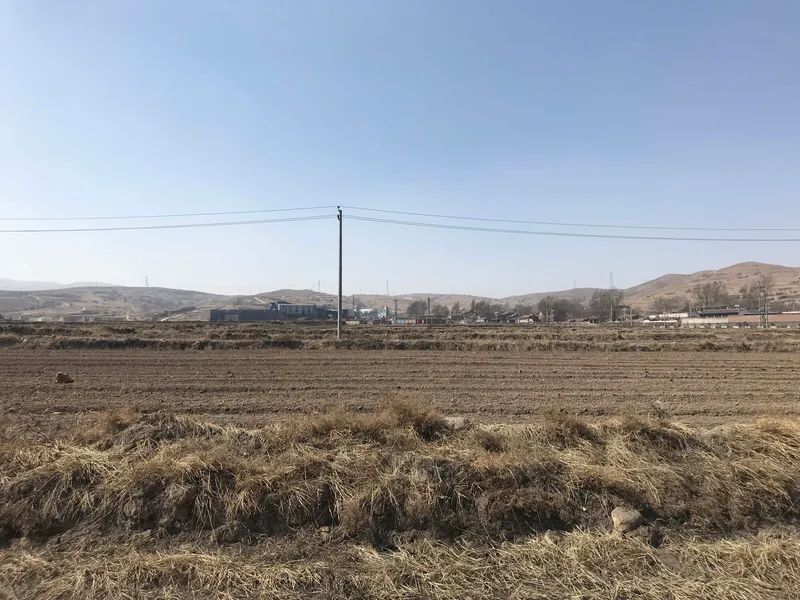
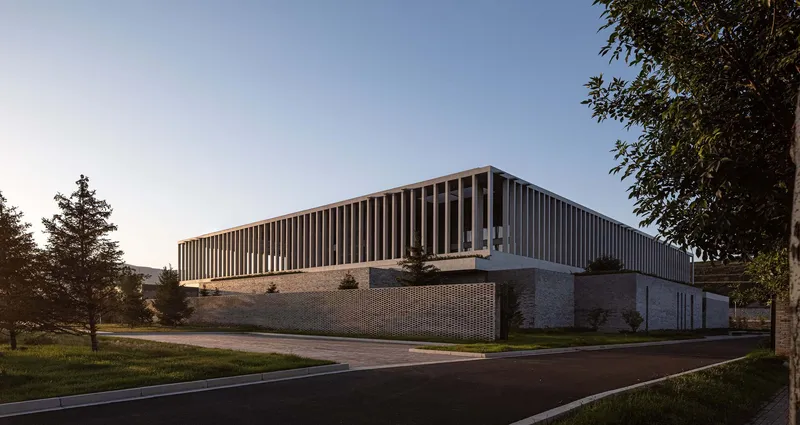
Seen from a distance, the factory reads as a long, low volume settled on agricultural fields, its horizontality exaggerated by the flat terrain. An aerial view reveals a more complex picture: the roof carries sawtooth skylights, geometric courtyard gardens are carved into the footprint, and rows of trees buffer the perimeter. The building's floor area ratio is a remarkably low 0.40, with a greening rate of 0.80, meaning the landscape is not an afterthought but a co-equal design element.
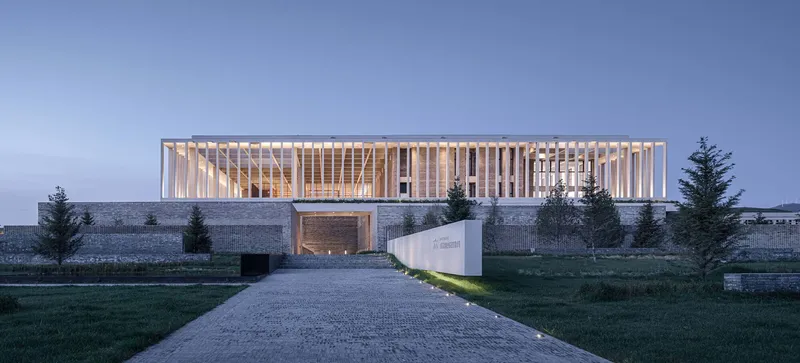
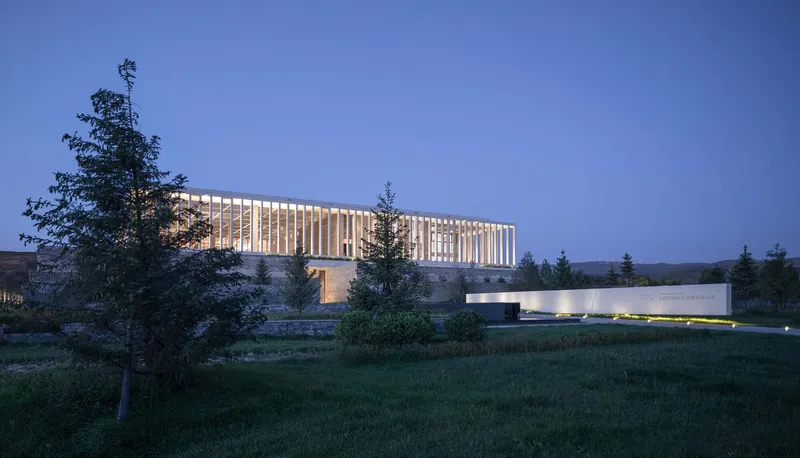
At twilight the upper concrete volume glows against the surrounding industrial fabric, and you begin to understand the project's posture. It is not a fortress; the landscape areas are deliberately left open to the local community, with benches and shallow water pools. But its thick brick walls and controlled entrances make clear that inside, the factory operates on its own spatial logic.
Brick Walls That Grow from Furniture to Facade
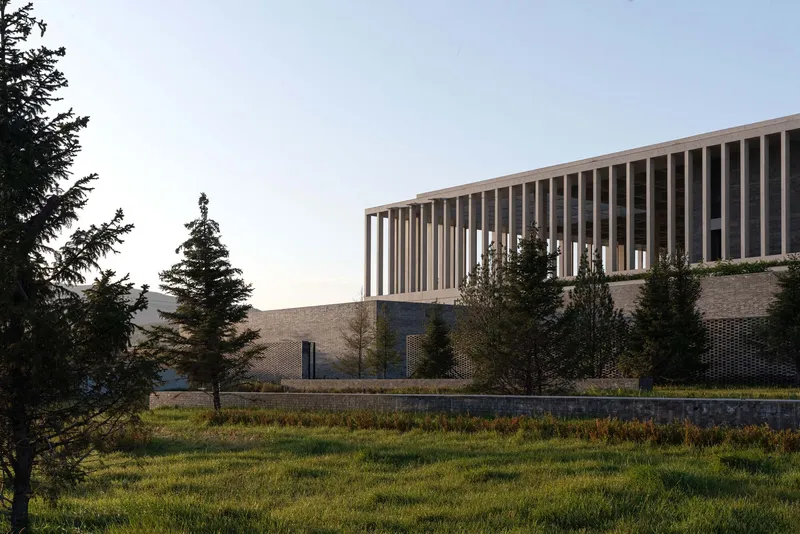
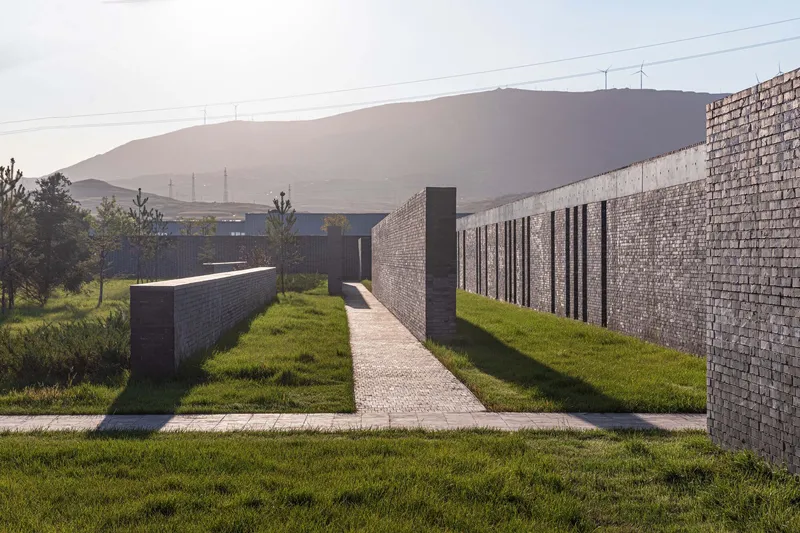
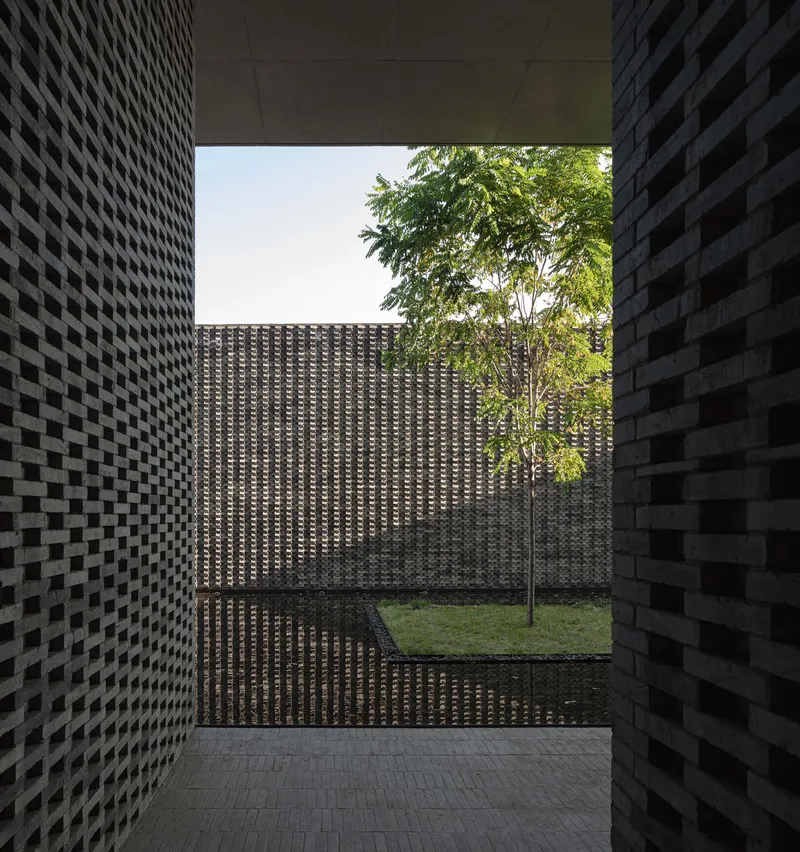
One of the project's smartest moves is the way its brick walls evolve across the site. Low masonry walls at the perimeter serve as benches for the community. Those walls gradually rise to become the property fence, then continue upward to form the building's opaque ground-floor facade. It is a single material gesture, grey brick laid in local construction patterns, that transitions from landscape furniture to architectural enclosure without a seam.
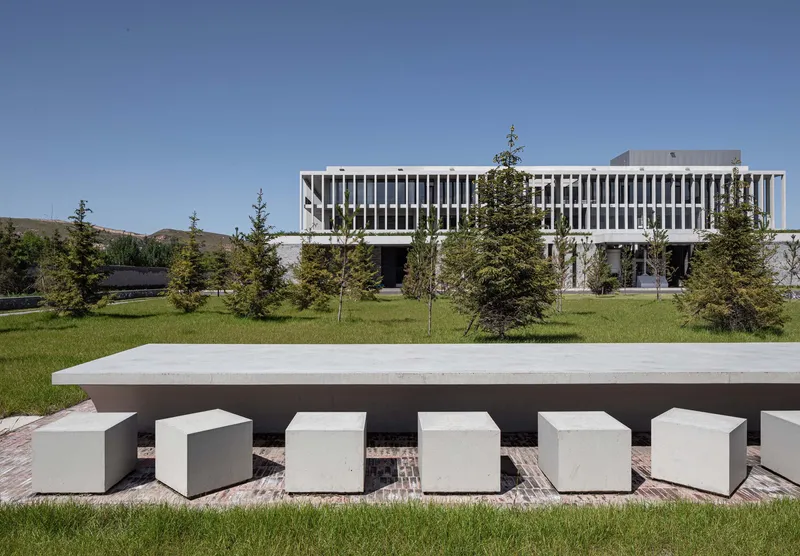
The outdoor seating area, with its concrete table and cubic stools set on a lawn, sits directly beneath the louvered upper volume. The juxtaposition is deliberate: a heavy, earthbound civic space below and a lighter, more permeable workplace above. Concrete pathways cut between low walls and lead the eye toward the surrounding hills, reinforcing the sense that the building is both rooted in its ground and reaching beyond it.
Four Doors, No Crossings
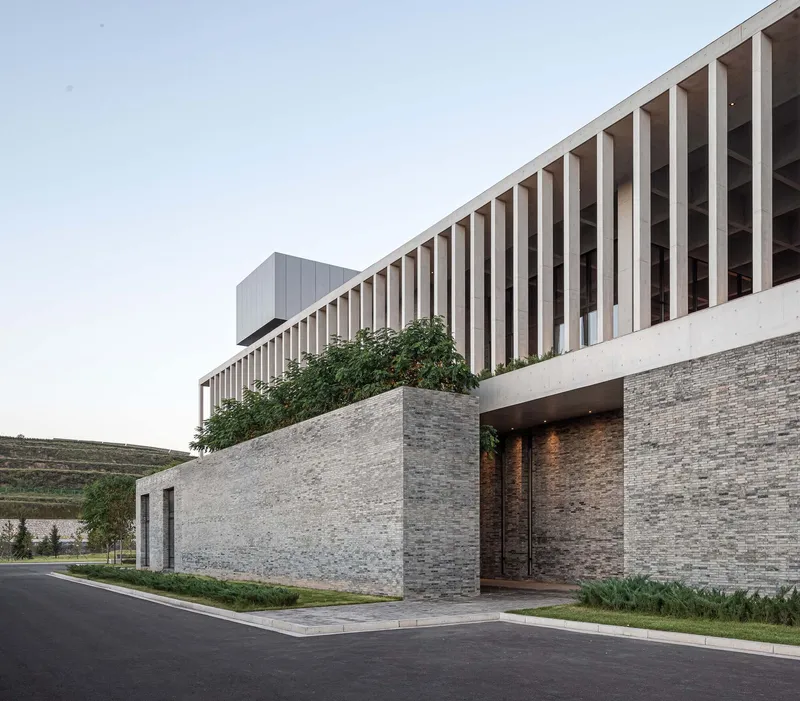
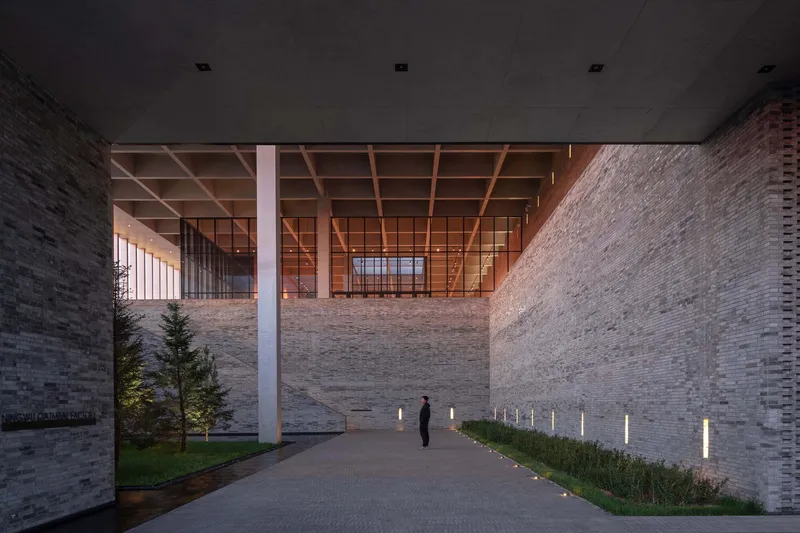
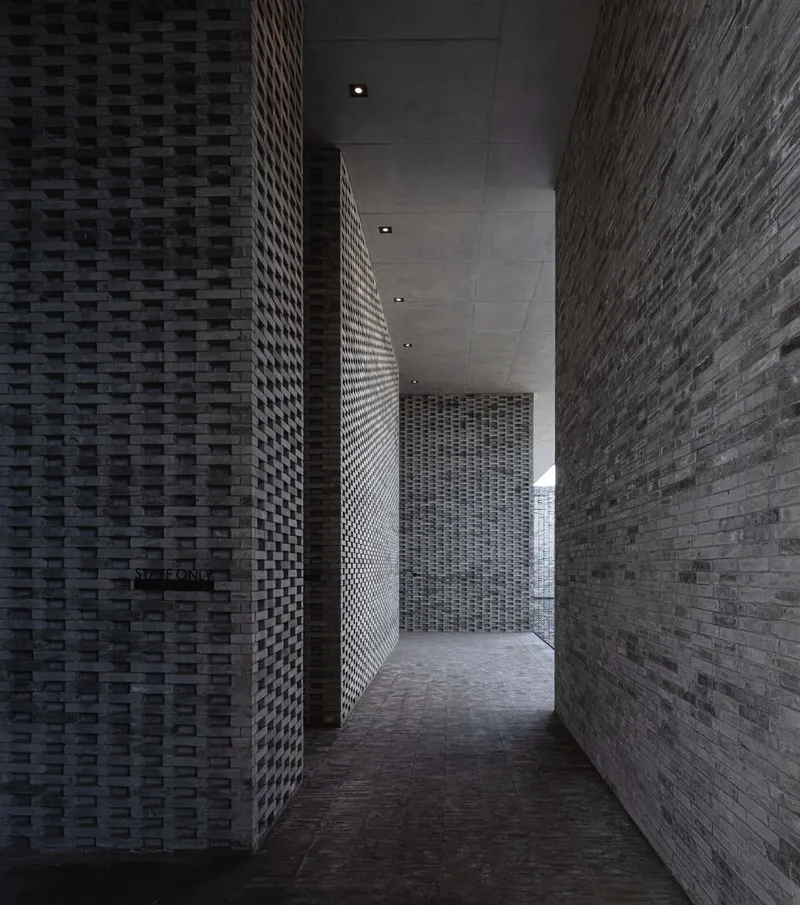
The factory has four distinct entrances: one for raw materials delivery, one for finished product loading, one for staff, and one for visitors. The circulation diagram ensures that these four flows never intersect inside the building. It is a logistics diagram elevated to architecture. Visitors enter through a layered stone threshold beneath a twelve-meter cantilevered concrete logo wall, then move through a sequence of spaces designed to slow them down, shifting scale, brightness, and material at every turn.
The covered entrance passage, with its timber coffered ceiling and flanking masonry walls, sets a civic tone that feels more cultural center than factory. The narrow corridor beyond, clad in basketweave brick with recessed ceiling lights, compresses the visitor's field of vision before releasing them into larger spaces. The production line itself is revealed only at the end of this promenade, viewed from an elevated corridor that keeps observers above and apart from the machinery.
Public Spaces Above the Production Line
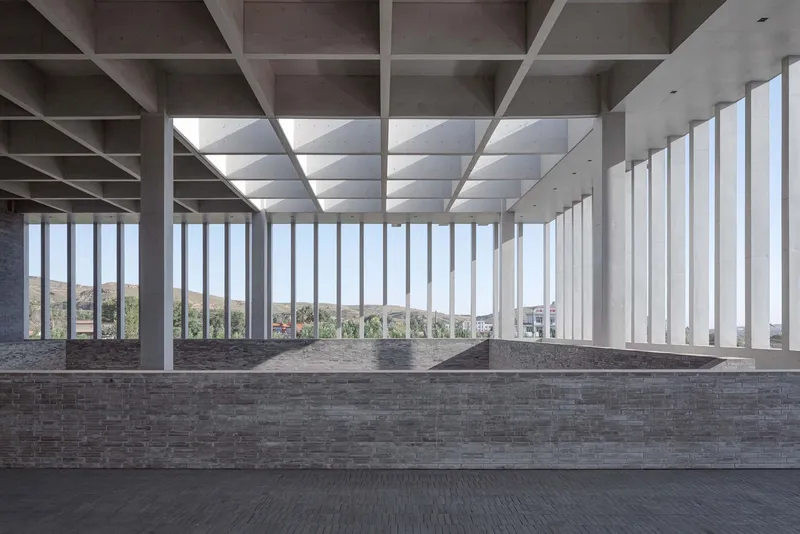
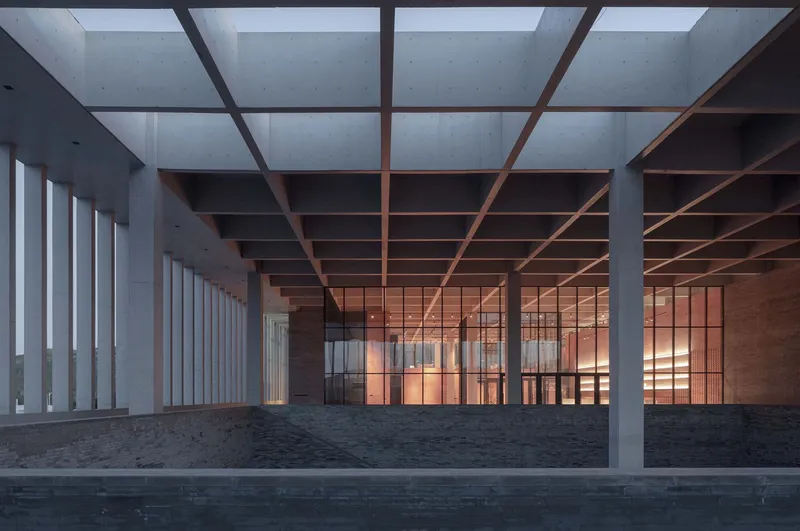
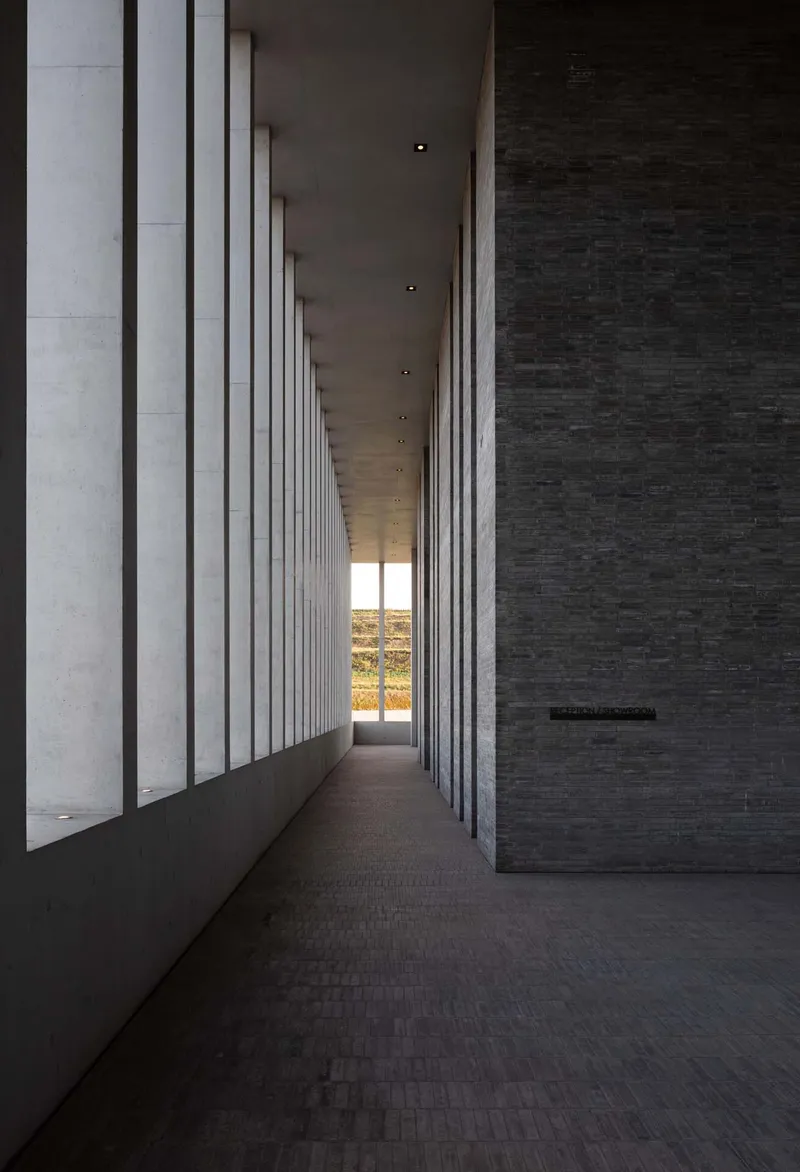
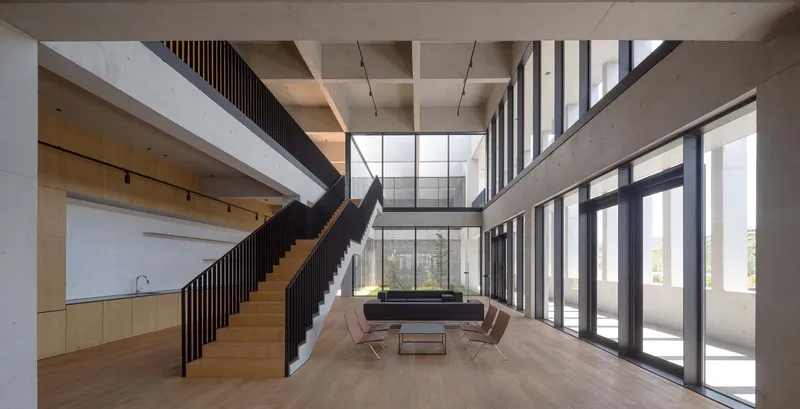
The upper volume is where the factory becomes public. A concrete colonnade wraps the perimeter, framing views of the hills and reflecting pools below. Inside, a coffered concrete ceiling with vertical fin windows creates an interior hall flooded with directional light, a space that could house a library or a museum but instead hosts the factory's shop, café, and offices. The decision to place the public program on top of the production spaces inverts the typical industrial section: the heavy, enclosed work happens at grade, while the open, luminous social life sits above it.
The colonnade at dusk is particularly striking. Rhythmic concrete fins cast long shadows on dark brick flooring, and the reflecting pool doubles the image. This is architecture performing for both the building's daily users and the surrounding community, a factory that offers a public promenade as part of its operational program.
Material Contrasts That Organize Experience
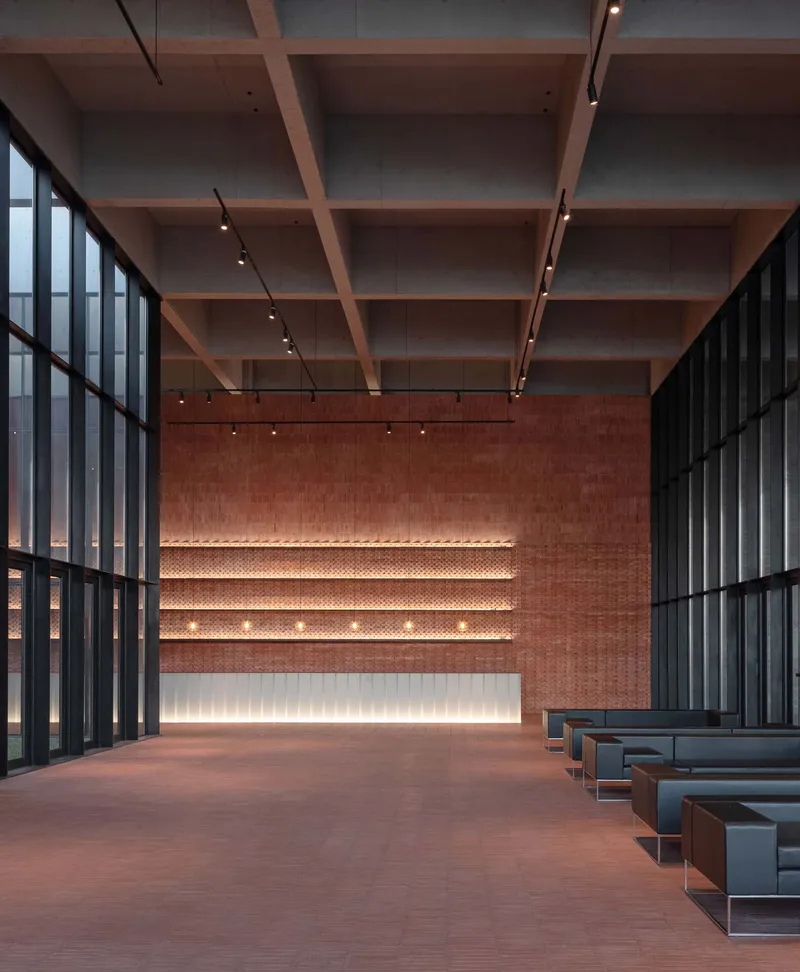
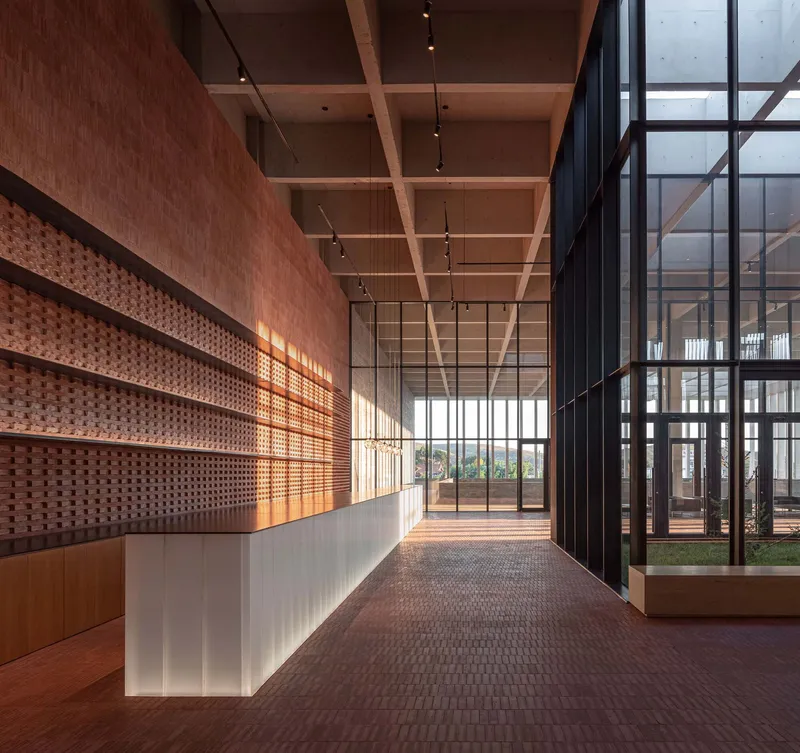
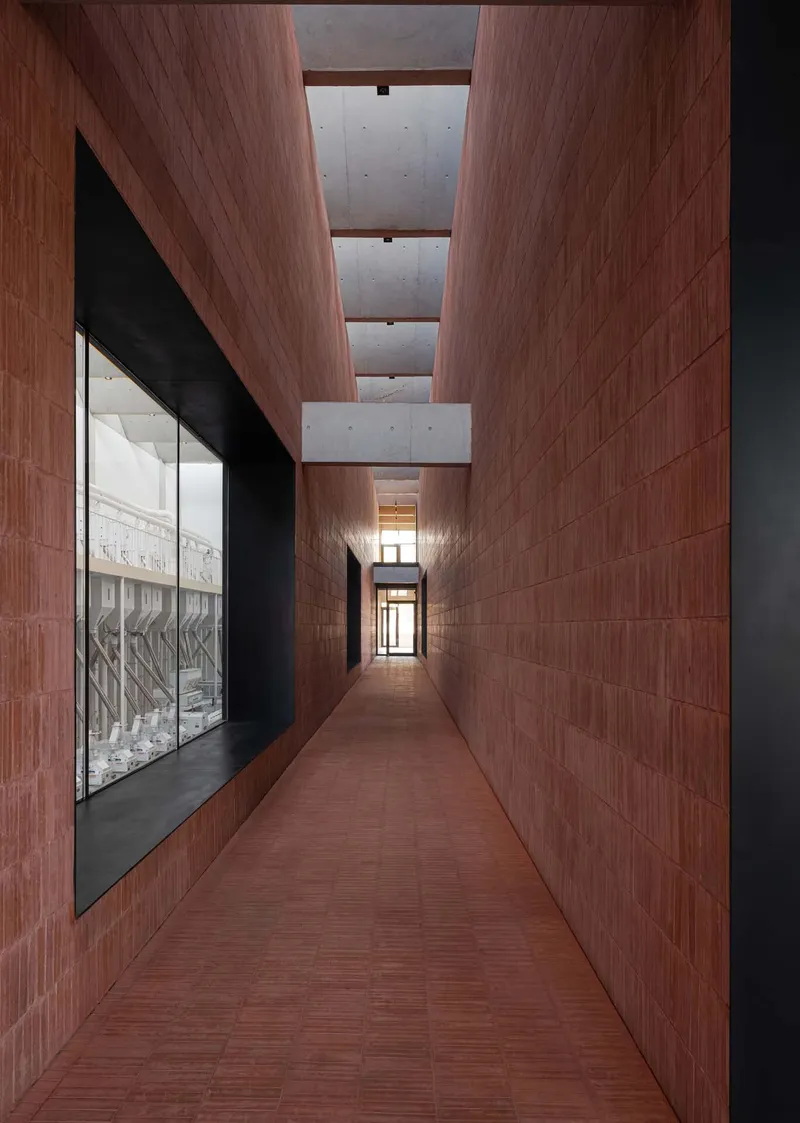
JSPA uses material shifts to signal programmatic changes. Grey brick dominates the exterior and production-adjacent zones, referencing local construction. Red brick with red cement joints marks interior public areas, giving them a warmer, more intimate character. Timber paneling and flooring appear in the dormitory, differentiating rest spaces from work. Exposed concrete binds everything together as the structural constant, visible in the coffered ceilings, the colonnades, and the cantilevered logo wall.
The lobby captures these contrasts in a single frame: an illuminated perforated brick wall glows behind a steel-framed glazing system, while a timber coffered ceiling overhead softens the industrial proportions. Nearby, a long corridor pairs perforated brick with timber beams alongside floor-to-ceiling steel windows. The palette is limited, but JSPA deploys it with enough variation to keep the spatial sequence legible and engaging.
A Dormitory Hidden in the Wall
The 600-square-meter employee dormitory is concealed within a thickened brick wall at the rear of the complex, an almost fortification-like gesture that separates living from working while keeping both within the same architectural envelope. Patios punched into this thick wall bring natural light into the sleeping quarters, and a garden between the factory and the dormitory provides an outdoor decompression space, complete with a concrete table and square seats.
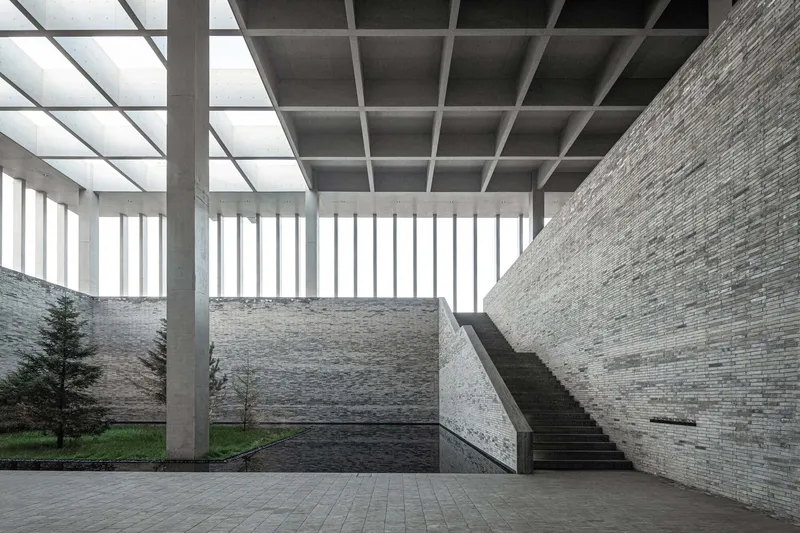
Interior courtyards within the main building serve a similar purpose for the factory's public and production zones. Stone walls, concrete columns, and coffered skylights create enclosed outdoor rooms that feel contemplative rather than utilitarian. These patios are critical to the building's passive strategy: the central production spaces receive north light through the sawtooth roof, while the patios handle daylight for the surrounding program. Rainwater collected on the roof is redirected through cast-in-place concrete water exhausts to pools at different levels, eventually cascading into the waterfall integrated with the entrance cantilever.
The Production Floor as Architecture
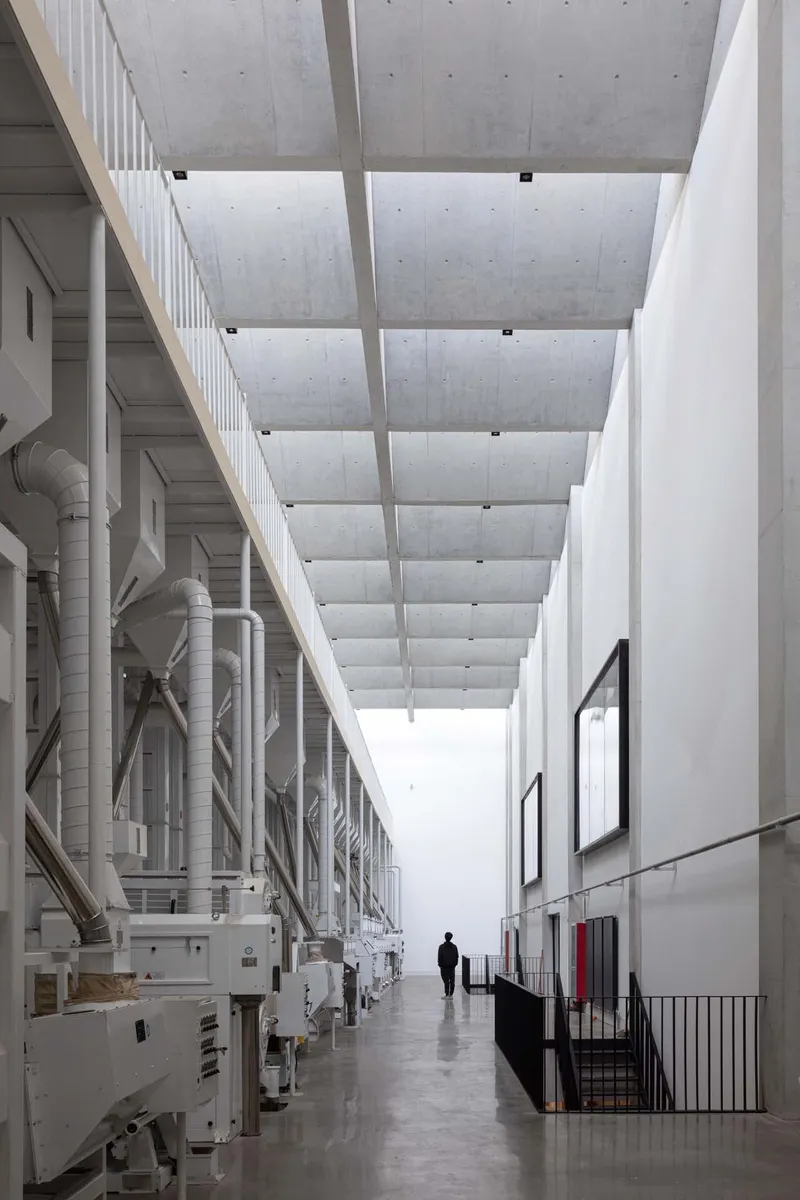
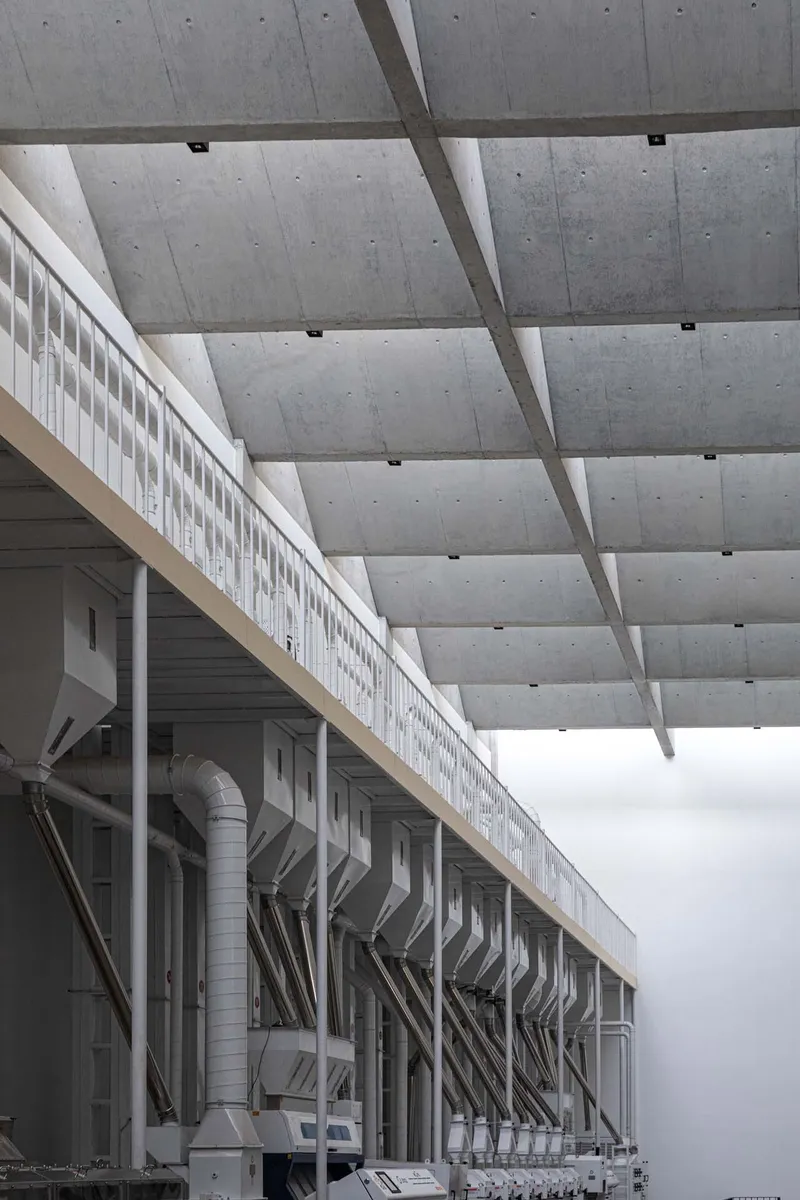
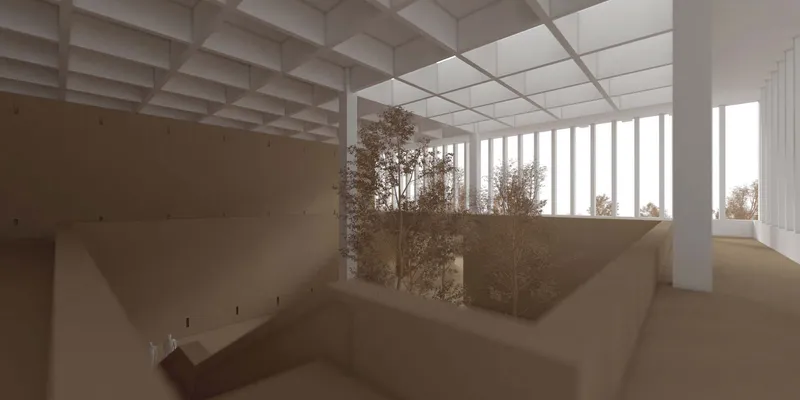
It would be easy for a firm with JSPA's design ambitions to lavish attention on the public spaces and then phone in the production halls. That does not happen here. The factory floor features the same coffered concrete ceiling as the public areas, with continuous clerestory windows above the equipment bringing controlled natural light into what are typically fluorescent-lit boxes. Exposed white mechanical ducts run along one wall with the same deliberateness as a gallery's lighting track.
The curving ramp visible in one of the interior views, framed by vertical louvers overlooking a planted courtyard, allows visitors to descend into proximity with the machinery without entering the production zone. It collapses the distance between audience and process while maintaining the hygienic separation that food production demands. The factory's two production lines, which transform raw oat into flour products, occupy the building's center of gravity, but the architecture ensures you experience them as part of a larger spatial composition rather than as isolated utilitarian enclosures.
Plans and Drawings
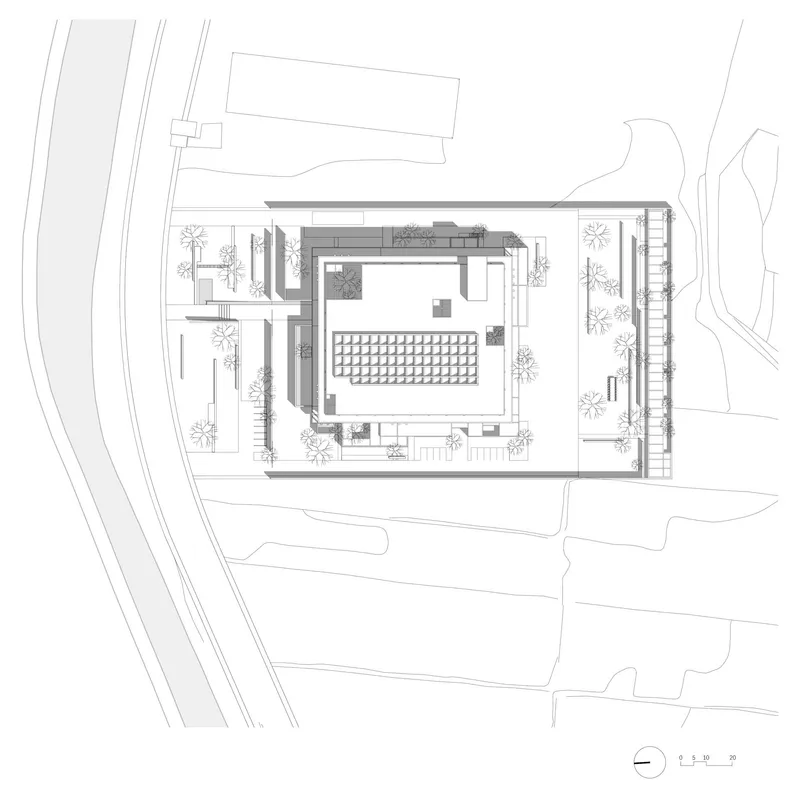
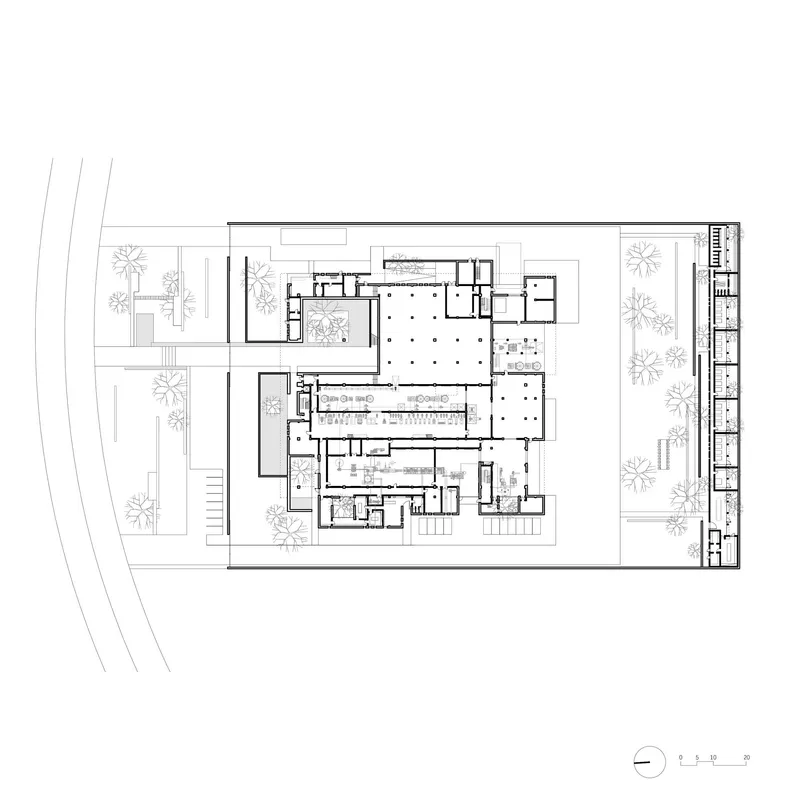
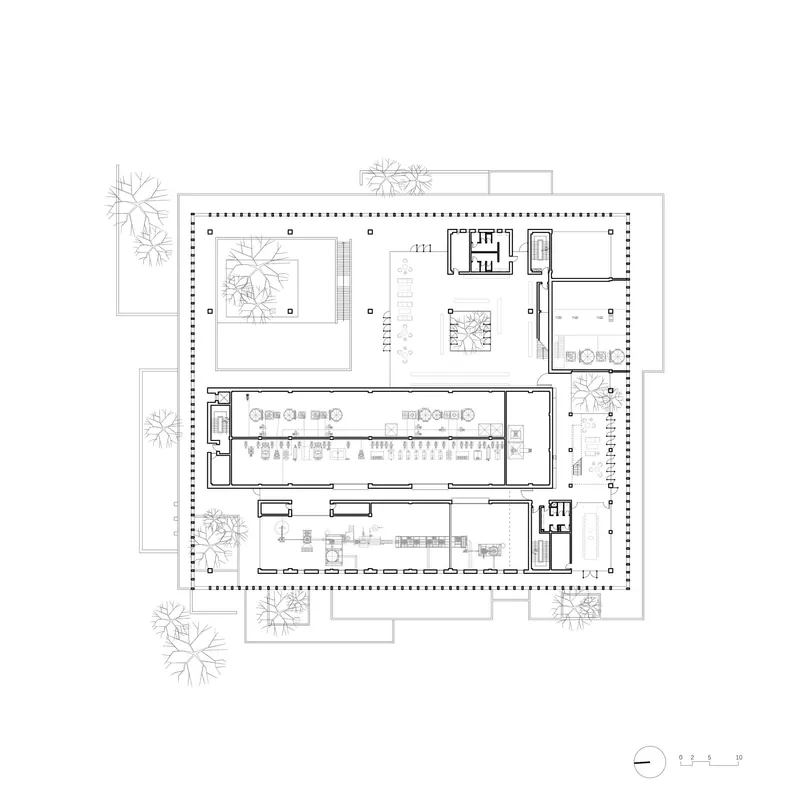
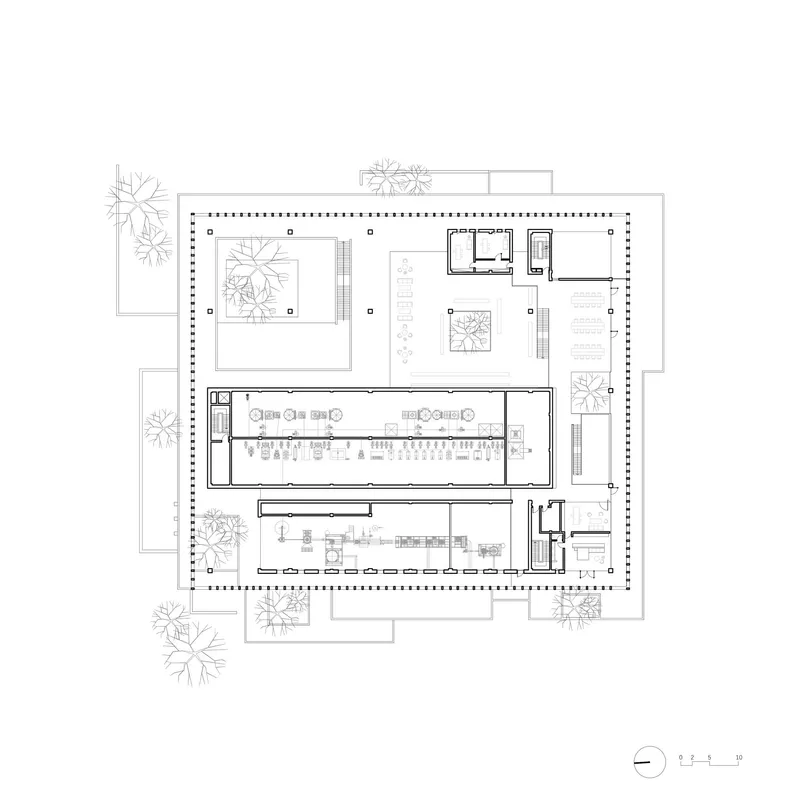
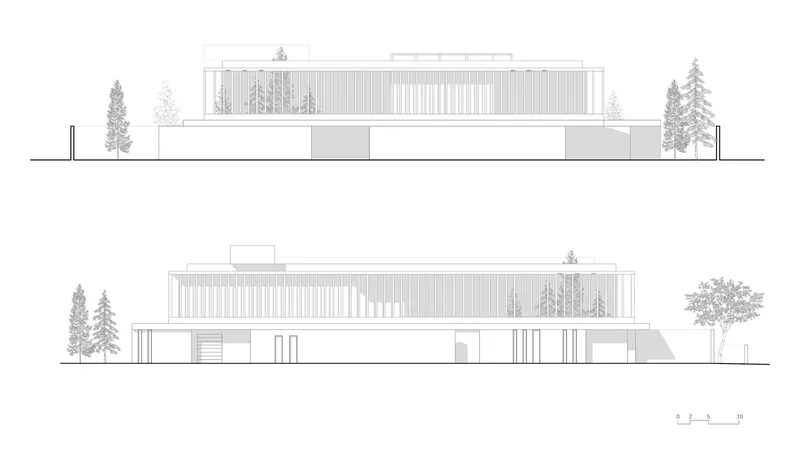
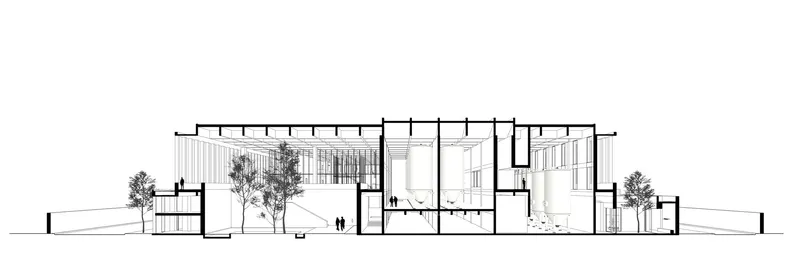
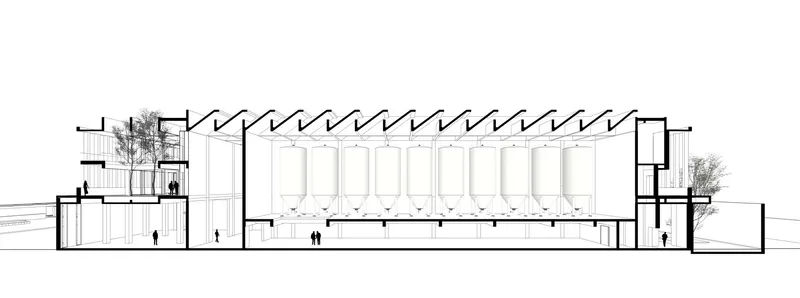
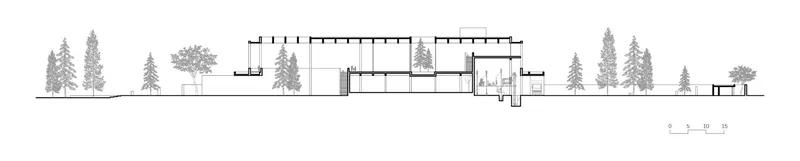
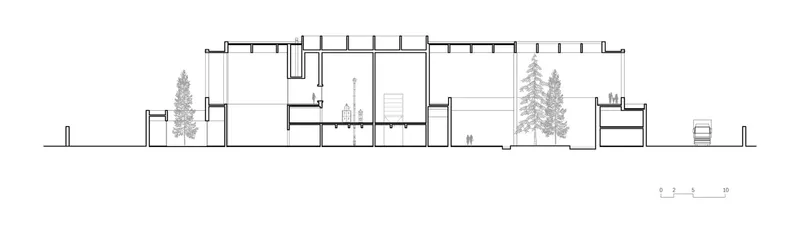
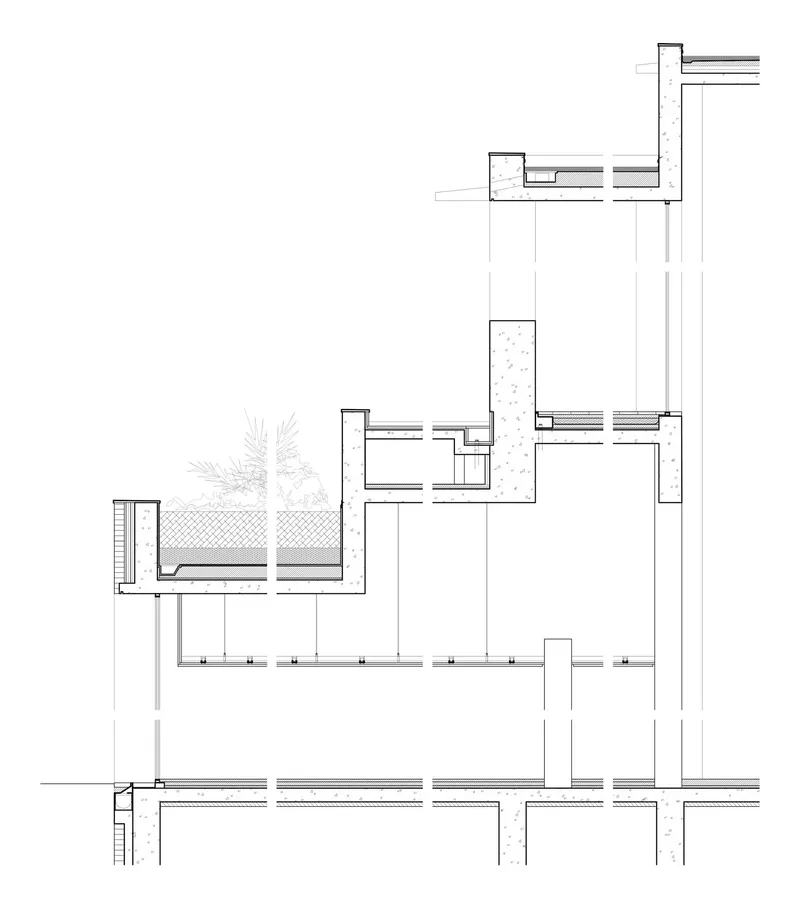
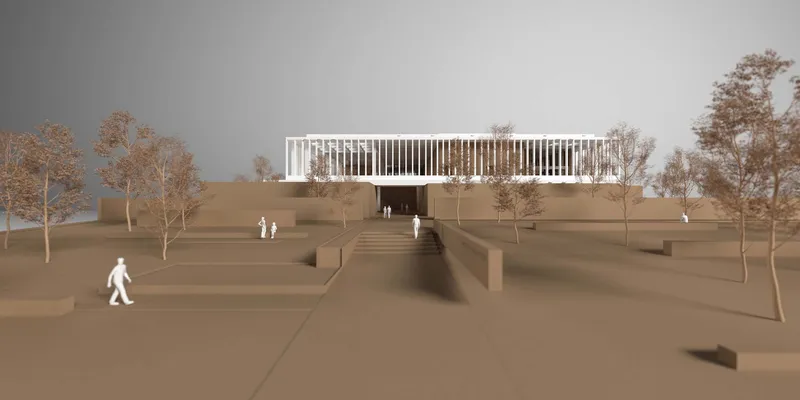
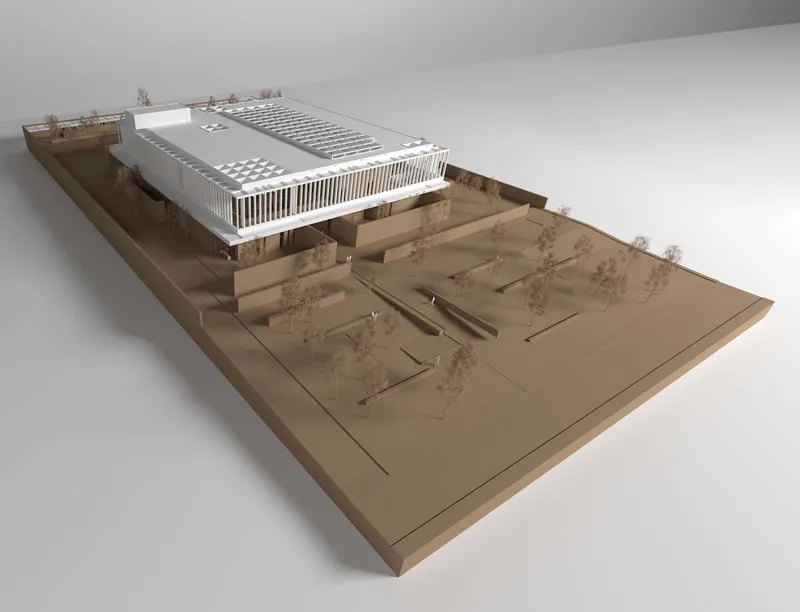
The site plan reveals the building's relationship to its terrain: a rectangular footprint set within a generous landscape of planted terraces and pathways, with the greening rate of 0.80 visible in the proportional dominance of soft ground over built area. The ground floor plan shows the grid of columns organizing the large central production hall, with service rooms and circulation packed into the perimeter walls. Upper-level plans clarify how the colonnade wraps the public program, and how internal courtyards are threaded through the floor plate to deliver light and air.
The sections are the most revealing drawings. They show the sawtooth roof structure opening to north light over the production floor, the layered relationship between the opaque brick ground level and the permeable concrete upper volume, and the way trees planted in courtyard wells grow up through the building's section. The detail section through the wall assembly demonstrates the care taken at the junction between brick, concrete, and planting, a joint that could easily have been left to the contractor but was clearly designed with precision.
Why This Project Matters
The Oatmeal Factory matters because it demonstrates that industrial architecture can do more than shelter equipment. With a budget of 70 million RMB and a design period that stretched from 2018 to 2019 followed by over two years of construction, JSPA had the time and resources to integrate public life, worker welfare, environmental strategy, and production efficiency into a single coherent building. The result is a factory that functions as a small piece of civic infrastructure for a community that had little of it, offering gardens, seating, and a café alongside its primary industrial purpose.
More broadly, the project challenges the assumption that factories must be cheap, expedient, and ugly. By using local brick, exposed concrete, and a rigorously organized plan, JSPA proves that the same materials and methods available to any industrial builder can produce architecture of real spatial intelligence. The building does not disguise its function or aestheticize labor. It simply insists that the people who make oatmeal, and the people who visit the place where oatmeal is made, deserve architecture that takes their experience seriously.
Oatmeal Factory by JSPA Design (Johan Sarvan, Florent Buis). Ningwu, Shanxi Province, China. 9,400 m². Completed 2021. Photography by Schran Images.
About the Studio
Share Your Own Work on uni.xyz
If projects like this are the kind of work you want to make, uni.xyz is a place to publish your own, find collaborators, and enter design competitions.


Popular Articles
Popular articles from the community

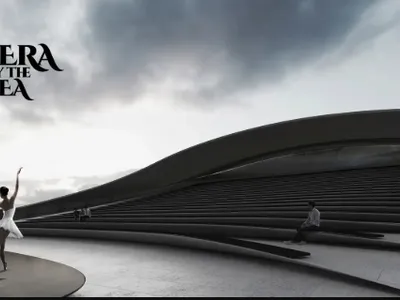
Opera by the Sea Estonia: Three Shells Dissolving Architecture into Tallinn's Coastline
A winning opera house proposal replaces monumental form with interconnected shells that blur the boundary between building, park and Baltic Sea.

The Amber Palace Opera: A Geological Fiction Surfaces on Tallinn's Baltic Waterfront
Pierre Brillard reimagines a Baltic legend as a public landscape, opera house, and waterfront promenade rooted in Tallinn's coastal identity.

Faces of the Soviet Avant-Garde: Turning Moscow's Street Names into an Open-Air Museum
A network of sculptural installations across a Moscow residential district transforms forgotten architect names into spatial encounters with cultural memor

Cloaked Colonization: A Mobile Underwater Habitat That Moves Like a Fish
Micah Abaya's shortlisted EHC Pacific entry reimagines ocean settlement as a dispersed network of self-sustaining architectural organisms.

Similar Reads
You might also enjoy these articles

Pixel Gardens: One Repeated Module Stacked Into a Terraced Social Housing Tower for Famagusta
Salem Bader's shortlisted housing tower builds a vertical neighbourhood from one repeated module, offsetting units to carve terraces, light and air.

Bao Huynh Watercolor Atelier: A Serene Art Retreat in Hội An
Bao Huynh Watercolor Atelier in Hội An blends multifunctional art spaces, sustainable design, local materials, and family-friendly living in a serene environment.

Atelier Macri Concept Store Interior Design by CASE-REAL
Atelier Macri store features a "ko" counter, walnut wood details, cork displays, blending retail, gallery, and seamless customer experiences.

Manuel Vargas Izquierdo Stadium and High-Performance Sports Center: Architectural Excellence in Jalpa de Méndez
The Manuel Vargas Izquierdo Stadium blends sustainable design, inclusive sports facilities, and cultural-inspired architecture, revitalizing Jalpa de Méndez’s public spaces.

Explore Power Generation Competitions
Discover active competitions in this discipline

Challenge to reimagine the Iron Throne

Photograph architecture without architects

Illustrate the lost glory of Angkor Wat - Render Challenge

Design challenge to reuse E-waste
Comments (0)
Please login or sign up to add comments
No comments yet. Be the first to comment!