

Katsuhiko Endo Floats a Black Museum Above Osaka's Nakanoshima Island Like a City Within a City
A five-story art museum in Osaka's riverside district replaces a singular entrance with an open passage that invites the city inside.


For nearly forty years, Osaka waited for a museum on Nakanoshima, the narrow island sandwiched between the Dojima and Tosabori rivers. The site, once home to a university hospital, sat empty after the facility relocated to Suita in 1993. When Katsuhiko Endo Architect and Associates won the open competition in 2017, the winning idea was disarmingly simple: make the museum operate like a city. Not a sealed cultural container, but a place of passages, intersections, and multiple entry points where the building meets its surroundings without hierarchy.
The result, completed in mid-2021 and opened to the public in February 2022, is a 20,000-square-meter institution that lifts its dark mass above a generous public landscape, treating the ground as shared urban territory rather than museum forecourt. The core organizing device is what Endo calls the "passage," a term borrowed from the French tradition of covered pedestrian arcades. A five-story atrium threads through the center of the building, with escalators crossing at ninety degrees, staircases folding beneath vaulted ceilings, and bridges connecting levels in a sequence that feels less like navigating floors and more like moving through a neighborhood.
A Hovering Volume on a Public Plinth


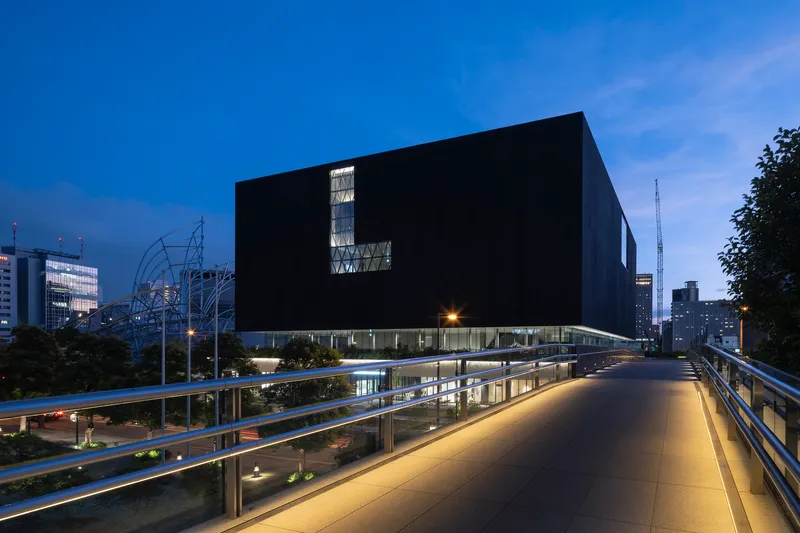
The most immediate architectural gesture is the split between base and body. The first and second floors dissolve into the surrounding landscape, their external spaces flowing continuously into planted promenades and pedestrian pathways. Above this permeable plinth, a monolithic dark volume hovers on slender columns, its mass reading as a single suspended block against the sky. Viewed from the surrounding pedestrian bridges at dusk, the building looks almost detached from the ground, a geometric formation floating over the island.
The strategy is practical as much as it is poetic. Nakanoshima sits in a flood-risk zone, so all artwork-related rooms begin on the third floor, keeping the collection above potential water damage. The first two levels handle public gathering, cafes, and circulation, absorbing the energy of the street rather than sealing it out. There is no single front door. Instead, a series of entrances welcomes visitors from all directions, with a second-floor walkway deck connecting the museum to surrounding public facilities.
Black Skin, 609 Precast Panels

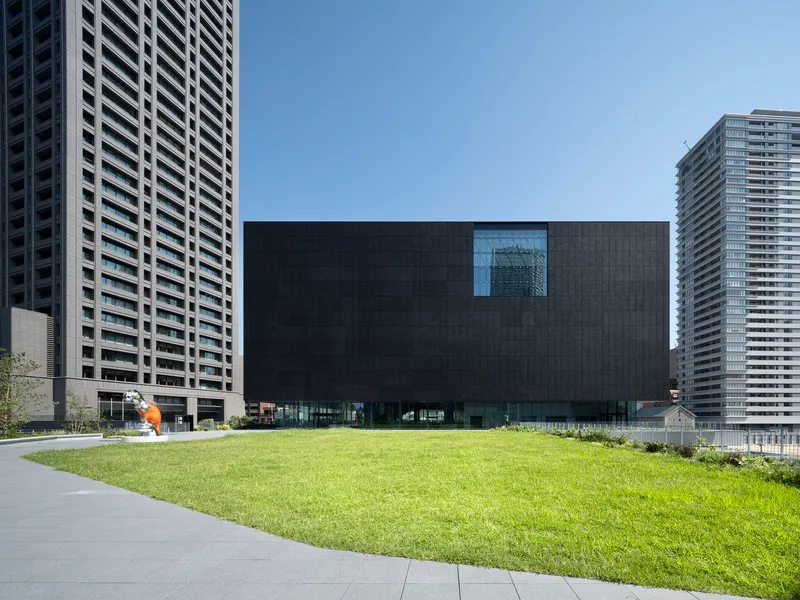
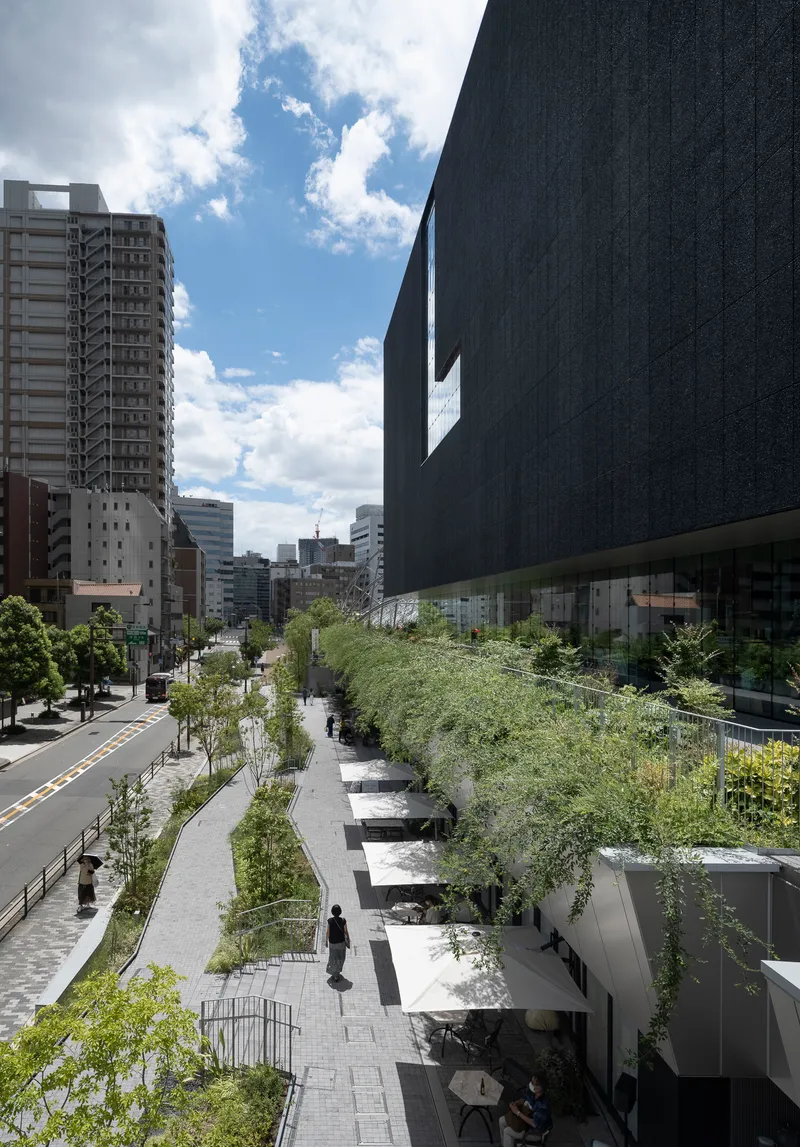
The facade's darkness is not paint or cladding in the conventional sense. It is composed of 609 precast concrete plates whose surface combines crushed Iwate Gensho stone, crushed sand from Uji in Kyoto, and black pigment. The result is a texture with geological specificity: regional stones ground into a skin that reads as heavy, mineral, and almost volcanic. Against the green of the planted promenades and the pale towers of the surrounding district, the building registers as an object from a different material world.
What keeps the mass from feeling oppressive is its elevation. The gardens, young trees, and accessible ramps that fill the ground plane create enough daylight and visual openness that the heavy volume overhead becomes a kind of canopy rather than a wall. Cyclists and pedestrians pass beneath and beside it without friction.
The Passage as Organizing Spine
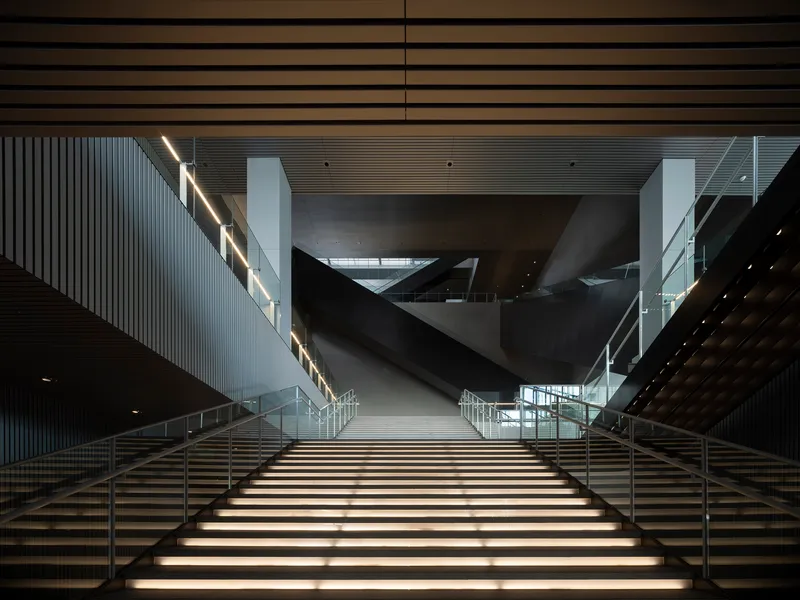


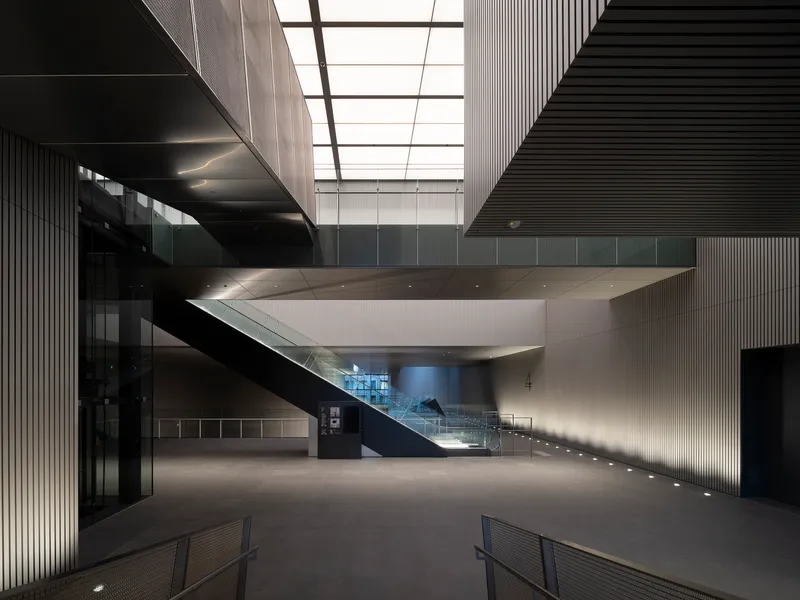
Inside, the building's core is its vertical passage: a five-story atrium that functions as both circulation spine and social condenser. Two large escalators intersect at right angles, their landing positions on the second and fourth floors deliberately separated to create a single continuous flow. Visitors moving between the permanent collection on the fourth floor and the special exhibition spaces on the fifth encounter the full volume of the atrium repeatedly, a spatial reminder that the building is organized around movement, not rooms.
The passage concept echoes nineteenth-century Parisian arcades, but Endo transposes it vertically. Where the original passages were horizontal shortcuts through city blocks, here the passage stacks. You ascend through it, cross it on bridges, and look down through it from balconies. The intersecting escalators give the atrium a rotational quality, so orientation shifts as you rise.
Platinum Silver and Controlled Light
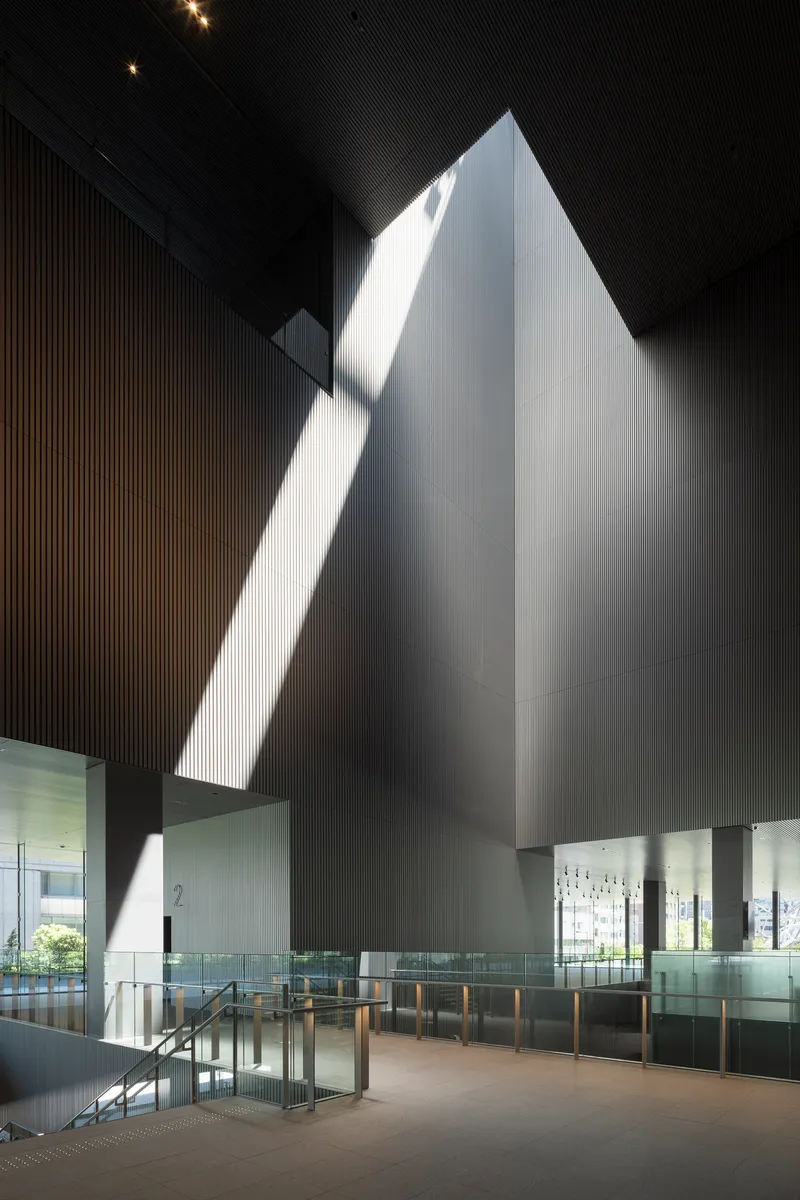
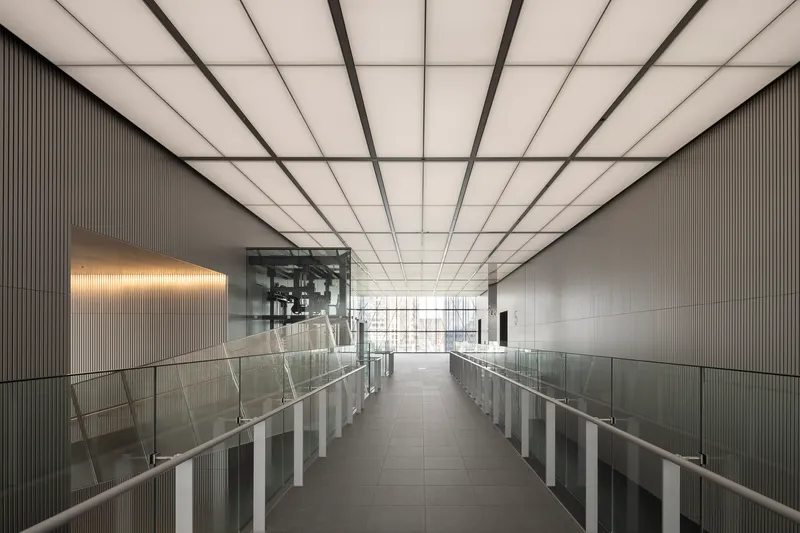
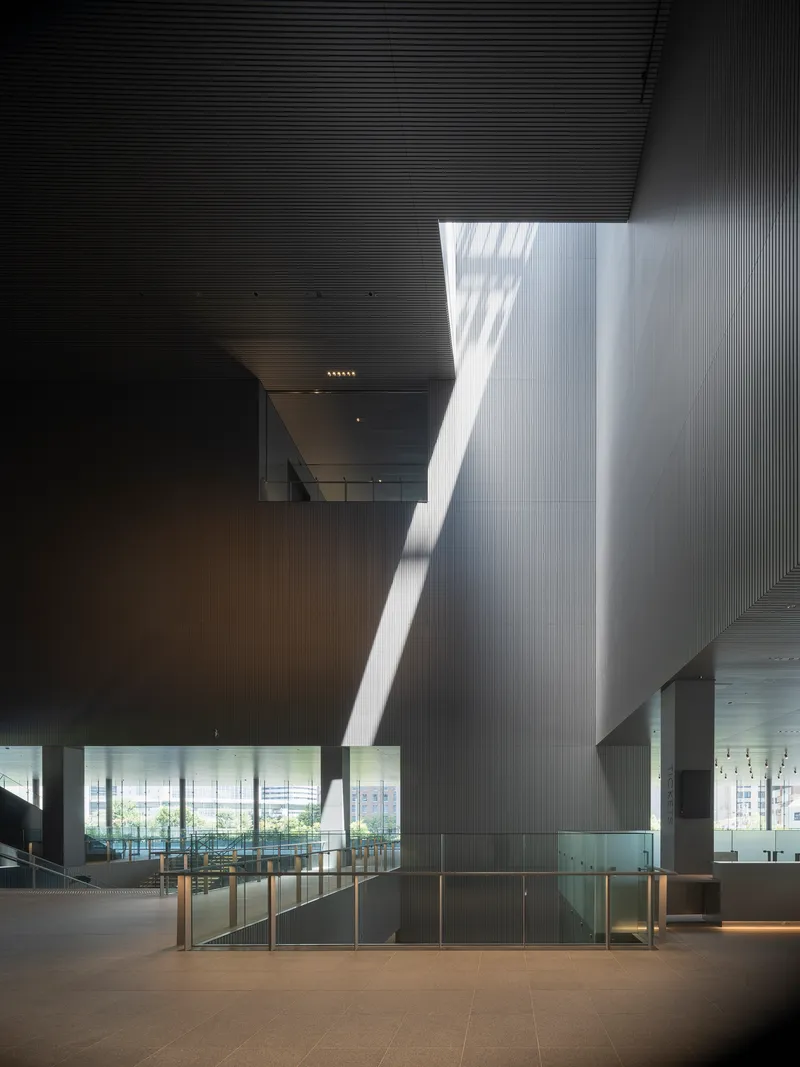
If the exterior is dark and mineral, the interior passage is metallic and luminous. Platinum silver louvers line the walls and ceilings of the main circulation spaces, their spacing set at a standard dimension of 17.5mm with thirty different types of concealed click-on fixings to maintain clean, unbroken joints. The louvre system is consistent across walls and ceilings, erasing the distinction between vertical and horizontal surfaces and giving the passage a tubular, almost intestinal coherence.
Natural light enters from a top light in the atrium and meets different color temperatures of interior lighting at each level. The result is a shifting atmospheric condition as you move vertically: warm at the base, cooler and sharper near the skylight. In image four, a pyramidal volume catches a blade of daylight slicing through the ribbed ceiling, a moment where the building's light strategy becomes almost theatrical.
Structural Bracing as Interior Spectacle
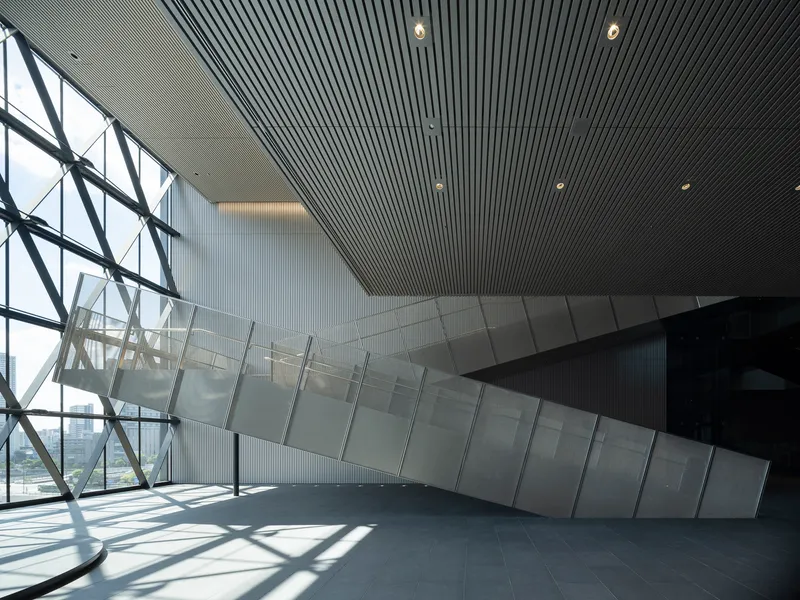
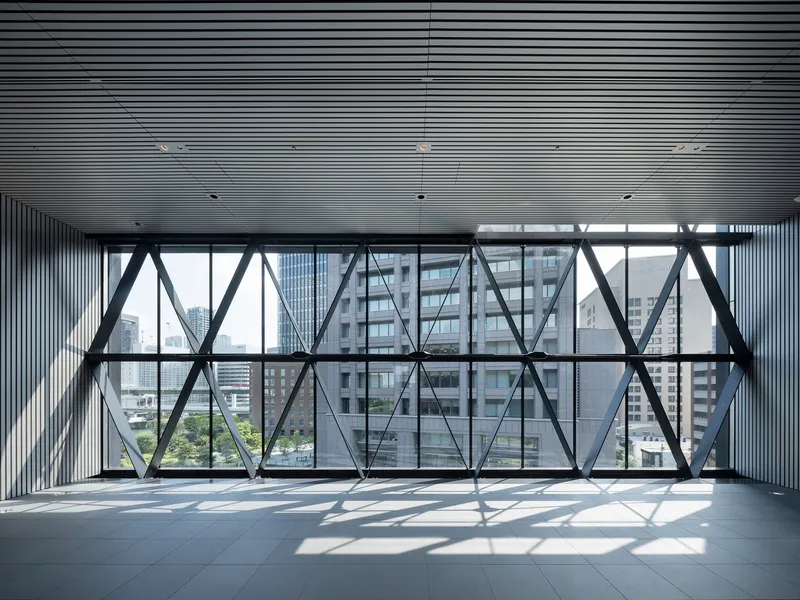

The five-floor steel frame sits on a base isolation system, a necessity in seismically active Osaka. But the structural bracing is not hidden. Triangulated steel members behind floor-to-ceiling glazing cast geometric shadow patterns across the tile flooring, turning engineering into ornament. The diagonal members read like oversized lattice screens, their shadows shifting with the sun and creating a constantly changing graphic pattern on the interior surfaces.
Jun Sato Structural Engineers designed the system so that the main museum building and the adjacent parking structure, which uses a separate earthquake-resistant system, connect through expansion joints. The structural logic is legible without being didactic: visitors can see how the building holds itself up, and the bracing gives the glazed lower levels a tectonic density that balances the open ground plane.
Interior Spaces for Art and Gathering
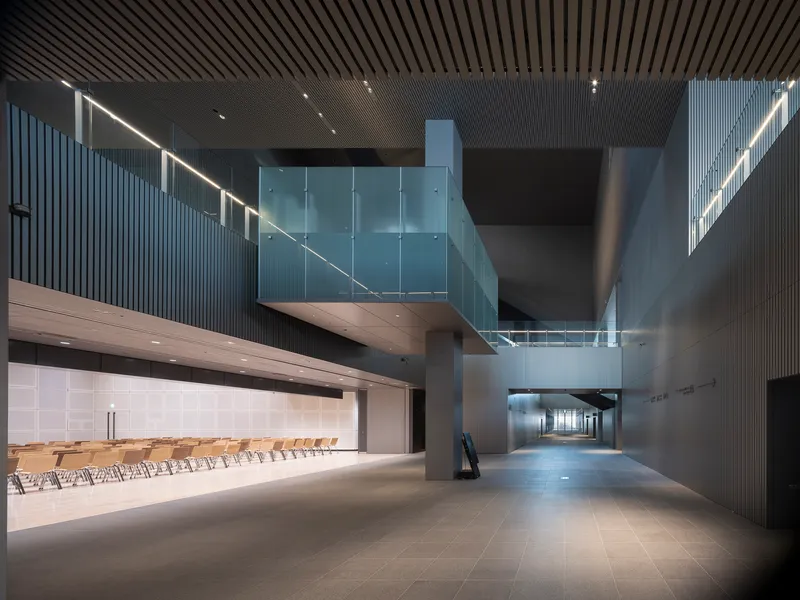
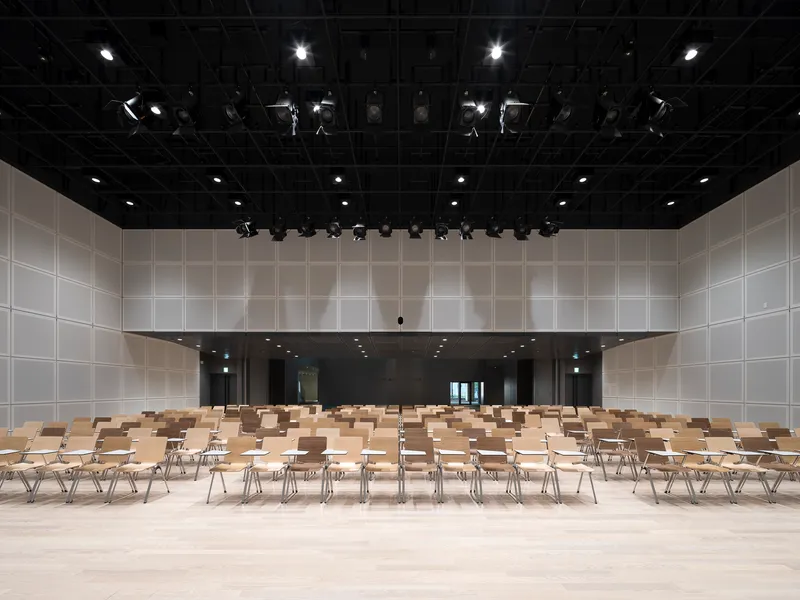
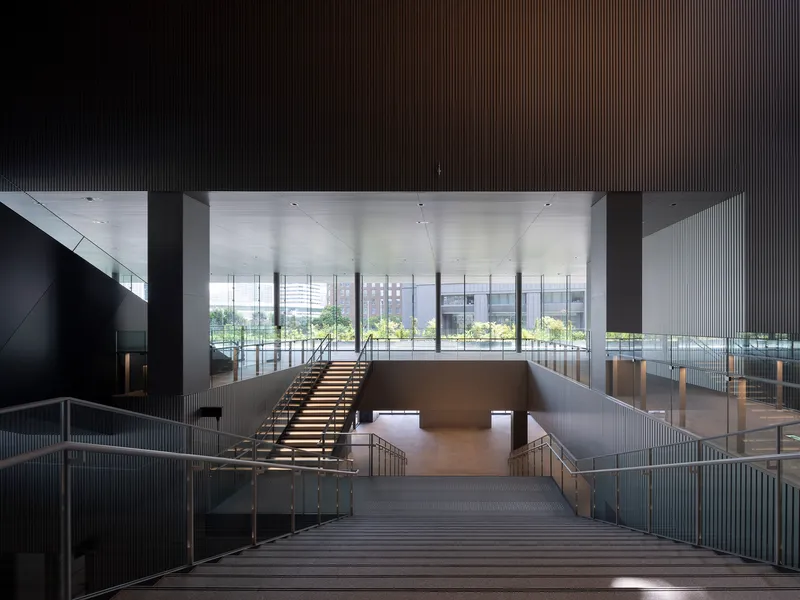
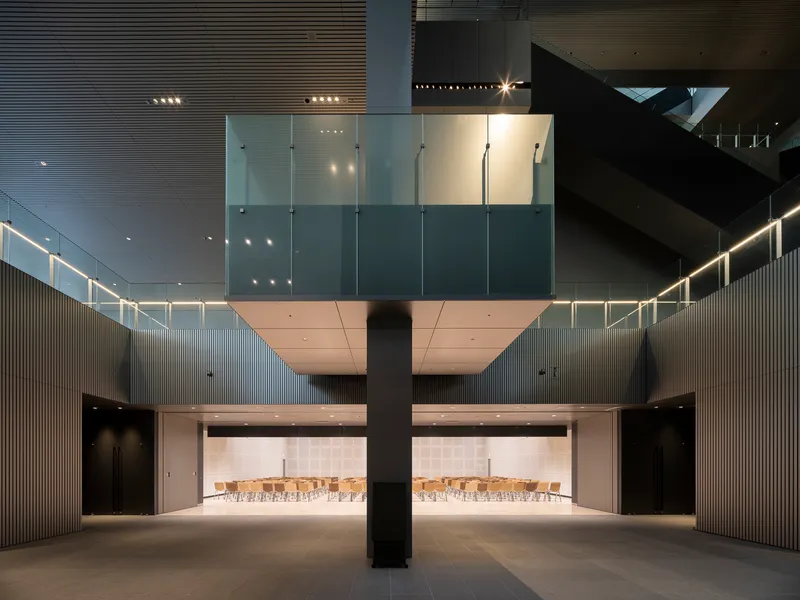
Beyond the passage, the museum contains a range of programmatic spaces that reinforce the city analogy. A performance hall with exposed rigging and white panel walls occupies a quieter wing. A lobby gallery with rows of wooden chairs and a suspended glass bridge functions as a transitional space between the public atrium and the more controlled exhibition rooms above. A central timber staircase descends toward perimeter glazing where the park greenery fills the view, momentarily grounding visitors in the landscape before they re-enter the metallic interior.
The third floor houses archives and support spaces, creating a programmatic buffer between the active ground levels and the contemplative galleries above. It is a layered section, each floor calibrated to a different pace of engagement.
Landscape as Extension

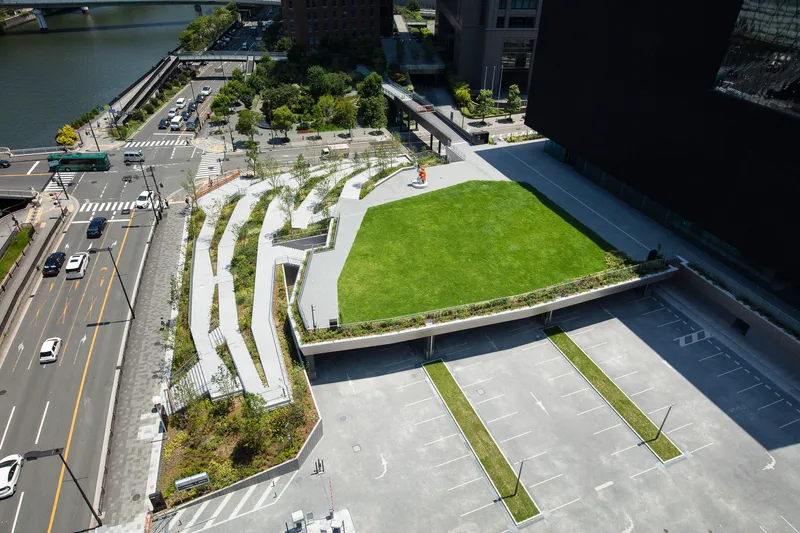
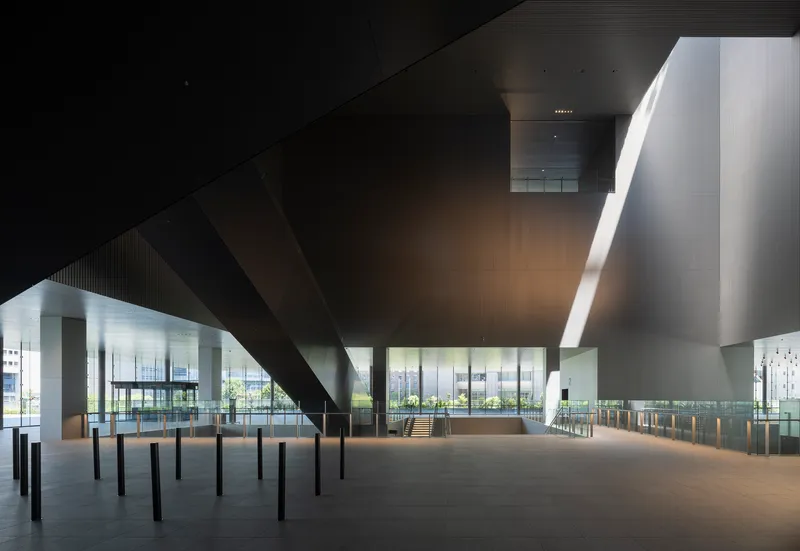
The ground plane is designed as public space first, museum threshold second. An open terrace with rich planting wraps the building, and the height difference between the site and surrounding streets is eliminated so that pedestrians flow in without encountering barriers. The rooftop adds a lawn and curving planted beds, extending the green infrastructure upward. This is not a building that ends at its walls.
Endo's strategy treats the museum as a nexus between the eastern and western halves of Nakanoshima, an island that has served as a cultural and commercial crossroads since the Edo period. The wide staircase at the main entrance, where visitors ascend beneath the cantilevered dark mass, frames the museum as a threshold in the city's larger spatial network rather than a destination in itself.
Plans and Drawings
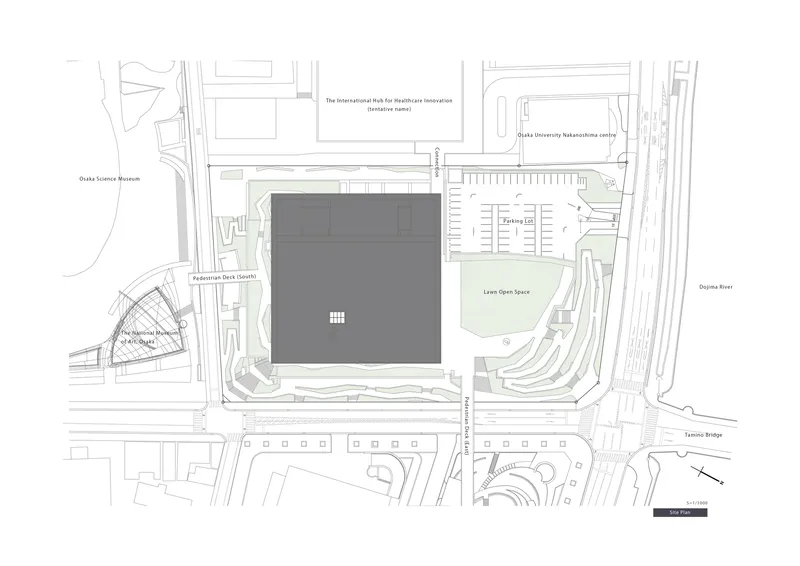
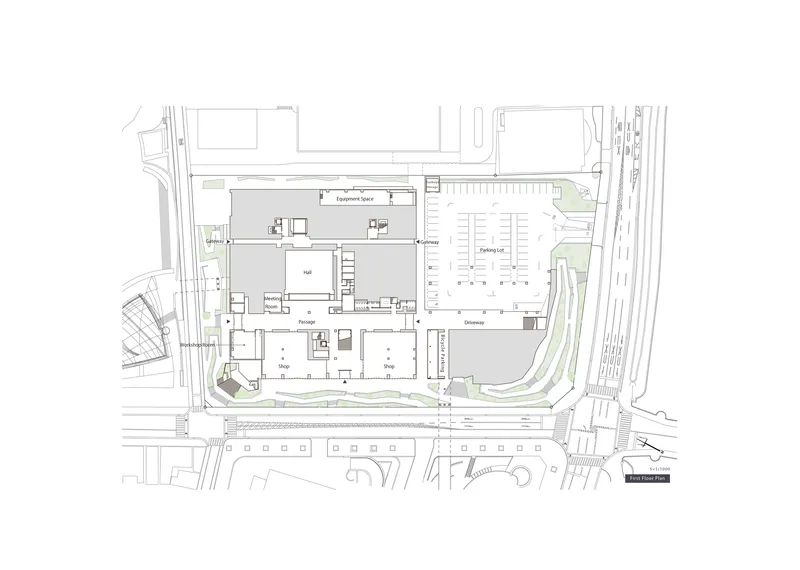
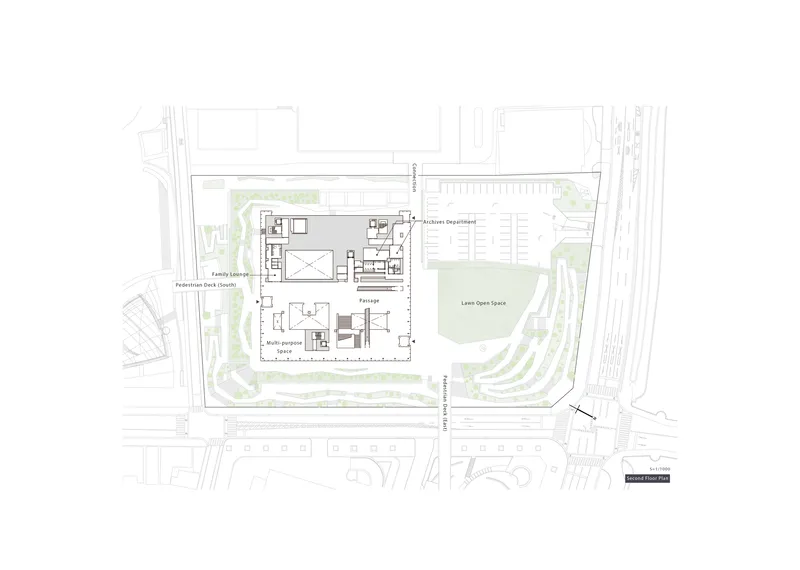

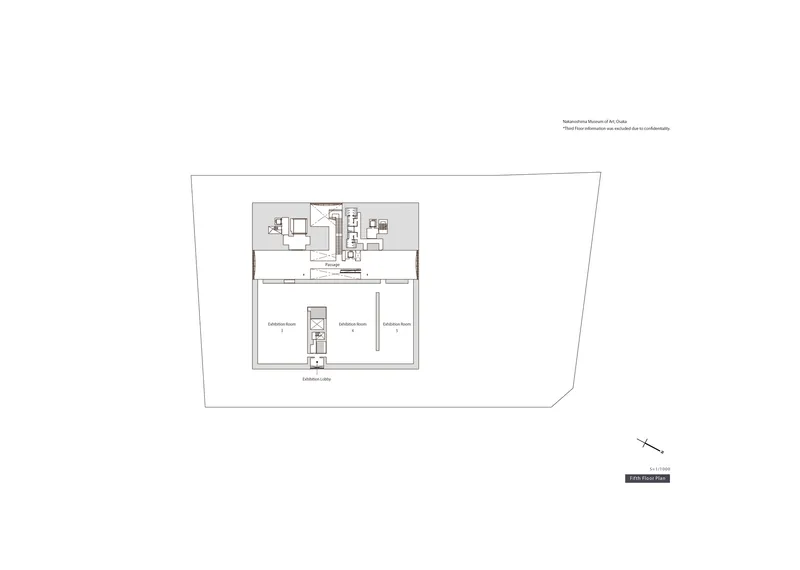

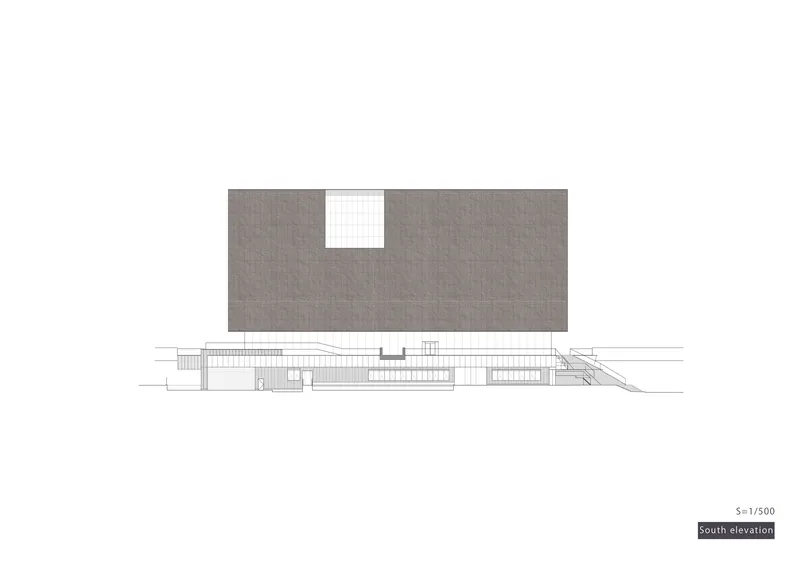
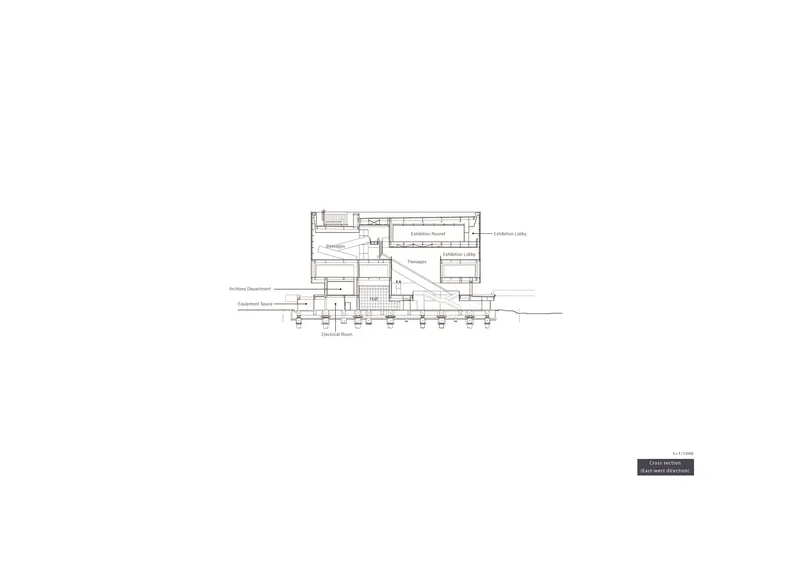
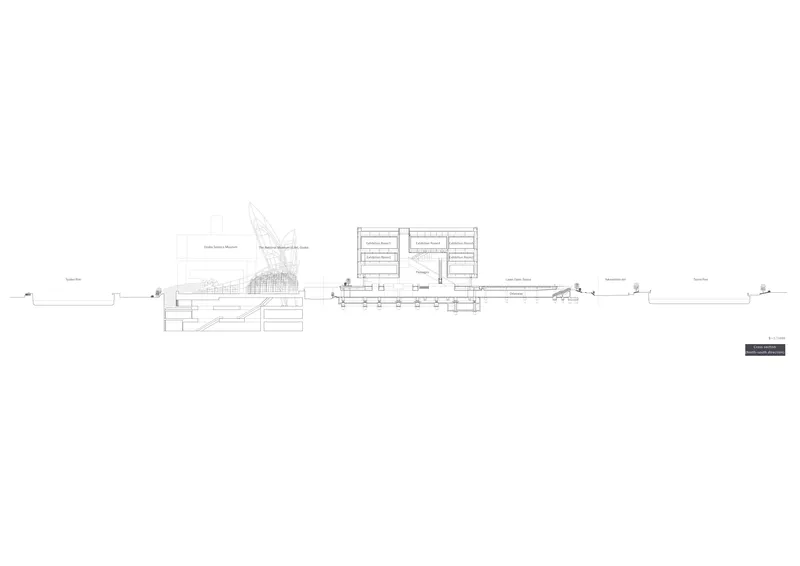
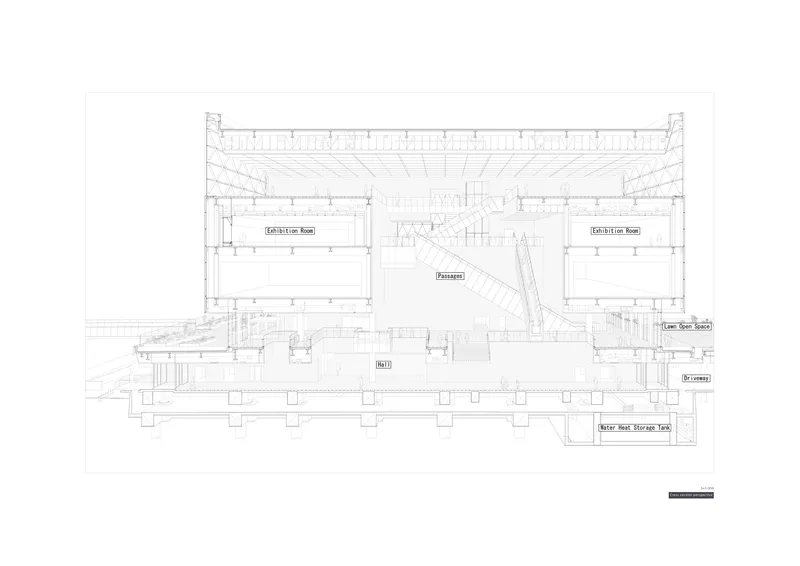
The plan drawings reveal the clarity of the organizational logic. The site plan shows how the square footprint sits within a larger field of parking and landscape, its edges not aligned with any single street but oriented to receive movement from multiple directions. The floor plans progress from open public halls at ground level through archive and service layers to the dedicated exhibition rooms on the upper floors, all orbiting the central void. The sections are particularly instructive: the north-south cut shows the full longitudinal span with basement storage tucked below, while the east-west section reveals how the exhibition wings flank the central atrium and its diagonal stair, confirming that the passage is not a leftover space but the building's structural and experiential spine.
Why This Project Matters
The Nakanoshima Museum of Art refuses a common trap of institutional architecture: the impulse to create a singular, photogenic gesture that works on magazine covers but leaves the surrounding city unchanged. By lifting its mass, eliminating a dominant entrance, and organizing its interior around a vertical passage modeled on urban arcades, Endo's building distributes its civic generosity across the ground plane and through its section simultaneously. The museum does not ask you to arrive at it; it asks you to move through it.
After nearly four decades of planning, the project delivers something rare: a large cultural institution that feels permeable without sacrificing spatial intensity. The five-story atrium with its crossing escalators and platinum louvers is genuinely disorienting in the best sense, a space that rewards repeated visits because it never reads the same way twice. For Osaka, and for any city rethinking how museums can function as urban infrastructure rather than cultural fortresses, Nakanoshima is a compelling proof of concept.
Nakanoshima Museum of Art Osaka by Katsuhiko Endo Architect and Associates. Located in Osaka, Japan. Total floor area: 20,012 sqm. Completed 2021. Photography by Hiroshi Ueda and Nao Takahashi.
About the Studio
Share Your Own Work on uni.xyz
If projects like this are the kind of work you want to make, uni.xyz is a place to publish your own, find collaborators, and enter design competitions.


Popular Articles
Popular articles from the community


Tsunami Convergenics: Turning Catastrophic Ocean Forces into Underwater Housing Infrastructure
A speculative underwater settlement off the coast of Onagawa, Japan, treats tsunamis and typhoons as energy sources rather than threats.

Temporary Home for Dogs: A Reversed Zoo Rethinks Animal Shelter Architecture
In Bucharest, a sinuous corridor and freed landscape flip the logic of containment, designing a shelter that works to make itself unnecessary.
Faces of the Soviet Avant-Garde: Turning Moscow's Street Names into an Open-Air Museum
A network of sculptural installations across a Moscow residential district transforms forgotten architect names into spatial encounters with cultural memor

Manzana Morphosis: Stretching Barcelona's Grid into a Living Landscape for 2050
A radical reworking of the Eixample manzana turns density into a tool for generous public space, vertical ecology, and environmental performance.

Similar Reads
You might also enjoy these articles

Pixel Gardens: One Repeated Module Stacked Into a Terraced Social Housing Tower for Famagusta
Salem Bader's shortlisted housing tower builds a vertical neighbourhood from one repeated module, offsetting units to carve terraces, light and air.

Bao Huynh Watercolor Atelier: A Serene Art Retreat in Hội An
Bao Huynh Watercolor Atelier in Hội An blends multifunctional art spaces, sustainable design, local materials, and family-friendly living in a serene environment.

Atelier Macri Concept Store Interior Design by CASE-REAL
Atelier Macri store features a "ko" counter, walnut wood details, cork displays, blending retail, gallery, and seamless customer experiences.

Manuel Vargas Izquierdo Stadium and High-Performance Sports Center: Architectural Excellence in Jalpa de Méndez
The Manuel Vargas Izquierdo Stadium blends sustainable design, inclusive sports facilities, and cultural-inspired architecture, revitalizing Jalpa de Méndez’s public spaces.

Explore Floating City Competitions
Discover active competitions in this discipline

Challenge to design public laboratory

Bring back Drive In's
Comments (0)
Please login or sign up to add comments
No comments yet. Be the first to comment!