
Kéré Architecture Builds the First Purpose-Built Goethe-Institut Around a Baobab Tree in Dakar
A compressed laterite earth campus in Senegal channels bioclimatic wisdom and oral culture traditions into a new civic landmark.


In over 75 years of global operation, the Goethe-Institut has never commissioned a building from the ground up. That streak ends in Dakar, where Kéré Architecture has completed a 1,800 square meter cultural campus that is simultaneously a library, auditorium, language school, café, and rooftop event space. The fact that the institution chose Senegal for this milestone, and that it chose Diébédo Francis Kéré to design it, says something about where the center of gravity in global architecture discourse is shifting.
What makes the project more than a feel-good headline is its material and spatial intelligence. The building is constructed almost entirely from compressed laterite earth bricks sourced from Senegalese soil, shaped into a double-skin facade system that filters light, encourages cross-ventilation, and shields occupants from the harmattan's dusty assault. The plan wraps around a courtyard anchored by a mature baobab tree, a direct reference to the Senegalese tradition of gathering beneath its canopy for communal dialogue and decision-making. The architecture does not simply contain a program; it embodies the cultural rituals the institution hopes to foster.
A Canopy Made of Laterite
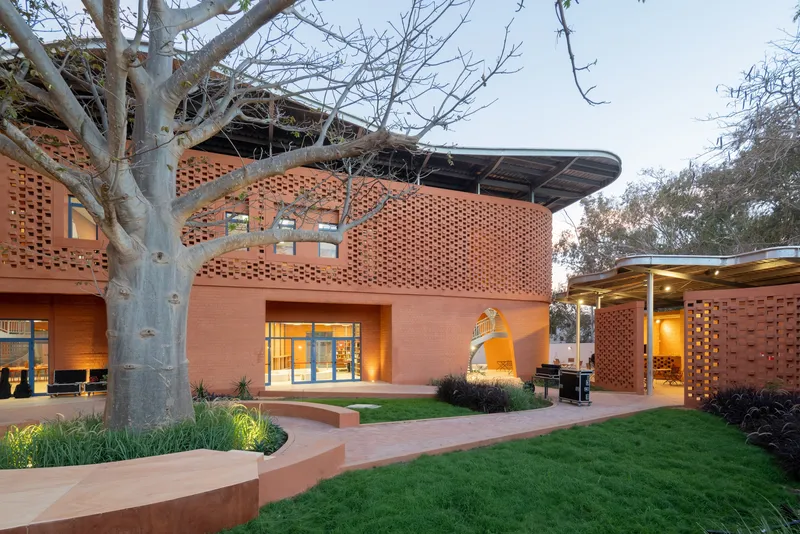
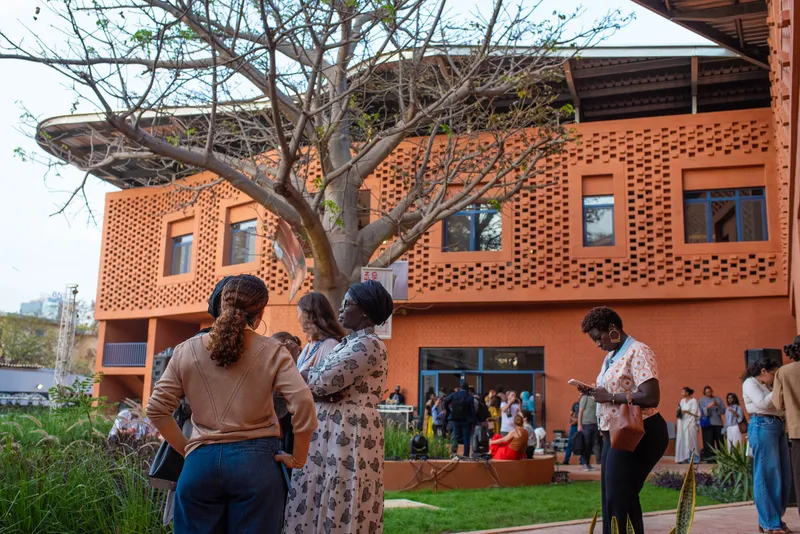
The building's massing is shaped to mirror the silhouette of the tree canopies already on site. That is not a metaphor pulled from a press release. The compact, two-storey volume genuinely traces the existing arboreal profile, maintaining continuity with the surrounding garden and shielding neighbors from event noise while buffering visitors from street traffic. From the exterior at dusk, the perforated brick skin glows with interior warmth, the curved volumes reading less like a building and more like a geological formation that has always belonged here.
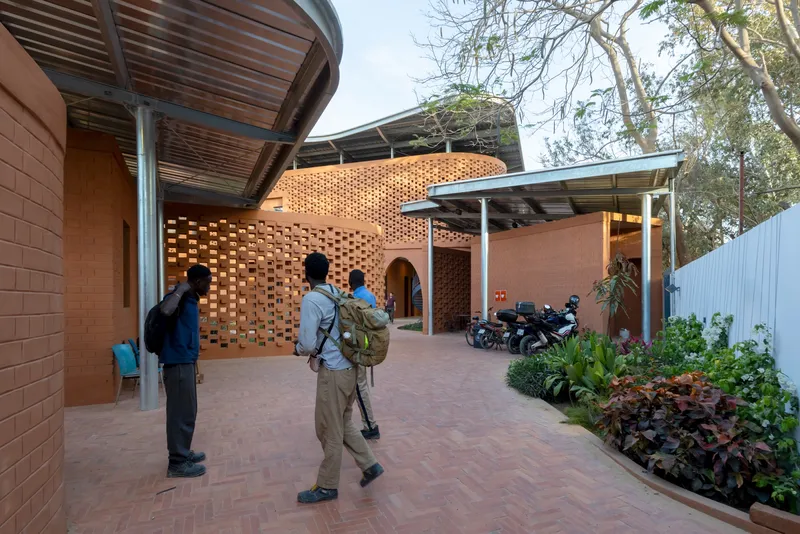
The courtyard operates as the social center. Visitors gather beneath the bare branches of the baobab, flanked on all sides by the latticed terracotta walls. Planted beds and patterned pavers soften the ground plane, and the entry sequence threads you through perforated brick screens that compress and release views in a rhythm that rewards slow movement.
Double Skin, Single Material

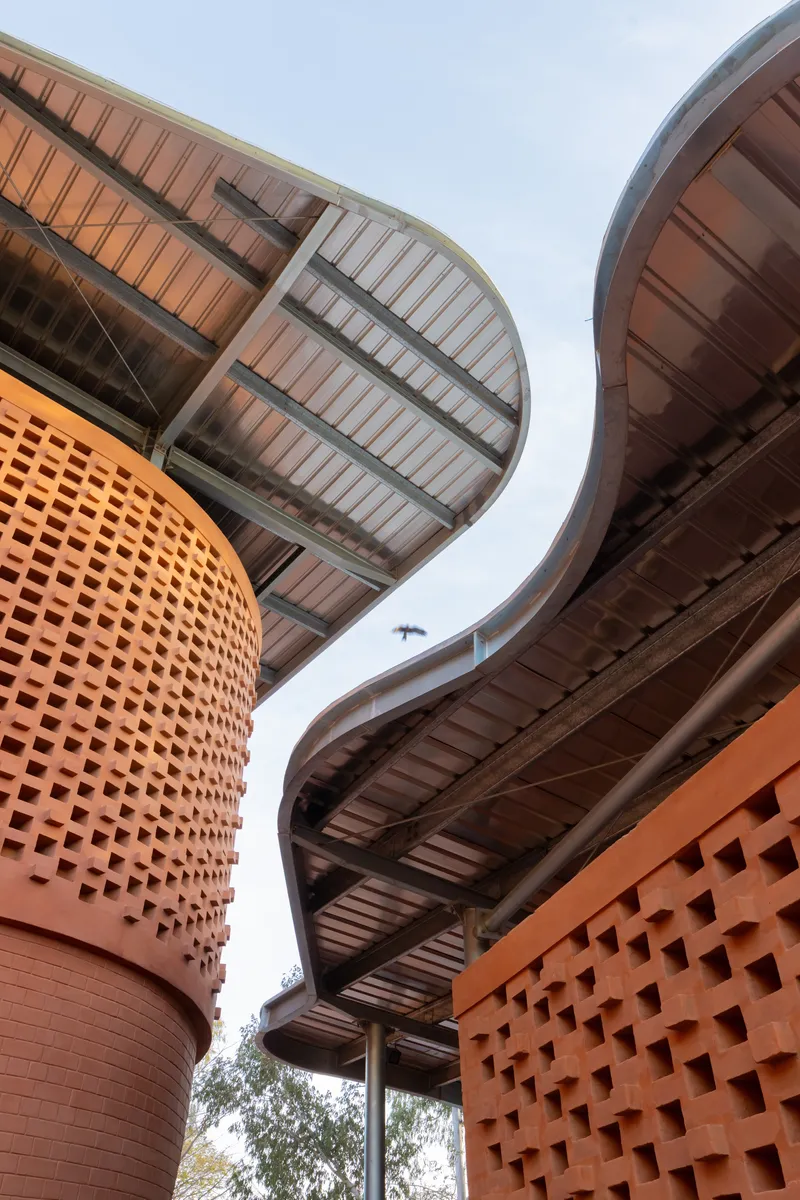
Kéré's detail strategy here is disciplined. The load-bearing masonry walls are constructed from compressed earth blocks, and so is the secondary perforated skin that wraps them. Both layers use the same laterite material, but one is solid and structural while the other is open and atmospheric. The gap between them becomes a breathing zone: air moves through the lattice, hits the thermal mass of the inner wall, and is tempered before entering occupied spaces. The result is a passively cooled envelope in a coastal equatorial climate, achieved without the mechanical complexity that most institutional clients default to.
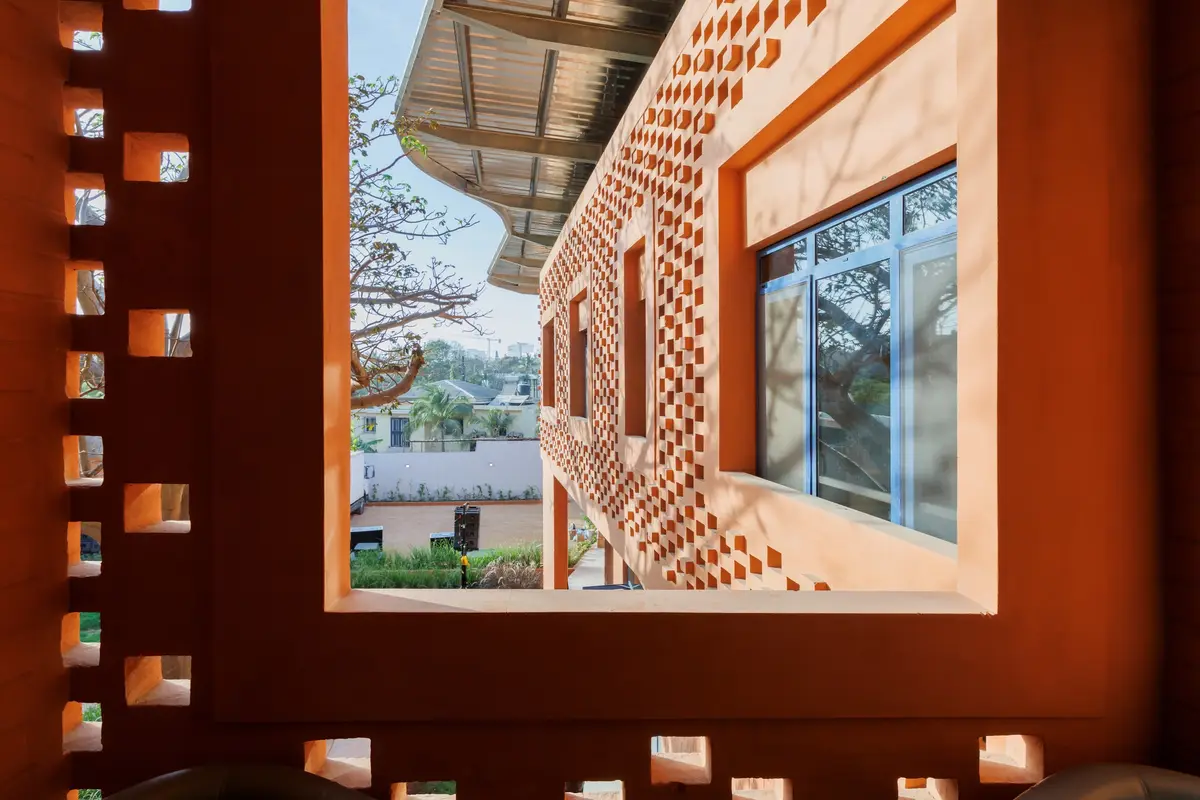
Up close, the craft registers. The curved surfaces of the terracotta blocks meet the perforated screens at clean junctions, the afternoon shadow casting intricate patterns across the facade. The roof, executed with higher aluminum content to resist the corrosive salt air off the Atlantic, caps the walls with a pragmatic honesty: corrugated metal, exposed timber soffits, no pretense.
The Spiral Core
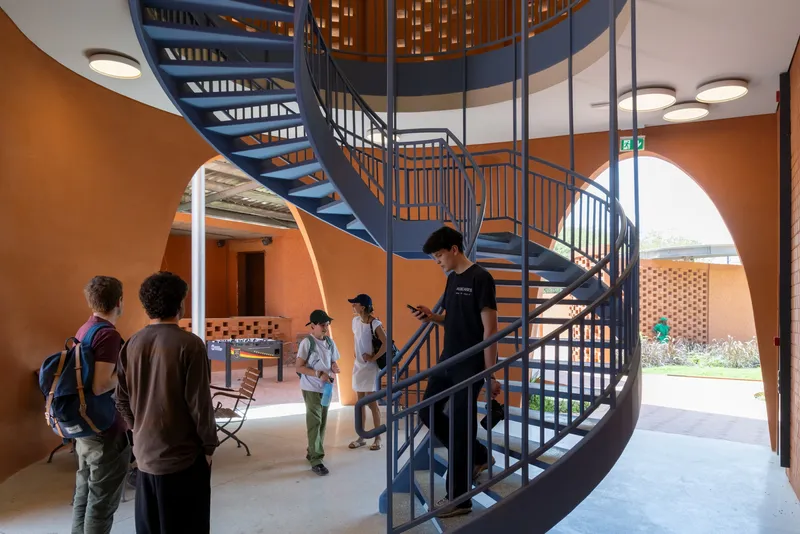
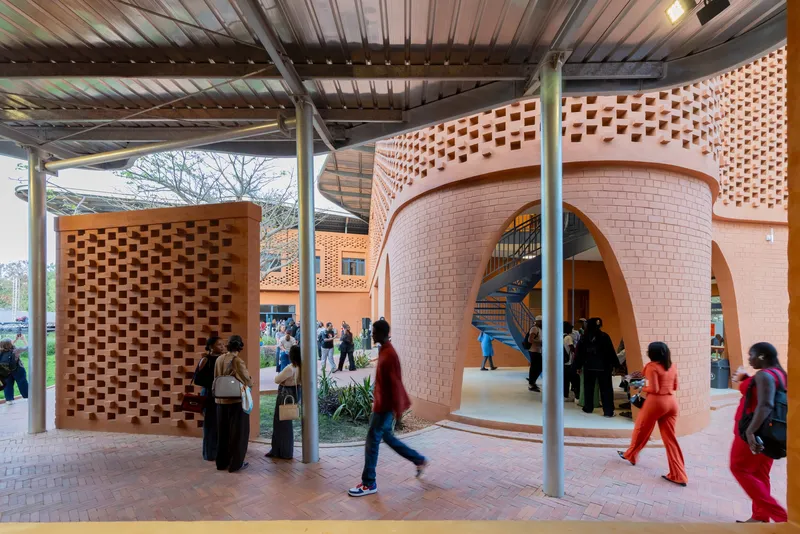
A central spiral staircase with steel railings connects the ground floor program to the classrooms, offices, and rooftop above. Viewed from below, the staircase occupies a cylindrical volume punctuated by round skylights that wash the terrazzo floor with controlled daylight. It is a functional circulation piece, but it also acts as a thermal chimney, pulling warm air upward and out.
From the covered porch on the upper level, the staircase tower reads as a brick turret anchoring the composition. Steel columns support a corrugated metal canopy that extends generous shade over the outdoor walkways. The tree-shaped pillars that hold the roof on the accessible rooftop are a structural gesture that loops back to the arboreal logic governing the entire project.
Thresholds and Passages
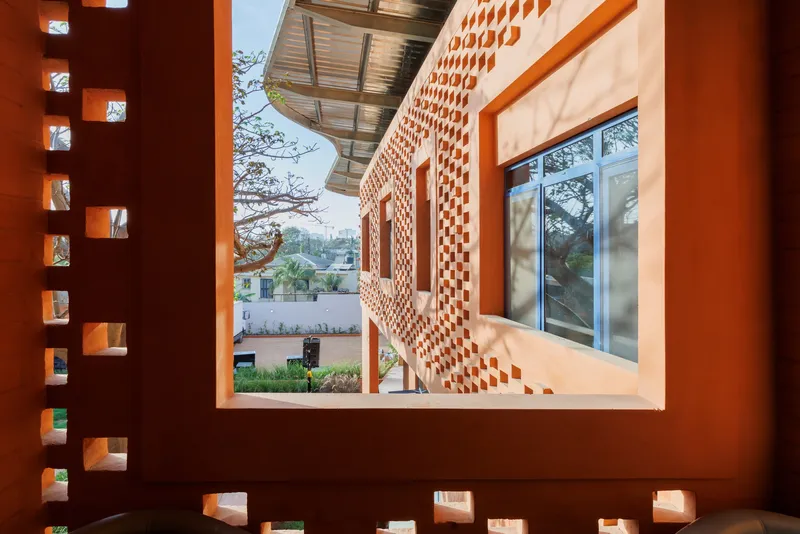
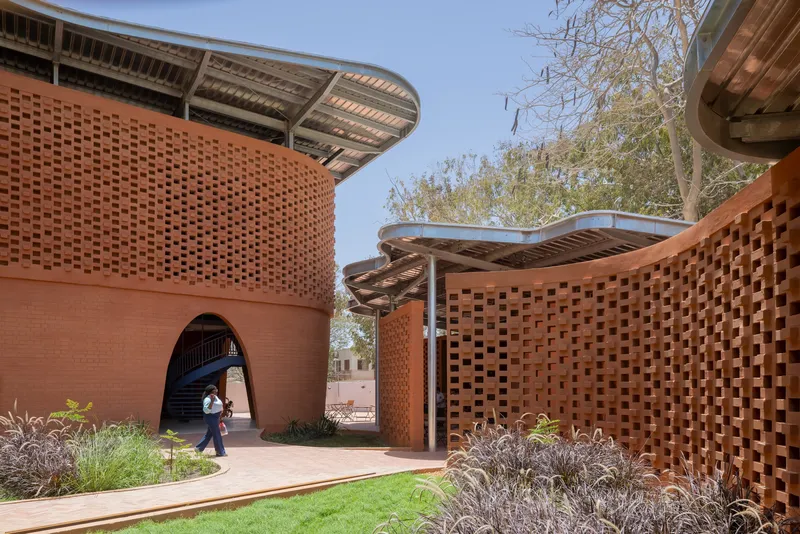
The most arresting spatial moments occur at the thresholds. Looking through a perforated brick opening, the courtyard appears as a framed landscape: the curved facade, the metal canopy, a sliver of sky. Elsewhere, an arched passageway tunnels between two terracotta volumes beneath an undulating metal roof, with planted beds lining the path. These are not corridors. They are choreographed transitions between outdoor, semi-outdoor, and indoor conditions, each one adjusting your relationship to light and air.
The project was realized through collaboration between German engineers from Rebuild.ing, Dakar-based firm Worofila, and sustainable construction specialists Élémenterre. That cross-continental team is evident in the precision of the masonry and the sophistication of the environmental strategy. The building performs at a level that validates compressed earth as a serious institutional material, not a concession to budget or locality.
The Library as Living Room

The reading room may be the project's most generous interior. A circular seating platform sits at the center, wrapped by timber bookshelves, beneath clustered ceiling lights that create a warm, even glow. The geometry is communal by design: you sit facing other readers, not a wall. It recalls the baobab logic outside, where gathering is the point and knowledge is exchanged laterally, not dispensed from above.
Kéré has described the project as both futurist and traditional, exploring new forms whose foundations were laid long ago. That tension is legible in this room. The materials are ancient, the seating arrangement references oral culture, but the lighting, the proportions, and the spatial generosity are entirely contemporary. Nothing here is nostalgic.
Plans and Drawings
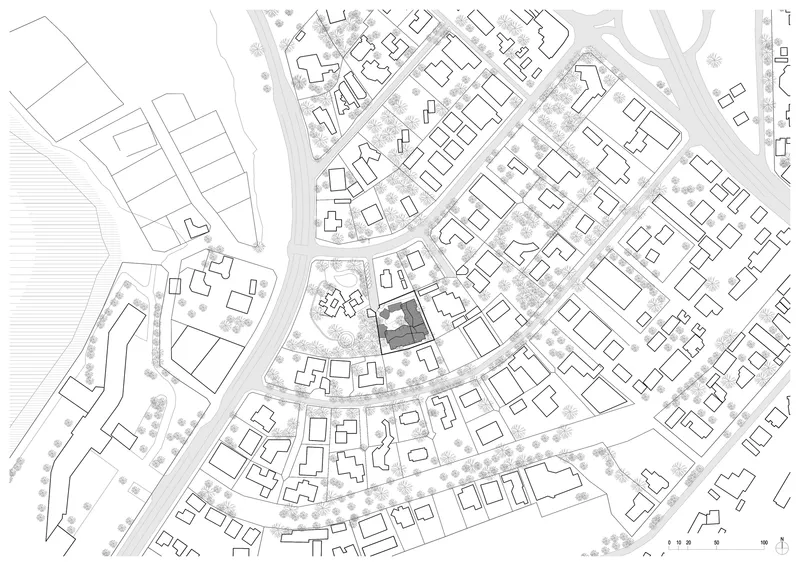
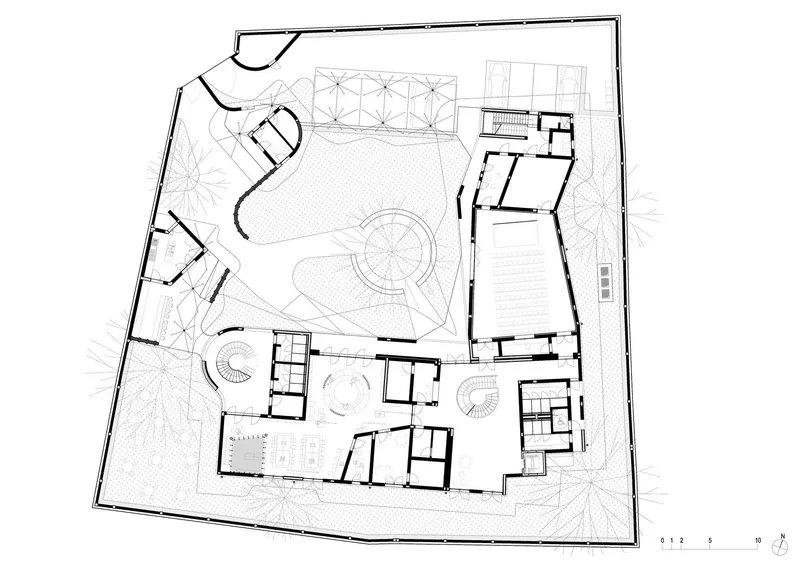
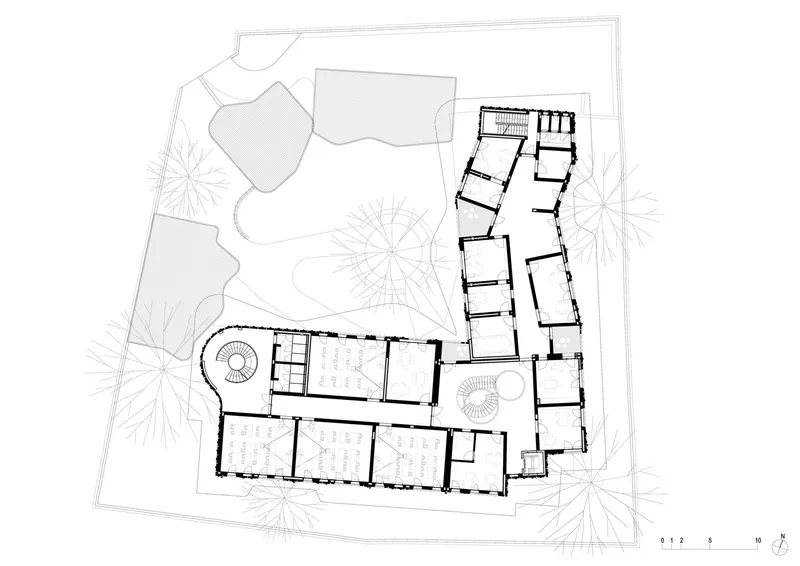
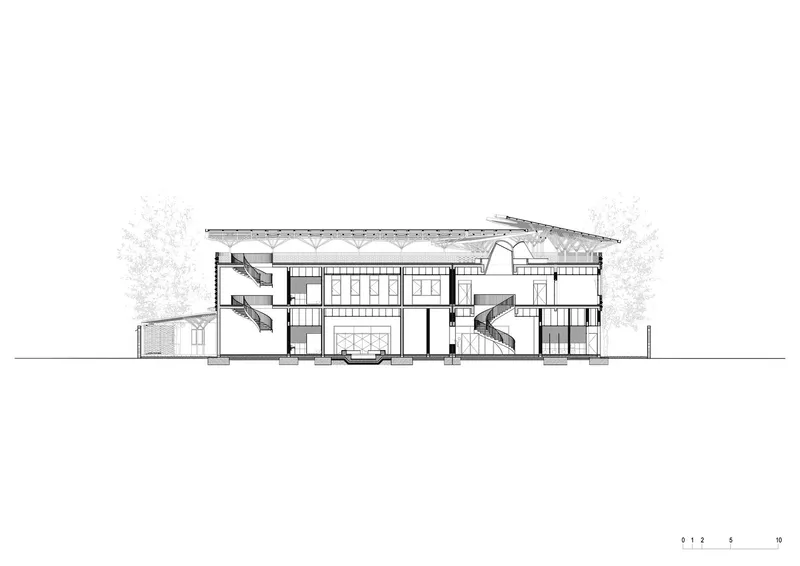
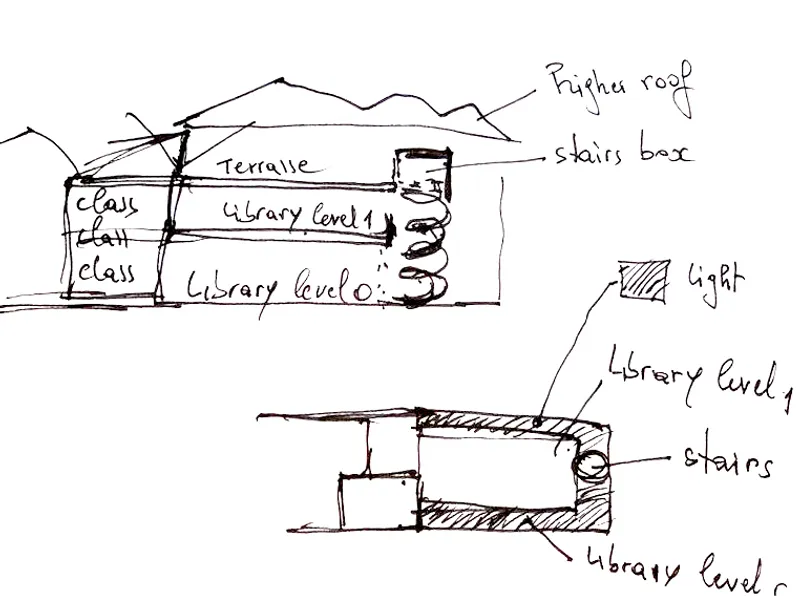
The site plans reveal the building's L-shaped footprint sitting within a 2,700 square meter plot in a residential neighborhood, adjacent to the Léopold Sédar Senghor Museum and near Cheikh Anta Diop University. The ground floor plan shows rooms arranged around a central circulation path, with courtyards punctuating the mass and the spiral stair anchoring the plan. The section drawings are particularly instructive: they expose the multi-level interior spaces, the sloped roof profile that tracks the tree canopy, and the relationship between the library's split levels and the rooftop terrace above.
Kéré's hand-drawn sketch section, with its loose ink lines and a mountain skyline looming behind, captures the ambition more directly than the technical drawings. It shows a building that wants to be landscape: terraced, permeable, rooted.
Why This Project Matters
The Goethe-Institut Sénégal matters because it proves that compressed earth construction can deliver institutional-grade architecture at a meaningful scale. This is not a rural school or a prototype pavilion. It is a 1,800 square meter, two-storey civic building in a major African capital, designed to host diplomacy, education, and public culture for decades. The fact that it achieves passive climate control in a coastal equatorial environment, using locally sourced laterite and a double-skin masonry system, makes it a case study that other institutions should be forced to confront before defaulting to glass and steel.
It also matters as a statement about who builds cultural infrastructure and where. The Goethe-Institut, a German institution, chose a Burkinabè architect to build its first purpose-designed campus on African soil, in the garden of a former president's home. The building does not perform European minimalism transplanted to the tropics. It is, unmistakably, a Senegalese building: shaped by Senegalese soil, cooled by Senegalese wind, organized around a Senegalese tree. That is the kind of cultural exchange the institution's mission promises, and here, for once, the architecture actually delivers it.
Goethe-Institut Sénégal by Kéré Architecture. Dakar, Senegal. 1,800 m². Completed 2026. Photography by Iwan Baan, Jean-Baptiste Joire, courtesy of Goethe-Institut Dakar.
About the Studio
Share Your Own Work on uni.xyz
If projects like this are the kind of work you want to make, uni.xyz is a place to publish your own, find collaborators, and enter design competitions.


Popular Articles
Popular articles from the community


U.GA Architects Wraps an Oval Rooftop Pool in Curved Board-Formed Concrete on Busan's Jeollidan-gil
In Busan's Jeonpo-dong, a 454 m² mixed-use block stacks a neighborhood facility, guest rooms and an oval rooftop pool inside spiraling concrete walls.

Architekt Andreas Gruber Scatters 23 Dark Timber Chalets Across a South Tyrolean Forest Edge
In Molini di Tures, Amonti Chalets breaks a resort into a hamlet of gabled timber houses, with parking, storage and services pushed into the slope.

GROUP A Strips a 1969 Rotterdam Harbor Headquarters to Its Frame and Wraps It in Timber Louvers
In Rotterdam's M4H harbor district, Ferro Offices reuses a 1969 frame, adds one timber storey and reaches BREEAM-NL Outstanding.

David Macias Steps a Doorless Stone and Plaster House Down a Tropical Colombian Hillside
In the humid hills of Colombia, Threshold House replaces the front door with an open void and terraces its 850 m² down the slope instead of fighting it.

Similar Reads
You might also enjoy these articles


LAVA Architecten Gives Vocational Education a Sawtooth-Roofed Face on a Mechelen School Campus
In Mechelen, Belgium, a 2,053 m² STEM school on a 6×6 m grid turns workshops and classrooms into rooms that can be rearranged as teaching changes.

KEMA Studio Turns a Derelict Marvila Attic into a 60 m² Lighthouse Apartment Above Lisbon
In Lisbon's Marvila district, a rebuilt roof, four skylights and two plywood volumes turn an unlivable attic into a bright home facing the Tagus.

Pixel Gardens: One Repeated Module Stacked Into a Terraced Social Housing Tower for Famagusta
Salem Bader's shortlisted housing tower builds a vertical neighbourhood from one repeated module, offsetting units to carve terraces, light and air.

Bao Huynh Watercolor Atelier: A Serene Art Retreat in Hội An
Bao Huynh Watercolor Atelier in Hội An blends multifunctional art spaces, sustainable design, local materials, and family-friendly living in a serene environment.
Explore African Architecture Competitions
Discover active competitions in this discipline

Challenge to design public laboratory

Bring back Drive In's
Comments (0)
Please login or sign up to add comments
No comments yet. Be the first to comment!