
Kiltro Polaris and JC Arquitectura Line Up Six Barrel Vaults for a Health Center in Rural Mexico
A raw concrete clinic in Escárcega, Campeche, uses courtyards between structural bays to ventilate, light, and cool every room naturally.


Escárcega is not a colonial town with a centuries-old plaza or a cathedral anchoring its grid. It is a twentieth-century settlement that grew up around the extraction of gum, rubber, and logwood, later consolidated by its railroad connection. With roughly 32,000 inhabitants and municipal status only since 1990, it is the kind of place where federal infrastructure investment arrives in batches rather than increments. The N1 Health Center, completed in 2022, is one of seven interventions meant to bring that infrastructure up to date. Kiltro Polaris Arquitectura and JC Arquitectura, led by Victor Imre Ebergenyi Kelly and Juan Carral O'Gorman, designed a 797-square-meter clinic that treats the commission not as a disposable public building but as a prototype for civic permanence.
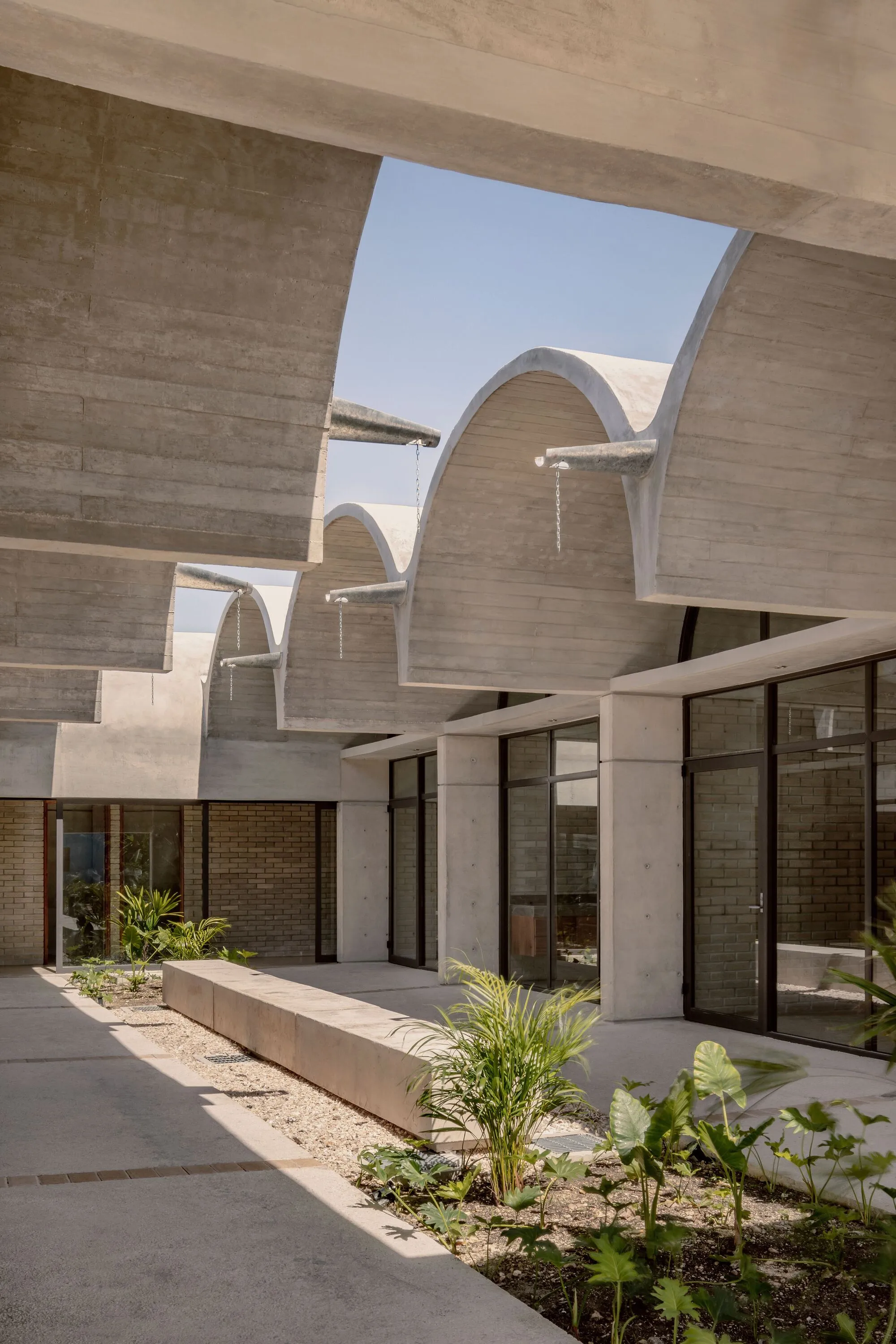
What makes the project worth studying is the directness of its structural logic: six concrete barrel vaults laid out in a linear sequence, interrupted by courtyards that do all the environmental work. There is no mechanical ventilation heroics, no parametric canopy, no philanthropic greenwashing. The vaults span the rooms, the courtyards separate them, and the resulting rhythm of solid and void handles light, air, and rainwater harvesting with an economy that feels almost pre-industrial. The architecture is brutalist in material but tropical in intention, and the tension between those two positions is what gives the building its character.
A Vault Repeated Six Times

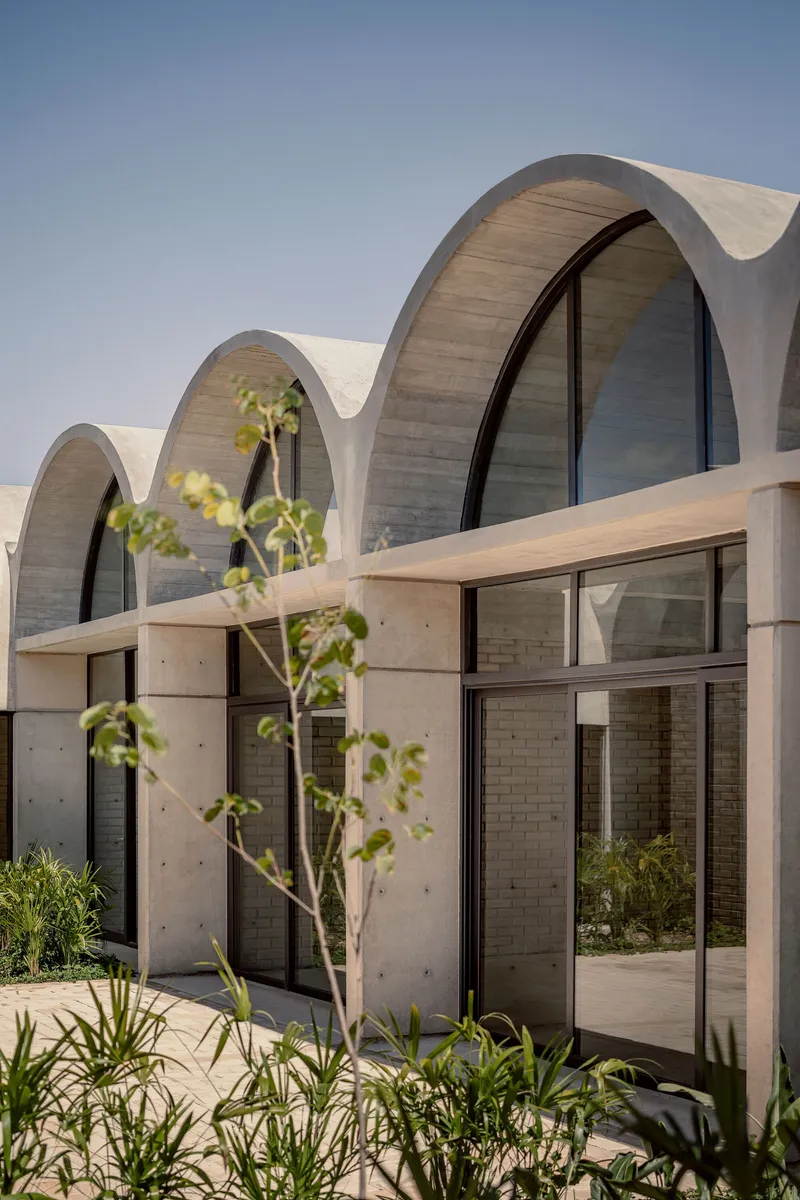
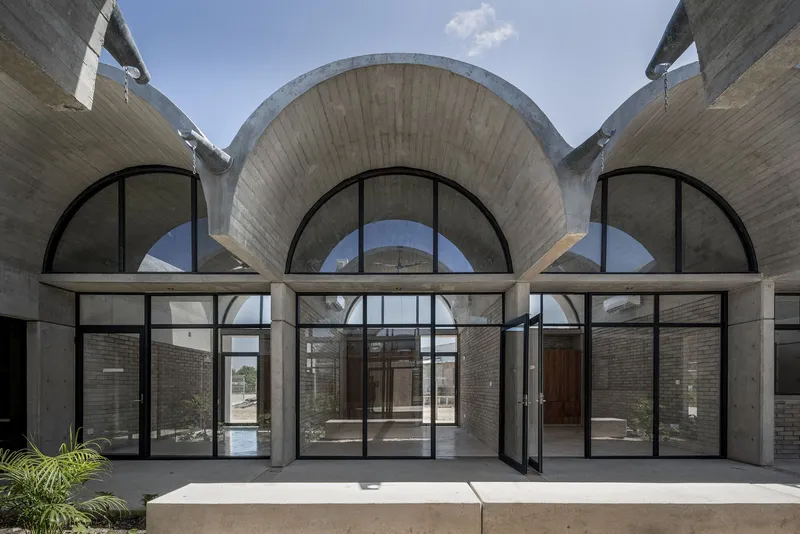
From the street, the building reads as a procession of concrete shells sitting above a brick perimeter wall. The barrel vaults are not decorative; they are the primary structural system, each one defining a single bay of the clinic. The repetition is deliberate and economic. Barrel vaults remain a relatively uncommon choice in Mexican architecture, and their deployment here is closer to the industrial logic of a warehouse or market hall than to the ecclesiastical overtones vaults often carry. The arched glazing beneath each shell lets you read the interior volume from outside, which gives the facade a transparency that raw concrete alone would deny.
The horizontal beam that ties the arches together at their base is a structural necessity that doubles as a visual datum line. It flattens what could become a scalloped roofline into something disciplined and legible. Young saplings planted along the frontage will eventually soften the mass, but the building does not depend on landscaping to justify itself.
Courtyards as Climate Machines


The courtyards between the vault bays are the real engine of the design. They pull hot air upward and out, funnel daylight into rooms on both sides, and collect rainwater through an integrated harvesting system. In a town where the climate is hot and humid for most of the year, these are not amenities: they are functional necessities dressed up as landscape. Planted beds and paved paths give staff and patients a sequence of outdoor rooms to pass through, breaking up what could otherwise be a long, oppressive corridor.
The paired sculptural skylights visible in the courtyard views are among the more refined details, channeling light deep into the plan without exposing interiors to direct solar gain. Between the glazed corridors and the open sky overhead, the experience of moving through the clinic is one of constant calibration between enclosure and exposure.
Concrete and Brick in Dialogue
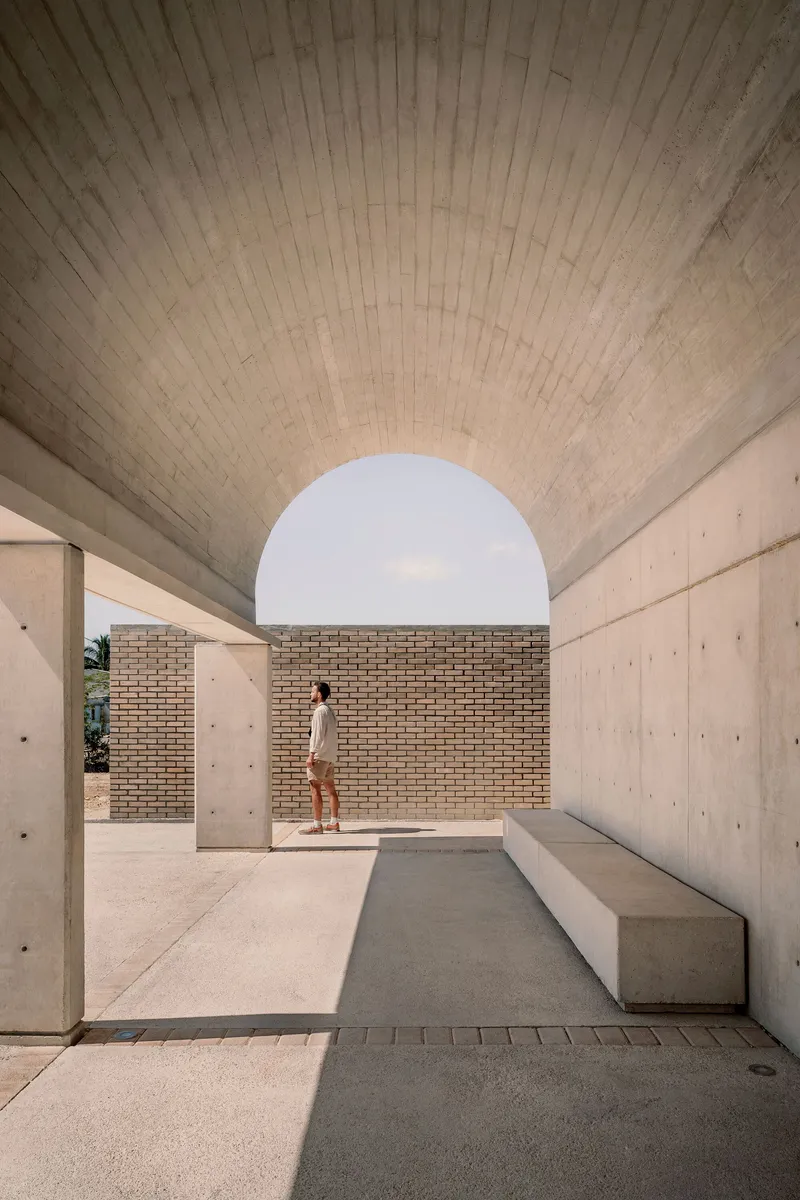


The material palette is limited to board-formed concrete, tan brick, polished concrete floors, and glass. That restraint is productive. The board-forming leaves a pronounced wood grain on the vault soffits, which catches raking light and gives the concrete a textile quality it would not otherwise possess. Brick walls appear at the perimeter and in the narrower service corridors, where their warmth offsets the coolness of the concrete overhead. The circular opening in one passageway frames a brick wall like a viewfinder, introducing a moment of almost monastic stillness into a building that is, at the end of the day, a basic treatment clinic.
The restroom interiors, with their concrete vanity and dual sinks beneath a vaulted ceiling, demonstrate that the design discipline extends into the most utilitarian spaces. There is no point where the material logic relaxes, and that consistency is what elevates the project above the standard Mexican public health facility.
Living Under the Vaults

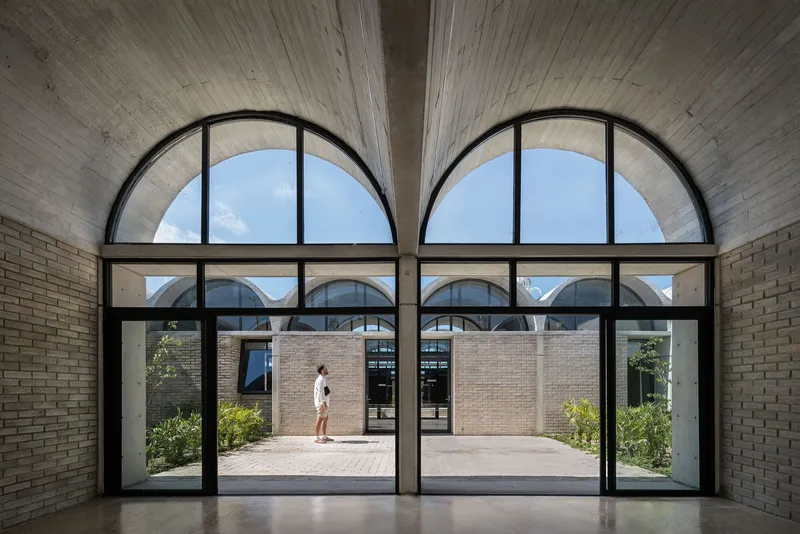

Inside the clinical rooms, the barrel vault overhead gives each space a generous verticality that belies the modest footprint. Floor-to-ceiling glazed doors on both sides of the rooms open onto adjacent courtyards, turning every treatment space into a through-ventilated volume. The polished concrete floor reflects light upward, amplifying the daylight that enters from both directions. It is a simple section, but executed with enough precision that the rooms feel calm rather than austere.
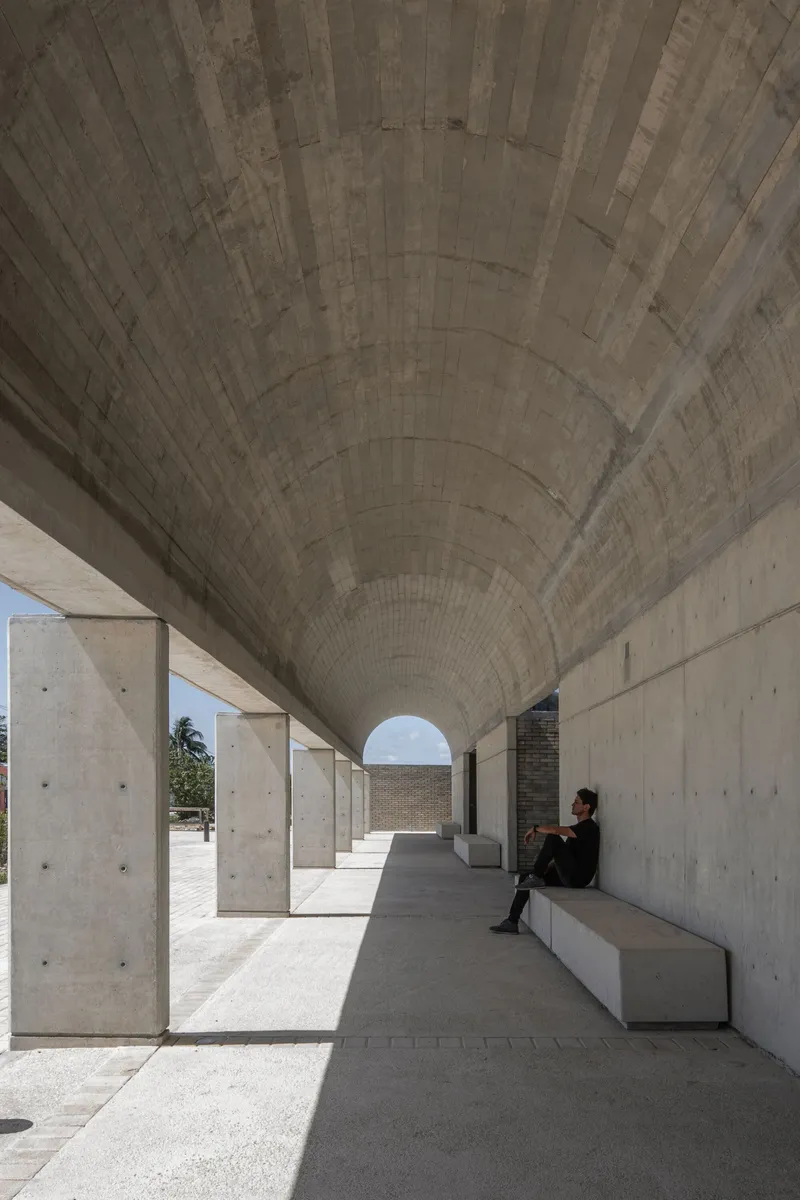
The covered colonnades with their square concrete columns provide shaded circulation for patients moving between consultation rooms. A seated figure in afternoon light, a person walking across sunlit paving: the photographs consistently show a building that is populated without being crowded, which speaks to the generosity of the plan.
Thresholds at Dusk

The covered porch with its timber-lined soffit represents the only moment where the material palette departs from concrete and brick. Lit at dusk under dramatic clouds, it reads as the building's threshold, the point where the public street meets the interior sequence of vaults and courtyards. The timber lining introduces a domestic warmth that signals arrival and welcome, a smart move for a healthcare building where anxiety is a given.
The barrel-vaulted colonnade photographed in bright daylight, by contrast, is all concrete and shadow. The difference between these two threshold conditions, one warm and sheltered, the other open and monumental, gives the building a tonal range that a single material strategy could not achieve.
Plans and Drawings
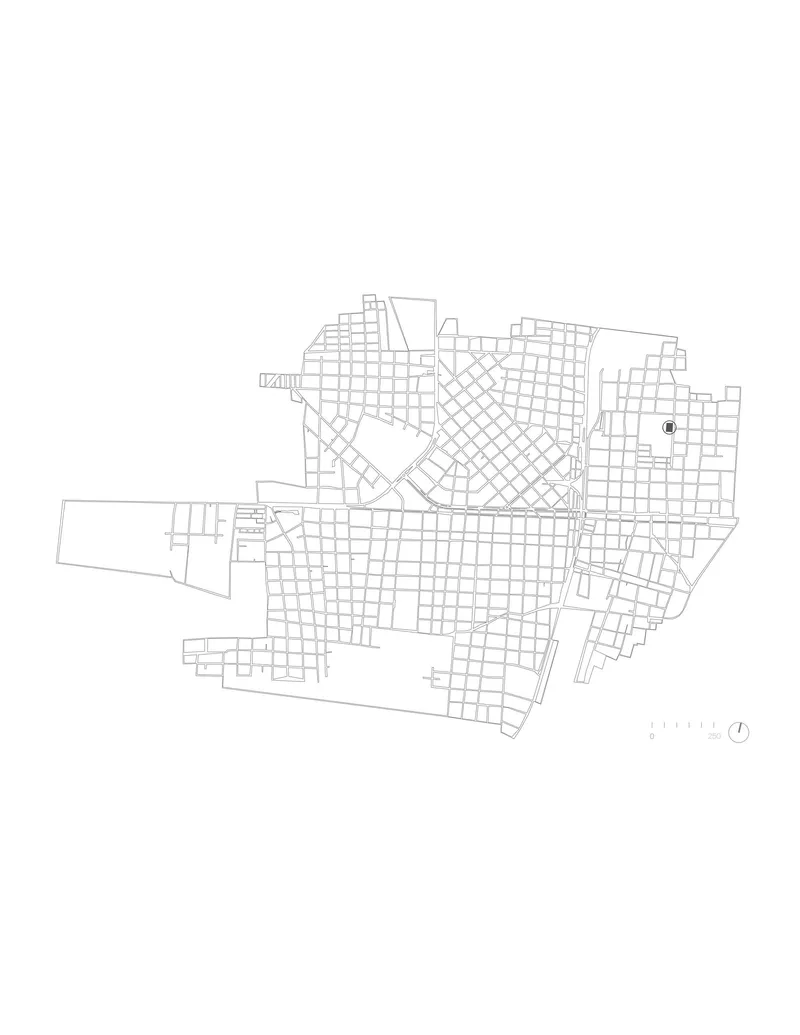
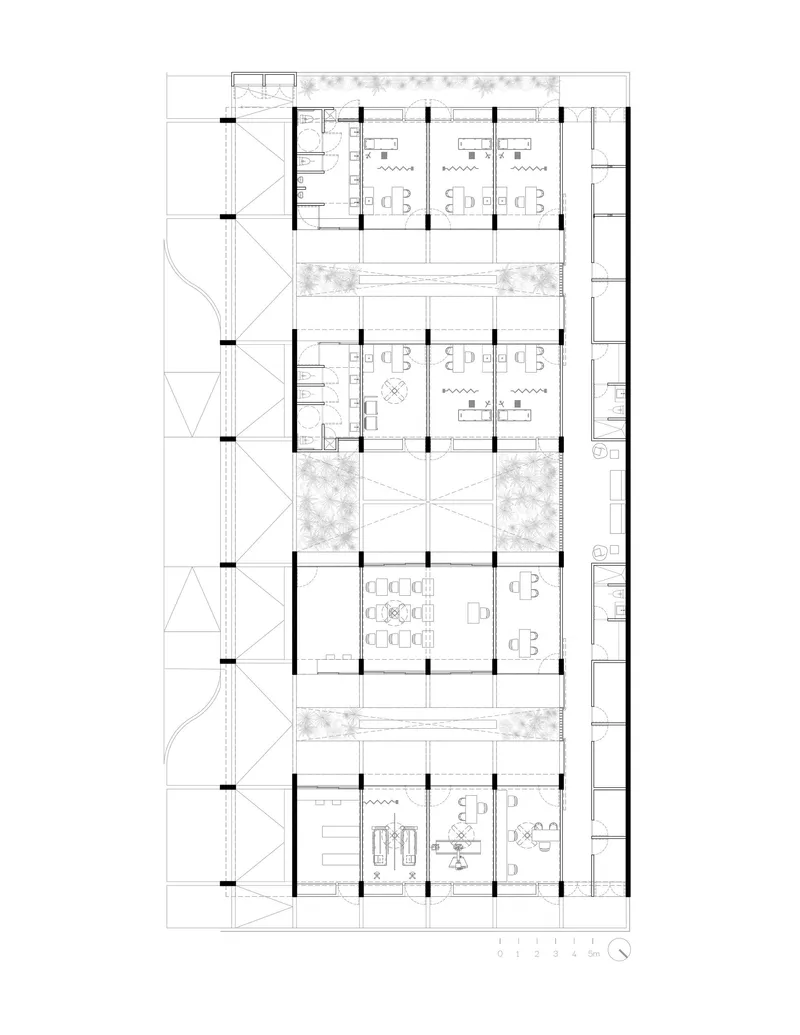


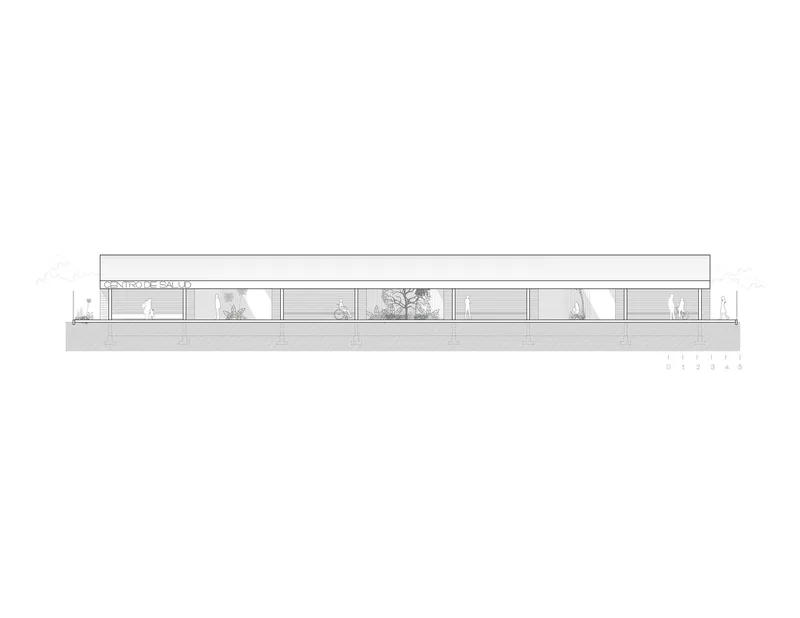

The site plan reveals how the building sits within Escárcega's loose urban grid, occupying a plot that stretches between two streets. The floor plan makes the courtyard-centered strategy legible at a glance: perimeter offices and treatment rooms wrap around planted terraces that punctuate the linear sequence. The axonometric sketch is the most economical representation of the concept, showing the vaulted modules as discrete, repeatable units with vegetation growing up between them.
The sections are where the design argument becomes most persuasive. The repeating arched vaults span cleanly over interior spaces, with courtyard palms reaching up between bays to indicate the scale of the voids. The elevation drawings reveal a long horizontal structure with a measured cadence of glazed openings and silhouetted figures, confirming that the building prioritizes proportion and rhythm over formal invention.
Why This Project Matters
Public health infrastructure in small Mexican cities is often treated as expendable, built to minimum standards with the expectation that it will be replaced within a generation. The N1 Health Center pushes back against that assumption. Its raw concrete vaults are designed to outlast political cycles, and its courtyard strategy ensures that the building will perform climatically without reliance on mechanical systems that may or may not be maintained. The architects conceived it explicitly as a versatile structure adaptable to the changing needs of a growing city, which means the barrel vault module could, in theory, serve purposes well beyond the clinic program.
The broader lesson is about ambition calibrated to context. Kiltro Polaris and JC Arquitectura did not import a metropolitan aesthetic onto a rural site. They took a structural type with industrial precedents, executed it in locally available materials, and organized the plan around the oldest passive cooling strategy in the book: the courtyard. The result is a building that borrows from brutalism's material honesty without inheriting its disregard for comfort. Nearly a century after Escárcega's first settlements, the town finally has a piece of public architecture built to last as long as the railroad that made it.
N1 Health Center by Kiltro Polaris Arquitectura and JC Arquitectura, Escárcega, Campeche, Mexico. 797 m², completed 2022. Photography by Cesar Béjar and Oscar Hernández.
About the Studio
Share Your Own Work on uni.xyz
If projects like this are the kind of work you want to make, uni.xyz is a place to publish your own, find collaborators, and enter design competitions.




Popular Articles
Popular articles from the community


Riyadh For All: Intergenerational Urban Design for Active Aging in Rabat
Riyadh For All reimagines urban design in Rabat with intergenerational co-living, adaptive courtyards, and Moroccan cultural exchange today.

Hill & Cross Opera: Sculptural Opera House Architecture Shaped by Tallinn’s Landscape and Identity
Hill & Cross Opera reimagines opera house architecture in Tallinn through its sculptural hill, civic plaza, glass wave and a luminous cross.

Co-life: Sustainable Architecture for Age-Friendly Community Living
Co-life reimagines sustainable architecture for seniors through courtyards, rammed earth, shared gardens, and spaces designed for belonging.

AL-JANNAH: Sustainable Architecture and Permaculture for Afghan Widows
AL-JANNAH uses sustainable architecture and permaculture to create resilient oasis of housing, learning, work and renewal for Afghan widows.


Similar Reads
You might also enjoy these articles

Bao Huynh Watercolor Atelier: A Serene Art Retreat in Hội An
Bao Huynh Watercolor Atelier in Hội An blends multifunctional art spaces, sustainable design, local materials, and family-friendly living in a serene environment.

Atelier Macri Concept Store Interior Design by CASE-REAL
Atelier Macri store features a "ko" counter, walnut wood details, cork displays, blending retail, gallery, and seamless customer experiences.

Manuel Vargas Izquierdo Stadium and High-Performance Sports Center: Architectural Excellence in Jalpa de Méndez
The Manuel Vargas Izquierdo Stadium blends sustainable design, inclusive sports facilities, and cultural-inspired architecture, revitalizing Jalpa de Méndez’s public spaces.
KAKR Buluh Awar Hall: Revitalizing Community and Ecology Through Bamboo Architecture
Community built bamboo hall revitalizes Buluh Awar village, empowering youth, restoring ecology, celebrating vernacular craftsmanship through sustainable architecture and culture.


Explore Opportunity Center Competitions
Discover active competitions in this discipline



Challenge to reimagine the Iron Throne


Photograph architecture without architects


Illustrate the lost glory of Angkor Wat - Render Challenge


Design challenge to reuse E-waste
Comments (0)
Please login or sign up to add comments
No comments yet. Be the first to comment!