

Kim Lenschow and Pihlmann Architects Mirror a Renaissance Villa with Its Concrete Twin in Aarhus
Two villas, one from 1897 and one from 2021, frame an Italian-inspired garden on a contested threshold between suburb and city.


A stately mansion built in 1897 with white rendered walls, sharp cornices, and elegant friezes inspired by the Italian Renaissance sat for decades on the outskirts of Aarhus. The city expanded around it. A gas station appeared. A ring road arrived. A hundred years of careless additions stripped the building of its original character, turning what was once a country estate into a dilapidated anomaly wedged between suburban housing and urban blocks. Kim Lenschow and pihlmann architects were handed the task of bringing it back to life, not as a museum piece but as 11 apartments split between the restored original and a new building they call Villa Landluft II.
What makes the project genuinely interesting is the relationship between old and new. Villa Landluft II is not a glass-and-steel contrast box. It is a deliberate mirror: matching the original in proportions, window rhythm, dormer symmetry, and cornice line, but executing all of it in cast-in-place concrete. The result is an unsentimental collage of times and typologies, where the two buildings read as siblings rather than strangers. Between them lies a private garden modeled on the Italian Renaissance tradition, completing a composition that treats the contested site as an opportunity rather than a compromise.
The Twin on the Street
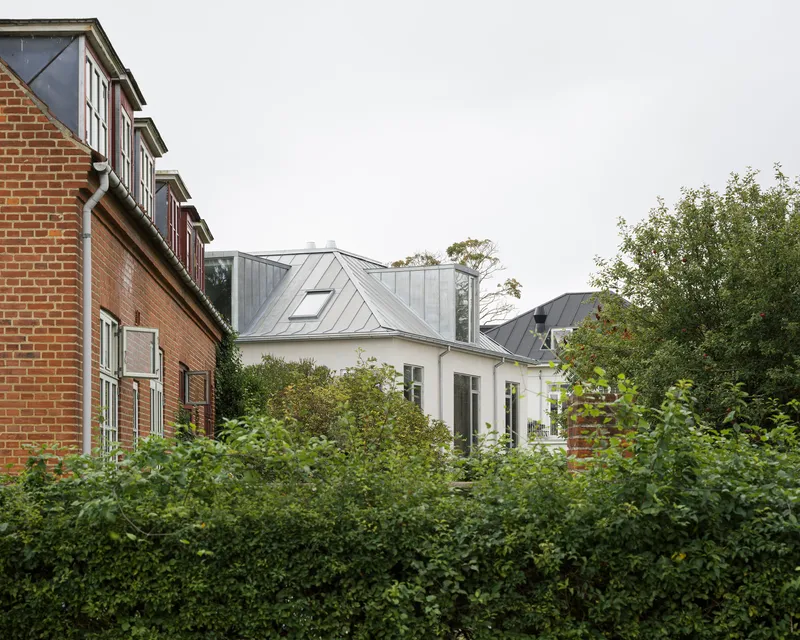
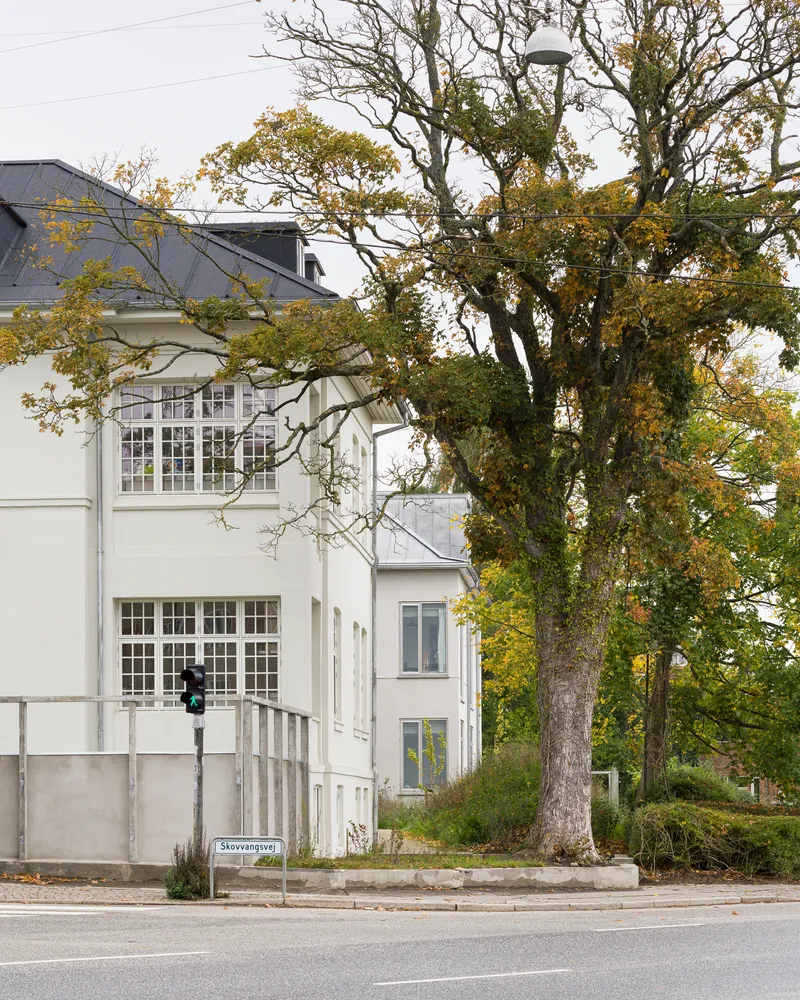
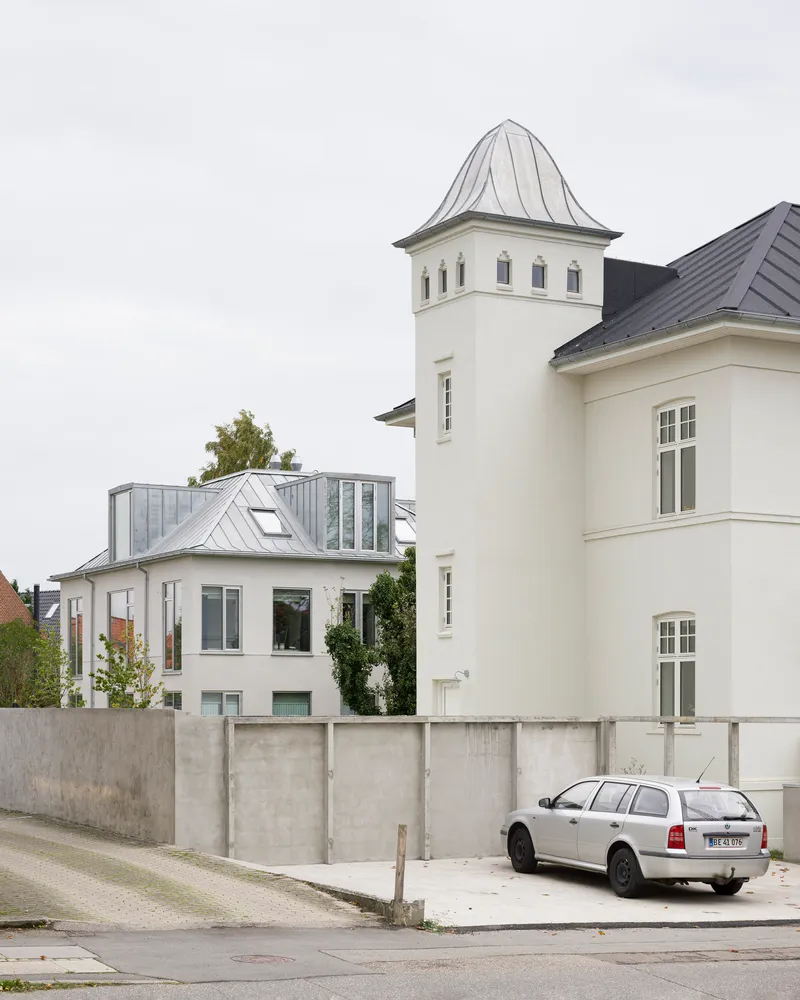
From the street, the two villas present a unified front. The original Villa Landluft, with its white rendered facade and standing seam metal roof, sits alongside its new concrete companion. Villa Landluft II takes the proportions, the grid of windows, and the distinctive cornice of the 1897 building and reinterprets them in a monochrome palette of grey and white. The effect is not mimicry. It is a conversation held across 124 years, where each building speaks the same architectural language with a different accent.
The site strategy extends beyond the buildings themselves. The plot's southeast corner has been left open and turned into a small-scale public space, deliberately blurring the boundary between private property and city life. A trellis borders the rest of the plot, blending rather than dividing. The architects have treated the cadaster not as a fortress wall but as a membrane.
The Garden Between
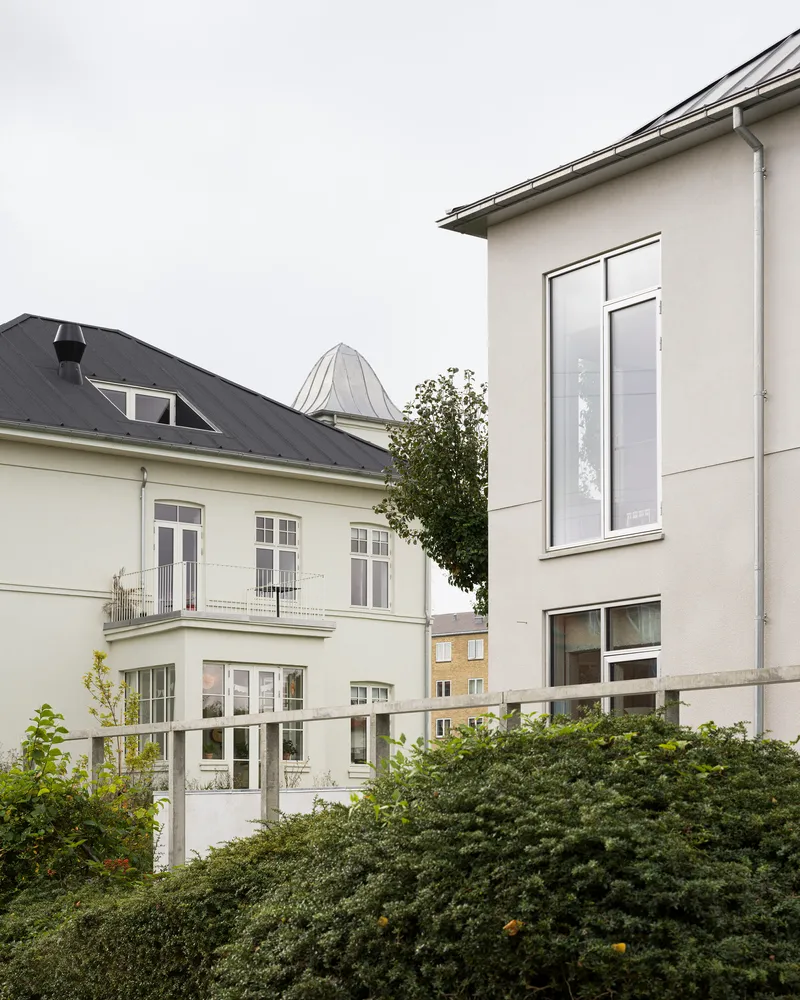
The private garden drawn from the Italian Renaissance tradition occupies the space between old and new. Viewed from the rear, the white rendered additions of the original villa rise above a hedge while the new building frames the opposite edge. The garden is not decoration. It is the spatial hinge that justifies placing a second villa on the plot rather than extending the first. The two buildings face each other across this shared ground, creating an intimate courtyard condition on a site that, by all rights, should feel exposed and fragmented.
Stucco Meets Ductwork
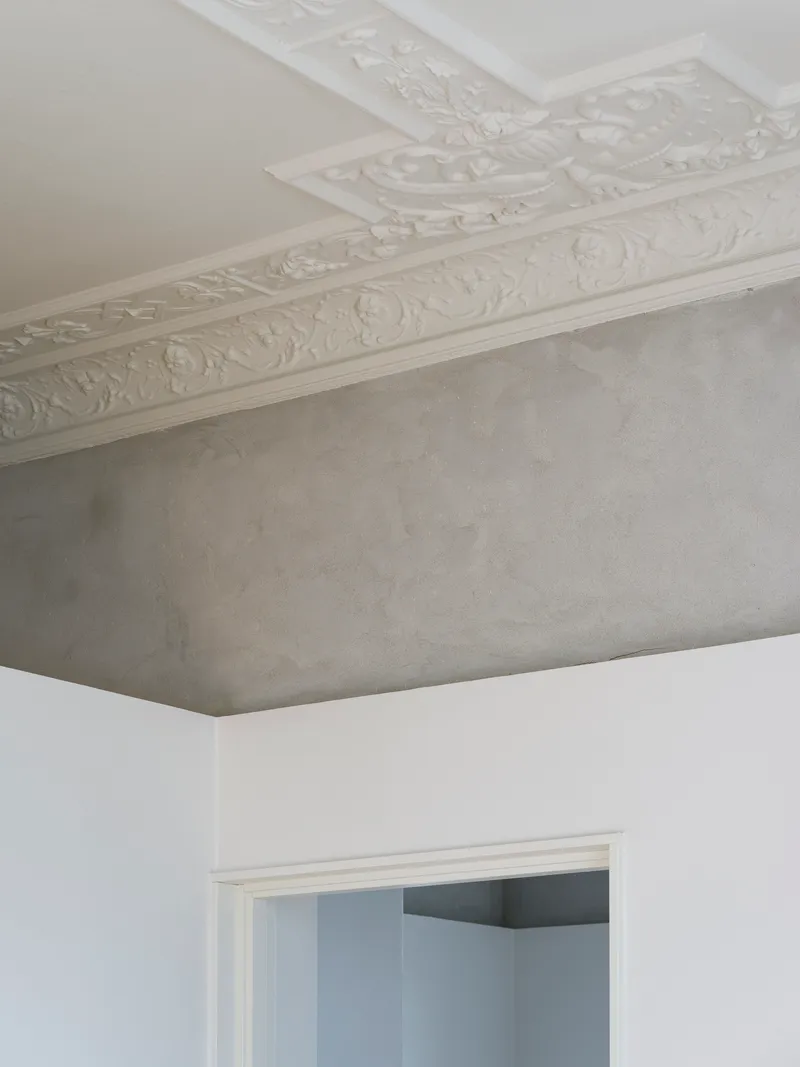

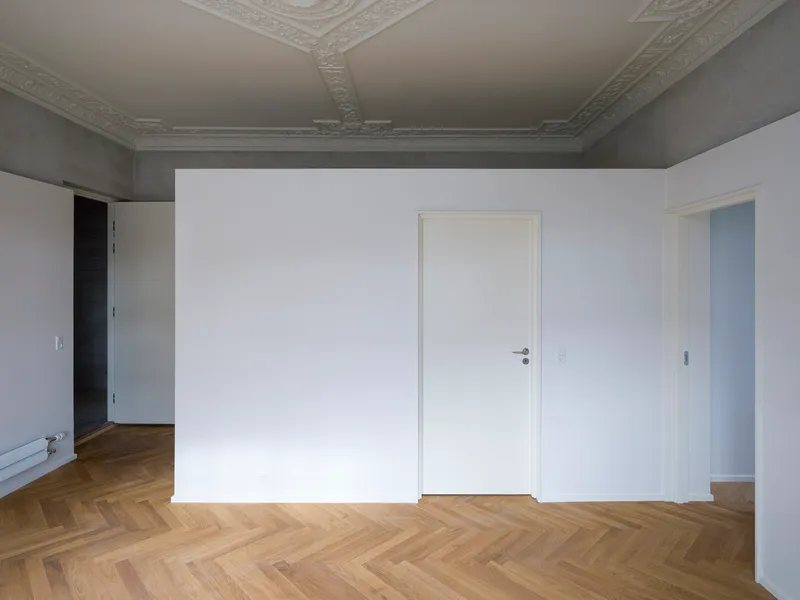
The renovation of the original mansion takes a pragmatic approach to preservation. Ornate plaster ceiling moldings with floral motifs survive intact, but galvanized ventilation pipes now run directly alongside them. The stucco has been reinterpreted as a functional cassette system, with thin sliding rails for curtains and wall decoration integrated into the historic plasterwork. Installations and insulating layers are left exposed rather than hidden behind new finishes.
The herringbone oak flooring has been maintained, and rooms read as enfilades of white-trimmed doorways. Wet rooms are inserted as discrete boxes within the stucco-decorated rooms, deliberately not taking advantage of the full ceiling height. The old plan remains legible. You can stand in a bathroom and still read the dimensions of the original room above you. It is a renovation that refuses to erase its host.
Concrete as Character
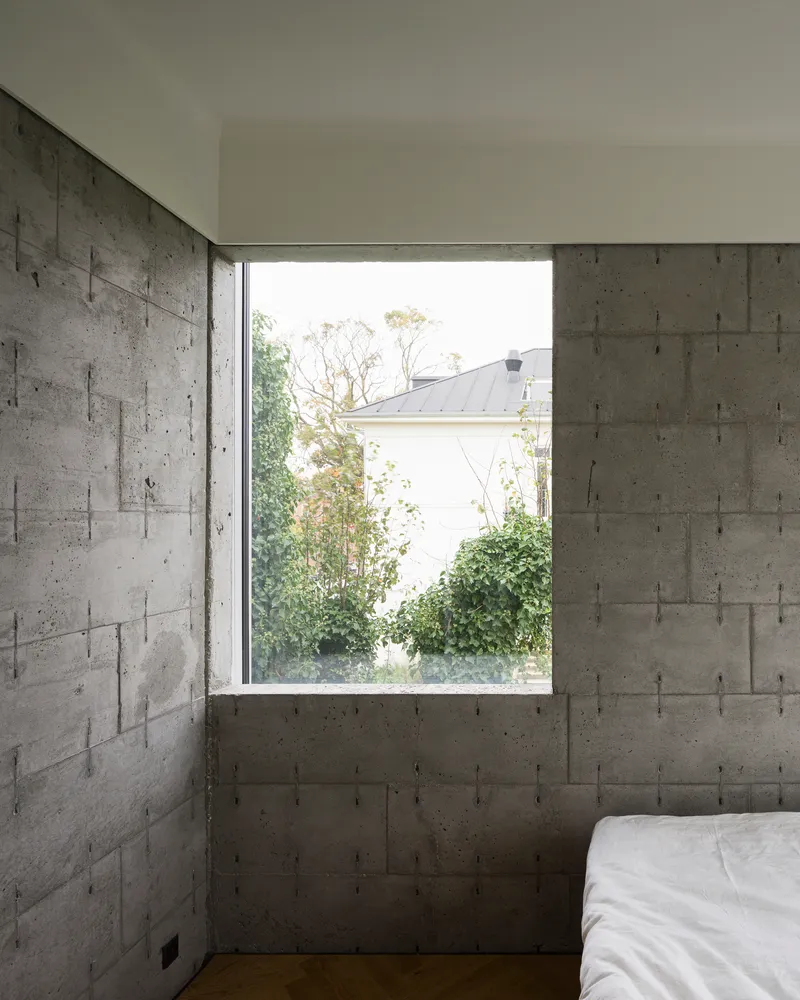
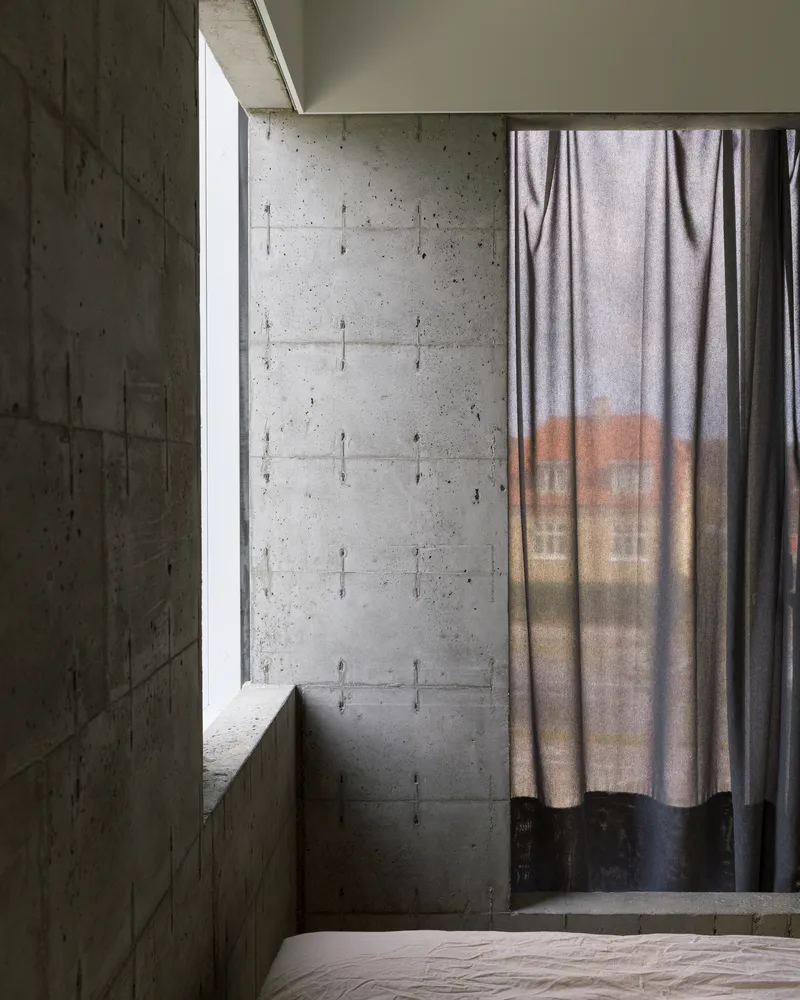
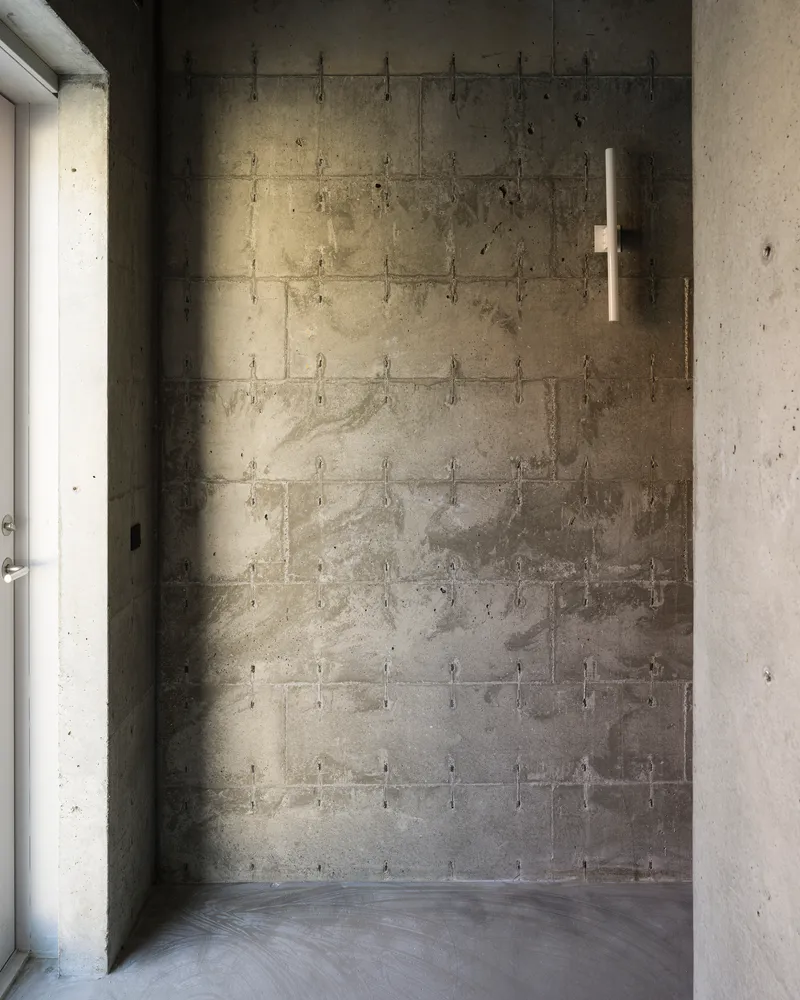
Villa Landluft II makes its structural framework the primary architectural experience. The cast-in-place concrete is left exposed throughout, and the formwork's imprint becomes a sensuous surface element rather than an imperfection to be concealed. Board-formed walls with visible tie holes create a texture that is simultaneously rough and precise, industrial and domestic.
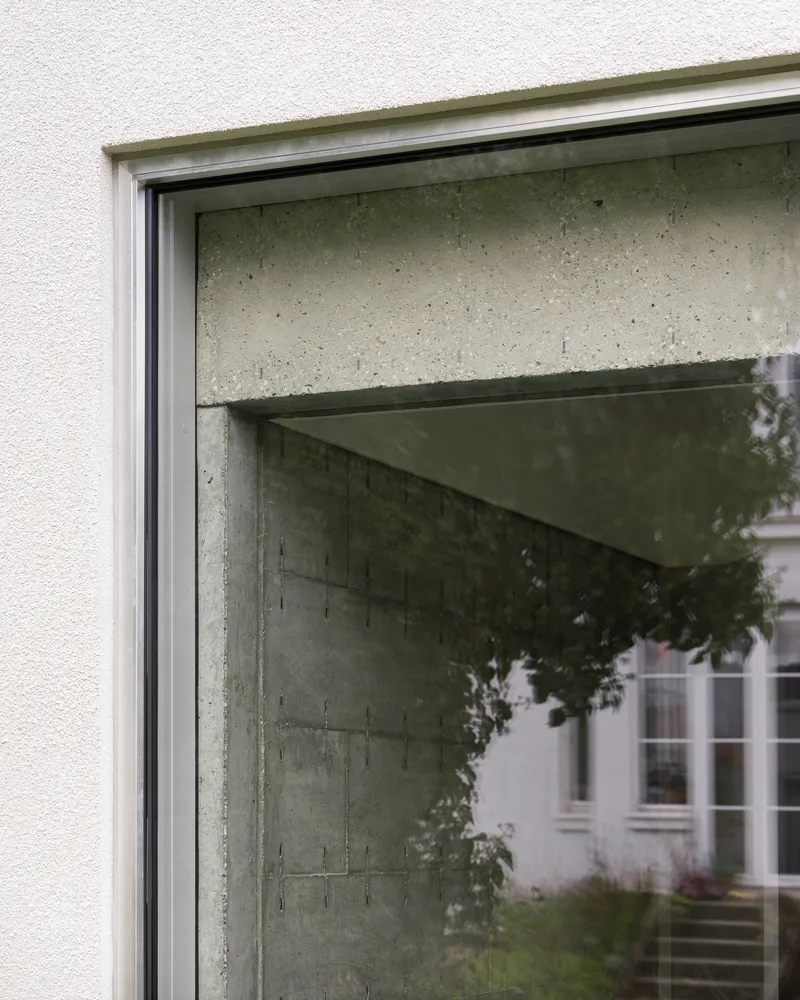
Windows are mounted on the outside of the concrete framework, a detail that makes the openings appear as sharp cuts in the concrete planes when viewed from inside. The interiors of the new building are monochrome in grey and white, with herringbone oak flooring providing the only warmth. Hung ceilings conceal ventilation and wiring, a contrast to the old building's exposed approach. Where the original villa wears its systems on its sleeve, the new one integrates them neatly. Two philosophies of craft in one project.
The Stairwell as Vertical Event
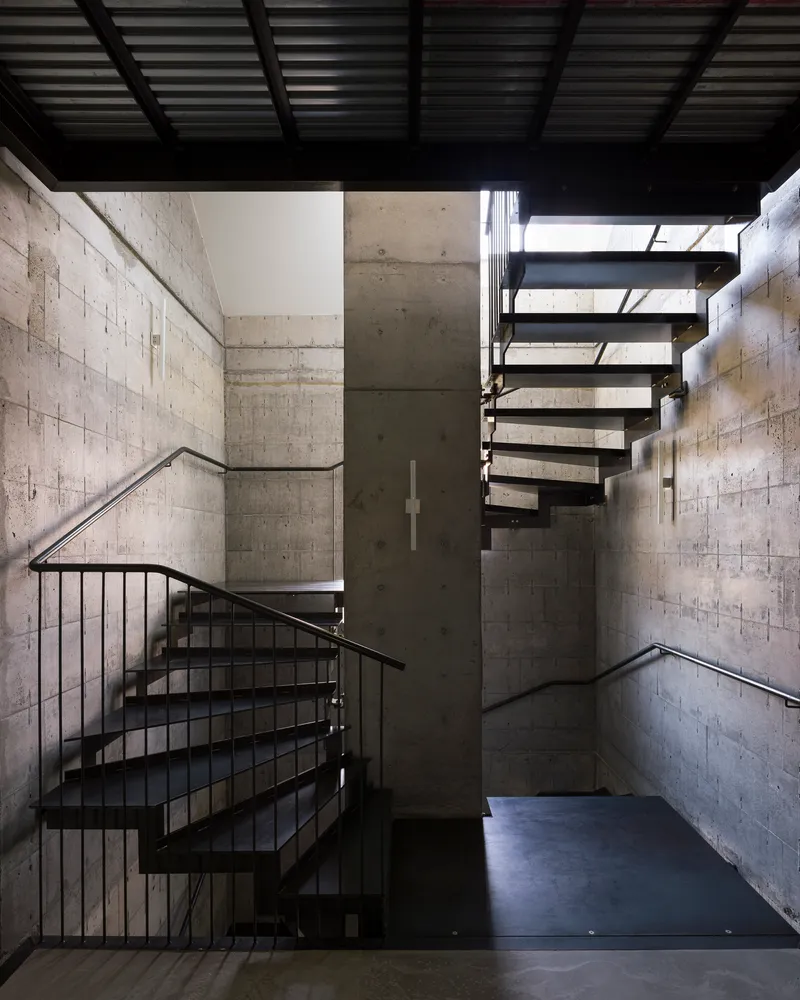


Both buildings share a material vocabulary in their stairwells: calcium silicate blocks and laser-cut steel plates. But the execution is distinct enough to register the difference between old and new. In Villa Landluft II, the double-height stairwell opens under skylights, with open-riser steel stairs winding between concrete block walls. The treads are cantilevered from the board-formed concrete, and the connections are left visible. The welded joints between tread and vertical railing are presented as objects of craft rather than hidden behind cladding.


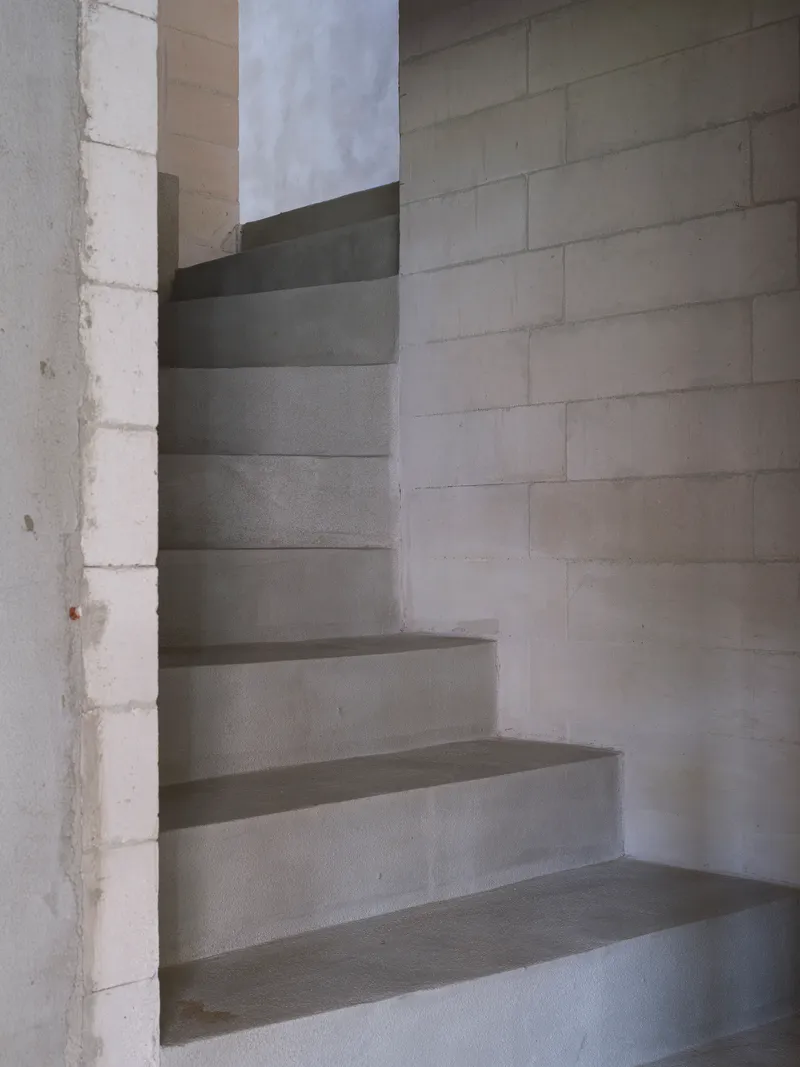
The stairwells serve as vertical spines for the apartments, which are arranged in mirrored pairs on each floor of the new building. Two three-room apartments share a central axis, a plan that is both spatially efficient and compositionally rigorous. The spiral staircase in the original villa, winding upward through a cylindrical shaft open to the sky, provides a moment of unexpected drama in what is otherwise a measured, disciplined project.
Living Inside the New Villa
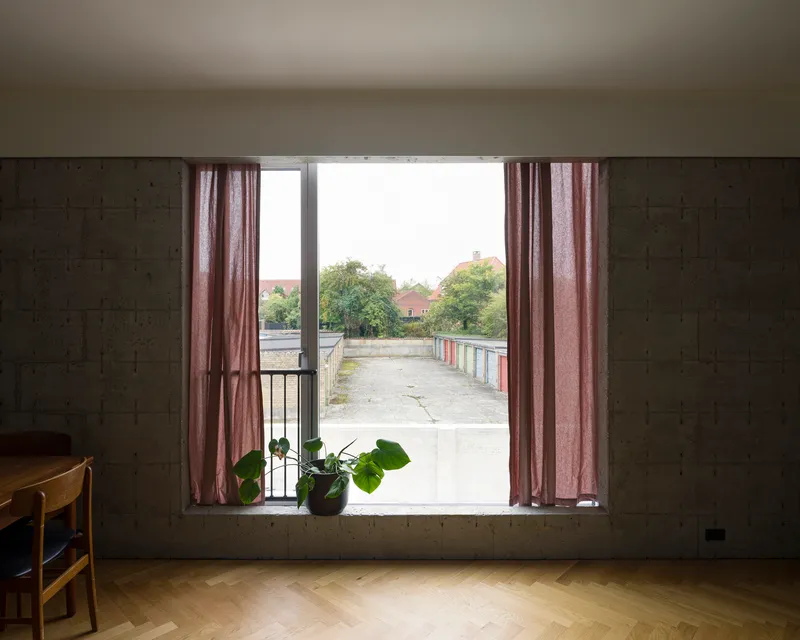


The apartments in both buildings share herringbone flooring and a restrained material palette, but the atmospheres diverge. In the old building, rooms open into one another through white-trimmed doorways beneath decorative ceilings, maintaining a sequence of thresholds that dates back to the 19th century. In the new building, pink curtains filter light through tall windows, and the kitchen opens from stainless steel counters and yellow tile floors into living spaces with oak herringbone underfoot.
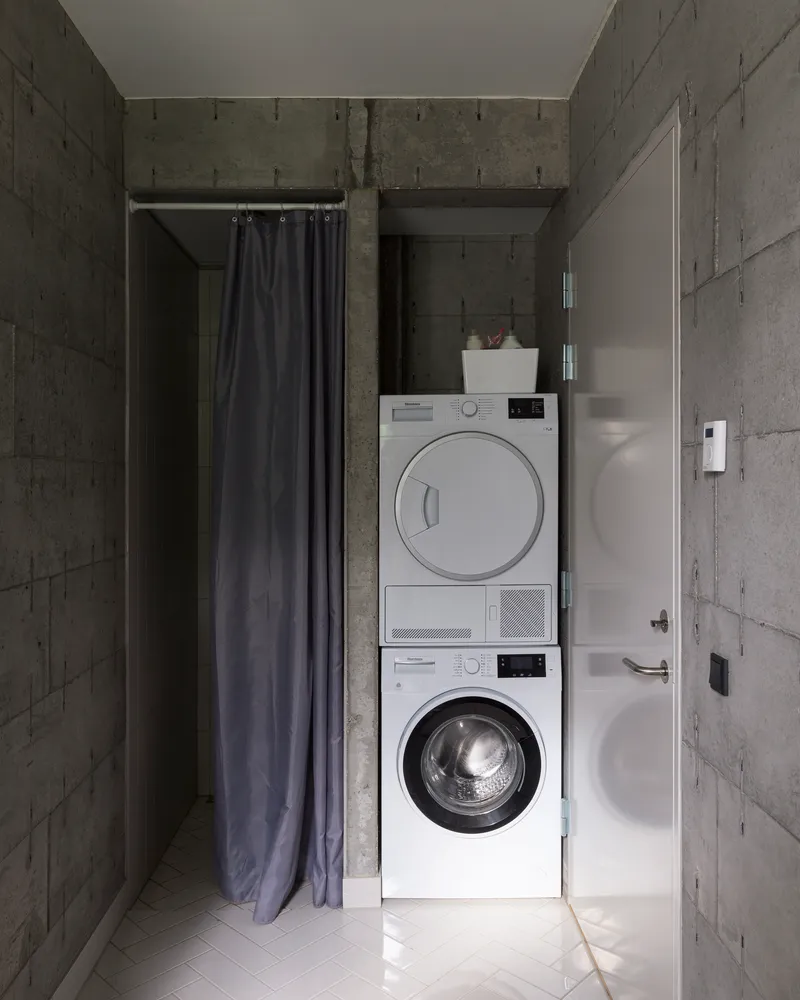


Even the utilitarian spaces receive attention. A compact laundry alcove is flanked by dark curtains and concrete walls, treating a functional necessity with the same spatial care as a bedroom. Bathrooms are compact but precisely detailed, with wall-hung basins, tall storage cabinets, and windows that open onto green foliage. Throughout both buildings, every room offers a view. The project insists that density does not have to mean deprivation.
Plans and Drawings
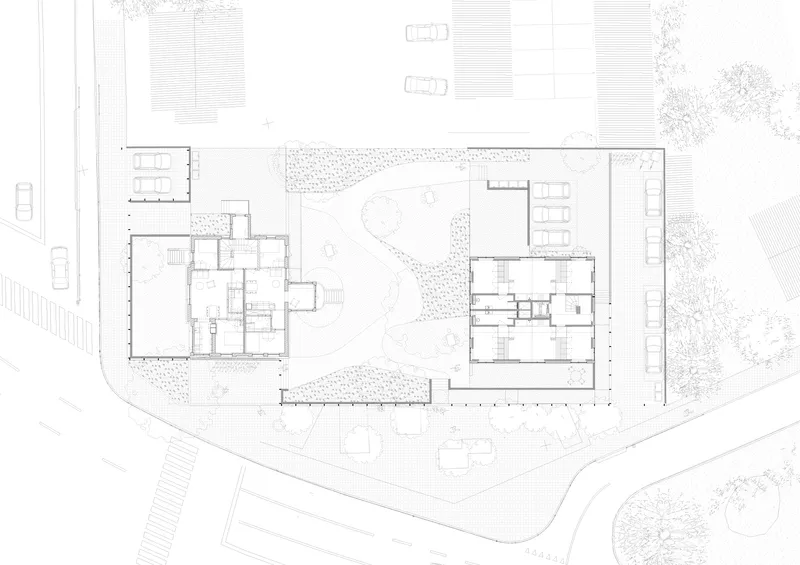

The site plan reveals the clarity of the architects' strategy: two rectangular footprints flanking a central courtyard, with parking and landscaping arranged to create a buffer from the ring road. The symmetry between old and new is not approximate. It is deliberate, geometrical, and legible from above. The exposed concrete beam visible in one of the interior thresholds shows how the new building's structure is organized to allow open floor plans while maintaining the rhythm of rooms that echoes the original mansion.
Why This Project Matters
Villa Landluft challenges the reflexive instinct to either preserve old buildings in amber or demolish them in favor of something entirely new. The project does both simultaneously, renovating the 1897 mansion with unsentimental pragmatism while constructing a new building that treats the original as a template rather than a relic. The mirroring strategy is not a gimmick. It is a coherent position on how architecture can acknowledge history without being paralyzed by it.
More broadly, the project demonstrates that contested, leftover urban sites can become places of genuine quality. A dilapidated villa next to a gas station on a ring road is nobody's idea of a prime location. But Kim Lenschow and pihlmann architects have turned the site's liabilities into a spatial proposition: two buildings framing a garden, a public corner opening to the city, and 11 apartments that prove density and dignity are not mutually exclusive. The lesson is simple and worth repeating: good architecture does not need a good site. It can make one.
Villa Landluft, by Kim Lenschow and pihlmann architects. Aarhus, Denmark. 386 m² (new building) + 366 m² (renovation). Completed 2021. Photography by Hampus Berndtson.
About the Studio
Kim Lenschow
Official website of Kim Lenschow, one of the studios behind this project.
kimlenschow.comShare Your Own Work on uni.xyz
If projects like this are the kind of work you want to make, uni.xyz is a place to publish your own, find collaborators, and enter design competitions.


Popular Articles
Popular articles from the community


Opera by the Sea Estonia: Three Shells Dissolving Architecture into Tallinn's Coastline
A winning opera house proposal replaces monumental form with interconnected shells that blur the boundary between building, park and Baltic Sea.

Opera on the Sea: Driftwood Logic Shapes a Timber Opera House on Estonia's Coast
Trevor Orgill's opera house translates the entangled drift of floating timber into a civic building where wood, water, and music converge.

Extended Shell: Retrofitting Kolkata's Balconies as Living Urban Thresholds
A modular retrofit system recovers the social and environmental intelligence of Kolkata's historic verandas for contemporary Park Street residents.

Manzana Morphosis: Stretching Barcelona's Grid into a Living Landscape for 2050
A radical reworking of the Eixample manzana turns density into a tool for generous public space, vertical ecology, and environmental performance.

Similar Reads
You might also enjoy these articles

Bao Huynh Watercolor Atelier: A Serene Art Retreat in Hội An
Bao Huynh Watercolor Atelier in Hội An blends multifunctional art spaces, sustainable design, local materials, and family-friendly living in a serene environment.

Atelier Macri Concept Store Interior Design by CASE-REAL
Atelier Macri store features a "ko" counter, walnut wood details, cork displays, blending retail, gallery, and seamless customer experiences.

Manuel Vargas Izquierdo Stadium and High-Performance Sports Center: Architectural Excellence in Jalpa de Méndez
The Manuel Vargas Izquierdo Stadium blends sustainable design, inclusive sports facilities, and cultural-inspired architecture, revitalizing Jalpa de Méndez’s public spaces.

KAKR Buluh Awar Hall: Revitalizing Community and Ecology Through Bamboo Architecture
Community built bamboo hall revitalizes Buluh Awar village, empowering youth, restoring ecology, celebrating vernacular craftsmanship through sustainable architecture and culture.

Explore Villa Competitions
Discover active competitions in this discipline

Challenge to design mud housing for contemporary communities

Challenge to reimagine the Iron Throne

Photograph architecture without architects

Illustrate the lost glory of Angkor Wat - Render Challenge
Comments (0)
Please login or sign up to add comments
No comments yet. Be the first to comment!