

Kokaistudios Breaks a Shanghai Mall into Five Buildings to Revive Xintiandi's Pedestrian Culture
An 88,600 square meter retail complex in Huangpu District channels Shikumen scale through timber canopies and open courtyards.


The conventional shopping mall is an introverted box. It seals off the city, controls the climate, and funnels foot traffic past as many storefronts as physics will allow. Kokaistudios, led by Filippo Gabbiani and Andrea Destefanis, took the opposite approach with Xintiandi Dongtaili. Instead of one monolithic volume, the 88,600 square meter program is split across five buildings, each held to four stories or less, separated by open pedestrian passages, courtyards, and planted terraces. The result is a retail precinct that behaves less like a mall and more like a neighborhood, which is exactly the point in a district whose identity was forged by Shanghai's fine-grained Shikumen lanes.
Situated south of Huaihai Road and east of Taiping Lake, the site faces the original Xintiandi Shikumen quarter across the water. It also absorbs two heritage structures: Lagnena Primary School and the former residence of Zhang Taiyan. The design challenge was therefore twofold. The architects had to deliver the floor area of a major commercial development while respecting the human scale and cultural memory embedded in the surrounding fabric. Their answer, a diagrid timber canopy that stitches the five volumes together and a setback strategy that opens generous terraces at every level, turns obligation into the project's strongest architectural move.
Five Buildings, One Neighborhood


Viewed from the street at dusk, the complex reads as a loose cluster of white podium volumes punctuated by glass office towers rising behind. This is deliberate. By distributing the commercial program across distinct buildings rather than fusing them into a single mass, Kokaistudios gives the development a rhythm that echoes the block-by-block grain of traditional Shanghai neighborhoods. The low-rise facades are finished in white precast concrete with punched openings, a restrained palette that recalls the solidity of Shikumen stone frames without resorting to pastiche.
The gaps between the buildings are not leftover space; they are the design. Pedestrian passages thread through the complex at ground level and are reinforced by a second-floor bridge system that links the volumes above. This dual-level circulation turns the development inside out: rather than corridors buried within a building, the primary routes are streets open to the sky, lined with shopfronts and planted beds.
The Timber Lattice Canopy
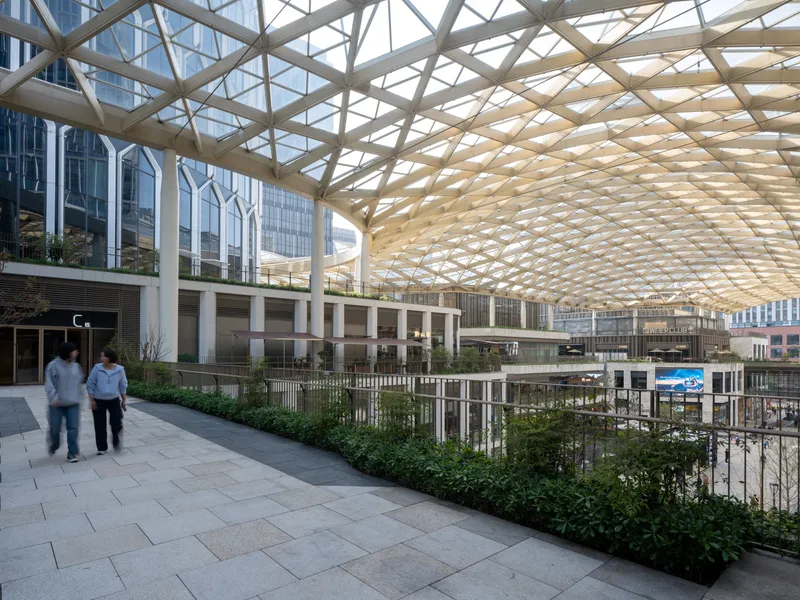


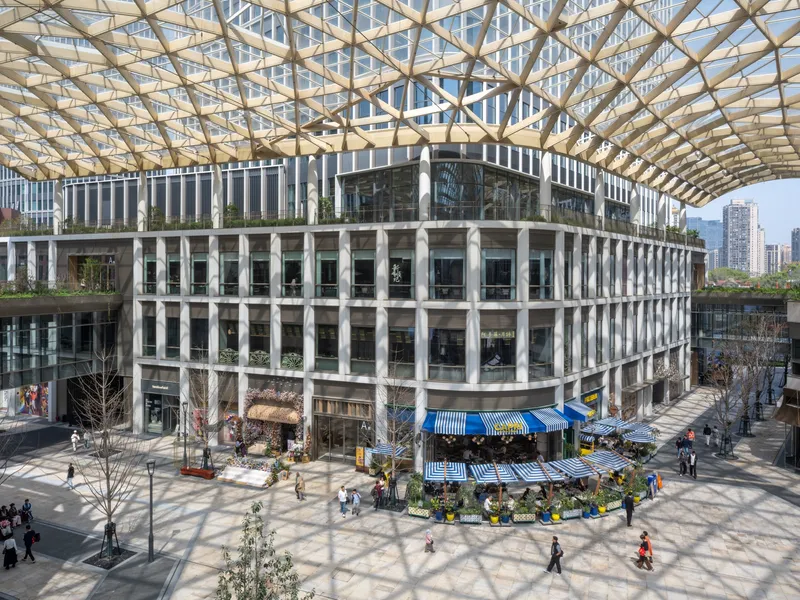
The most immediately striking element is the expansive timber diagrid canopy that spans the central courtyard and key pedestrian passages. Its triangulated geometry is both structural and atmospheric: the lattice filters daylight into a dappled pattern that shifts throughout the day, creating the feel of a covered market rather than an enclosed atrium. Below, wooden benches and planted beds populate the ground plane, giving visitors a reason to linger that has nothing to do with shopping.
The canopy also does important urban work. It visually unifies the separate buildings into a single composition and signals to passersby that the ground between the volumes is public, walkable territory. At dusk, when the shopfronts beneath the lattice glow against the darkening sky, the canopy transforms from a sunshade into a lantern, drawing people in from the surrounding streets.
Facades That Step Back
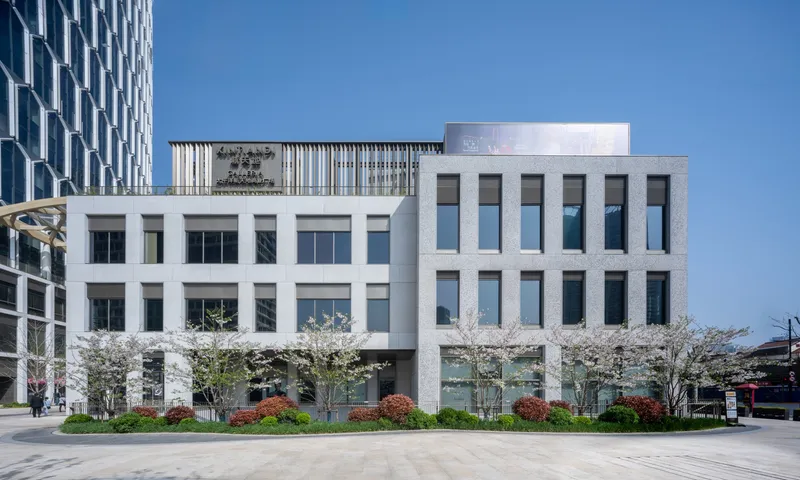
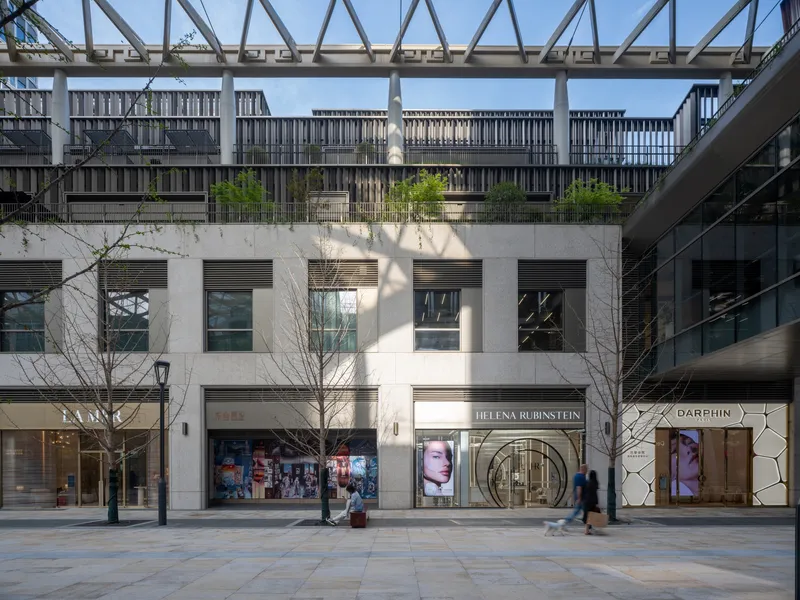

Each of the five buildings employs a setback strategy. Upper floors recede from the street edge, creating terraces planted with trees and furnished with railings that double as display. The effect is twofold. Vertically, the setbacks reduce the visual weight of what is, in aggregate, a very large development. Horizontally, they widen the pedestrian corridors at ground level, giving the streets between the buildings a generous proportion that feels civic rather than commercial.
Material articulation reinforces this layering. At street level, glass storefronts offer transparency and activity. The middle floors are clad in white precast panels with horizontal windows. Vertical metal fins wrap the upper volumes, adding texture and shadow while screening mechanical equipment and service areas. The composition is orderly without being repetitive, and each building carries enough individuality to support the fiction that this cluster grew over time.
Interior Atriums and Vertical Circulation
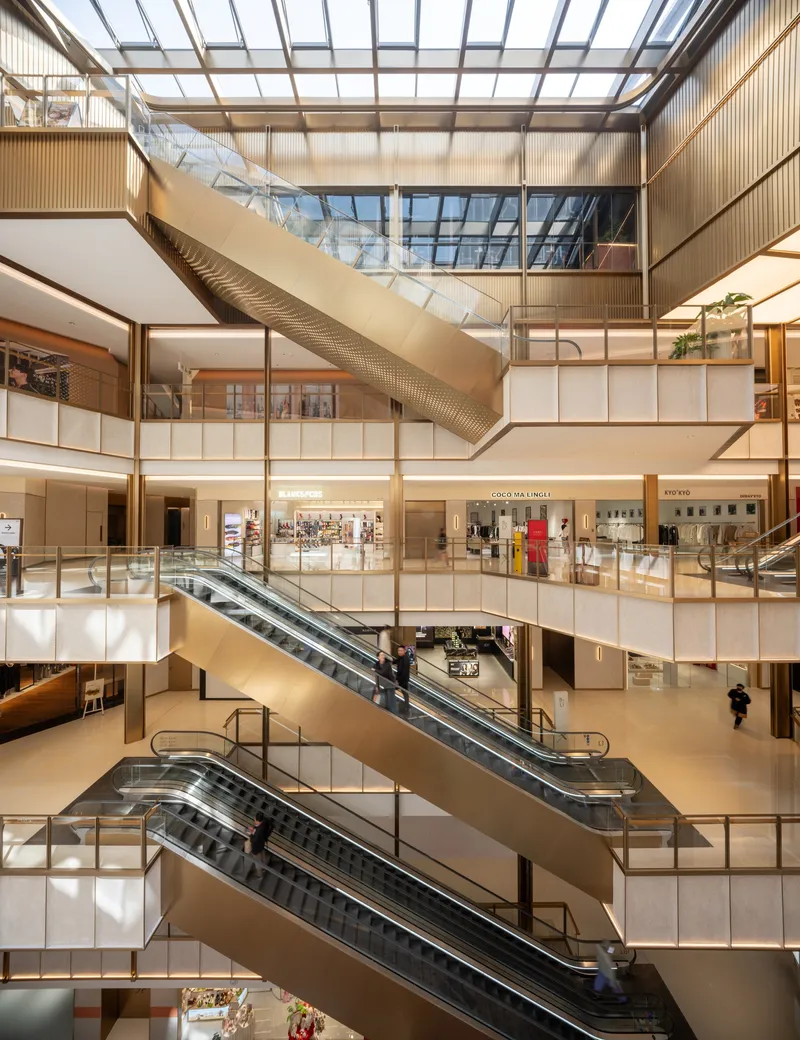

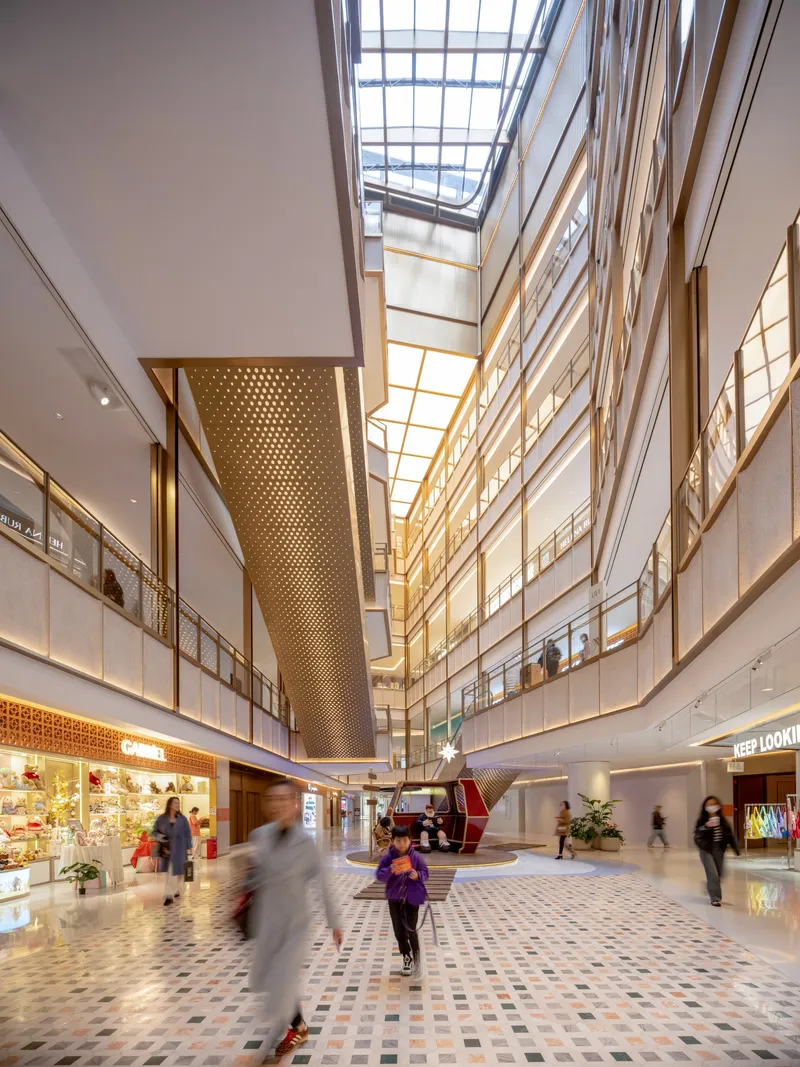
Step inside any of the five buildings and the scale shifts. Multi-story atriums carved through the floor plates flood the interiors with daylight via chevron-patterned skylights and glazed roofs. Escalators cut diagonally through these voids, and balconies trimmed in brass or perforated metal ring the openings, offering views down to mosaic floors and up to the sky. The materiality here is warmer and more detailed than the exterior: walnut cladding, geometric tile patterns, and orange accent panels give each building its own interior identity.
Kokaistudios clearly understands that an escalator is not just a transit device but a moment of spatial theater. The mirrored panels flanking some of the escalator runs amplify the sense of height and movement, turning the mundane act of changing floors into something worth noticing. It is a small gesture that pays dividends in a building type where vertical circulation can easily feel like an afterthought.
Food Halls and Social Spaces
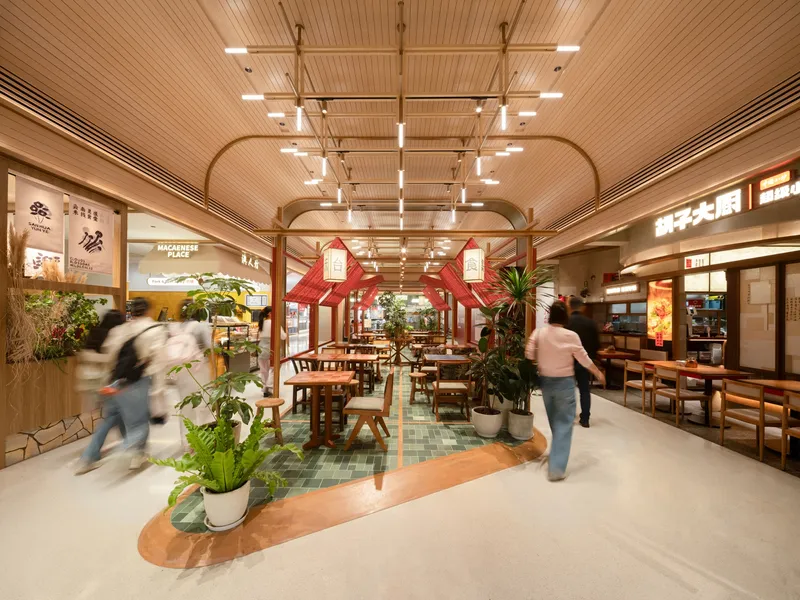


The food halls occupy a distinct tonal register. Timber slat ceilings drop the scale to something intimate. Red kiosk structures and fabric banners inject color into an otherwise neutral palette. Potted plants scattered between tables blur the boundary between dining and garden. These spaces are designed for lingering: the acoustic warmth of the wood, the low ceiling plane, and the generous aisle widths all signal that speed is not the priority.
This matters because the success of Dongtaili as a "total community" hinges on whether people come for more than transactions. A food market that encourages sitting, browsing, and conversation is the kind of social infrastructure that converts a commercial development into a genuine piece of city life.
Courtyards and the Ground Plane
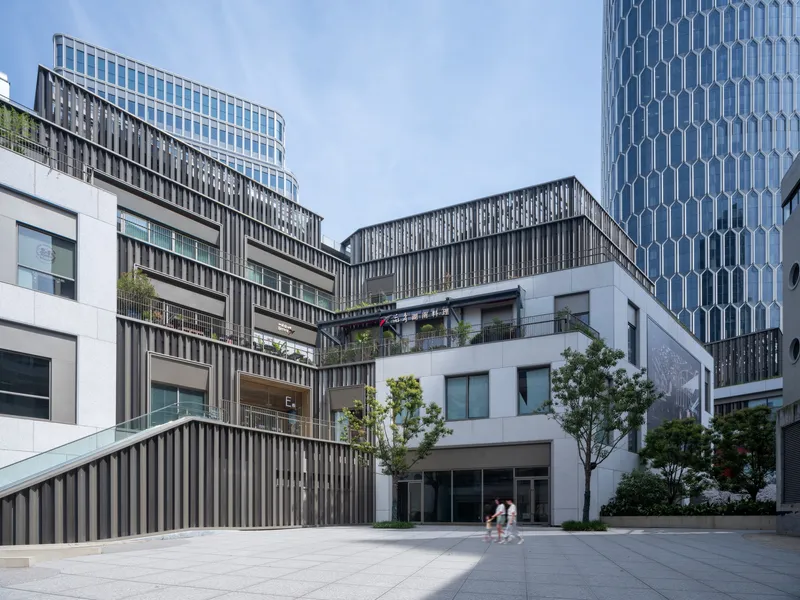


Between the buildings, the ground plane is treated with the care typically reserved for public parks. Paved walkways are flanked by planted beds and vertical metal fin screens that modulate views between courtyards and streets. The screens serve as a contemporary interpretation of the solid-void rhythm of Shikumen doorframes: they define thresholds without creating barriers. You know you are moving from one zone to another, but you are never stopped.
At twilight, the courtyards come alive. Curved glass volumes glow beneath the diagrid canopy, bare trees cast silhouettes against illuminated facades, and the scale of the complex shrinks to something almost domestic. The 43,000 square meters of underground commercial space remain invisible, accessed through subtle entries that do not disrupt the pedestrian choreography above. Keeping the underground program hidden is a smart move: it allows the surface to remain porous and walkable.
Material Detail


Kokaistudios deploys a restricted material palette of wood, glass, steel, and precast concrete, but extracts variety through finish and scale. Exterior precast panels appear in at least five different textures, from smooth white to ribbed and aggregate. Interior surfaces toggle between perforated brass columns, walnut cladding, and green glazed tile in the restrooms, a detail that speaks to a level of design resolution extending well beyond the big architectural moves.
The curved concrete facades with vertical louvers are perhaps the most accomplished moment. Their geometry introduces a formal generosity absent from the orthogonal white volumes, and the louvers create a deep shadow line that reads differently at every hour. It is an expensive detail, but it earns its cost by giving the complex its most photogenic elevation.
Plans and Drawings
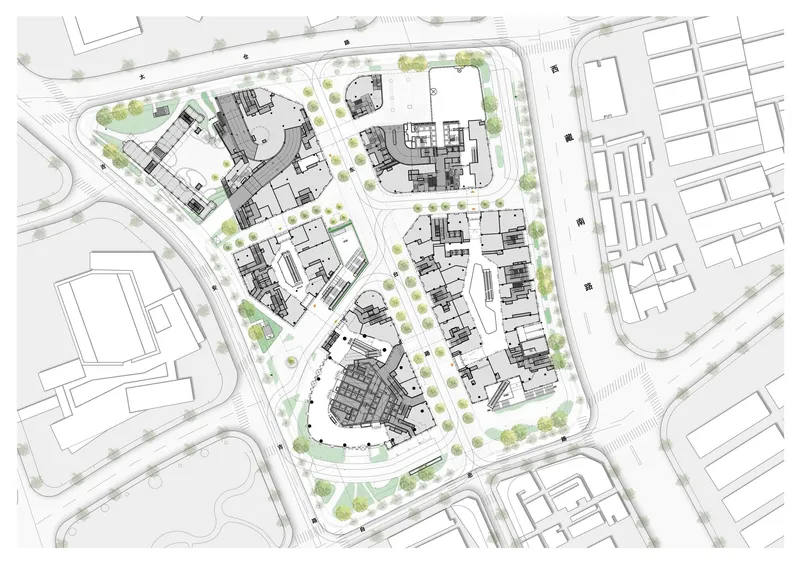
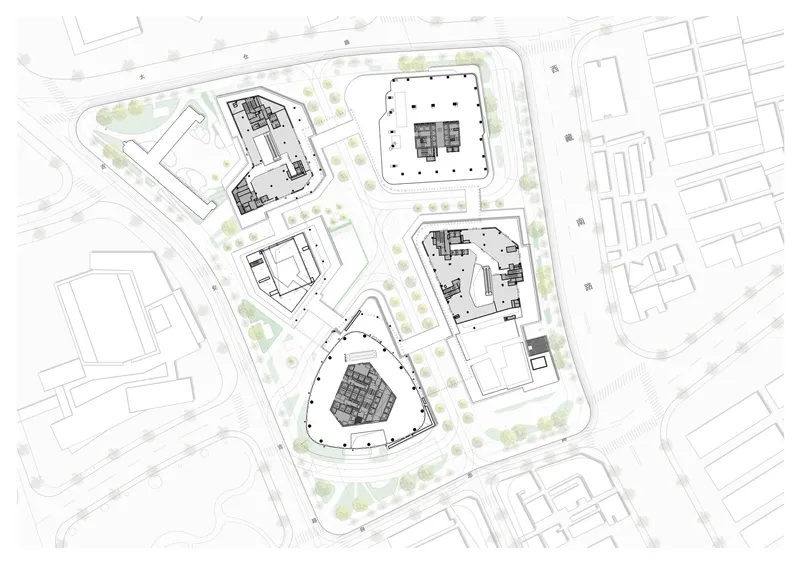
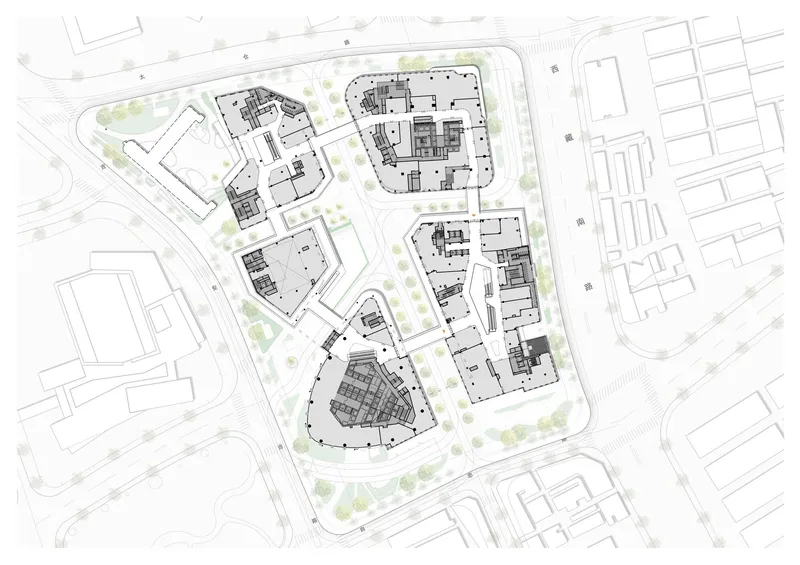
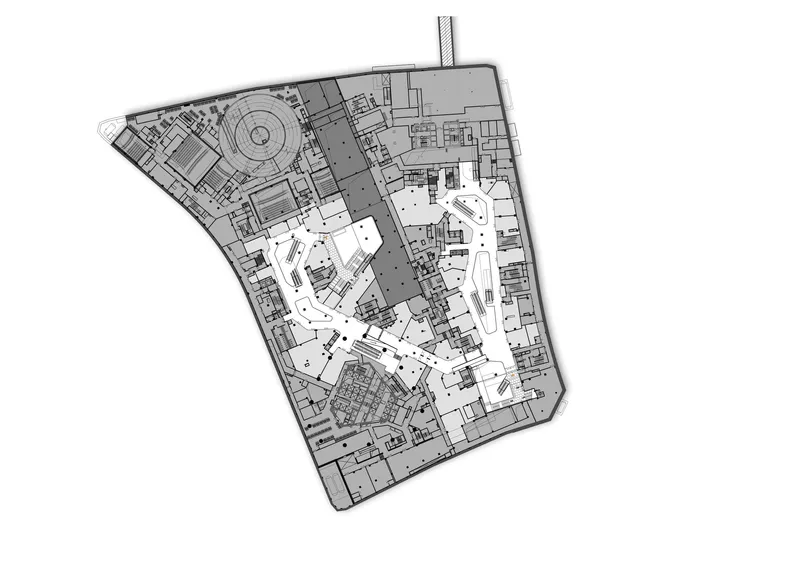
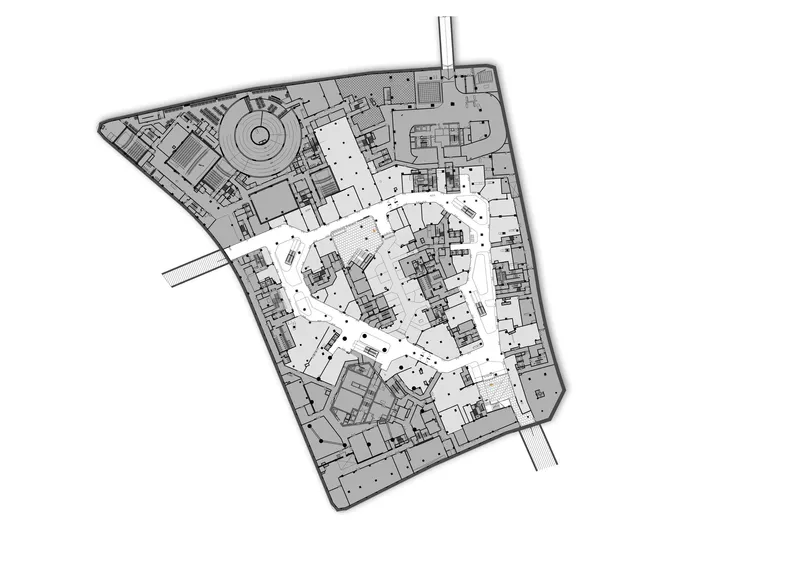
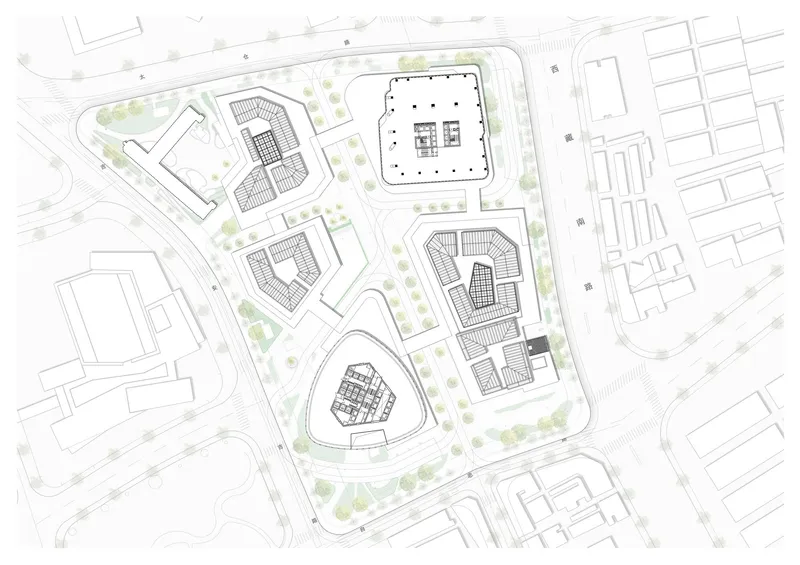


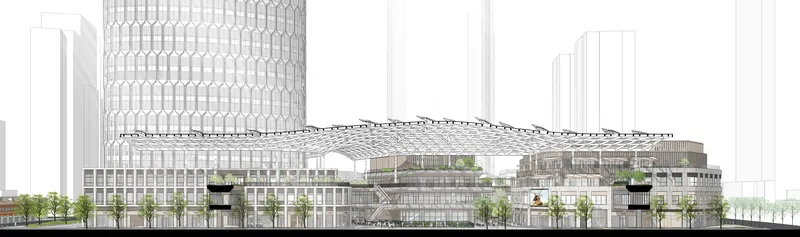


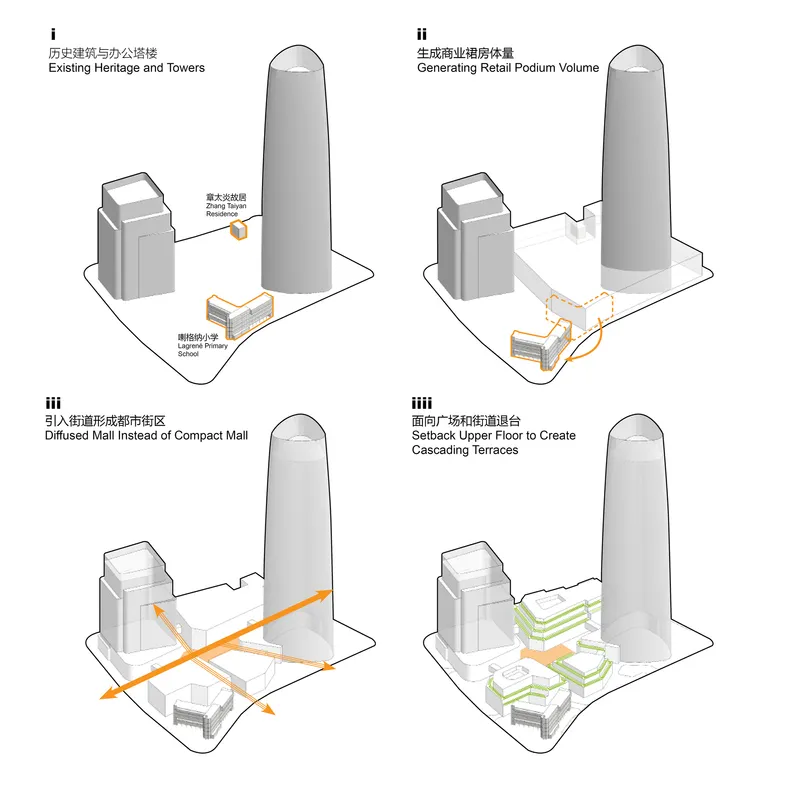


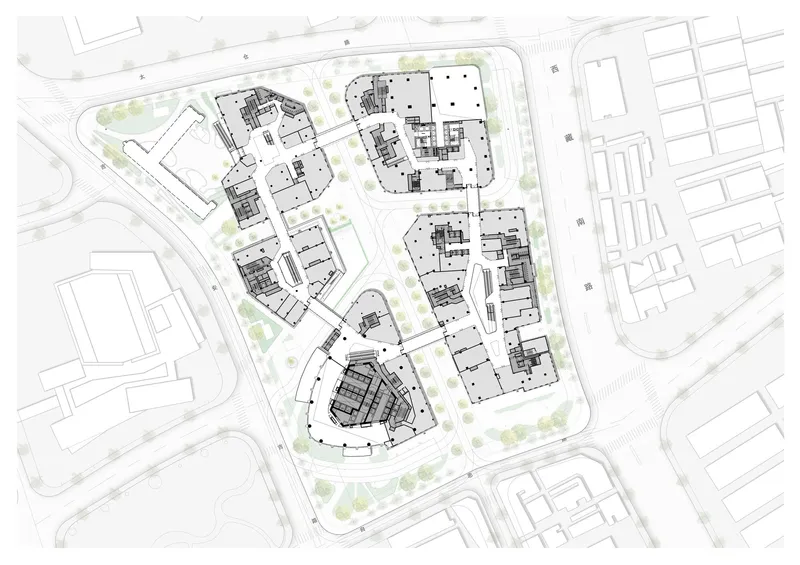
The site plans reveal the discipline behind the apparent informality. Five building footprints are arranged around a triangular central canopy structure, with street trees lining the perimeter roadways to mediate between the precinct and the city grid. The ground floor plans show how interior circulation spines align with the outdoor passages, creating continuous loops that encourage exploration. The massing diagrams are especially telling: they illustrate how the design evolved around the two heritage structures, preserving sight lines and access while building up density behind them.
Sections and elevations confirm the low-rise strategy. The podium buildings hug the ground while the office towers rise clean behind them, separated by enough distance that the towers never loom over the courtyards. The circulation diagrams, rendered in orange and green, map a multi-level pedestrian network that loops through and around the complex, ensuring that no dead ends exist and every route offers a different sequence of views.
Why This Project Matters
Xintiandi Dongtaili is proof that a large commercial development can defer to its context without sacrificing commercial viability. By splitting the program into five buildings capped at four floors, Kokaistudios gave the project a scale that belongs in this part of Shanghai. The timber canopy, the setback terraces, and the open passages are not decorative strategies; they are structural decisions about how 88,600 square meters of retail and office space should meet the street, the lake, and two irreplaceable heritage buildings.
The deeper ambition is the idea of a "total community," a place where commerce, dining, walking, and lingering overlap without hierarchy. Whether the development actually achieves that will depend on factors beyond architecture: tenanting, programming, maintenance, and the unpredictable behavior of the public. But the spatial framework is right. The streets are wide enough, the canopy is welcoming enough, and the food halls are warm enough to support the kind of daily encounters that turn a development into a neighborhood. In a city that has demolished much of its historic grain in the name of progress, a project that rebuilds that grain at contemporary scale is worth paying attention to.
Xintiandi Dongtaili Mall by Kokaistudios (lead architects: Filippo Gabbiani and Andrea Destefanis), Shanghai, China. 88,600 m². Completed 2025. Photography by RAWVISION studio.
About the Studio
Share Your Own Work on uni.xyz
If projects like this are the kind of work you want to make, uni.xyz is a place to publish your own, find collaborators, and enter design competitions.


Popular Articles
Popular articles from the community


Temporary Home for Dogs: A Reversed Zoo Rethinks Animal Shelter Architecture
In Bucharest, a sinuous corridor and freed landscape flip the logic of containment, designing a shelter that works to make itself unnecessary.

Opera on the Sea: Driftwood Logic Shapes a Timber Opera House on Estonia's Coast
Trevor Orgill's opera house translates the entangled drift of floating timber into a civic building where wood, water, and music converge.

Tsunami Convergenics: Turning Catastrophic Ocean Forces into Underwater Housing Infrastructure
A speculative underwater settlement off the coast of Onagawa, Japan, treats tsunamis and typhoons as energy sources rather than threats.

The Amber Palace Opera: A Geological Fiction Surfaces on Tallinn's Baltic Waterfront
Pierre Brillard reimagines a Baltic legend as a public landscape, opera house, and waterfront promenade rooted in Tallinn's coastal identity.

Similar Reads
You might also enjoy these articles

Bao Huynh Watercolor Atelier: A Serene Art Retreat in Hội An
Bao Huynh Watercolor Atelier in Hội An blends multifunctional art spaces, sustainable design, local materials, and family-friendly living in a serene environment.

Atelier Macri Concept Store Interior Design by CASE-REAL
Atelier Macri store features a "ko" counter, walnut wood details, cork displays, blending retail, gallery, and seamless customer experiences.

Manuel Vargas Izquierdo Stadium and High-Performance Sports Center: Architectural Excellence in Jalpa de Méndez
The Manuel Vargas Izquierdo Stadium blends sustainable design, inclusive sports facilities, and cultural-inspired architecture, revitalizing Jalpa de Méndez’s public spaces.

KAKR Buluh Awar Hall: Revitalizing Community and Ecology Through Bamboo Architecture
Community built bamboo hall revitalizes Buluh Awar village, empowering youth, restoring ecology, celebrating vernacular craftsmanship through sustainable architecture and culture.

Explore Shopping Mall Competitions
Discover active competitions in this discipline

Challenge to reimagine the Iron Throne

Photograph architecture without architects

Illustrate the lost glory of Angkor Wat - Render Challenge

Design challenge to reuse E-waste
Comments (0)
Please login or sign up to add comments
No comments yet. Be the first to comment!