

KW House by Eugenio Simonetti: Immersive Forest Living in Southern Chile
KW House by Eugenio Simonetti is a modern forest home in Chile, blending glass, wood, and metal for sustainable, immersive living.


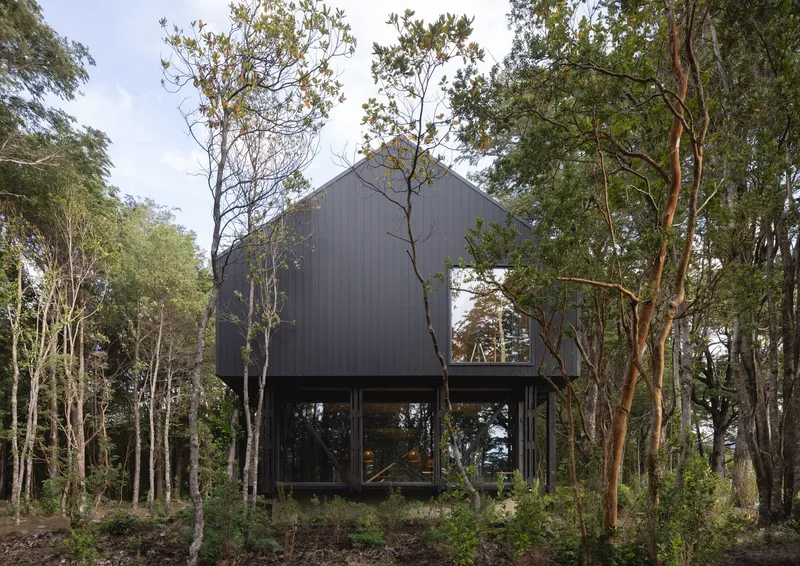
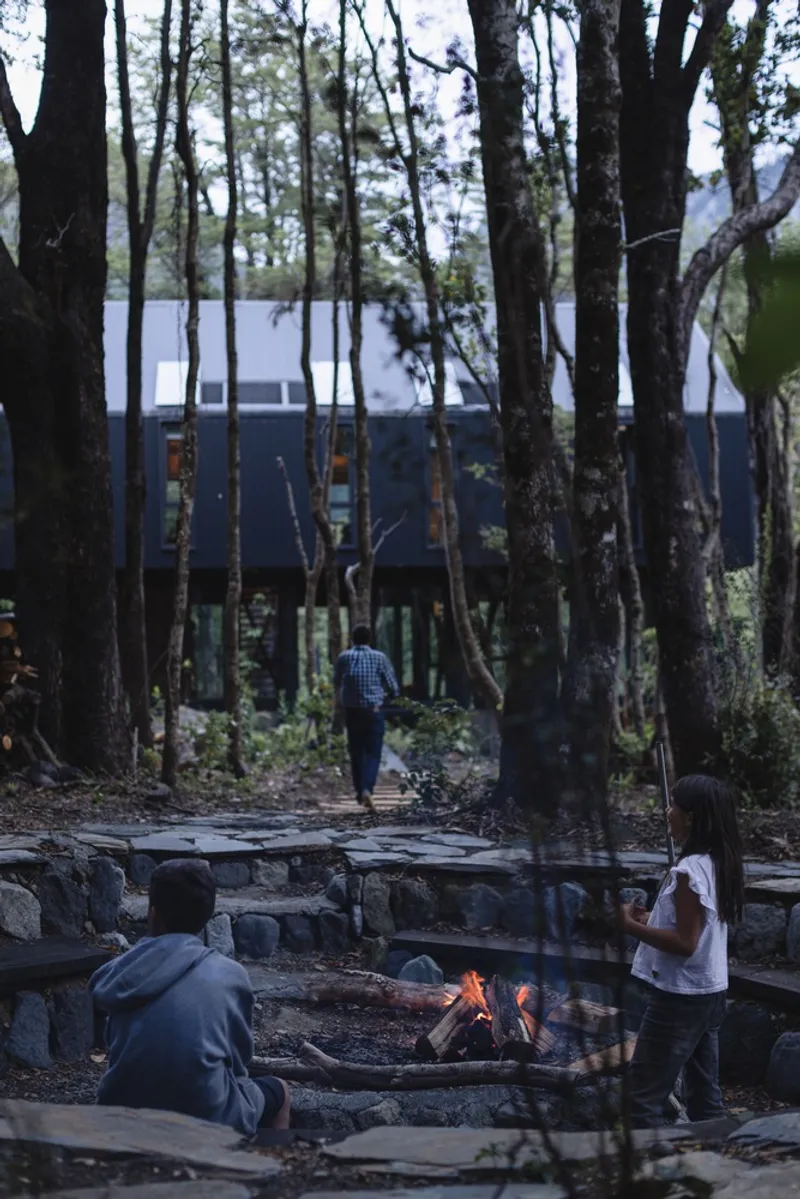
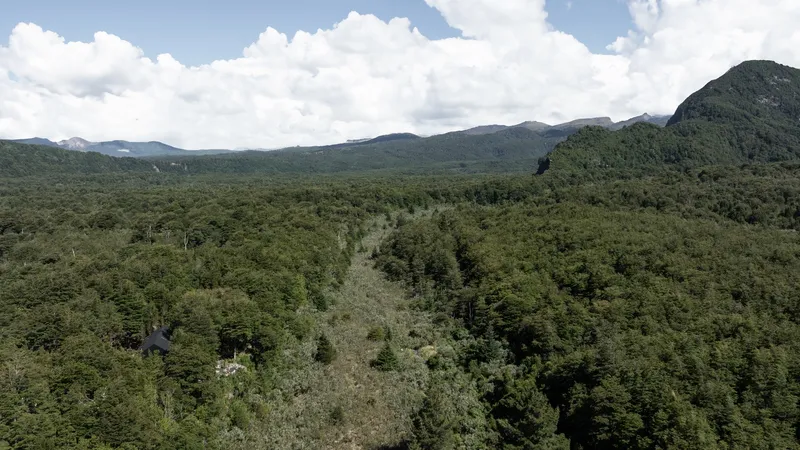
KW House, designed by Eugenio Simonetti, sits at the heart of a protected native forest in southern Chile, surrounded by Coihue, Ulmo, and Arrayanes trees. Overlooking the El Cerduo mountain range, a historic wild boar pass between Chile and Argentina, and nestled at the foot of the Villarrica volcano, the residence is an architectural dialogue between human habitation and natural preservation.
The design strategy focuses on creating a home that feels both immersed in and protected by the forest, achieving harmonious integration with the environment while offering year-round comfort.
Transparent Living: First Floor Design
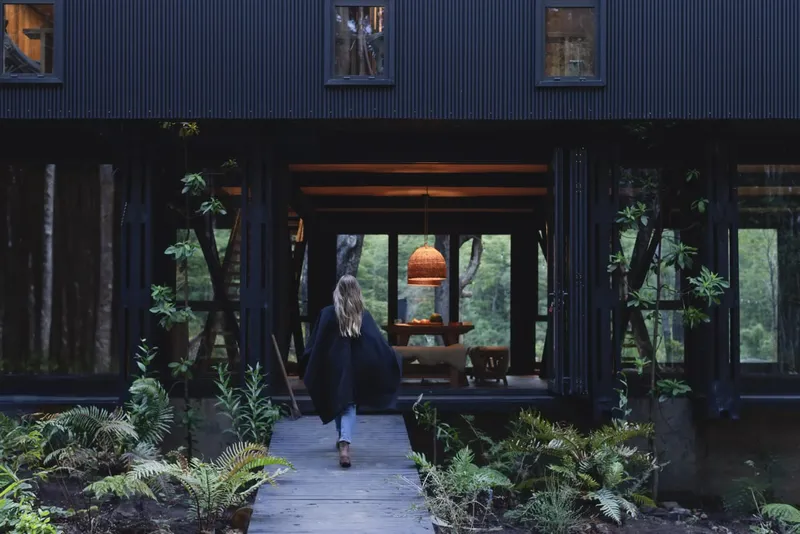
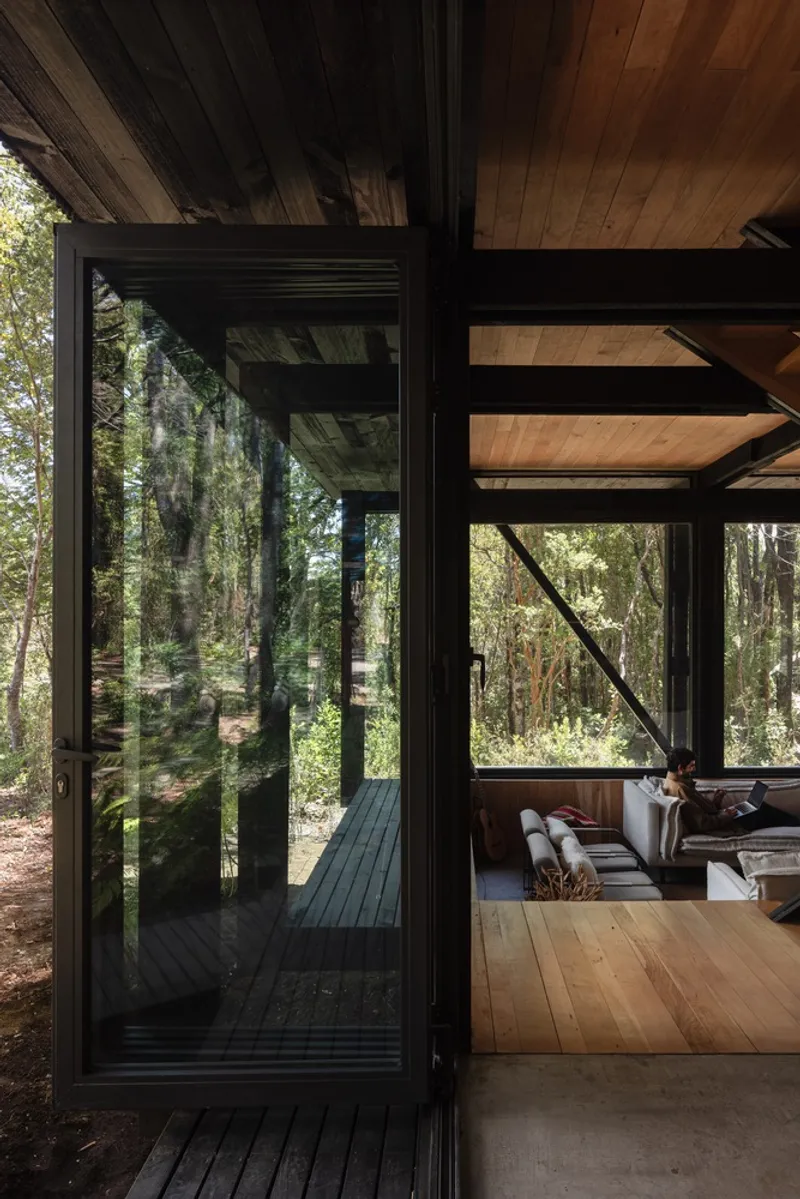
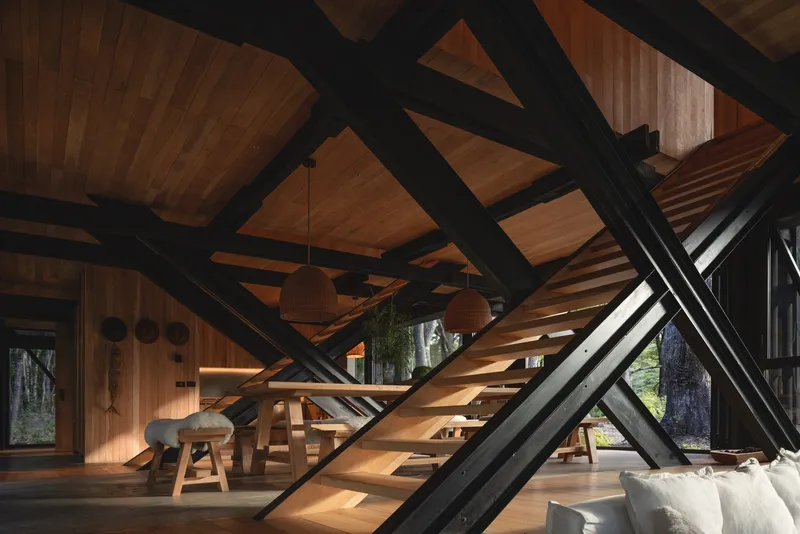
The first floor is conceived as a “glass aquarium,” featuring an open-plan living space where the living room, dining room, and kitchen occupy a central axis defined by three sculptural staircases that serve both structural and circulatory functions. This design ensures that no matter where you are, the surrounding forest feels like an extension of the home.
High-performance materials, including polyurethane insulation and Low-e thermopanel aluminum windows with thermal breaks (U-value of 1.7 W/m²K), maintain comfortable indoor temperatures throughout the year, making the home suitable for both winter retreats and summer escapes.
Indoor-Outdoor Connection
The first floor is designed to respond to seasonal variations:
- Summer: Folding windows on both sides of the dining room open completely, transforming the space into a barbecue area that connects seamlessly to terraces via wooden bridges. Natural cross-ventilation ensures a fresh interior while offering uninterrupted views of the forest and El Cerduo mountains.
- Winter: The house closes hermetically, maintaining warmth through a fireplace in the living room, a wood stove, and a perimeter circulation that links recreational zones, creating cozy, protected interiors.
Private and Flexible Second Floor
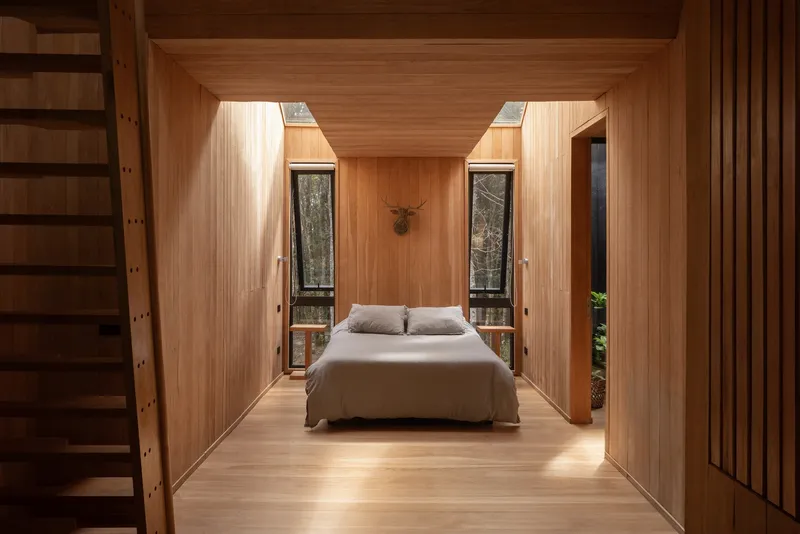
The second floor is designed as a series of bedroom apartments, each with a private bathroom and staircase. This layout allows spaces to be connected or separated depending on whether the occupants are family members or guests, providing flexible privacy solutions.
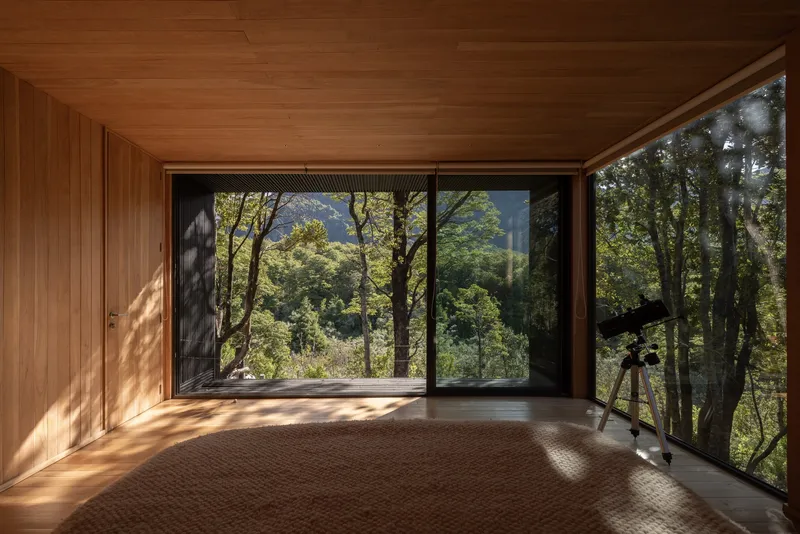
Bedrooms prioritize rest and relaxation, with minimal furniture, abundant Lenga wood paneling, and subtle natural light from skylights. The orientation maximizes views of the forest and western mountains, while creating a warm, secluded atmosphere.
Durable and Low-Maintenance Materials
Given the region’s extreme climate, with heavy winter rains and cold temperatures, the second floor features metal cladding on the roof and walls, reducing long-term maintenance. The second-floor eaves extend beyond the first floor, sheltering windows and creating a perimeter terrace that covers a small herbaceous garden, blending practicality with aesthetic appeal.
KW House: A Forest Retreat That Balances Comfort and Nature
KW House exemplifies how modern residential architecture can coexist with nature without compromising comfort. Its strategic use of materials, indoor-outdoor integration, and thoughtful seasonal adaptability make it a model for sustainable forest living in Chile and beyond.

All photographs are works of Pablo Casals Aguirre


Popular Articles
Popular articles from the community


Cube Design Draws an Ecological Corridor Between Two Shenzhen Hills with the Nankai Building
Beside Shenzhen's container docks, the Nankai Building pairs stacked balconies with a climbing green screen to connect two hillsides across its height.

graciastudio Turns a Viewless Tijuana Lot Inward Around a Courtyard of Concrete, Timber and Trees
In Tijuana, Jorge Gracia's GA2 House stacks a timber-clad private floor over exposed concrete and replaces a missing view with a planted interior patio.


Aquadapt: An Underwater Habitat That Rewrites Its Rooms by the Hour
Curved modules ring the seabed while one shell shifts from breakfast room to cinema, farm and football pitch as residents' needs change.

David Ortega Stacks a Two-Story Mexico City Penthouse Around a Steel Stair and a Pergola-Shaded Roof Terrace
In Colonia Roma, a 300 m² penthouse uses oak joinery, a planted steel stair and a slatted roof pergola to make a new-build apartment feel like a house.

Similar Reads
You might also enjoy these articles


Hodi-Mandai Geram
Project Function: Preservation and revitalization of the Intangible heritage and socio-spatial identity of the Hodi by Housing, Cultural Memory Center, Sacred Grove, landscape, local tourism economy


Olio Towers: A Mid-Rise for Performers That Fuses Housing, Rehearsal, and Stage
Located blocks from Houston's Theater District, this modular tower stacks living units around a central performance atrium.

Oasis: Modular Green Housing Carved into Dhaka's Urban Fabric
A shortlisted Plugin Housing entry reclaims unauthorized settlements in Dhaka with stepped concrete volumes, green roofs, and ventilation-driven design.

Black Hole: A Floating Megastructure for the Post-Physical Era
Emiliano Mazzarotto envisions a spherical, self-scaling arena where e-sports, digital hotels, and holographic stadiums replace traditional public space.

Explore Housing Competitions
Discover active competitions in this discipline

Challenge to reimagine the Iron Throne

Photograph architecture without architects

Illustrate the lost glory of Angkor Wat - Render Challenge

Design challenge to reuse E-waste
Comments (0)
Please login or sign up to add comments
No comments yet. Be the first to comment!