

LDT Residence by UOS Architecture Studio: Contextual Minimalism in the Heart of Ubud’s Rice Fields
LDT Residence blends modern minimalism with Balinese landscape, using natural materials, low-rise form, and private pool-facing interiors.


Architects: UOS Architecture Studio
Embracing the Landscape: A Humble Dialogue with Nature
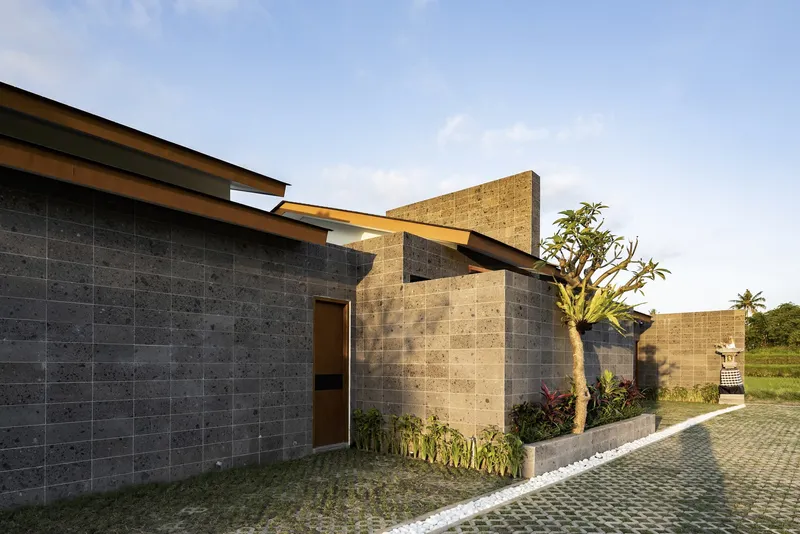
Located just outside the lush tropical outskirts of Ubud, Bali, the LDT Residence by UOS Architecture Studio is a thoughtful response to rural serenity and natural harmony. Surrounded by expansive rice fields and local plantations, the project comprises two single-storey villas, each designed to blend into the agrarian skyline without disrupting the visual rhythm of the surrounding environment.
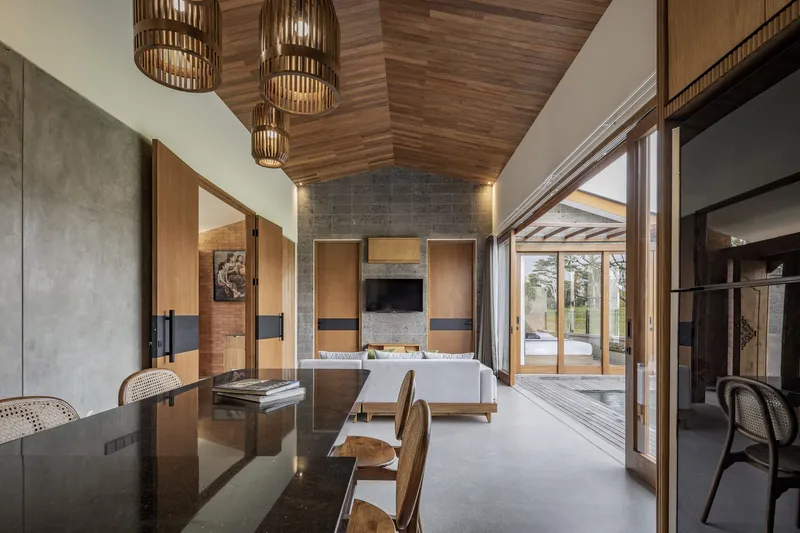
Each villa occupies a 200-square-meter plot, with a 150-square-meter building footprint, accommodating two bedrooms, a living area, dining space, kitchen, and a private pool. Despite the compact size, the design achieves a calm spatial experience rooted in minimalism and contextual sensitivity.
Low-Rise Living: Design Challenges and Site Constraints
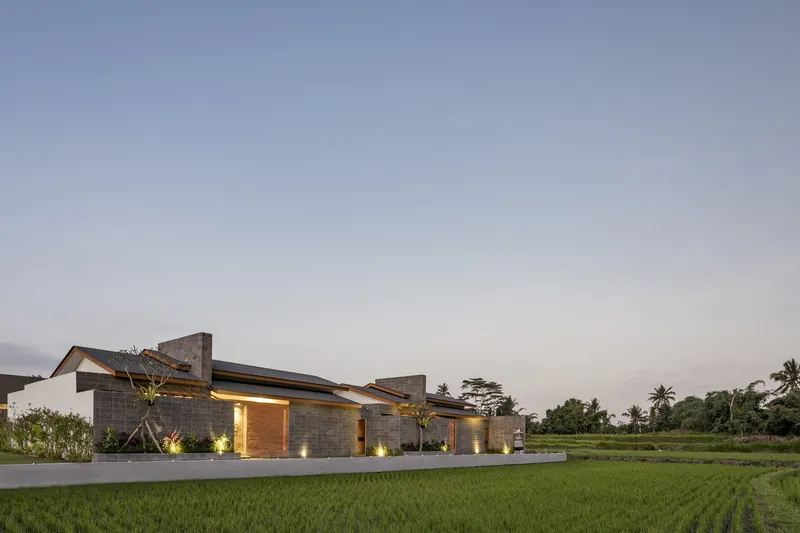
The design posed a unique challenge: how to integrate a full residential program on a narrow, elongated site without overwhelming the open landscape or compromising privacy. The architectural solution was to create modestly scaled volumes that align with the site’s linear shape, while ensuring each room connects visually to nature.
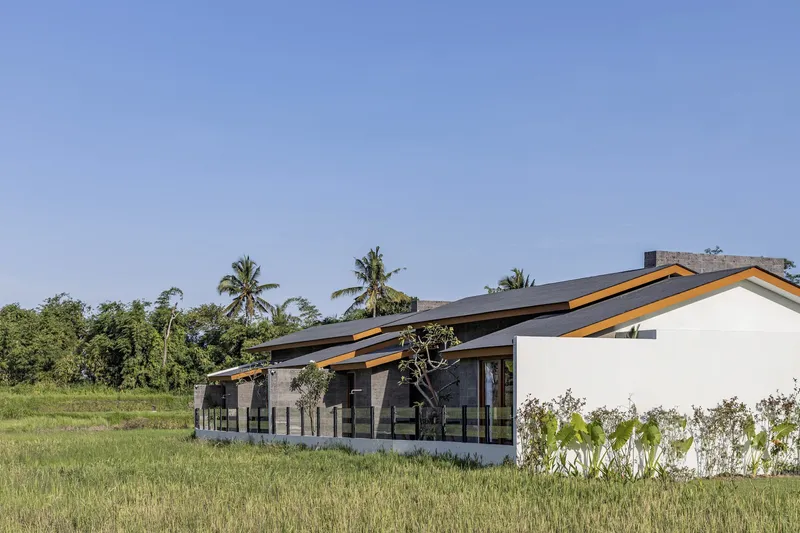
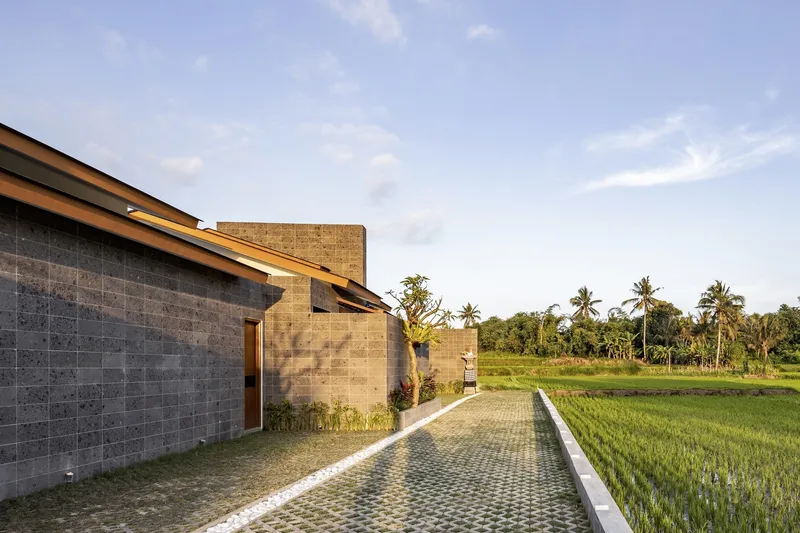
To avoid a monotonous elongated mass, the roofline is crafted with a compound staggered form, creating visual breaks and layered profiles. A central wall extending upward between the living area and bedroom helps split the roof composition, visually anchoring the structure while reducing its perceived scale.
Sustainable Roof and Water Management Strategy
Given Bali's high annual rainfall, the roof design is both aesthetic and functional. Sloped in segments and layered like a stepped formation, the roof allows for efficient rainwater drainage, directing runoff to pre-planned catchment areas. This environmental responsiveness is a central aspect of the residence’s sustainability strategy.
Material Palette: Earthy Tones and Local Craftsmanship
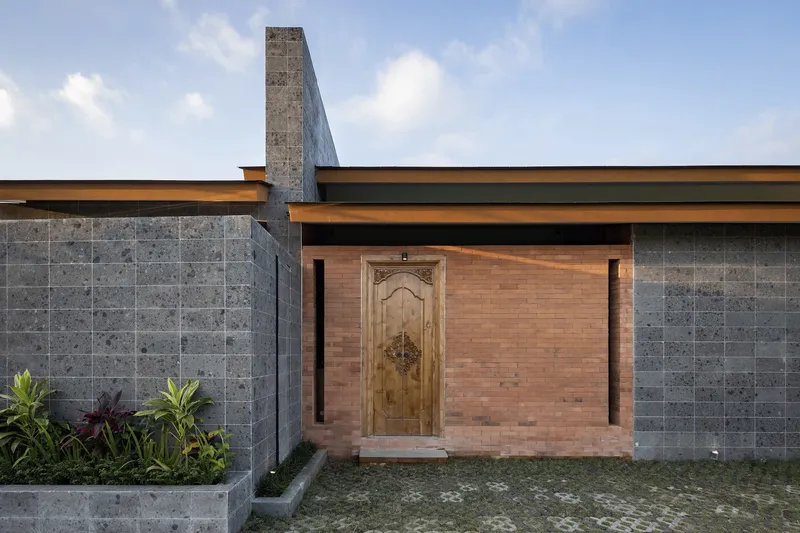
The facade features a restrained yet warm composition, primarily clad in brownish-gray “Paras Tulung Agung” natural stone, a local material that blends seamlessly with the site’s color palette. The main entrance is accented with exposed brick, providing both texture and a subtle reference to vernacular Indonesian architecture.
While the front facade remains intentionally closed to protect privacy and mitigate noise from the adjacent road, the rear elevation opens fully toward the rice fields and private pool, reinforcing the sense of refuge and spatial openness.
Spatial Arrangement: Privacy Through Orientation
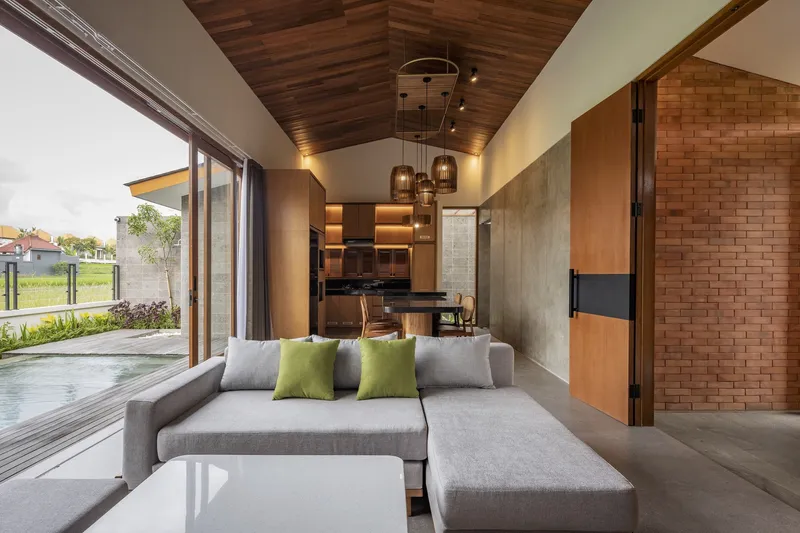
All interior spaces are arranged in a linear sequence along the site’s length, maintaining a clean and rational layout. Service areas like kitchens and utility spaces are placed near the front, creating a buffer against the street. In contrast, the bedrooms and living areas face the rear, offering uninterrupted views of the pool and the picturesque rice field horizon beyond.
This approach not only prioritizes privacy and tranquility but also ensures that every room benefits from a framed natural view, a hallmark of UOS Architecture Studio’s design ethos.
Modest, Modern, and Contextually Rooted
The LDT Residence is a model of quiet architecture—one that resists unnecessary monumentality in favor of balance with nature and local context. Through careful planning, strategic material selection, and climatic sensitivity, the villas achieve a simple yet refined spatial quality, perfectly suited to their tropical surroundings.
Three words that define the project: Simple. Aligned. Eye-catching.

All photographs are works of Indra Wiras




Popular Articles
Popular articles from the community

FAMM Arquitectura Organizes Ten Villas Around Courtyards and Jungle in Nosara, Costa Rica
El Molino pairs two elongated volumes with deep overhangs and timber louvers to build a compact coastal community five minutes from the beach.

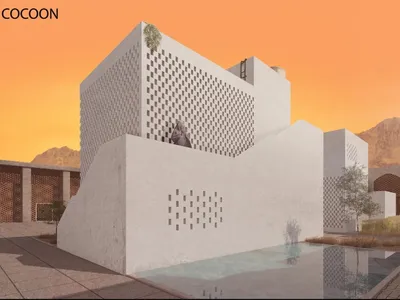
A Reinforced Cocoon: Vernacular Architecture for Security, Healing and Community in Qandahar
A Reinforced Cocoon reimagines Afghan vernacular architecture as secure community space for widowed women, families, healing and resilience.
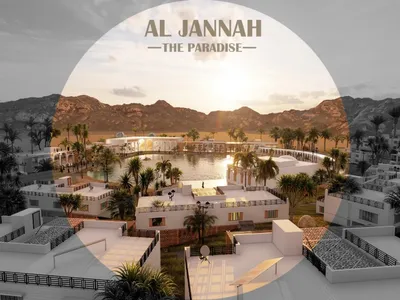
AL-JANNAH: Sustainable Architecture and Permaculture for Afghan Widows
AL-JANNAH uses sustainable architecture and permaculture to create resilient oasis of housing, learning, work and renewal for Afghan widows.

Riyadh For All: Intergenerational Urban Design for Active Aging in Rabat
Riyadh For All reimagines urban design in Rabat with intergenerational co-living, adaptive courtyards, and Moroccan cultural exchange today.


Similar Reads
You might also enjoy these articles


Hodi-Mandai Geram
Project Function: Preservation and revitalization of the Intangible heritage and socio-spatial identity of the Hodi by Housing, Cultural Memory Center, Sacred Grove, landscape, local tourism economy


Olio Towers: A Mid-Rise for Performers That Fuses Housing, Rehearsal, and Stage
Located blocks from Houston's Theater District, this modular tower stacks living units around a central performance atrium.

Oasis: Modular Green Housing Carved into Dhaka's Urban Fabric
A shortlisted Plugin Housing entry reclaims unauthorized settlements in Dhaka with stepped concrete volumes, green roofs, and ventilation-driven design.

Black Hole: A Floating Megastructure for the Post-Physical Era
Emiliano Mazzarotto envisions a spherical, self-scaling arena where e-sports, digital hotels, and holographic stadiums replace traditional public space.

Explore Architecture Competitions
Discover active competitions in this discipline



The International Standard for Design Portfolios


The Global Benchmark for Architecture Dissertation Awards

The Global Benchmark for Graduation Excellence


Challenge to reimagine the Iron Throne
Comments (0)
Please login or sign up to add comments
No comments yet. Be the first to comment!