

Lecture Hall Building and Logistics Laboratory at the University of Applied Sciences for Beverage Technology
A contemporary campus landmark combining lecture halls, laboratories, and beverage production spaces with wood, concrete, and light-filled design to support hands-on learning.


Designed by Bez+Kock Architekten, the new Lecture Hall Building and Logistics Laboratory at the University of Applied Sciences for Beverage Technology in Geisenheim, Germany, expands the historic academic campus with a contemporary, highly functional architectural ensemble. Completed in 2025 and spanning 9,520 m², the project strengthens the university’s legacy of educating generations of winemakers and beverage technologists since its origins as the Royal Prussian Institute for Fruit and Wine Growing founded in 1872. Captured through the lens of Brigida González, the buildings form a striking gateway to the eastern campus, framed by a majestic cedar tree along Von-Lade-Straße.
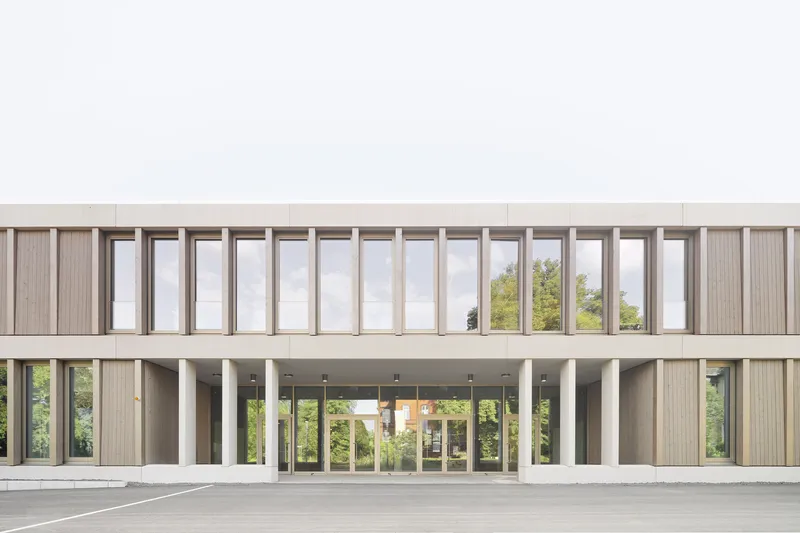
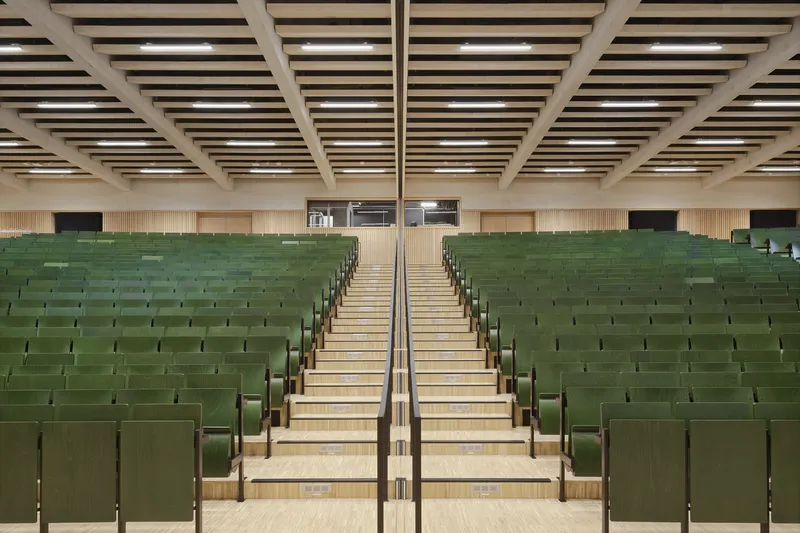
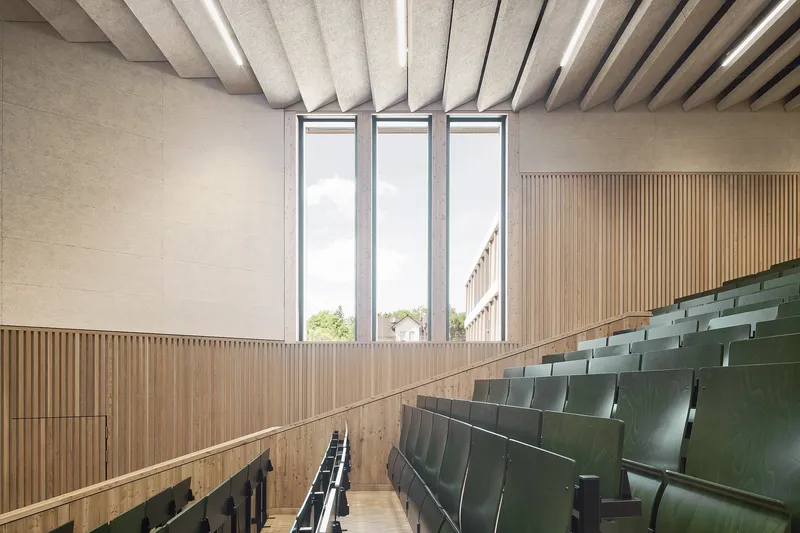
The lecture hall building features a generous covered entrance that functions as an outdoor extension of the foyer, opening directly onto the campus lawn. Inside, the 700-seat lecture hall is shaped by the steep terrain, with ascending seating that mirrors the site’s natural topography. A centrally positioned staircase illuminated from above leads to four seminar rooms on the upper floor, ensuring intuitive circulation and abundant natural light.


Adjacent to it, the logistics laboratory follows the curvature of Falterstrasse, using a staggered footprint that provides optimal room depths for diverse classroom sizes. Its upper floor adopts a triple-bay arrangement with offices on both sides, while vertical air spaces create visual and spatial connections across levels. The material palette blends coarse precast concrete elements with slender wooden pilasters arranged in disciplined rhythm, casting dynamic shadows on the façade. Inside, exposed wood and board-formed concrete reinforce a sense of handcrafted authenticity and durability.

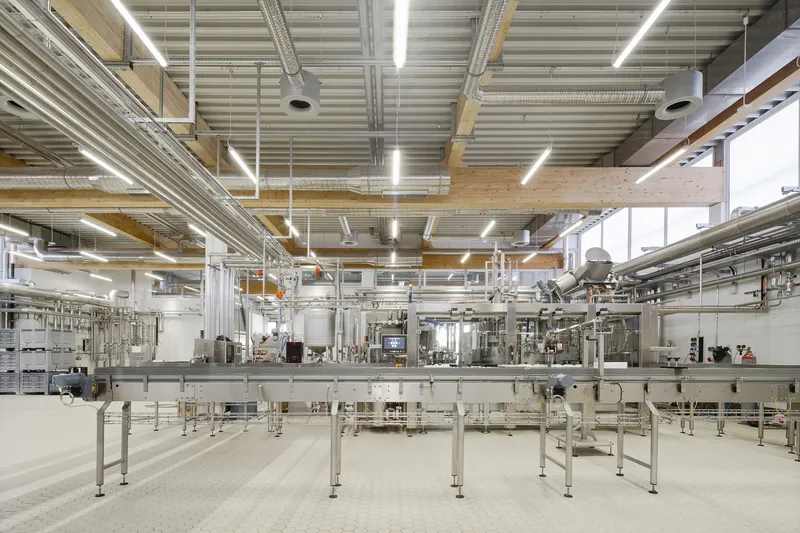
A key component of the campus expansion is the Beverage Technology Center (BTC), which plays a central role in hands-on training for future beverage technologists. Skillfully responding to the sloping terrain, the building presents a welcoming, transparent base level facing the future campus square, while the production hall is accessed from the higher ground on the north side. Surrounding the central hall are laboratories, workshops, and administrative spaces that support a fully automated beverage production workflow—from fruit delivery and juice extraction to distillation, bottling, and canning.

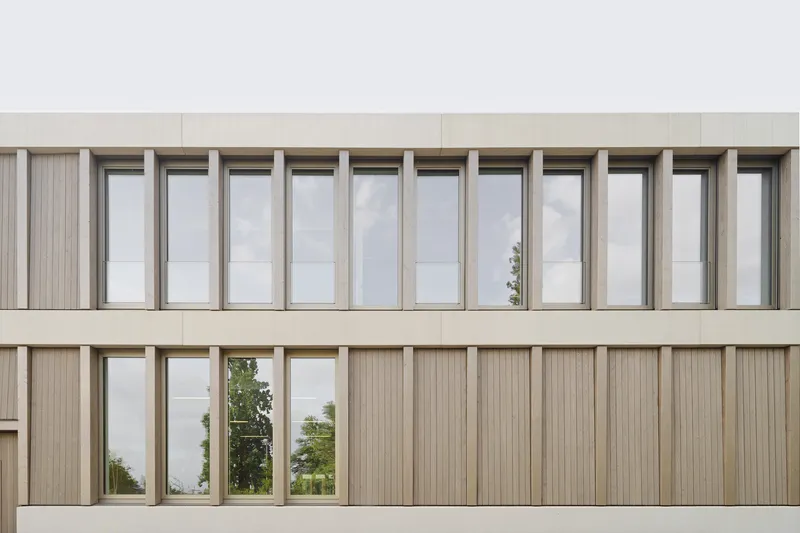

The building’s wooden structure is wrapped in translucent polycarbonate cladding, transforming it into a softly glowing lantern that brings filtered daylight deep into the production hall. Below, the basement contains a publicly viewable show winery with an adjacent tasting area, alongside a sensory laboratory, coffee roasting facility, and several specialized workshops. The interplay of wood and concrete achieves a balance of strength, warmth, resilience, and sustainability, giving the ensemble a distinctive architectural identity that supports modern education while honoring Geisenheim’s deep-rooted winemaking culture.


All photographs are works of Brigida González


Popular Articles
Popular articles from the community


Opera on the Sea: Driftwood Logic Shapes a Timber Opera House on Estonia's Coast
Trevor Orgill's opera house translates the entangled drift of floating timber into a civic building where wood, water, and music converge.

Temporary Home for Dogs: A Reversed Zoo Rethinks Animal Shelter Architecture
In Bucharest, a sinuous corridor and freed landscape flip the logic of containment, designing a shelter that works to make itself unnecessary.
Tsunami Convergenics: Turning Catastrophic Ocean Forces into Underwater Housing Infrastructure
A speculative underwater settlement off the coast of Onagawa, Japan, treats tsunamis and typhoons as energy sources rather than threats.

Manzana Morphosis: Stretching Barcelona's Grid into a Living Landscape for 2050
A radical reworking of the Eixample manzana turns density into a tool for generous public space, vertical ecology, and environmental performance.

Similar Reads
You might also enjoy these articles


Hodi-Mandai Geram
Project Function: Preservation and revitalization of the Intangible heritage and socio-spatial identity of the Hodi by Housing, Cultural Memory Center, Sacred Grove, landscape, local tourism economy


Olio Towers: A Mid-Rise for Performers That Fuses Housing, Rehearsal, and Stage
Located blocks from Houston's Theater District, this modular tower stacks living units around a central performance atrium.

Oasis: Modular Green Housing Carved into Dhaka's Urban Fabric
A shortlisted Plugin Housing entry reclaims unauthorized settlements in Dhaka with stepped concrete volumes, green roofs, and ventilation-driven design.

Black Hole: A Floating Megastructure for the Post-Physical Era
Emiliano Mazzarotto envisions a spherical, self-scaling arena where e-sports, digital hotels, and holographic stadiums replace traditional public space.

Explore Academic Building Competitions
Discover active competitions in this discipline

Challenge to design public laboratory

Challenge to reimagine the Iron Throne

Photograph architecture without architects

Illustrate the lost glory of Angkor Wat - Render Challenge
Comments (0)
Please login or sign up to add comments
No comments yet. Be the first to comment!