

A 100m² Library That Rethinks Civic Space in Zanzibar
Parallel Studio's Lei Wa Lakom Library uses coral walls, reading nooks, and open-air pavilions to build more than a room of books.


A library for children on the island of Zanzibar should not look like a library anywhere else. That much is obvious, but the follow-through is rare. Parallel Studio, the Kuwait-based practice led by Mai Al Busairi, has delivered a 100 square meter structure that refuses to collapse into either tropical pastiche or imported minimalism. The Lei Wa Lakom Library, completed in 2025, is the second built project under the firm's Parallel Gives initiative, and it reads less like charity architecture and more like a serious investigation into what a community reading room can be when materials, climate, and children's bodies are given equal weight in the design process.
What makes the project interesting is its refusal to treat enclosure as a binary condition. The building is a collection of zones: shaded walkways, open pavilions, enclosed reading rooms, circular nooks punched into thick walls. Air moves through louvered timber shutters. Light enters through glass porthole openings. The boundaries between inside and outside are negotiated surface by surface, not declared by a single envelope. For a building this small, there is a surprising amount of spatial variety, and almost none of it depends on expensive materials or complex construction.
Walls That Breathe and Walls That Glow
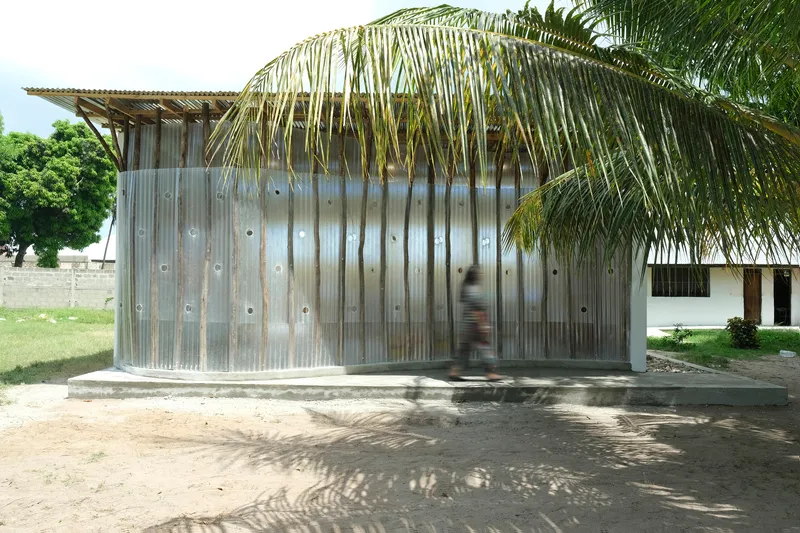
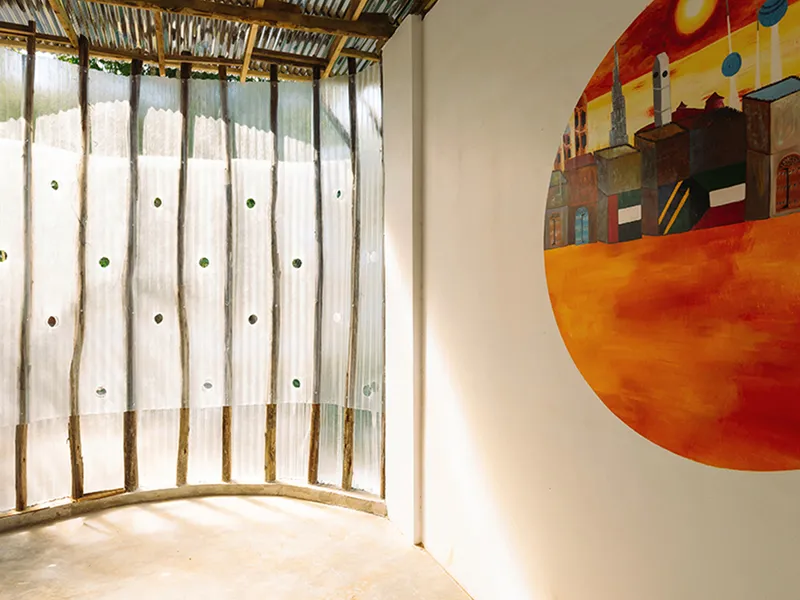
The library's most distinctive move is its curved corrugated metal facade, perforated with circular glass openings that turn a utilitarian material into something luminous. From the outside, these portholes read as playful punctuation along the sweep of the wall. From the inside, they frame views of greenery and filter light into reading nooks. The effect is specific to children's scale: the openings are placed low, at eye level for someone sitting cross-legged on the floor.
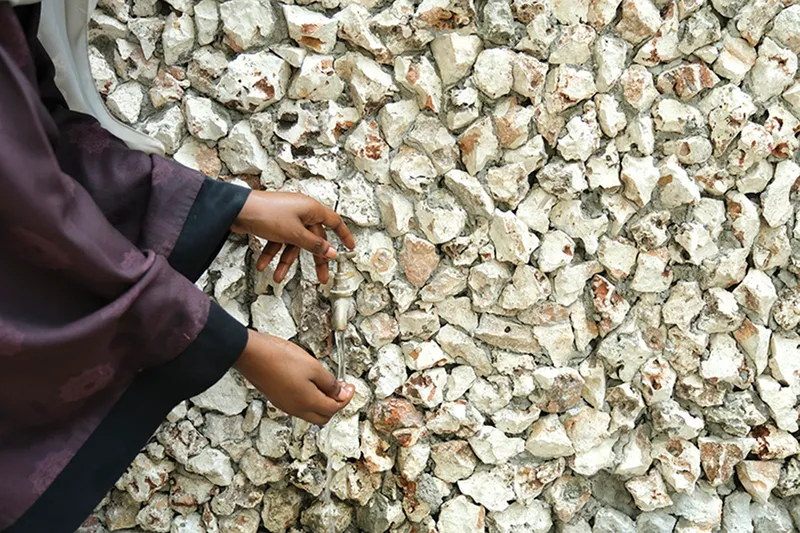
Elsewhere, the material palette shifts to crushed coral or oyster shell aggregate, creating a tactile, rough-textured surface that is both structurally honest and visually rich. You can see hands touching this wall in one image, and the gesture feels intentional: this is architecture meant to be felt, not just seen. The white plaster walls that frame the rest of the building are deliberately plain, letting the textured and perforated surfaces carry the visual energy.
Reading Nooks as Architecture's Smallest Unit
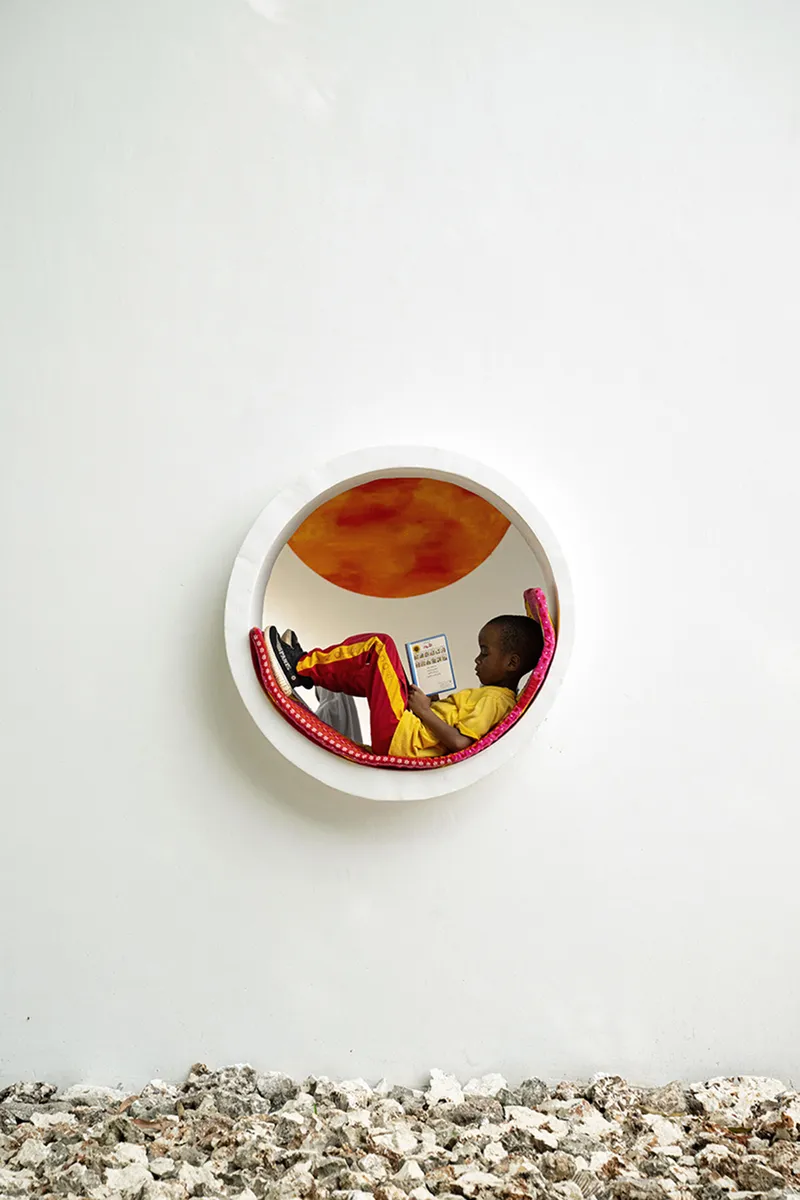
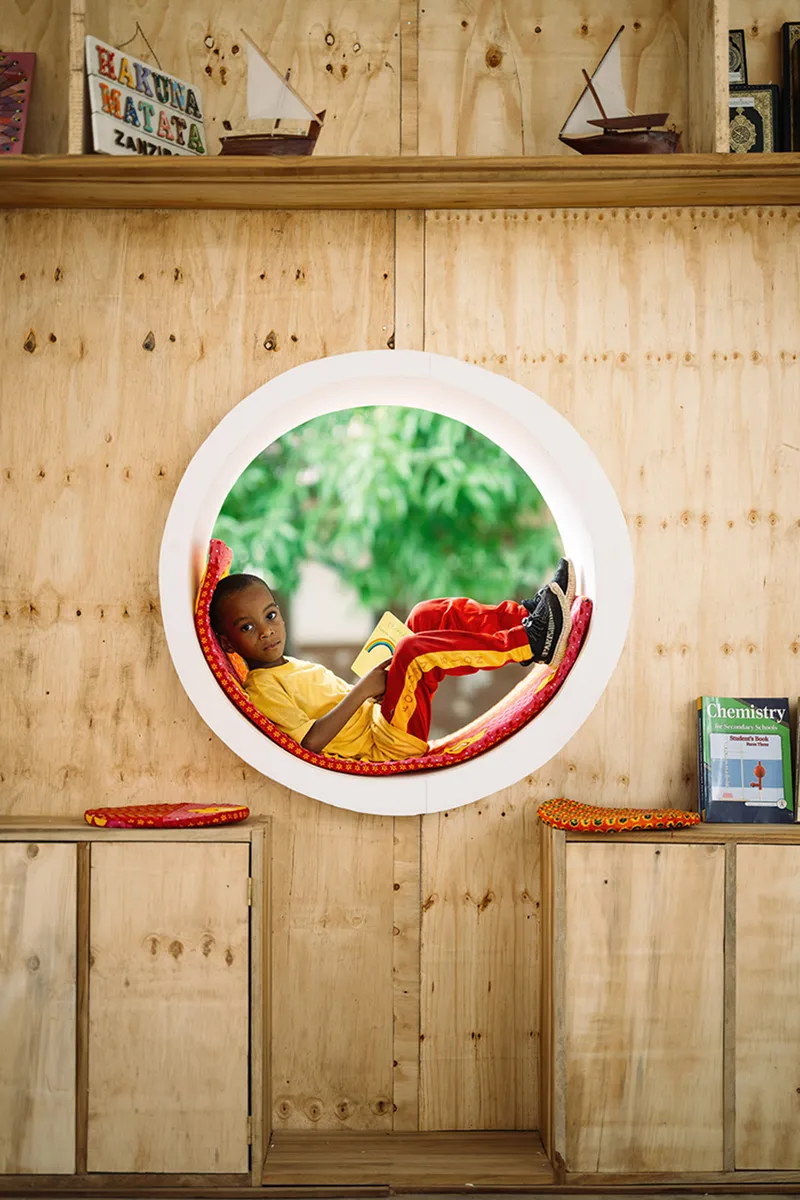
The circular reading nooks are the building's most photographed detail, and they deserve the attention. Each one is a small cylindrical cavity set into the thickness of the wall, painted orange on the interior, and sized for a single child. From outside, you see a kid framed in a perfect circle, book in hand, gravel at the base of the wall. From inside, the child looks outward through the same opening toward palms and sky. It is a genuinely delightful piece of design because it does three things at once: it creates privacy within a communal room, it thickens the wall into habitable space, and it gives children a sense of ownership over a piece of the building.
These nooks are not ornamental. They solve a real problem in children's libraries, which is that not every child wants to sit at a table. Some want to curl up. Some want to hide. The nooks provide that option without requiring furniture, and they will never break or need replacement. That durability matters in a context where maintenance budgets are thin.
Timber, Light, and the Interior Room
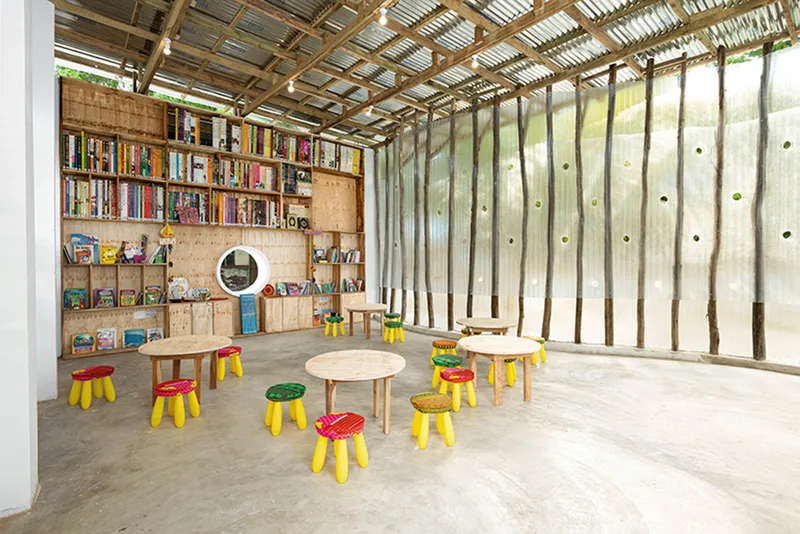
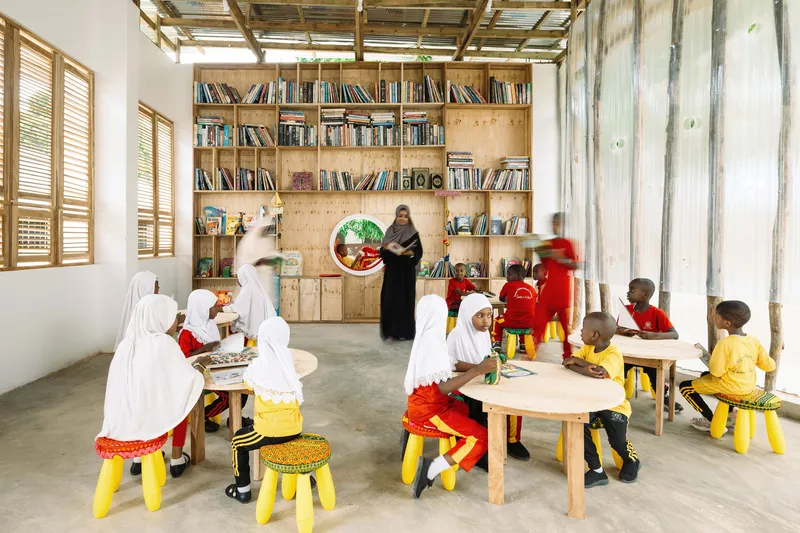
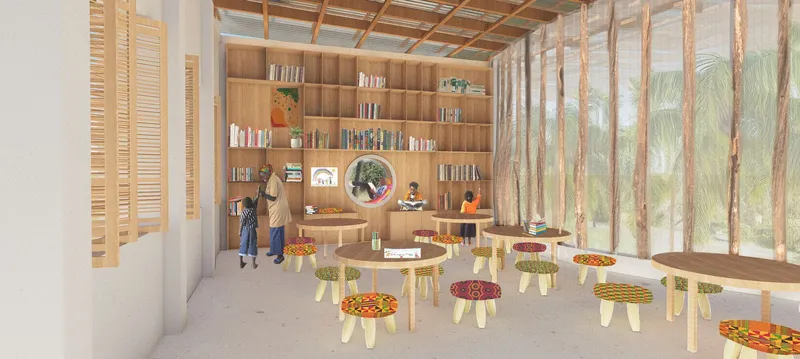
Inside the main reading room, the palette reduces to plywood shelving, polished concrete floors, and exposed timber roof trusses. The shelving runs floor to ceiling along one wall, creating a warm backdrop and a functional surface simultaneously. Low tables and stools are arranged for group work, and the louvered timber windows along the opposite wall ensure that the room never feels sealed. Palm trees are visible through the louvers, and the cross-ventilation is evident in the way fabric and hair move in the photographs.
The exposed roof structure is worth noting. The trusses are straightforward timber members with corrugated metal cladding above, creating a deep ceiling plane that traps a layer of warm air above the occupied zone. It is a passive cooling strategy that costs nothing to operate, and it gives the room a generous vertical proportion that belies its modest footprint. At 100 square meters, this is a small building, but the interior never feels cramped.
Thresholds and In-Between Spaces
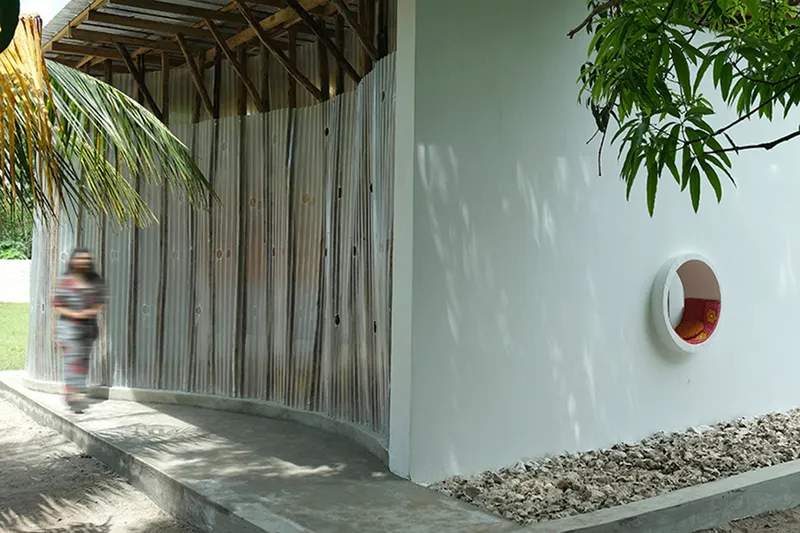
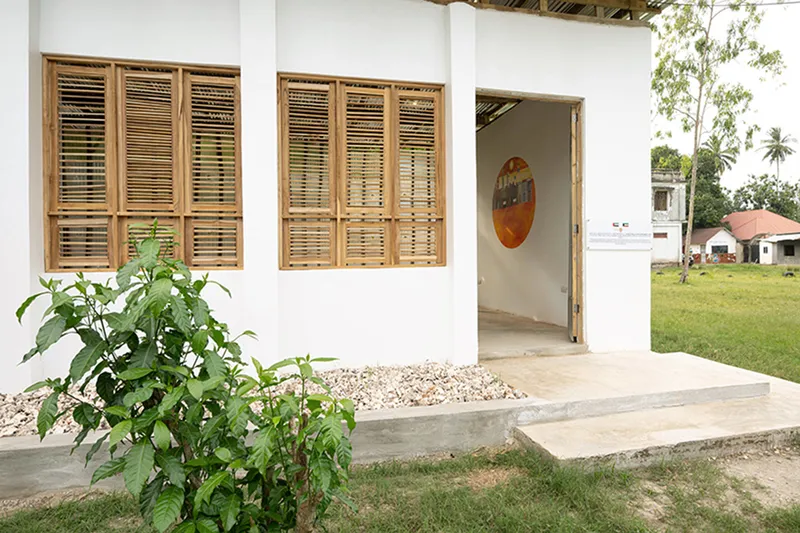
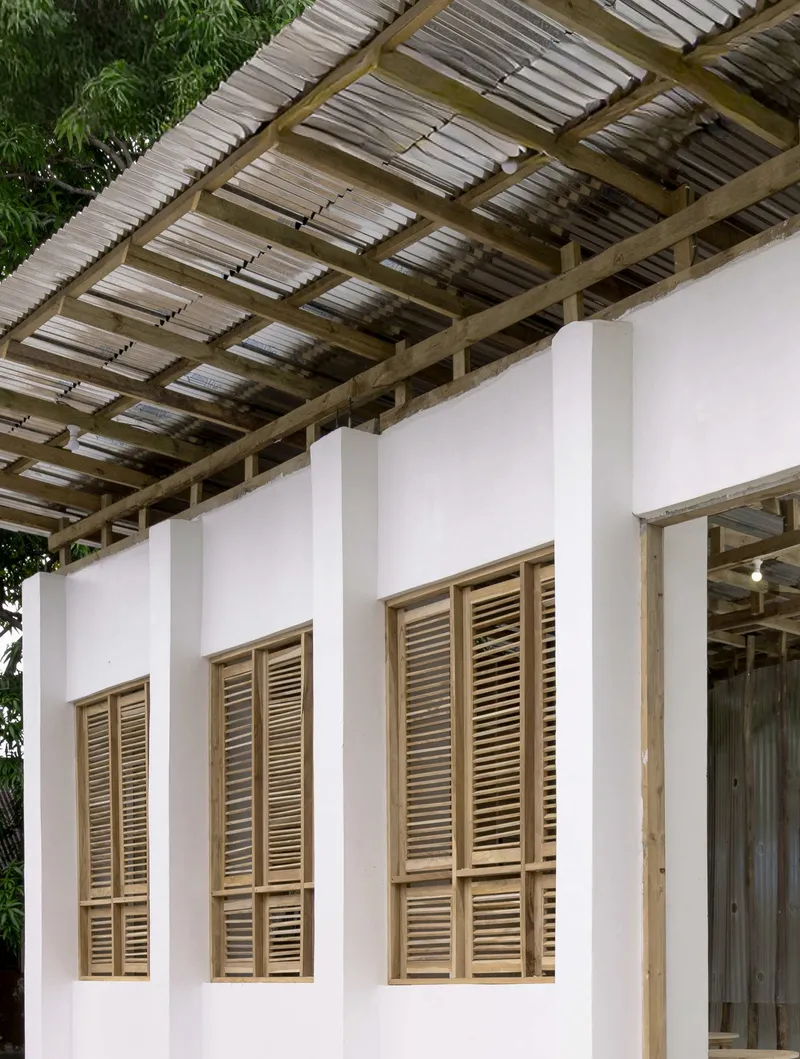
The building's circulation is a sequence of thresholds rather than a corridor. Vertical timber screens create covered walkways that are neither inside nor outside. A figure passing through dappled light in one image could be arriving or departing; the ambiguity is the point. The entrance porch, with its louvered shutters and gravel bed beside a planted shrub, signals a transition from the dusty public realm to a cooler, quieter zone without a formal door.
These in-between spaces are critical in Zanzibar's climate, where direct sun is intense but shade is immediately comfortable. The corrugated metal and thatch canopies overhead are lightweight and replaceable, while the white plastered walls below provide thermal mass. The combination means the building can be almost entirely open to the air during the day and still feel sheltered.
The Courtyard and Collective Life
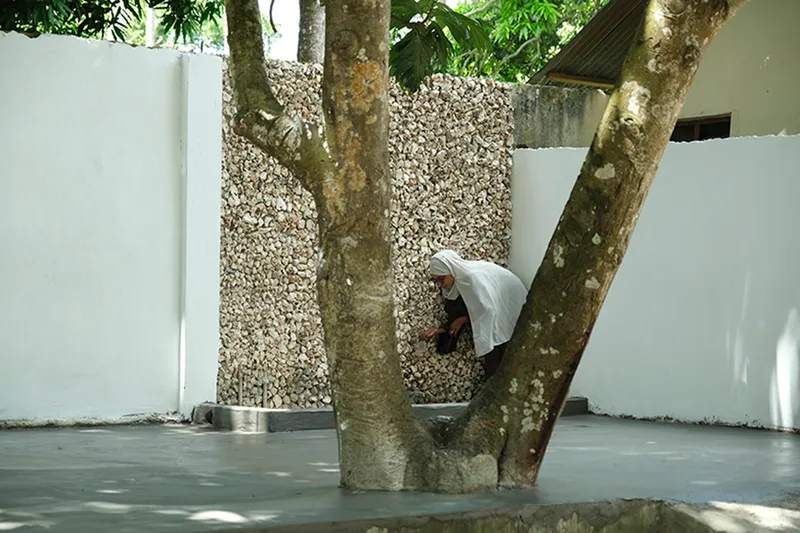
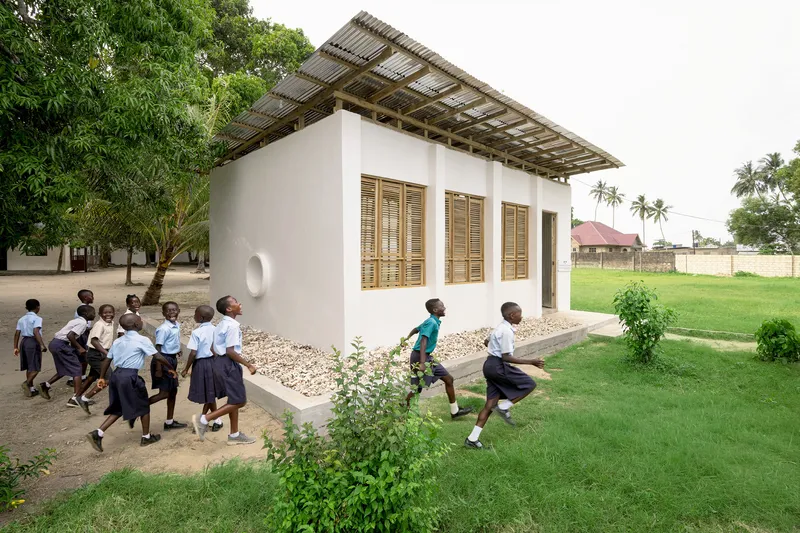
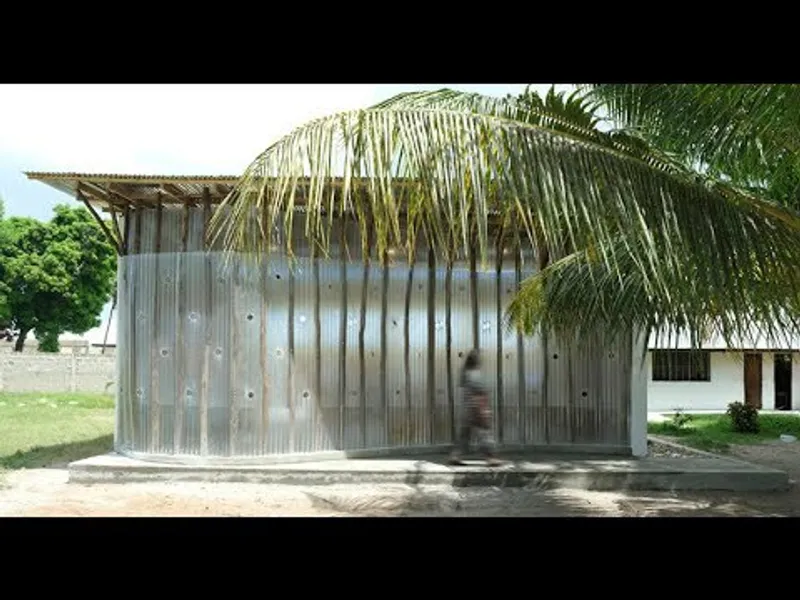
A courtyard with preserved tree trunks and a crushed stone feature wall forms the social center of the project. A seated figure in the shade of existing trees suggests that this space is already being used as intended: as a place to pause, not just pass through. The decision to keep existing trees and integrate them into the design is a small but significant act. It roots the building in its site in a literal way, and it provides shade that no canopy could replicate for decades.
Adjacent to the courtyard, children run past a white plastered classroom wall. The image captures the building in use, which is always the real test. The corrugated metal canopy overhead protects the facade from rain while allowing air to move freely beneath it. The whole assembly, walls, canopy, courtyard, trees, works as a system rather than a collection of parts.
Plans and Drawings
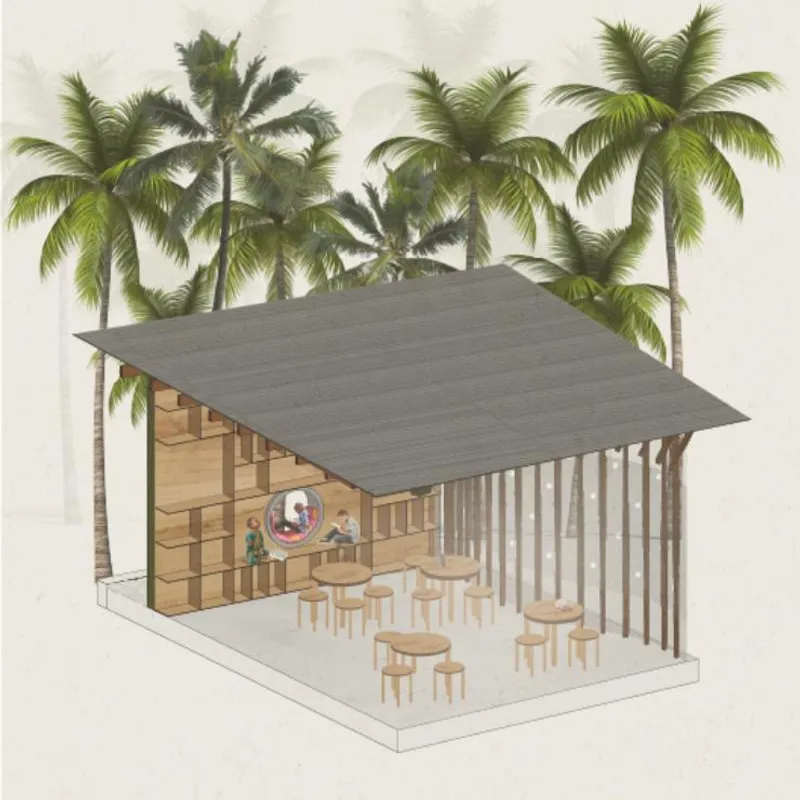
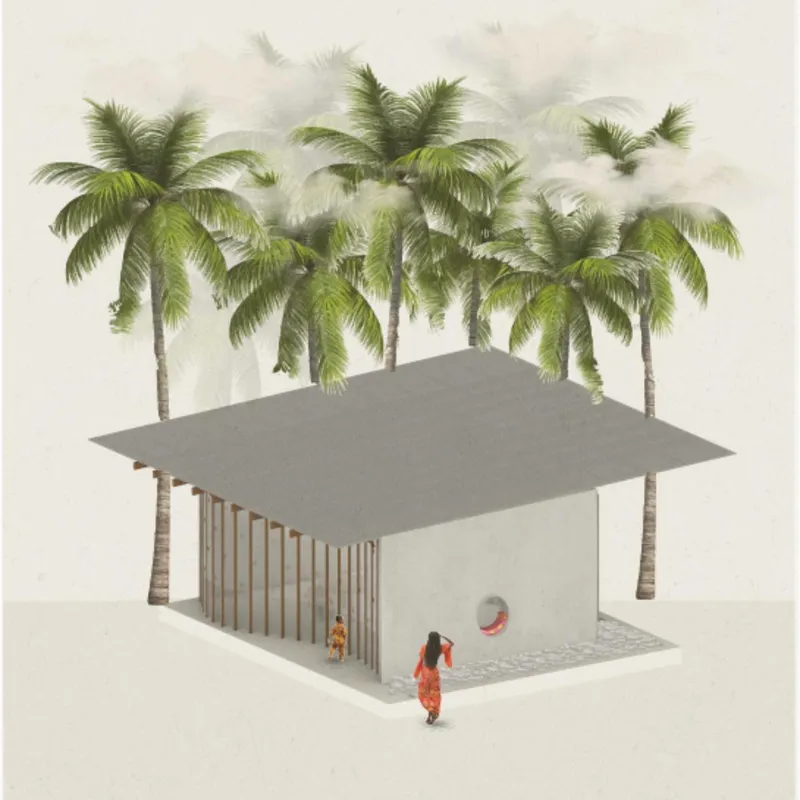
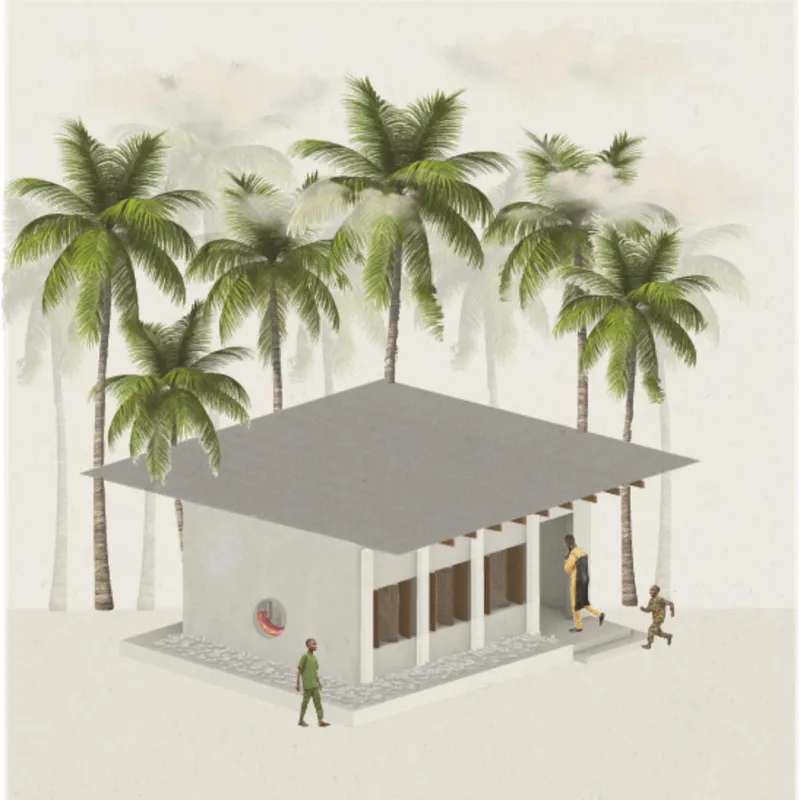
The axonometric drawings reveal a campus-like arrangement of small pavilions connected by covered paths beneath an existing palm canopy. Each pavilion has a flat or low-pitched roof supported by slender columns, and the corrugated screen walls appear as freestanding elements rather than load-bearing enclosures. The separation of structure from screen is key to the building's adaptability: openings can be adjusted, screens replaced, and new pavilions added without reworking the foundations.
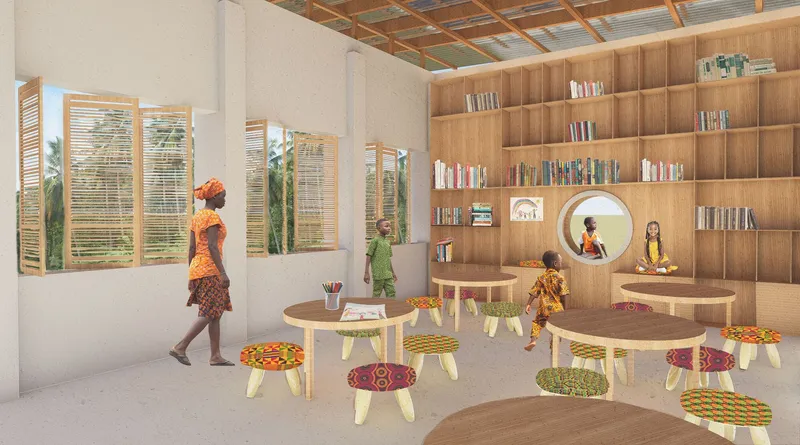
The interior rendering shows the timber shelving wall in its full extent, confirming that it functions as both spatial divider and storage. Small stools with patterned fabric seats add color without requiring a large budget. The exposed rafters are clearly legible, and the relationship between the louvered windows and the bookshelves suggests that natural light was a primary design driver for the interior layout.
Why This Project Matters
The Lei Wa Lakom Library is not the first small civic building in East Africa, and it will not be the last. What sets it apart is the precision of its ambitions. At 100 square meters, it does not try to be a cultural center, a school, and a community hall all at once. It is a library, and every design decision, from the reading nooks to the louvered ventilation to the low tables, serves that purpose. The result is a building that feels complete rather than compromised by its budget.
For architects working in similar contexts, the project offers a useful lesson: material inventiveness does not require material excess. Corrugated metal, plywood, crushed coral, timber louvers, and white plaster are combined here with enough care and specificity that the building achieves a real identity. Mai Al Busairi and Parallel Studio have demonstrated that a philanthropic initiative can produce architecture that is genuinely good, not just good enough. That distinction matters, because children deserve spaces that take them seriously, and this one does.
Lei Wa Lakom Library by Parallel Studio (lead architect Mai Al Busairi). Zanzibar, Tanzania. 100 m². Completed 2025.
About the Studio
Share Your Own Work on uni.xyz
If projects like this are the kind of work you want to make, uni.xyz is a place to publish your own, find collaborators, and enter design competitions.


Popular Articles
Popular articles from the community


Manzana Morphosis: Stretching Barcelona's Grid into a Living Landscape for 2050
A radical reworking of the Eixample manzana turns density into a tool for generous public space, vertical ecology, and environmental performance.
Temporary Home for Dogs: A Reversed Zoo Rethinks Animal Shelter Architecture
In Bucharest, a sinuous corridor and freed landscape flip the logic of containment, designing a shelter that works to make itself unnecessary.

Extended Shell: Retrofitting Kolkata's Balconies as Living Urban Thresholds
A modular retrofit system recovers the social and environmental intelligence of Kolkata's historic verandas for contemporary Park Street residents.

Singing Woman: Contemporary Architecture Inspired by Estonia’s Voice and the Sea
Singing Woman turns Estonia’s song culture into flowing opera house architecture, blending public life, landscape, sea, and national memory.

Similar Reads
You might also enjoy these articles

Bao Huynh Watercolor Atelier: A Serene Art Retreat in Hội An
Bao Huynh Watercolor Atelier in Hội An blends multifunctional art spaces, sustainable design, local materials, and family-friendly living in a serene environment.

Atelier Macri Concept Store Interior Design by CASE-REAL
Atelier Macri store features a "ko" counter, walnut wood details, cork displays, blending retail, gallery, and seamless customer experiences.

Manuel Vargas Izquierdo Stadium and High-Performance Sports Center: Architectural Excellence in Jalpa de Méndez
The Manuel Vargas Izquierdo Stadium blends sustainable design, inclusive sports facilities, and cultural-inspired architecture, revitalizing Jalpa de Méndez’s public spaces.
KAKR Buluh Awar Hall: Revitalizing Community and Ecology Through Bamboo Architecture
Community built bamboo hall revitalizes Buluh Awar village, empowering youth, restoring ecology, celebrating vernacular craftsmanship through sustainable architecture and culture.

Explore Reading Room Competitions
Discover active competitions in this discipline

Challenge to design locus for the upliftment of human rights

Challenge to design public laboratory

Design challenge to reuse E-waste
Comments (0)
Please login or sign up to add comments
No comments yet. Be the first to comment!