

Lightwell District: A Tri-Lobed Bridge That Turns Infrastructure Into Urban Spectacle
Three luminous ribs arc over a waterway, merging pedestrian circulation with programmable light to anchor a new kind of public space.


Most pedestrian bridges ask only to be crossed. Lightwell District asks to be inhabited. Three white structural ribs arc over a dark waterway, their surfaces laced with programmable LED systems that shift from cool cyan to deep violet, turning a piece of transit infrastructure into a beacon that draws people in rather than simply moving them across. The ambition here is to collapse the distance between engineering and atmosphere, making the bridge itself the destination.
Designed by Farruh Farhodov and Cesar Barrera, Lightwell District was developed as an entry to the Ella Malicay competition. The project reimagines a waterway crossing as a civic anchor, layering circulation, gathering space, and light art into a single tri-lobed structure set against a high-rise urban backdrop. It is a proposition that infrastructure can generate community rather than simply serve it.
Three Ribs, One Continuous Gesture
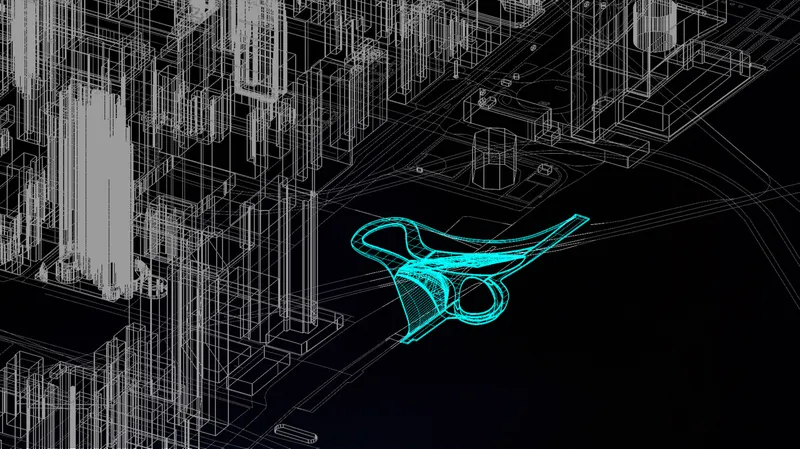
The axonometric wireframe reveals the project's core formal logic: three parabolic lobes, each a distinct structural rib, converge at shared landing points on either bank. The cyan highlight isolates the bridge from its site context, making legible the way the lobes overlap to create sheltered zones at different elevations. It is a clean diagram that communicates the ambition to generate spatial variety from a single repeated element.
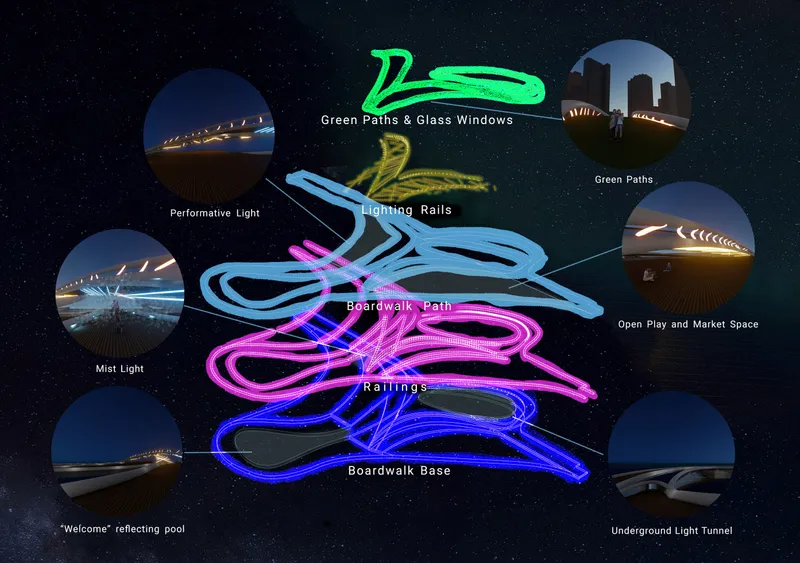
The exploded diagram breaks this further into its constituent systems. Circulation paths peel apart to show how pedestrian flow is distributed across multiple levels, while annotated lighting components reveal the technical backbone beneath the luminous skin. What emerges is a project that treats structure, movement, and illumination as co-dependent layers rather than sequential afterthoughts.
Night as the Primary Design Condition
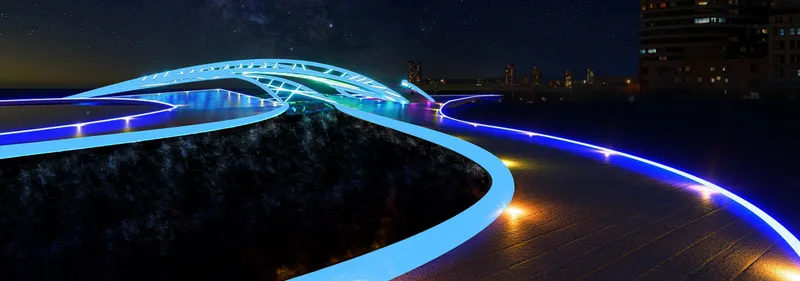
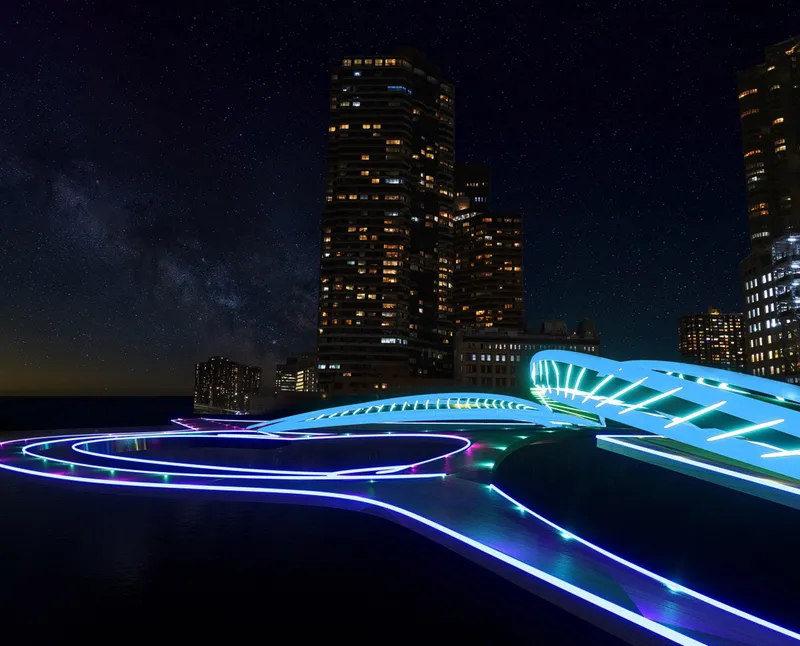
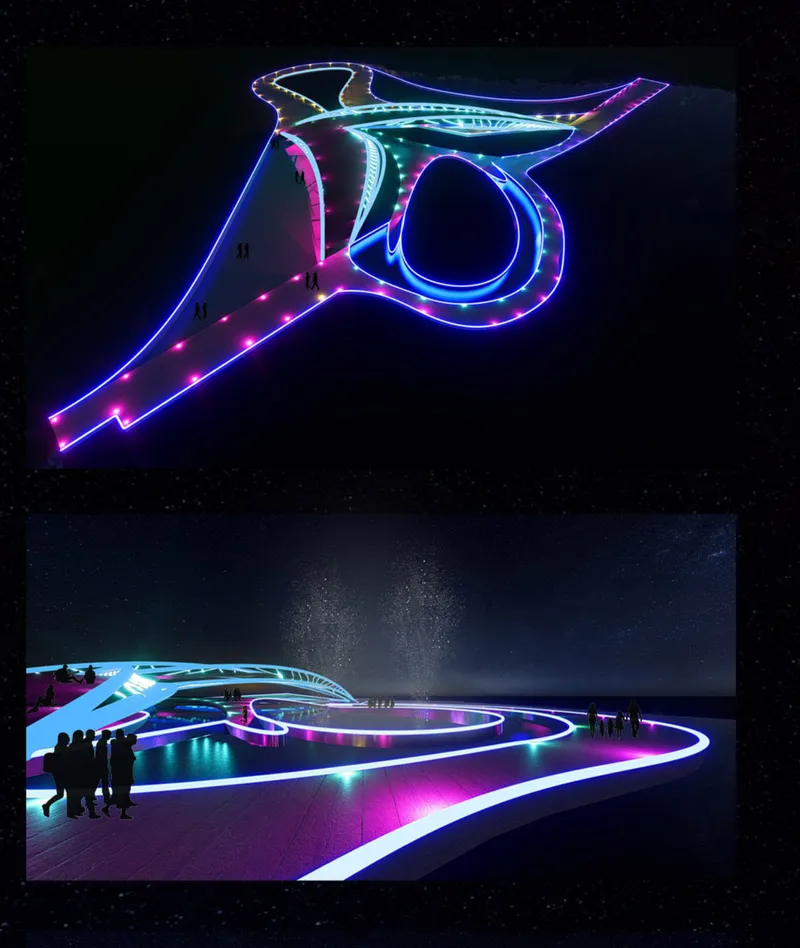
Lightwell District is conceived for darkness. The nighttime rendering of the bridge over the waterway is the project's signature image: three white arches glow against the black water, their reflections doubling the structure's presence. The designers understand that light is not decoration here but material, defining edges, depth, and mood in a way that daylight alone cannot. The curving rooftop view reinforces this commitment, showing blue and purple light trails streaming beneath the structure as if the bridge were exhaling color into the night sky.
Walking Beneath the Arches
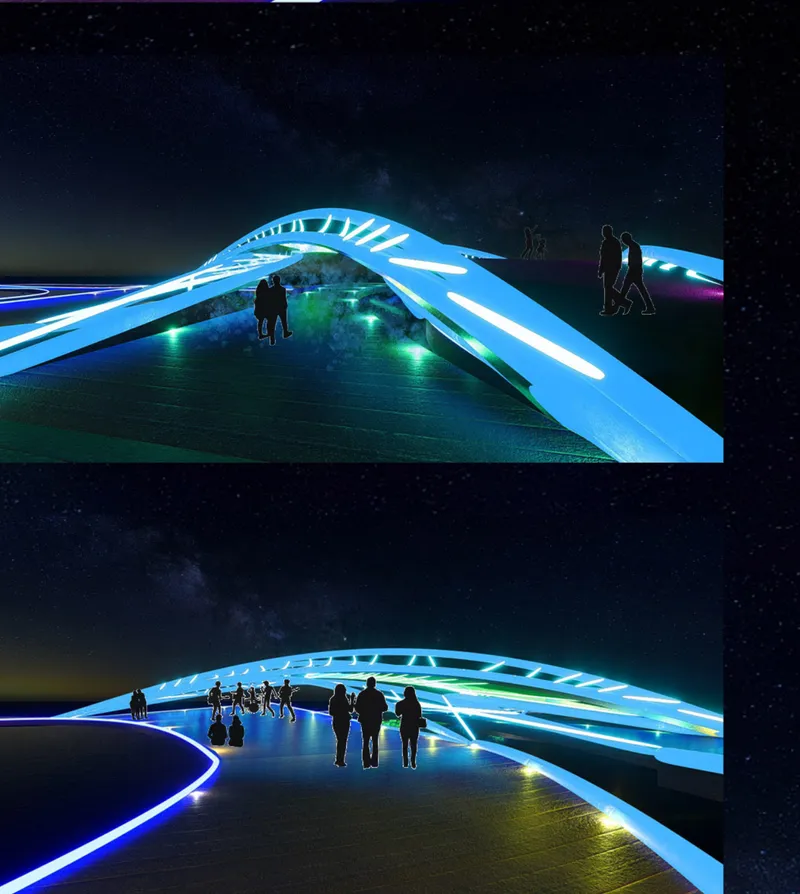
From the deck level, the experience shifts from spectacle to intimacy. Visitors walk beneath the white arched ribs as they converge overhead, creating a canopy that frames the sky. The human figures in the rendering are not incidental; they ground the scale, showing that the space between the ribs is generous enough to feel open yet defined enough to feel sheltered. It is the kind of threshold condition that good public architecture thrives on.
The aerial view confirms that the bridge performs as a gathering surface, not just a linear path. Multicolored LED gradients wash across the deck, and clusters of visitors linger at points where the lobes widen. The geometry encourages pause. The designers have avoided the common trap of making a bridge feel like a corridor, instead producing a topography of light and structure that rewards lingering.
Urban Scale and Contextual Reach
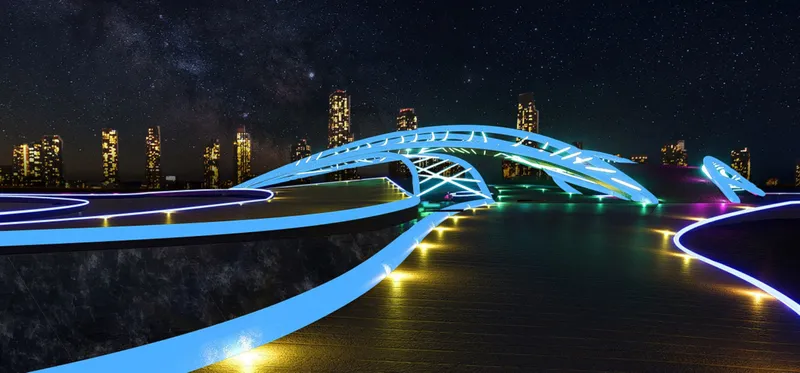
The long view anchors Lightwell District in its urban context. Highrise towers stack up in the background while a planted median extends beneath the bridge's span, suggesting that the project is conceived as part of a larger landscape strategy. The bridge's illumination holds its own against the towers' scale, a deliberate assertion that civic infrastructure can compete with commercial development for visual and social prominence. It reads as both a connector and a counterpoint to the vertical city around it.
Why This Project Matters
Farhodov and Barrera have identified something that many urban designers overlook: the pedestrian bridge is one of the few remaining building types that can simultaneously serve transit, create public space, and operate as civic symbol. By tripling the structural rib and saturating it with programmable light, they have turned a utilitarian crossing into a place that people would choose to visit. The tri-lobed geometry does real spatial work, generating variation in section and plan that keeps the experience from becoming monotonous.
The project's commitment to nighttime experience is its sharpest move. Too many competition entries treat lighting as a final render flourish. Here, it is the organizing principle. Structure follows light, and public life follows both. Lightwell District makes a convincing case that the next generation of urban infrastructure should be designed for the hours when cities actually come alive.
View the Full Project
About the Designers
Designers: Farruh Farhodov, Cesar Barrera
Enter a Design Competition on uni.xyz
uni.xyz runs architecture and design competitions year-round that reward proposals with spatial conviction and real site intelligence.
Project credits: Lightwell District by Farruh Farhodov, Cesar Barrera Ella Malicay (uni.xyz).


Popular Articles
Popular articles from the community


Singing Woman: Contemporary Architecture Inspired by Estonia’s Voice and the Sea
Singing Woman turns Estonia’s song culture into flowing opera house architecture, blending public life, landscape, sea, and national memory.

Tsunami Convergenics: Turning Catastrophic Ocean Forces into Underwater Housing Infrastructure
A speculative underwater settlement off the coast of Onagawa, Japan, treats tsunamis and typhoons as energy sources rather than threats.

Extended Shell: Retrofitting Kolkata's Balconies as Living Urban Thresholds
A modular retrofit system recovers the social and environmental intelligence of Kolkata's historic verandas for contemporary Park Street residents.

Manzana Morphosis: Stretching Barcelona's Grid into a Living Landscape for 2050
A radical reworking of the Eixample manzana turns density into a tool for generous public space, vertical ecology, and environmental performance.

Similar Reads
You might also enjoy these articles

Day and Night Park: A Time-Based Urban Newsstand in Beijing
A temporary urban newsstand in Beijing blending travel, light, and reading through poetic colors, compact form, and community-focused design.

Modernist Patio Renovation in El Masnou, Barcelona by Oliver Segura Arquitectura + Cebrià Arquitectura
Modernist patio renovation blending tradition and innovation with a movable pool, leveled floors, and Catalan materials in El Masnou.

Alto Residencial Coop: Cooperative Housing Development in Santiago de Compostela by Carbajo Barrios Arquitectos
A linear cooperative housing complex blending white volumes and perforated metal façades, enhancing community living, natural light, privacy, and urban integration.

Vil Genis School by BPA ARCHITECTURE – Massy, France
Vil Genis School in Massy, France, features sustainable design, south-facing classrooms, community integration, accessible spaces, and modern educational architecture.


Comments (0)
Please login or sign up to add comments
No comments yet. Be the first to comment!