
Line+Studio and GAD Scatter Five Stone Volumes Across a Yunnan Hilltop to Form a Cultural Center
In Mile, China, red earth pigment and canyon-like spaces turn a terraced plateau into a geological event disguised as architecture.


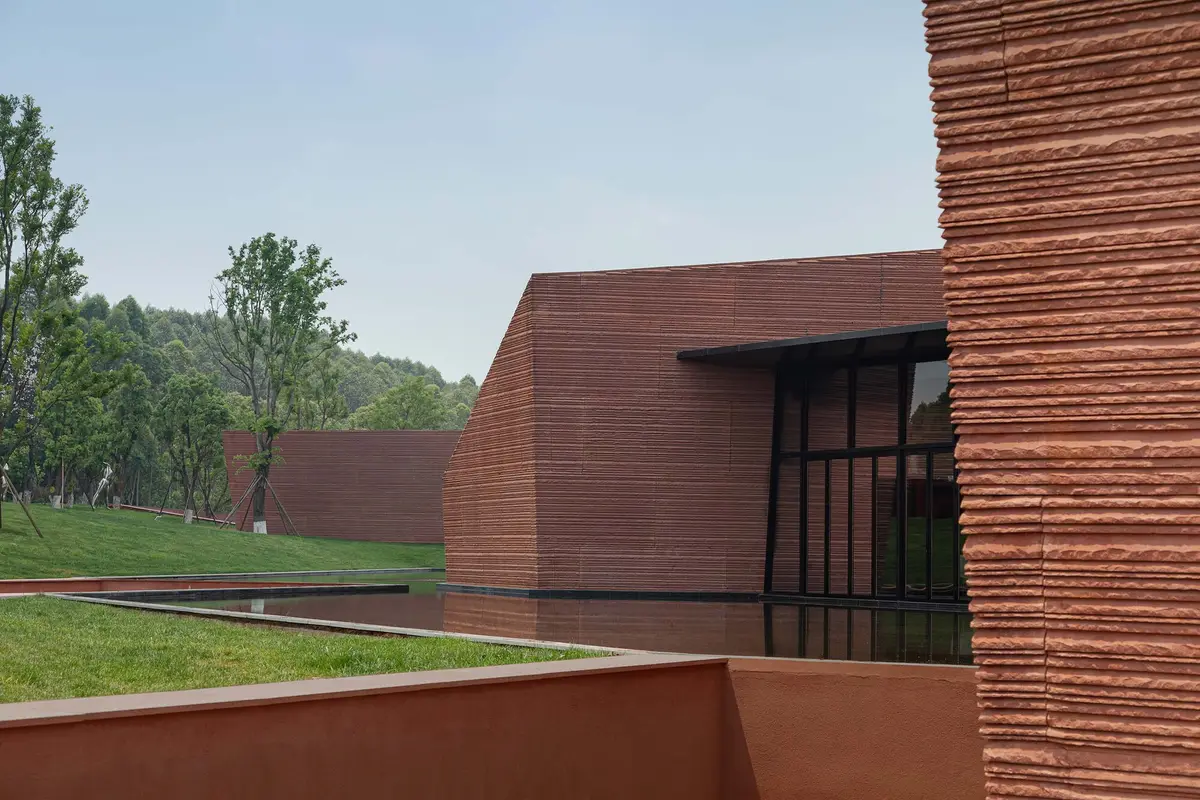
Architecture that tries to look like landscape usually ends up looking like neither. The Red Stone Formation Cultural Center, a collaboration between Line+Studio and GAD, is one of the rare cases where the conceit works. Five angular volumes, clad in red GRC panels infused with local soil, sit on a terraced hilltop outside Mile City in Yunnan Province like boulders half-buried by geological time. The color is not decorative. It is extracted from the ground beneath the building, a literal translation of the Yunnan-Guizhou Plateau's iron-rich earth into a curtain wall system.
What makes the project genuinely interesting is its refusal to behave like a civic monument. There is no grand axis, no symmetrical facade, no processional approach. The five stone-like volumes are arranged asymmetrically around a glass atrium, each housing a different function: exhibition halls, a theater, lecture spaces. Visitors navigate a five-to-six-meter height difference as though walking through a mountain canyon, arriving at the central atrium not by ceremony but by discovery. At nearly 10,000 square meters, the building is substantial, yet its massing fragments it into something that reads as a cluster rather than an institution.
A Geological Disguise on the Plateau
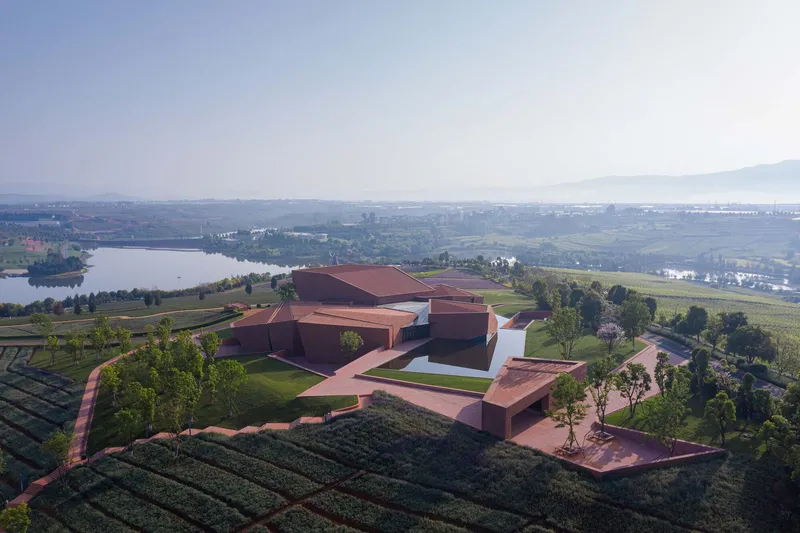

From the air, the cultural center reads as an outcrop. The angular red roofs emerge from terraced gardens and agricultural plots, their color nearly indistinguishable from the tilled soil around them. The site was deliberately relocated to a prominent hilltop overlooking the Dongfengyun Art Town, a sprawling creative community that artist Luo Xu has been building with red brick installations and tile kilns since 2014. The architects inherited that material vocabulary and translated it into a contemporary construction system.
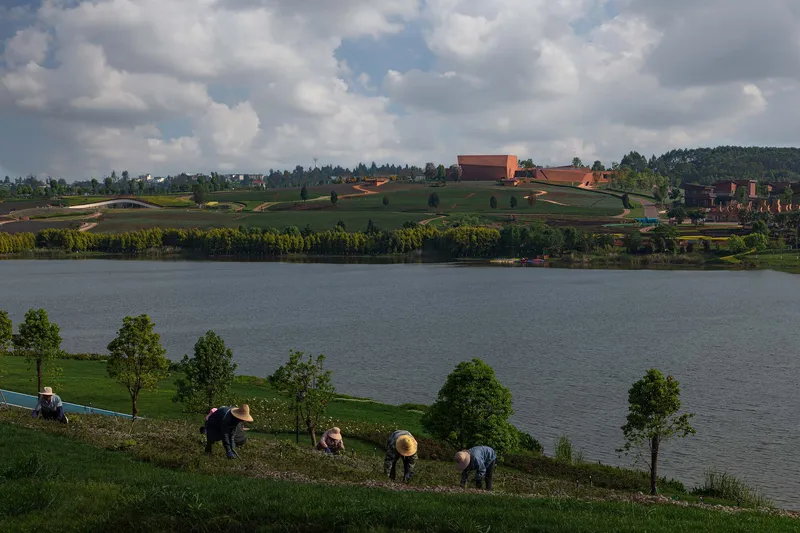
The distant views across the lake reveal how the building negotiates its terrain. Rather than flattening the slope, the volumes step down the hillside, their rooflines mimicking the cadence of the surrounding mountains. At twilight, the massing dissolves into silhouette, and the building looks less placed than grown.
Red Skin, Local Soil


The exterior cladding is the project's most technically ambitious move. GRC panels, cast with local red soil mixed into the concrete, are hung as a dry curtain wall system. The result is a horizontally striated surface with hidden joints that wraps continuously around curved and angular volumes alike. The system allows for large veneer plates and sharp edges while minimizing visible construction traces, a critical detail when the entire building depends on the illusion of monolithic mass.
The reflecting pool at the base amplifies the effect. In still conditions, the red volumes double themselves in the water, and the boundary between building and ground becomes genuinely ambiguous. It is a simple landscape move that earns its keep. Up close, the horizontally lined texture gives the panels a sedimentary quality, as though the walls were compressed layers of the plateau itself.
Canyon Interiors and Column-Free Spans

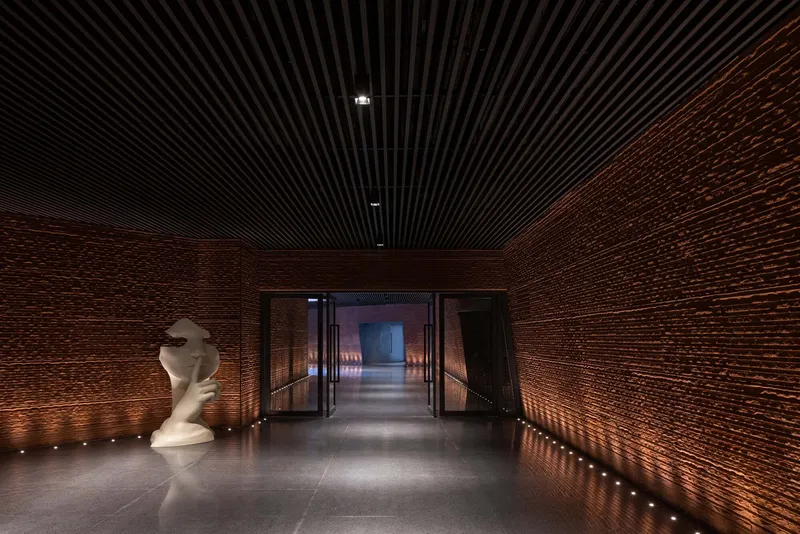

The canyon metaphor extends inward. Interior galleries are lined with the same textured red walls, and the slatted black ceilings create a compressed atmosphere that recalls narrow gorges more than white-cube galleries. Recessed floor lighting washes the walls from below, emphasizing their rough, geological texture. The effect is immersive without being theatrical.
The exhibition hall achieves a column-free span of 35 meters east to west, while the glass atrium stretches nearly 24 meters. These are serious structural feats for a steel-frame building in a seismic zone rated at level 8 or higher. The auditorium, with its timber tread stairs and blackened ceiling, functions as both performance venue and informal gathering space. The architects used a wet pasting technique to extend the exterior wall texture to interior surfaces and the roof, reducing both material thickness and cost while maintaining visual continuity between inside and out.
The Rooftop as Public Ground


The rooftop terraces are treated as extensions of the surrounding terrain rather than afterthoughts. Salmon-colored paving flows between angled red brick parapets, creating outdoor rooms that frame views of the lake and mountains. The drone view reveals how the angular roofs and curving boundary walls interlock with the agricultural plots below, reinforcing the idea that the building is an inhabited landform.
This is where the asymmetrical layout pays its biggest dividend. Because there is no dominant facade or axis, every rooftop vantage point offers a different composition of volume, landscape, and sky. The building resists the urge to tell you where to stand.
Models and Massing

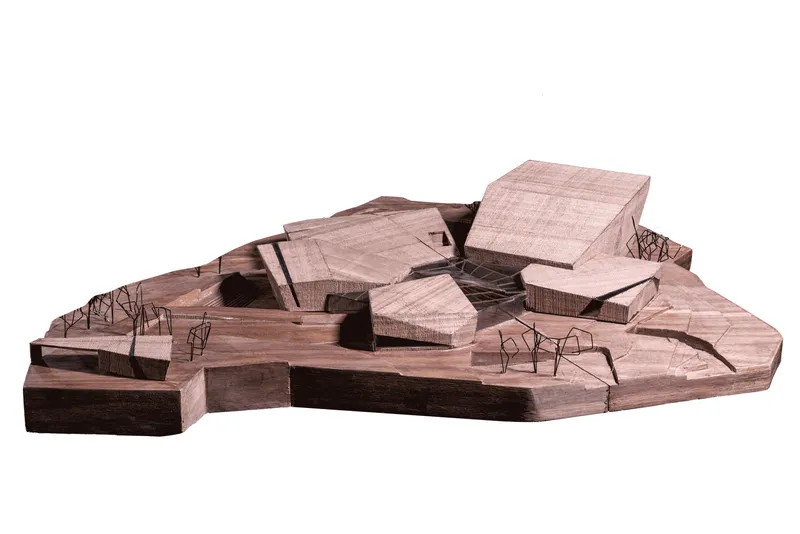
The physical models clarify the compositional logic. Three to five interlocking volumes radiate from a central courtyard, their angular forms loosely clustered on a topographic base studded with wire trees. The models show how the architects tested the relationship between solid mass and connective void, arriving at an arrangement where the glass atrium acts as a geological fissure between the stone-like bodies.
What the models also reveal is the project's debt to the existing art town. The scale and grain of the cultural center is calibrated to the surrounding sculpture installations and kilns, not to an abstract urban grid. It is a building designed to be a neighbor, not a landmark.
Plans and Drawings
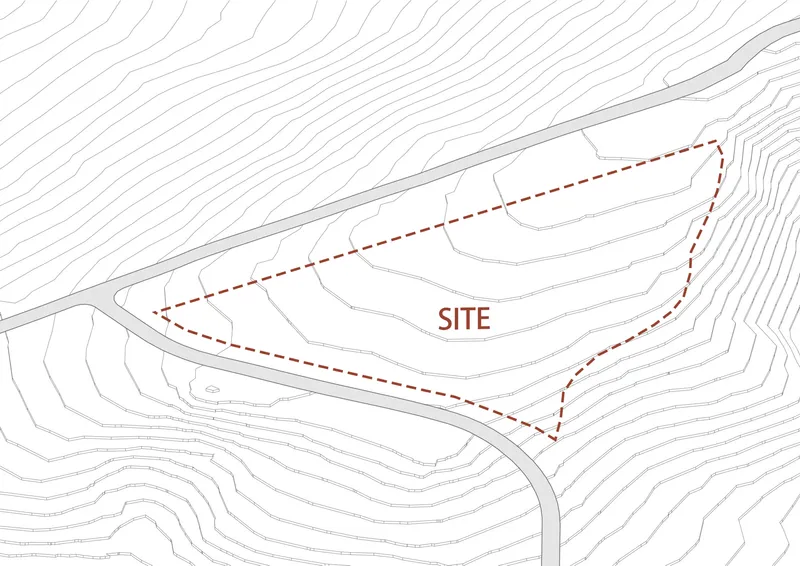

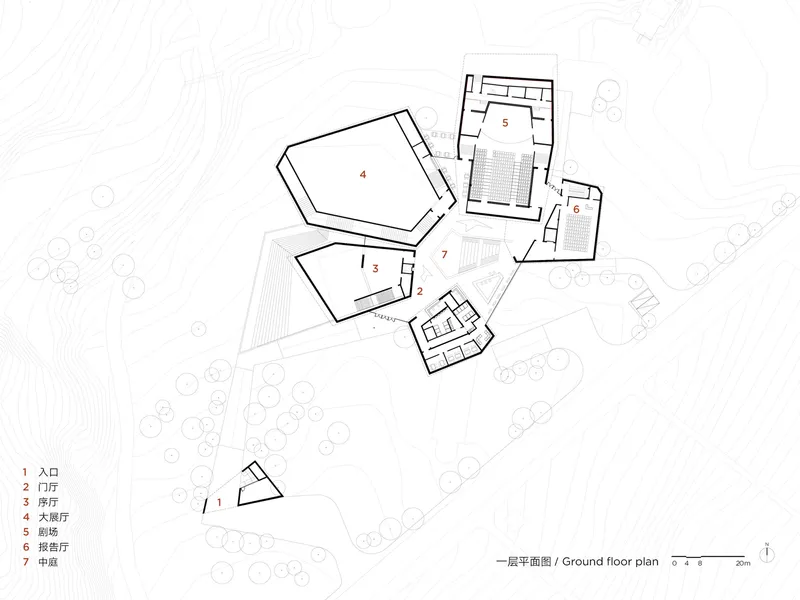
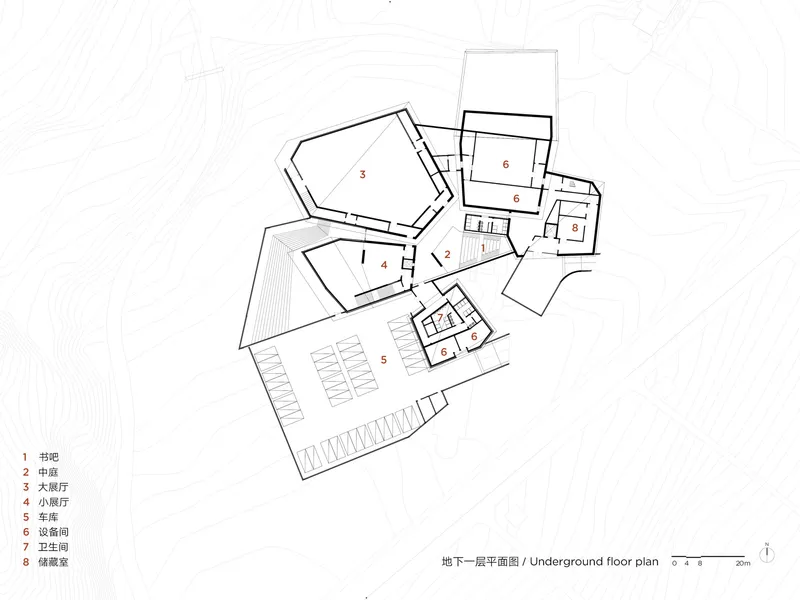
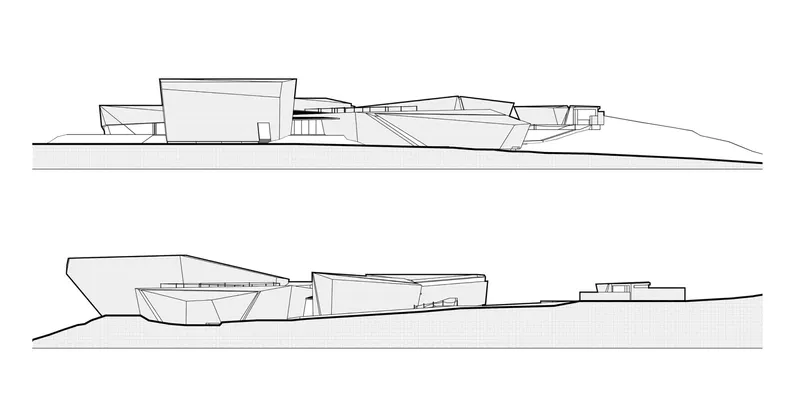


The site plan and topographic drawing make explicit what the photographs hint at: the building occupies a sloped triangular parcel, and its five volumes are arranged to navigate contour lines rather than ignore them. The ground floor plan shows numbered angular volumes radiating from a central circulation spine, while the underground plan reveals a parking level and service spaces tucked beneath. Sections cut through the complex illustrate how the volumes embed themselves in the slope, with interior staircases bridging the five-to-six-meter height difference.
The construction details are worth studying. The curtain wall assembly drawings show the angled GRC panel connections to floor slabs, the layered rain screen build-up, and the roof overhang with its suspended lighting track and aluminum panel system. These drawings demonstrate the technical rigor required to make a building look effortless: every sharp edge, every hidden joint, every seismic connection is the result of careful engineering. Civil construction was completed in under half a year, a timeline that speaks to the efficiency of the prefabricated panel system.
Why This Project Matters
The Red Stone Formation Cultural Center succeeds because it commits fully to its premise without letting that premise overwhelm the architecture. The geological metaphor is not a shape exercise. It is embedded in the material system (local soil in the GRC mix), the spatial sequence (canyon-like interiors), and the site strategy (volumes stepping down a hillside). When a building claims to be inspired by landscape, the question is always whether it would survive without the explanatory text. This one does. The red volumes look like they belong on the plateau because they are, quite literally, made of it.
The collaboration between Line+Studio and GAD also offers a model for how multi-office teams can produce coherent work. The building does not read as a committee product. Its asymmetrical massing, its rigorous material palette, and its refusal of civic grandeur all point to a shared conviction: that a cultural center in rural Yunnan should feel like a place to wander, not a place to be received. In the expanding landscape of Chinese cultural buildings, where spectacle is the default mode, that restraint is itself a statement.
Red Stone Formation Cultural Center, designed by Line+Studio and GAD. Mile, Yunnan Province, China. 9,937 m². Completed 2021. Photography by Ce Wang, Xi Chen, and Lei Sun.
About the Studio
Share Your Own Work on uni.xyz
If projects like this are the kind of work you want to make, uni.xyz is a place to publish your own, find collaborators, and enter design competitions.


Popular Articles
Popular articles from the community


Opera on the Sea: Driftwood Logic Shapes a Timber Opera House on Estonia's Coast
Trevor Orgill's opera house translates the entangled drift of floating timber into a civic building where wood, water, and music converge.


ETEH Reworks the Shared Spaces of São Domingos School in Brazil Around Timber, Color and Hanging Plants
At São Domingos School in Brazil, 436 m² of hall, refectory and library are recast with timber joinery, a yellow and blue code and trailing greenery.

The Amber Palace Opera: A Geological Fiction Surfaces on Tallinn's Baltic Waterfront
Pierre Brillard reimagines a Baltic legend as a public landscape, opera house, and waterfront promenade rooted in Tallinn's coastal identity.

FCC Arquitectura Expands a Portuguese Granite House with a Board-Marked Concrete Wing
In Portugal, JV House pairs a cleaned-up whitewashed and granite dwelling with a timber-shuttered concrete extension, courtyards and a garden pool.

Similar Reads
You might also enjoy these articles

LAVA Architecten Gives Vocational Education a Sawtooth-Roofed Face on a Mechelen School Campus
In Mechelen, Belgium, a 2,053 m² STEM school on a 6×6 m grid turns workshops and classrooms into rooms that can be rearranged as teaching changes.

KEMA Studio Turns a Derelict Marvila Attic into a 60 m² Lighthouse Apartment Above Lisbon
In Lisbon's Marvila district, a rebuilt roof, four skylights and two plywood volumes turn an unlivable attic into a bright home facing the Tagus.

Pixel Gardens: One Repeated Module Stacked Into a Terraced Social Housing Tower for Famagusta
Salem Bader's shortlisted housing tower builds a vertical neighbourhood from one repeated module, offsetting units to carve terraces, light and air.

Bao Huynh Watercolor Atelier: A Serene Art Retreat in Hội An
Bao Huynh Watercolor Atelier in Hội An blends multifunctional art spaces, sustainable design, local materials, and family-friendly living in a serene environment.


Comments (0)
Please login or sign up to add comments
No comments yet. Be the first to comment!