

LYCS Architecture Breaks a Shaoxing Pre-School into Six White Cabins Around a Green Carpet
In one of China's densest old cities, a 16,512-square-meter kindergarten hides four stories of program beneath grass slopes and sculptural rooflines.


A pre-school for eighteen classes could easily become a monolith, especially on a tight urban site hemmed in by residential towers and tile-roofed houses in Shaoxing's old city. LYCS Architecture chose the opposite path: they fragmented the 16,512-square-meter program into six small-scale volumes with asymmetrical double-pitched roofs, arranged them in a U shape around a generous central courtyard, and then pulled a continuous landscape of grass slopes up and over the buildings until the boundary between ground plane and architecture nearly dissolved.
What makes Kincang Modern Pre-School genuinely interesting is not its whimsy (though there are tunnel slides buried in the hillocks) but its strategy of urban repair. Shaoxing's dense old city rarely gets new educational buildings, and the ones it does get tend to be inward-looking fortresses. Here the six cabins face the Xiaoshao Canal, present a soft white aluminum facade to the neighborhood, and invite the surrounding landscape up onto the roofscape. The result is a four-story kindergarten that reads, from most vantage points, like a cluster of small houses sitting on a grassy knoll.
A Village of Cabins in a Dense City
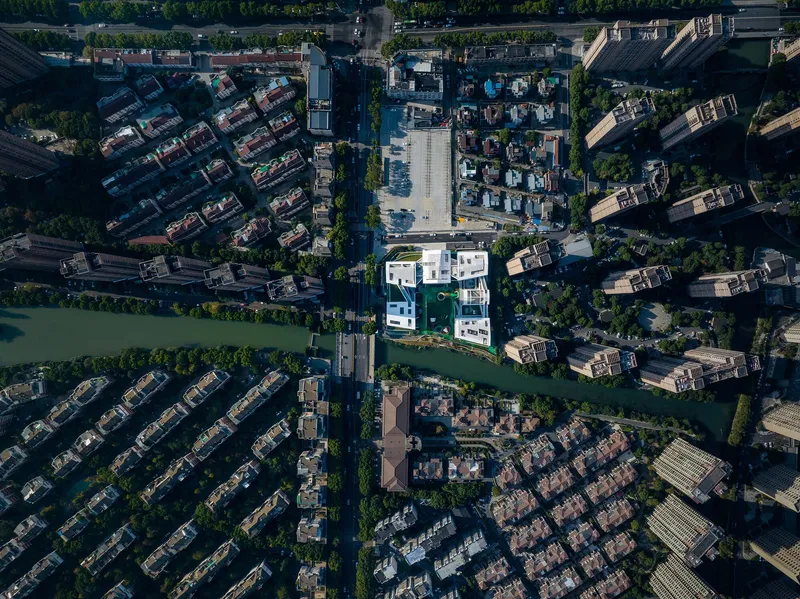
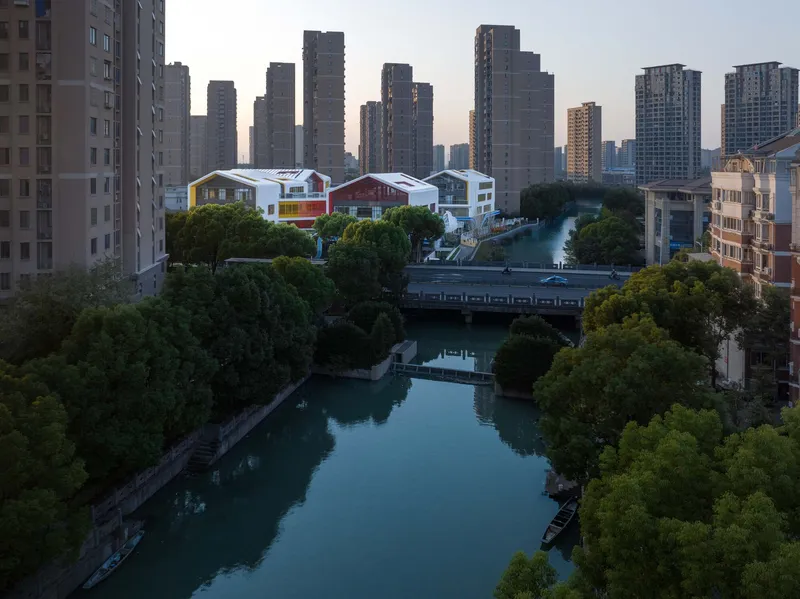
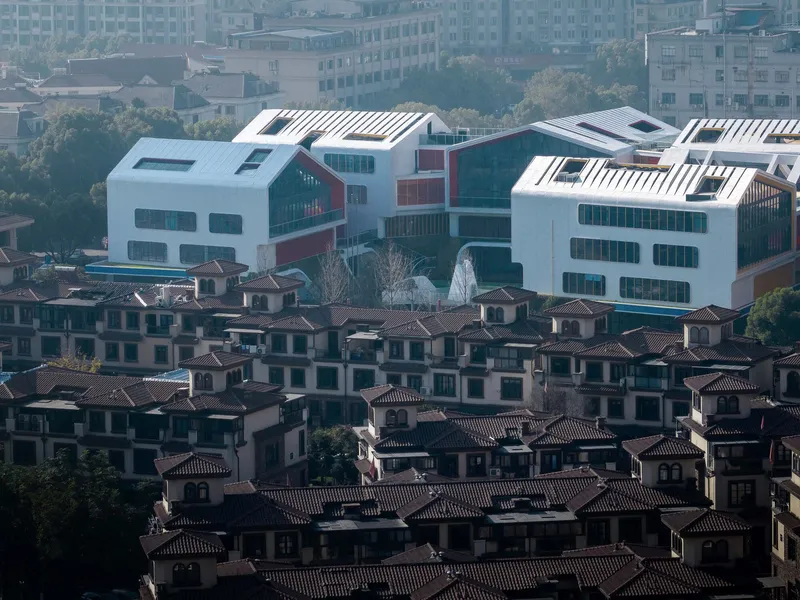
From the air and from the canal, the relationship between the school and its context is striking. Shaoxing's old city is a patchwork of grey tile roofs, mid-rise slabs, and high-rise towers. Into that texture LYCS dropped six white volumes whose ridgelines echo the surrounding pitched roofs but subtly deflect: each ridge is torqued into a hyperbolic curve, producing asymmetrical slopes that give every cabin its own silhouette. The effect is recognizable enough to belong to the neighborhood yet distinct enough to signal something new.
A plot ratio of 1.3 meant that density was non-negotiable. Rather than stack floors into a single block, the architects spread the load across the six cabins and stitched them together at their bases, hiding circulation and shared amenities beneath the green carpet while keeping the roofline low and varied. The school never overwhelms the canal-side townscape the way a conventional four-story block would.
White Aluminum and Warm Accents
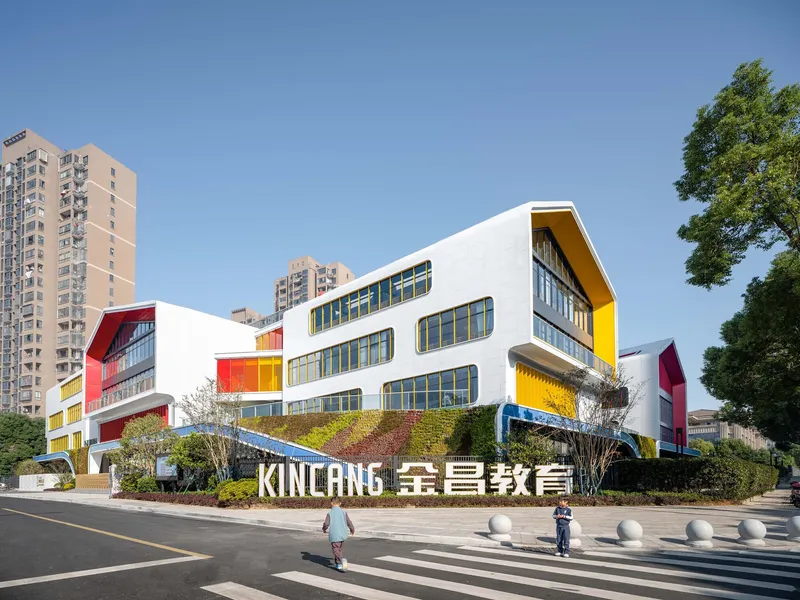
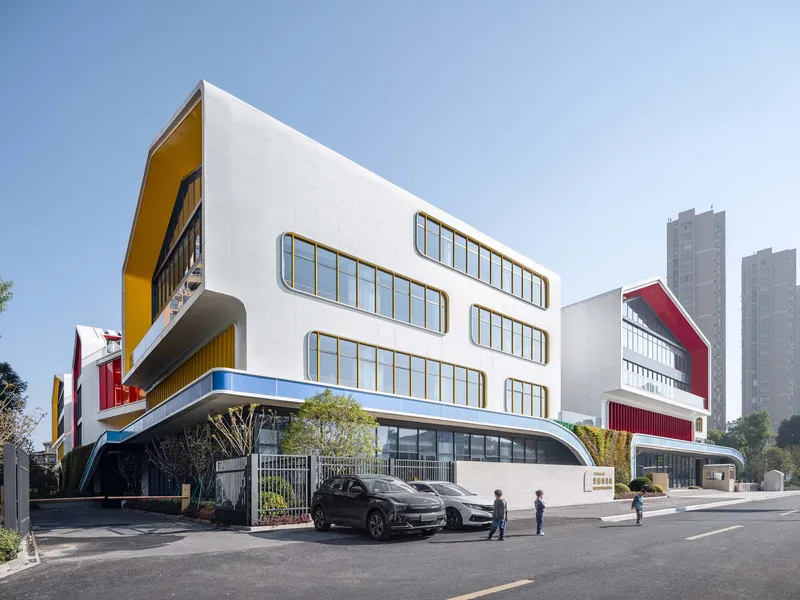
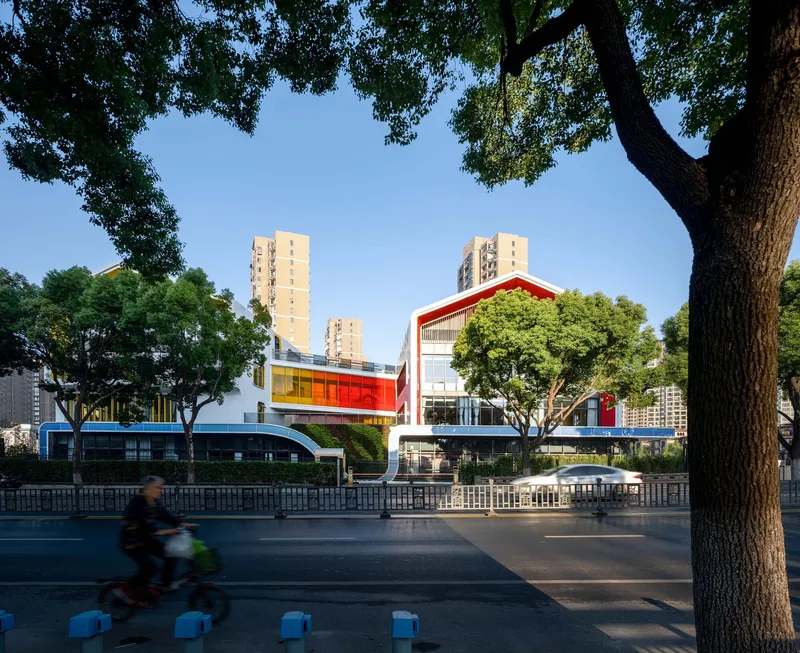
The street-level facade is the school's public face, and it does a lot of work. White aluminum panels form the dominant skin, punctured by horizontal ribbon windows that let daylight deep into the classrooms. Gables and openings are chamfered and rounded, a detail that reads as playful from a distance but is rooted in child safety: no sharp corners at small-person height. Panels of warm yellow and orange-red appear at key openings, hinting at the life inside without resorting to the garish primary-color palette that haunts so much kindergarten design.
Against the backdrop of high-rise residential towers, the school looks modest, almost domestic. A cyclist passing under the mature street trees might mistake it for a housing cluster. That scale negotiation is deliberate. LYCS chose grade-A environment-friendly materials that provide fire resistance and good thermal inertia while keeping the visual weight down. The aluminum cladding weathers cleanly in Shaoxing's humid climate, and its matte white finish reflects light into the narrow streets.
The Green Carpet and the Courtyard
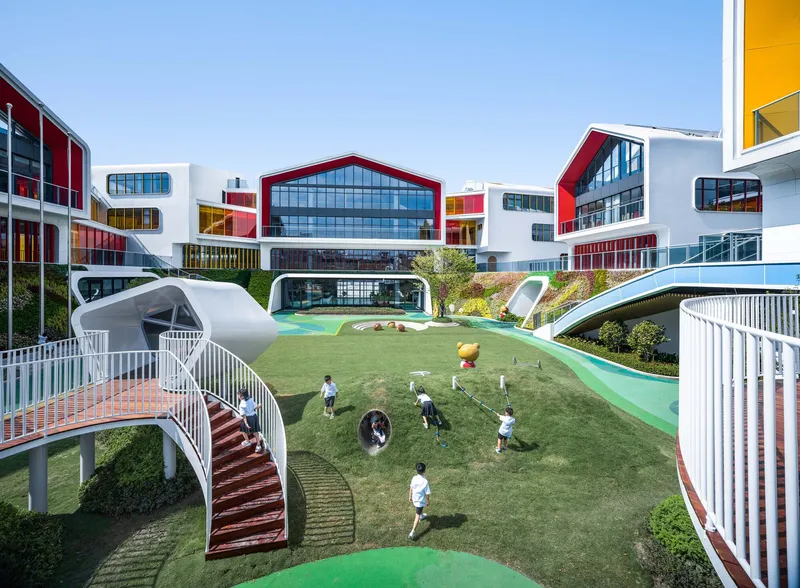
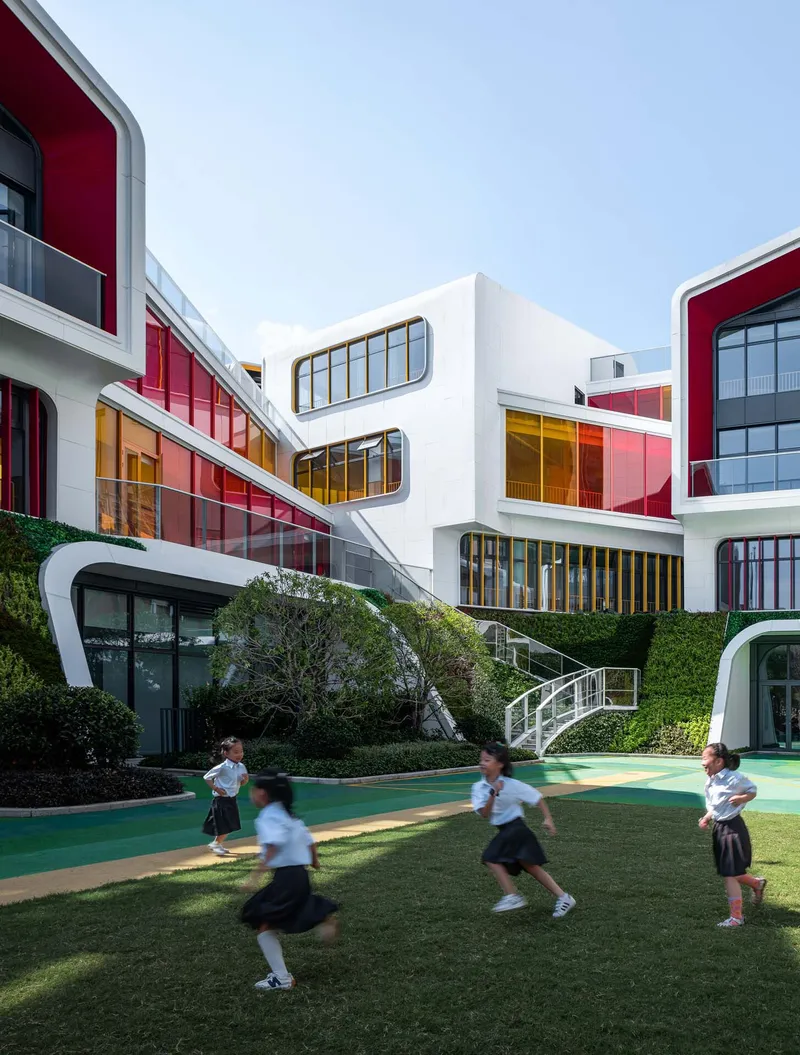
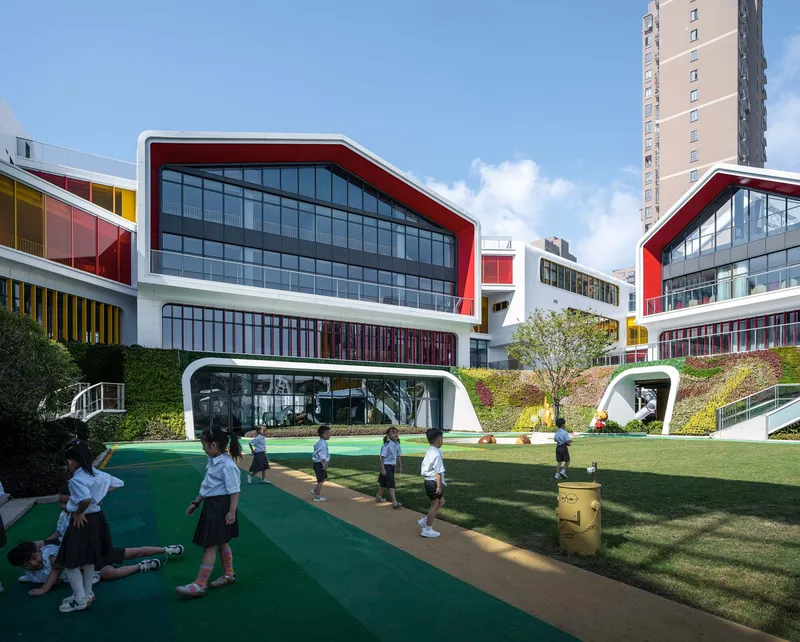
The central courtyard is the engine of the plan. Enclosed on three sides by the U-shaped arrangement of cabins, it provides a protected outdoor room where children gather on a green running track, roll across open lawns, and spill out from portal-like openings at the building's base. Grass slopes ramp upward from the courtyard to the second floor, blurring the line between landscape and architecture. The result is a multi-dimensional play surface: children walk on top of the building as easily as they walk beside it.
This continuous green blanket does more than provide play area. It insulates the concrete structure, manages stormwater, and gives the school a fifth facade visible from the surrounding towers. In a city where most new construction is hard-edged and impervious, the green roofscape is a small act of ecological generosity.
Slides, Tunnels, and Topographic Play
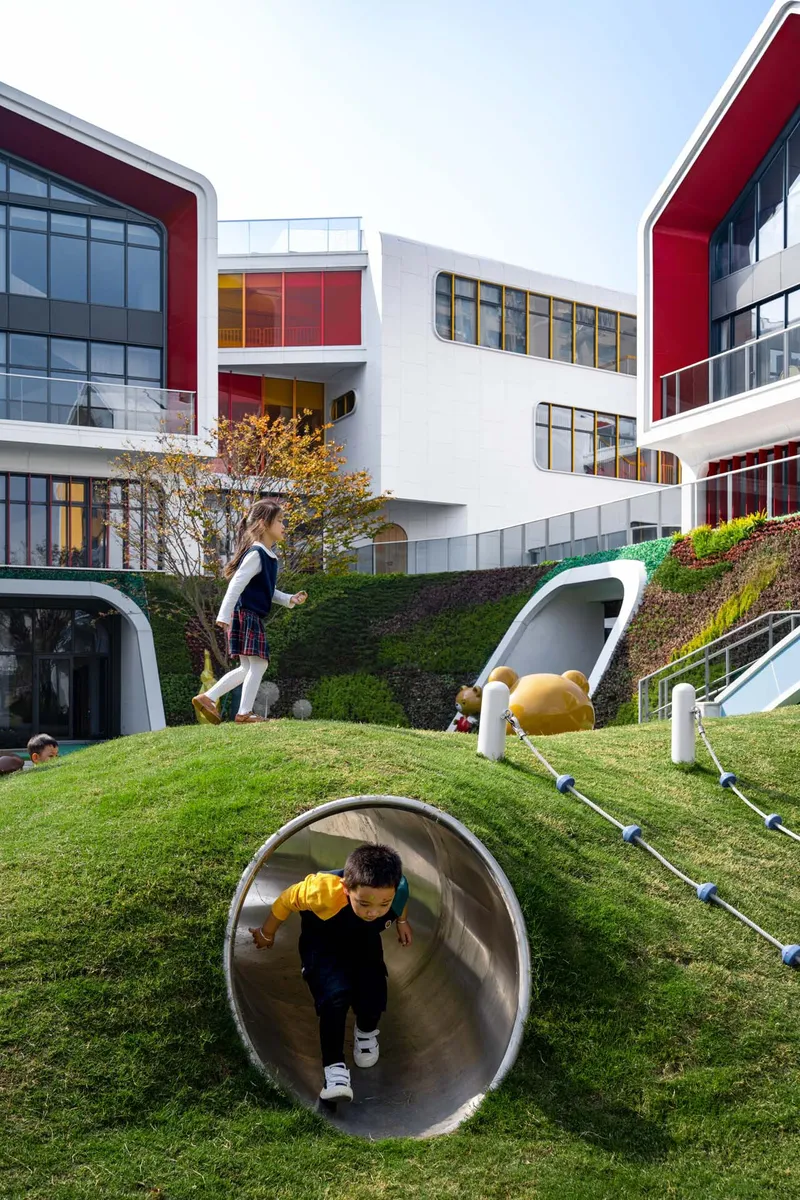
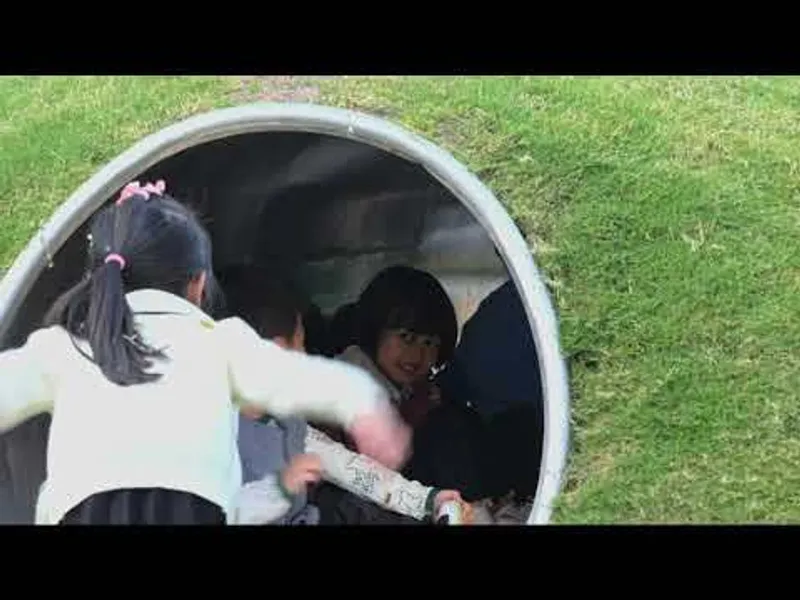
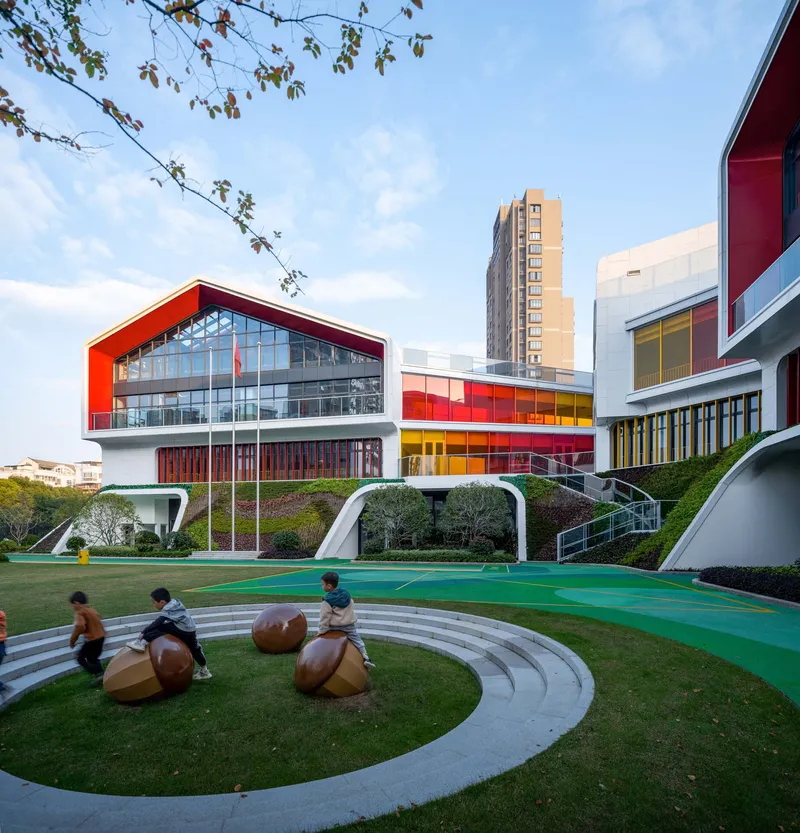
The landscape is not decorative. Tubular slides are embedded directly into the grassed slopes, allowing children to shoot from an upper terrace down to the courtyard. Concrete tunnels, round in section and scaled for crawling, burrow through the hillocks. Circular stepped seating and wooden climbing spheres populate the outdoor play areas, all positioned beneath mature trees that soften the geometry.
The design concept draws on "The Wizard of Oz" and the theme of exploration, but the architects exercise restraint. There are no oversized cartoon characters or thematic murals. Instead, exploration is embedded in the spatial sequence itself: children discover a tunnel entrance half-hidden by grass, negotiate a slope that turns into a slide, or peer through a chamfered opening to see the canal below. The architecture teaches spatial awareness through direct physical engagement, which is more effective than any storybook mural.
Interior Warmth and Flexibility

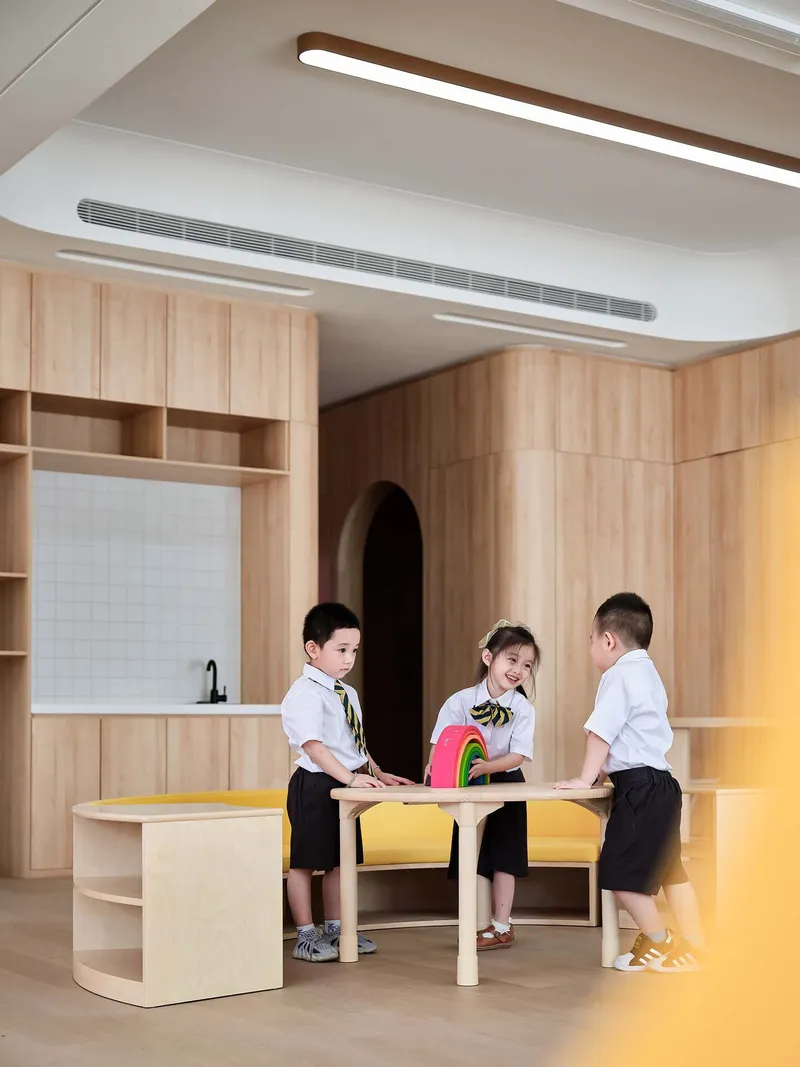
Step inside and the palette shifts. The white aluminum exterior gives way to warm wood tones, light millwork, and white tile surfaces. In the classrooms, each unit contains an activity area, nap room, drinking room, cloakroom, and toilets, all arranged so that furniture can be rearranged freely to accommodate different learning scenarios. The international kindergarten curriculum emphasizes diversified courses under the umbrella of "exploring the future," and the flexible interiors make that ambition spatial rather than rhetorical.
Corridors glow orange through vertical mullions, saturating the circulation zones with warm light that contrasts with the cool white of the exterior. Railing handrails are set at child-appropriate heights, and every corner is rounded. These are quiet, functional decisions, but they accumulate into an interior that feels genuinely considered for its three-to-six-year-old occupants rather than imposed on them. The first-floor active line, which houses a 200-seat theater, a swimming pool, a picture-book library, a basketball court, and a parent-child dining bar, runs beneath the U-shaped perimeter, keeping high-traffic program at ground level and freeing the upper floors for quieter classroom use.
Plans and Drawings
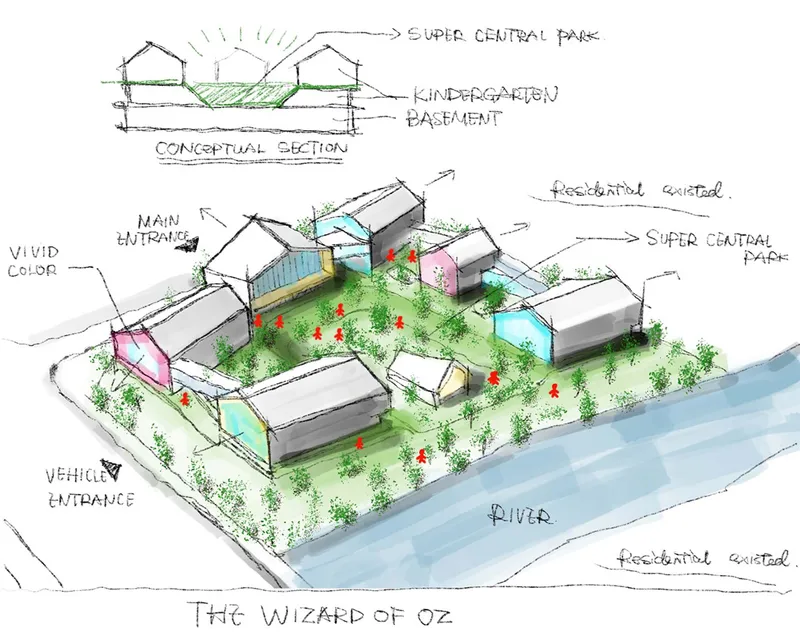
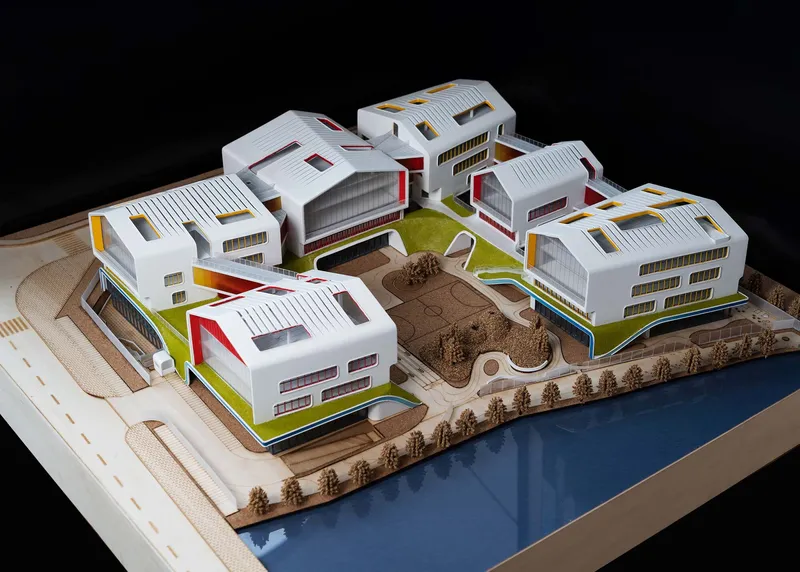
The conceptual sketch and physical model reveal the organizing logic clearly. Six barrel-vaulted pavilions cluster around the central green, their ridges torqued at slightly different angles. Color accents mark entrances and active zones. The landscape is drawn as a continuous topographic surface that wraps from ground to roof, confirming that the green carpet was a founding idea rather than an afterthought. The underground drop-off area, visible at the base of the model, keeps morning vehicle traffic entirely separate from the pedestrian courtyard, a critical safety decision on a site bordered by busy neighborhood streets.
Why This Project Matters
Kindergarten design has been in a renaissance across China for the past decade, but much of that work occupies suburban campuses with generous setbacks and open sites. Kincang Modern Pre-School demonstrates that the same ambition can be realized on a constrained urban parcel in one of the country's densest historic cities. By breaking the program into village-scale volumes, pulling landscape over structure, and embedding play into the topography itself, LYCS Architecture delivers an educational building that contributes to Shaoxing's urban renewal rather than retreating from it.
The broader lesson is one of proportionality. A school for young children does not need to announce itself with spectacle. It needs to offer safety, flexibility, and just enough spatial surprise to make a four-year-old want to explore. The six white cabins along the canal accomplish all three, and they do it without consuming more visual space than the neighborhood can absorb. That balance of civic generosity and architectural modesty is harder to achieve than it looks.
Kincang Modern Pre-School, designed by LYCS Architecture. Shaoxing, China. 16,512 m². Completed 2022. Photography by Qingshan Wu and Shanghai Benxi vision.
About the Studio
Share Your Own Work on uni.xyz
If projects like this are the kind of work you want to make, uni.xyz is a place to publish your own, find collaborators, and enter design competitions.


Popular Articles
Popular articles from the community


Cloaked Colonization: A Mobile Underwater Habitat That Moves Like a Fish
Micah Abaya's shortlisted EHC Pacific entry reimagines ocean settlement as a dispersed network of self-sustaining architectural organisms.
Opera by the Sea Estonia: Three Shells Dissolving Architecture into Tallinn's Coastline
A winning opera house proposal replaces monumental form with interconnected shells that blur the boundary between building, park and Baltic Sea.
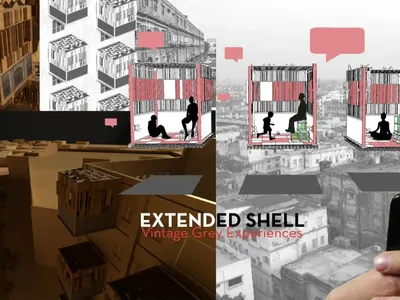
Extended Shell: Retrofitting Kolkata's Balconies as Living Urban Thresholds
A modular retrofit system recovers the social and environmental intelligence of Kolkata's historic verandas for contemporary Park Street residents.

The Amber Palace Opera: A Geological Fiction Surfaces on Tallinn's Baltic Waterfront
Pierre Brillard reimagines a Baltic legend as a public landscape, opera house, and waterfront promenade rooted in Tallinn's coastal identity.

Similar Reads
You might also enjoy these articles

Pixel Gardens: One Repeated Module Stacked Into a Terraced Social Housing Tower for Famagusta
Salem Bader's shortlisted housing tower builds a vertical neighbourhood from one repeated module, offsetting units to carve terraces, light and air.

Bao Huynh Watercolor Atelier: A Serene Art Retreat in Hội An
Bao Huynh Watercolor Atelier in Hội An blends multifunctional art spaces, sustainable design, local materials, and family-friendly living in a serene environment.

Atelier Macri Concept Store Interior Design by CASE-REAL
Atelier Macri store features a "ko" counter, walnut wood details, cork displays, blending retail, gallery, and seamless customer experiences.

Manuel Vargas Izquierdo Stadium and High-Performance Sports Center: Architectural Excellence in Jalpa de Méndez
The Manuel Vargas Izquierdo Stadium blends sustainable design, inclusive sports facilities, and cultural-inspired architecture, revitalizing Jalpa de Méndez’s public spaces.


Comments (0)
Please login or sign up to add comments
No comments yet. Be the first to comment!