

MA+Co and Neometro Turn a Melbourne Industrial Backstreet into a Vertical Neighbourhood
9 Wilson Ave brings 71 dual-aspect apartments, open-air walkways, and a blush-red concrete facade to Brunswick's evolving Jewell Station Precinct.


Brunswick sits at a threshold. The inner-Melbourne suburb's industrial DNA, its brickworks, warehouses, and rail corridors, is being steadily rewritten by medium-density housing. The risk in that rewriting is generic apartment blocks that ignore what made the place legible in the first place. 9 Wilson Ave, the fourth building in the Jewell Station Precinct, takes a different approach. Designed by MA+Co with developer Neometro, the eight-storey project replaces a stretch of car parks and asphalt with 71 apartments, nine commercial tenancies, and a streetscape that genuinely prioritises walking and cycling over driving.
What makes the building worth studying is not any single gesture but the way it stacks several good decisions into a coherent whole. A blush-red pigmented concrete facade nods to Brunswick's brick heritage without cosplaying as a Victorian terrace. Every apartment is dual-aspect, reaching toward both a central courtyard and the surrounding streets. Circulation is open-air, not sealed in air-conditioned corridors, which means the hallways themselves become social infrastructure. Twelve apartments are purpose-built Specialist Disability Accommodation, threaded through the building rather than isolated on one floor. And the street below has been reshaped by landscape architects Mud Office into a planted boulevard. None of these moves is unprecedented, but together they add up to a building that does real urban work.
Blush Concrete and Brunswick's Brick Memory
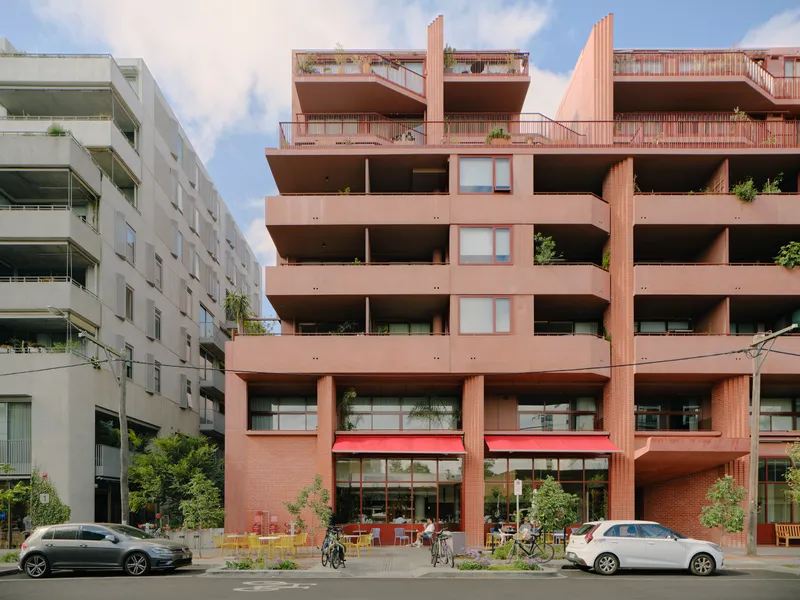
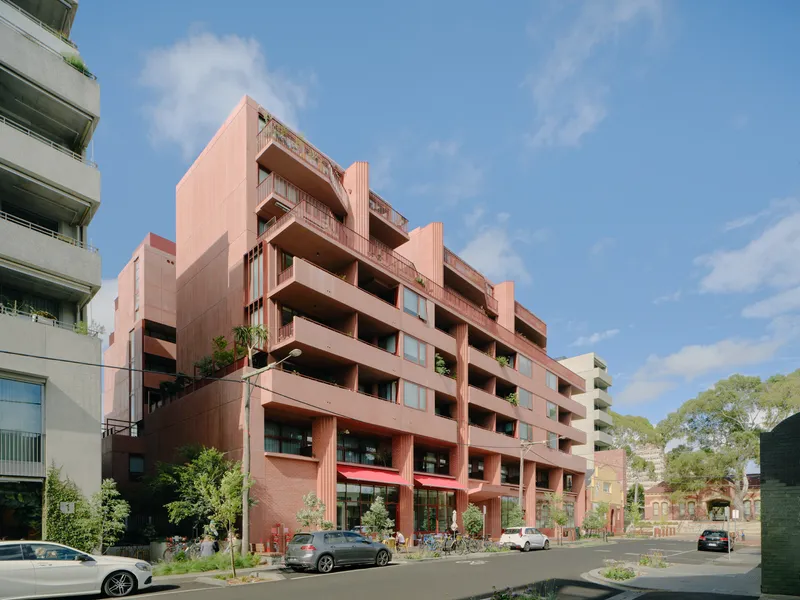
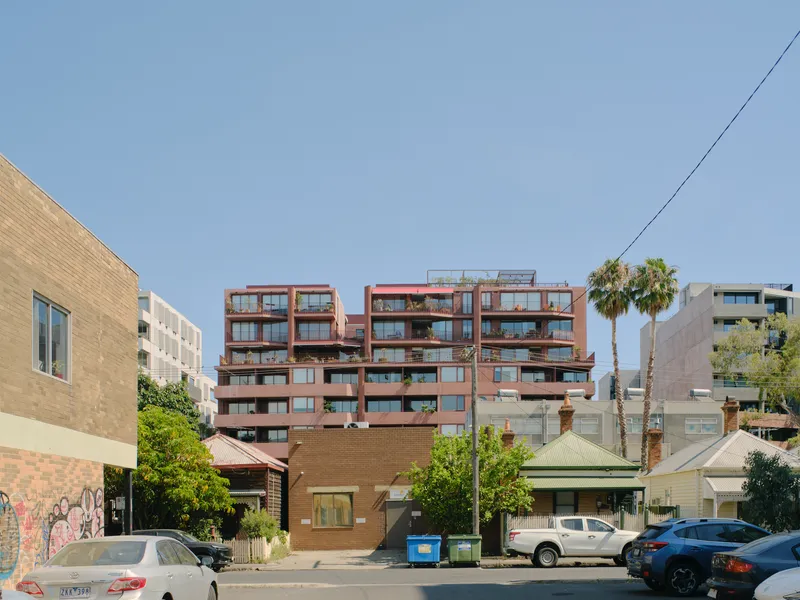
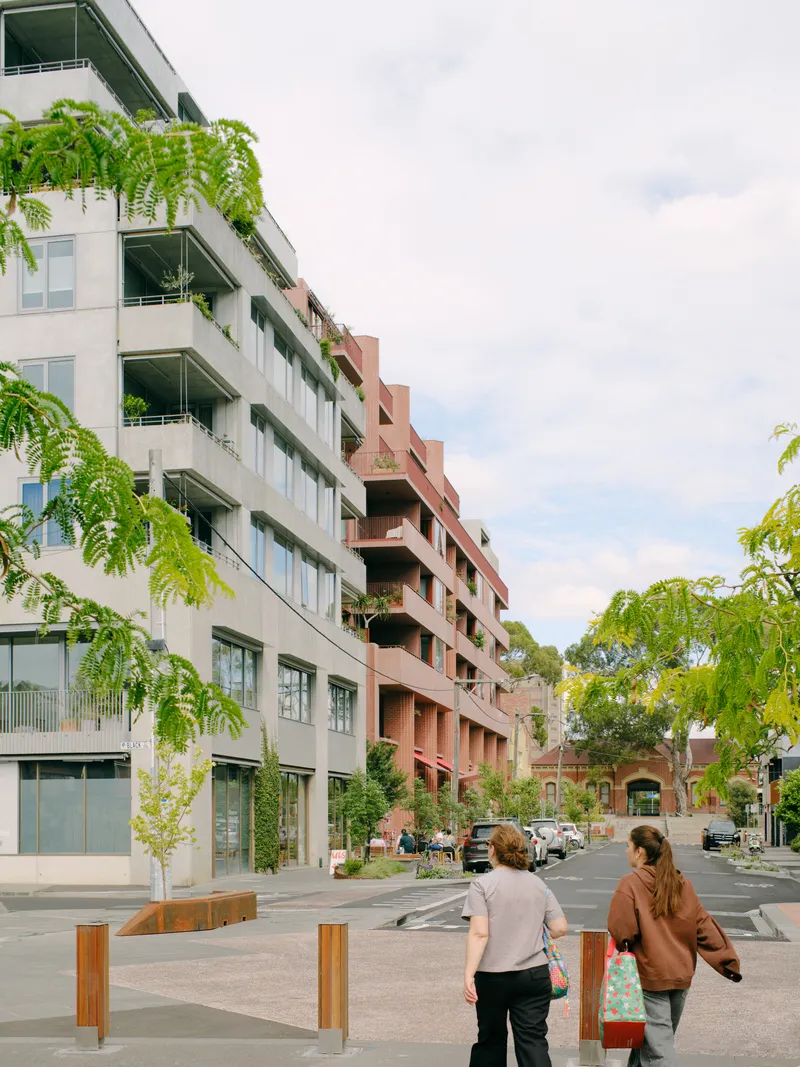
The facade is the most immediately legible decision. Rather than brick veneer or painted render, MA+Co chose a pigmented concrete that reads warm and mineral, somewhere between terracotta and sandstone depending on the light. It is a contemporary abstraction of Brunswick's brickmaking past: the colour connects the building to its context without resorting to pastiche. Deep recessed balconies punctuate the surface, creating shadow lines that break the mass down and give each apartment a usable outdoor room rather than a decorative ledge.
The massing steps back as it rises, reducing the building's apparent bulk from the street and allowing planted balconies to cascade down the facade. Vertical fluted chimneys on the upper levels add rhythm and a slightly civic quality, recalling the industrial stacks that once defined Brunswick's skyline. The overall effect is a building that feels heavy and grounded, not taut and lightweight, which suits the rawness of the suburb.
A Street Redesigned for People
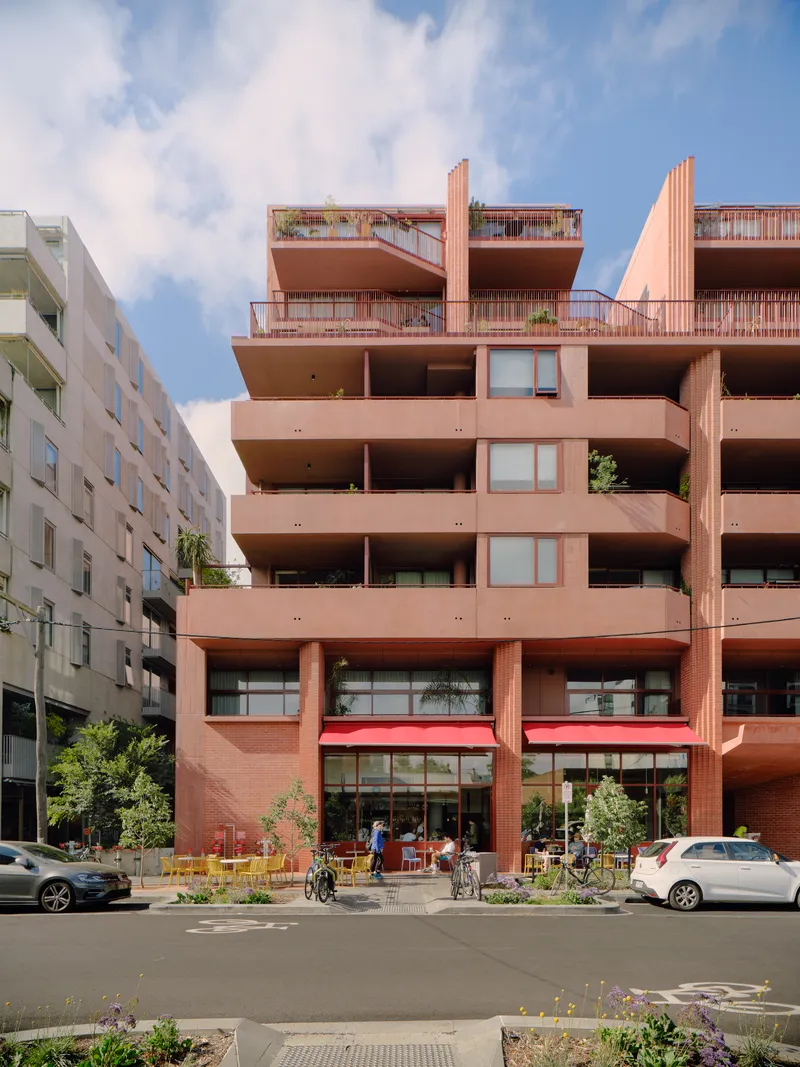
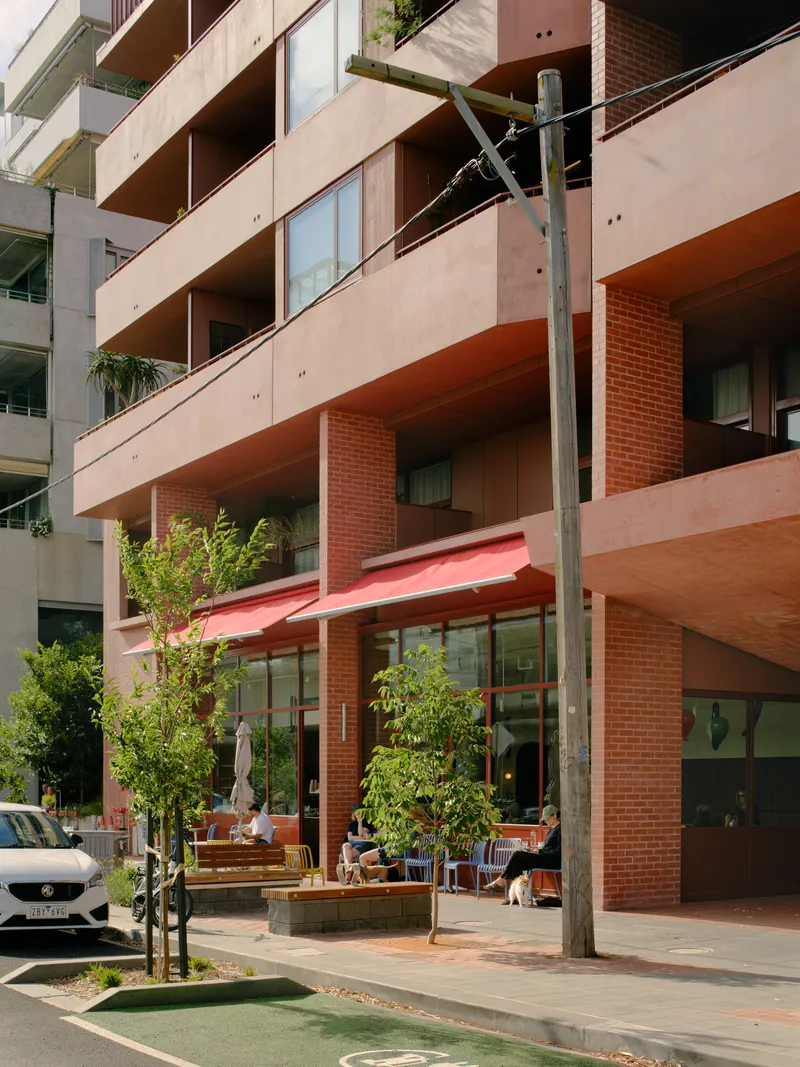
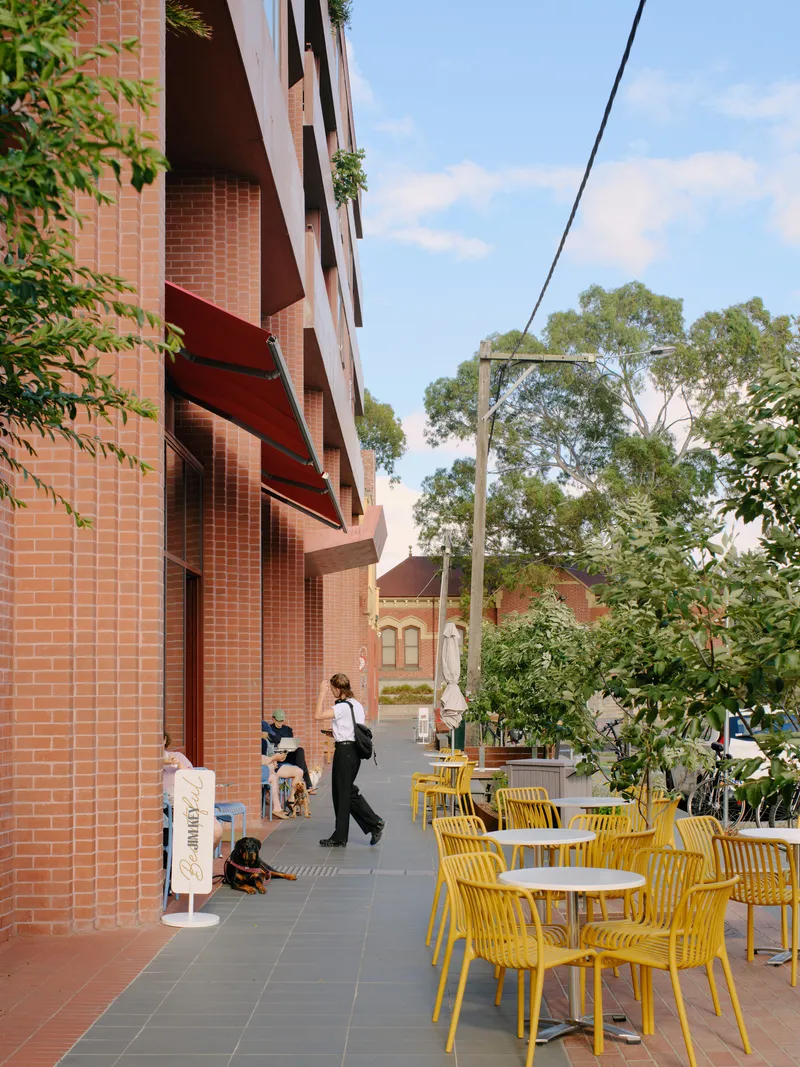
Wilson Avenue was, until recently, the kind of street you drove through on the way to somewhere else. The ground plane of 9 Wilson Ave is designed to change that calculus. A colonnade of red-tinted concrete columns creates a sheltered threshold between public footpath and semi-private retail space. Café seating spills out beneath red awnings, yellow furniture punctuating the earthy tones of the building like signage that says "stay."
Planted beds, timber bench seating, and a deliberate absence of car parking at grade all contribute to a street that now reads as boulevard, not service lane. Mud Office's landscape strategy treats the footpath as an extension of the building's social ambition: a zone where residents, workers, and passersby overlap. It is a convincing demonstration that the ground floor of an apartment building can be as important as any penthouse.
The Courtyard as Organising Heart
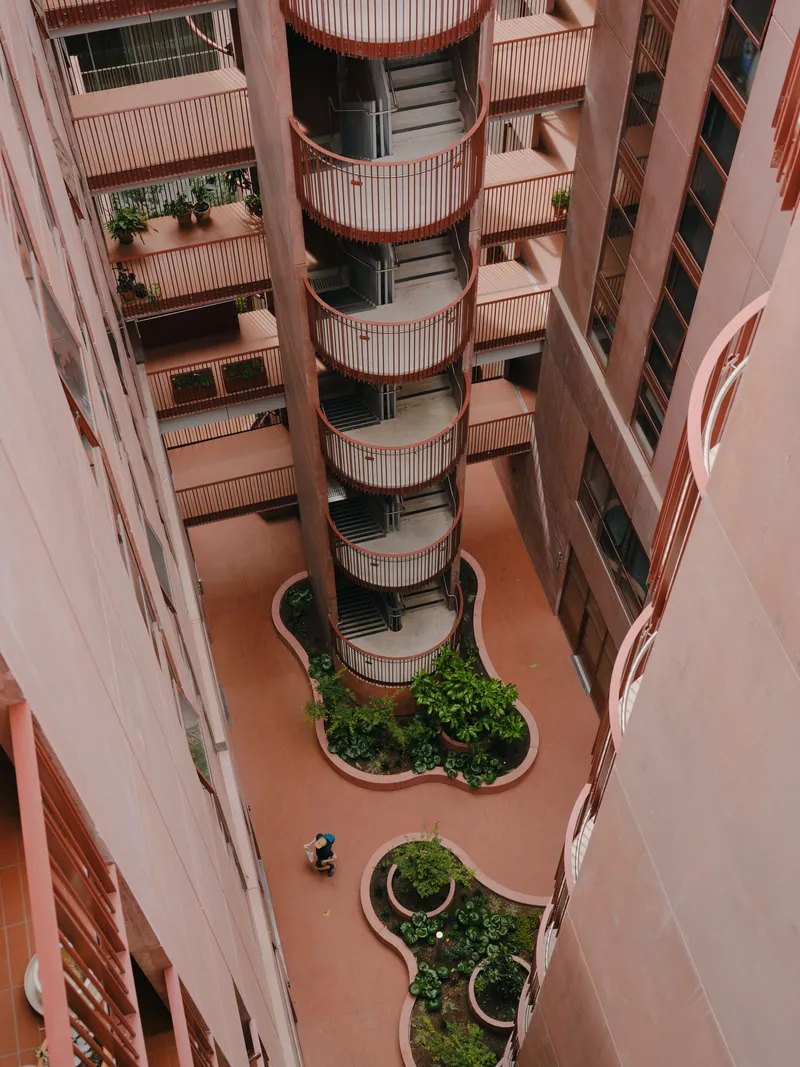
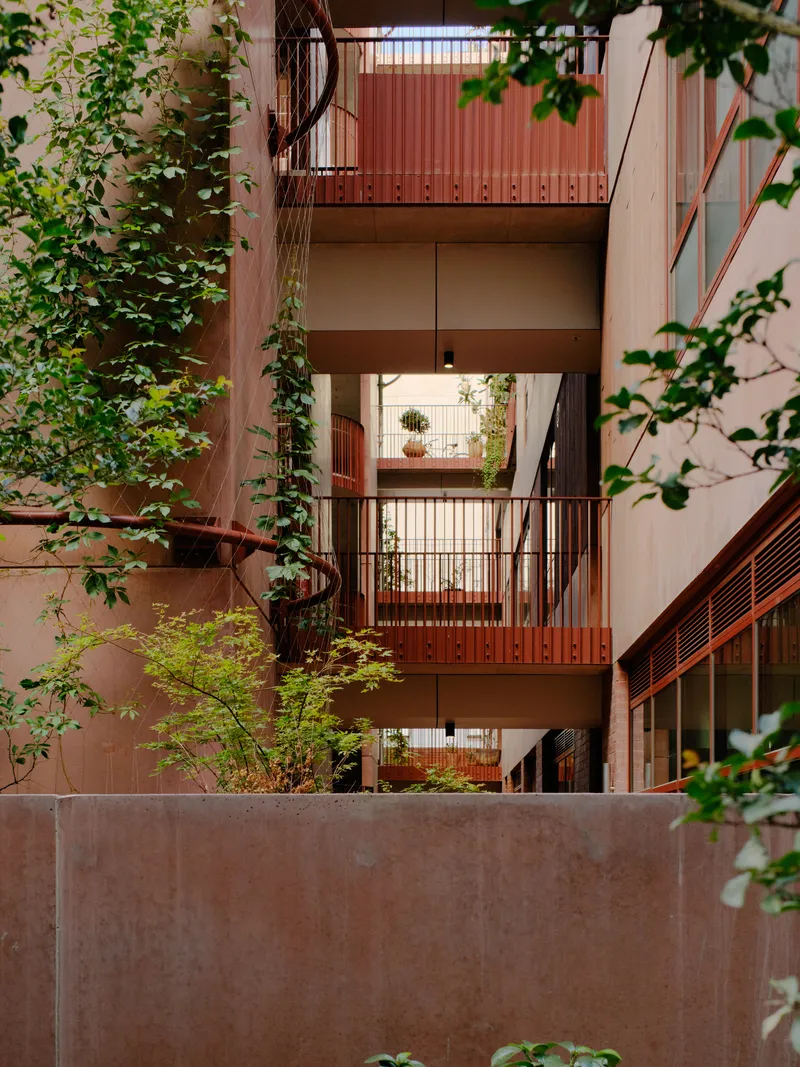
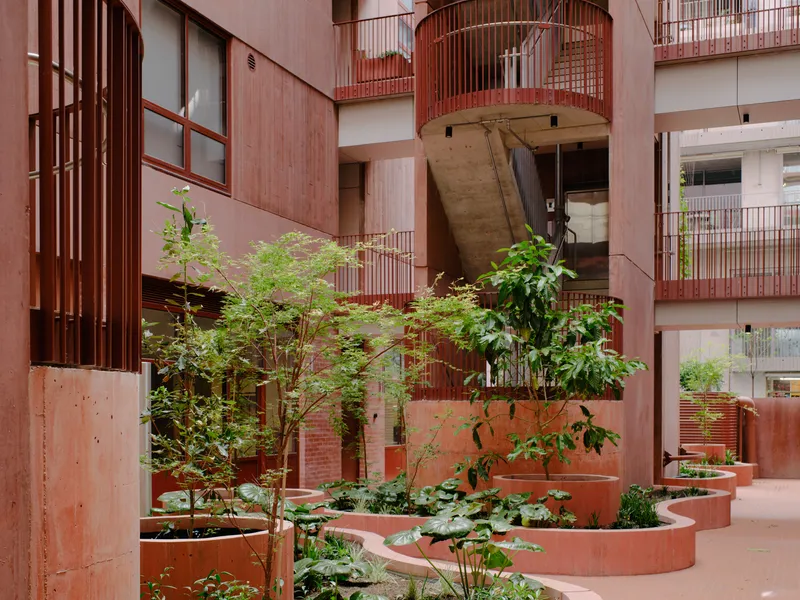
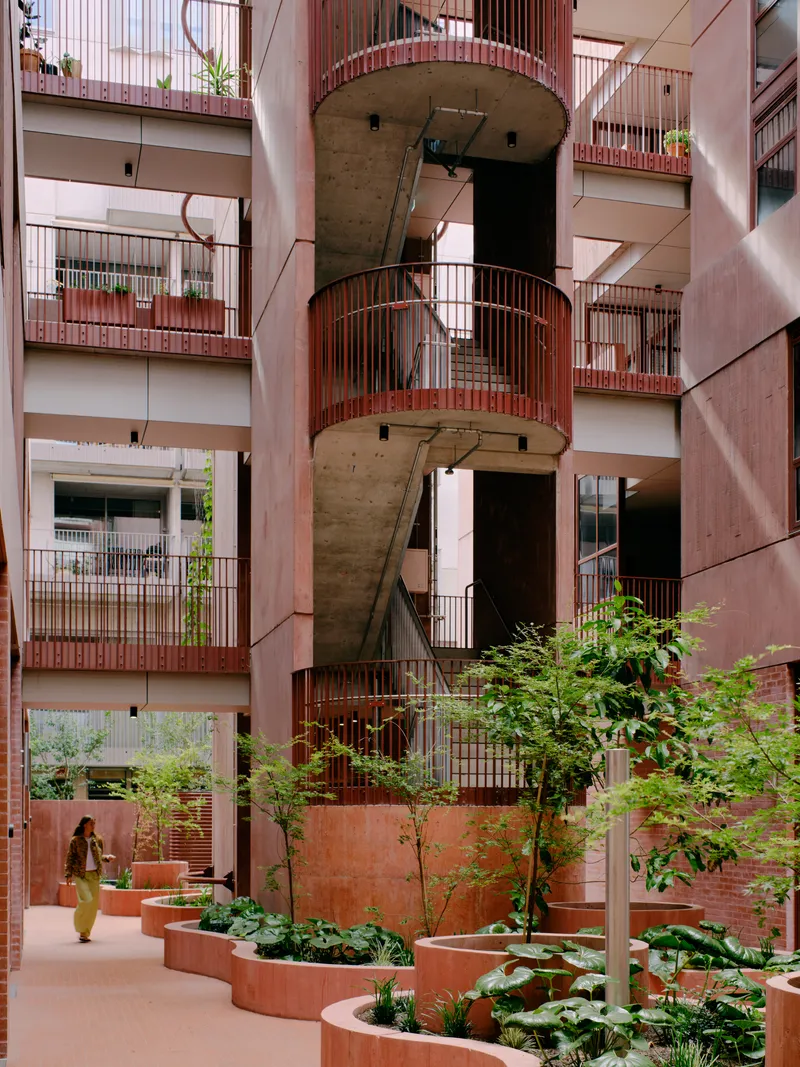
At the centre of the plan sits a landscaped courtyard that does double duty as light well and communal garden. Curved raised planters soften the geometry and introduce planting at a scale that will mature over time, climbing vines already reaching toward the upper levels. A cylindrical balcony tower anchors one corner, giving the courtyard a focal point and breaking the rectangular monotony that plagues many mid-rise schemes.
Because every apartment is dual-aspect, the courtyard is not merely decorative. It provides cross-ventilation pathways and a second outlook for units that might otherwise face only the street. The stacked balconies with metal railings frame views back into this shared green space, reinforcing the idea that residents are part of a vertical neighbourhood, not a stack of disconnected units.
Open-Air Circulation as Social Infrastructure
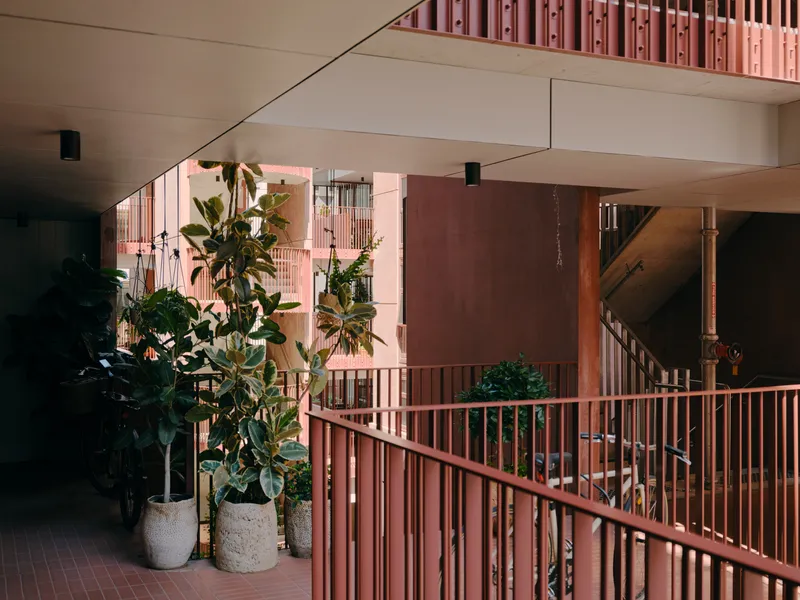
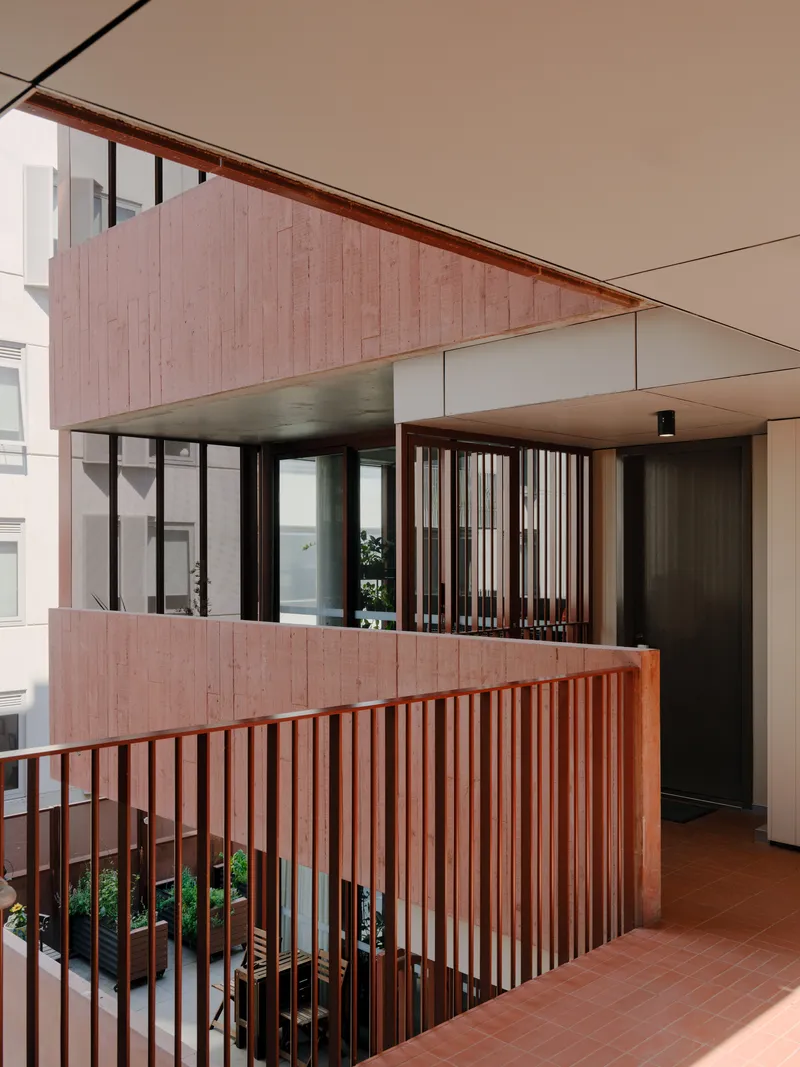
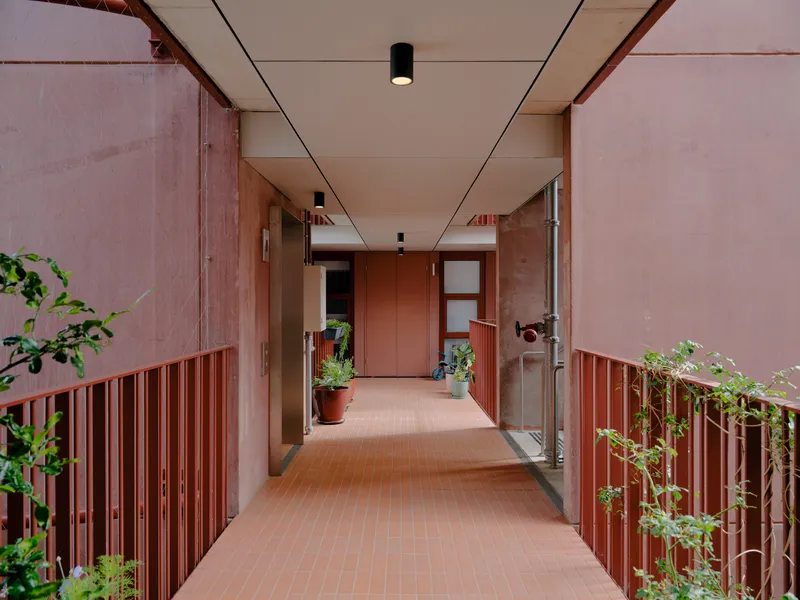
The corridors of 9 Wilson Ave are arguably its most distinctive feature. Pink-toned vertical timber slat balustrades line open walkways that feel more like elevated laneways than apartment hallways. Potted plants, angular ceiling beams, and natural light turn what would normally be dead space into something closer to a subtropical veranda. You pass through these walkways every time you come home, which means you also pass your neighbours.
The open-air approach has practical consequences too. There is no need to mechanically ventilate or cool these corridors, which contributes to the building's 7.5-star NatHERS energy rating. Bridges and staircases between clusters create informal meeting points, deliberately fragmenting the typical double-loaded corridor into smaller, more intimate groupings. It is a spatial strategy borrowed from tropical housing traditions, adapted here for a temperate climate with real conviction.
Inside the Apartments
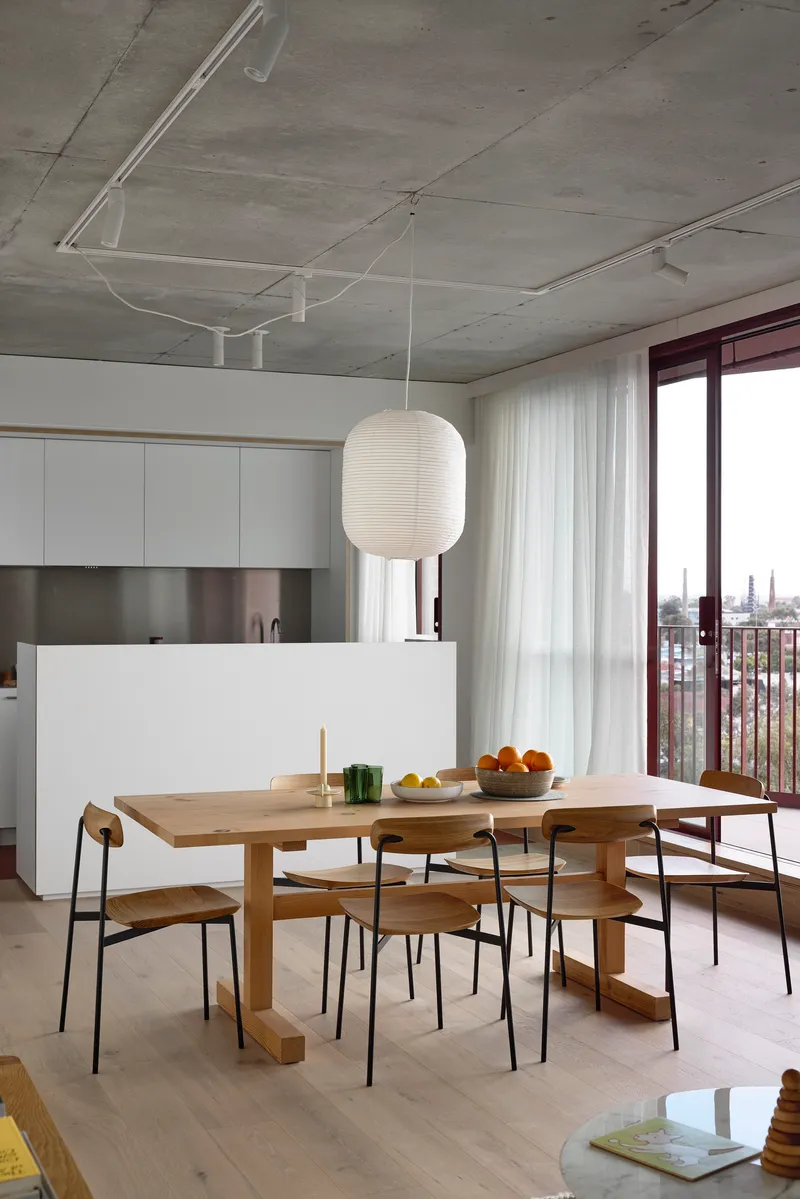
Interiors follow the building's ethos of raw expressed materials. Exposed concrete ceilings are left unfinished, paired with engineered oak flooring and stainless steel benchtops that will patina rather than degrade. The palette is restrained: warm neutrals, sheer curtains filtering light from deep balcony doors, and enough spatial generosity that furniture can breathe. Double-glazed windows throughout provide acoustic separation from the busy precinct while contributing to the building's passive thermal performance.
Neometro's guiding principle of "wear in, not wear out" is legible here. The finishes are chosen for longevity rather than showroom appeal. Terracotta tiles and concrete surfaces will age well, developing character rather than demanding replacement. It is an approach that aligns sustainability with aesthetics, making the long view the more attractive one.
Rooftop and Shared Amenity
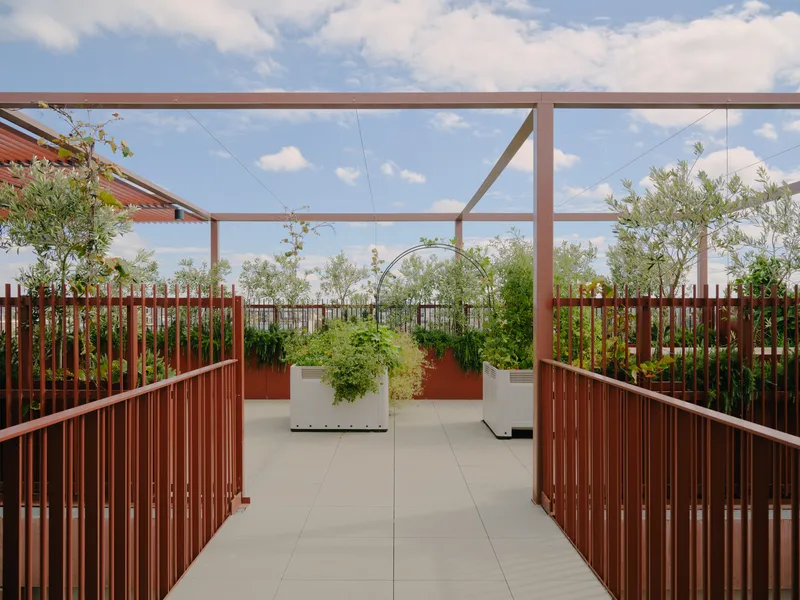
The rooftop terrace extends the communal ambition upward. A steel-frame pergola provides structure for future planting and dappled shade, while vertical slat screens offer wind protection without blocking views. Planted beds at this level contribute to the building's thermal mass strategy, insulating the upper floors while creating usable green space. The detailing is consistent with the rest of the building: robust, legible, and designed to improve with time.
From the rooftop, the stepped massing of the building becomes legible as a deliberate urban form. The setbacks create terraces at multiple levels, distributing outdoor amenity throughout the section rather than concentrating it at the top. Pedestrians visible at the street intersection below confirm the scale: this is a building that participates in its neighbourhood rather than overlooking it from a distance.
Ground Floor Activation
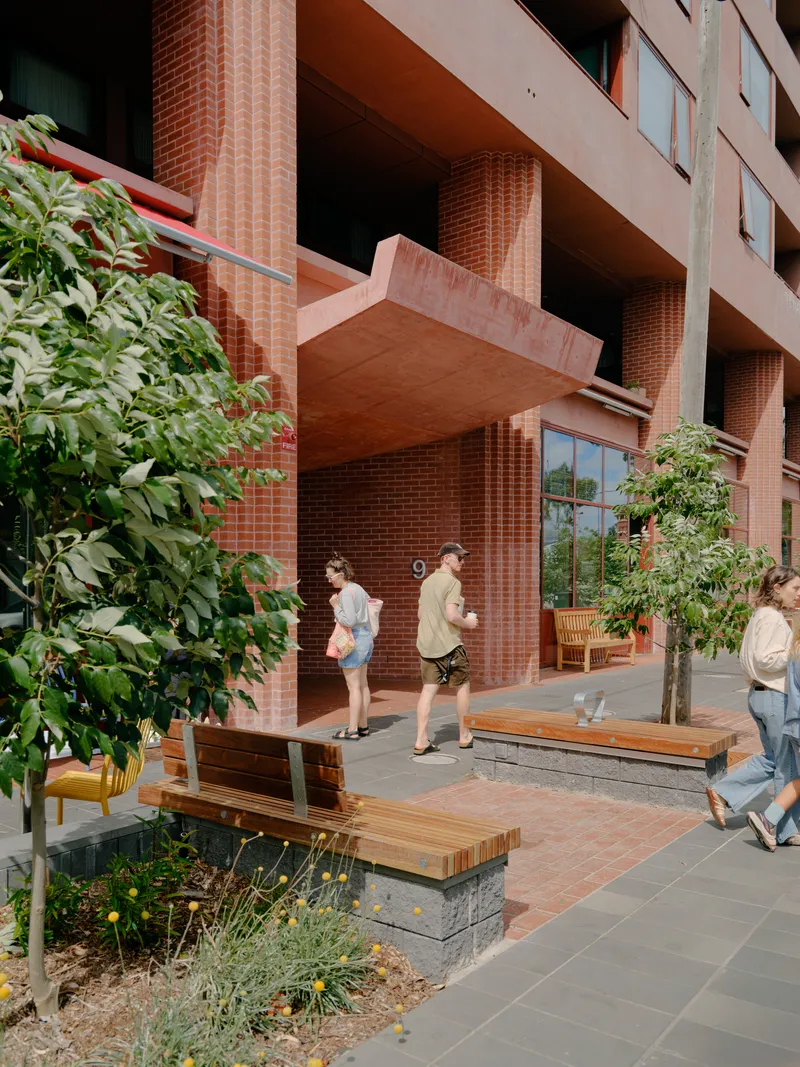
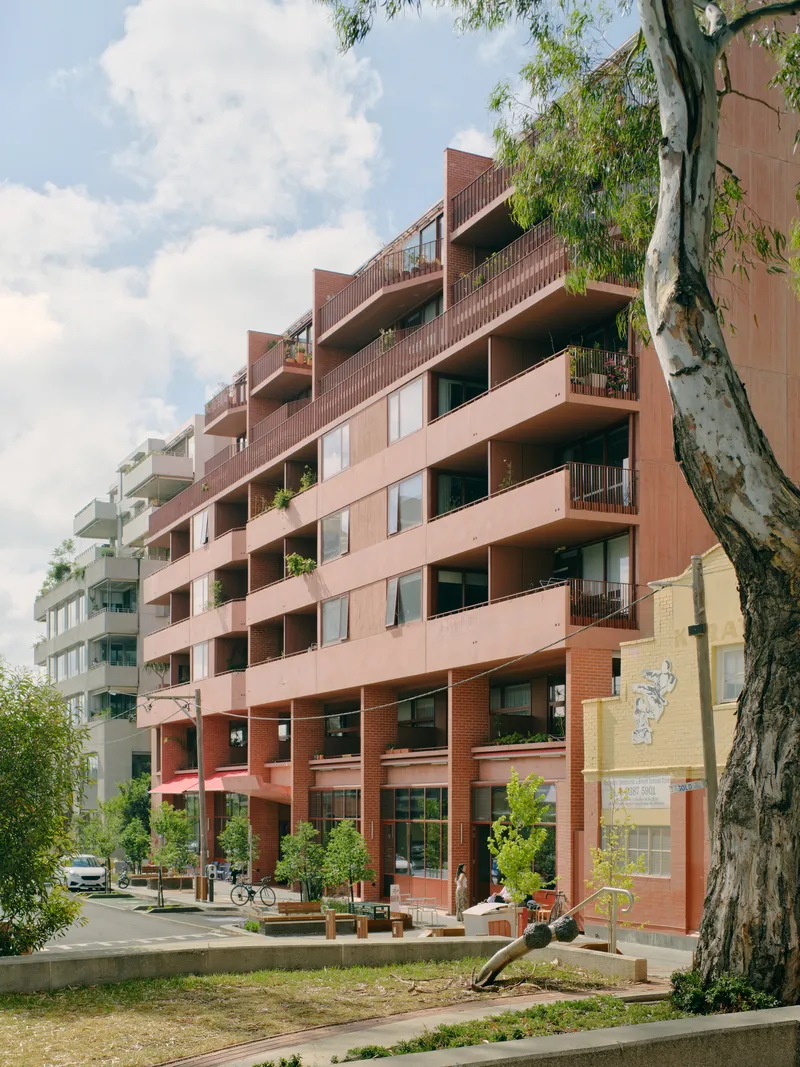
The ground level is programmed with four commercial tenancies, four office suites, and thirteen loft dwellings, a mix that ensures Wilson Avenue is active at different times of day. Timber bench seating beneath the colonnade invites lingering without commercial obligation. The planted beds at column bases blur the line between landscape and architecture, giving the building a generous interface with the public realm.
This activation matters because the Jewell Station Precinct is still evolving. 9 Wilson Ave does not just respond to an existing streetscape; it is helping to create one. The decision to front retail and hospitality onto a street that was recently a car park is a bet on urban transformation, and the quality of the ground-floor design suggests it is a bet worth making.
Why This Project Matters
9 Wilson Ave matters because it demonstrates that mid-rise apartment buildings in Australian suburbs can do more than house people. By integrating Specialist Disability Accommodation, open-air circulation, mixed-use programming, and a redesigned streetscape into a single project, MA+Co and Neometro have produced a building that operates as genuine urban infrastructure. The 7.5-star NatHERS rating is achieved not through gadgetry but through fundamental spatial decisions: dual aspect, cross-ventilation, thermal mass, deep shading. These are passive strategies with long payoffs.
The project also raises a useful question about materiality and memory. The blush-red concrete facade does not replicate Brunswick's brick heritage; it abstracts it into something new that still belongs to the place. In a city where inner-suburban development often produces buildings that could be anywhere, that specificity counts. As the fourth piece of the Jewell Station Precinct, 9 Wilson Ave suggests that precinct-scale thinking, where each building contributes to a larger streetscape narrative, is a more productive model than isolated site-by-site development. It is a strong argument for what the Australian medium-density apartment can become.
9 Wilson Ave Apartment, designed by MA+Co with Neometro. Brunswick, Melbourne, Australia. Completed 2024. Photography by Tom Ross.
About the Studio
Share Your Own Work on uni.xyz
If projects like this are the kind of work you want to make, uni.xyz is a place to publish your own, find collaborators, and enter design competitions.


Popular Articles
Popular articles from the community


Jaramillo Van Sluys Arquitectura and Urbanismo Turn a Demolished Registry Lot in Quito into an Orchard Plaza
In Quito's Centro Histórico, a 2,800 m² plaza exposes the San Agustín convent wall and redraws its lost Augustinian orchard in volcanic stone.

Juan García Correa, John González and Claudia Rueda Sink a Circular Amphitheater into a Manizales Engineering Building
On the La Nubia campus in Manizales, Colombia, the S1 Building folds labs and offices into a hillside of ramped lawns that double as a campus route.

David Ortega Stacks a Two-Story Mexico City Penthouse Around a Steel Stair and a Pergola-Shaded Roof Terrace
In Colonia Roma, a 300 m² penthouse uses oak joinery, a planted steel stair and a slatted roof pergola to make a new-build apartment feel like a house.

LT2A and OPEN Architectes Thread a Brick and Glass High School Through a Wooded Belgian Campus
In Braine-l'Alleud, a 3,000 m² wing for Collège Cardinal Mercier pairs pale brick with a glazed colonnade, deferring to a small chapel and a dense wood.

Similar Reads
You might also enjoy these articles


LAVA Architecten Gives Vocational Education a Sawtooth-Roofed Face on a Mechelen School Campus
In Mechelen, Belgium, a 2,053 m² STEM school on a 6×6 m grid turns workshops and classrooms into rooms that can be rearranged as teaching changes.

KEMA Studio Turns a Derelict Marvila Attic into a 60 m² Lighthouse Apartment Above Lisbon
In Lisbon's Marvila district, a rebuilt roof, four skylights and two plywood volumes turn an unlivable attic into a bright home facing the Tagus.

Pixel Gardens: One Repeated Module Stacked Into a Terraced Social Housing Tower for Famagusta
Salem Bader's shortlisted housing tower builds a vertical neighbourhood from one repeated module, offsetting units to carve terraces, light and air.

Bao Huynh Watercolor Atelier: A Serene Art Retreat in Hội An
Bao Huynh Watercolor Atelier in Hội An blends multifunctional art spaces, sustainable design, local materials, and family-friendly living in a serene environment.

Comments (0)
Please login or sign up to add comments
No comments yet. Be the first to comment!