
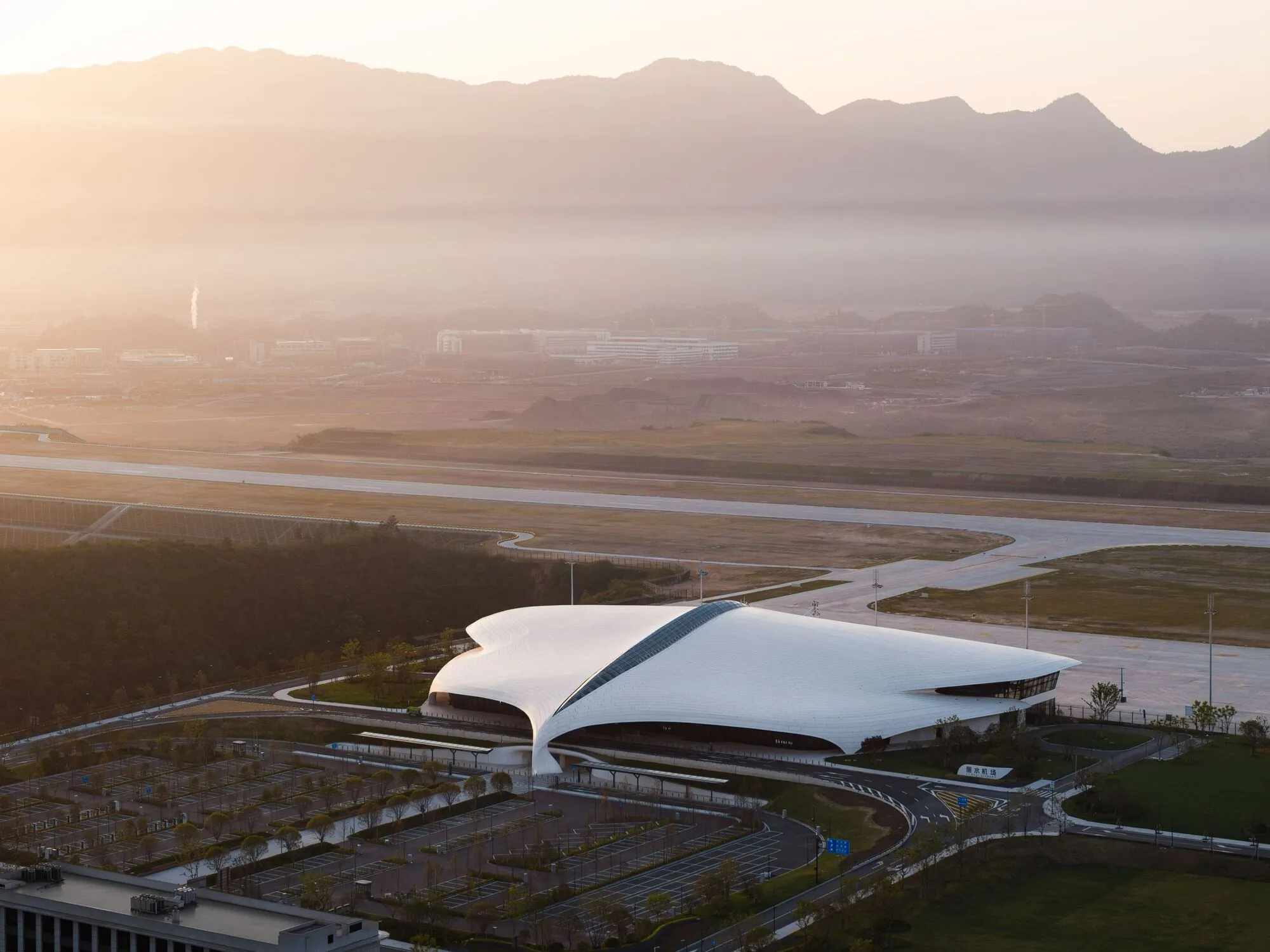
MAD Architects Lands a Cloud-Shaped Airport Terminal in the Mountains of Lishui
A twin-lobed white canopy gives Zhejiang Province's newest airport the silhouette of a drifting cloud against misty peaks.


Lishui is one of those Chinese cities that most Western architects couldn't place on a map, yet it sits in some of Zhejiang Province's most dramatic terrain: river valleys threaded between forested mountain ridges, blanketed in mist more mornings than not. Until now, the region had no direct air link to the rest of the country. The terminal that MAD Architects designed to change that is a 12,100 square meter building that treats its roof as landscape, a billowing white form that borrows its logic from the clouds that hang over the surrounding peaks.
What makes the project worth studying is not the formal gesture alone, which is by now a familiar move in MAD's repertoire, but the way it negotiates scale. An airport terminal, even a small regional one, is inherently an industrial building: vast clear spans, rigid security sequences, acres of apron. The Lishui terminal accepts all of that and still manages to feel intimate, largely through a continuous timber-slat ceiling that pulls your eye along curves rather than toward vanishing points. It is an exercise in softening infrastructure without pretending infrastructure is soft.
A Roofline Borrowed from the Valley

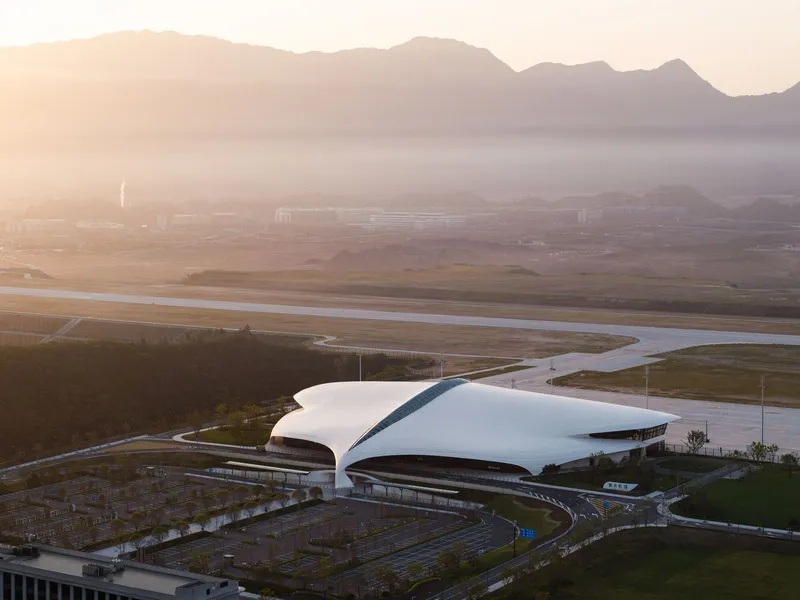
From above, the terminal reads as two lobes joined along a central spine, their edges curving outward like the wings of a manta ray. The white surface is deliberate: against the deep green of the surrounding hills and the grey tones of morning fog, the building reads less as a piece of architecture and more as a topographic event. MAD has long been interested in buildings that mimic natural landforms, and here the strategy is particularly effective because the context is genuinely wild. There is no dense urban fabric to compete with, just mountains, a river, and sky.
The aerial view reveals a disciplined ground plane beneath that expressive canopy. Parking lots, bus lanes, and vehicular drop-offs are organized in neat bands parallel to the terminal face. The roof floats above all of it, creating a covered threshold zone that blurs the boundary between outside and inside well before passengers reach the glazed facade.
Arrival as Landscape Experience
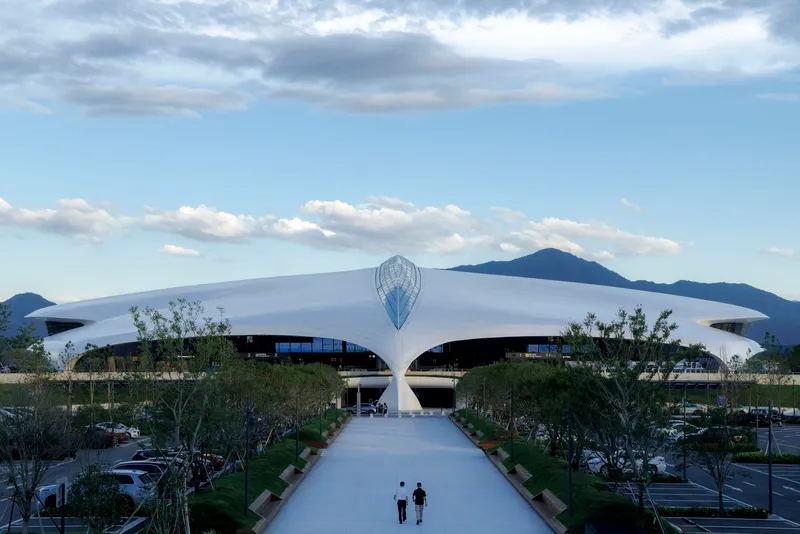
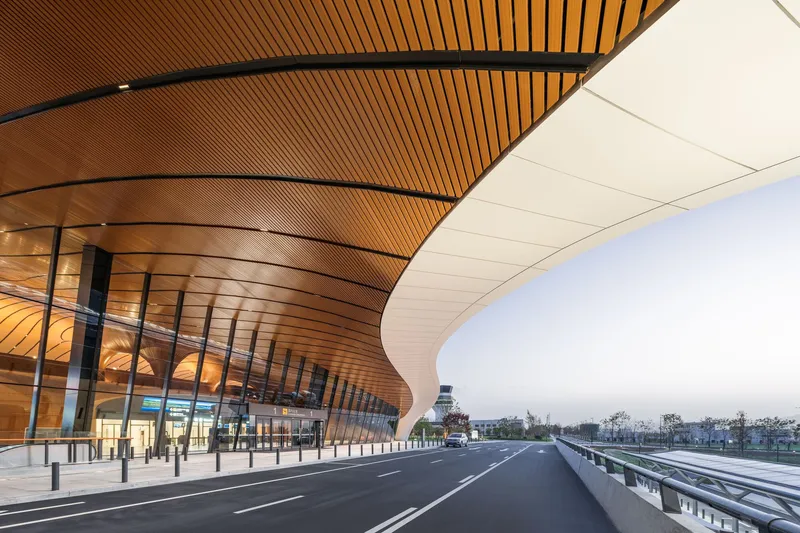
The approach sequence is the building's strongest moment. Visitors walking toward the entrance pass beneath the sweeping canopy, which dips low enough to frame the mountains behind it in a panoramic slot. It is a cinematic trick, directing attention simultaneously forward to the terminal and backward to the landscape you are about to leave. The white soffit overhead acts as a reflector, bouncing diffused light downward and keeping the arrival path bright without direct sun.
At dusk, the roadway-side facade reveals a second reading. The timber-slat ceiling extends outward from the interior through the glazed wall, wrapping the drop-off zone in warm tones that contrast with the cool white exterior shell. This inside-out continuity is one of the project's most convincing details, making the transition from car to terminal feel seamless rather than bureaucratic.
Timber Canopy, Not Timber Structure

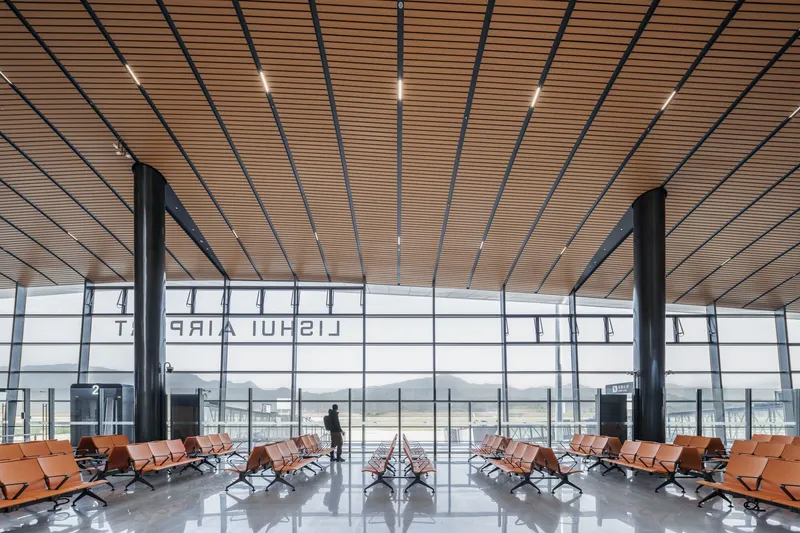
Inside, the timber-slat ceiling does the heavy lifting. It flows continuously from the check-in hall through security and into the departure gates, rising and falling in gentle waves that echo the roof's exterior profile. The slats are not structural; they conceal a conventional steel frame and mechanical systems above. But the visual effect is powerful. The wood grain and warm color temperature counteract the institutional feel that plagues most airports, creating a space that feels closer to a well-designed train station than to a typical Chinese regional terminal.
At the departure gates, floor-to-ceiling glazing opens the interior to the airfield and, beyond it, the mountain horizon. Columns are kept slender and few, allowing the ceiling to read as a single uninterrupted surface. The seating zones are generous, and the proportions feel relaxed for a building of this program. MAD clearly calibrated the ceiling height and the glazing ratio to avoid the cavernous emptiness that small terminals often suffer from when they aim for grandeur.
Plans and Drawings
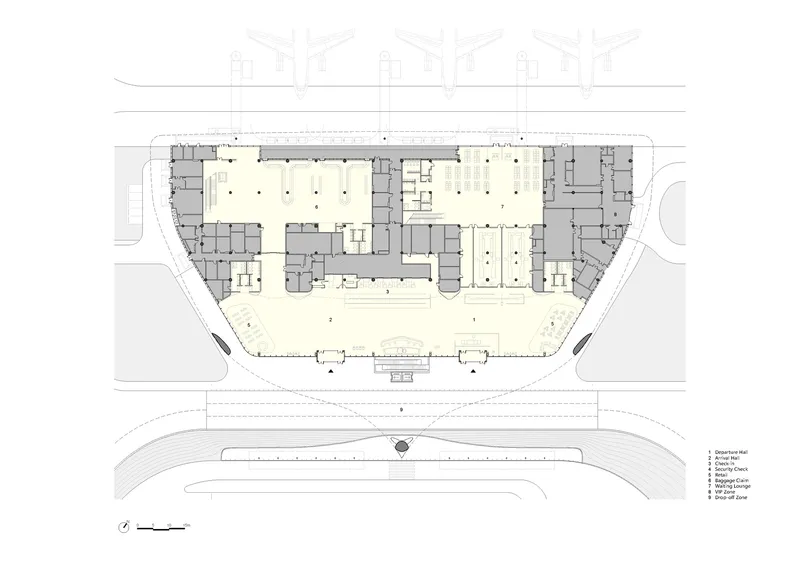
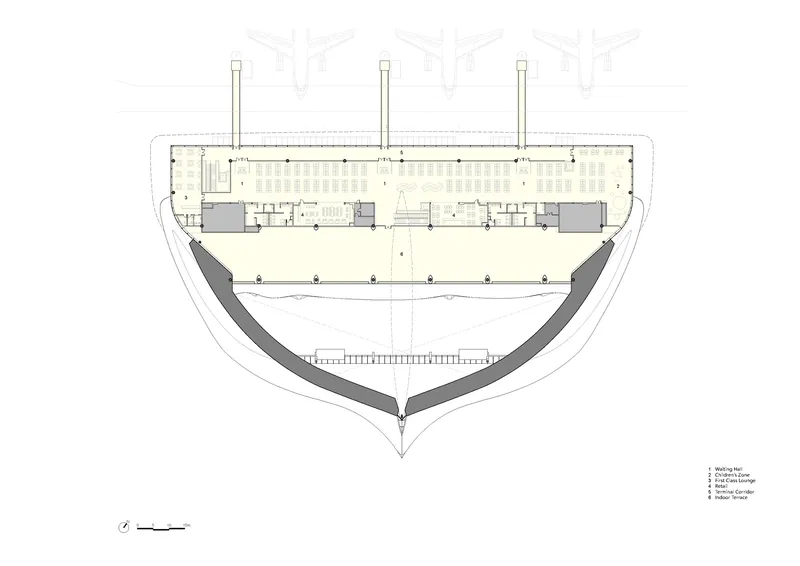
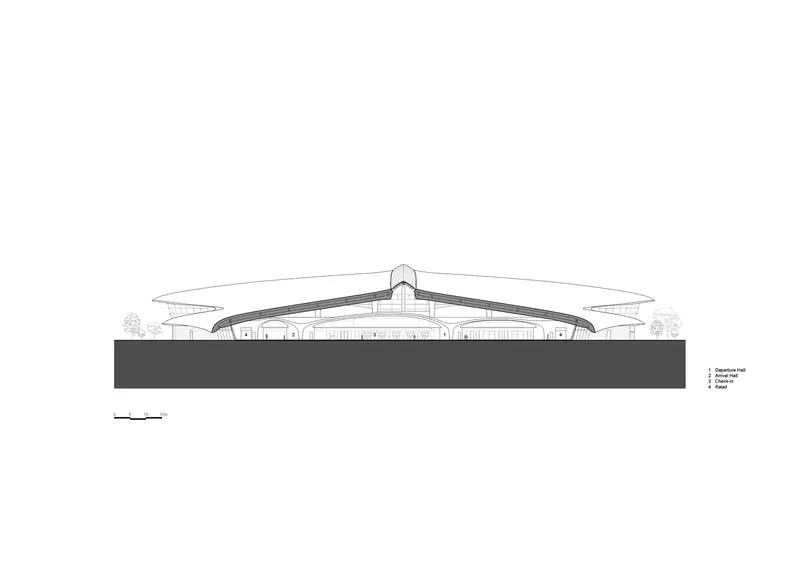
The floor plans confirm what the photographs suggest: the building is organized along a clear linear axis. The ground level plan shows an arched public plaza on the landside and a gridded interior divided into check-in, security, and commercial zones. Three vertical circulation cores punctuate the upper level, which curves along its southern edge to follow the roof geometry. The plans are surprisingly compact for 12,100 square meters, evidence that the generous spatial feeling comes from section, not from excess floor area.
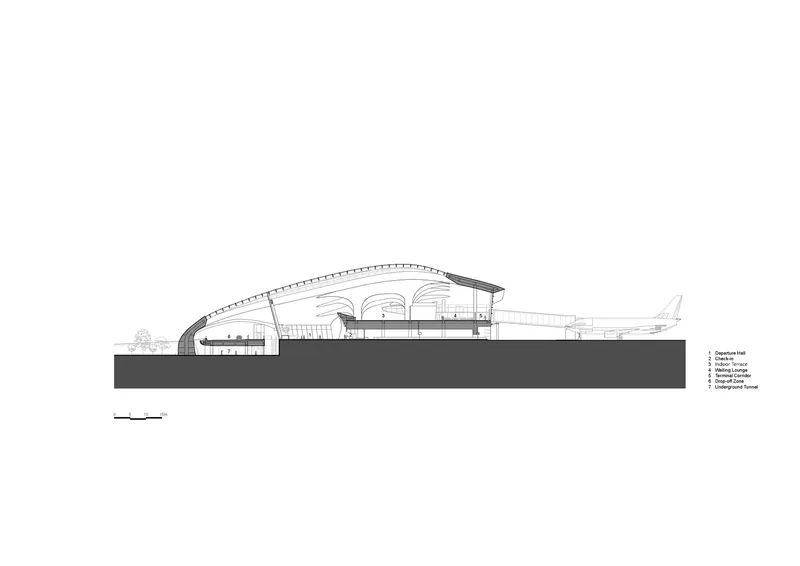
The sections are the most revealing drawings. The transverse cut exposes the arched roof structure, a series of steel ribs that create a cathedral-like profile over the main hall. The longitudinal section shows a symmetrical gabled form, almost domestic in its silhouette, that conceals the twin-lobed plan beneath a single sweeping ridgeline. An aircraft parked on the apron provides scale: the terminal is modest, but the roof makes it monumental.
Why This Project Matters
Regional airports are expanding rapidly across China, and most of them are forgettable: generic steel sheds with curtain walls and terrazzo floors, designed to process bodies rather than welcome travelers. Lishui's terminal demonstrates that a regional facility can be architecturally ambitious without being oversized or wasteful. The building serves a small city with limited passenger volume, yet it delivers a spatial experience that rivals terminals handling ten times the traffic. That economy of means, achieving presence through roof form and material warmth rather than sheer square footage, is the real lesson here.
For MAD, the project also represents a maturation of their formal language. The organic curves that once read as provocative gestures in competition renderings now feel grounded, literally rooted in a specific valley between specific mountains. When the morning mist rolls in and the white roof blurs into the clouds above, the building almost disappears. For an airport, a building type that usually announces itself at maximum volume, that quiet integration with landscape is a rare and welcome thing.
Lishui Airport by MAD Architects. Lishui, Zhejiang Province, China. Completed 2025. 12,100 m². Photography by Arch EXIST, CreatAR Images, Ding Junhao, and Blackstation Architectural.
About the Studio
Share Your Own Work on uni.xyz
If projects like this are the kind of work you want to make, uni.xyz is a place to publish your own, find collaborators, and enter design competitions.



Popular Articles
Popular articles from the community


Conexión: Biophilic Design Reimagines High-Rise Living in Hong Kong
Conexión reimagines high-rise living in Hong Kong through biophilic design, green facades, shared spaces, daylight, water and nature within.
EW PARK: Sustainable Architecture Reimagines the Future of Urban Parking
EW PARK reimagines city parking as a modular wooden tower combining automation, solar energy, electric mobility, and adaptable urban design.

Co-Life: Senior Housing Design That Reconnects Older Adults With the City
Co-Life reimagines senior housing design through healing gardens, shared streets, workshops, and a sustainable community across generations.

The Musturak Paradise: Senior Living Architecture for a Connected Future in Temara, Morocco
The Musturak Paradise reimagines senior living architecture in Temara via private homes, social spaces, culture, community, and shared care.


Similar Reads
You might also enjoy these articles

Bao Huynh Watercolor Atelier: A Serene Art Retreat in Hội An
Bao Huynh Watercolor Atelier in Hội An blends multifunctional art spaces, sustainable design, local materials, and family-friendly living in a serene environment.

Atelier Macri Concept Store Interior Design by CASE-REAL
Atelier Macri store features a "ko" counter, walnut wood details, cork displays, blending retail, gallery, and seamless customer experiences.

Manuel Vargas Izquierdo Stadium and High-Performance Sports Center: Architectural Excellence in Jalpa de Méndez
The Manuel Vargas Izquierdo Stadium blends sustainable design, inclusive sports facilities, and cultural-inspired architecture, revitalizing Jalpa de Méndez’s public spaces.

KAKR Buluh Awar Hall: Revitalizing Community and Ecology Through Bamboo Architecture
Community built bamboo hall revitalizes Buluh Awar village, empowering youth, restoring ecology, celebrating vernacular craftsmanship through sustainable architecture and culture.


Comments (0)
Please login or sign up to add comments
No comments yet. Be the first to comment!