

Magnetic Colony: Sponge-Like Modular Domes for Arctic Self-Sufficiency
A shortlisted arctic housing concept clusters 3000 residential units inside bio-inspired domes powered by wind energy and internal agriculture.


What if the key to surviving the Arctic lay not in fortifying against nature but in mimicking it? The Magnetic Colony borrows its internal logic from the anatomy of a sponge: a porous, cellular structure perforated with transparent openings that pull natural light deep into a thermally insulated core. The result is a fully autonomous settlement concept where 1000 to 1200 people live, grow food, generate power, and manage water without relying on external supply chains.
Designed by Antony Melnikov, the project was shortlisted in the EHC - Arctic competition, which challenges designers to rethink human habitation in extreme polar environments. The proposal clusters three domed blocks into a single colony housing 3000 residential units, supported by wind generators, underground water boreholes, and hyperloop cargo transport. It is equal parts survival kit and spatial manifesto.
Four Zones Stacked Inside a Dome
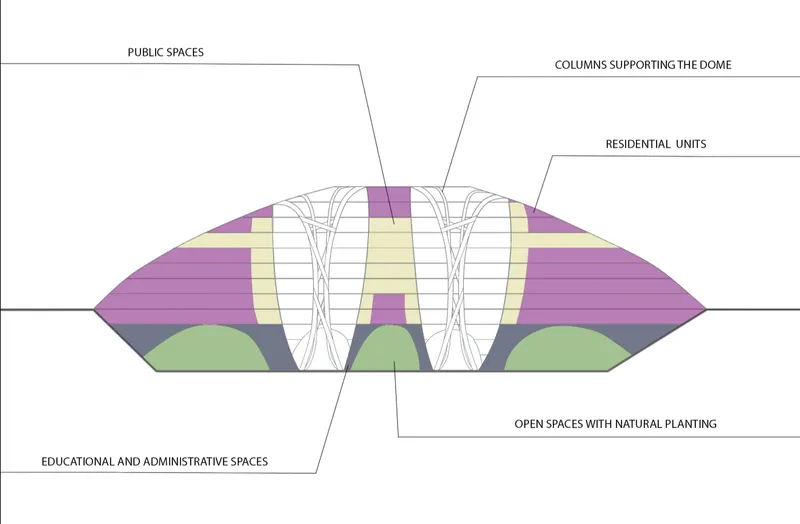
The section drawing reveals how the colony organizes life vertically across four distinct zones. The first level is the Green Zone, where natural vegetation grows on soil heated by a substructure of regulated pipes. Above it sits an educational and administrative zone containing schools, libraries, and laboratories. The upper floors combine residential, public, and operational functions in a mixed-use arrangement designed for flexibility. Seventy percent of the colony's volume is dedicated to residential use; the remaining thirty percent serves shared public functions.
Each of the 1600 modular units within a single block is organized to support localized public life while accommodating diverse uses. The spatial interlinking between levels is deliberate: it encourages social interaction and allows efficient energy distribution across the dome's height. The central dome's block structure mimics wool-based insulation, reducing heat loss, which is the dominant energy concern in any Arctic settlement.
A Cellular Interior Inspired by Biology

The axonometric diagram strips back the dome's skin to expose its organic cellular interior. Rendered in purple tones, the drawing makes the sponge analogy explicit: irregular voids of varying scale nest within a continuous structural matrix. These voids are not random; they correspond to living units, communal spaces, and light wells that channel daylight from the transparent outer openings inward. The bio-integrated approach blurs the boundary between architectural enclosure and ecological system, treating the building less as a container and more as a living organism with circulatory logic.
Three Blocks, One Colony, Zero Dependence

Pulled back to the site scale, the plan diagram shows three circular residential blocks arranged in a tight cluster. Wind generators ring the perimeter, supplying clean energy to the settlement, while a hyperloop connection handles cargo transport to maintain logistical independence. Food is cultivated internally within the Green Zone, and water is drawn from underground boreholes. The tripartite arrangement is not arbitrary: it balances structural redundancy with the ability to phase construction over time, allowing the colony to grow incrementally as population or resources shift.
Modular Assembly for Phased Arctic Growth

The construction sequence diagrams illustrate how the colony scales. Technical parts form concentric rings that support the central dome of habitation, enabling phased, adaptive development without disrupting existing occupied zones. A modular construction system means components can be prefabricated off-site and assembled in Arctic conditions where traditional building methods face severe limitations. The supply chain diagram tracks this process from material sourcing through assembly, closing the loop on a system designed for long-term resilience.
Scalability is not just a structural convenience here; it is a survival strategy. Arctic conditions change, populations fluctuate, and energy demands shift seasonally. A colony that can add or reconfigure rings without compromising its thermal envelope or social infrastructure has a meaningful advantage over fixed-footprint alternatives.
Why This Project Matters
The Magnetic Colony's strength lies in its refusal to treat the Arctic as a problem to be endured. Instead, Melnikov frames polar habitation as a design opportunity that demands integrated thinking across energy, food production, water sourcing, logistics, and social infrastructure. The sponge metaphor is more than aesthetic: it drives real decisions about light penetration, thermal performance, and spatial variety within a single structural system.
Where many extreme-environment proposals lean on technological spectacle, this project grounds itself in spatial logic. The four-zone stacking, the concentric ring construction, the tripartite site plan: each decision connects back to a clear rationale about how people actually live in isolation. That discipline, applied to one of the planet's most hostile landscapes, makes the Magnetic Colony a compelling entry in the growing conversation about climate-adaptive settlement design.
View the Full Project
About the Designers
Designer: Antony Melnikov
Enter a Design Competition on uni.xyz
uni.xyz runs architecture and design competitions year-round that reward proposals with spatial conviction and real site intelligence.
Project credits: Magnetic Colony by Antony Melnikov EHC - Arctic (uni.xyz).


Popular Articles
Popular articles from the community


Architekt Andreas Gruber Scatters 23 Dark Timber Chalets Across a South Tyrolean Forest Edge
In Molini di Tures, Amonti Chalets breaks a resort into a hamlet of gabled timber houses, with parking, storage and services pushed into the slope.

David Ortega Stacks a Two-Story Mexico City Penthouse Around a Steel Stair and a Pergola-Shaded Roof Terrace
In Colonia Roma, a 300 m² penthouse uses oak joinery, a planted steel stair and a slatted roof pergola to make a new-build apartment feel like a house.

LT2A and OPEN Architectes Thread a Brick and Glass High School Through a Wooded Belgian Campus
In Braine-l'Alleud, a 3,000 m² wing for Collège Cardinal Mercier pairs pale brick with a glazed colonnade, deferring to a small chapel and a dense wood.

U.GA Architects Wraps an Oval Rooftop Pool in Curved Board-Formed Concrete on Busan's Jeollidan-gil
In Busan's Jeonpo-dong, a 454 m² mixed-use block stacks a neighborhood facility, guest rooms and an oval rooftop pool inside spiraling concrete walls.

Similar Reads
You might also enjoy these articles

Gil Mello Arquitetura Tilts a Single Roof Toward the Waterfalls on a Plateau Above Aiuruoca, Brazil
In Aiuruoca, Minas Gerais, a 200 m² house of local labor and reclaimed poles pairs a low valley veranda with a tall mountain one.
U.GA Architects Wraps an Oval Rooftop Pool in Curved Board-Formed Concrete on Busan's Jeollidan-gil
In Busan's Jeonpo-dong, a 454 m² mixed-use block stacks a neighborhood facility, guest rooms and an oval rooftop pool inside spiraling concrete walls.

Felipe Hess Arquitetos Turns a Blind Stone Wall to the Street and Opens a Brazilian House onto a Courtyard and Canal
A canal-front house in Brazil hides behind painted stone and planting, then opens to an olive-tree courtyard, a reed-ceilinged porch and a curving pool.

David Macias Steps a Doorless Stone and Plaster House Down a Tropical Colombian Hillside
In the humid hills of Colombia, Threshold House replaces the front door with an open void and terraces its 850 m² down the slope instead of fighting it.


Comments (0)
Please login or sign up to add comments
No comments yet. Be the first to comment!