

Manu Pages Taller d'Arquitectura Plants a Palm Grove Inside a Barcelona Warehouse for GPA Offices
A precast concrete industrial shell in Barcelona becomes a light-filled headquarters where tall palms and timber partitions replace conventional office wal


Corporate offices rarely feel alive. They feel calibrated, optimized, maybe branded, but rarely alive. The new GPAINNOVA headquarters in Barcelona, designed by Manu Pages Taller d'Arquitectura, is a notable exception. Set inside a precast concrete industrial warehouse, the 1,780 square meter fit-out transforms a generic shell into something closer to an inhabited garden, where full-grown palm trees rise from timber planter boxes and puncture the visual field in place of conventional walls.
What makes this project genuinely interesting is its refusal to treat planting as decoration. The palms are not desk accessories or lobby garnishes. They are spatial devices, positioned at intersections where they interrupt sightlines, create intimacy without enclosure, and draw the eye upward to the skylights that feed them light. The entire layout is organized around visual contact, a diaphanous plan where transparency is the default and privacy is the exception. It is an office designed from the logic of a greenhouse rather than a floor plate.
An Industrial Shell, Left Honest

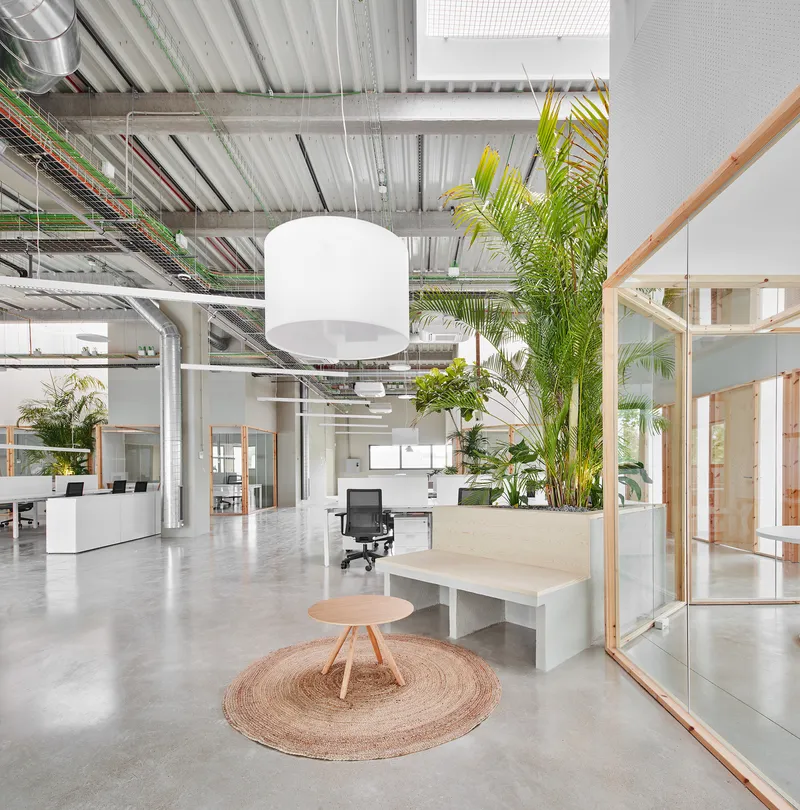
The existing warehouse offers high ceilings, a robust precast concrete frame, and generous clear spans, exactly the kind of raw industrial volume that tempts architects to either erase its character or fetishize it. Manu Pagès does neither. The exposed mechanical ducts, cable trays, and structural soffit are left visible and unapologetic, painted in coordinated whites and grays so they recede into the ceiling plane without pretending they aren't there. The polished concrete floor below anchors everything in material honesty.
The result is an interior that reads as infrastructure first and fit-out second. There is no false ceiling hiding complexity, no drywall veneer suggesting this was always an office. The warehouse's bones remain legible, and the new elements inserted within it, timber frames, glass panels, planter boxes, register clearly as a second layer, a lighter system nested inside a heavier one.
Timber and Glass as a Partition System


The meeting rooms and enclosed offices are defined by a consistent kit of parts: timber frames holding floor-to-ceiling glass, sometimes with a central timber column, sometimes capped by translucent corrugated panels that filter skylight from above. These partitions read as furniture rather than architecture. They sit on the polished concrete slab without touching the overhead structure, reinforcing the sense that they could be moved or removed.
This modularity serves the open-plan logic well. Because the glass walls are fully transparent, no enclosed room becomes a dead zone. People inside meeting rooms remain visible to the floor; people outside can orient themselves by looking through multiple layers of glazing. The timber brings warmth that the concrete shell lacks on its own, and the proportions of the frames, their mullion widths, their corner details, suggest careful craft despite the deliberately casual industrial setting.
Palms as Spatial Instruments

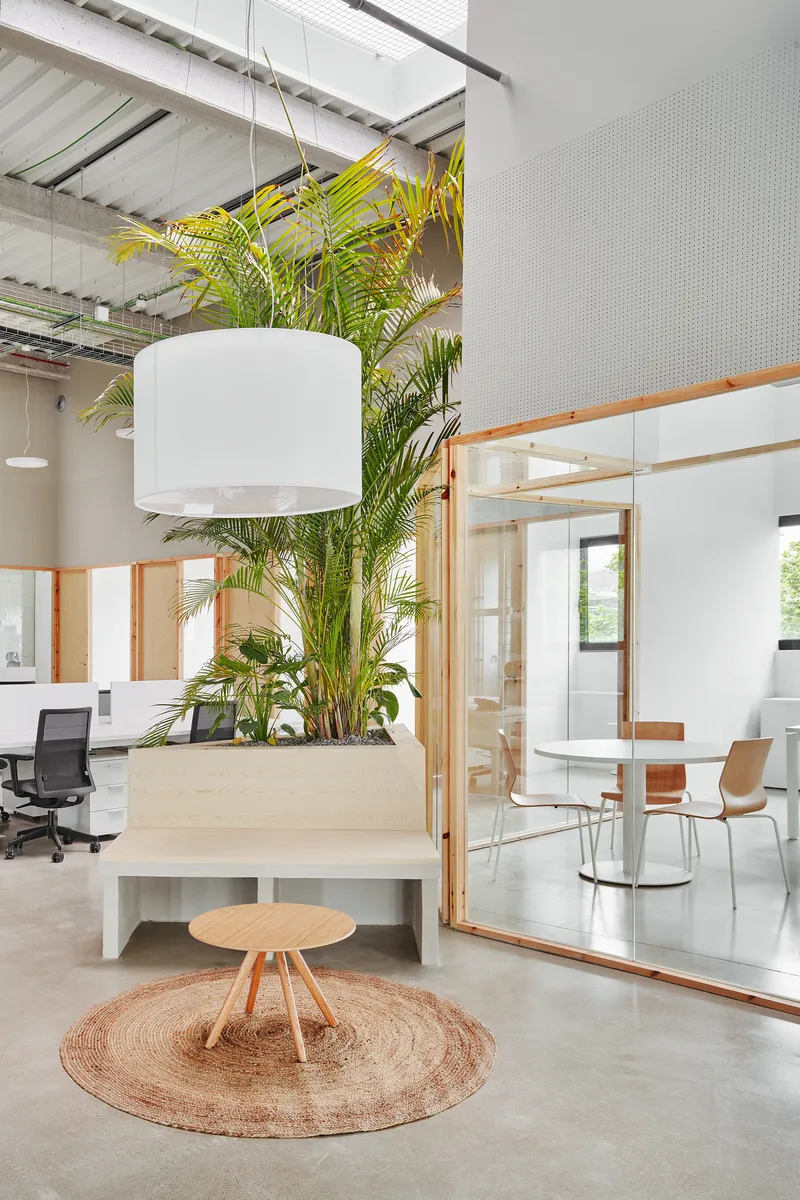

The most distinctive move is the placement of large-format palms in raised white planter boxes positioned at key junctures throughout the plan. These are not small desk plants. They are tall, canopy-forming specimens whose fronds reach toward the skylights overhead. Positioned beside glass partitions and at corridor intersections, they break what would otherwise be uninterrupted sightlines across a very large floor plate.
This is worth pausing on, because most offices that introduce greenery do so cosmetically. Here, the palms perform the role that partition walls or screens typically play. They soften the space acoustically, interrupt glare from the skylights, and create zones of relative enclosure without blocking light or isolating teams. The connection between planter box and skylight above is deliberate: the natural light that enters from the roof feeds the palms, and the palms in turn filter and redistribute that light downward. It is a small ecosystem logic applied to corporate space.
Sightlines and Visual Democracy


One of the project's stated goals is that everyone in the office remains in visual contact. Looking through the photographs, this claim holds up. The combination of glass partitions, open work areas, and strategically placed palms creates a layered depth where you can see through two, three, sometimes four planes of space before the view terminates. The corridor views in particular have a quality that is closer to a botanical glasshouse than a corporate floor.
There is an implicit argument here about hierarchy. No private corner office claims the best light or the longest view. The skylights distribute illumination evenly, the palms are shared amenities rather than executive perks, and the glass-walled meeting rooms are visible from all sides. Whether this idealism survives the inevitable territorial negotiations of daily office life is another question, but the architecture at least starts from a generous premise.
Moments of Material Contrast

Not every surface is glass and timber. A painted masonry block wall appears behind one of the corner meeting nooks, its rough texture a deliberate foil to the smooth glazing that frames it. Elsewhere, translucent corrugated ceiling panels introduce a softer, more diffuse quality of light compared to the open skylights. These moments of material variation keep the fit-out from feeling like a single repeated module stretched across the entire floor.
The material palette, concrete, timber, glass, masonry, and white-painted steel, is restrained but not minimal. Each material carries its own texture and light response, and the overall impression is of a space that has been composed rather than specified from a catalog. The discipline is in the editing: there is just enough variety to sustain interest over 1,780 square meters without the whole thing becoming busy.
Plans and Drawings
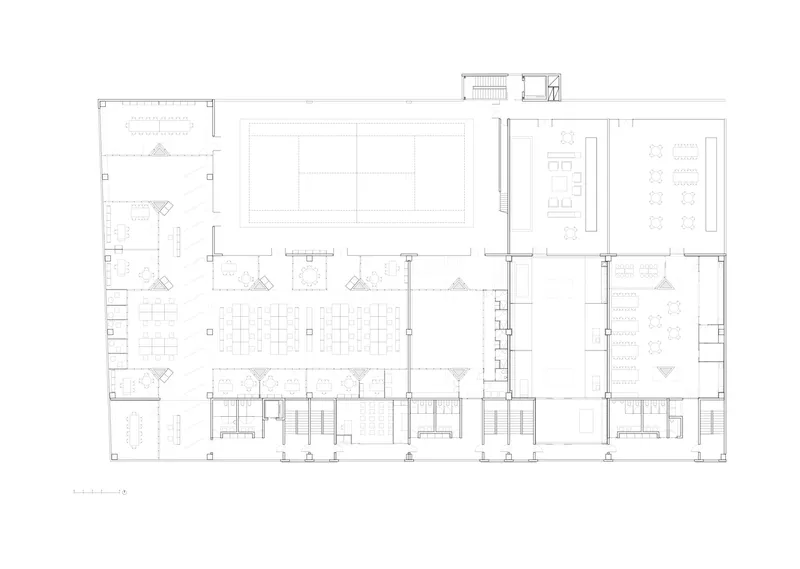
The floor plan reveals the organizational logic more clearly than any photograph. Open work areas cluster around a central courtyard or atrium zone, with enclosed rooms, meeting spaces, and service cores arranged along the perimeter. Staircases at opposite ends suggest the plan spans at least two levels, though the photographic documentation focuses on the main workspace floor. The drawing confirms that the glass-and-timber partition system is not arbitrary; it follows a rationalized grid that aligns with the existing structural bays of the warehouse.
Why This Project Matters
The conversion of industrial shells into office space is now so common that it borders on genre. Exposed ducts, polished concrete, and a few potted plants have become a formula. What distinguishes the GPA Offices is the seriousness with which the planting is treated as architecture. The palms are not aesthetic appliqué; they are load-bearing elements in the spatial strategy, doing the work that walls or screens do in lesser projects. That integration, between horticultural logic and plan organization, is genuinely uncommon.
Manu Pagès has also managed something difficult: making a very large open floor feel neither oppressive nor chaotic. The layered transparency of glass walls, palm canopies, and skylit ceilings creates a depth and rhythm that keeps the eye moving. For a company headquartered in a building that was never meant to house people at desks, the result feels not just habitable but genuinely inviting. The warehouse is still a warehouse. It just happens to also be a grove.
GPA Offices by Manu Pages Taller d'Arquitectura, led by architect Manu Pagès. Located in Barcelona, Spain. 1,780 m². Completed in 2021. Photography by José Hevia.
About the Studio
Share Your Own Work on uni.xyz
If projects like this are the kind of work you want to make, uni.xyz is a place to publish your own, find collaborators, and enter design competitions.


Popular Articles
Popular articles from the community

Temporary Home for Dogs: A Reversed Zoo Rethinks Animal Shelter Architecture
In Bucharest, a sinuous corridor and freed landscape flip the logic of containment, designing a shelter that works to make itself unnecessary.
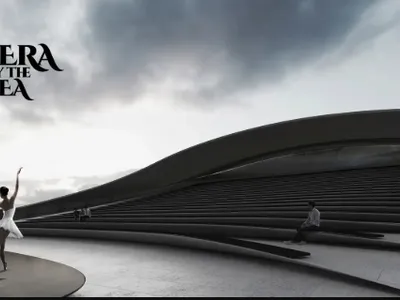
Opera by the Sea Estonia: Three Shells Dissolving Architecture into Tallinn's Coastline
A winning opera house proposal replaces monumental form with interconnected shells that blur the boundary between building, park and Baltic Sea.
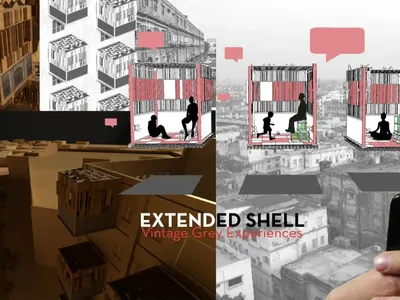
Extended Shell: Retrofitting Kolkata's Balconies as Living Urban Thresholds
A modular retrofit system recovers the social and environmental intelligence of Kolkata's historic verandas for contemporary Park Street residents.

Singing Woman: An Opera House That Performs Before the Curtain Rises
Ovidiu Cristian Pavel's conceptual opera house translates Estonia's choral identity into a sculpted waterfront landmark facing the Baltic Sea.

Similar Reads
You might also enjoy these articles

Pixel Gardens: One Repeated Module Stacked Into a Terraced Social Housing Tower for Famagusta
Salem Bader's shortlisted housing tower builds a vertical neighbourhood from one repeated module, offsetting units to carve terraces, light and air.

Bao Huynh Watercolor Atelier: A Serene Art Retreat in Hội An
Bao Huynh Watercolor Atelier in Hội An blends multifunctional art spaces, sustainable design, local materials, and family-friendly living in a serene environment.

Atelier Macri Concept Store Interior Design by CASE-REAL
Atelier Macri store features a "ko" counter, walnut wood details, cork displays, blending retail, gallery, and seamless customer experiences.

Manuel Vargas Izquierdo Stadium and High-Performance Sports Center: Architectural Excellence in Jalpa de Méndez
The Manuel Vargas Izquierdo Stadium blends sustainable design, inclusive sports facilities, and cultural-inspired architecture, revitalizing Jalpa de Méndez’s public spaces.

Comments (0)
Please login or sign up to add comments
No comments yet. Be the first to comment!