
Margine Strips a 1970s Salento Villa Back to Its Curved Bones in Casa Lèvanzo
A renovation in Caprarica di Lecce peels away octagonal canopies and heavy overhangs to reveal a geometry of arcs and rectangles.


Most 1970s villas in the Salento don't age gracefully. Heavy concrete overhangs, ornamental canopies, and octagonal flourishes pile up into a visual noise that has little to do with the landscape. When Margine took on a single-family house in Caprarica di Lecce for a young professional couple, the studio's first instinct was subtraction. Casa Lèvanzo is a 140-square-meter renovation that reads less like an addition and more like an excavation: stripping away the period excesses to find the core geometry underneath.
What makes the project genuinely interesting is the tension between two geometries that the clearing revealed. A semicircular living volume interlocks with a sharp rectangular sleeping block, and the entire plan negotiates the meeting point of those two shapes through a sequence of custom elements: a curved sofa that hugs the arc, a fireplace column that doubles as a technical divider, and a cabinet-wall that hides three service rooms behind a single plane. It is a small house, but one that thinks about sequence the way a much larger building might.
A Facade Found by Subtraction
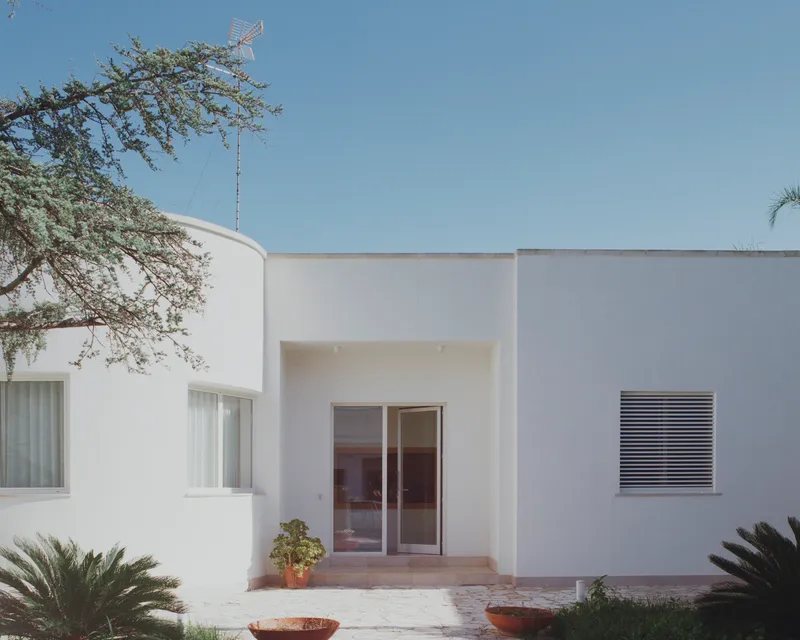
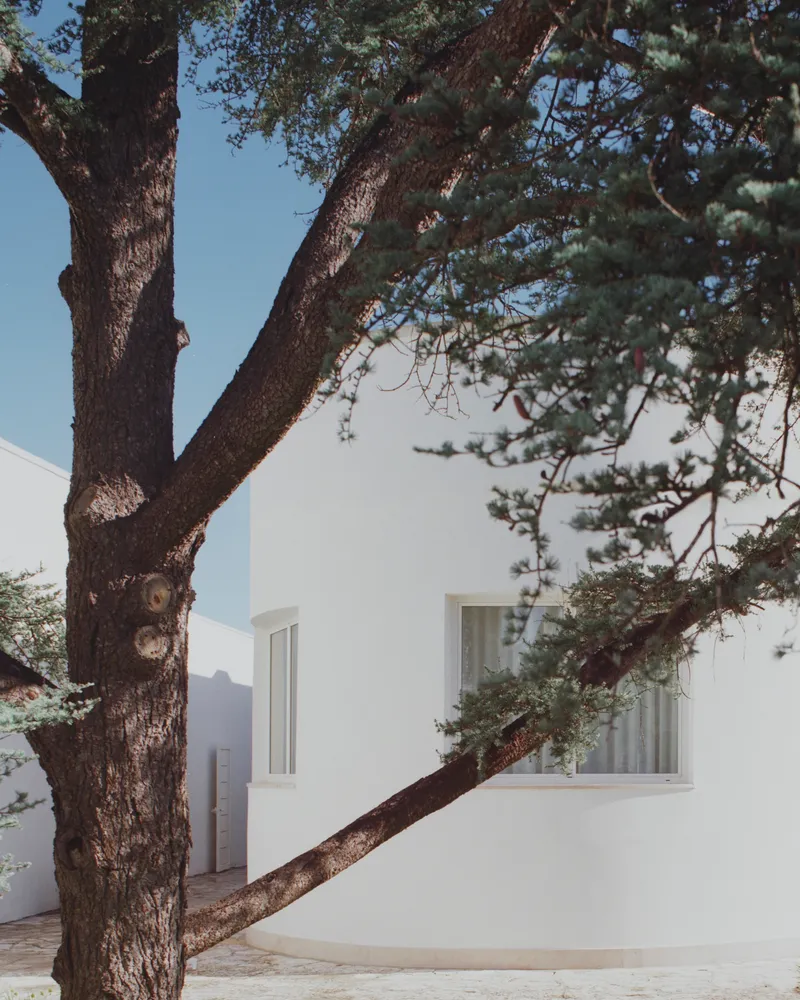
The exterior is almost aggressively plain, and that is the point. White stucco wraps the volume tightly once the original canopies and overhangs have been removed. Narrow vertical windows punch through the surface like slits, giving the facade a proportional restraint that the 1970s original never had. A mature tree in the front garden does more compositional work than any architectural ornament could: its twisted branches cast moving shadows across the white planes, providing the kind of visual richness that a building this pared-down needs.
Margine's gamble here is that formal simplification will let the context do the talking. In a small Salento village, surrounded by stone walls and agricultural land, the quiet facade slots in without competing. The recessed entry, framed by terracotta planters and a single overhanging branch, establishes a domestic scale before you even cross the threshold.
The Curved Living Room and Its Fireplace Spine
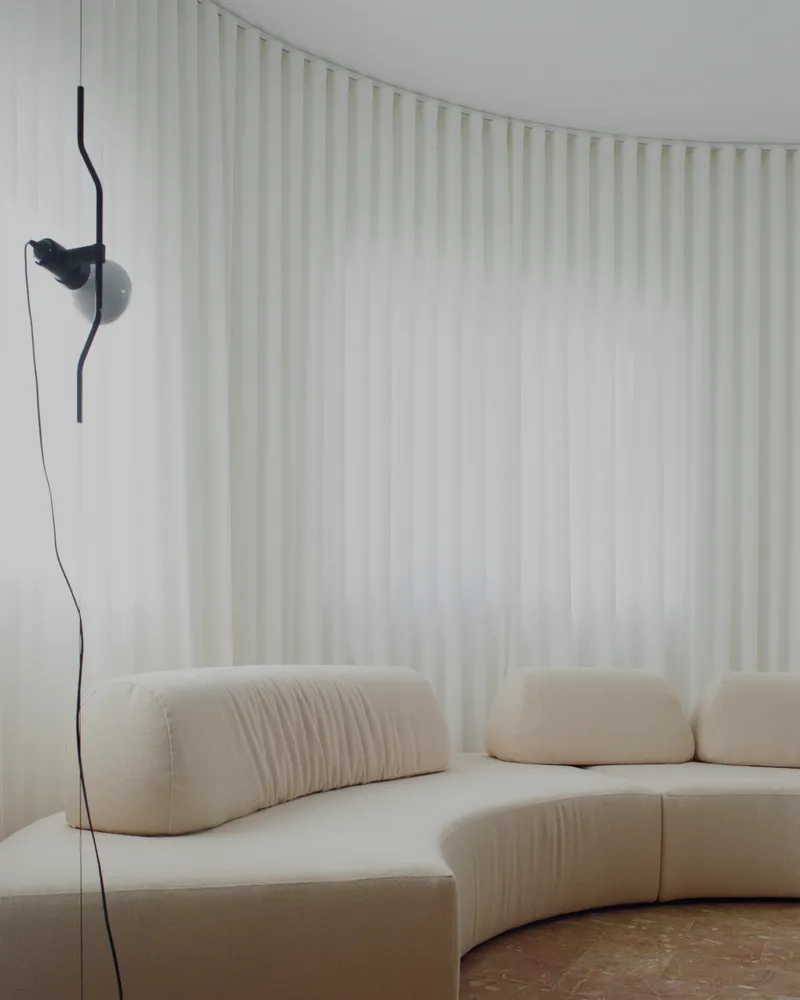
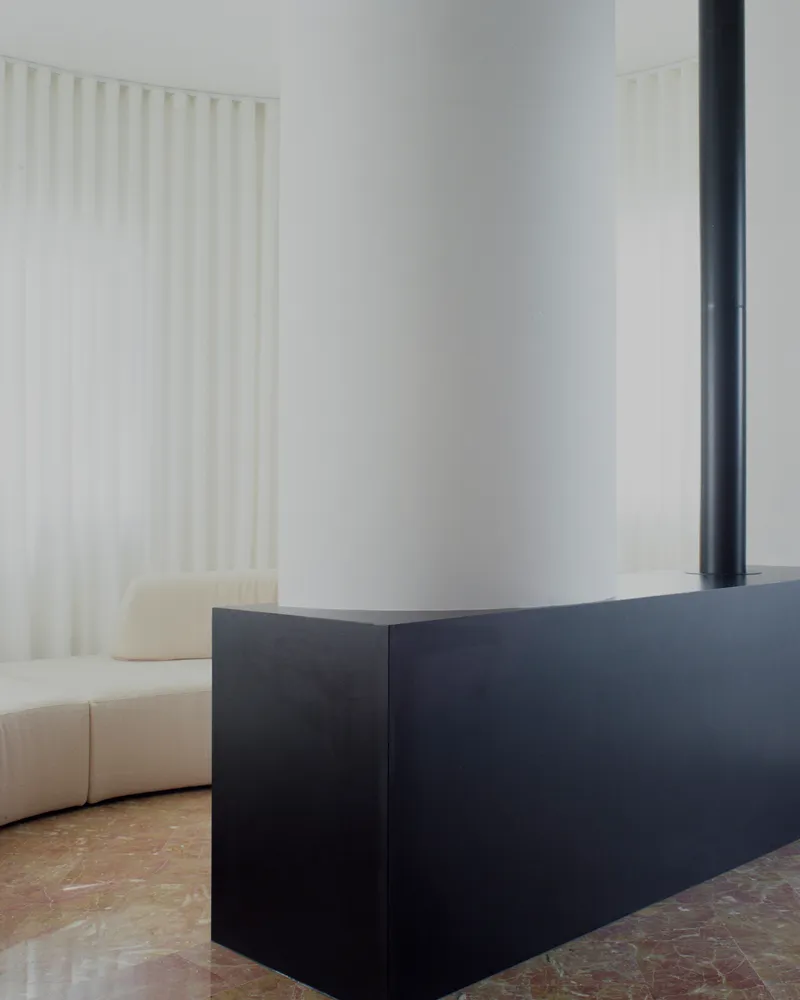
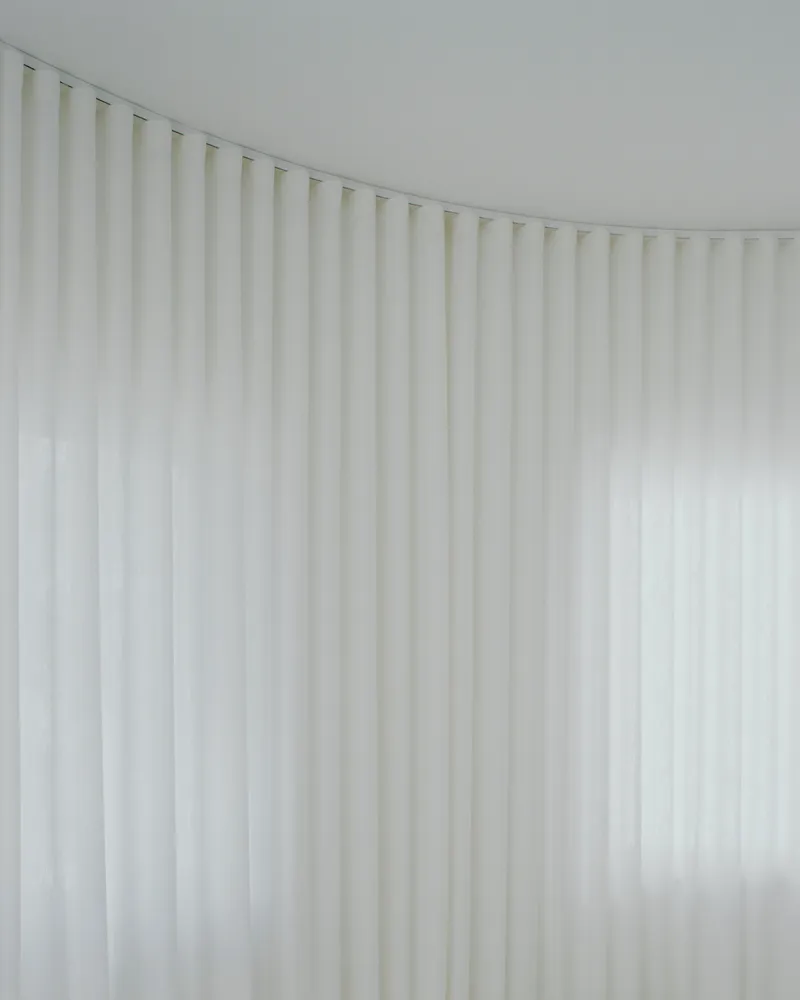
The semicircular geometry of the main living area is the most striking spatial move. A custom sofa, upholstered in pale fabric, follows the arc of the wall, anchored by floor-to-ceiling curtains that soften the curve into something atmospheric rather than purely geometric. The translucent ribbed curtain, tracked along the ceiling, catches the low-angle Salento sun and diffuses it into a warm, even glow. It is a room designed for lounging, reading, and staring at a fire.
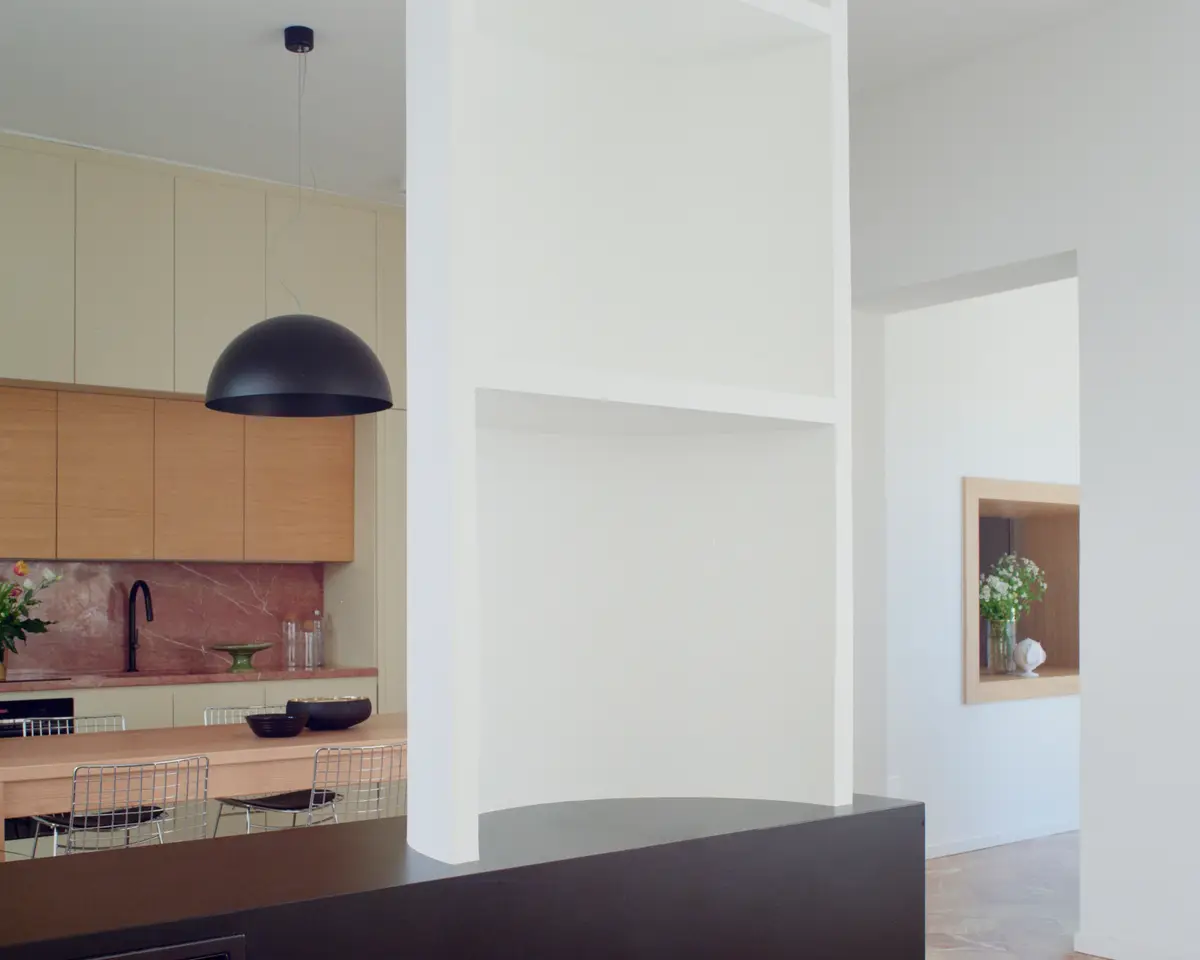
The fireplace system, finished in black gres stoneware, occupies a hollow semi-column that functions as the room's spine. It divides the living area from the dining zone without closing either space off. The black steel hearth sits low, almost at floor level, creating a focal point that draws the eye down to the reclaimed Rosa del Garda marble floor. As a piece of spatial engineering, the column does triple duty: it heats, it divides, and it conceals mechanical runs.
Kitchen as Concealed Infrastructure
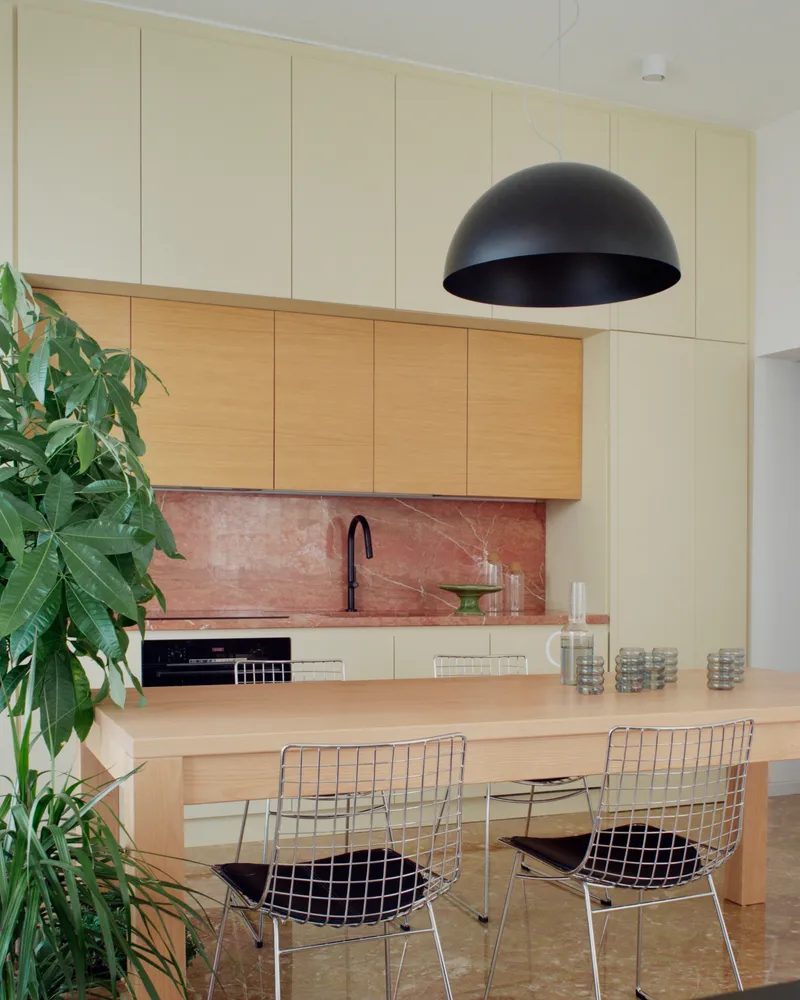
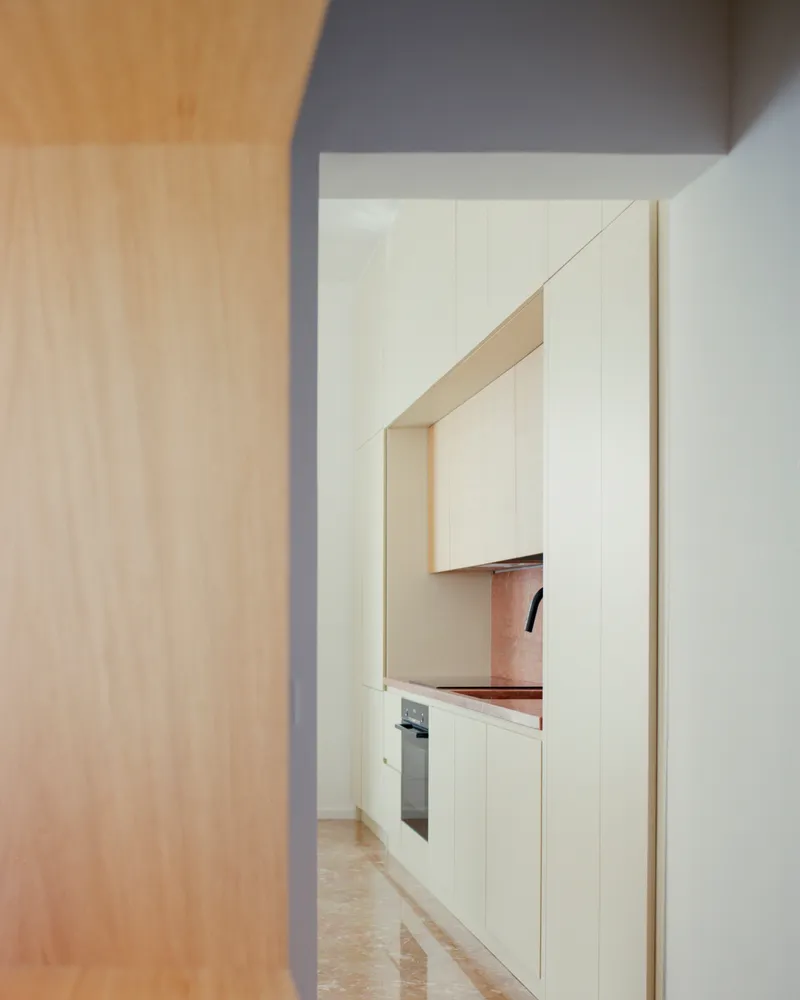
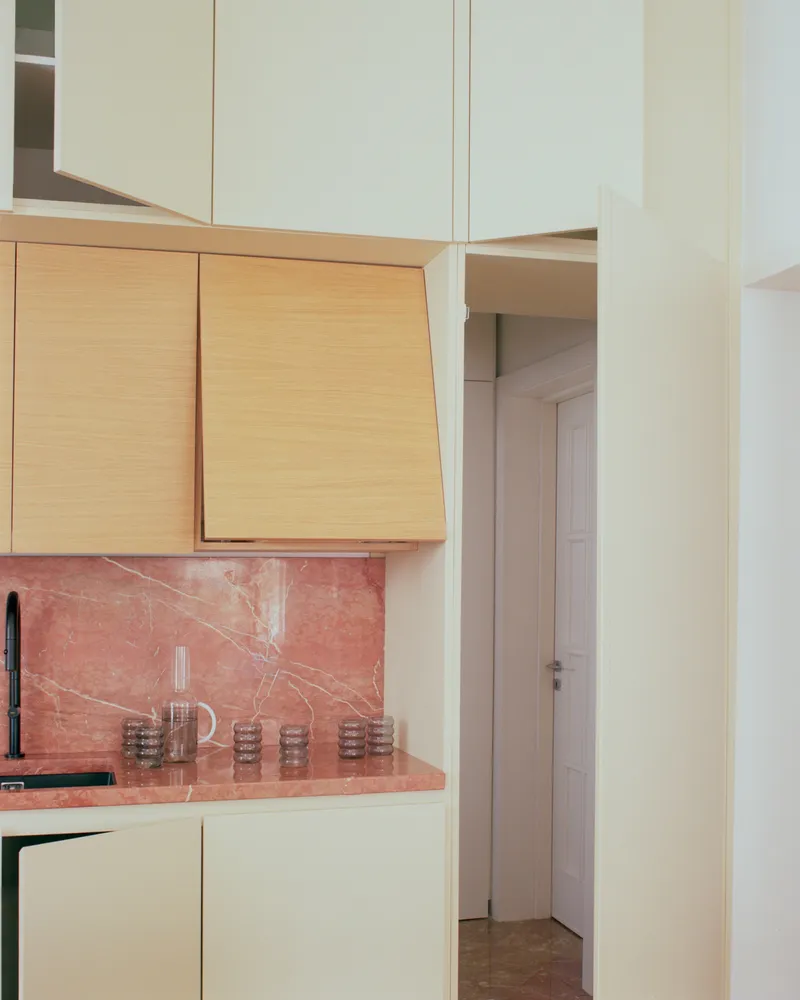
Margine treats the kitchen not as a standalone room but as a thick wall packed with program. Beige lacquered panels and oak cabinetry compose a continuous surface that, from the living side, reads as a clean plane punctuated by a recessed niche for display. From the kitchen side, the same wall opens up to reveal the pantry, guest bathroom, and laundry room. The laundry itself was carved from the footprint of the original entrance, a clever bit of spatial recycling that adds utility without adding area.
The pink Rosa del Garda marble, reclaimed and repurposed, appears as both backsplash and countertop, giving the kitchen a warmth that the beige cabinetry alone would lack. Wire mesh dining chairs under a dome pendant keep the space from tipping into preciousness. It is a working kitchen that happens to photograph well, not the other way around.
Thresholds and Internal Windows
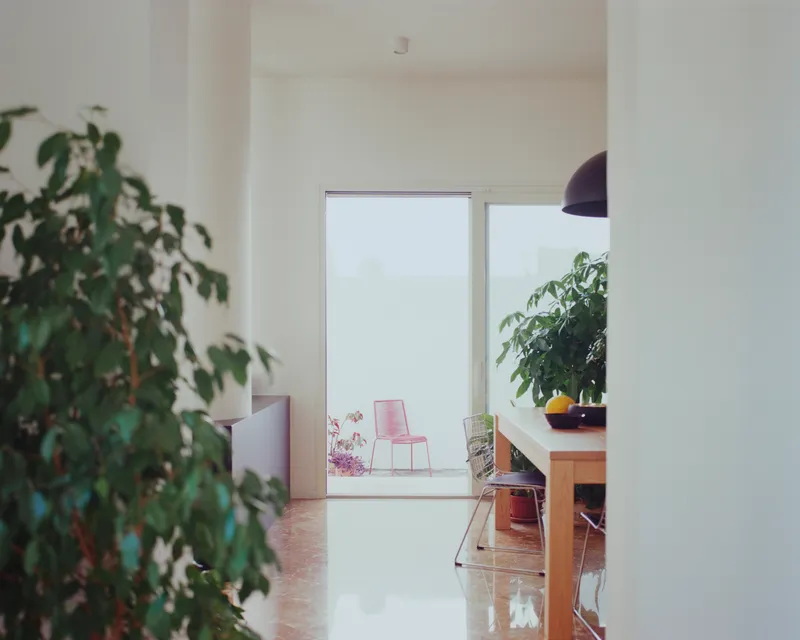
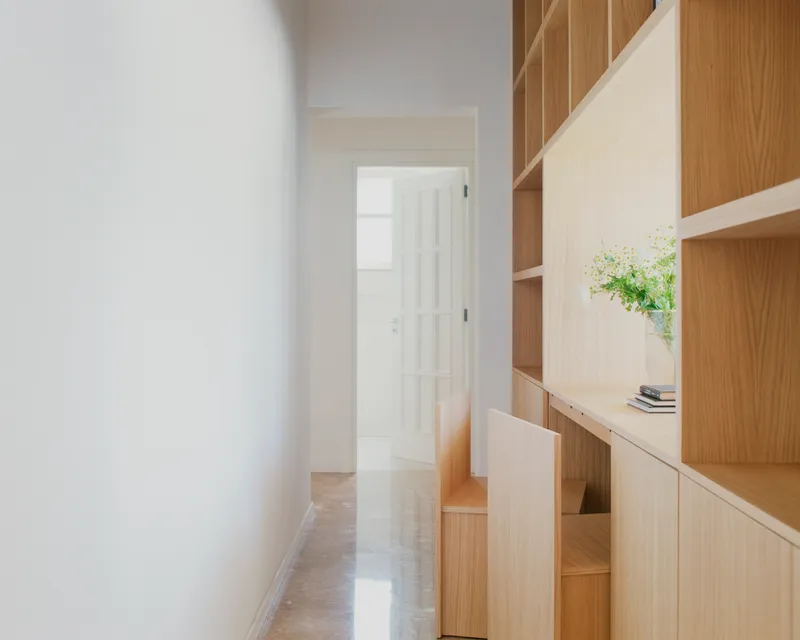
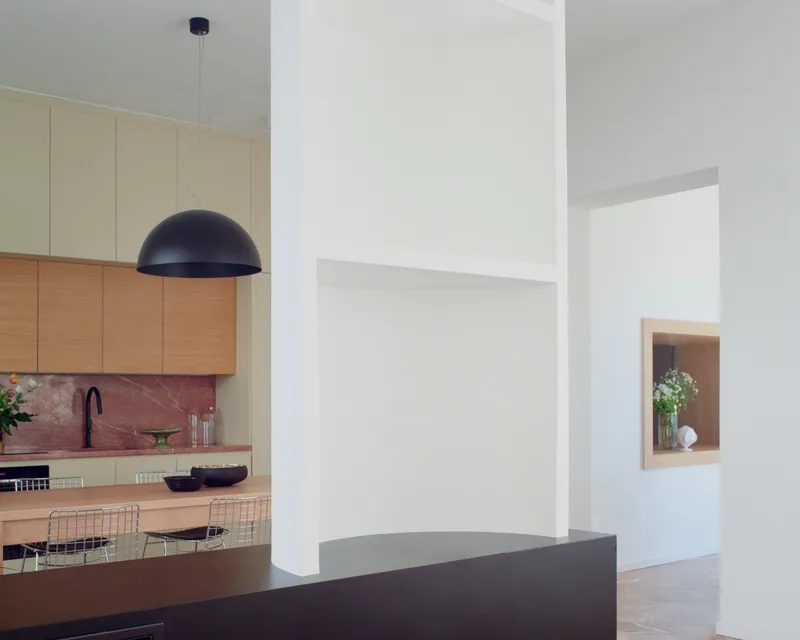
The plan relies on visual connections to keep 140 square meters from feeling tight. Internal windows open sightlines between the living and sleeping zones, allowing borrowed light to travel through the house. The corridor, lined with floor-to-ceiling oak shelving, terminates at a glazed door that frames a sunlit patio and pulls the garden into the interior sequence. Every doorway is treated as an opportunity: the view through the pale wood paneling into the kitchen, or the recessed wall niche in the open plan, functions less as passage and more as curated vignette.
The pendant lamp visible through the hallway door is a small detail, but it is telling. Margine places objects at the end of sightlines the way a curator hangs art at the terminus of a gallery. It is a method that makes a compact house feel composed rather than merely organized.
Sleeping Quarters and Material Warmth
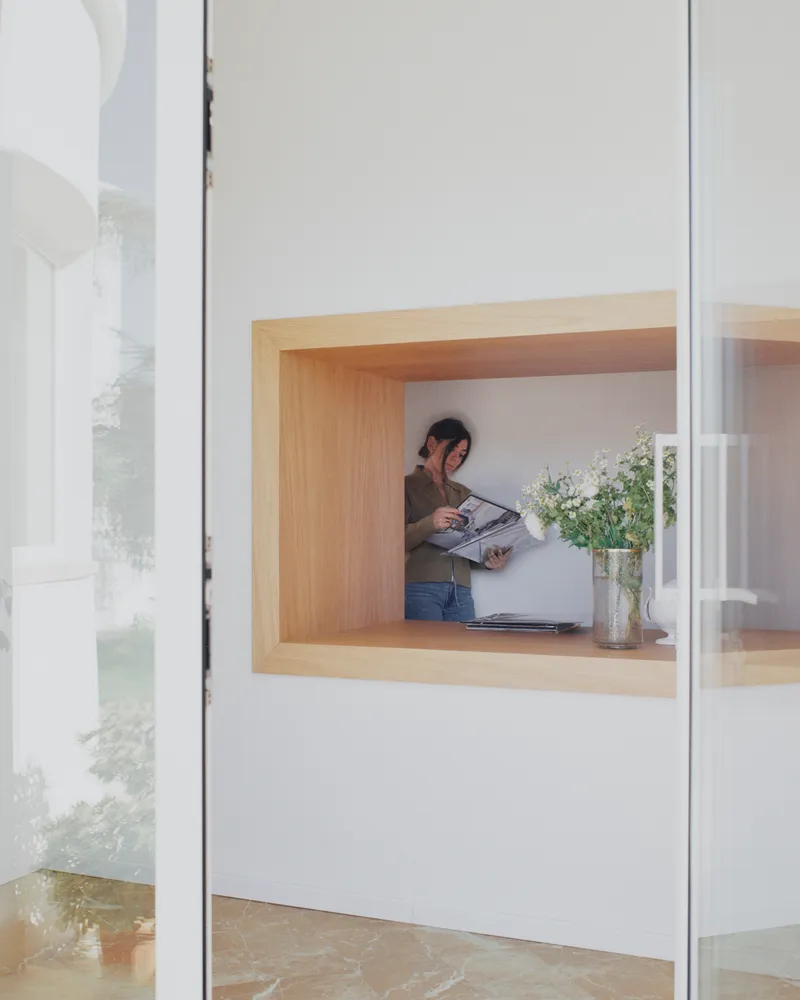
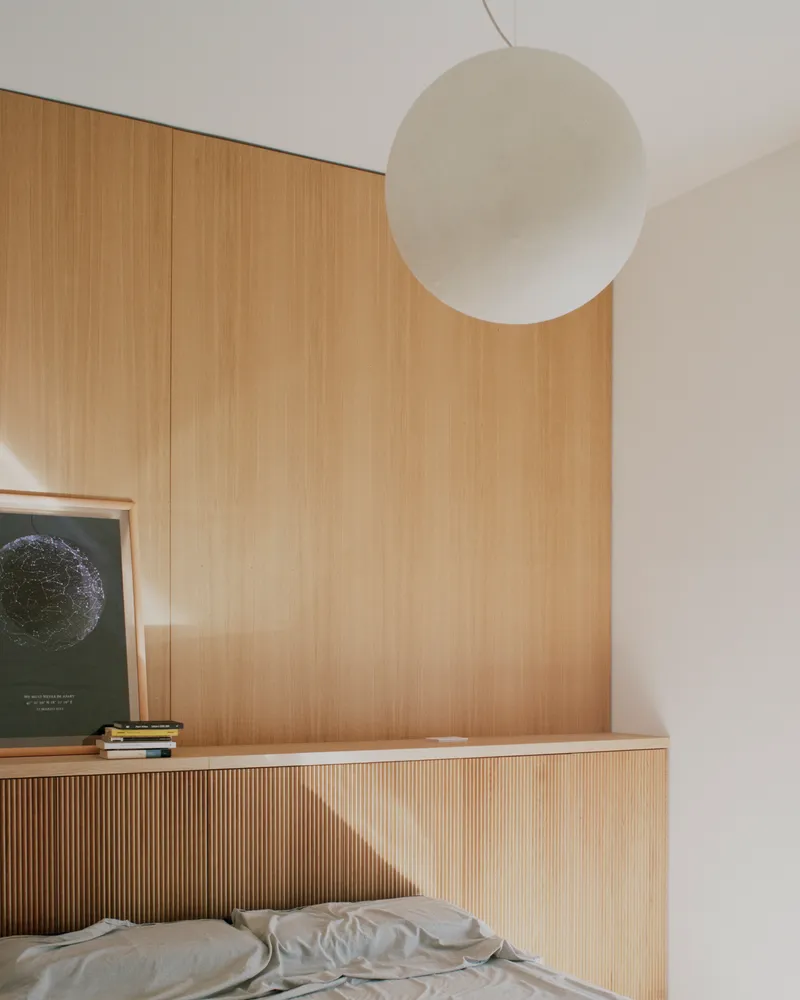
Where the living room trades in curves and diffused light, the sleeping block is rectilinear and material. The ribbed oak headboard wall wraps the bed in a warm, tactile enclosure. A spherical pendant hangs low, reinforcing the sense that this is a space scaled to the body rather than to the room. The timber-lined window nook, wide enough for standing and reading beside a vase of flowers, suggests that even the smallest leftover dimensions can be activated.
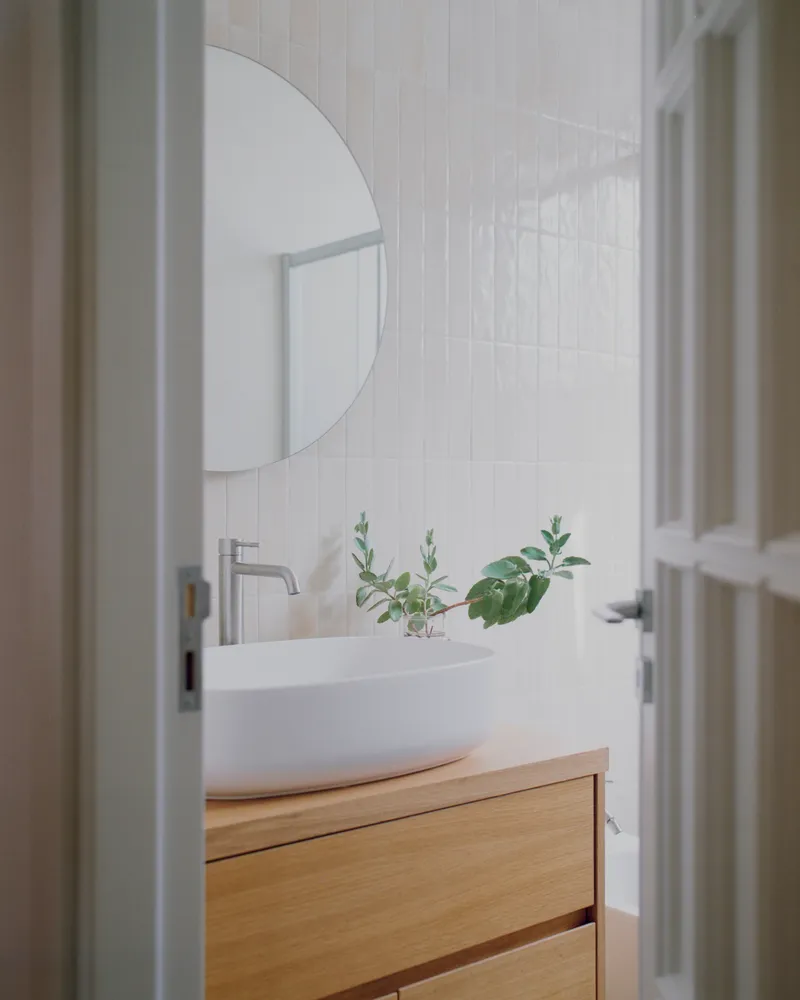
The bathroom continues the oak and white palette but shifts to vertical tiles and a vessel sink, keeping surfaces hygienic without abandoning the material continuity that holds the house together. A round mirror breaks the geometry just enough to recall the curved living room on the other side of the plan.
Light as Choreography
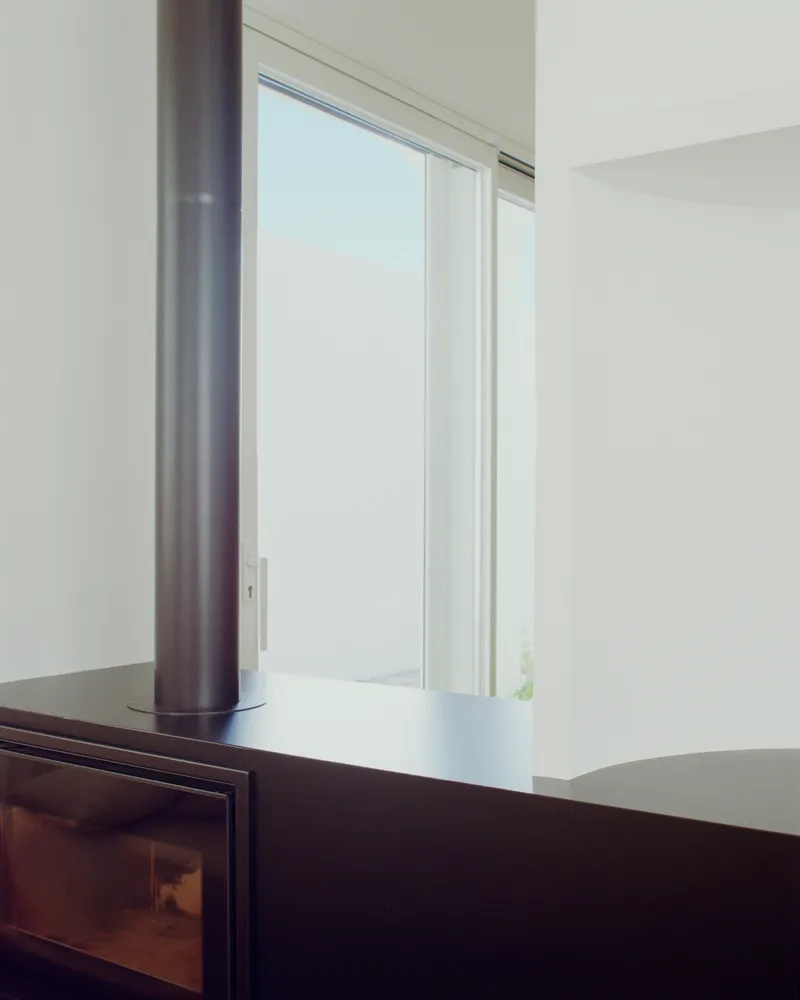
Puglia's sunlight is intense and low, particularly in the seasons when the house is most likely occupied. Margine exploits this through a careful placement of glazed openings. The sliding glass door beside the wood-burning stove frames a muted sky like a painting, while the narrow vertical slits on the facade ration direct sun into controlled shafts. The ribbed curtain in the living room acts as a filter, translating harsh Salento light into something softer. Nothing here is accidental; every opening has a role in the light choreography.
Plans and Drawings
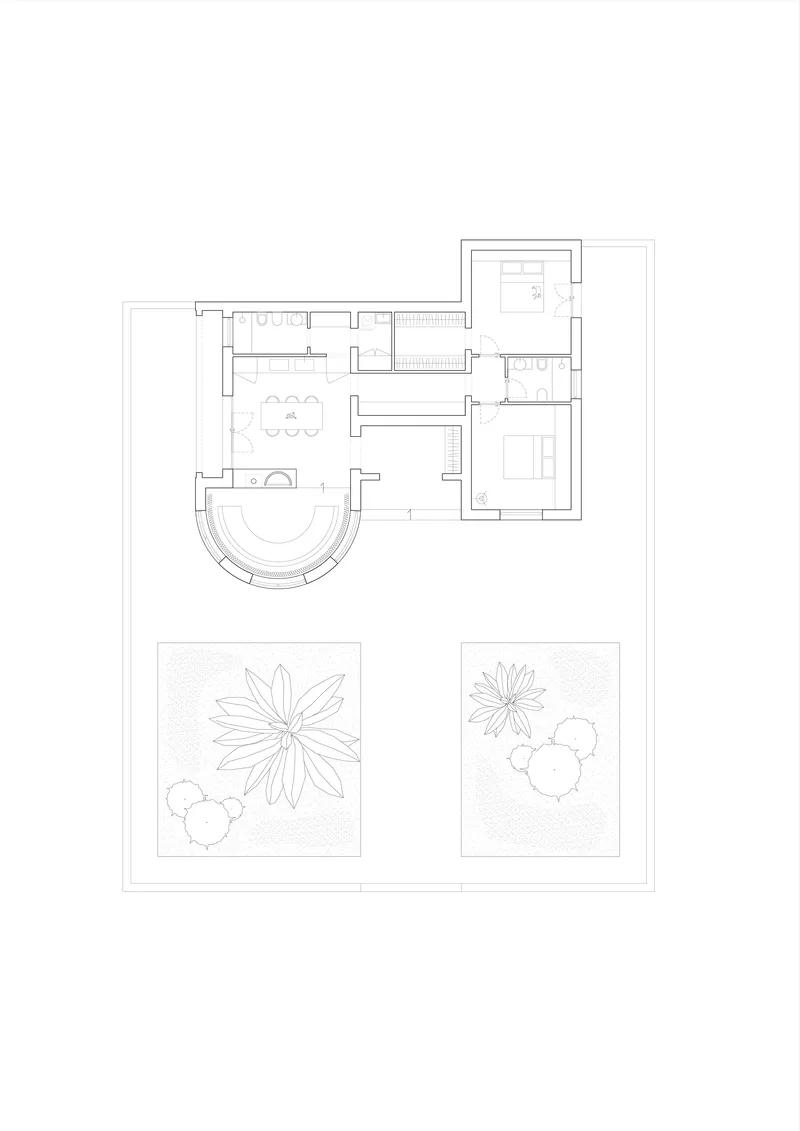
The floor plan makes the interlocking geometry explicit. The curved wall of the living area sweeps into two planted courtyards, while the rectangular sleeping block sits perpendicular, creating a hinge at the kitchen-fireplace spine. Two courtyards with planted beds bring greenery deep into the footprint and ensure cross-ventilation. Reading the plan, you can see how every service function, from laundry to pantry, is absorbed into the cabinet-wall, leaving the primary rooms free of clutter. It is a plan that earns its 140 square meters.
Why This Project Matters
Casa Lèvanzo is a case study in the kind of renovation work that southern Italian villages increasingly need. The 1970s building stock across Puglia is vast, architecturally mediocre, and often well-built enough to warrant adaptation rather than demolition. Margine's approach, stripping a house to its structural logic and discovering a geometry worth celebrating, offers a replicable method. It doesn't require exotic materials or heroic engineering, just a willingness to subtract before adding.
More broadly, the project demonstrates that adaptive reuse doesn't need to announce itself. There is no exposed concrete left as a ruin-chic gesture, no industrial steel inserted for contrast. The result is simply a well-organized house with clear spatial ideas, a coherent material palette, and a sensitivity to the quality of light that defines its region. For a 140-square-meter renovation in a small village, that is more than enough.
Casa Lèvanzo, designed by Margine, is located in Caprarica di Lecce, Italy. The renovation covers 140 m² and was completed in 2026. Photography by ©Marcello Mariana.
About the Studio
Share Your Own Work on uni.xyz
If projects like this are the kind of work you want to make, uni.xyz is a place to publish your own, find collaborators, and enter design competitions.


Popular Articles
Popular articles from the community


Extended Shell: Retrofitting Kolkata's Balconies as Living Urban Thresholds
A modular retrofit system recovers the social and environmental intelligence of Kolkata's historic verandas for contemporary Park Street residents.

The Amber Palace Opera: A Geological Fiction Surfaces on Tallinn's Baltic Waterfront
Pierre Brillard reimagines a Baltic legend as a public landscape, opera house, and waterfront promenade rooted in Tallinn's coastal identity.

Singing Woman: An Opera House That Performs Before the Curtain Rises
Ovidiu Cristian Pavel's conceptual opera house translates Estonia's choral identity into a sculpted waterfront landmark facing the Baltic Sea.

Opera on the Sea: Driftwood Logic Shapes a Timber Opera House on Estonia's Coast
Trevor Orgill's opera house translates the entangled drift of floating timber into a civic building where wood, water, and music converge.

Similar Reads
You might also enjoy these articles

Pixel Gardens: One Repeated Module Stacked Into a Terraced Social Housing Tower for Famagusta
Salem Bader's shortlisted housing tower builds a vertical neighbourhood from one repeated module, offsetting units to carve terraces, light and air.

Bao Huynh Watercolor Atelier: A Serene Art Retreat in Hội An
Bao Huynh Watercolor Atelier in Hội An blends multifunctional art spaces, sustainable design, local materials, and family-friendly living in a serene environment.

Atelier Macri Concept Store Interior Design by CASE-REAL
Atelier Macri store features a "ko" counter, walnut wood details, cork displays, blending retail, gallery, and seamless customer experiences.

Manuel Vargas Izquierdo Stadium and High-Performance Sports Center: Architectural Excellence in Jalpa de Méndez
The Manuel Vargas Izquierdo Stadium blends sustainable design, inclusive sports facilities, and cultural-inspired architecture, revitalizing Jalpa de Méndez’s public spaces.

Explore Curvilinear Architecture Competitions
Discover active competitions in this discipline

Challenge to design luxury tourism on rails

VR headsets Storefront design competition

Designing a staircase for a client
Comments (0)
Please login or sign up to add comments
No comments yet. Be the first to comment!