

Matsuyama Architect and Associates Shelters an Elderly Couple Under a Single Roof Canopy in Amami
A 138-square-meter steel-and-concrete house on a subtropical hilltop protects two weavers from typhoons while framing open valley views.


On Amami-Oshima Island, where typhoons barrel through a humid subtropical climate with regularity, the most generous architectural gesture might simply be a roof. Matsuyama Architect and Associates took that idea literally for House for Parents, a 138-square-meter residence designed as a permanent nesting ground for an elderly couple who spent their working lives making Oshima Tsumugi, a traditional woven fabric. The house sits at the summit of a hill overlooking a quiet village and surrounding mountains on the Pacific side of northern Amami. Everything about the design, from its structural logic to its material palette, is organized around the idea of living comfortably beneath a single sheltering canopy.
What makes the project genuinely compelling is the structural gambit at its core. A four-meter-span steel framework supports a flat rectangular roof that floats above a constellation of independent concrete walls. Because the walls do not carry the roof, the floor plan is freed from the column grid. Rooms can be defined, opened, or dissolved without structural consequences. The effect, as the architects describe it, is akin to a comfortable habitat under trees: the canopy is constant, but the spaces below breathe and shift in response to view, light, and program.
A Roof That Does Everything
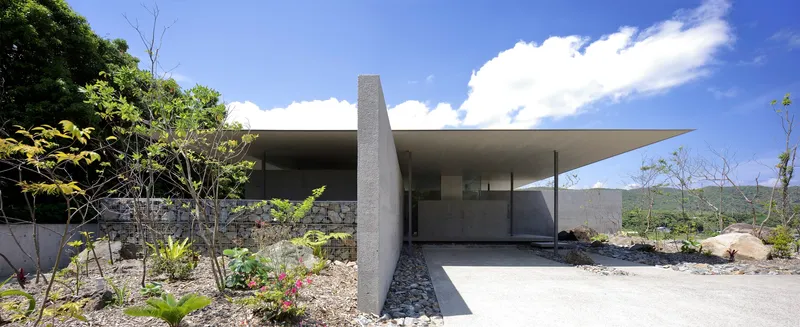

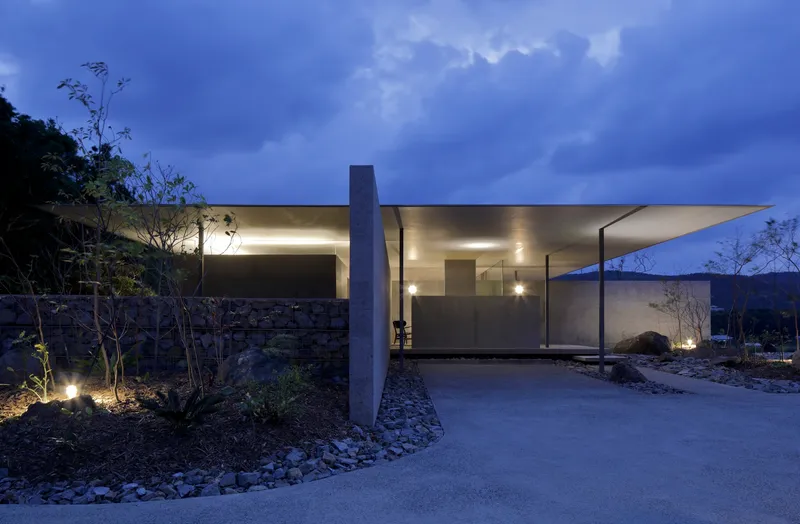
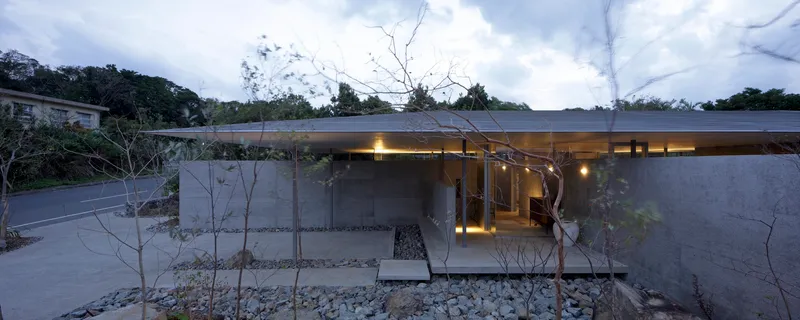
The roof plane is the single most assertive element in the composition. It extends well beyond the enclosed rooms, cantilevering over gravel gardens, carports, and entry platforms to create a continuous zone of shade and rain protection. In a climate where sudden downpours and punishing winds are seasonal certainties, this overhang is not decorative. It is the building's primary environmental strategy, reducing solar gain on glazed walls and keeping wind-driven rain away from openings.
Seen from the road, the house reads as a low-profile horizontal bar floating just above the terrain. Its restrained silhouette avoids competing with the hillside landscape, and the thin edge of the roof slab gives the structure an almost weightless quality despite being built to withstand typhoon-force winds.
Steel Frame, Free Walls
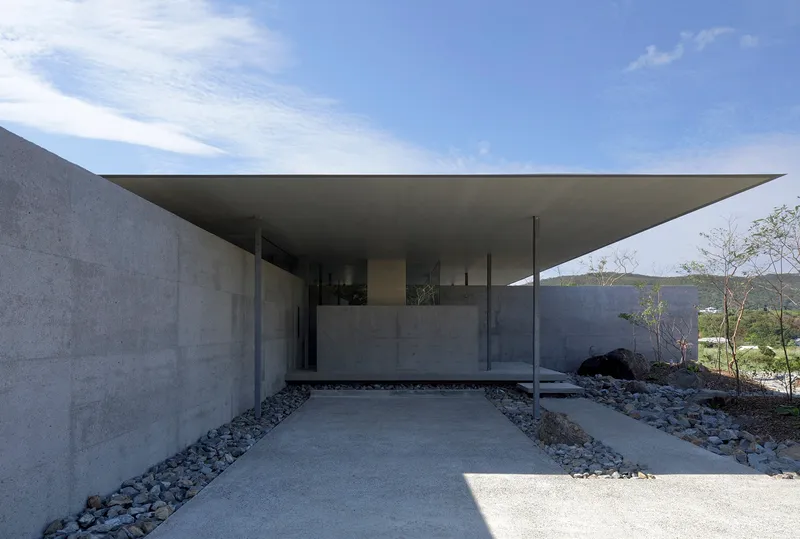
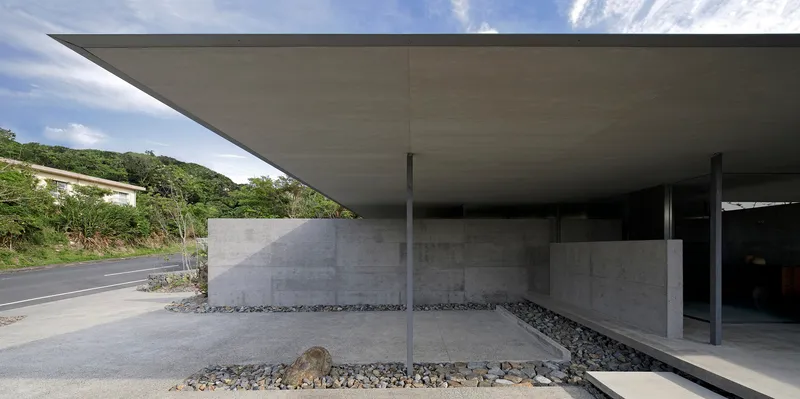
Slender steel columns, spaced on a four-meter grid, do all the vertical work of holding up the roof. The concrete walls that define individual rooms stand independently, touching the roof but not supporting it. This separation is visible in the carport and at the entrance, where you can see the columns marching on their regular rhythm while concrete planes slide between them at odd angles. The clarity of the system is satisfying: you always know what is structure and what is enclosure.
The decision to use steel rather than reinforced concrete for the frame keeps the columns thin enough to disappear inside wall assemblies or stand exposed as fine vertical lines in open areas. For a house of only 138 square meters on a 1,301-square-meter site, the proportions could easily have become chunky. The steel frame prevents that.
Concrete Walls as Landscape Directors

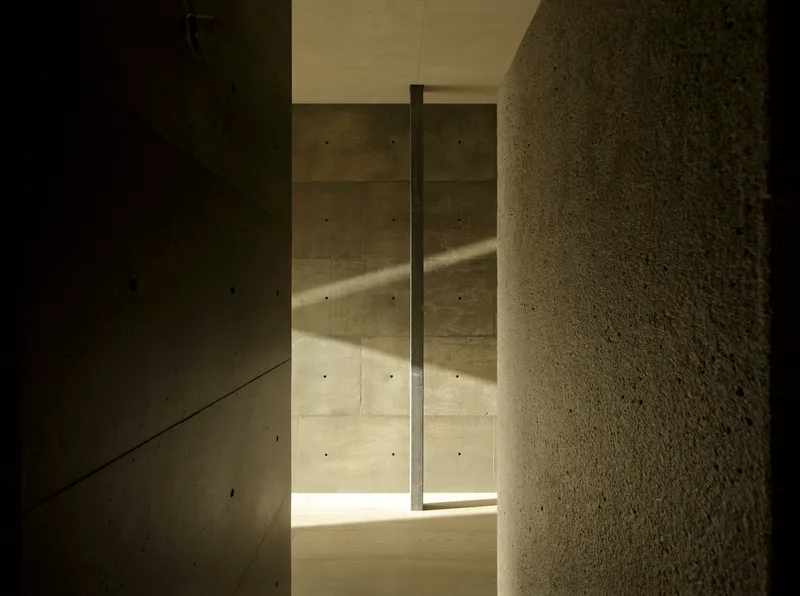

Board-formed concrete walls run through the house in long, continuous planes, often projecting outward past the glass line to reach into the garden. The effect is deliberate: the living room does not end at a wall but expands toward the external landscape through these projecting fins. They channel views, direct circulation, and create the kind of compressed-then-released spatial sequence that makes a small house feel larger than its numbers suggest.
In the corridors, the texture of the formwork is left exposed and paired with rough stone surfaces, producing narrow passages that are almost geological in character. A vertical slot window in one hallway casts a sharp line of sunlight onto the stone, turning the mundane act of walking between rooms into a sensory event. The contrast with the open, glass-walled living spaces is stark and intentional.
Living Between Inside and Outside

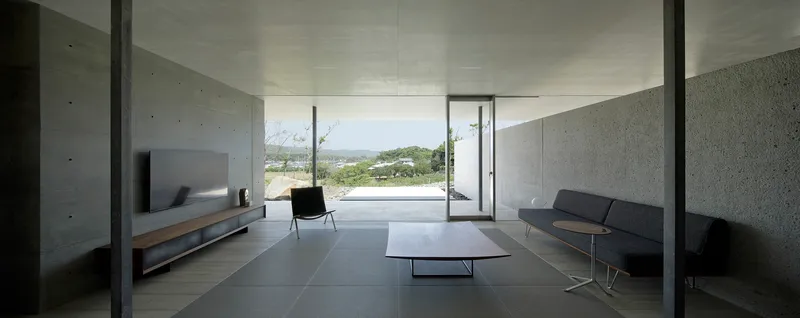
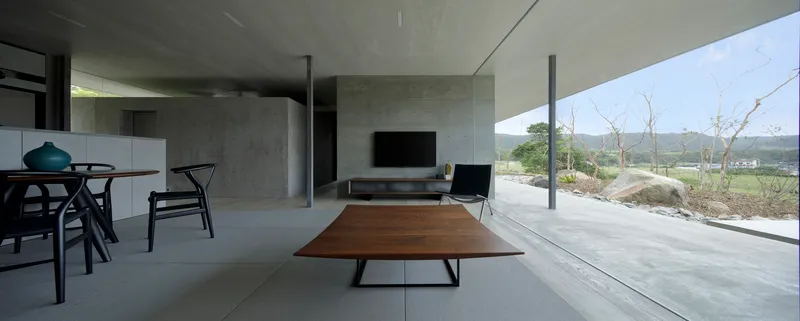
The main living area is the payoff for all that structural maneuvering. Floor-to-ceiling sliding glass panels open onto a terrace that looks out over the hillside toward low vegetation and distant mountains. The dark tile floor, walnut furniture by Shibayama Furniture Factory, and the raw concrete ceiling give the room a palette that recedes, letting the landscape do the talking. At dusk, the room becomes a lantern on the hilltop, its occupants silhouetted against the view.
There is a studied casualness to the way the couple is shown inhabiting this space: seated on low furniture, the terrace open, the evening settling in. For two people who spent decades at the loom making Oshima Tsumugi, the openness of this room must feel like a profound change in scale. The house is designed around their retirement, and the generosity of the living room speaks directly to that shift.
Courtyards and Planted Rooms

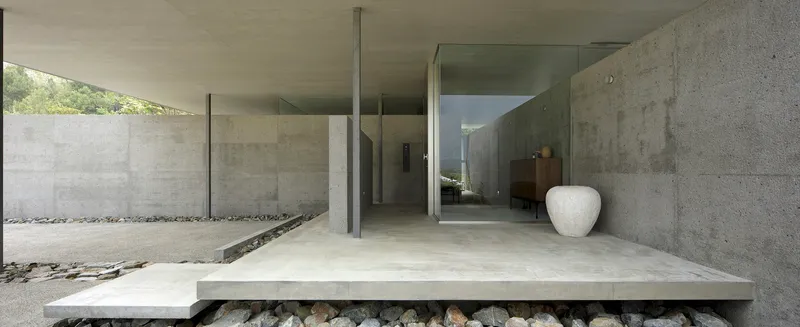

Not all the outdoor space is borrowed from the surrounding hillside. Walled courtyards, landscaped by Urata garden design office, bring pockets of planting inside the building's footprint. Young trees rise from mulch beds bordered by stone, their canopies still years away from maturity. These courtyards will change the character of the house over time as the saplings grow to fill the spaces the architects have left for them.
A pebble garden visible through floor-to-ceiling glass creates a transitional zone that is neither fully inside nor fully outside. The elevated concrete entry platform floats above river stones, reinforcing the sense that the house sits lightly on its terrain. The gravel and stone landscaping also serves a practical purpose: it allows rainwater to percolate rather than pooling, a sensible choice in a region where rainfall can be torrential.
Quiet Rooms

A tatami-floored room with concealed cove lighting and a translucent screen offers the most traditionally Japanese moment in the house. The warm glow at dusk is a counterpoint to the coolness of the concrete and glass elsewhere. It is a room for rest, for intimacy, for the rituals of daily life that do not require a panoramic view.
The translucent screen filters light rather than blocking it, maintaining a connection to the rest of the house while providing privacy. In a dwelling for two people, this balance matters. There is no need for strict acoustic or visual separation, but moments of enclosure within the larger open plan give each inhabitant the option to withdraw.
Plans and Drawings


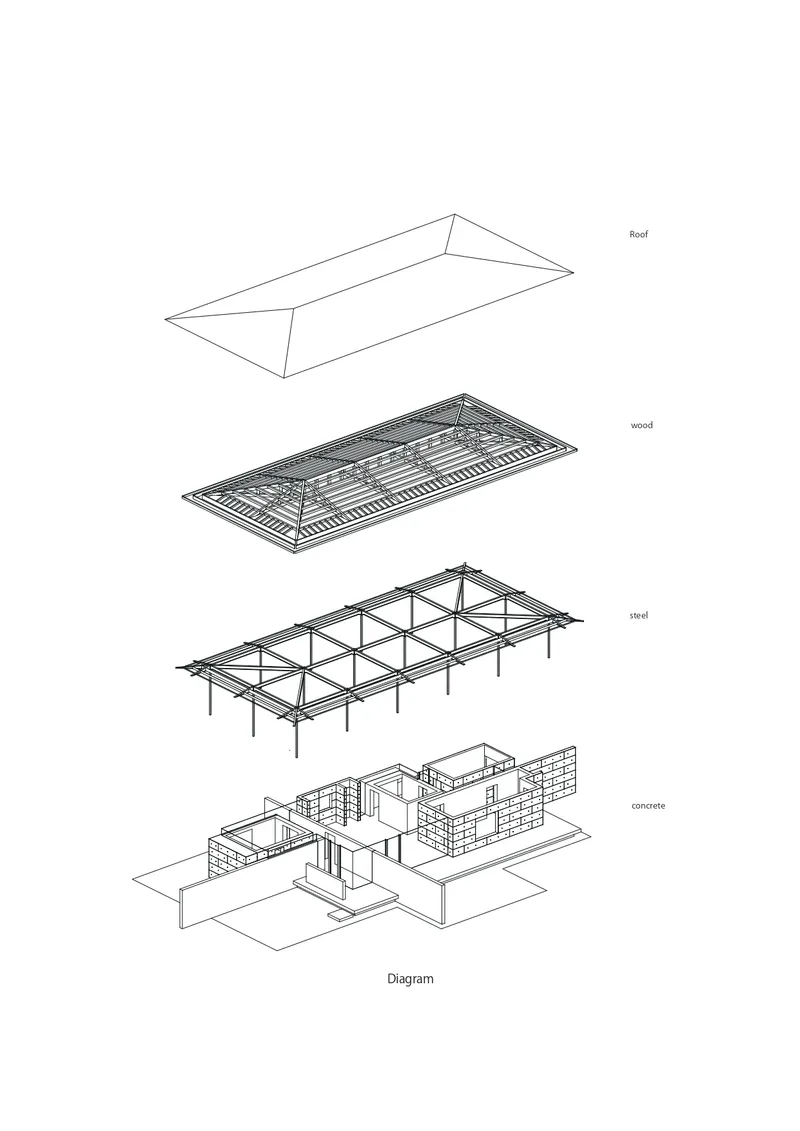

The site plans reveal how the house is positioned at the upper edge of the plot, with the parking and approach road at the perimeter and landscaped gardens filling the remainder. The exploded axonometric is the most instructive drawing: it pulls apart roof, wood deck, steel frame, and concrete base into four distinct layers, making the structural independence of each system legible at a glance. You can see that the steel grid and the concrete walls operate on entirely different geometries, overlapping but never coinciding.
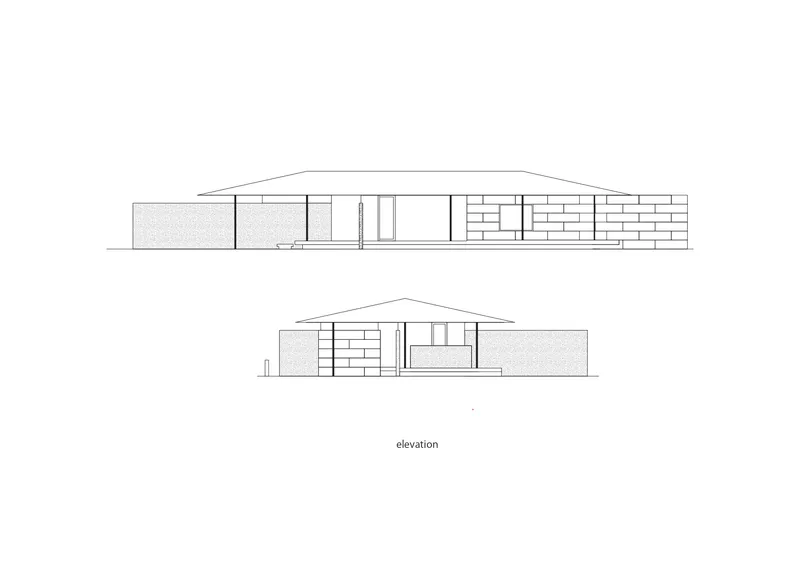
Elevation and section drawings confirm the low-slung profile. The hipped roof barely rises above the surrounding tree line, and interior ceiling heights are kept modest, reinforcing the sense of shelter. The sections show how room divisions are formed entirely by freestanding concrete walls of varying height, some reaching the ceiling and others stopping short to allow air and light to flow over them.
Why This Project Matters
House for Parents is a convincing argument that residential architecture in extreme climates does not need to retreat into bunker mode. The building is open, light, and connected to its landscape while still being engineered to survive typhoons. The structural strategy of separating the roof from the walls is not novel in principle, but its execution here is disciplined and purposeful. Every decision traces back to either the climate or the clients' way of life, and the absence of gratuitous formal moves is refreshing.
For two people transitioning from a lifetime of focused craft to the open rhythms of retirement, the house offers a new spatial generosity without losing the intimacy of small, textured rooms. It earned the 2019 JAAF Award and a Kukan Design Award Gold Prize, recognition that speaks to the quality of its thinking. More importantly, it demonstrates that a house for aging parents can be an act of architectural ambition rather than a concession to practicality.
House for Parents by Matsuyama Architect and Associates, Amami, Japan. 138 m². Completed 2018. Photography by Toshihisa Ishii.
About the Studio
Share Your Own Work on uni.xyz
If projects like this are the kind of work you want to make, uni.xyz is a place to publish your own, find collaborators, and enter design competitions.


Popular Articles
Popular articles from the community


Opera on the Sea: Driftwood Logic Shapes a Timber Opera House on Estonia's Coast
Trevor Orgill's opera house translates the entangled drift of floating timber into a civic building where wood, water, and music converge.

Tsunami Convergenics: Turning Catastrophic Ocean Forces into Underwater Housing Infrastructure
A speculative underwater settlement off the coast of Onagawa, Japan, treats tsunamis and typhoons as energy sources rather than threats.

Manzana Morphosis: Stretching Barcelona's Grid into a Living Landscape for 2050
A radical reworking of the Eixample manzana turns density into a tool for generous public space, vertical ecology, and environmental performance.

The Amber Palace Opera: A Geological Fiction Surfaces on Tallinn's Baltic Waterfront
Pierre Brillard reimagines a Baltic legend as a public landscape, opera house, and waterfront promenade rooted in Tallinn's coastal identity.

Similar Reads
You might also enjoy these articles

Bao Huynh Watercolor Atelier: A Serene Art Retreat in Hội An
Bao Huynh Watercolor Atelier in Hội An blends multifunctional art spaces, sustainable design, local materials, and family-friendly living in a serene environment.

Atelier Macri Concept Store Interior Design by CASE-REAL
Atelier Macri store features a "ko" counter, walnut wood details, cork displays, blending retail, gallery, and seamless customer experiences.

Manuel Vargas Izquierdo Stadium and High-Performance Sports Center: Architectural Excellence in Jalpa de Méndez
The Manuel Vargas Izquierdo Stadium blends sustainable design, inclusive sports facilities, and cultural-inspired architecture, revitalizing Jalpa de Méndez’s public spaces.

KAKR Buluh Awar Hall: Revitalizing Community and Ecology Through Bamboo Architecture
Community built bamboo hall revitalizes Buluh Awar village, empowering youth, restoring ecology, celebrating vernacular craftsmanship through sustainable architecture and culture.


Comments (0)
Please login or sign up to add comments
No comments yet. Be the first to comment!