
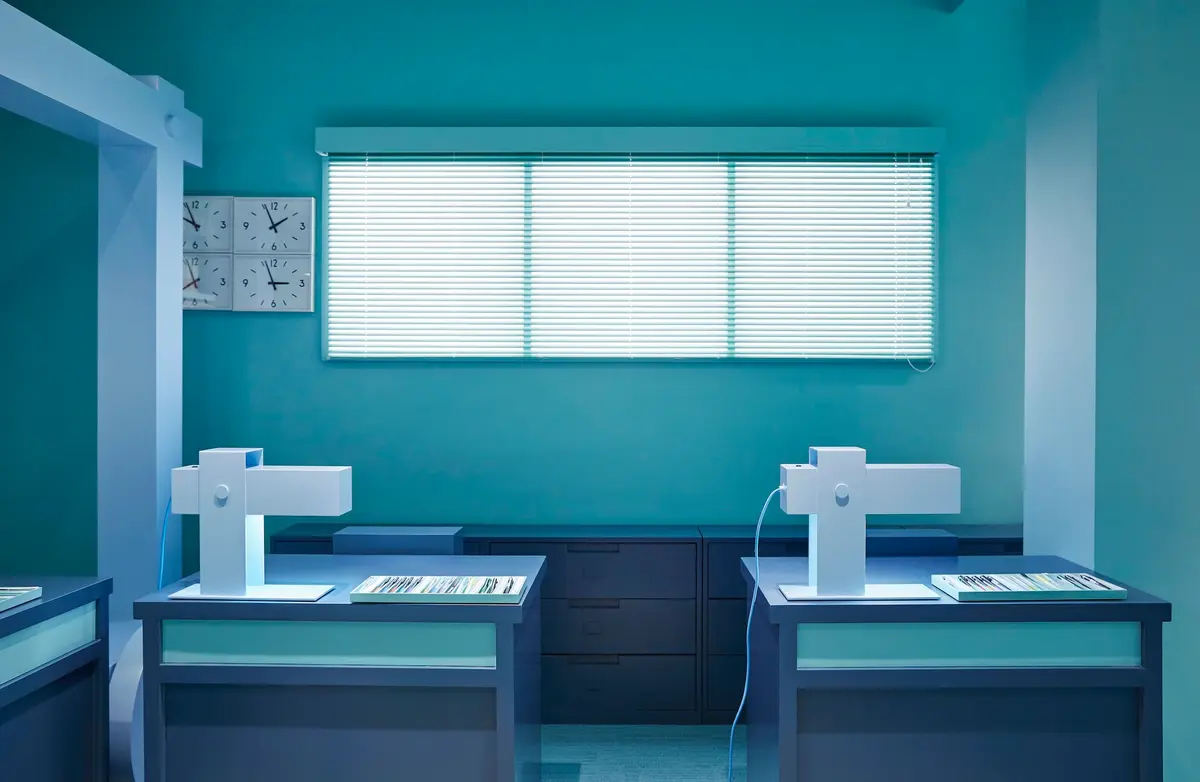
maumstudio Transforms 48 Square Meters into a Cobalt Archive for PILOT's First Korean Concept Store
A popup store in Seoul's Seongdong-gu reframes the act of writing as an institutional ritual inside a fictional office.


There is something deeply satisfying about a retail space that refuses to look like one. maumstudio's PILOT OFFICE Store in Seoul's Seongdong-gu district does not present pens on shelves. Instead it constructs a parallel world: a fictional government office where writing instruments are the bureaucratic currency and every surface, from binder spines to carpet tiles, enforces a single, saturated cobalt logic. At just 48 square meters, the space is tiny, but the commitment to its conceit is total.
Conceived as the 'Precious Words Collection Office,' the popup store is PILOT's first concept store in Korea, and it reads less like brand activation and more like set design for a film that takes stationery as seriously as espionage. That tonal precision is what makes the project worth studying. Where most popup interiors aim for Instagram bait through material excess, maumstudio achieves the same magnetism through narrative discipline: one color, one fiction, one mood, held without flinching across every detail.
Total Color Commitment
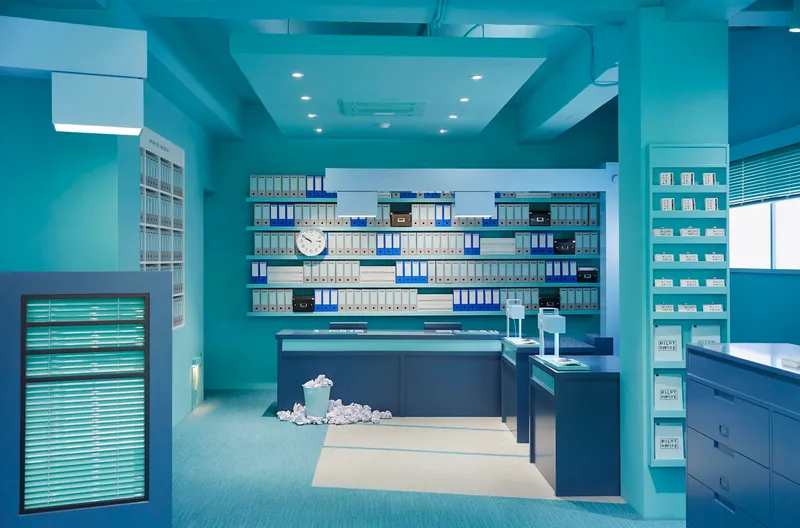
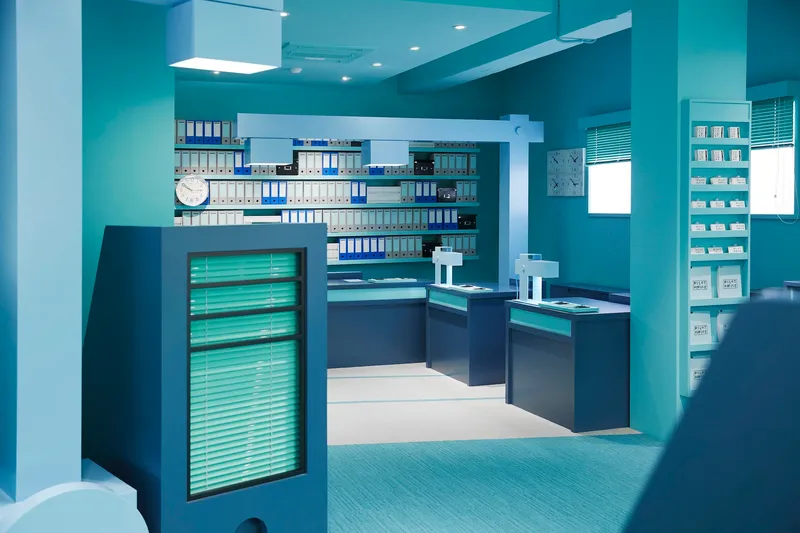
The turquoise walls are not an accent. They are the architecture. maumstudio drenches the interior in a single cobalt-adjacent tone that moves across every vertical surface, compressing the tiny footprint into a hermetic environment. Navy service counters and illuminated panels sit against these walls like bureaucratic furniture pulled from a parallel dimension. Recessed ceiling lighting washes the space evenly, eliminating shadows that might break the illusion.
The color choice is strategic. PILOT's brand identity centers on ink, and turquoise sits squarely in the range of their most recognizable cartridge tones. But the designers push the association beyond product recognition into spatial atmosphere. The result feels institutional, almost governmental, which is exactly the point: this is an office, and the color is its dress code.
The Archive as Display System

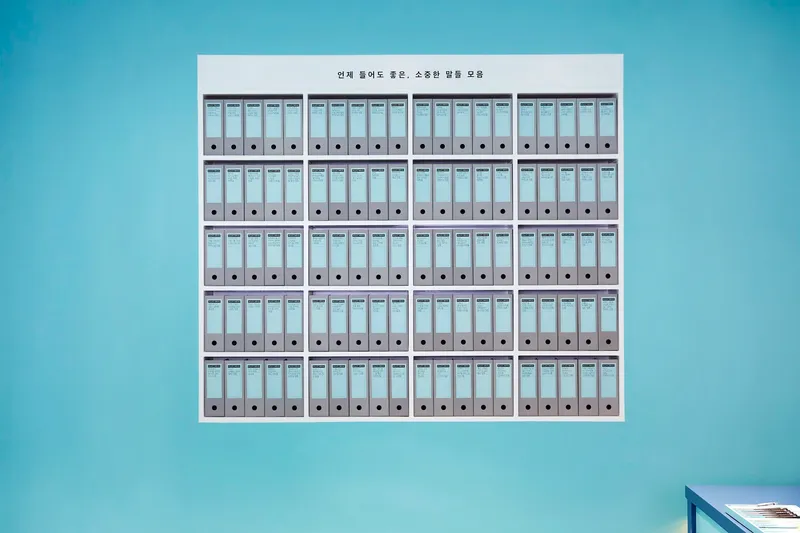
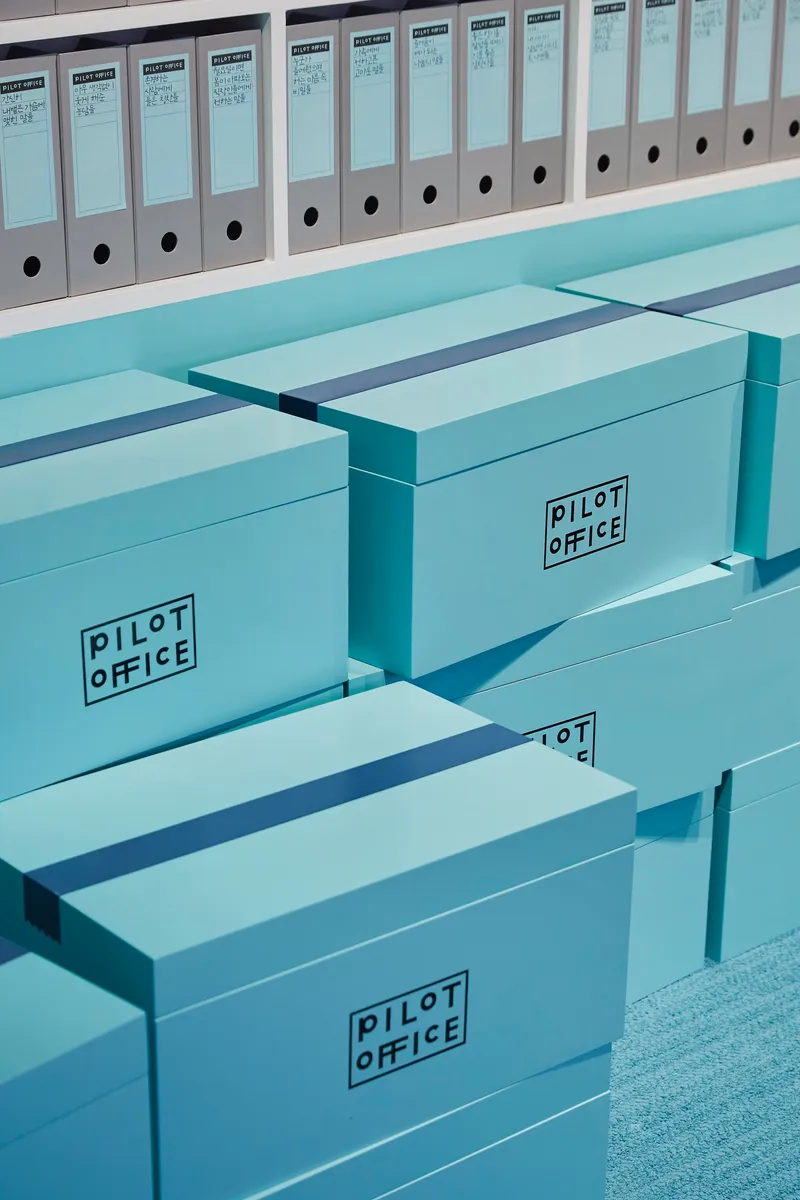
Filing binders are the store's primary visual motif, and they do serious work. Wall-mounted shelving holds rows of blue and grey binders arranged with the obsessive regularity of a records department. Labeled boxes sit in five-row grids. Stepped shelving units present storage containers in coordinated color schemes. None of this is accidental; it converts the commercial act of browsing products into the physical experience of rifling through an archive.
The genius of this approach is that it dignifies the product category. Pens are small, inexpensive, easy to overlook. By placing them within a framework of archival gravity, maumstudio grants writing instruments the reverence usually reserved for rare manuscripts or classified documents. You are not shopping. You are consulting the collection.
Workstations and the Writing Ritual
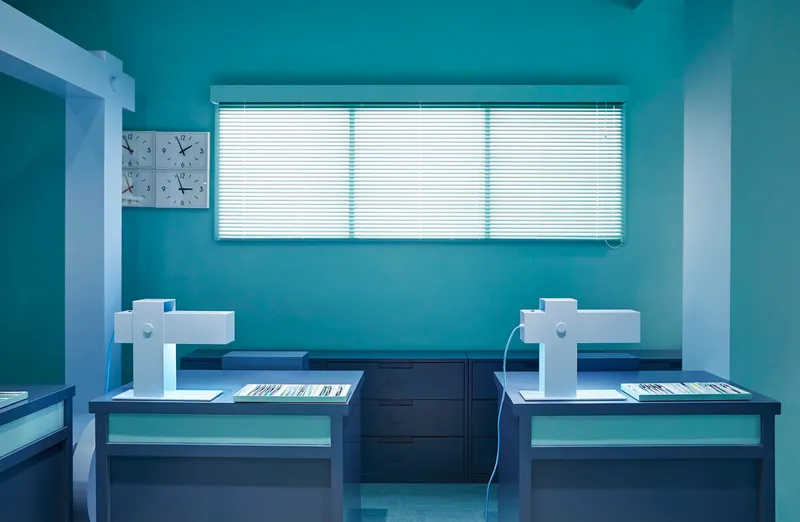

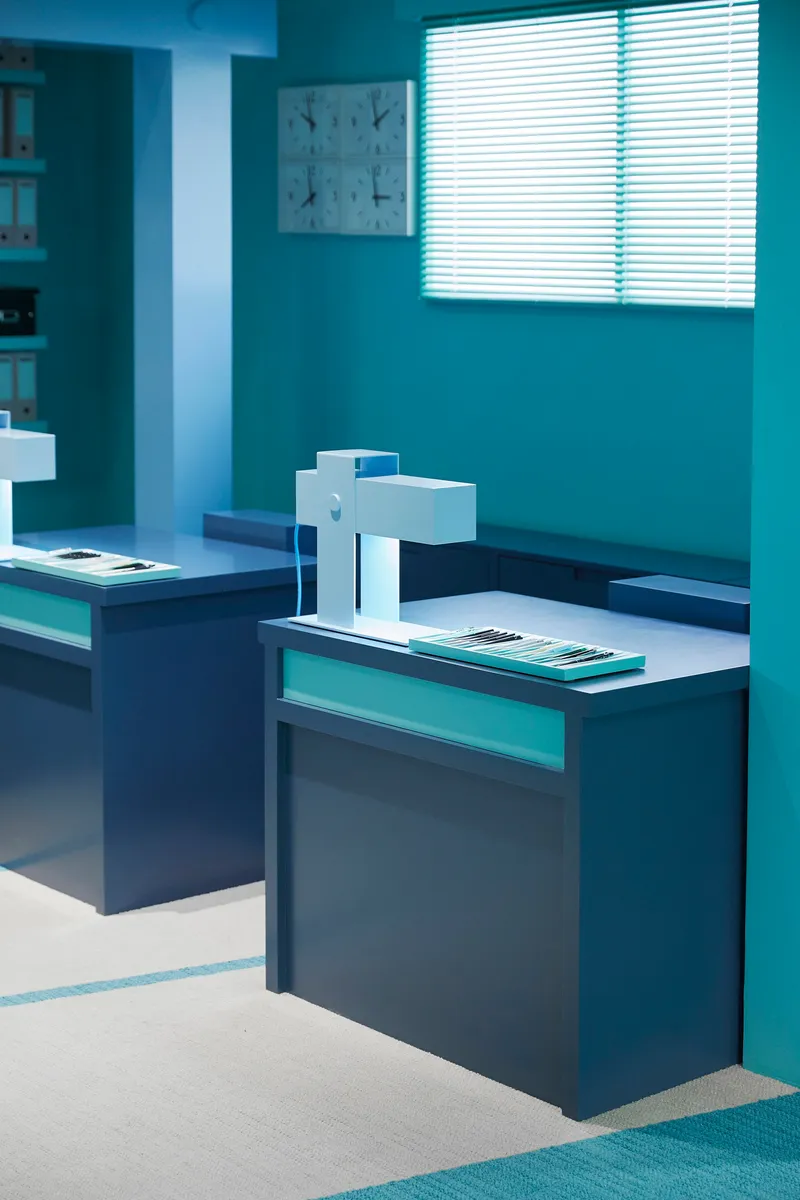
Two mirrored workstations face each other beneath a wall of horizontal blinds, each lit by a task lamp. A clock grid above reinforces the office fiction: you are on the clock. Recessed skylights pour daylight into corners, mixing with the artificial lighting in a way that makes the space feel simultaneously clinical and warm. These are experience stations where visitors test PILOT's writing instruments on various papers, and their design makes the act of testing a pen feel like filling out a form at a consulate.
The venetian blinds deserve specific mention. They appear throughout the project, slicing exterior light into horizontal bands that rhyme with the lined paper the pens are meant to write on. It is a small formal gesture, but it threads daylight into the store's narrative vocabulary.
Object Theater
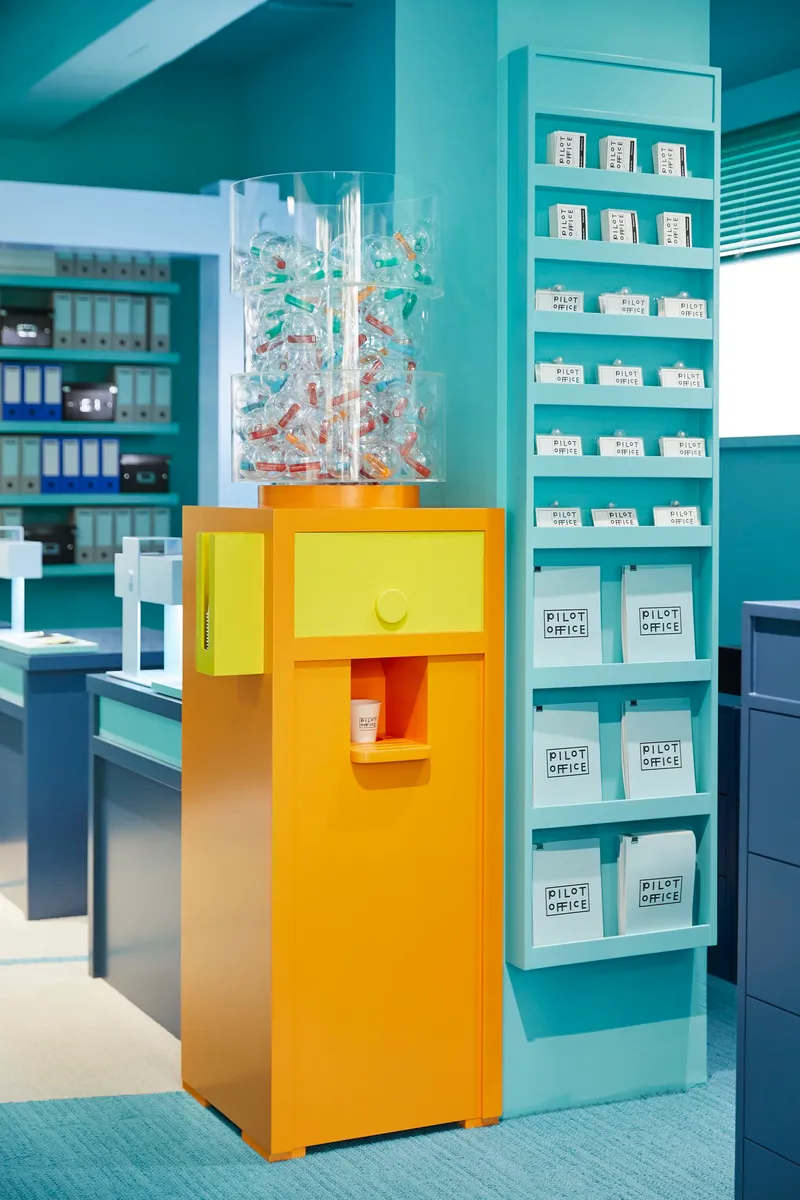
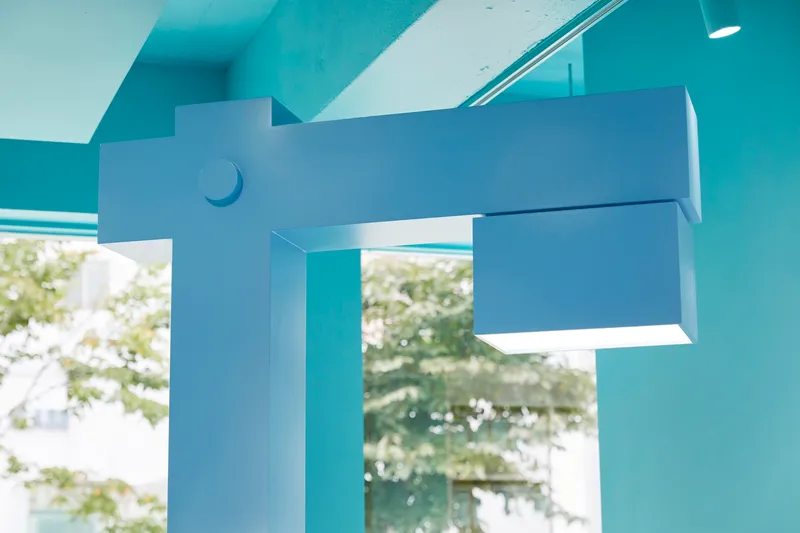
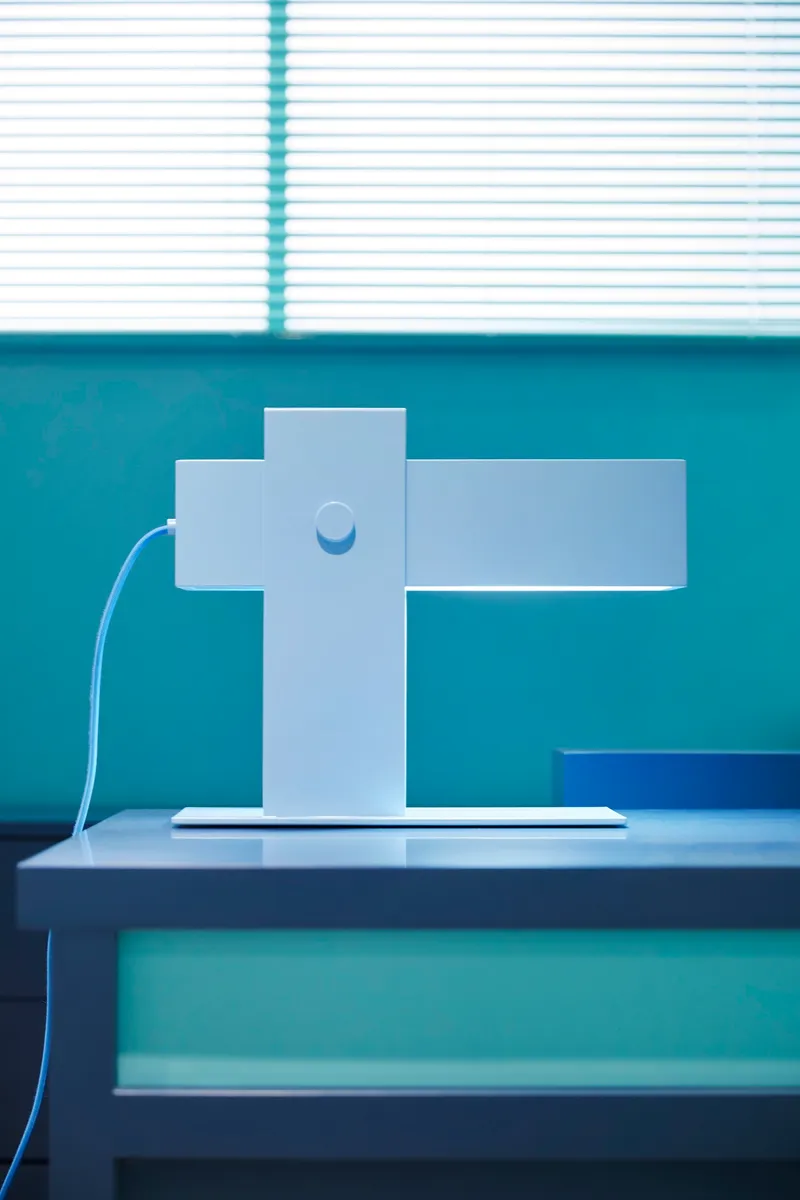
Scattered throughout the space are custom display elements that function more like sculptural props than retail fixtures. A yellow pedestal dispenser with a transparent acrylic dome holds colorful objects like a gumball machine reimagined for office supplies. A pale blue articulated display mount with a cylindrical joint cradles a single instrument as though it were a specimen. A white cross-shaped display stand catches venetian blind shadows from above.
These moments of object isolation are critical. They counterbalance the density of the archive walls by giving individual products room to breathe. The strategy borrows from museum exhibition design, where a single artifact in a vitrine commands more attention than a hundred objects on a shelf. maumstudio understands that in 48 square meters, hierarchy of attention must be carefully orchestrated.
Furniture as Character
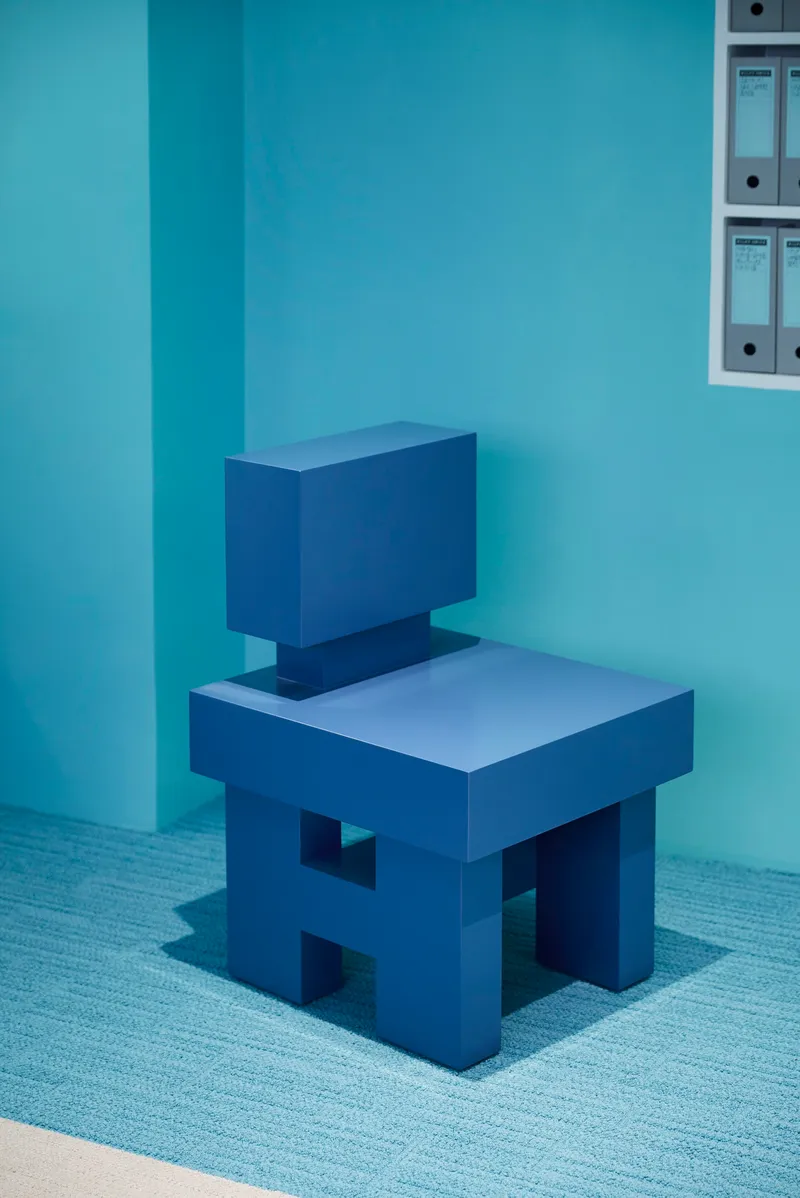
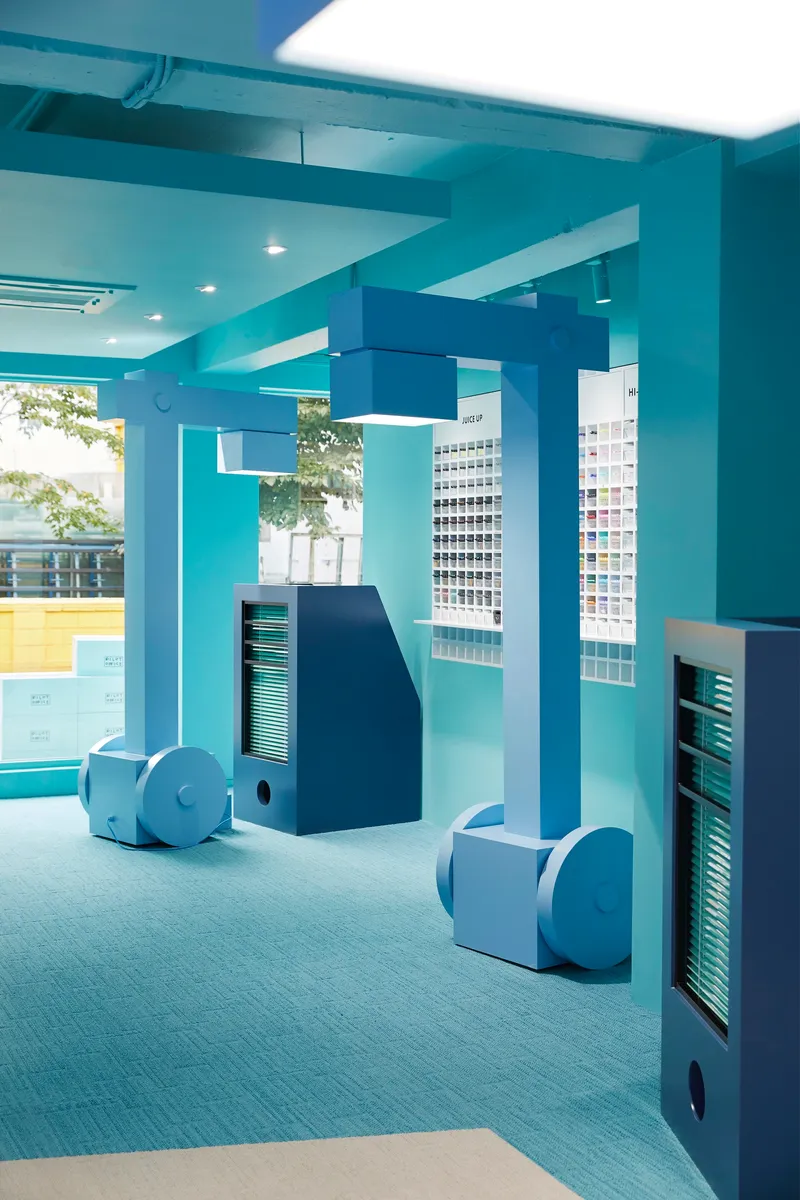
Custom furniture pieces are designed not for comfort but for narrative consistency. A geometric chair in solid blue sits in a corner like a prop waiting for an actor. Curved blue storage forms rest on the floor near glazed openings, their organic shapes softening the grid logic of the surrounding architecture. Stepped display platforms in the exhibition area present a white architectural model, hinting at the design process itself.
The overall effect is of a space populated by objects that belong to its fiction rather than to the real world of commerce. Every element is custom, every surface coordinated, every form deliberate. For a popup that likely existed for only a matter of weeks or months, the level of spatial specificity is remarkable.
Material Palette and Process


A material sample board on display reveals the designers' process: color swatches and texture specimens organized in a grid system that mirrors the archive walls. It is a rare moment of transparency in a project that otherwise maintains its fiction completely. The board confirms what the space implies: every hue, every surface finish, every material junction was selected against a controlled palette.
Glass partitions reflect rows of white binders on shelving, multiplying the archive effect and making the 48-square-meter footprint feel more expansive than it is. The reflections also introduce visual depth where actual depth is impossible, a pragmatic trick that doubles as atmosphere.
Plans and Drawings

The floor plan reveals the angular open workspace with scattered furniture islands and perimeter service areas. At 48 square meters, the layout is essentially a single room with no partition walls. Furniture placement alone defines zones of circulation, display, and experience. The plan confirms what the photographs suggest: the architecture here is not spatial division but atmospheric saturation. The walls are the project.
Why This Project Matters
Popup stores are typically disposable, and they look it. They lean on novelty, branded decals, and photogenic backdrops that age the moment the lease expires. maumstudio's PILOT OFFICE Store is different because it builds a world instead of a set. The 'Precious Words Collection Office' conceit is not a marketing tagline applied to a space; it is a spatial logic that generates every design decision, from the color of the carpet to the shape of the chairs. The result is an interior that feels authored rather than decorated.
For architects, the project is a concise lesson in what total design commitment can achieve at the smallest scale. 48 square meters, a single color story, a clear narrative framework, and an obsessive attention to object placement produce a space that punches far above its footprint. It also raises a productive question: if a pen store can sustain this level of architectural ambition, what is stopping the rest of retail design?
PILOT OFFICE Store by maumstudio. Located at 57 Yeonmujang-gil, Seongdong-gu, Seoul, South Korea. 48 m². Completed in 2022. Creative Direction by Dalwoo Lee; Space Lead by Eunhye Oh. Photography by Ju Yeon Lee.
About the Studio
Share Your Own Work on uni.xyz
If projects like this are the kind of work you want to make, uni.xyz is a place to publish your own, find collaborators, and enter design competitions.


Popular Articles
Popular articles from the community


LT2A and OPEN Architectes Thread a Brick and Glass High School Through a Wooded Belgian Campus
In Braine-l'Alleud, a 3,000 m² wing for Collège Cardinal Mercier pairs pale brick with a glazed colonnade, deferring to a small chapel and a dense wood.

Juan García Correa, John González and Claudia Rueda Sink a Circular Amphitheater into a Manizales Engineering Building
On the La Nubia campus in Manizales, Colombia, the S1 Building folds labs and offices into a hillside of ramped lawns that double as a campus route.

David Macias Steps a Doorless Stone and Plaster House Down a Tropical Colombian Hillside
In the humid hills of Colombia, Threshold House replaces the front door with an open void and terraces its 850 m² down the slope instead of fighting it.

Cube Design Draws an Ecological Corridor Between Two Shenzhen Hills with the Nankai Building
Beside Shenzhen's container docks, the Nankai Building pairs stacked balconies with a climbing green screen to connect two hillsides across its height.

Similar Reads
You might also enjoy these articles


LAVA Architecten Gives Vocational Education a Sawtooth-Roofed Face on a Mechelen School Campus
In Mechelen, Belgium, a 2,053 m² STEM school on a 6×6 m grid turns workshops and classrooms into rooms that can be rearranged as teaching changes.

KEMA Studio Turns a Derelict Marvila Attic into a 60 m² Lighthouse Apartment Above Lisbon
In Lisbon's Marvila district, a rebuilt roof, four skylights and two plywood volumes turn an unlivable attic into a bright home facing the Tagus.

Pixel Gardens: One Repeated Module Stacked Into a Terraced Social Housing Tower for Famagusta
Salem Bader's shortlisted housing tower builds a vertical neighbourhood from one repeated module, offsetting units to carve terraces, light and air.

Bao Huynh Watercolor Atelier: A Serene Art Retreat in Hội An
Bao Huynh Watercolor Atelier in Hội An blends multifunctional art spaces, sustainable design, local materials, and family-friendly living in a serene environment.

Comments (0)
Please login or sign up to add comments
No comments yet. Be the first to comment!