
Meier Unger Transforms an Altenburg Storefront into a Joyful Community Co-Working Lab
A 180-square-meter space in eastern Germany gets striped curtains, painted floors, and a glass brick ceiling to serve a small city's big ambitions.


Altenburg is not the kind of German city that lands on design tourism itineraries. A small town in Thuringia with a population under 30,000, it faces the familiar challenges of eastern German shrinkage: vacant storefronts, aging infrastructure, and a civic energy that needs constant tending. The Stadtmensch initiative, a local community group, took over an empty commercial space with two distinct halves: a conventional shop front facing the street and a rear hall roofed with a curved canopy of glass bricks. Meier Unger, the Berlin-based studio led by Jan Meier and Lena Unger, was tasked with making this 180-square-meter space work as a co-working hub, café, event venue, and handicraft workshop, all at once.
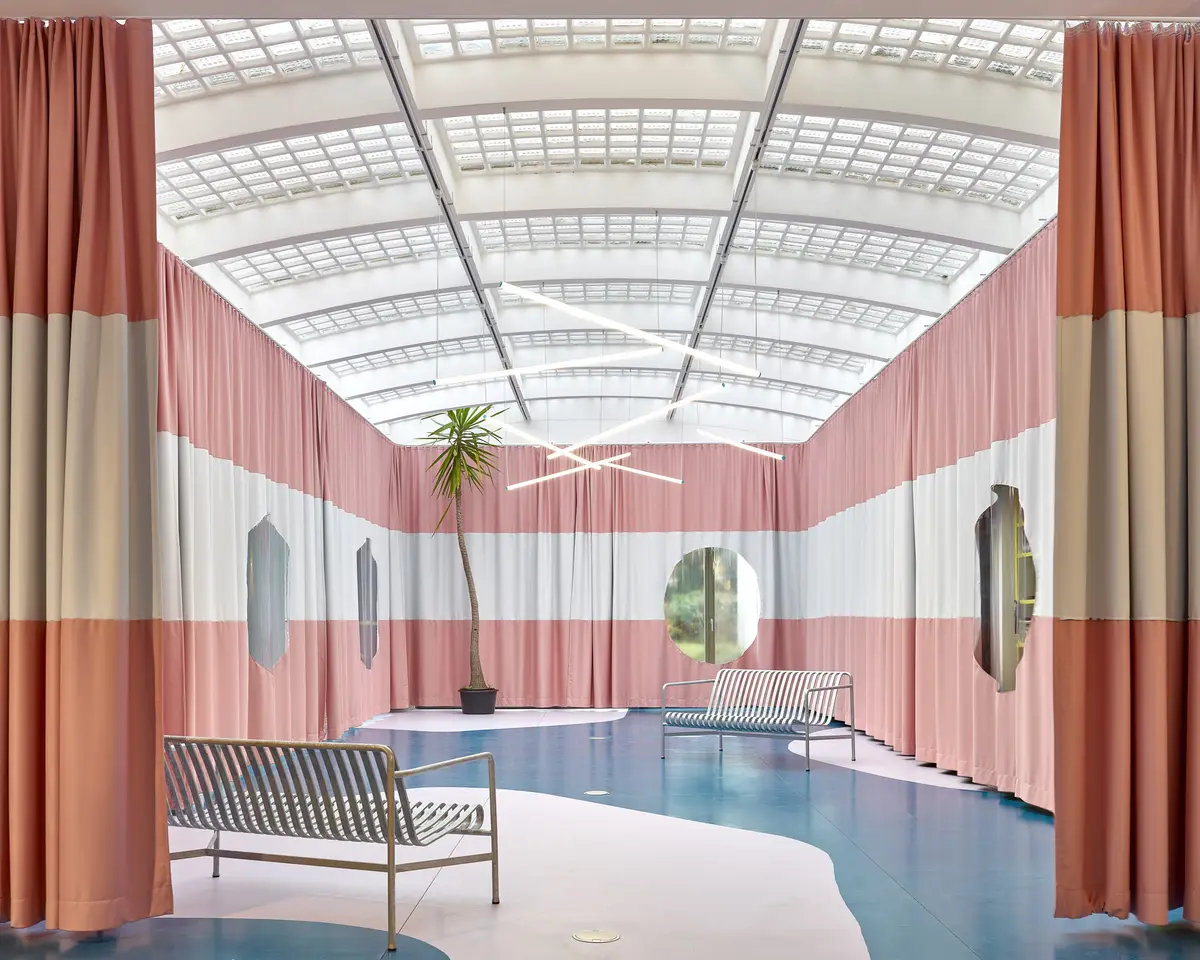
What makes the project genuinely interesting is the refusal to treat frugality as an excuse for blandness. Rather than gutting the space and inserting a clean-lined coworking template, the architects leaned into color, pattern, and theatricality. Striped curtains in pink and white become space dividers. An organic, flowing pattern painted directly onto linoleum flooring gives the rear hall a sense of generous scale it might not otherwise claim. Columns get bright blue capitals as if they are wearing party hats. The result is a space that reads as expressive and specific rather than provisional, which is precisely what a community initiative in a struggling town needs to signal permanence and ambition.
The Glass Brick Ceiling Sets the Tone
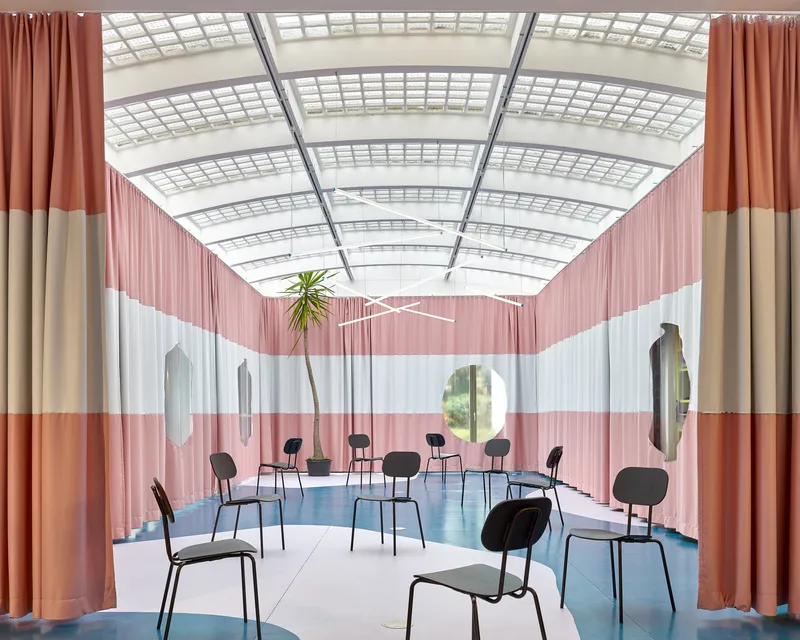
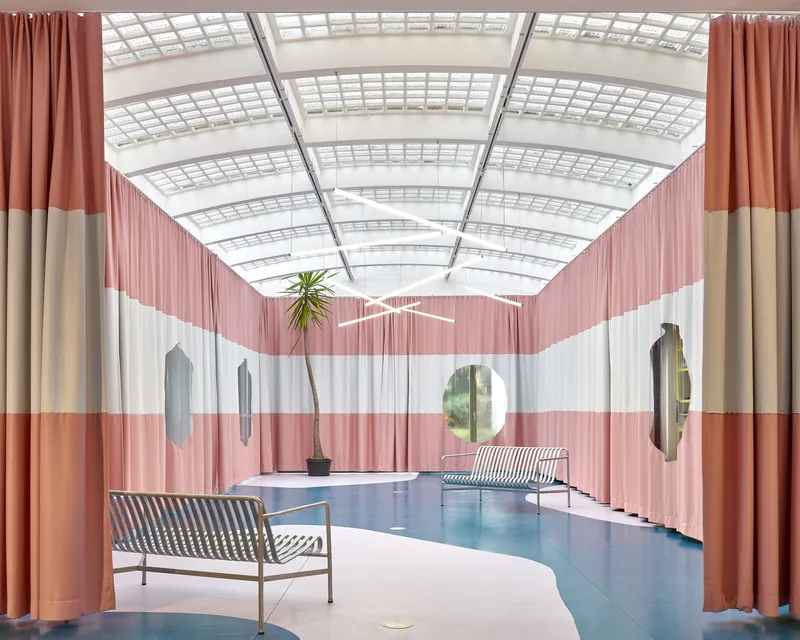
The rear hall is the spatial showpiece. Its curved roof of glass bricks floods the room with diffused, even light, creating the kind of luminous ambiance that would cost a fortune to achieve artificially. Meier Unger wisely chose not to compete with this ceiling. Instead, the floor and furnishings respond to its gridded rhythm: the blue-painted linoleum flows in sweeping curves underneath, and black chairs are arranged in loose clusters that feel casual rather than institutional. The skylight transforms what could be a gloomy backroom into the most desirable zone in the building.
The lengthwise view through the hall reveals how the architects used the ceiling's regularity as a counterpoint to everything below. Where the grid above is strict, the floor pattern is liquid. Where the glass bricks are neutral, the furnishings pop with saturated color. It is a conversation between existing structure and new intervention that never turns hostile.
Curtains as Architecture
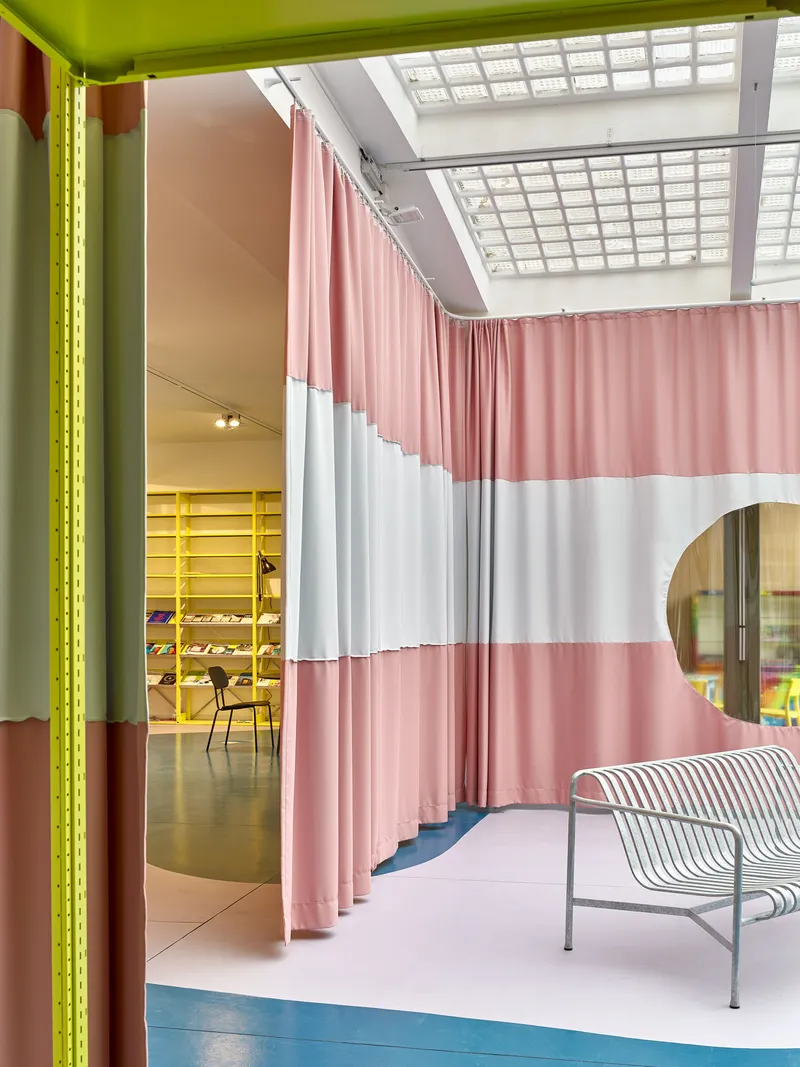
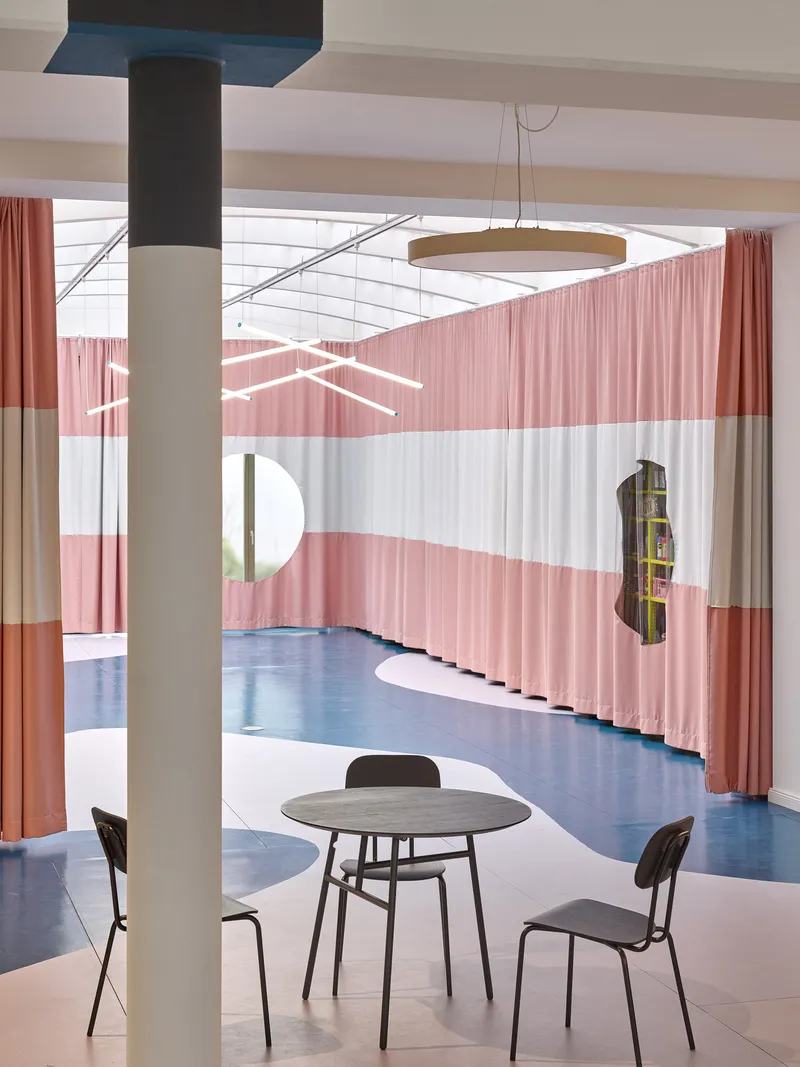
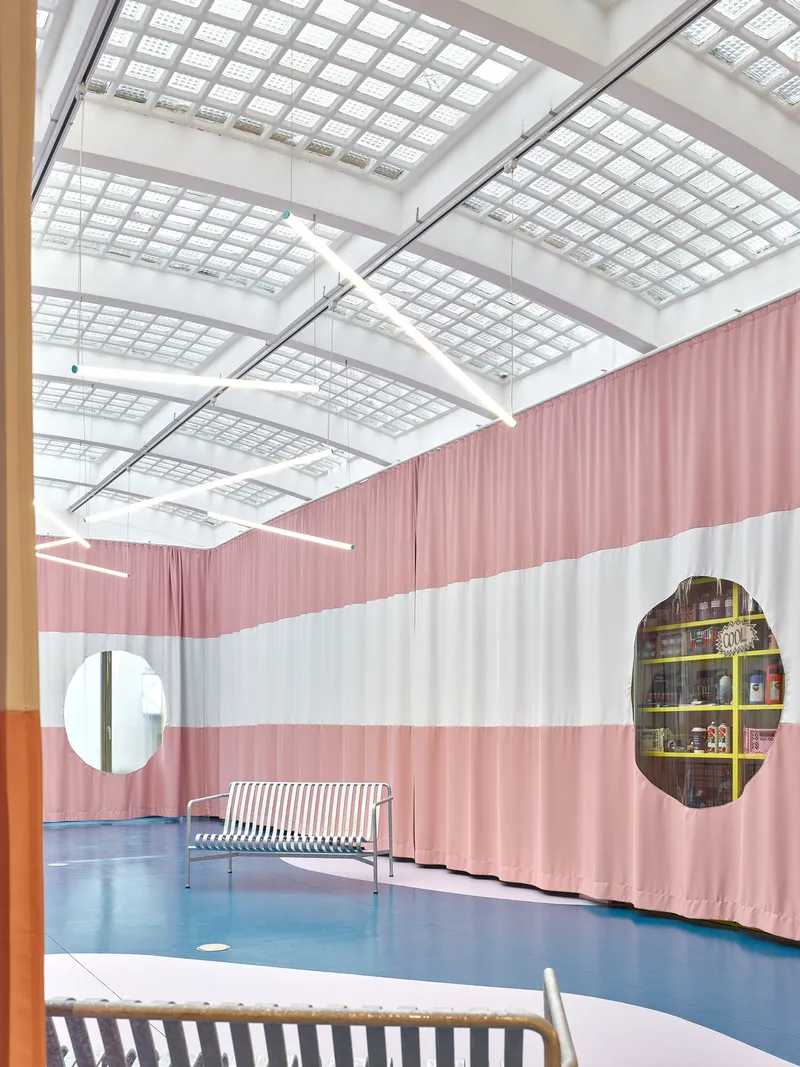
The boldest move here is using striped fabric curtains as the primary spatial dividers. In a 180-square-meter space that needs to host seminars one day and children's craft workshops the next, hard walls would be a liability. The curtains, hung from tracks below the ceiling, allow the floor plan to reconfigure in minutes. But they also do something more subtle: their pink and white stripes introduce a visual warmth and softness that steel-and-glass partitions never could.
The oval cutouts in the curtain panels are a particularly smart detail. They maintain visual connection between zones even when the curtains are closed, framing glimpses of bookshelves and activity beyond like portholes on a ship. Under the coffered skylight, the ring light and round table create a sense of focused intimacy within the larger hall. The fabric walls are not just functional; they establish a visual language that is playful without being childish.
Color and Object as Identity
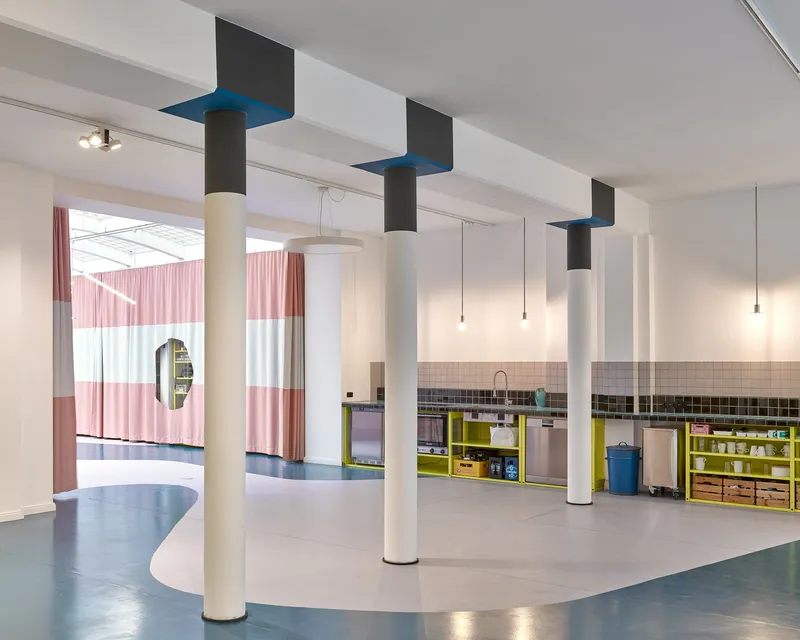
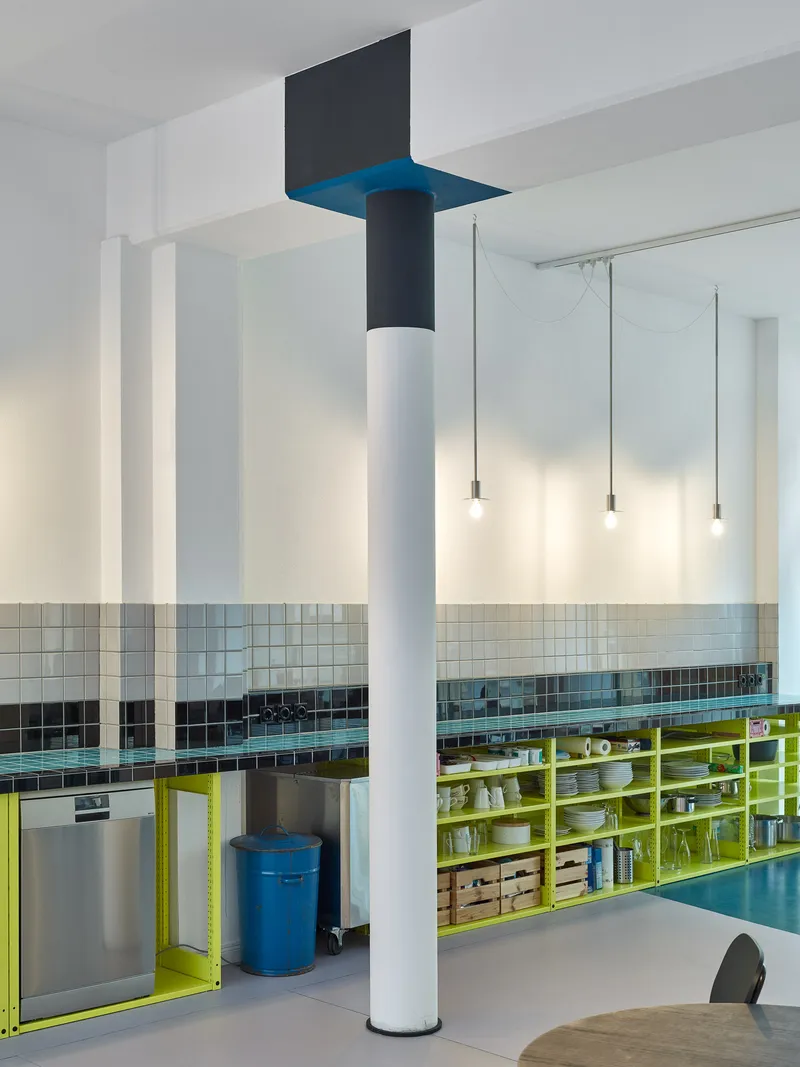
The yellow kitchen unit visible from the column hall acts as an anchor, pulling the eye through the space and signaling that this is a place where people eat, drink, and linger. Its color is deliberate: against the blue floor and the pink curtains, yellow reads as inviting and domestic. The horizontal tile band on the kitchen counter adds a layer of material texture that keeps the palette from feeling purely graphic.
The column treatment deserves attention on its own. Each cylindrical column receives a blue square capital and a black crown, turning structural necessities into decorative events. It is a postmodern gesture, but it does not carry postmodernism's ironic distance. These columns are genuinely cheerful. They celebrate the existing structure rather than hiding it, which aligns perfectly with the architects' stated intent to emphasize the inherent qualities of what was already there.
Storage and the Hidden Life of Community Spaces
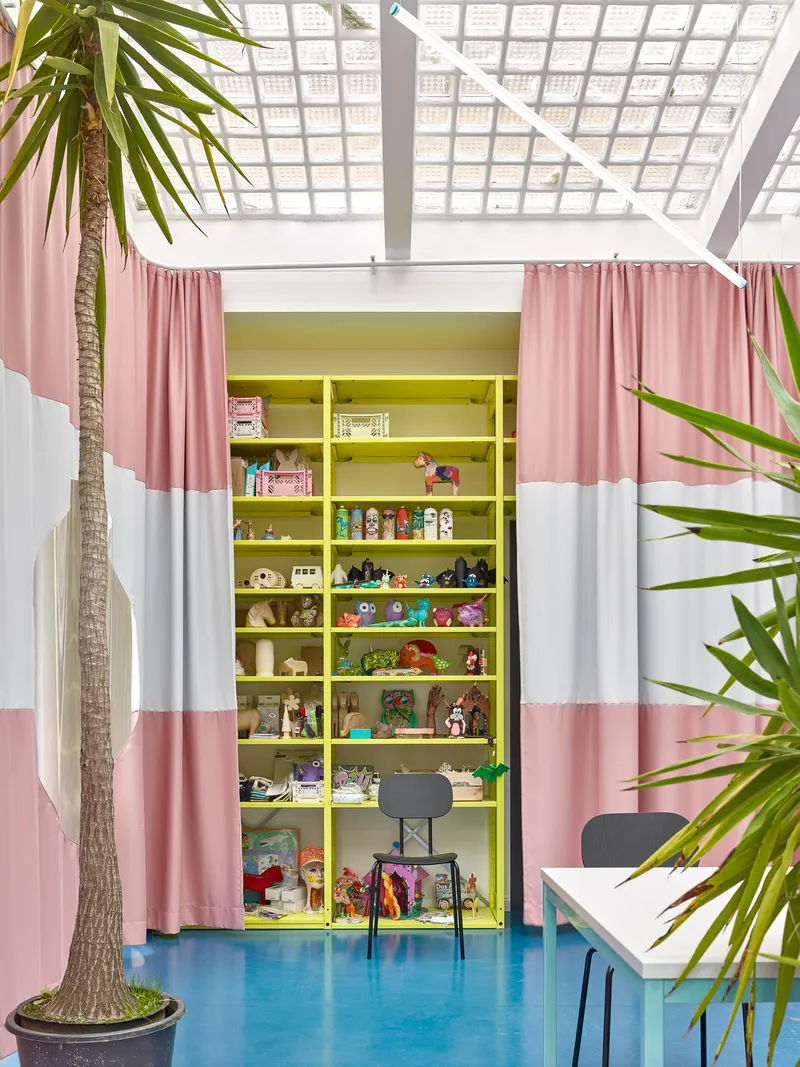
One image tells a story that most architectural photography avoids: the yellow shelving unit behind a parted curtain, stuffed with toys and flanked by potted palm fronds. Community spaces live or die by their ability to absorb clutter. A coworking café that also hosts children's workshops needs somewhere to put the craft supplies, the board games, the seasonal decorations. Meier Unger addressed this by designing significant built-in storage that the curtains can conceal or reveal depending on the event.
This is the kind of pragmatic thinking that separates a lasting community project from a photogenic pop-up. The shelving is bright yellow, matching the kitchen, so even when exposed it reads as part of the design rather than as backstage mess. The palm fronds are a nice touch of staged domesticity, but the real achievement is that this space can look polished for a seminar at 10 a.m. and then be ready for a kids' party by noon.
Plans and Drawings
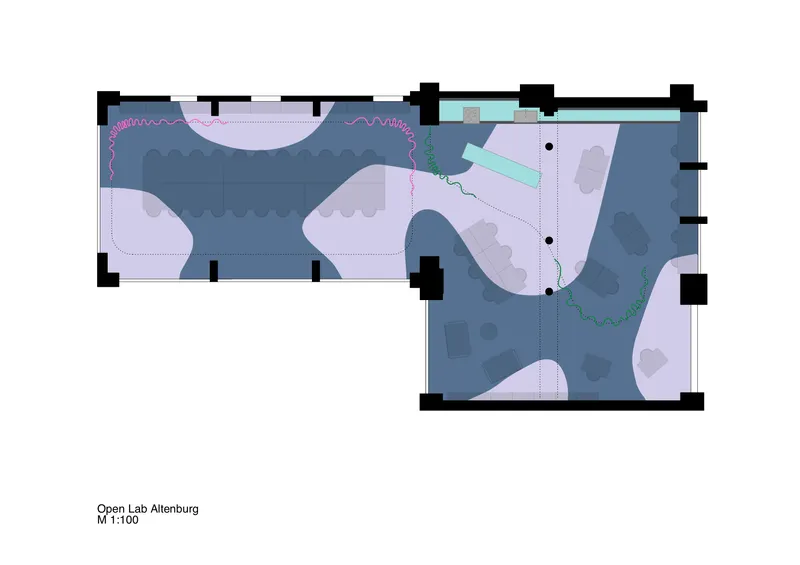
The floor plan confirms the two-room logic. The street-facing shop and the rear hall connect through a narrowed passage, with curved partition walls softening the transition. Furniture is scattered in loose groupings rather than fixed rows, reinforcing the flexibility that makes the space viable for its many programs. The plan also reveals how the curtain tracks allow multiple configurations, from one open room to several intimate zones.
Why This Project Matters
Open Lab Altenburg is a reminder that small budgets and small towns do not require small thinking. Meier Unger spent almost nothing on structural intervention: no new walls, no demolished ceilings, no exotic materials. Steel, concrete, fabric, linoleum, and paint. The intelligence is in how those ordinary materials are deployed to create a space with genuine personality. The glass brick roof was already there; the architects simply gave it a worthy ground plane. The columns were already there; they simply dressed them up.
More broadly, the project demonstrates how architecture can serve civic repair. Altenburg does not need another minimalist white cube. It needs spaces that feel generous, welcoming, and slightly surprising, places that make residents think their town is worth investing in. The striped curtains and blue floors may look whimsical in photographs, but they are doing serious work: signaling that this community space was designed with care, intention, and respect for the people who use it every day.
Open Lab Co-Working Altenburg by Meier Unger (Jan Meier, Lena Unger). Altenburg, Germany. 180 m². Completed 2021. Photography by Philip Heckhausen.
About the Studio
Share Your Own Work on uni.xyz
If projects like this are the kind of work you want to make, uni.xyz is a place to publish your own, find collaborators, and enter design competitions.


Popular Articles
Popular articles from the community


Cube Design Draws an Ecological Corridor Between Two Shenzhen Hills with the Nankai Building
Beside Shenzhen's container docks, the Nankai Building pairs stacked balconies with a climbing green screen to connect two hillsides across its height.


The Amber Palace Opera: A Geological Fiction Surfaces on Tallinn's Baltic Waterfront
Pierre Brillard reimagines a Baltic legend as a public landscape, opera house, and waterfront promenade rooted in Tallinn's coastal identity.

Aquadapt: An Underwater Habitat That Rewrites Its Rooms by the Hour
Curved modules ring the seabed while one shell shifts from breakfast room to cinema, farm and football pitch as residents' needs change.

Singing Woman: An Opera House That Performs Before the Curtain Rises
Ovidiu Cristian Pavel's conceptual opera house translates Estonia's choral identity into a sculpted waterfront landmark facing the Baltic Sea.

Similar Reads
You might also enjoy these articles

LAVA Architecten Gives Vocational Education a Sawtooth-Roofed Face on a Mechelen School Campus
In Mechelen, Belgium, a 2,053 m² STEM school on a 6×6 m grid turns workshops and classrooms into rooms that can be rearranged as teaching changes.

KEMA Studio Turns a Derelict Marvila Attic into a 60 m² Lighthouse Apartment Above Lisbon
In Lisbon's Marvila district, a rebuilt roof, four skylights and two plywood volumes turn an unlivable attic into a bright home facing the Tagus.

Pixel Gardens: One Repeated Module Stacked Into a Terraced Social Housing Tower for Famagusta
Salem Bader's shortlisted housing tower builds a vertical neighbourhood from one repeated module, offsetting units to carve terraces, light and air.

Bao Huynh Watercolor Atelier: A Serene Art Retreat in Hội An
Bao Huynh Watercolor Atelier in Hội An blends multifunctional art spaces, sustainable design, local materials, and family-friendly living in a serene environment.

Explore Co-Working Competitions
Discover active competitions in this discipline

Challenge to reimagine the Iron Throne

Photograph architecture without architects

Illustrate the lost glory of Angkor Wat - Render Challenge

Design challenge to reuse E-waste
Comments (0)
Please login or sign up to add comments
No comments yet. Be the first to comment!