

D Office arkitekter Wraps a 15,300 m² School Around an Atrium Courtyard on Gothenburg's Hisingen
Lundby School combines sports halls, a cultural school, and classrooms for 630 students in a timber and glass volume facing Bravida Arena.


Gothenburg's Hisingen island now has a new civic anchor. Lundby School, completed in 2024 by D Office arkitekter, replaces the former Lundby gymnasium with a 15,300 m² complex that serves 630 students in grades 7 through 9, including students with intellectual disabilities. Situated opposite Bravida Arena and the Lundbybadet swimming complex, the building was always destined to be more than a school. It houses a cultural school, sports and recreation administration offices, and two full-sized sports halls with combined seating for 1,000 spectators. The 500-million-kronor project, built over two years in collaboration with Peab and City Property Management, is arguably the most ambitious piece of educational infrastructure Gothenburg has delivered in decades.
What makes the project genuinely interesting is not the program list but the way D Office arkitekter organized it. Rather than distributing functions across separate pavilions or stacking them in a slab, the architects wrapped classroom wings, sports halls, and communal spaces around a large central courtyard. The result is a building that reads as a single coherent institution from the street while offering a protected, daylit interior world for students. The three-story atrium, lined in timber cladding and ringed by curved balconies, acts as both the social heart and the orientation device. You always know where you are because you can always find the courtyard.
Timber and Glass: A Facade That Communicates

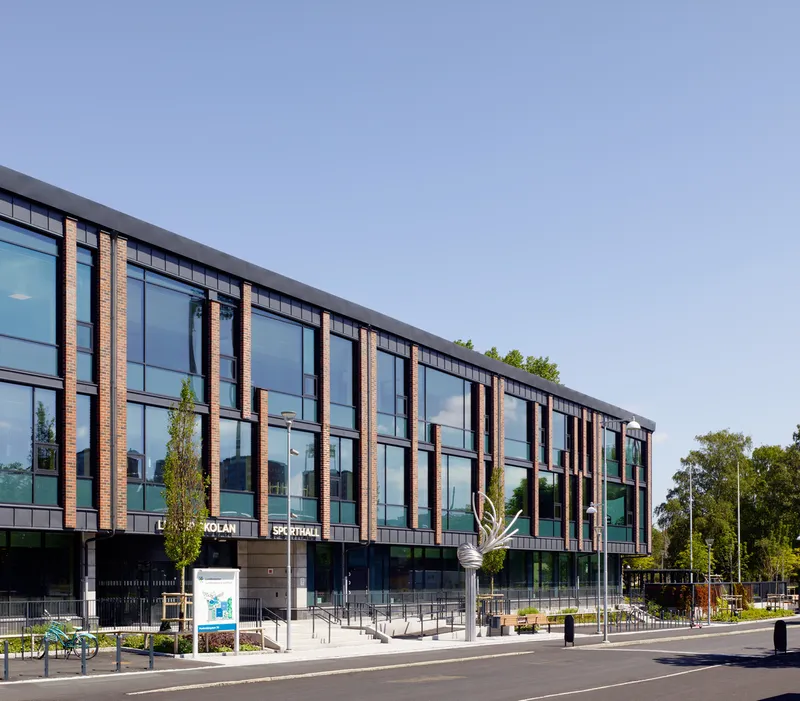

The exterior is a studied composition of vertical timber louvres, slot windows, and generous glazed sections at ground level. The curved timber-clad facade facing the main plaza gives the school a strong public face without resorting to institutional monotony. Vertical slots punctuate the upper floors, controlling solar gain while creating a rhythmic pattern that reads differently depending on your angle of approach. At street level, floor-to-ceiling glass panels expose the building's interior life to passersby: bicycle racks and signage mark the thresholds where city meets school.
D Office arkitekter clearly wanted the building to illuminate its surroundings, literally. The transparency at grade creates safe outdoor zones after dark, an important consideration for a site adjacent to a major arena that draws evening crowds. Meanwhile, the timber cladding ages gracefully alongside the young trees planted in the landscaped courtyard, establishing a material palette that will soften over time rather than deteriorate.
The Atrium as Social Infrastructure


The three-story atrium is the move that holds the whole project together. Curved balconies wrap around a central void, and a spiral staircase connects floors beneath a daylit clerestory. The timber-clad walls give the space warmth that polished concrete atriums in comparable schools typically lack. Light washes down from above, reaching the ground floor social areas where students cluster on curved upholstered seating or sit on the floor beside their lockers.
There is a deliberate generosity to these circulation and gathering zones. They are not leftover corridors but programmed social spaces with furniture scaled for teenagers. The curved geometries resist the right-angle rigidity that makes so many schools feel like filing cabinets for children. For a building that serves students with a range of abilities, this spatial legibility matters: the atrium is always visible, always orienting.
Material Calm: Slate, Terrazzo, and Restrained Color

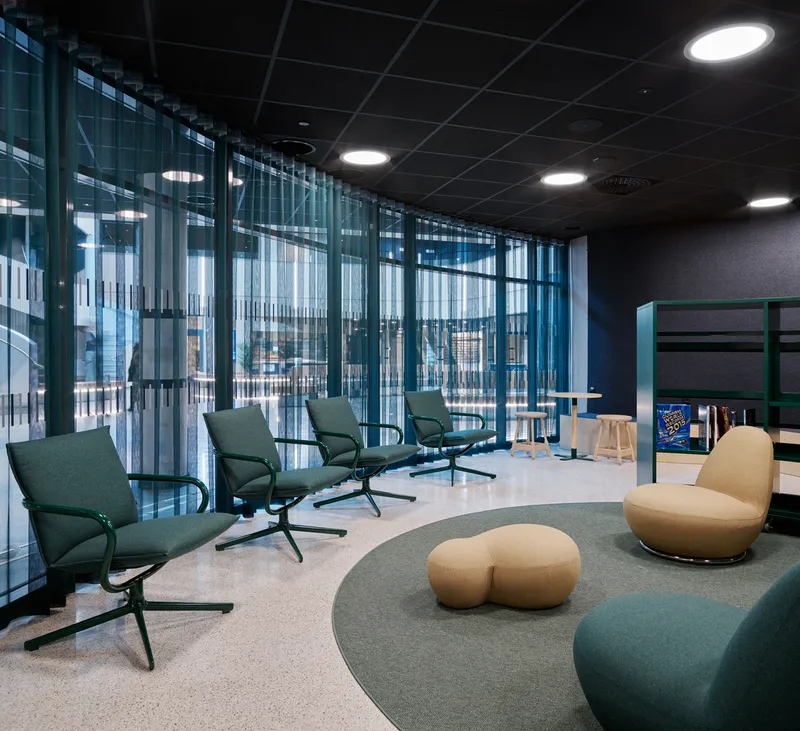
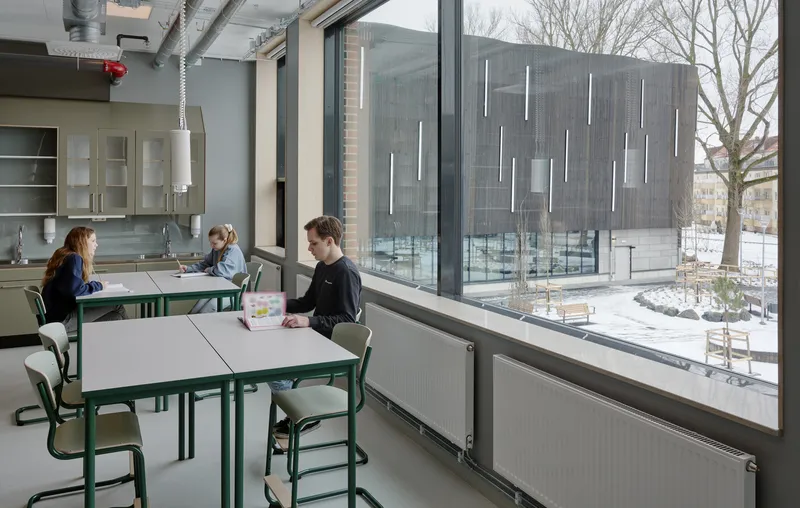
The interior material palette is notably restrained. Cast-in-place terrazzo flooring appears in the dining hall and media library, providing a durable, low-maintenance surface that reads as sophisticated rather than institutional. Slate and wood carry through from the exterior, reinforcing a connection to the Nordic landscape outside the windows. The dining area, with its green steel tables and chairs overlooking a snowy courtyard, demonstrates how simple color choices against a neutral backdrop can create a room that feels specific and intentional.
A curved service counter with fluted panels and a bronze sculpture on a cylindrical plinth hint at the cultural ambition embedded in the project. These are not typical school interiors. Sound-dampened floor surfaces reduce impact noise between the three floors, and insulated glass with high-performance u-values, sound insulation ratings, and integrated solar shading keeps the deep-plan spaces comfortable without mechanical excess. The lounge areas, with teal armchairs facing full-height curtain walls, could pass for a well-funded coworking space. That is the point: the architects treated teenagers as people who deserve spatial quality, not as occupants to be managed.
The Lecture Hall and Flexible Gathering

Lundby School preserves and renovates a 1950s auditorium that can seat 800, but the new tiered lecture hall offers something different: a flexible, informal space for smaller assemblies. Grey felt-covered steps double as seating, and circular timber stools can be arranged or removed depending on the event. A suspended ceiling grid manages acoustics and lighting. It is a room designed for presentations, debates, and performances alike, reflecting the school's dual identity as an educational and cultural institution.
Sports Halls Built for a Neighborhood
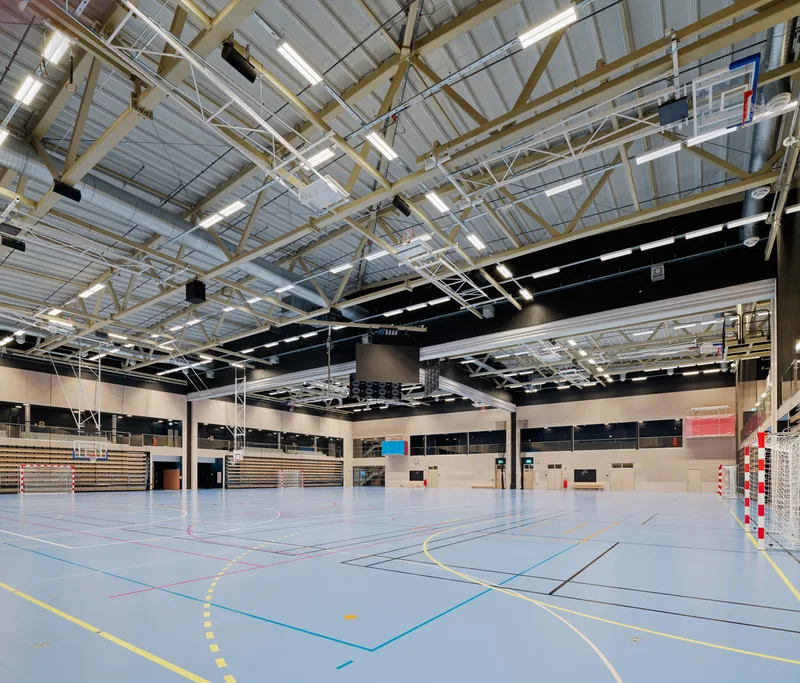
The two new sports halls occupy the building's largest single volumes, with exposed steel trusses and linear tube lighting spanning multi-line court floors. A curtain wall allows the halls to be divided into separate full-sized courts for simultaneous use. With retractable bleachers accommodating up to 1,000 spectators, these are not afterthought gymnasiums. They are community facilities that happen to sit inside a school, available for evening and weekend events that serve Hisingen residents well beyond the student population.
Positioning the sports program adjacent to the dining hall and the main courtyard means the halls benefit from natural wayfinding. You do not need a map to find them. The 10-meter ceiling height accommodates competitive play, and the multi-line floor markings suggest a booking schedule that rotates between handball, basketball, and badminton. For a neighborhood that already orbits Bravida Arena, adding 1,000 more spectator seats inside a school is a meaningful civic investment.
Plans and Drawings
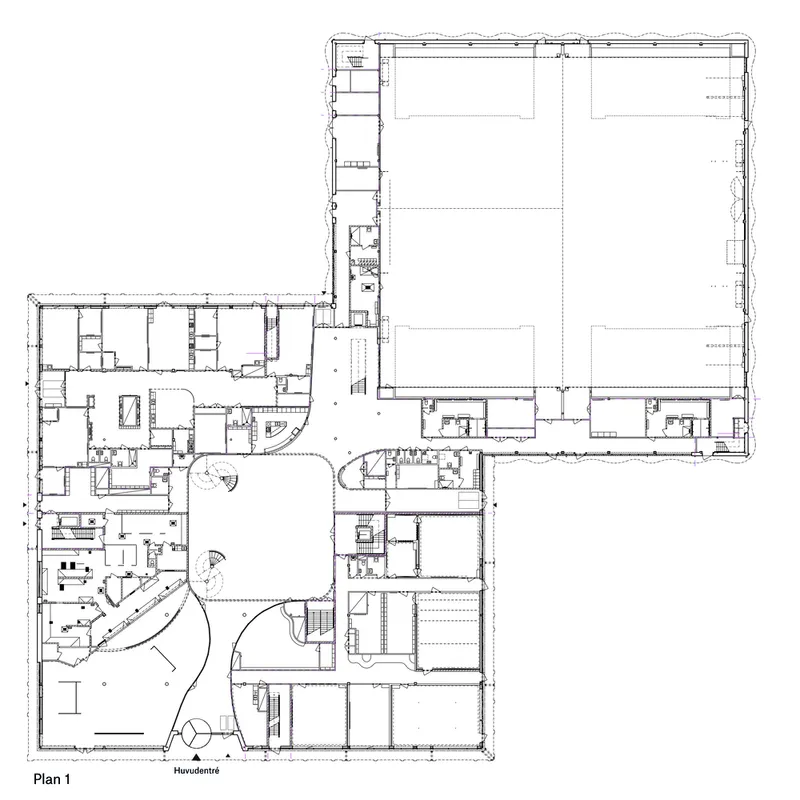
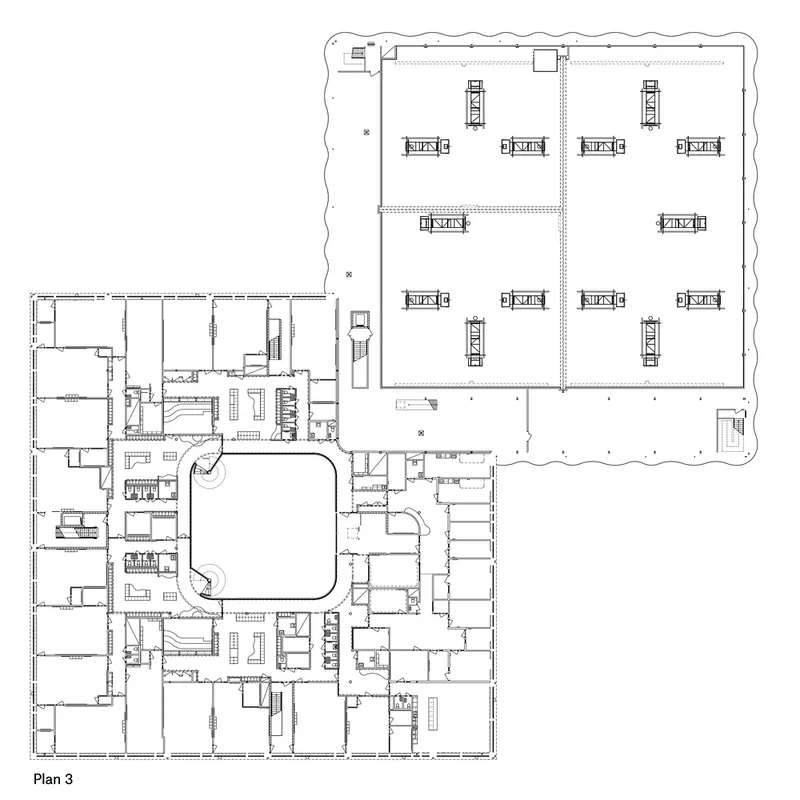

The floor plans reveal the courtyard strategy clearly. Classroom wings and support spaces wrap around the large central void on the upper floors, while the sports hall occupies one entire wing at ground level. The separation between the academic bar and the sports volume is legible in plan but dissolved in experience by the continuous circulation that rings the atrium. The elevation drawings show how the central glazed volume, flanked by vertical timber louvres, mediates between the building's public and private faces. Each facade responds to its orientation: more glass where transparency serves the street, more timber where privacy and solar control take priority.
Why This Project Matters
Lundby School matters because it refuses the false choice between institutional efficiency and architectural ambition. At 15,300 m², serving 630 students across a wide range of abilities, this building could easily have been a utilitarian box with a sports annex. Instead, D Office arkitekter delivered a courtyard building with a coherent material language, genuine spatial generosity in its common areas, and a program that folds cultural, athletic, and educational functions into a single legible institution. The inclusive design is not a bolt-on accommodation but a spatial premise: the atrium orients everyone equally.
For Gothenburg and for the broader conversation about Scandinavian school design, the project sets a benchmark. It demonstrates that public investment at this scale (500 million kronor) can produce architecture that strengthens a neighborhood rather than merely serving a demographic. The sports halls seat 1,000. The auditorium seats 800. The cultural school occupies dedicated space. These are not student amenities; they are civic infrastructure embedded in an educational wrapper. If more cities treated schools as the community anchors they inevitably become, we would have better neighborhoods, not just better buildings.
Lundby School, designed by D Office arkitekter, Hisingen, Gothenburg, Sweden. 15,300 m². Completed 2024. Photography by Bert Leandersson.
About the Studio
Share Your Own Work on uni.xyz
If projects like this are the kind of work you want to make, uni.xyz is a place to publish your own, find collaborators, and enter design competitions.




Popular Articles
Popular articles from the community


Co-life: Sustainable Architecture for Age-Friendly Community Living
Co-life reimagines sustainable architecture for seniors through courtyards, rammed earth, shared gardens, and spaces designed for belonging.

The Musturak Paradise: Senior Living Architecture for a Connected Future in Temara, Morocco
The Musturak Paradise reimagines senior living architecture in Temara via private homes, social spaces, culture, community, and shared care.

Conexión: Biophilic Design Reimagines High-Rise Living in Hong Kong
Conexión reimagines high-rise living in Hong Kong through biophilic design, green facades, shared spaces, daylight, water and nature within.
EW PARK: Sustainable Architecture Reimagines the Future of Urban Parking
EW PARK reimagines city parking as a modular wooden tower combining automation, solar energy, electric mobility, and adaptable urban design.


Similar Reads
You might also enjoy these articles


Hodi-Mandai Geram
Project Function: Preservation and revitalization of the Intangible heritage and socio-spatial identity of the Hodi by Housing, Cultural Memory Center, Sacred Grove, landscape, local tourism economy


Olio Towers: A Mid-Rise for Performers That Fuses Housing, Rehearsal, and Stage
Located blocks from Houston's Theater District, this modular tower stacks living units around a central performance atrium.

Oasis: Modular Green Housing Carved into Dhaka's Urban Fabric
A shortlisted Plugin Housing entry reclaims unauthorized settlements in Dhaka with stepped concrete volumes, green roofs, and ventilation-driven design.

Black Hole: A Floating Megastructure for the Post-Physical Era
Emiliano Mazzarotto envisions a spherical, self-scaling arena where e-sports, digital hotels, and holographic stadiums replace traditional public space.


Explore School Building Competitions
Discover active competitions in this discipline



Challenge to design public laboratory


Challenge to reimagine the Iron Throne


Photograph architecture without architects


Illustrate the lost glory of Angkor Wat - Render Challenge
Comments (0)
Please login or sign up to add comments
No comments yet. Be the first to comment!