
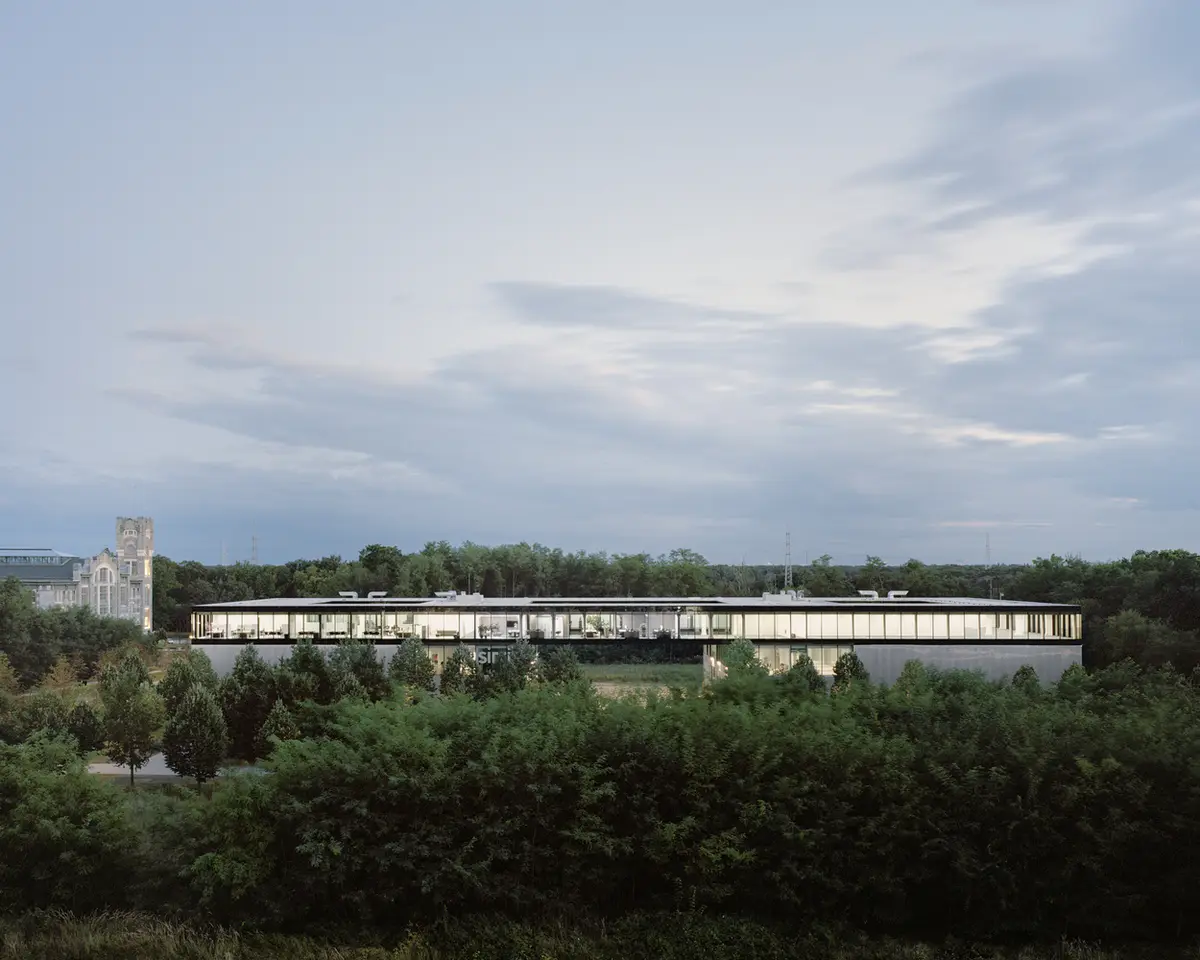
XDGA Stacks a Modular Smart Manufacturing Campus on a Former Coal Mine in Genk
A phased, reconfigurable factory and office complex rises at Thor Park, converting Belgium's industrial past into a tech-driven future.


The coal mines of Waterschei in Genk, Belgium, closed decades ago, but the land never stopped being productive. Thor Park, the technology ecosystem that now occupies the former mining site, has been steadily converting industrial heritage into forward-looking infrastructure. The Smart Manufacturing Campus, designed by XDGA and completed in 2024, is the latest and perhaps most architecturally deliberate addition: a 35,520 m² facility conceived as a repeatable module that companies can expand, shrink, or rearrange without altering the fundamental logic of the building.
What makes this project genuinely interesting is not the word "modular" on its own, which has become a reflex in industrial architecture briefs, but the specificity of how XDGA delivers on the promise. The campus stacks production floors, laboratories, logistics routes, and office space into a single compact section, then tiles that section across the site in phases. Phase 1 alone delivers 3,500 m² of production floor, 1,000 m² of lab and testing rooms, and 3,500 m² of offices within an 8,000 m² footprint and 48,000 m³ of volume. The structural engineering, handled by Bollinger & Grohmann, uses a steel frame that keeps the ground floor column-free for heavy machinery while supporting a patio-perforated office level above. The result is an industrial building that reads more like an inhabited infrastructural landscape than a factory.
A Horizontal Presence on a Reclaimed Landscape

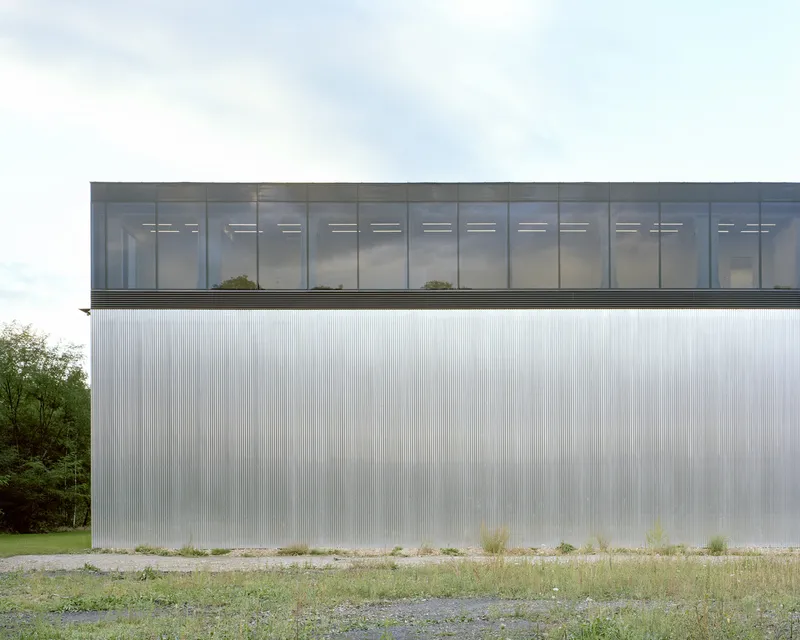
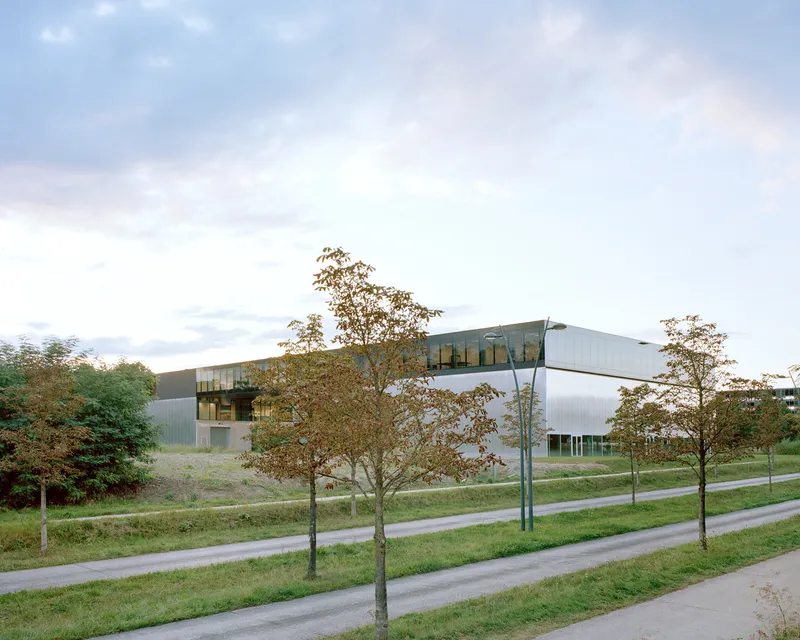
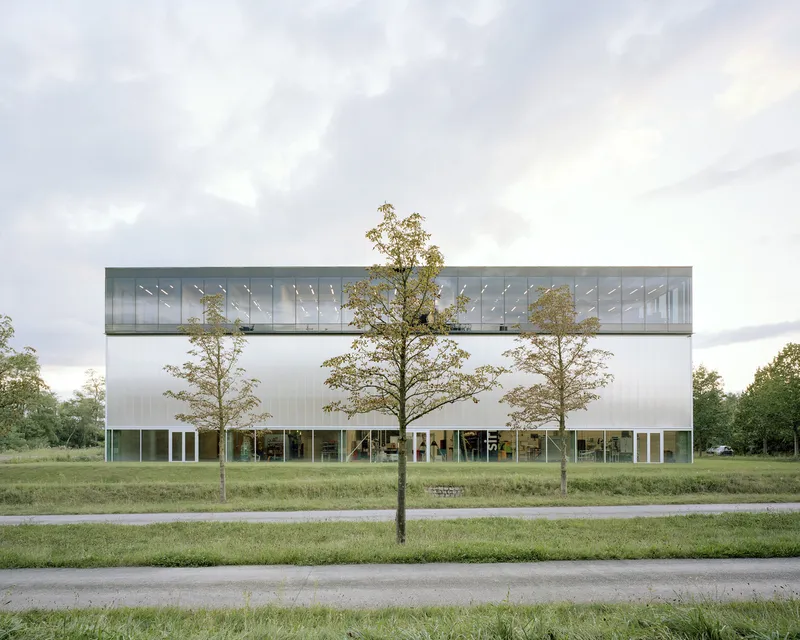
Seen from the perimeter, the campus presents a long, low-slung profile clad in corrugated metal with a clerestory band of glazing. It sits among wildflower meadows and young tree plantings, a deliberate effort to weave the building into Thor Park's restored natural setting rather than bulldoze it. The metallic skin gives the volumes a taut, industrial restraint that avoids both the bleakness of standard factory sheds and the forced whimsy of tech campuses trying too hard to look casual.
At dusk the upper office volumes glow from within, making the stacking strategy legible from a distance. You can immediately read where production ends and knowledge work begins, yet the two registers feel continuous rather than disjointed. XDGA's proportioning keeps everything grounded; even the cantilevered portions never tip into bravado.
The Elevated Bridge and Courtyard as Connective Tissue
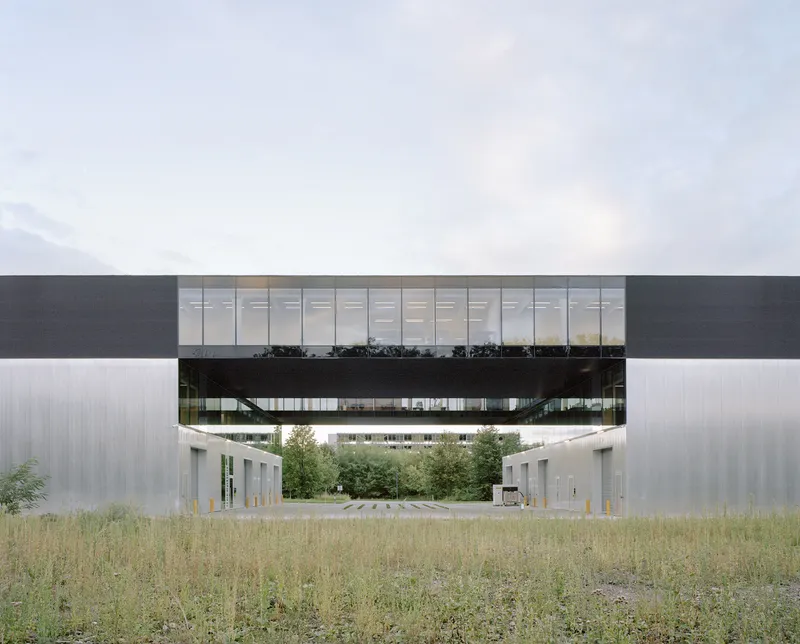
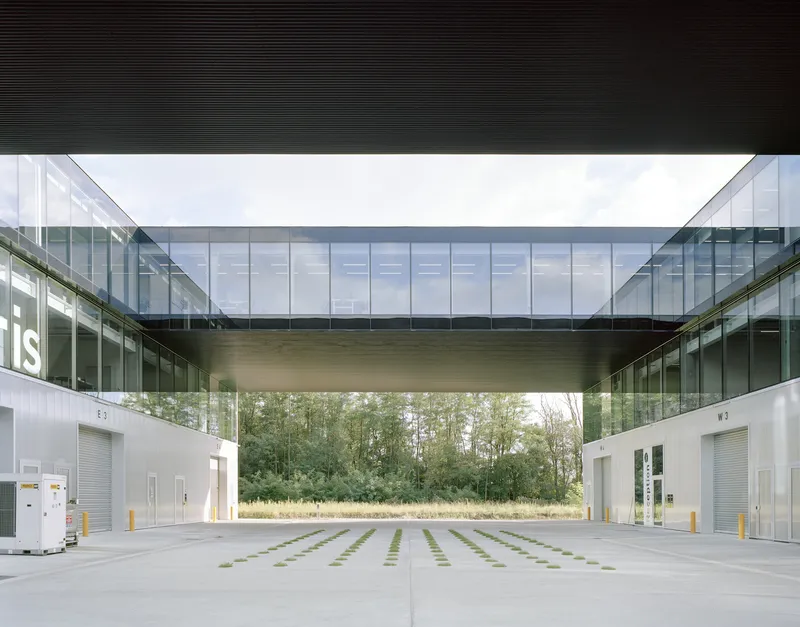
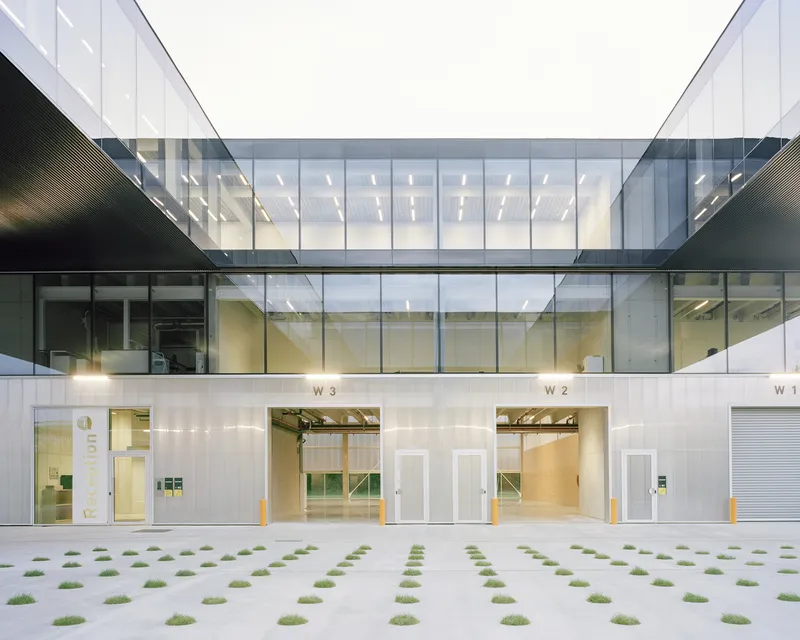
The glazed skybridge is the most immediately photogenic element, spanning between two corrugated volumes above a gravel courtyard with grid paving. It does real work, though: connecting separate production or office modules so that people and materials can move between phases without going outdoors or navigating loading zones. Below the bridge, the courtyard doubles as a service yard with loading bays, yellow bollards marking truck routes, and flush pavement that allows heavy vehicles to pass through.
The courtyard elevations reveal the building's organizational clarity. Loading docks sit at ground level, glass curtain walls rise above them, and the bridge locks the composition together. It is a fundamentally pragmatic arrangement, but the careful alignment of openings, the consistent cladding rhythm, and the landscaped ground plane give it a compositional rigor that most logistics-oriented buildings never attempt.
Column-Free Production and the Inner Street
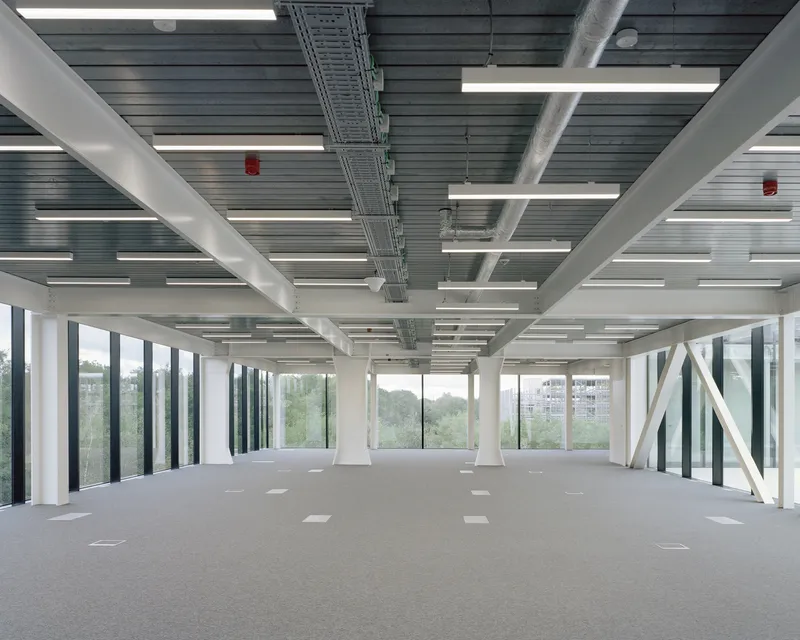
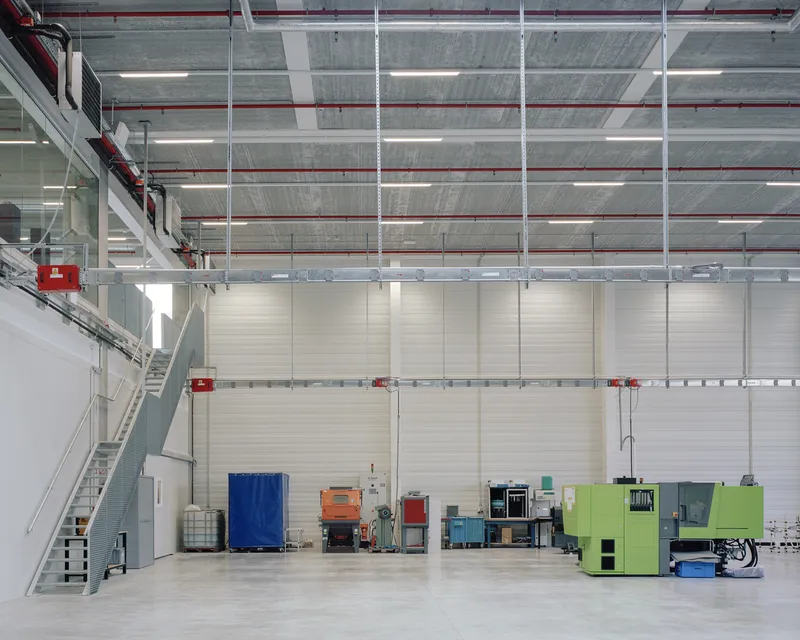
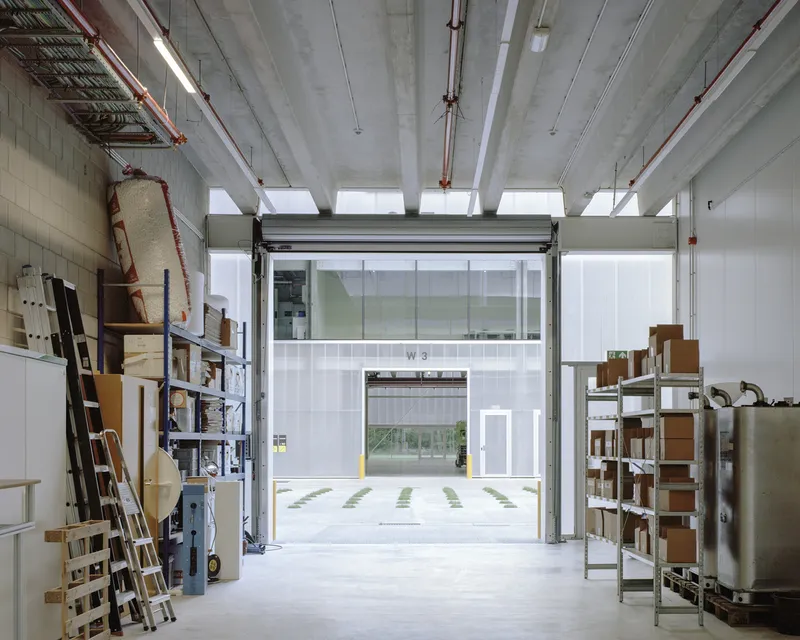
The ground floor is where the building earns its industrial credentials. A wide, partially covered interior street runs through the center of each module, organizing freight traffic and logistics flows while giving heavy machinery unobstructed access. The column-free spans, made possible by the steel frame structure, mean that production layouts can be completely reconfigured without negotiating around structural elements. White-painted beams and linear lighting strips create a surprisingly clean overhead plane for a space designed to accommodate robotic equipment, material shelving, and roll-up doors.
The double-height workshop zones visible in several areas show the vertical generosity XDGA built into the section. Mezzanine levels with open stairs provide intermediate platforms for testing and assembly without subdividing the main production volume. Red mechanical conduits run exposed overhead, color-coded for legibility, a pragmatic detail that also gives these spaces their visual identity.
Offices Organized Around Daylit Patios

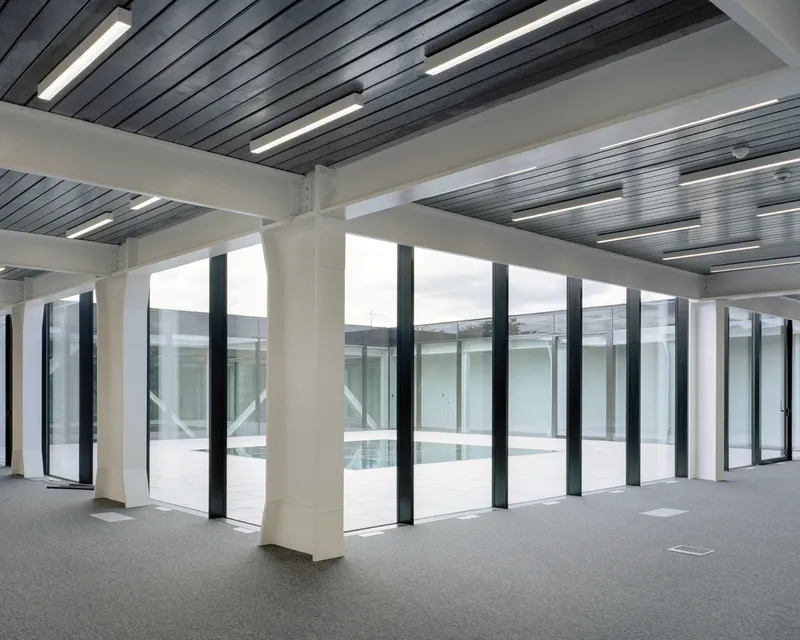
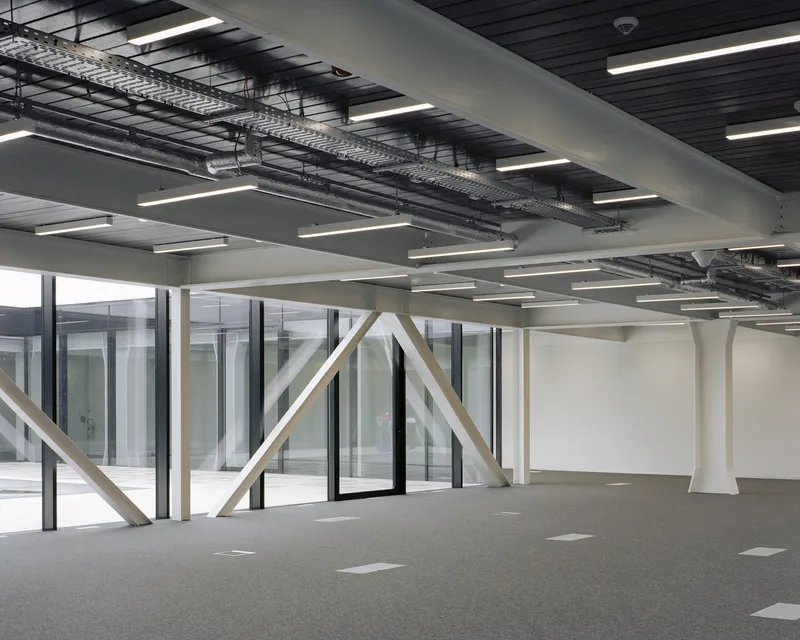
Move upstairs and the character shifts entirely. The upper level arranges office space around a grid of spacious patios that punch through the floor plate, pulling natural light deep into the underlying workshops while creating outdoor breakout zones for office workers. Floor-to-ceiling glazing lines these courtyards, with diagonal structural bracing expressed honestly behind the glass. Flush pavement with integrated skylights in the courtyard floors means that the production level below also benefits from zenithal daylight, a smart sectional move that serves two programs at once.
The office interiors are deliberately restrained. White columns, exposed cable trays, polished concrete: nothing competes for attention, and tenants can configure partitions and furniture without fighting against a predetermined aesthetic. The glass-walled meeting rooms overlooking woodland offer the most striking contrast in the entire building, framing mature trees through curtain walls that could belong to a research institute rather than a manufacturing campus.
Interior Atmosphere: Industrial Honesty with Precision
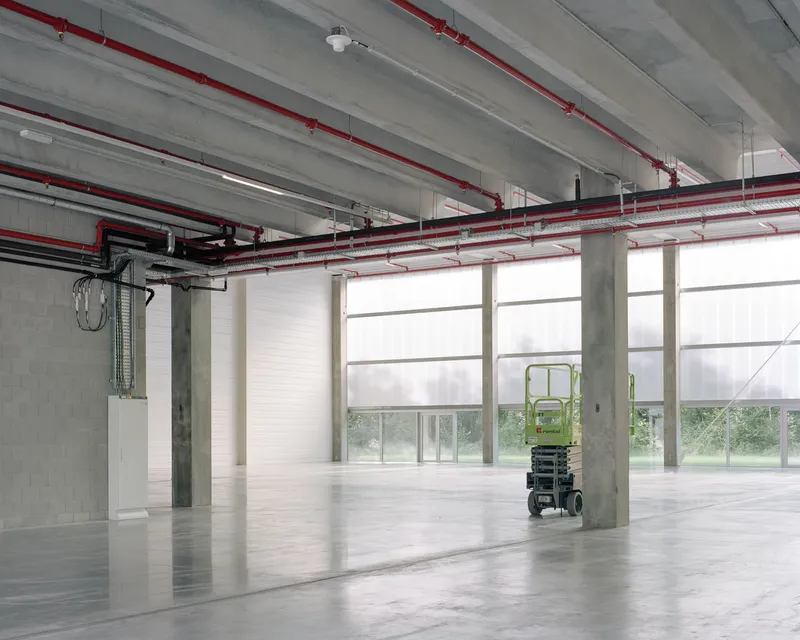
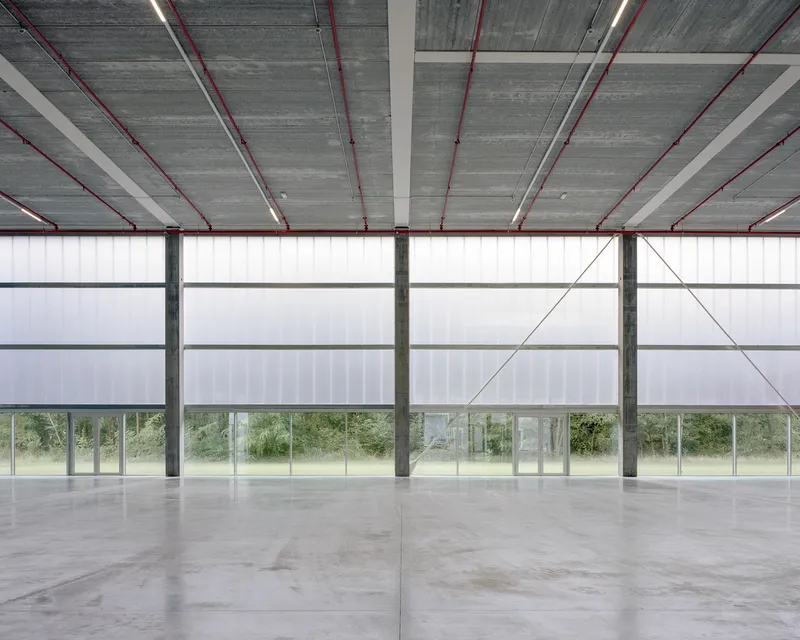
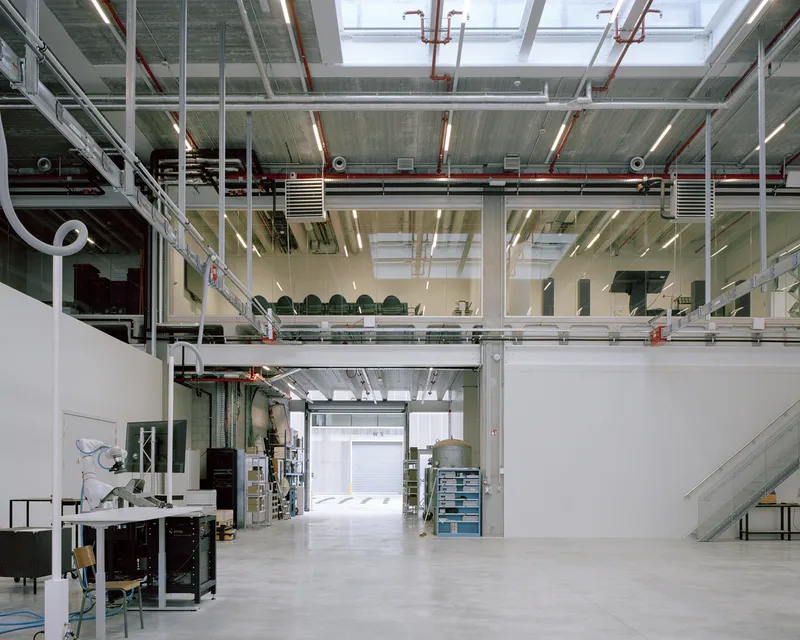
Throughout the campus, XDGA maintains a consistent material palette of exposed concrete, glass, steel, and corrugated metal. The interiors never pretend to be something other than a working environment, but the precision of execution lifts them well above standard industrial fit-out. Red conduits and piping become the dominant color accent against white and grey surfaces, a choice that reads as intentional rather than incidental.
Translucent panel facades and window blinds modulate light without blocking it, softening the industrial glare that plagues most factory floors. In the mezzanine zones, layered concrete slabs and exposed soffits create a sectional depth that rewards the eye. These are spaces designed to be occupied for long stretches by people who build, test, and think, and they treat all three activities with equal seriousness.
Where Work Meets Woodland
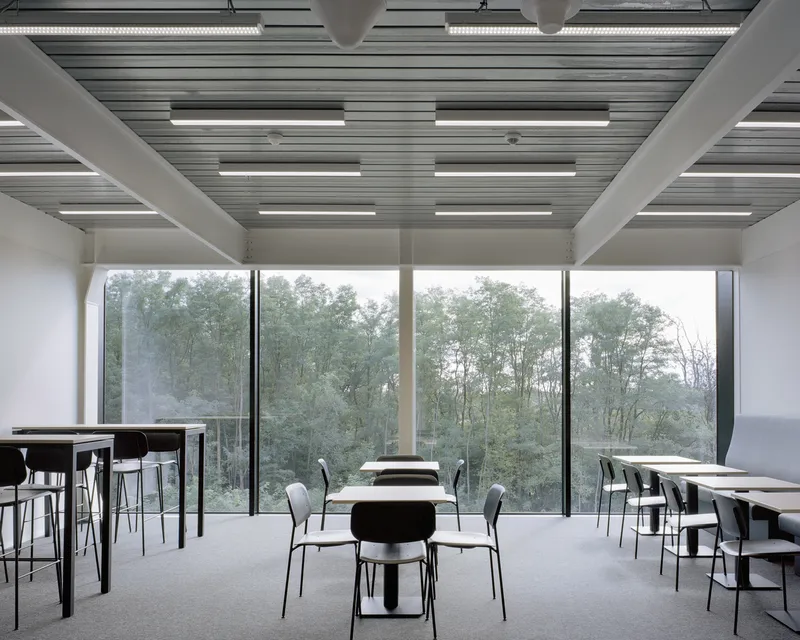
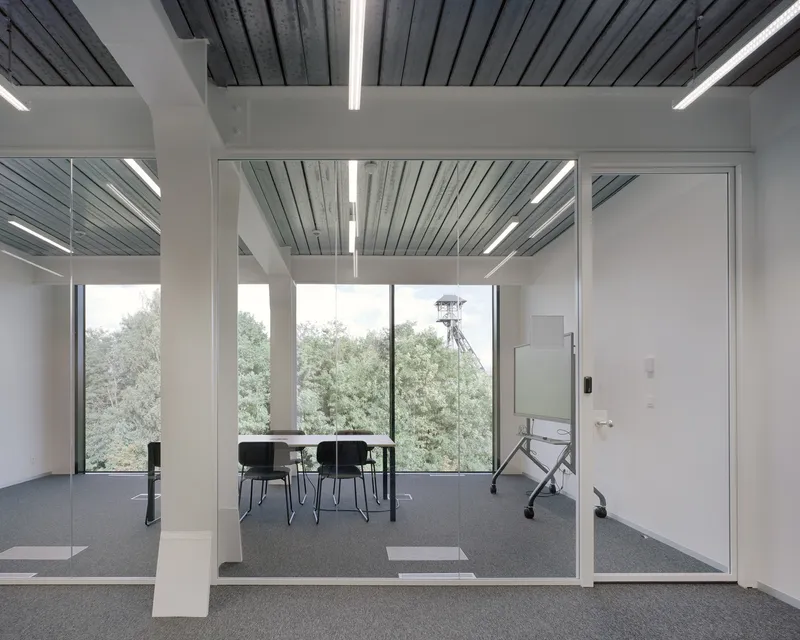
Some of the most compelling moments in the campus occur where the building meets the surrounding landscape. A dining area with floor-to-ceiling glazing opens directly onto dense woodland, the exposed structural ceiling framing the view like a covered terrace. Meeting rooms at the upper level achieve the same effect on a smaller scale, offering prospect and respite within a fundamentally industrial complex.
The street facade along the entry drive shows XDGA's skill at managing scale. A translucent upper volume cantilevers over the glazed ground floor, and three planted trees soften the transition to the parking zone. It is a restrained composition, but it signals that this is not a speculative warehouse. The building has a public face because it expects to attract talent as much as it accommodates machinery.
Entry Sequence and Site Legibility
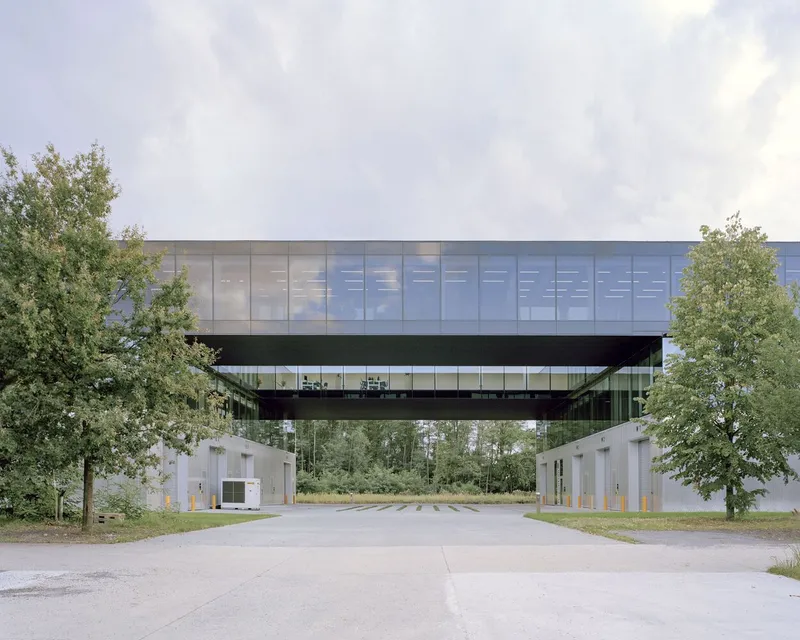
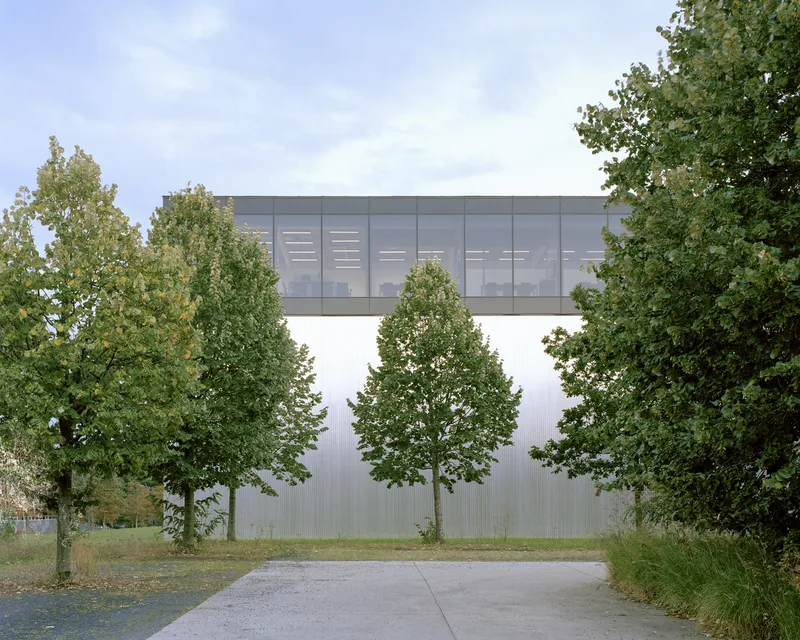
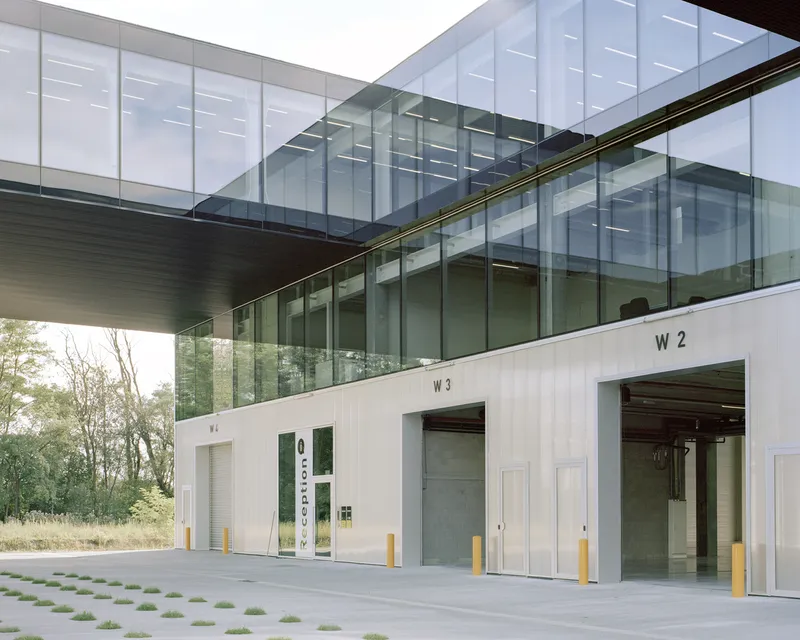
Arriving at the campus, you pass beneath the elevated bridge flanked by security kiosks, a threshold that cleanly separates the public approach from the working interior. Mature trees line the gravel path, lending the arrival sequence an almost parklike quality that belies the heavy logistics operating behind the corrugated facades. The loading dock entries, tucked beneath the cantilevered glass volume, are clearly marked but never dominate the composition. XDGA manages the prosaic requirements of industrial access, bollards, roll-up doors, turning radii, without letting them dictate the architectural experience.
Plans and Drawings
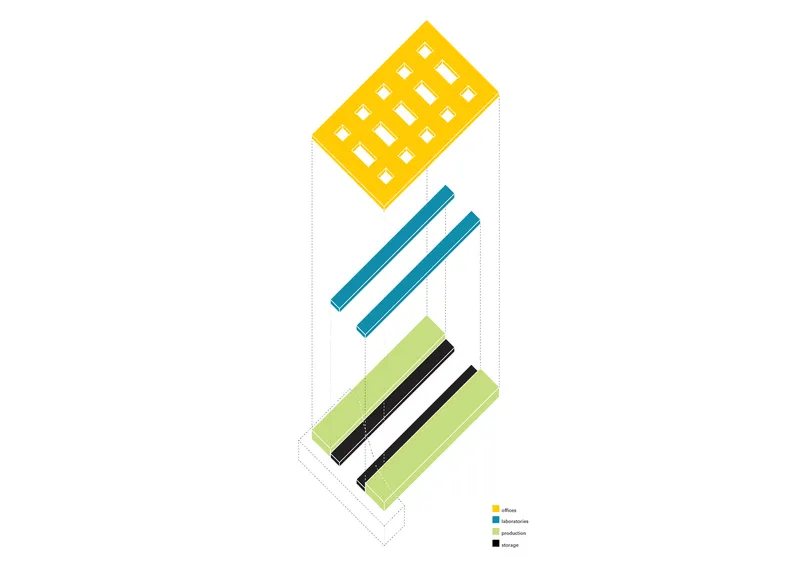
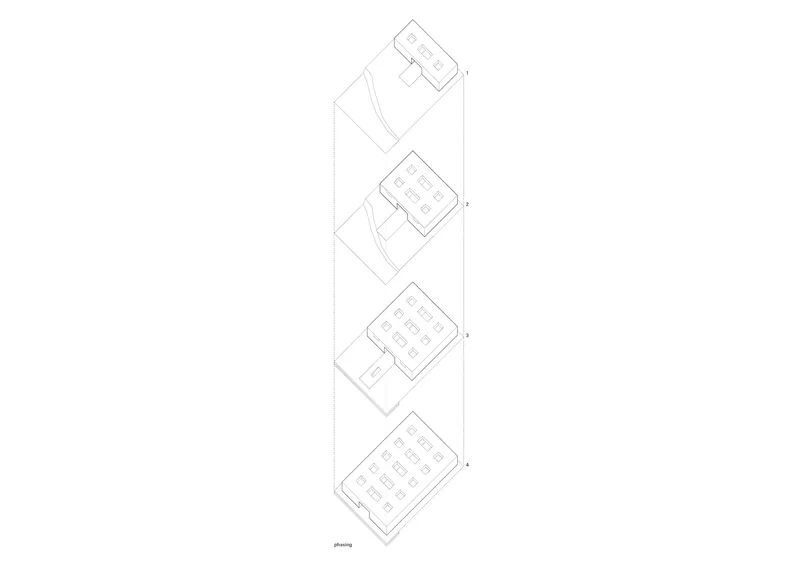
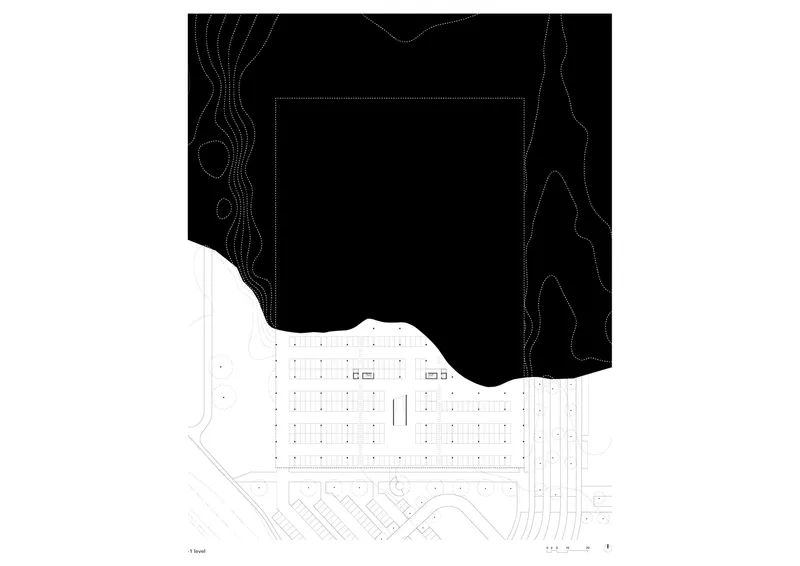
The axonometric drawing makes the phasing strategy immediately legible: four stacked programmatic volumes, color-coded by function, slot into a repetitive grid that can extend across the site. The floor plan shows four rotated rectangular volumes connected by a central circulation spine, a layout that allows each module to function independently or in combination. The site plan reveals how the building footprint relates to Thor Park's topographic contours and restored landscape, sitting within rather than against the terrain.
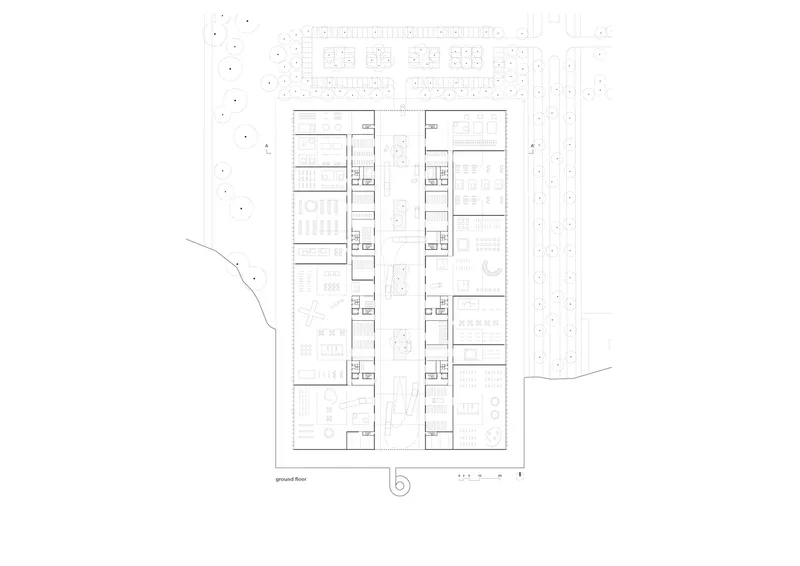
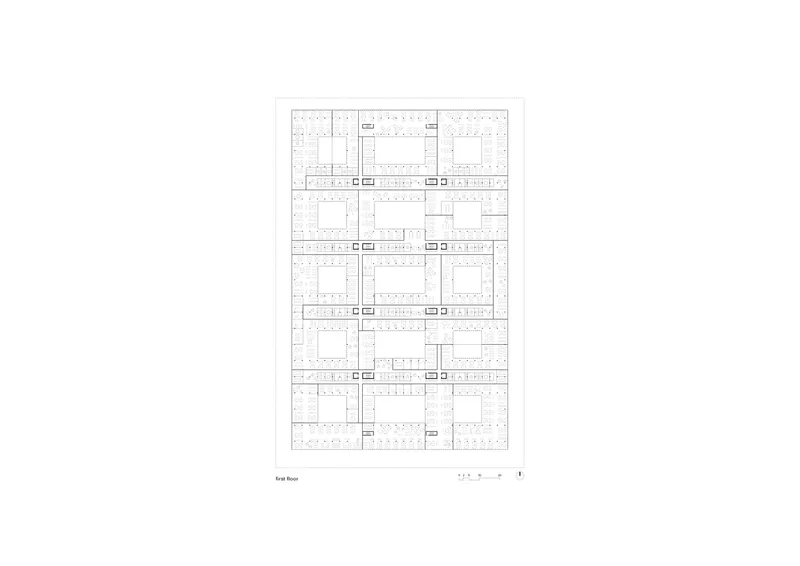
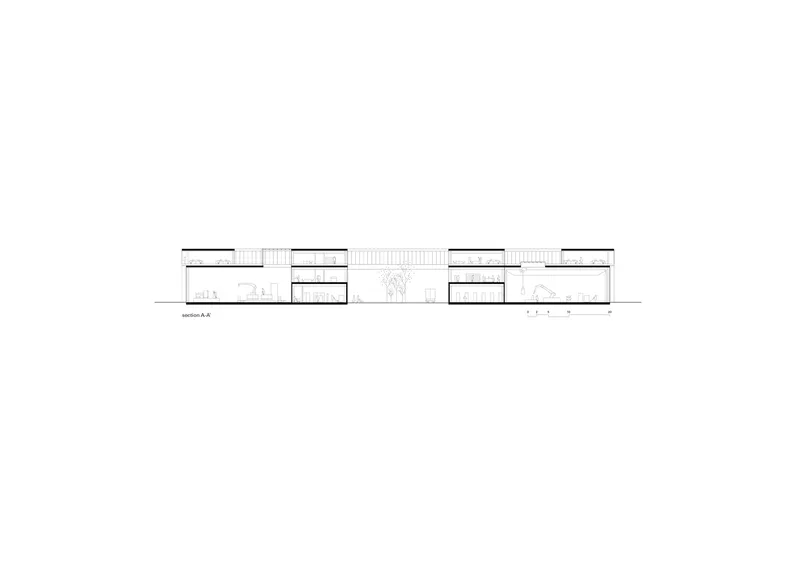
At ground level, paired linear volumes organize production around the central inner street, with parking and landscape buffers at the perimeter. The first floor plan shows the repetitive office modules arranged around central circulation cores and patio voids, confirming that the daylight strategy is baked into the plan rather than applied after the fact. The longitudinal section is the most revealing drawing: it shows the relationship between the roofline, the interior volumes, and the planted courtyard, making clear how the stacking of functions produces a compact section with real spatial variety.
Why This Project Matters
Industrial architecture tends to operate in one of two modes: the anonymous shed that treats spatial quality as irrelevant, or the branded corporate campus that prioritizes image over function. XDGA's Smart Manufacturing Campus occupies a rare middle ground. It takes the logistics of manufacturing, truck access, column-free spans, reconfigurable partitions, and treats them as design problems worth solving well. The patio strategy alone, which serves daylight, outdoor amenity, and sectional connectivity simultaneously, demonstrates a level of architectural thinking that most factory buildings never receive.
The deeper significance lies in the phasing logic. The campus is designed for 30,000 m² across four phases, meaning the building you see today is roughly one quarter of the eventual whole. If the modular system works as intended, each subsequent phase should slot into the existing framework without disrupting operations or compromising the architectural composition. That is a hard promise to keep, and only time will tell. But Phase 1 sets a strong precedent: proof that industrial modularity can be spatially generous, contextually sensitive, and architecturally precise all at once.
Smart Manufacturing Campus by XDGA. Located at Thor Park, Genk, Belgium. 35,520 m². Completed 2024. Structural engineering by Bollinger & Grohmann. Photography by Maxime Delvaux.
About the Studio
Share Your Own Work on uni.xyz
If projects like this are the kind of work you want to make, uni.xyz is a place to publish your own, find collaborators, and enter design competitions.


Popular Articles
Popular articles from the community


graciastudio Turns a Viewless Tijuana Lot Inward Around a Courtyard of Concrete, Timber and Trees
In Tijuana, Jorge Gracia's GA2 House stacks a timber-clad private floor over exposed concrete and replaces a missing view with a planted interior patio.


Singing Woman: An Opera House That Performs Before the Curtain Rises
Ovidiu Cristian Pavel's conceptual opera house translates Estonia's choral identity into a sculpted waterfront landmark facing the Baltic Sea.

Manzana Morphosis: Stretching Barcelona's Grid into a Living Landscape for 2050
A radical reworking of the Eixample manzana turns density into a tool for generous public space, vertical ecology, and environmental performance.

Aquadapt: An Underwater Habitat That Rewrites Its Rooms by the Hour
Curved modules ring the seabed while one shell shifts from breakfast room to cinema, farm and football pitch as residents' needs change.

Similar Reads
You might also enjoy these articles


Bamboo Housing Challenge 2026: Design Affordable, Sustainable Homes Using Bamboo
An international design competition by Bamboo U and IBUKU inviting architects and designers to reimagine affordable housing using bamboo — with the winning design built full-scale in Bali.

Computational Design & Education: Beegraphy Design Awards Introduces 7th Category (Featuring Jiyun's Innovative Approach)
Dive into Beegraphy’s 7th Design Awards category, where computational design meets education to create immersive, interactive learning tools, inspired by Jiyun’s work.

From Parametric Lighting to Urban Furniture: Join the 2nd Workshop in Beegraphy’s Computational Design Series
Dive into Cutting-Edge Design Techniques and Practical Applications with Industry Experts

Last Call: Unleash Your Architectural Genius in SHAK's Kindergarten Design Competition
Urgent call for architects to join SHAK's kindergarten design competition before the looming deadline

Explore Modular Building Competitions
Discover active competitions in this discipline

Challenge to reimagine the Iron Throne

Photograph architecture without architects

Illustrate the lost glory of Angkor Wat - Render Challenge

Design challenge to reuse E-waste
Comments (0)
Please login or sign up to add comments
No comments yet. Be the first to comment!