

Modular Refugee Housing Architecture: Homeland by Guangxin Xie
A modular refugee housing system transforming borderlands into humane, flexible, and rapidly deployable living environments.


In contemporary discourse on humanitarian design, modular refugee housing architecture has emerged as a critical response to displacement crises. The project Homeland, an Editor’s Choice entry of the No Man’s Land competition by Guangxin Xie, positions architecture as an instrument of dignity, stability, and social reconstruction.
Set against the politically and spatially ambiguous condition of "no man’s land," the proposal reframes transitory territory into a structured, community-driven habitat. Rather than treating refugee camps as temporary encampments, the design establishes a scalable and resilient architectural system that prioritizes comfort, safety, and belonging.
Concept: From No Man’s Land to Homeland
The project originates from a fundamental question: how can architecture convert spaces of uncertainty into environments of psychological and social stability?
For asylum seekers, the idea of home is not merely physical shelter but a framework of emotional security. The design responds by transforming fragmented land into an interconnected system of courtyards, shared spaces, and private units. Each courtyard operates as a social condenser, enabling communication, cultural exchange, and collective resilience.
This shift from isolation to community is central to the architectural strategy. The project redefines "home" as a distributed network rather than a singular dwelling.
Site Strategy: Infrastructure as Opportunity
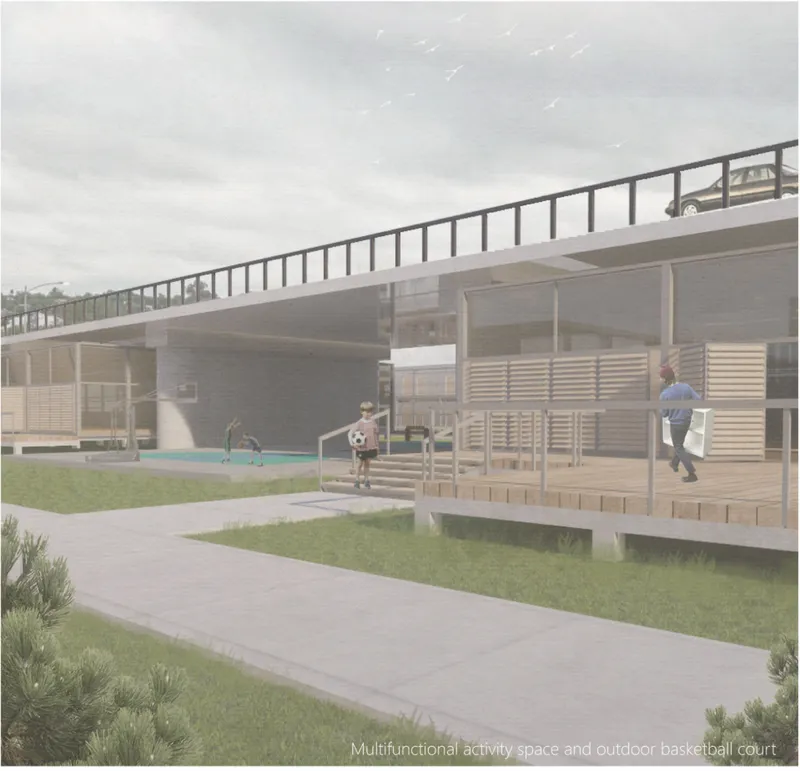
Located around the Eagle Pass, Piedras Negras international bridge, the proposal strategically occupies the underutilized space beneath existing infrastructure. Instead of altering the bridge, the design integrates with it, leveraging its structural footprint to organize the camp.
Elevating the built mass above ground level serves multiple purposes:
- Protection from flooding and environmental risks
- Reduction in construction complexity
- Creation of shaded public realms beneath
This infrastructural parasitism allows the architecture to coexist with existing systems while maximizing spatial efficiency.
Modular System and Construction Logic
At the core of the proposal is a modular construction system, enabling rapid deployment and adaptability. The architecture is composed of repeatable units organized along linear frameworks, ensuring scalability based on population needs.
Key principles include:
- Simple structural grid: Steel frame systems provide clarity, speed, and ease of assembly
- Prefabricated modules: Units can be replicated and extended with minimal technical complexity
- Flexible partitions: Internal layouts adapt to varying family sizes and changing needs
This system allows the camp to evolve over time, responding dynamically to fluctuating occupancy levels.
Spatial Organization: Courtyards as Social Infrastructure
The planning strategy is anchored in a series of interconnected courtyards. These spaces function as semi-private communal zones that mediate between individual units and larger public areas.
Each courtyard acts as:
- A social living room for residents
- A circulation node linking different clusters
- A microclimate regulator enhancing ventilation and daylight
By embedding social interaction into the spatial hierarchy, the design fosters a sense of belonging and reduces the psychological stress associated with displacement.
Programmatic Layers and Public Life
Beyond housing, the project introduces a layered program that supports daily life and long-term integration:
- Canteen and retail spaces
- Public classrooms and training areas
- Community gathering platforms
- Recreational spaces such as basketball courts
These functions transform the camp from a survival environment into a productive and participatory community.


Religious and Emotional Infrastructure
A defining element of the proposal is the religious activity center, positioned as the spiritual core of the camp. The structure features a triangular roof form, symbolizing stability and aspiration.
Constructed with lightweight membrane materials and supported by a steel frame, the space is both visually distinct and environmentally responsive. It provides a setting for reflection, meditation, and collective rituals, addressing the emotional and psychological needs of displaced populations.
Material Strategy and Sustainability
The project emphasizes sustainable refugee housing architecture through the use of recycled and renewable materials such as wood, steel, and stone.
Material considerations include:
- Reduction of construction waste
- Lower embodied energy
- Ease of transportation and assembly
By prioritizing resource efficiency, the design aligns ecological responsibility with humanitarian urgency.
Flexibility and Future Adaptation
Flexibility is embedded at multiple scales of the project:
- Units can expand or contract based on occupancy
- Public spaces can host multiple functions
- Temporary structures can transition into longer-term use
This adaptability ensures that the architecture remains relevant beyond immediate emergency conditions, supporting gradual stabilization and integration.
Human-Centered Design Approach
The project recognizes that displacement is not only a logistical issue but also a deeply human experience. Security, privacy, and dignity are treated as essential design parameters.
By combining modular efficiency with spatial sensitivity, the proposal creates an environment where individuals can rebuild routines, relationships, and identity.
Homeland demonstrates how modular refugee housing architecture can transcend the limitations of conventional camp design. Through a synthesis of infrastructure reuse, modular systems, and community-focused planning, the project transforms a transient condition into a structured and humane living environment.
In doing so, it offers a compelling model for future humanitarian architecture, where speed, sustainability, and dignity are not competing priorities but integrated objectives.



Popular Articles
Popular articles from the community


Conexión: Biophilic Design Reimagines High-Rise Living in Hong Kong
Conexión reimagines high-rise living in Hong Kong through biophilic design, green facades, shared spaces, daylight, water and nature within.

Co-life: Sustainable Architecture for Age-Friendly Community Living
Co-life reimagines sustainable architecture for seniors through courtyards, rammed earth, shared gardens, and spaces designed for belonging.

Hill & Cross Opera: Sculptural Opera House Architecture Shaped by Tallinn’s Landscape and Identity
Hill & Cross Opera reimagines opera house architecture in Tallinn through its sculptural hill, civic plaza, glass wave and a luminous cross.

Riyadh For All: Intergenerational Urban Design for Active Aging in Rabat
Riyadh For All reimagines urban design in Rabat with intergenerational co-living, adaptive courtyards, and Moroccan cultural exchange today.

Similar Reads
You might also enjoy these articles

Eco Chapel: A Green Architecture Pavilion Designed in Symbiosis with the Forest
Eco Chapel uses green architecture to weave prayer, learning and reuse into a forest pavilion shaped by modular hexagonal canopies for life.
Kaffeebühnen: Coffee Shop Architecture Designed as a Civic Stage Between Vienna’s City and Park
Kaffeebühnen turns coffee shop architecture into a civic stage, linking Vienna’s park edge, urban life, warm timber yards, and coffee craft.
Healing Façade: Sustainable Architecture for Reforestation, Community, and Sacred Ecology in Ethiopia
Healing Façade reimagines sustainable architecture as a living wall that restores soil, catches water and renews Ethiopia's forest churches.


Urban Forest: A Vertical Ecosystem for 5,000 Workers in Singapore's Changi Business Park
Radially stacked pods and layered green decks turn a 7-acre plot into 47 acres of ecological workspace projected for 2040.


Comments (0)
Please login or sign up to add comments
No comments yet. Be the first to comment!