
Moon Pavilion by Atelier Guo: Blending Minimalism, Nature, and Cultural Reflection in Huizhou
Moon Pavilion by Atelier Guo blends poetic inspiration, greenhouse heritage, boat-like structure, and sustainable design, harmonizing architecture with nature.


Conceptual Vision: Translating Poetry into Architecture
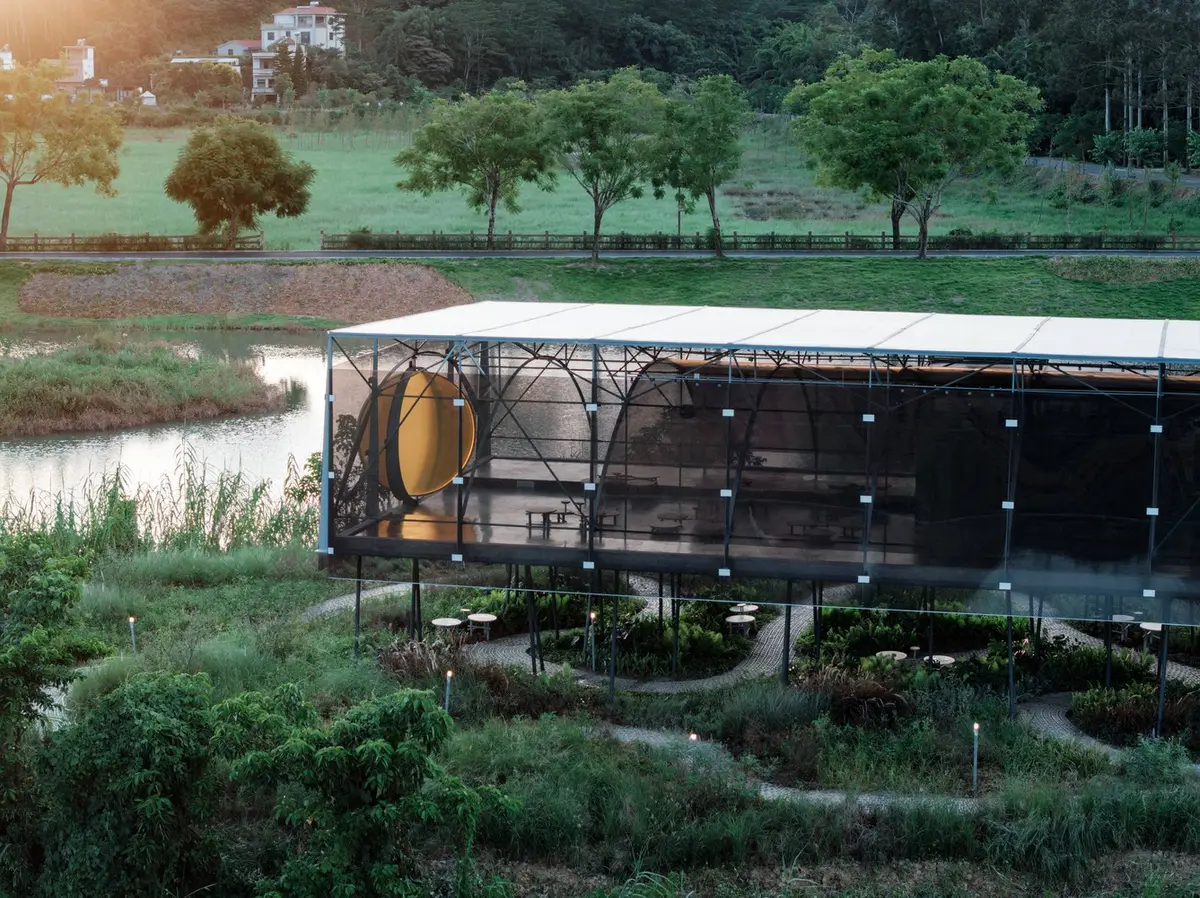
The Moon Pavilion emerges as a poetic interpretation of a classic Chinese verse depicting a poet, blissfully intoxicated amidst a blooming flower field. Instead of creating a literal representation of this imagery, Atelier Guo approached the project with abstraction, transforming spatial motifs—water, moon, flower, and boat—into tangible architectural elements. The pavilion is a reinterpretation of an abandoned greenhouse, layered with new conceptual, material, and formal gestures that evoke both memory and imagination.
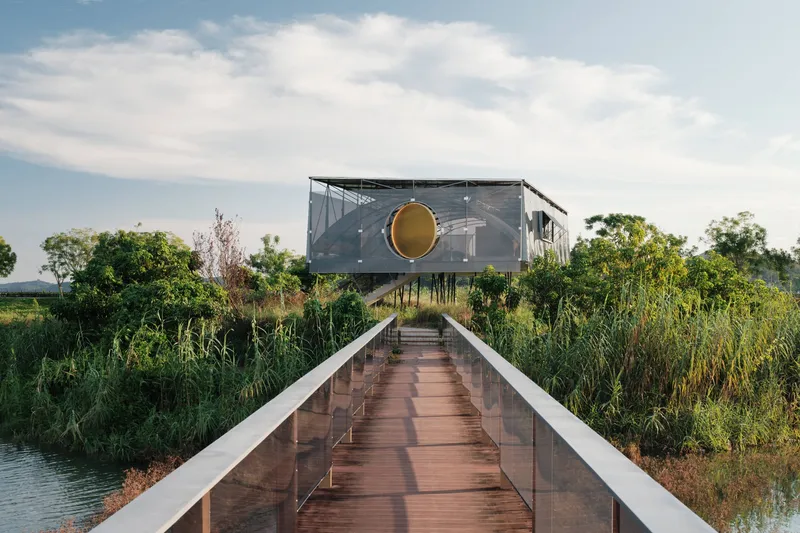
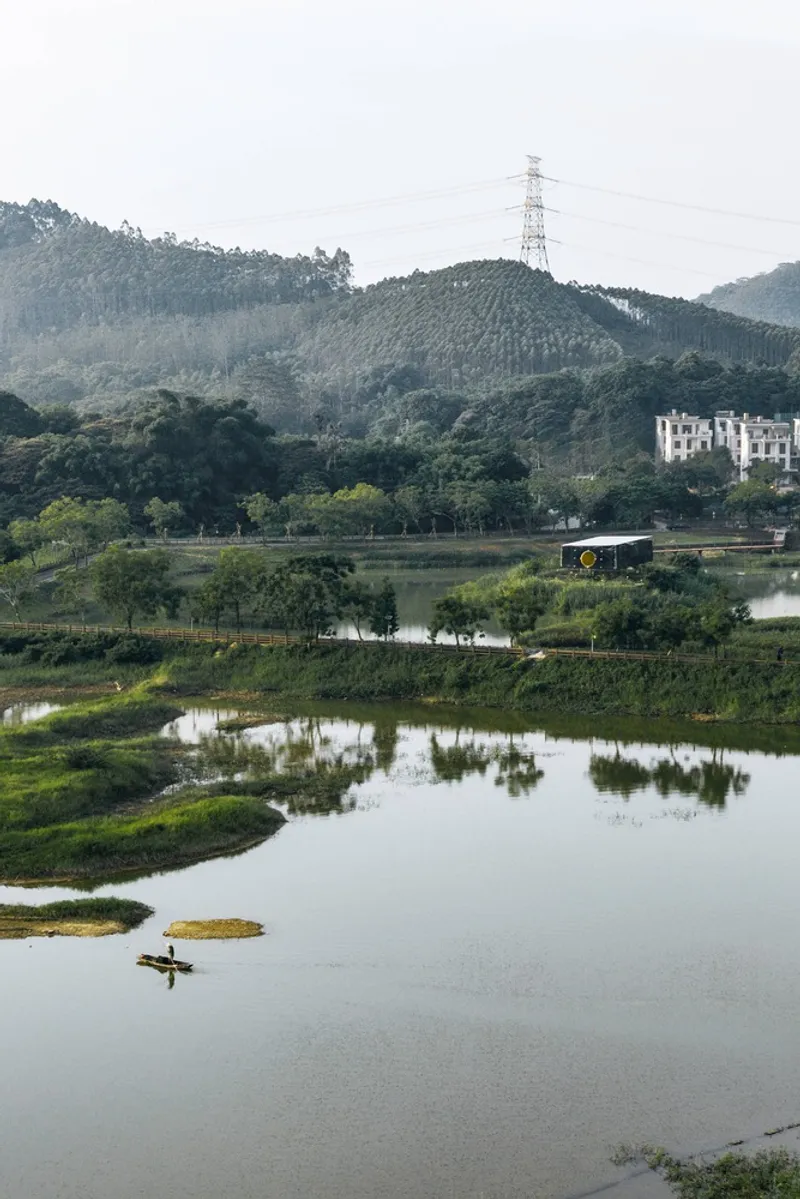
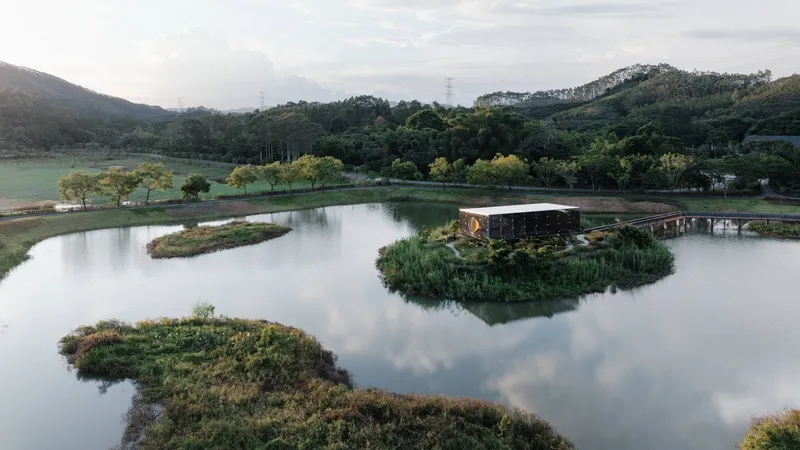
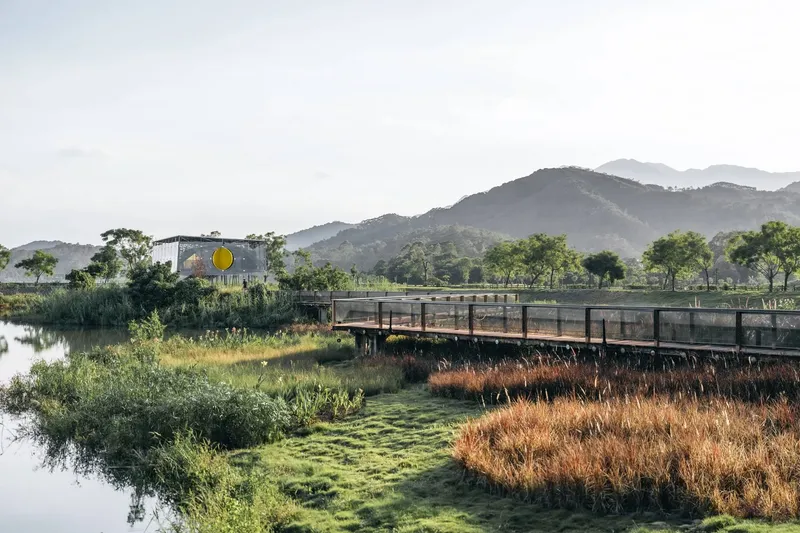
At the heart of the design lies the moon—a symbol historically associated with reflection, poetry, and the tranquil beauty of night. The pavilion features a rotatable moon installation on its façade, which visually connects the artificial and natural moon, mirrored in the surrounding pond. Visitors experience a fluid perception of space, with the pavilion’s silhouette evoking the image of the moon rising over the horizon.
Concept and Inspiration
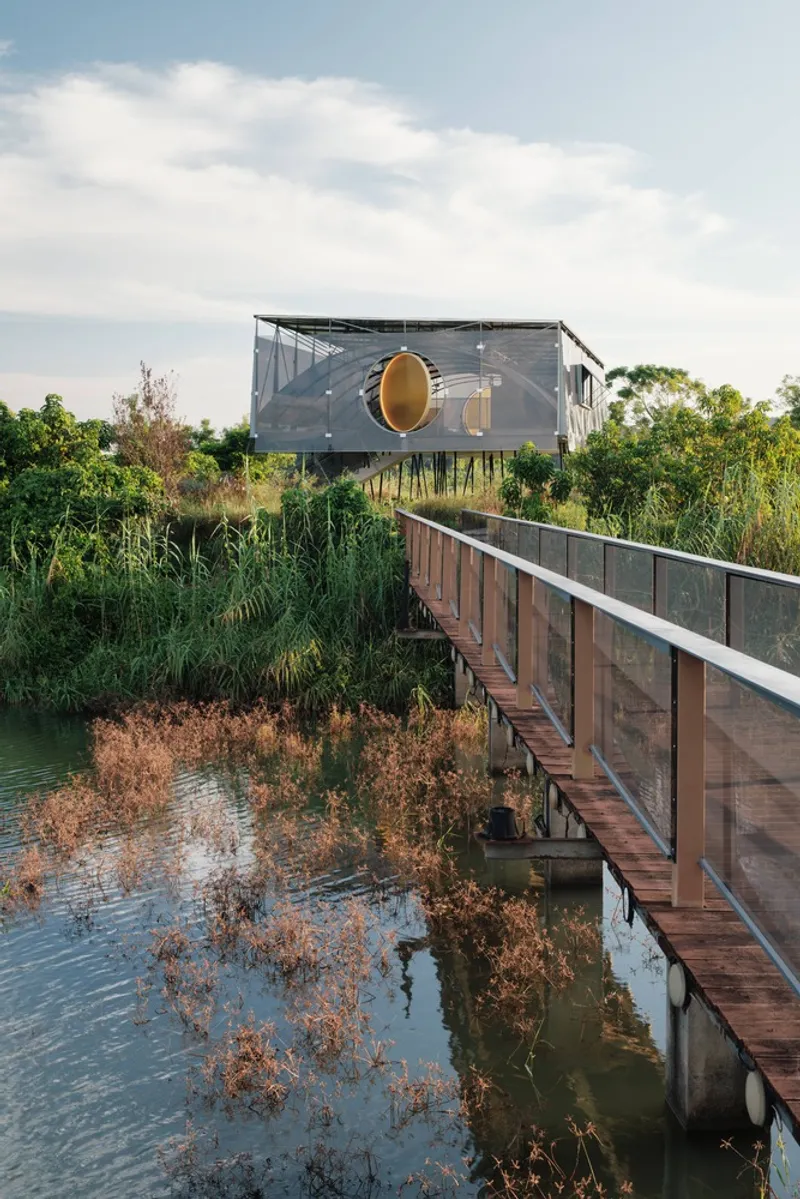
The Moon Pavilion by Atelier Guo draws poetic inspiration from an ancient Chinese verse depicting a poet intoxicated amidst a field of flowers. Rather than literal representation, the design abstracts the imagery into layered architectural motifs: moon, water, flowers, and boats. By starting with an abandoned greenhouse, the pavilion transforms the memory of the site into a contemporary architectural expression, blending natural elements with artistic interpretation.
Architectural Elements
The Moon
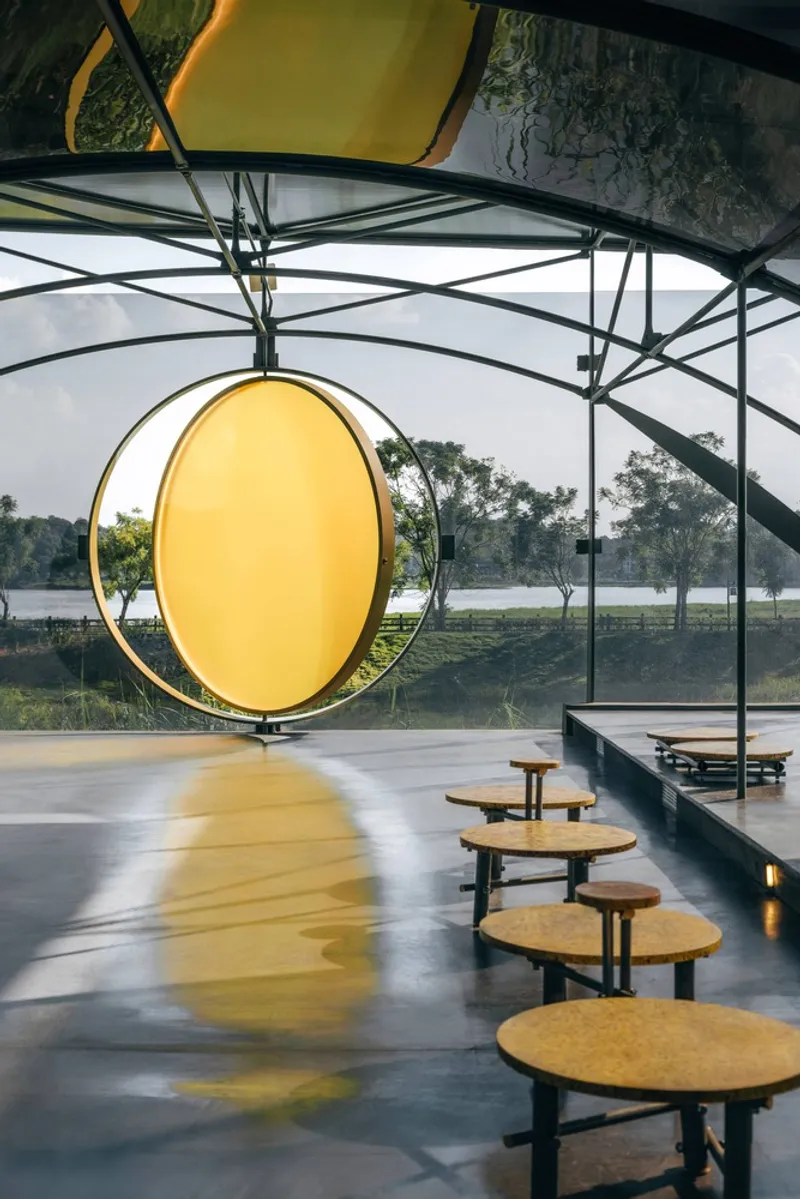
The pavilion’s namesake feature—a rotatable moon installation—anchors the design concept. From afar, it reflects alongside the natural moon in the surrounding pond, creating a dialogue between artificial and natural celestial bodies. As visitors stroll along the water’s edge, the pavilion’s silhouette evokes the rising moon, reinforcing the poetic narrative.
Greenhouse Heritage
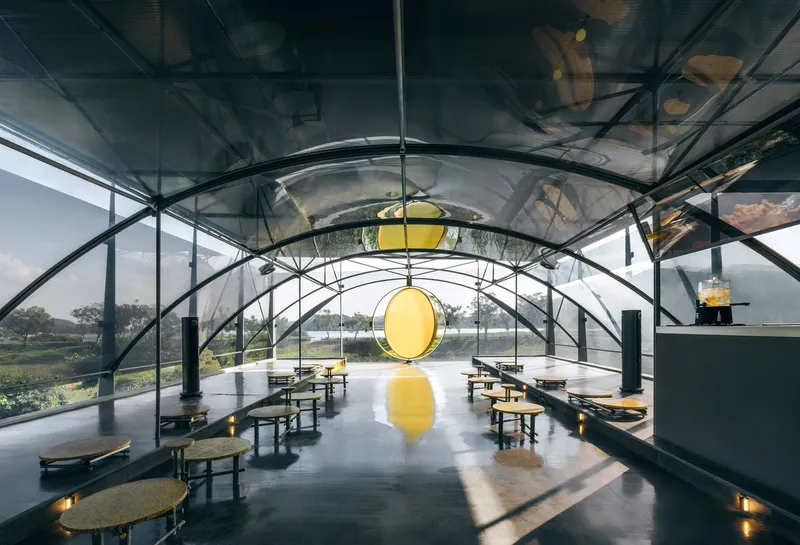
The design preserves the spirit of the original greenhouse, characterized by a lightweight pin-jointed structure, semi-transparent polycarbonate panels, and shaded black netting. These features impart a delicate, luminous quality to the interior while maintaining a temporary, agrarian aesthetic. The two-story pavilion reinterprets the greenhouse’s proportions, layering spatial depth and structural clarity.
Boat-Like Structure
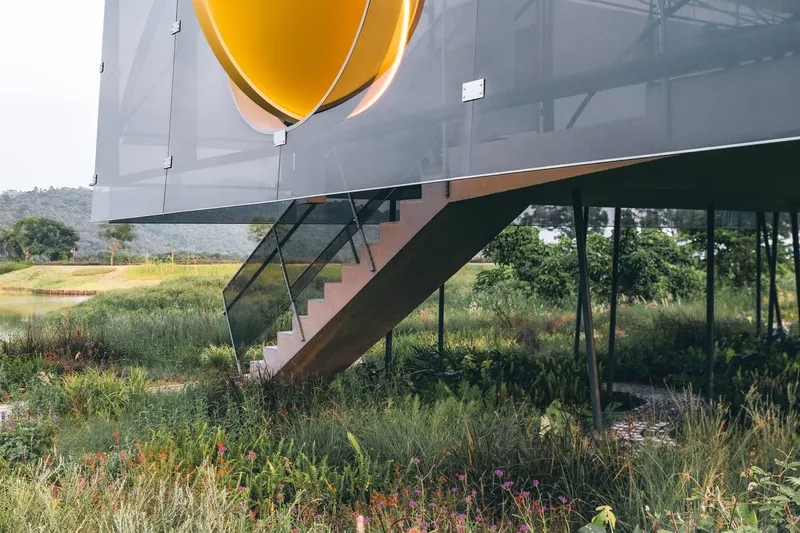
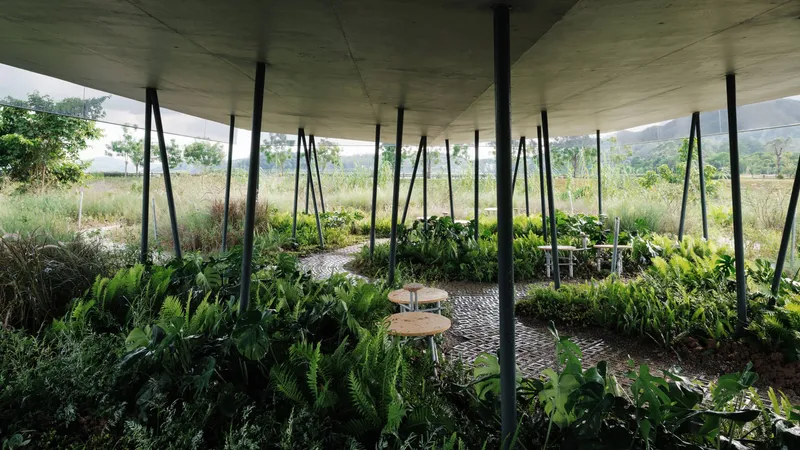
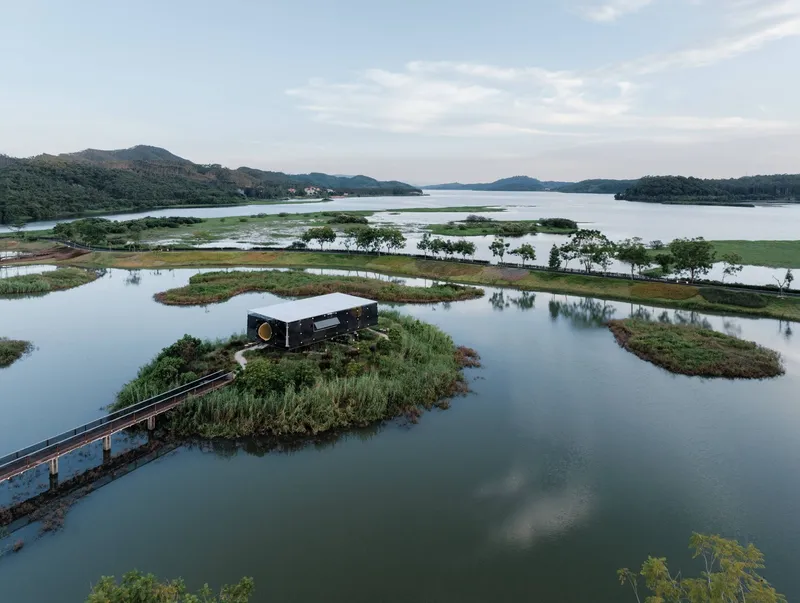
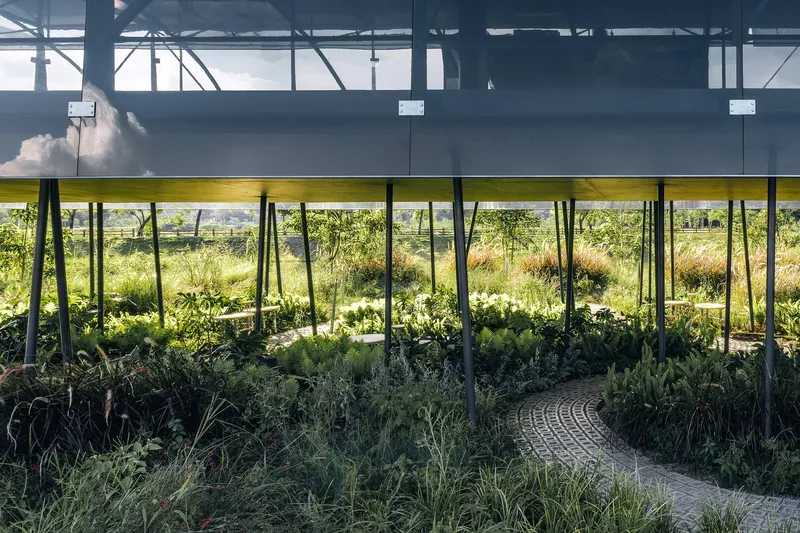
Inspired by traditional boat supports, the pavilion’s raised concrete slab on the second floor expands the greenhouse’s footprint vertically. The V-shaped first-floor slab evokes a boat hull, while irregular steel columns hide utilities, creating both functional and poetic structural solutions. This duality of light roof and solid base reinforces the metaphorical connection to a boat floating on water.
Green Island Concept
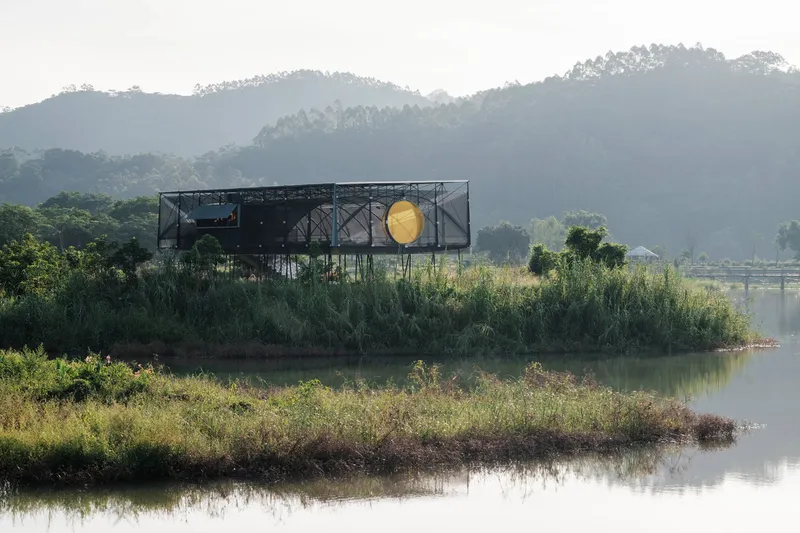
The pavilion blurs the line between indoors and outdoors, allowing plants to spill from the structure into the surrounding landscape. Shade-tolerant species occupy the ground beneath the slab, gradually transitioning to the existing vegetation beyond. This living edge complements the pavilion’s geometric precision while maintaining a natural, organic integration with its environment.
Sunglasses Effect
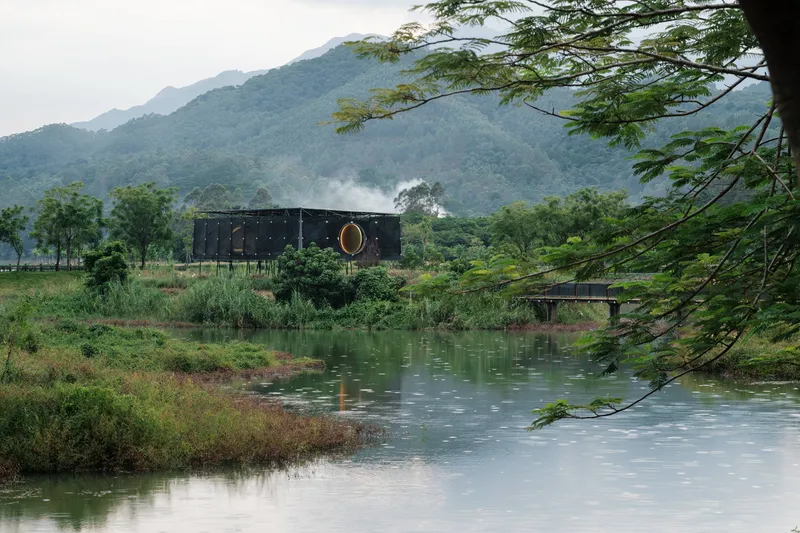
Clad in dark polycarbonate panels, the pavilion appears from a distance like a pair of sunglasses, emphasizing contrast and transparency. This dark exterior enhances the brightness of the moon installation during the day and highlights the structural hierarchy of steel elements.
Sustainability Features
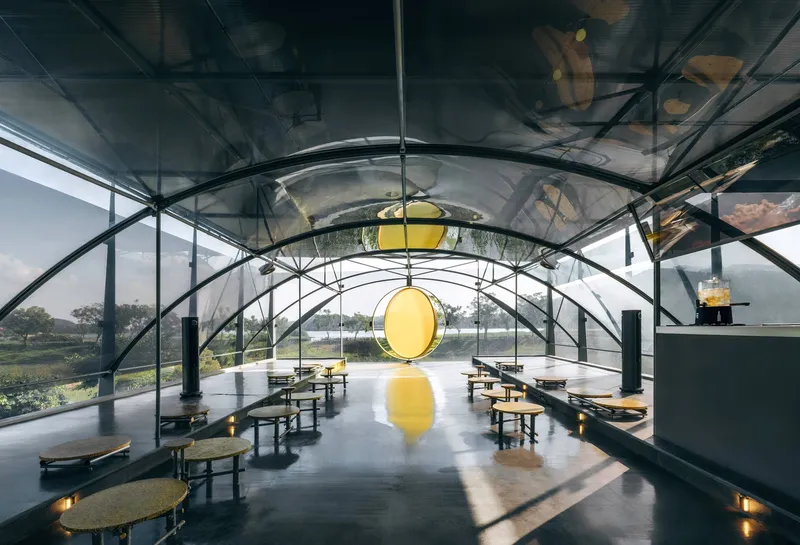
The semi-transparent polycarbonate panels posed thermal challenges, addressed through passive ventilation, strategic shading, and mist fans. Sustainability consultants used simulation and calculation to ensure a comfortable microclimate, relying primarily on air movement to balance indoor and outdoor conditions.
Moon Pavilion Highlights
- Poetic Inspiration: Ancient verse reinterpreted into spatial, visual, and symbolic motifs
- Innovative Structure: Boat-inspired concrete slab with irregular steel columns
- Greenhouse Legacy: Semi-transparent, lightweight construction retaining agrarian character
- Landscape Integration: Living edge dissolving indoor-outdoor boundaries
- Sustainability: Passive ventilation, shading, and misting for thermal comfort
All photographs are works of Hao Chen, Yumeng Zhu


Popular Articles
Popular articles from the community


Singing Woman: An Opera House That Performs Before the Curtain Rises
Ovidiu Cristian Pavel's conceptual opera house translates Estonia's choral identity into a sculpted waterfront landmark facing the Baltic Sea.
Cloaked Colonization: A Mobile Underwater Habitat That Moves Like a Fish
Micah Abaya's shortlisted EHC Pacific entry reimagines ocean settlement as a dispersed network of self-sustaining architectural organisms.
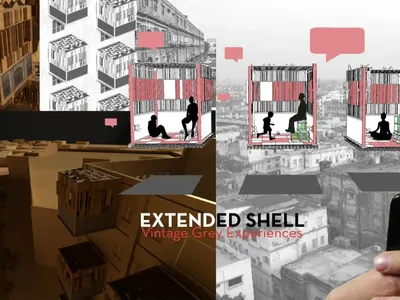
Extended Shell: Retrofitting Kolkata's Balconies as Living Urban Thresholds
A modular retrofit system recovers the social and environmental intelligence of Kolkata's historic verandas for contemporary Park Street residents.

Opera on the Sea: Driftwood Logic Shapes a Timber Opera House on Estonia's Coast
Trevor Orgill's opera house translates the entangled drift of floating timber into a civic building where wood, water, and music converge.

Similar Reads
You might also enjoy these articles


Hodi-Mandai Geram
Project Function: Preservation and revitalization of the Intangible heritage and socio-spatial identity of the Hodi by Housing, Cultural Memory Center, Sacred Grove, landscape, local tourism economy


Olio Towers: A Mid-Rise for Performers That Fuses Housing, Rehearsal, and Stage
Located blocks from Houston's Theater District, this modular tower stacks living units around a central performance atrium.

Oasis: Modular Green Housing Carved into Dhaka's Urban Fabric
A shortlisted Plugin Housing entry reclaims unauthorized settlements in Dhaka with stepped concrete volumes, green roofs, and ventilation-driven design.

Black Hole: A Floating Megastructure for the Post-Physical Era
Emiliano Mazzarotto envisions a spherical, self-scaling arena where e-sports, digital hotels, and holographic stadiums replace traditional public space.

Explore Poetic Architecture Competitions
Discover active competitions in this discipline

Challenge to reimagine the Iron Throne

Photograph architecture without architects

Illustrate the lost glory of Angkor Wat - Render Challenge

Design challenge to reuse E-waste
Comments (0)
Please login or sign up to add comments
No comments yet. Be the first to comment!