

More Than A Boy's Club
An essay advocating for Women in Architecture.

Since the inception of the Pritzker Prize in 1979, only six women have won the prestigious award: Zaha Hadid in 2004, Kazuyo Sejima in 2010 (alongside Ryue Nishizawa), Carme Pigem in 2017 (alongside Ramon Vilalta and Rafael Aranda), Yvonne Farell and Shelley McNamara in 2020, and finally Anne Lacaton in 2021 (alongside Jean-Philippe Vassal). It’s both strange to think and unsurprising that only 6 women have won this high honor in the 42 years that it has existed; of course, we can’t disregard the fact that the number of prominent female architects (or just female architects, for that matter) has risen significantly in the modern era than in the 1900s. Still, it’s amazing how small the number of female winners is – this doesn’t mean that the award should go to a woman every year, or that there should be a male winner and a female winner of the Pritzker Prize yearly either. It is simply an indictment of two very significant things, firstly, that women in architecture in the ‘olden days’ were scarce, and secondly, that the increase of women in architecture in the modern era is nothing short of astounding and exciting. The message is clear – there should be more women in architecture.
When I say “there should be more women in architecture”, it isn’t a radical sexist movement for women against the patriarchy – it is simply a call to availability. Back in the 1900s, architecture was a premier boys club – the job to design big and tall buildings and large master-planned houses and cities (to certain extents) was a very manly thing to do. Back in those days, the social dynamic between men and women was very Neanderthalic – it was very ‘hunter, gatherer’. There was no leeway for the roles to mix and match - there was only the system: the man goes out and works while the woman stays at home to do chores and to keep the house in order until her husband comes back. Imagine having some of the best and brightest minds of the world stuck in the kitchen, unable to contribute more to society, simply because of the dynamics at play. Think of all the advancements we would’ve missed out on if we still lived in an era like that – thankfully, we don’t, but it is still a pain to imagine a world where we do. Again, the phrase “there should be more women in architecture” is simply just the architectural way of saying ‘we need more women involved in contributing to society’ – nothing more, nothing less.
Besides, what’s the worst thing that could happen by including more women in architecture? Will we wake up one day and say “Oh no, the female restrooms in this place actually accommodate the needs of the people using it” - or maybe we’ll say ‘Oh God, that building is so pink! Why did we let women design these?’. Sarcastic overtones aside, women in architecture won’t be limited to designing women’s bathrooms and getting blamed for something being colored pink – women in architecture should be seen as men are seen: competent, working-class citizens, who want to contribute great things to our society. That’s all they should be seen as – people doing their job. A job they are qualified for because they are competent individuals. At the end of the day, that’s what they deserve – they deserve to be treated as equals and not as slaves or a lesser caste to men. Architecture, for the longest time, has been a premier boys club, but that notion is severely antiquated – it’s so antiquated that if it were a building, we’d probably be lobbying for an adaptive reuse project on it. All jokes aside, we, as a profession, should stay open to the contributions of women in our field because there is no downside to this whatsoever.
That’s one of the best things about architecture, it doesn’t matter who you are, what gender you are (or what gender you identify as), or where you came from – what matters is you, creating things and putting your best ideas forward. That’s the thing that matters the most to our profession at the end of the day – ideas. People won’t look at a building and think “it’s so ugly, a lady must’ve designed it!” or “Wow, that interior is so ugly, why did they put a woman in charge of that” – quite the contrary, if they find a building leaning away from their aesthetic tastes they would simply say, “Wow, I do not like the design the architect did on that building”. Let’s face it, we architects don’t know the gender of who designed what when we look at something – if we don’t know, how would the public know? More importantly, why would they care if something was designed by a man or a woman – quite frankly, we don’t even care what gender designed the building, we judge designs as good or bad. We don’t judge it as ‘good for a girl design’ or ‘bad for a boy design’, we judge the building programs by logic and the aesthetic by preference – it’s as simple as that.
Take The High Line, for example – this iconic architectural landmark of adaptive reuse is an idea that most (if not all) cities and or countries want to have in their backyard. It’s a beautiful piece of modern architecture – it’s essentially everything an architect wants a project to be: it’s elegant, it has a brilliant albeit simple concept, and it’s outrageously iconic – the mastermind of this awe-inspiring feat of architecture? A woman. Specifically, Liz Diller, one of the founding partners of DS+R and one of my idols. She describes herself as a maverick, a rebel, and a non-conformist – funny thing is, based on Liz Diller’s description of herself she could be considered a man or a rock and roll icon, take your pick. I simply mean that the words maverick, rebel, and non-conformist aren’t the words you’d typically associate with a woman, and yet here we are – I agree with her self-description because how she described herself is exactly how she designs. She designs iconic architectural pieces that create a lasting impact on society (i.e., The Broad, The Blur, The Bubble, etc.) and she is a vocal champion of democratizing public space – which is essentially the idea that brought ‘The High Line’ into existence. She looked at the current situation and took a drastic approach to formulate a solution – so she is, as she describes herself, a maverick, a rebel, and a non-conformist. It’s refreshing to see a woman use those words to describe herself and make something impactful, perhaps even iconic.
The architecture profession has always been teeming with people willing to challenge conventions, people like Zaha Hadid, Tatiana Bilbao, and Odile Decq come to mind specifically when speaking about this topic, but of course, there are many more. Even though their styles may be different, they still share in the glory of being advocates, pioneers, and champions of their philosophies. Their collective works and vision have helped shape what architecture has become and have steered our practices in a more progressive direction. Case in point, Zaha Hadid, the Dame herself, was a strong advocate of parametric architecture – she not only believed in the artistry of geometric patterns and shapes but also in the cohesion of those shapes to create wondrous spaces. Another example is Odile Decq, she’s a strong believer in expressing and asserting one’s individuality and explores this philosophy in all of her designs – she also created a school based on this philosophy. Tatiana Bilbao, a vocal proponent of sustainable design and social housing, constantly advocates for better social housing programs because of her philosophy ‘Houses are not for sale, Houses are for people’ – she is also one of the pioneers that brought collages into the limelight. Her belief that renders ‘kill’ the creative process of the design has brought a rise in collage-style presentations over the past few years. As you can see, women in architecture can be just as influential (maybe even more so) as men.
With that, I would like to end with a quote from Anton Ego ‘Not everyone can become a great artist, but a great artist can come from anywhere.’ This, in a nutshell, is exactly what we gain by welcoming more women in architecture – we welcome the possibility of having more great artists join the storied ranks of our profession’s history. We welcome more rebels, more non-conformists, more champions, more pioneers, more of what makes our profession great – we welcome more people who are dedicated to making our world a better place. At the end of the day, that’s the greatest contribution of women in architecture – they add more strength to the ranks of a great profession, they add more art in a job that requires a ton of artistry, they breathe new and progressive life into outmoded things, and they create and conceptualize things we haven’t even dreamed possible.



Popular Articles
Popular articles from the community


Hill & Cross Opera: Sculptural Opera House Architecture Shaped by Tallinn’s Landscape and Identity
Hill & Cross Opera reimagines opera house architecture in Tallinn through its sculptural hill, civic plaza, glass wave and a luminous cross.

The Earth Pod: 3D Printed Homes for Resilient Refugee Communities
The Earth Pod reimagines refugee housing through 3D printed homes made from clay, combining resilience, self-sufficiency, and rapid shelter.

The Musturak Paradise: Senior Living Architecture for a Connected Future in Temara, Morocco
The Musturak Paradise reimagines senior living architecture in Temara via private homes, social spaces, culture, community, and shared care.

AL-JANNAH: Sustainable Architecture and Permaculture for Afghan Widows
AL-JANNAH uses sustainable architecture and permaculture to create resilient oasis of housing, learning, work and renewal for Afghan widows.


Similar Reads
You might also enjoy these articles

Day and Night Park: A Time-Based Urban Newsstand in Beijing
A temporary urban newsstand in Beijing blending travel, light, and reading through poetic colors, compact form, and community-focused design.

Modernist Patio Renovation in El Masnou, Barcelona by Oliver Segura Arquitectura + Cebrià Arquitectura
Modernist patio renovation blending tradition and innovation with a movable pool, leveled floors, and Catalan materials in El Masnou.

Alto Residencial Coop: Cooperative Housing Development in Santiago de Compostela by Carbajo Barrios Arquitectos
A linear cooperative housing complex blending white volumes and perforated metal façades, enhancing community living, natural light, privacy, and urban integration.
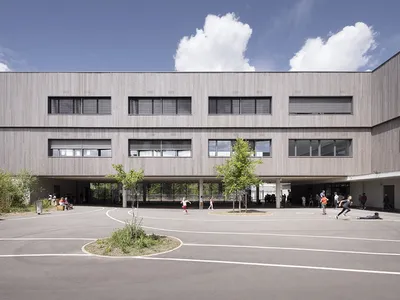
Vil Genis School by BPA ARCHITECTURE – Massy, France
Vil Genis School in Massy, France, features sustainable design, south-facing classrooms, community integration, accessible spaces, and modern educational architecture.






Comments (1)
Please login or sign up to add comments
The blog advocates for female architect's role through examples in a convincing manner. Recognition of notable women is well presented with personal insight on their work.