

Moriyama Teshima Architects Raises a Ten-Storey Mass Timber Landmark on Toronto's Waterfront
Limberlost Place brings net-zero passive ventilation and exposed black spruce structure to George Brown College's lakeside campus.


Before 2022, mass timber buildings in Toronto could not legally rise above six storeys. Limberlost Place, designed by Moriyama Teshima Architects and completed in 2025, pushes that ceiling to ten. Sitting on a former brownfield site at George Brown College's waterfront campus on Queens Quay East, the building is among the first public tall timber structures anywhere, and it doubles as a living laboratory for the architecture students who occupy it. The timber, sustainably sourced black spruce from Ontario's Limberlost Forest and processed into cross-laminated and glulam members by Quebec-based Nordic Structures, is not hidden behind drywall. Roughly half the wood structure remains exposed, knots and seams included, so the building teaches through its own bones.
What makes Limberlost Place genuinely interesting is not just that it is tall and made of wood. It is the convergence of three ambitions in a single frame: a structural system that achieves nine-metre column-free spans with a remarkably thin timber-concrete composite slab found in no other building worldwide; a passive climate strategy built around twin nine-storey solar chimneys, operable windows, and deep lake water cooling that drives the project to net-zero; and a spatial concept organized around what the architects call "Breathing Rooms," a term that applies equally to the generous spans, the social connectivity between floors, and the actual flow of fresh air through the section. Few institutional buildings attempt all three at once. Fewer still pull them off inside a 38-metre height limit.
Copper Skin, Timber Core

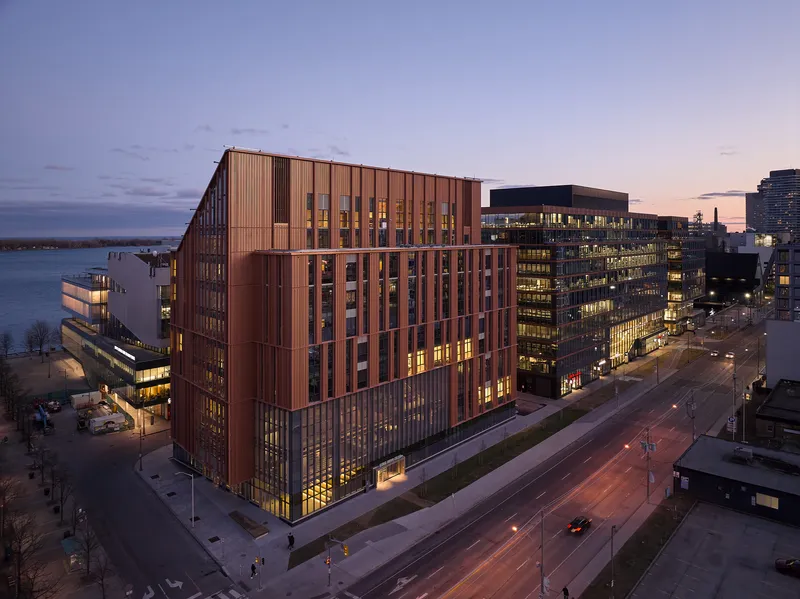
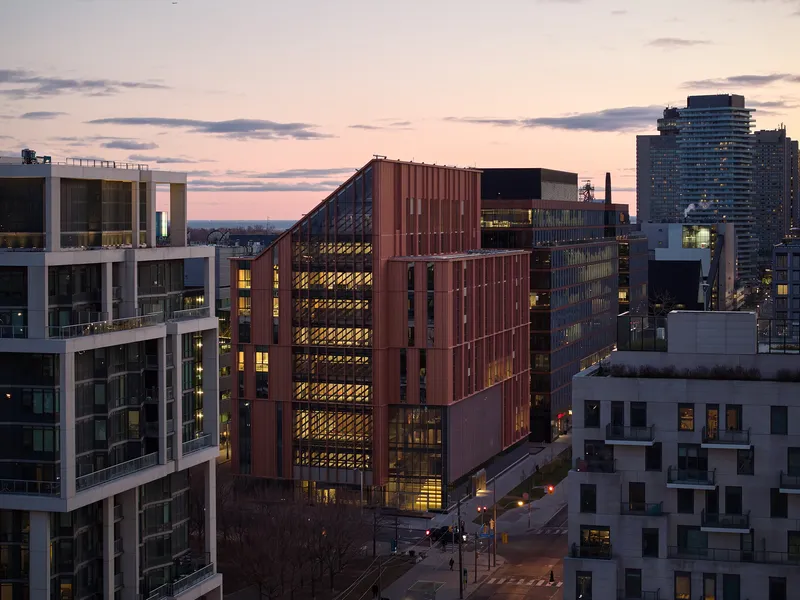
From the street, Limberlost Place presents not as a wood building but as a vertically ribbed copper volume. The fins catch light differently through the day, shifting from warm amber at noon to a deep glow at dusk. The copper cladding wraps a thermally efficient prefabricated envelope calibrated at a 40-percent window-to-wall ratio, balancing daylight penetration against energy loss. High-to-slab windows drive light deep into floor plates while the peaked roofline, a nod to traditional Ontario roofscapes, slopes at an angle optimized for the photovoltaic array that crowns the building.
The contrast between the metallic exterior and the warm interior is deliberate. Step through the ground-level entrance and the material world flips: copper gives way to exposed glulam columns, CLT ceiling panels, and the visible grain of Canadian spruce. It is a building that reserves its most generous gesture for those who enter it.
The Learning Landscape


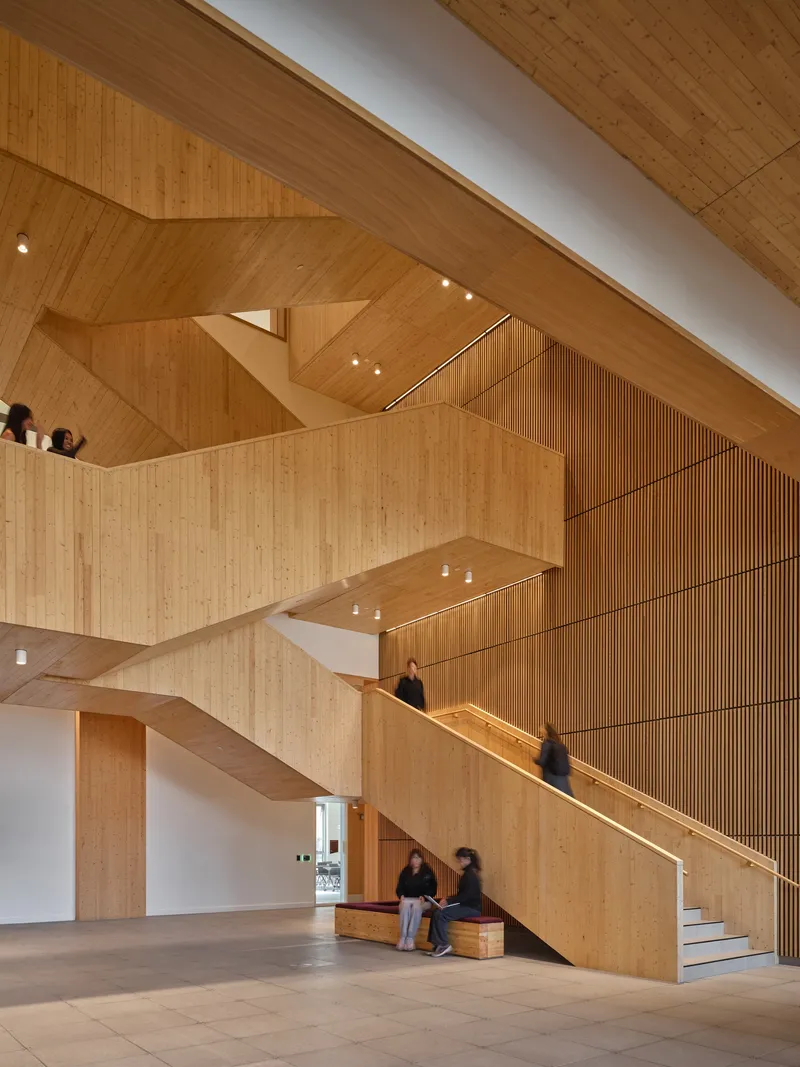
The triple-height atrium that rises from the main doors along the Martin Goodman Trail is the building's civic heart. Oversized seat-stairs ascend through the space, creating what the architects call the Learning Landscape: a loose, informal territory where students congregate on stepped platforms, red carpet squares, and timber landings. The atrium is visible from multiple levels through vertical timber screens and open balconies, collapsing the boundary between corridor and commons.
Three three-storey mass timber columns, among the largest in North America, stand within this atrium volume. They are not decorative. They carry real load and their scale gives the space a civic seriousness that smaller timber buildings rarely achieve. The decision to leave them exposed, complete with the evidence of their fabrication, turns structure into pedagogy. For students in the School of Architectural Studies, every beam joint is a lesson in tectonics.
Breathing Rooms and Solar Chimneys

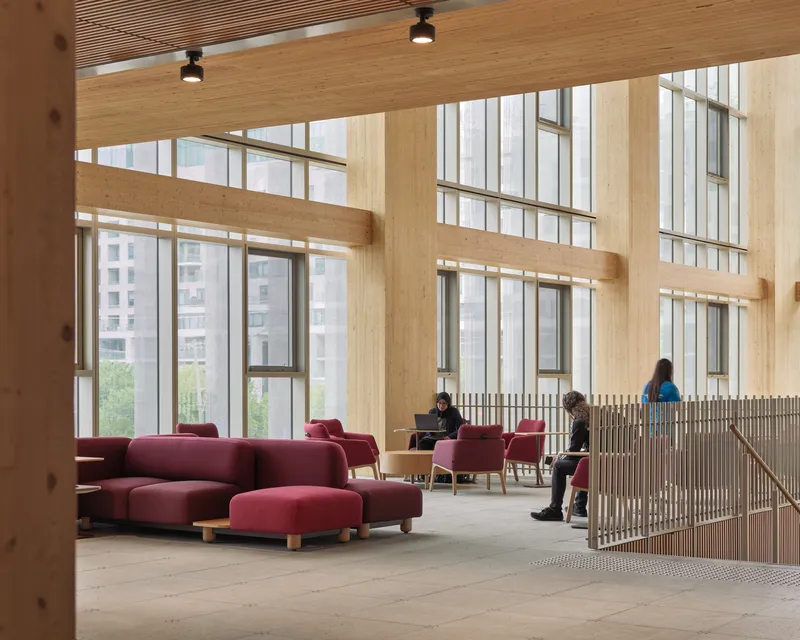
Each upper floor pairs two double-height Breathing Rooms with the building's twin solar chimneys in a skip-stop arrangement. These are not mechanical shafts. They are nine-storey vertical volumes that draw warm air upward by convection, pulling fresh air through operable windows on the occupied floors below. The system is passive: no fans, no compressors for much of the year. Thermostat screens in classrooms and offices tell occupants when to open or close their manually operated windows, turning building users into active participants in the climate strategy.
Combined with rooftop photovoltaics and deep lake water cooling drawn from nearby Lake Ontario, the passive ventilation strategy pushes Limberlost Place to net-zero performance. The 30-percent reduction in embodied carbon compared to an equivalent concrete structure is significant, though the architects are transparent that below-grade concrete work still accounts for 40 percent of the building's total embodied carbon. Honesty about that ratio is itself a form of pedagogy.
Timber Structure on Display
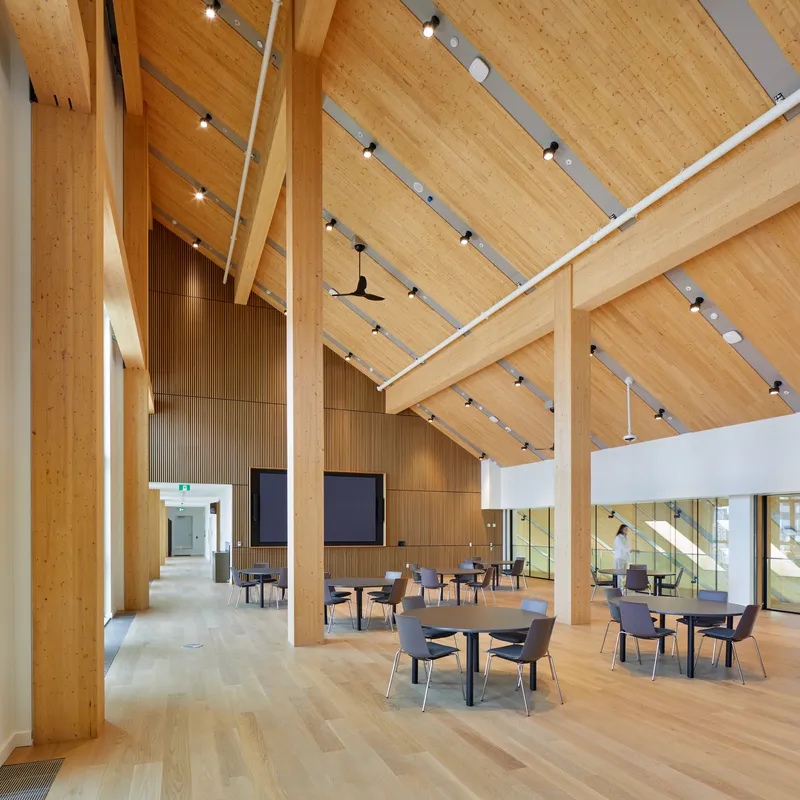


The structural innovation here is worth spelling out. The composite floor system laminates CLT panels with a concrete topping, separated by a sound-insulating rubber layer. These composite slabs were pre-topped offsite to reduce the shoring required during construction, a technique the design team has since open-sourced for the broader industry. The result is a floor plate thin enough to fit ten storeys within a 38-metre height cap, achieving nine-metre column-free spans without the deep beams that typically eat into ceiling height in timber buildings.
Glulam columns embed within perimeter walls (referred to as "wallums") to support extra-wide slab bands, creating a beamless aesthetic overhead. In the assembly hall and upper lounges, the exposed timber ceiling reads as continuous and calm, more like a finished surface than a working structure. Tubular skylights punch through in places, washing the wood grain in diffused daylight and reinforcing the material's warmth.
Program as Community Infrastructure


Limberlost Place is not purely an academic building. It packs a daycare, a fitness centre with a climbing wall, event spaces, executive offices for the Brookfield Sustainability Institute, and lecture halls alongside conventional classrooms and computer labs. The daycare occupies a ground-level room with floor-to-ceiling windows overlooking the tree-lined street, its low wooden furniture in visual harmony with the structural timber above. The climbing wall, tucked into a split-level volume with blue crash mats, is an unexpected find inside a mass timber frame.
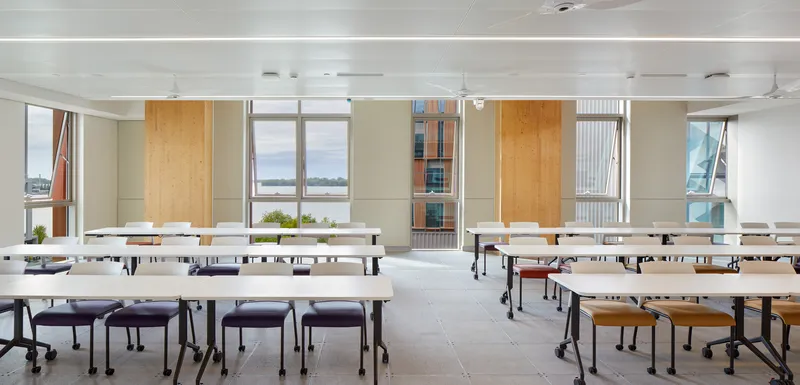
Classrooms on levels two through nine use movable furniture and operable windows, varying from pale blue desks under plywood ceiling panels to grey modular seating with tablet arms facing views of the waterfront and surrounding residential towers. The variety signals that no single room type was imposed: each floor adapts its layout to program needs while maintaining the same exposed timber structure overhead, giving the building visual coherence without monotony.
Bridges, Screens, and Circulation

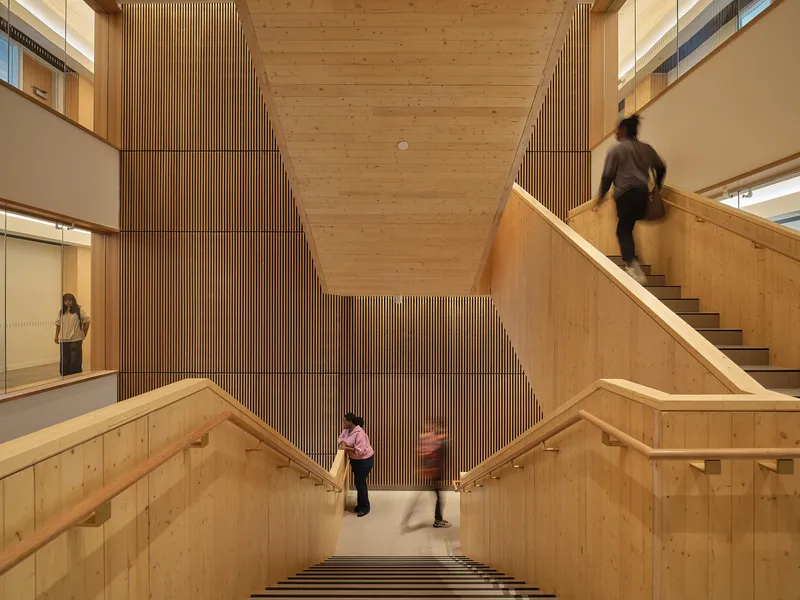

Internal bridges with diagonal timber bracing connect floor plates across the atrium, functioning as both circulation and inhabitable thresholds. Vertical slatted screens line the stairwells, filtering light and creating a layered depth that changes as you move through the building. These screens are the project's recurring motif, appearing at balcony railings, partition walls, and facade recesses, and they perform multiple roles: visual privacy, acoustic softening, and a rhythmic grain that echoes the wood's own material character.
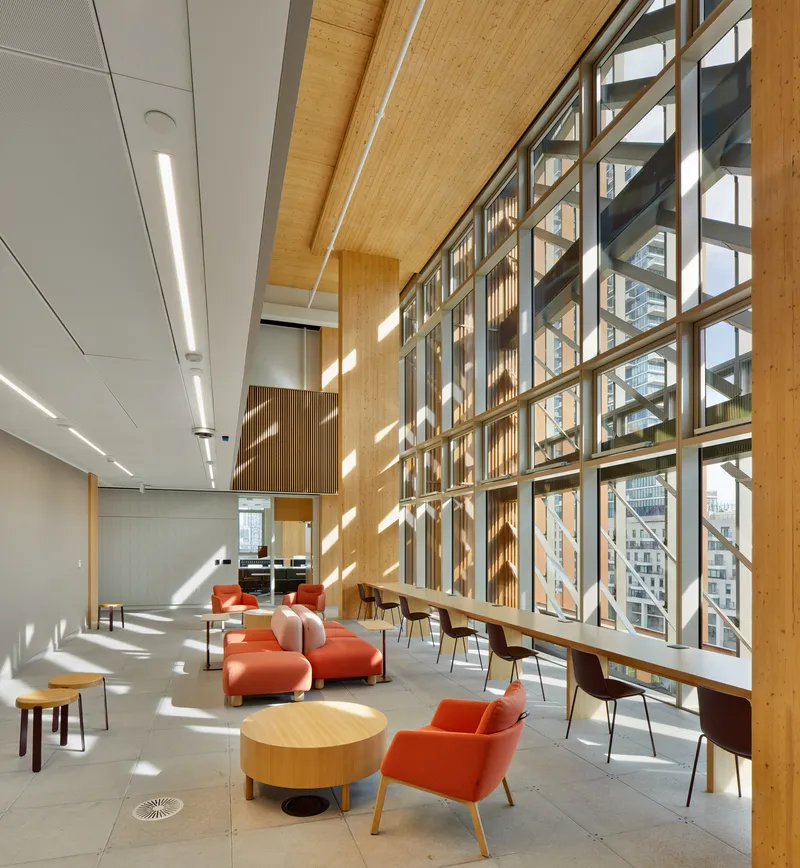
Study areas along the curtain wall use low orange seating modules and timber desks oriented toward the glass, giving students both natural light and outward views. The skip-stop section means that lounges on alternating floors enjoy double-height volumes, a generous spatial move that makes the building feel larger than its footprint suggests.
Rooftop and Green Infrastructure


The angled rooftop hosts a solar panel array oriented to maximize photovoltaic capture, its slope visible against the Toronto skyline. Below the panels, vegetated green roofs extend across lower volumes, visible through clerestory windows and glass partitions from interior workspaces. These planted surfaces are not ornamental: they manage stormwater, reduce heat island effects, and provide visual relief from the hard urban context of waterfront condominiums and asphalt.
The fact that meeting rooms and workspaces look out onto these green roofs, rather than onto mechanical equipment, shows a discipline in the plan that keeps the building's sustainability systems legible and present without reducing them to signage or marketing.
Plans and Drawings


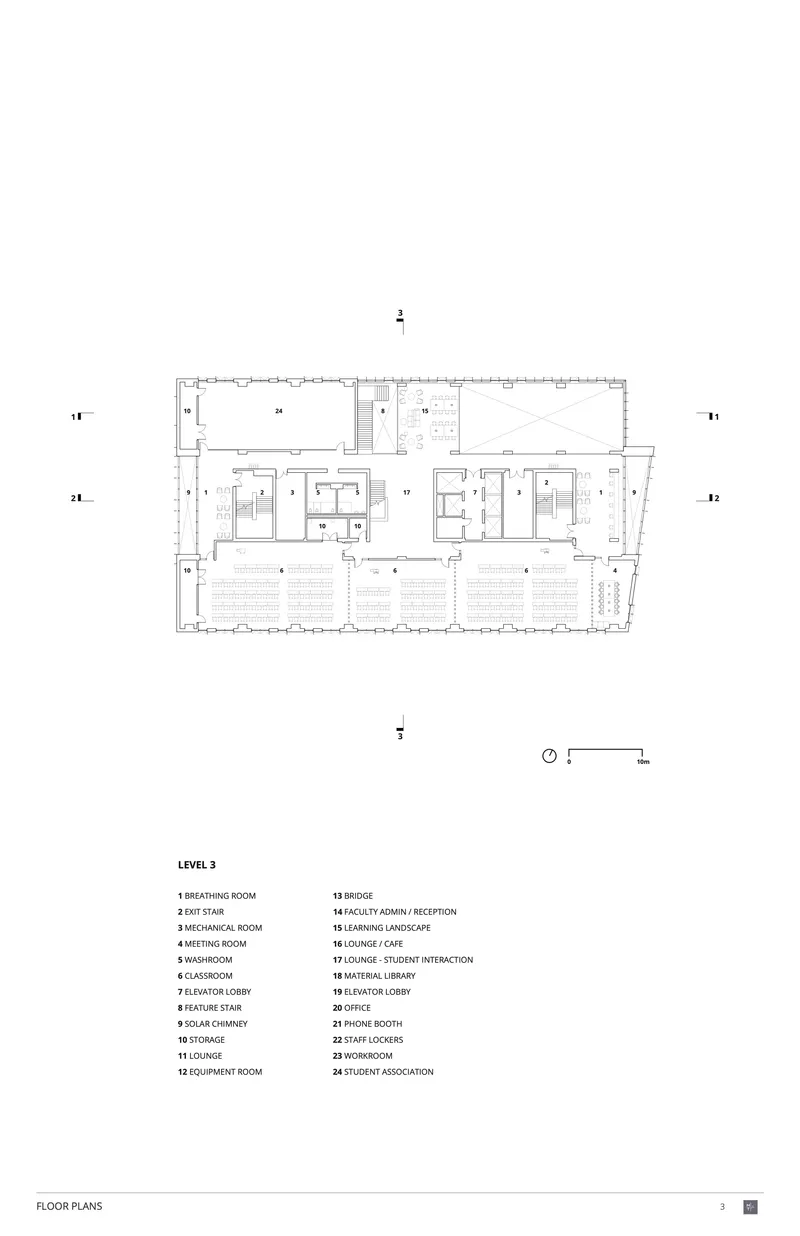

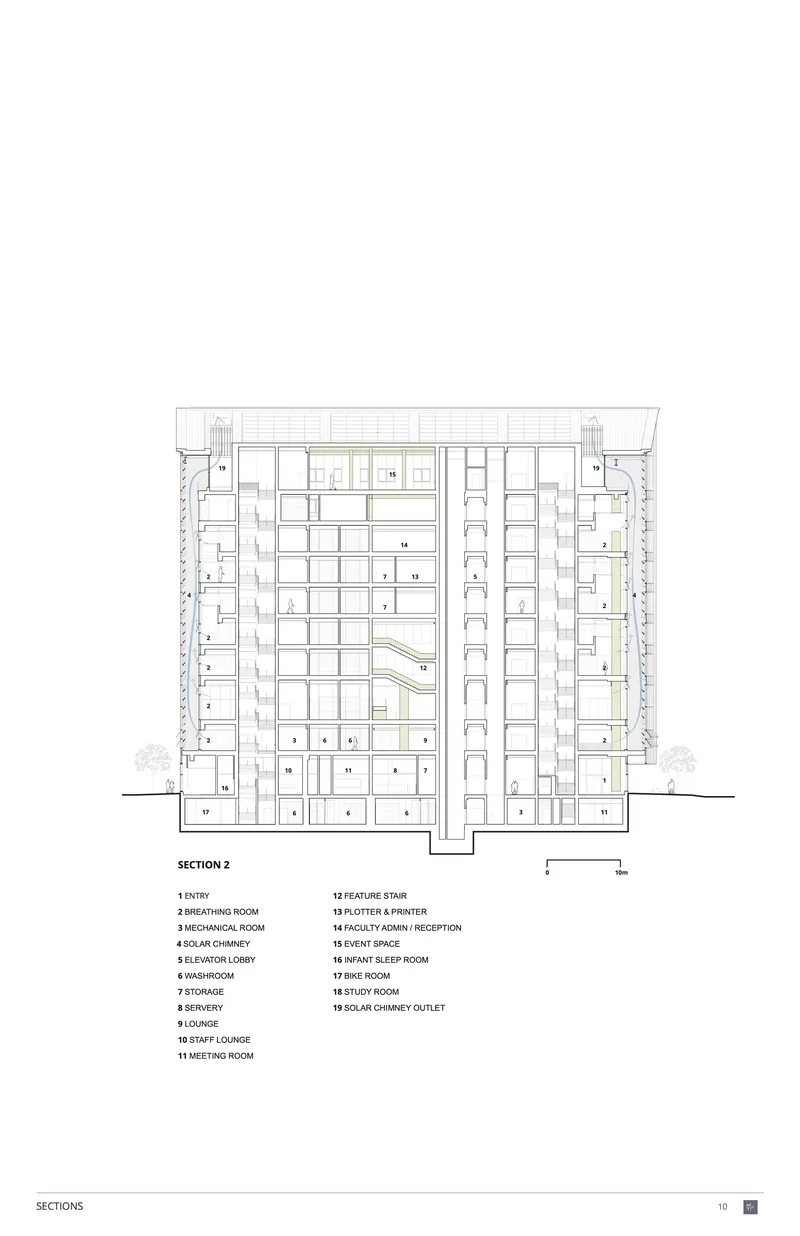




The ground floor plan reveals the Learning Landscape's relationship to the street: the stepped atrium rises directly from the entry lobby alongside Queens Quay East, pulling the public realm into the building's section. Upper floor plans show the skip-stop logic clearly, with Breathing Rooms and solar chimneys staggering across alternating levels. The section drawing is perhaps the most revealing document, illustrating how the twin chimneys create continuous vertical voids through the entire building height, driving the passive ventilation strategy that defines the project's environmental performance.
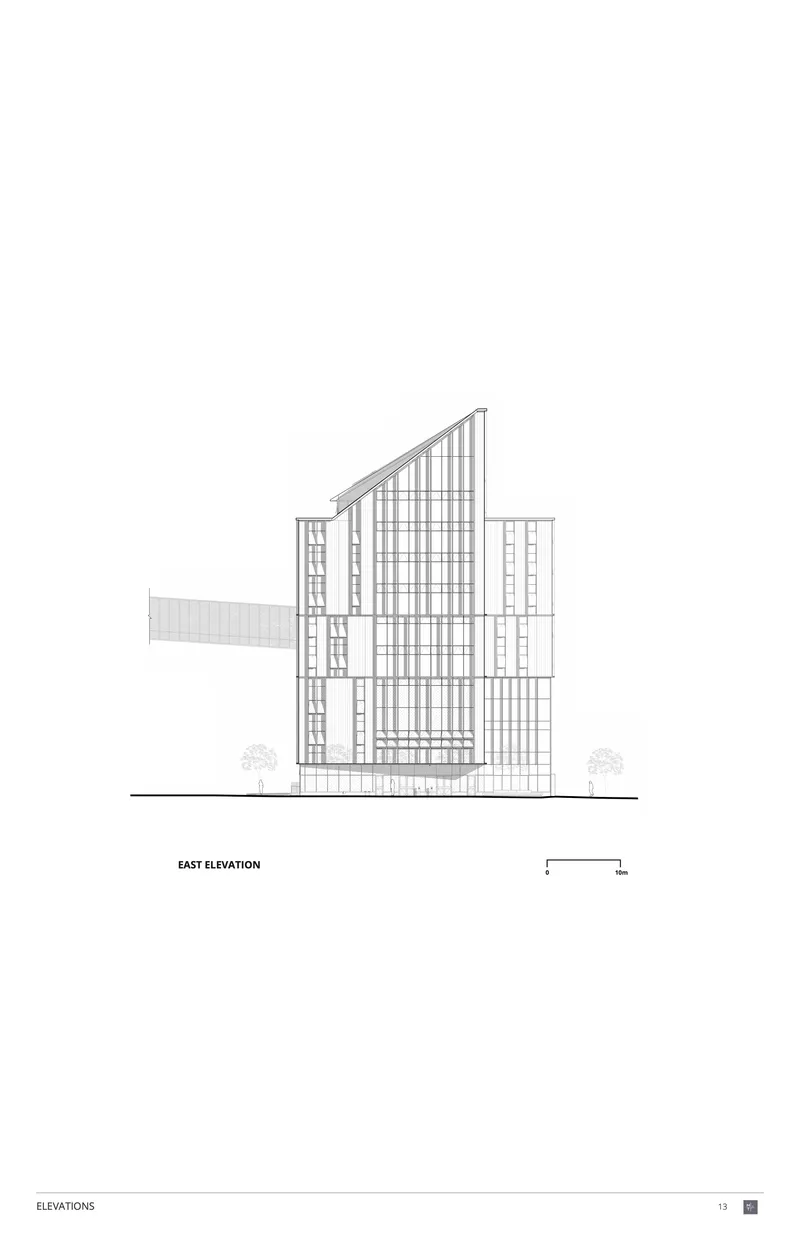
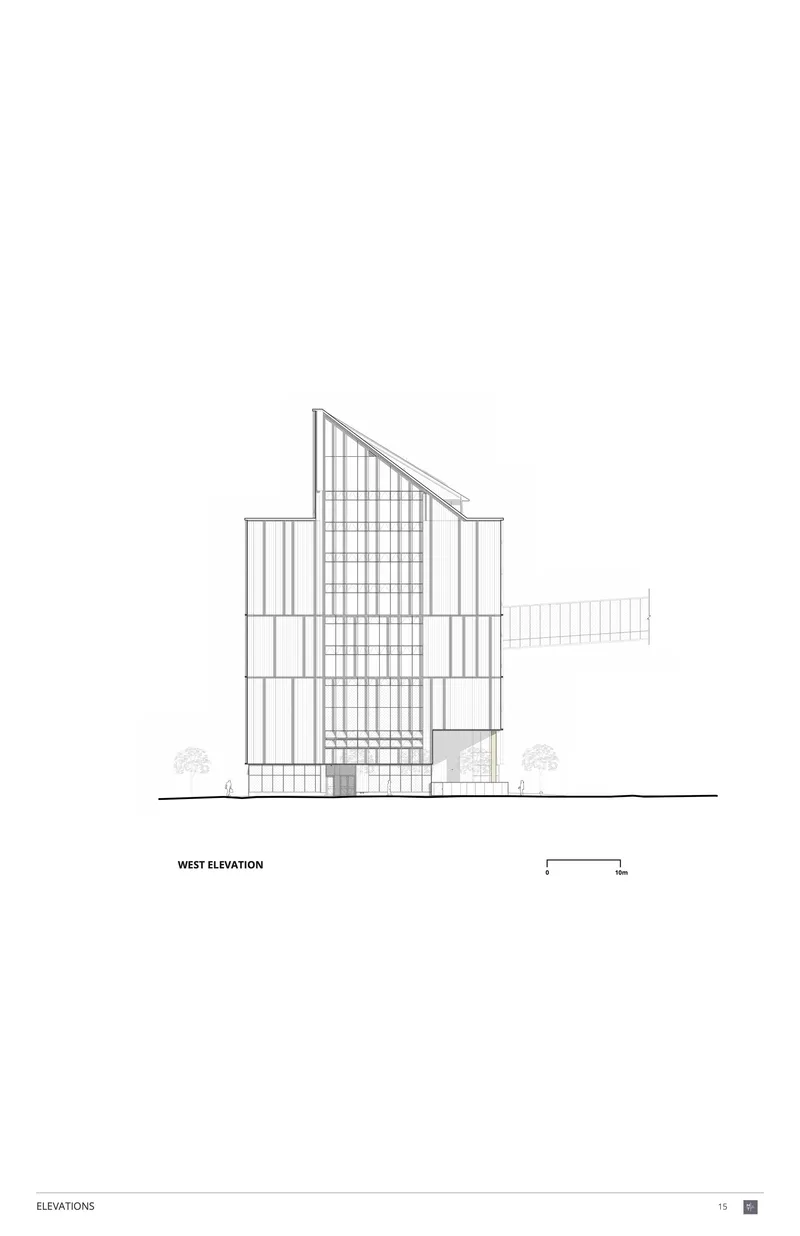
The exploded axonometric makes the timber structural layers legible: CLT floor plates, glulam columns, and composite slab bands stack with a clarity that reinforces the building's didactic mission. Elevations show the fenestration pattern varying across cardinal directions, with the peaked roofline most pronounced on the east and west facades. The open-sourced nature of these construction innovations means that these drawings are not just representations of one building but templates for an emerging construction typology.
Why This Project Matters
Limberlost Place matters because it treats mass timber not as an aesthetic preference but as a systemic proposition. The structural innovation (composite CLT-concrete slabs pre-topped offsite), the passive climate strategy (solar chimneys, operable windows, deep lake cooling), and the pedagogical mission (exposed structure, open-sourced construction knowledge) are not separate features but interdependent parts of a single argument. The building contends that tall timber construction can deliver net-zero performance, civic generosity, and structural ambition simultaneously, and it does so within the regulatory and economic constraints of a public college campus.
The decision to open-source the team's innovations is perhaps the most consequential move of all. Many landmark buildings remain singular achievements, their lessons locked inside proprietary systems or one-off engineering. By releasing their composite slab system and construction sequencing methods for broader use, Moriyama Teshima Architects and George Brown College are betting that the real impact of Limberlost Place will be measured not in awards but in the buildings that follow it. On a derelict brownfield site near the ghost of Google's abandoned Quayside project, that bet on collective knowledge over proprietary spectacle feels like exactly the right call.
Limberlost Place by Moriyama Teshima Architects, led by Carol Phillips and Phil Silverstein. Toronto, Canada. Completed 2025. Photography by doublespace photography and Tom Arban.
About the Studio
Share Your Own Work on uni.xyz
If projects like this are the kind of work you want to make, uni.xyz is a place to publish your own, find collaborators, and enter design competitions.


Popular Articles
Popular articles from the community


Manzana Morphosis: Stretching Barcelona's Grid into a Living Landscape for 2050
A radical reworking of the Eixample manzana turns density into a tool for generous public space, vertical ecology, and environmental performance.

Faces of the Soviet Avant-Garde: Turning Moscow's Street Names into an Open-Air Museum
A network of sculptural installations across a Moscow residential district transforms forgotten architect names into spatial encounters with cultural memor

Cloaked Colonization: A Mobile Underwater Habitat That Moves Like a Fish
Micah Abaya's shortlisted EHC Pacific entry reimagines ocean settlement as a dispersed network of self-sustaining architectural organisms.

Temporary Home for Dogs: A Reversed Zoo Rethinks Animal Shelter Architecture
In Bucharest, a sinuous corridor and freed landscape flip the logic of containment, designing a shelter that works to make itself unnecessary.

Similar Reads
You might also enjoy these articles

Bao Huynh Watercolor Atelier: A Serene Art Retreat in Hội An
Bao Huynh Watercolor Atelier in Hội An blends multifunctional art spaces, sustainable design, local materials, and family-friendly living in a serene environment.

Atelier Macri Concept Store Interior Design by CASE-REAL
Atelier Macri store features a "ko" counter, walnut wood details, cork displays, blending retail, gallery, and seamless customer experiences.

Manuel Vargas Izquierdo Stadium and High-Performance Sports Center: Architectural Excellence in Jalpa de Méndez
The Manuel Vargas Izquierdo Stadium blends sustainable design, inclusive sports facilities, and cultural-inspired architecture, revitalizing Jalpa de Méndez’s public spaces.

KAKR Buluh Awar Hall: Revitalizing Community and Ecology Through Bamboo Architecture
Community built bamboo hall revitalizes Buluh Awar village, empowering youth, restoring ecology, celebrating vernacular craftsmanship through sustainable architecture and culture.

Explore Heavy Timber Competitions
Discover active competitions in this discipline

Challenge to design public laboratory

Design challenge to reuse E-waste
Comments (0)
Please login or sign up to add comments
No comments yet. Be the first to comment!