

MORPHLUID: A Solar-Responsive Envelope That Shades and Breathes Through Liquid-Filled Panels
Sandesh's MORPHLUID uses sun-heated liquid chambers to morph panels, turning an envelope module into both a shading device and a ventilation system.


Most building envelopes treat the sun as a threat to be blocked. MORPHLUID treats it as the trigger. The project proposes panels filled with liquid chambers that react to solar radiation, shifting their shape as temperatures climb. Heat produces movement, and that movement produces shade and airflow. The envelope does not wait for a thermostat or a motor; it responds to the same energy it is defending against.
Developed by Sandesh within an advanced architectural research framework and published as a project on uni.xyz, MORPHLUID starts from a pressing condition: rising global temperatures and cities that lean ever harder on mechanical cooling. Rather than proposing a more efficient machine, the research asks whether solar energy, water and material pigmentation can be combined into a self-regulating architectural component. In doing so, it moves the envelope away from static protection and toward adaptive behaviour.
Borrowing the Logic of Leaves and Skin
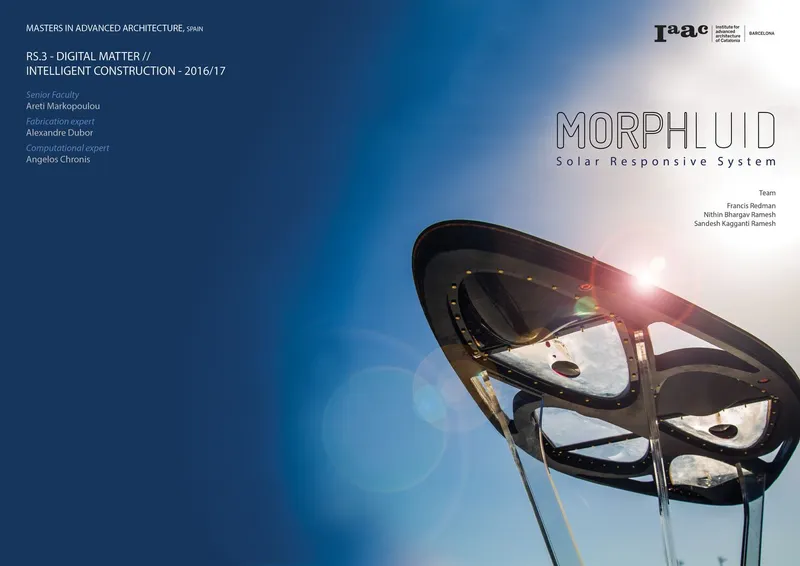
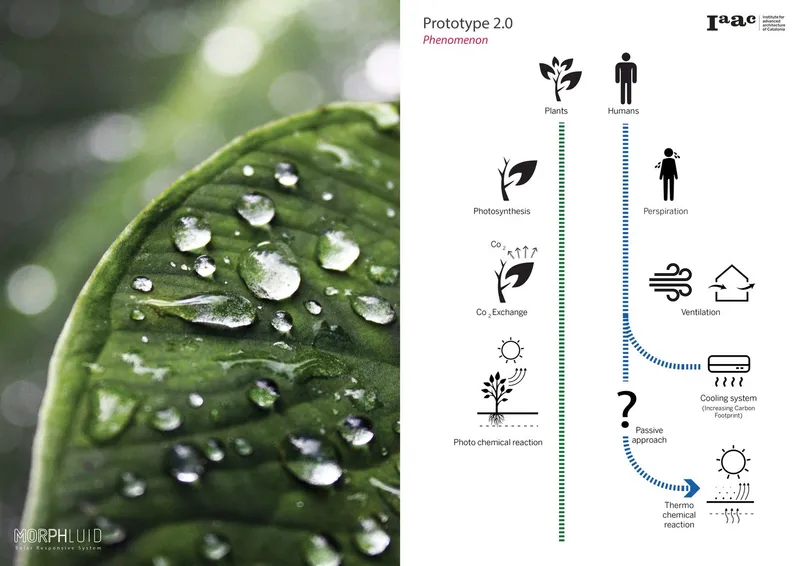
The cover image sets the tone: the underside of a dark canopy prototype, its glazed openings caught against a deep blue sky and a flare of sun. It reads as a shelter built to face the sun directly. The diagram page that follows explains the reasoning. A close-up of water droplets on a green leaf sits beside icons comparing plant and human cooling, setting photosynthesis, transpiration and perspiration side by side as systems that regulate temperature through controlled fluid movement and phase change, with no external energy input.
This is where the project earns its biomimetic claim. It does not copy the look of a leaf. It borrows the operating principle: fluid moves in response to heat, and that movement manages comfort. Translating a physiological process into a building component is harder than borrowing a form, and the project commits to that harder path.
A Central Axis That Holds the Fluid in Balance
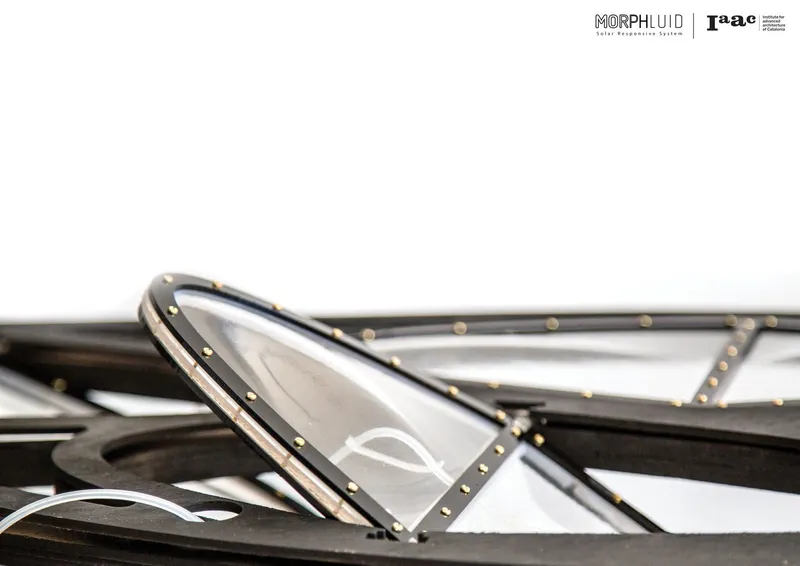
The close-up of a tilted translucent panel, held in a black frame studded with brass rivets with a clear tube running below, shows the system at the scale of a single unit. Inside these chambers, solar exposure drives thermochemical reactions. As temperature differentials build within the liquid, they trigger controlled movement and the panel morphs. Two responses follow from one action: the deformation cuts direct solar gain as it rises, and it opens paths for air so that heat can dissipate naturally.
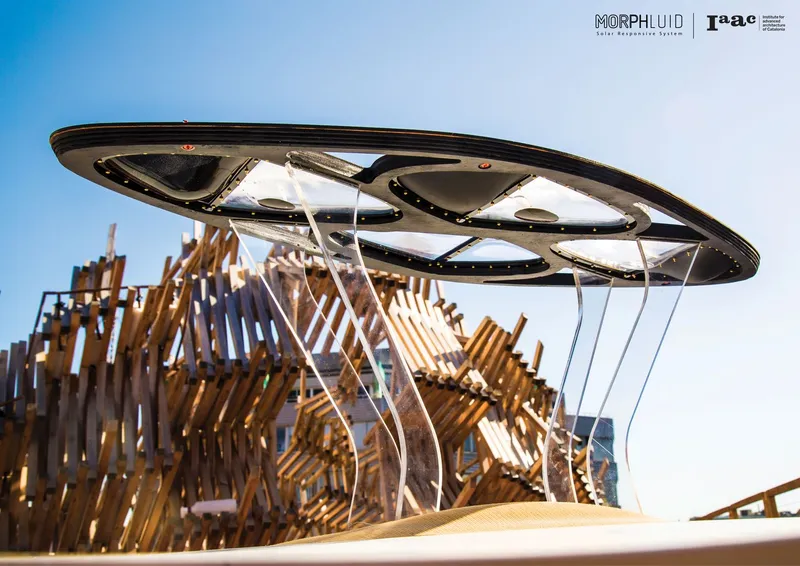
The low view of the round black canopy on curved acrylic supports, raised above a stacked timber lattice, shows what Prototype 2.0 is trying to achieve. The project went through several iterations to balance structural stability, fluid behaviour and environmental performance. The panel geometry keeps the fluid stable along a central axis so that pressure stays in equilibrium during activation. That detail matters: a responsive envelope that wobbles or leaks out of balance is a liability. The testing also showed that small changes in form can shift thermal performance considerably, which makes geometry a climate tool as much as a structural one.
Rivets, Tubes and the Craft of a Responsive Surface
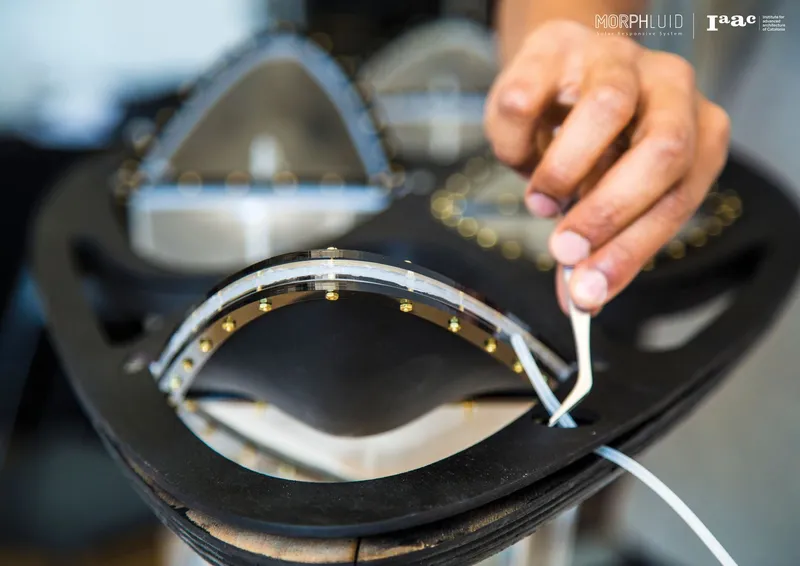
A hand works a small tool against a tube at the riveted edge of a black panel. This image does what many renders cannot: it shows the project being assembled at the bench. Responsive architecture often lives only in diagrams, and here the reader sees physical connections, sealed edges and the plumbing that carries the liquid. The prototype is built by hand, with every joint tested, and that hands-on quality gives the research credibility that a simulation alone would not.
Four Modes, One Module, Many Scales
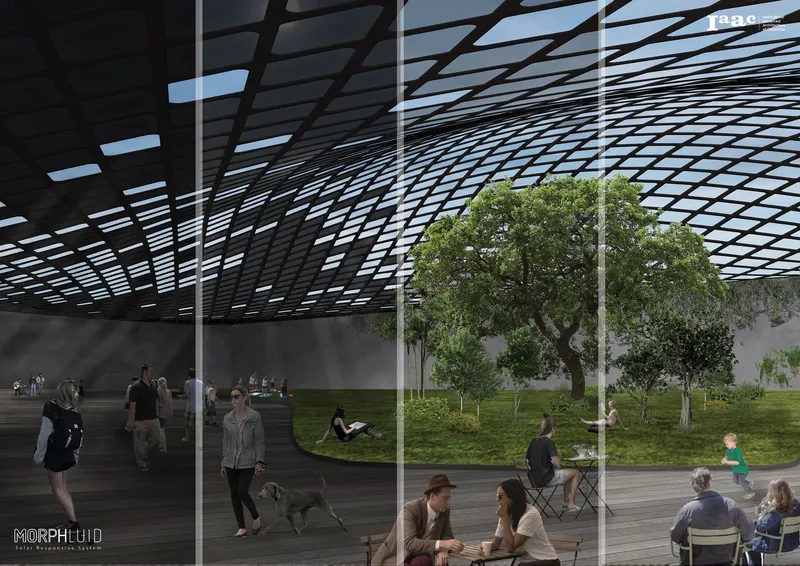
The final render puts the system to use: a gridded glazed canopy over a lawn with a tree, café tables beneath, and people walking a dog. It is an ordinary public scene, and that is the point. MORPHLUID is conceived as a modular system whose units respond to three inputs: sun, water and pigmentation. By adjusting these, a module can deliver shading with ventilation, shading without ventilation, ventilation without shading, or a neutral passive response.
That menu of behaviours allows the same component to be tuned for different climatic zones and to work as a façade system, a pavilion element or a freestanding shading device. The canopy shown here suggests the most immediate application: outdoor public rooms that stay comfortable without any powered cooling.
Why This Project Matters
MORPHLUID combines two passive strategies that are usually handled separately. Shading and ventilation are often assigned to different elements, such as louvres for one and operable windows for the other. Here, both come from a single deformation driven by the sun itself. That integration is the project's strongest idea, and it points toward envelopes that do more with fewer parts and no electrical input.
Just as valuable is the method. Sandesh moves from biological analogy to physical prototype, iterates toward pressure equilibrium, and then generalises the result into a modular kit with defined behaviours. The questions that remain, about durability, maintenance and long-term fluid performance, are the right ones to ask of any responsive system. As cooling demand grows, research that tests these ideas in physical prototypes is the kind the field needs.
View the Full Project
About the Designers
Designer: Sandesh
Enter a Design Competition on uni.xyz
uni.xyz runs architecture and design competitions year-round that reward proposals with spatial conviction and real site intelligence.
Project credits: MORPHLUID: A Solar Responsive System by Sandesh.


Popular Articles
Popular articles from the community


Manzana Morphosis: Stretching Barcelona's Grid into a Living Landscape for 2050
A radical reworking of the Eixample manzana turns density into a tool for generous public space, vertical ecology, and environmental performance.
Opera by the Sea Estonia: Three Shells Dissolving Architecture into Tallinn's Coastline
A winning opera house proposal replaces monumental form with interconnected shells that blur the boundary between building, park and Baltic Sea.
Temporary Home for Dogs: A Reversed Zoo Rethinks Animal Shelter Architecture
In Bucharest, a sinuous corridor and freed landscape flip the logic of containment, designing a shelter that works to make itself unnecessary.

The Amber Palace Opera: A Geological Fiction Surfaces on Tallinn's Baltic Waterfront
Pierre Brillard reimagines a Baltic legend as a public landscape, opera house, and waterfront promenade rooted in Tallinn's coastal identity.

Similar Reads
You might also enjoy these articles

Healing Façade: A Modular Chapel System That Restores Ethiopia's Sacred Forests
Winner of the Eco-Chapel competition, this circular timber façade collects water from air to rebuild soil and reforest degraded Ethiopian landscapes.
Kaffeebühnen: Where Coffee Shop Architecture Becomes a Civic Stage in Vienna
A linear sequence of timber boxes, transparent shells, and open yards turns the Viennese café tradition into a public performance space.
Eco Chapel: A Modular Forest Pavilion That Grows Like the Landscape It Protects
Hexagonal timber modules weave through existing trees, turning a chapel into a living system for prayer, education, and reforestation.


Urban Forest: A Vertical Ecosystem for 5,000 Workers in Singapore's Changi Business Park
Radially stacked pods and layered green decks turn a 7-acre plot into 47 acres of ecological workspace projected for 2040.

Explore Passive Architecture Competitions
Discover active competitions in this discipline

Design challenge to equip cities with modern furniture

Design challenge to reuse E-waste

Packaging challenge - Design meets sustainability
Comments (0)
Please login or sign up to add comments
No comments yet. Be the first to comment!