

Dominic Spalt Architektur Threads a Red Steel Skeleton Through a 1960s House in Liechtenstein
A multi-generational renovation in Schaan replaces a gabled attic with an open living volume and wraps the facade in a planted scaffold.


In the center of Schaan, Liechtenstein, tucked between an old printing works and an office building, a 1960s single-family house has been quietly split into two stacked flats for three generations. Dominic Spalt Architektur didn't gut the building or bury it under a fashionable new shell. The interventions are surgical: the attic's gabled roof was removed and replaced by an open-plan living volume, a red steel exoskeleton was bolted onto the south facade, and the ground floor apartment was left almost entirely alone. The result is a house that reads differently from every angle, its industrial red framework standing in frank contrast to the white rendered walls beneath.
What makes the project worth studying is the economy of its means. Rather than expanding the footprint, Spalt found new space vertically, converting the attic into a double-height living room that connects visually to a forty-year-old garden tree on one side and the Drei Schwestern mountain range on the other. The red steel scaffold that wraps the terrace and balcony isn't decorative: it supports climbing plants that will eventually become a green filter for the rooms behind. The house is designed to change again, this time with the seasons.
A Red Scaffold Against White Walls
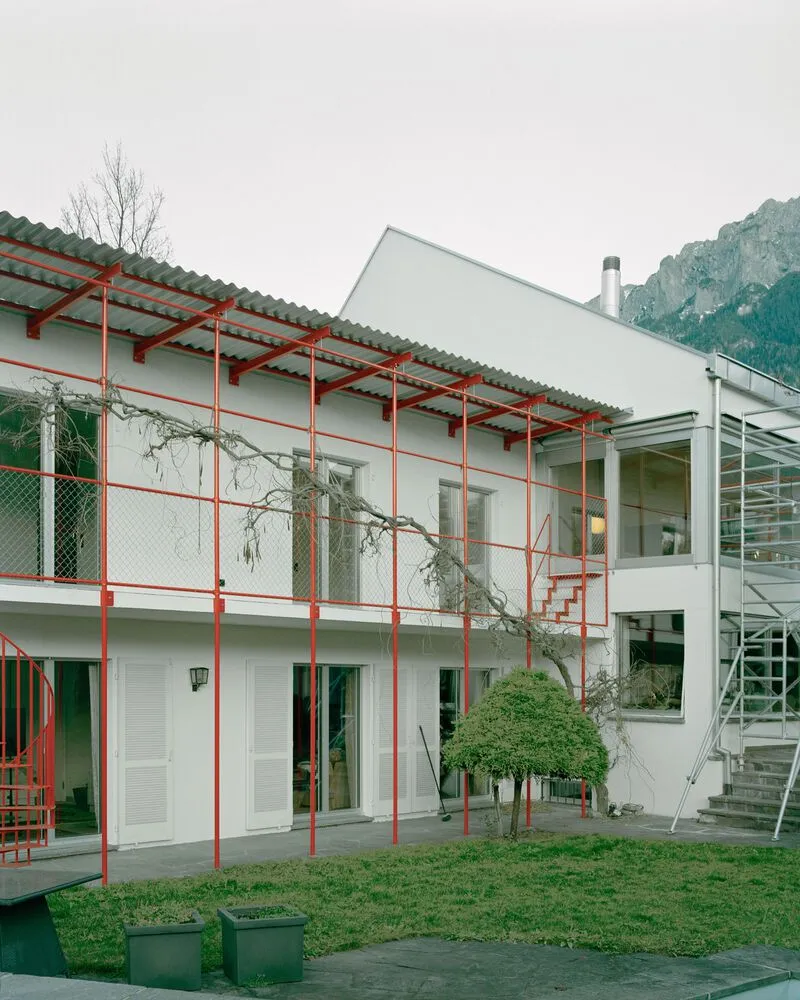
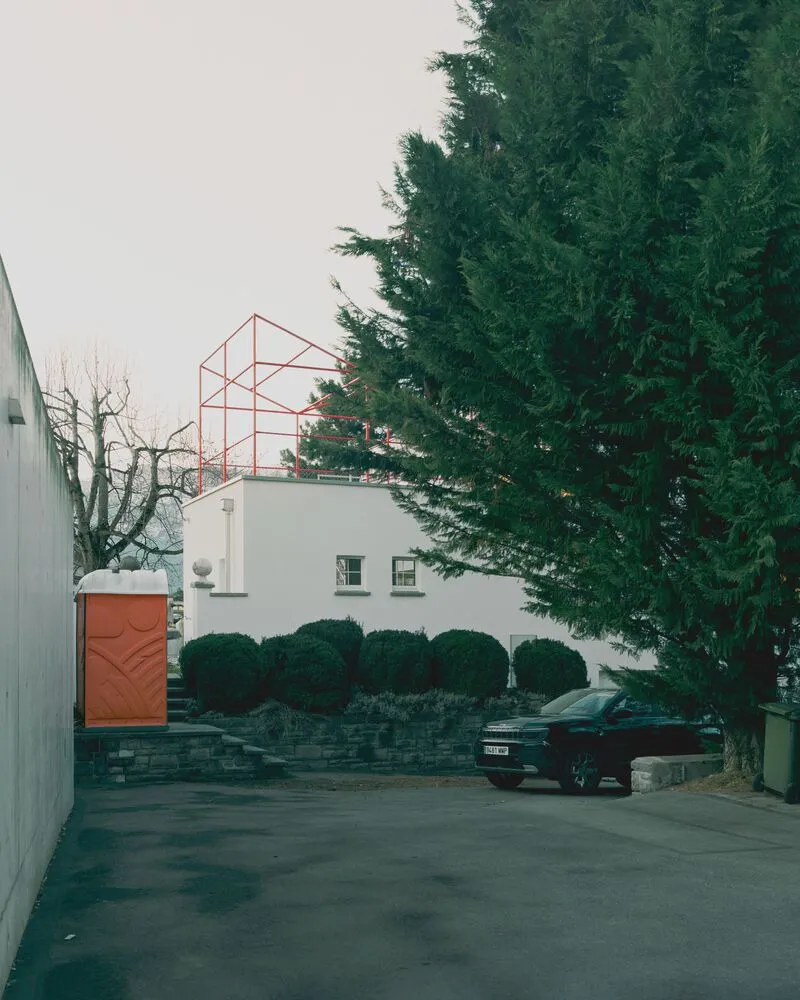
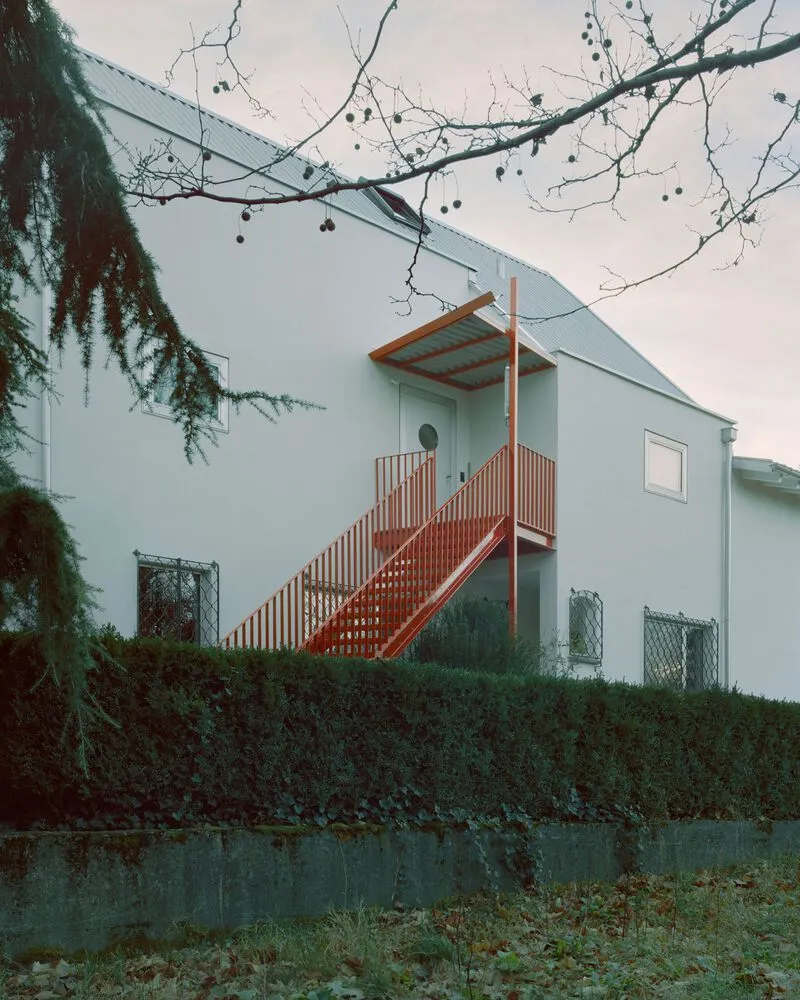
The most visible gesture is the red steel framework that wraps the upper levels and terrace. Seen from the street, the skeletal structure rises above the white rendered facade like construction scaffolding that decided to stay. It carries a corrugated iron canopy, a spiral staircase, and mesh railings, all finished in the same assertive red. The color choice isn't arbitrary: it declares the new work as new, making no attempt to blend with the existing house or its suburban neighbors.
The framework does double duty as infrastructure for planting. Bare branches already lace through the steel members, and as the vine coverage thickens over time, the structure will transform from an exposed skeleton into a living screen. It's a pragmatic approach to solar shading that avoids mechanical louvres or fixed screens, relying instead on seasonal growth to modulate light and privacy.
The Spiral Staircase and Exterior Circulation
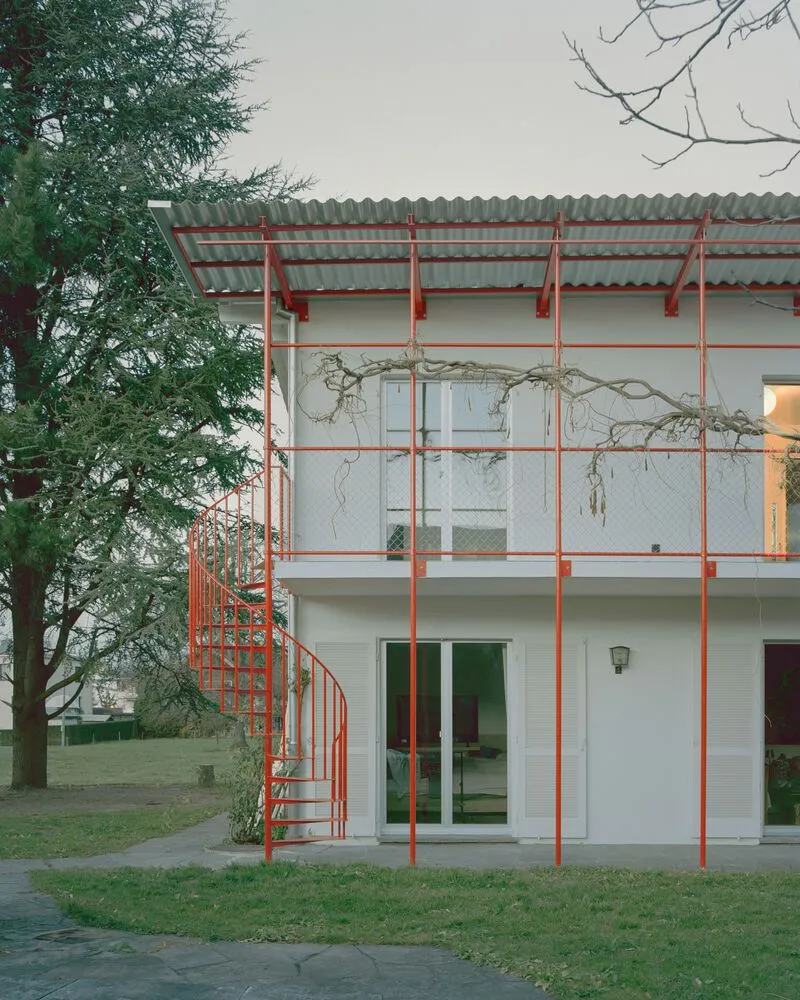
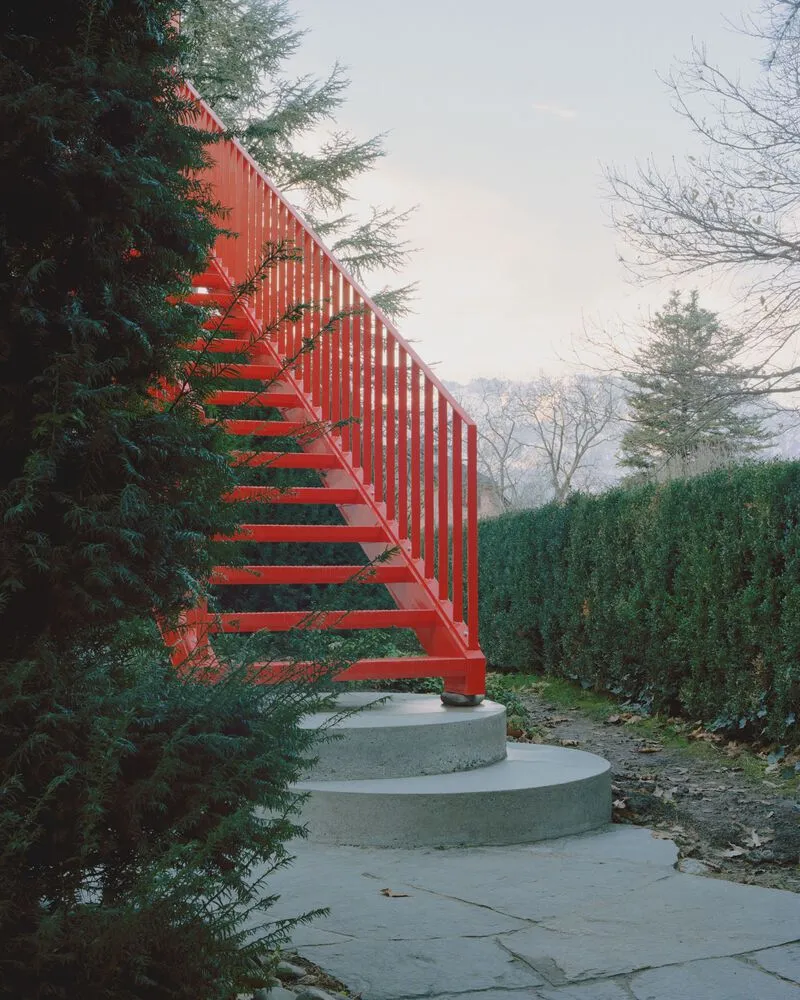
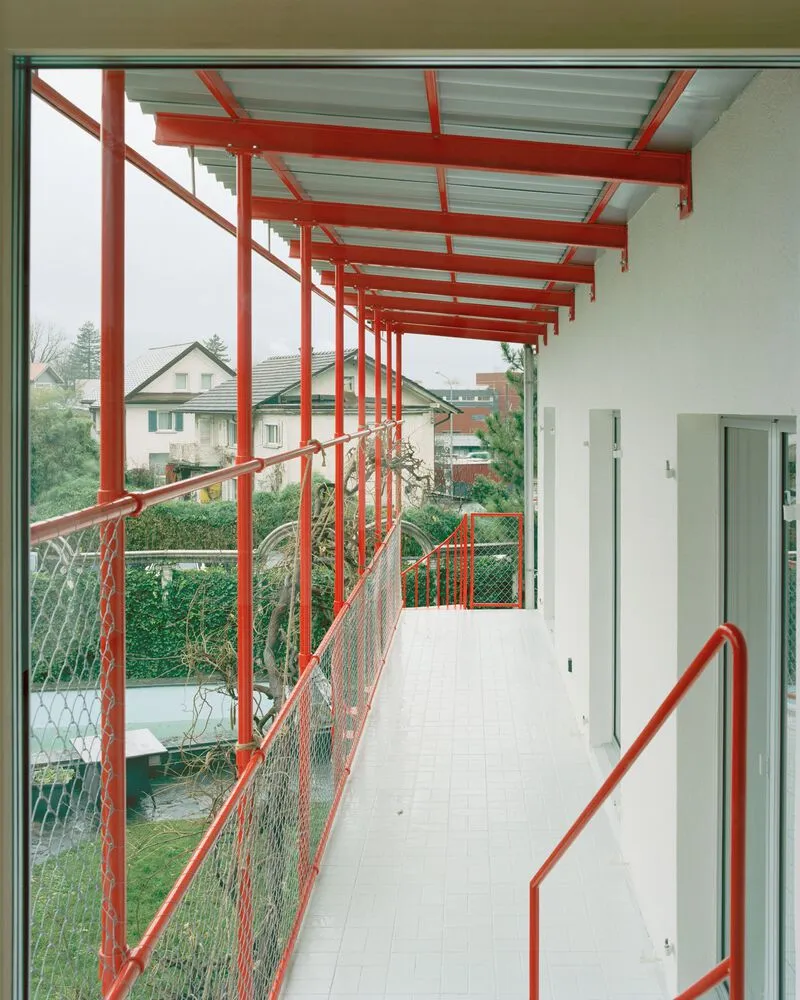
A red steel spiral staircase connects the two levels of the balcony structure, giving the upper apartment its own external access and preserving the independence of the ground floor flat below. The staircase emerges from a garden path lined with evergreen trees, and at dusk the illuminated interior volume above it turns the whole assembly into a kind of urban lantern. The mesh railing along the exterior walkway keeps the visual weight low, allowing views out over the neighboring rooftops and gardens.
Separating circulation in a multi-generational house is the kind of functional detail that determines whether the arrangement actually works. Each generation gets a front door, a threshold, a distinct sense of arrival. The spiral stair also resolves what could have been an awkward interior compromise, freeing the internal staircase to serve only the upper flat's bedrooms and mezzanine.
The Double-Height Living Volume

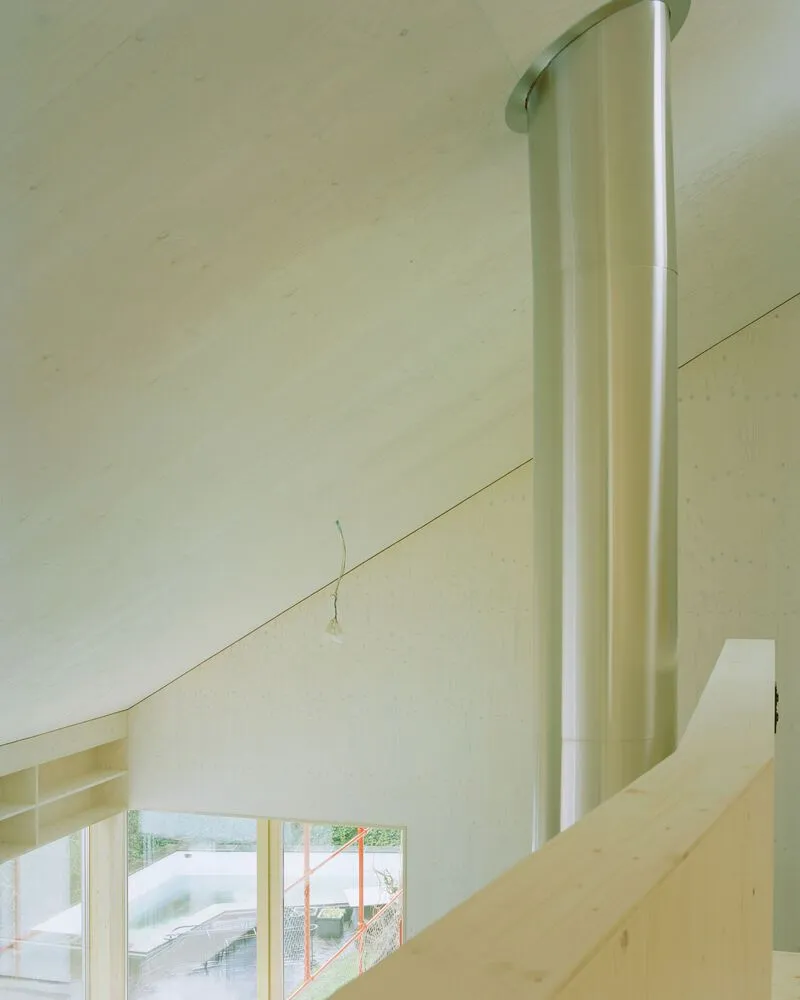
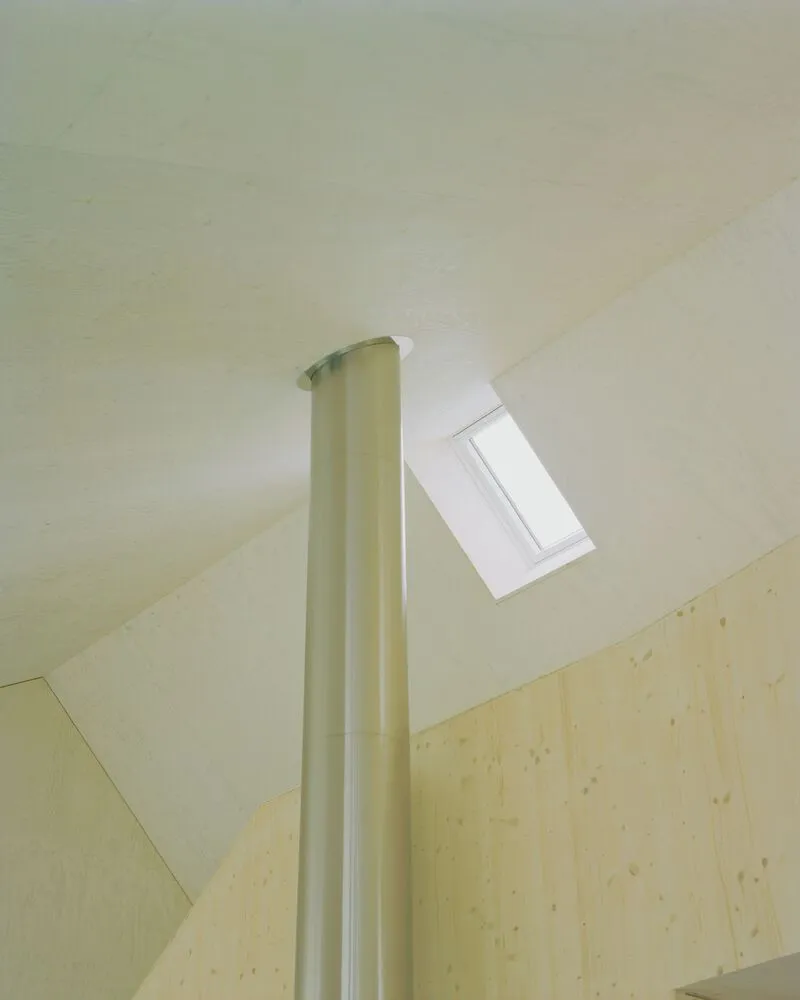
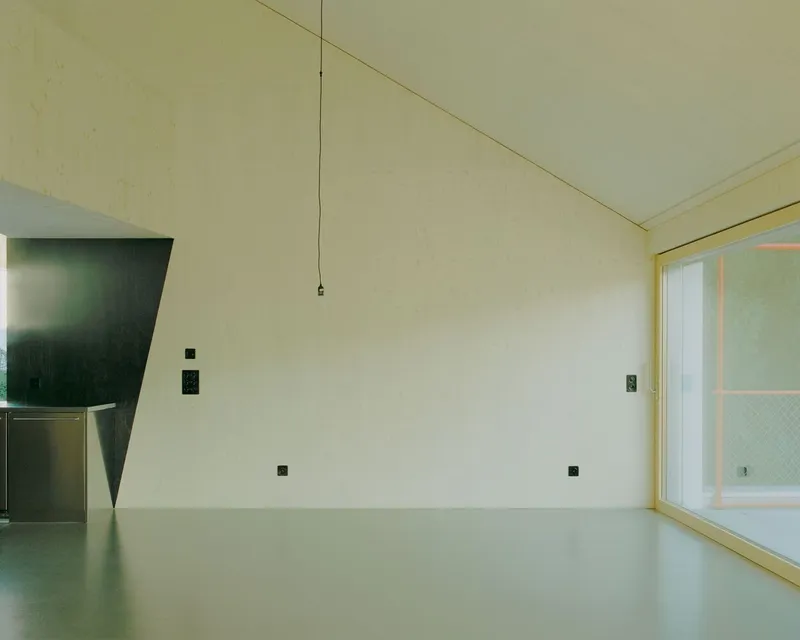
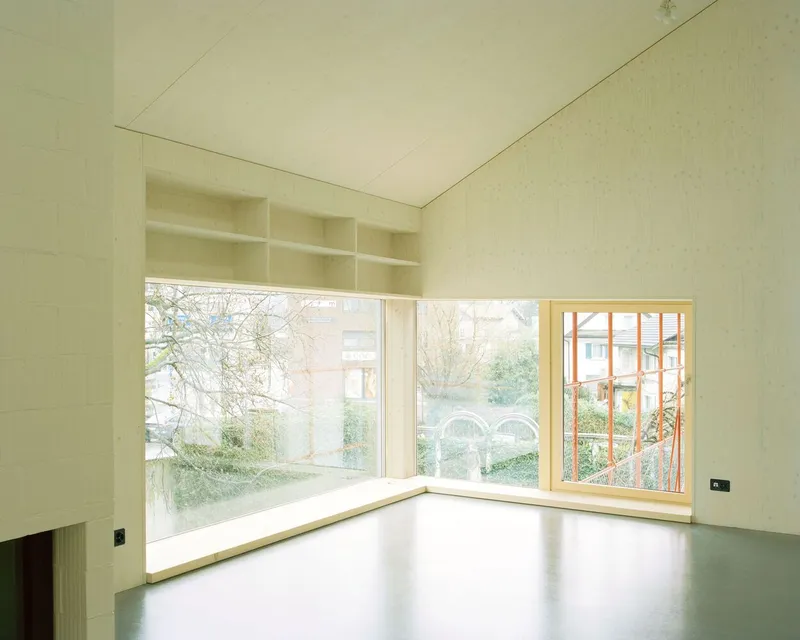
Removing the old gabled attic opened up a double-height volume that now contains the kitchen, living area, and a mezzanine. Industrially manufactured plywood panels line the walls and ceiling, their pale tone reflecting daylight deep into the space. A white cylindrical column passes through the room and up through the sloped ceiling, a structural remnant that Spalt left exposed rather than concealing it. Skylights cut into the roof plane wash the column with overhead light, turning necessity into a quiet focal point.
The mezzanine is treated as an independent object inserted into the volume rather than a conventional loft. A semi-circular cut-out where it meets the kitchen window allows light to pass between levels and prevents the lower space from feeling capped. The spatial trick is simple but effective: you read the full ceiling height from the living area while the mezzanine provides an intimate upper room.
Kitchen and Material Palette
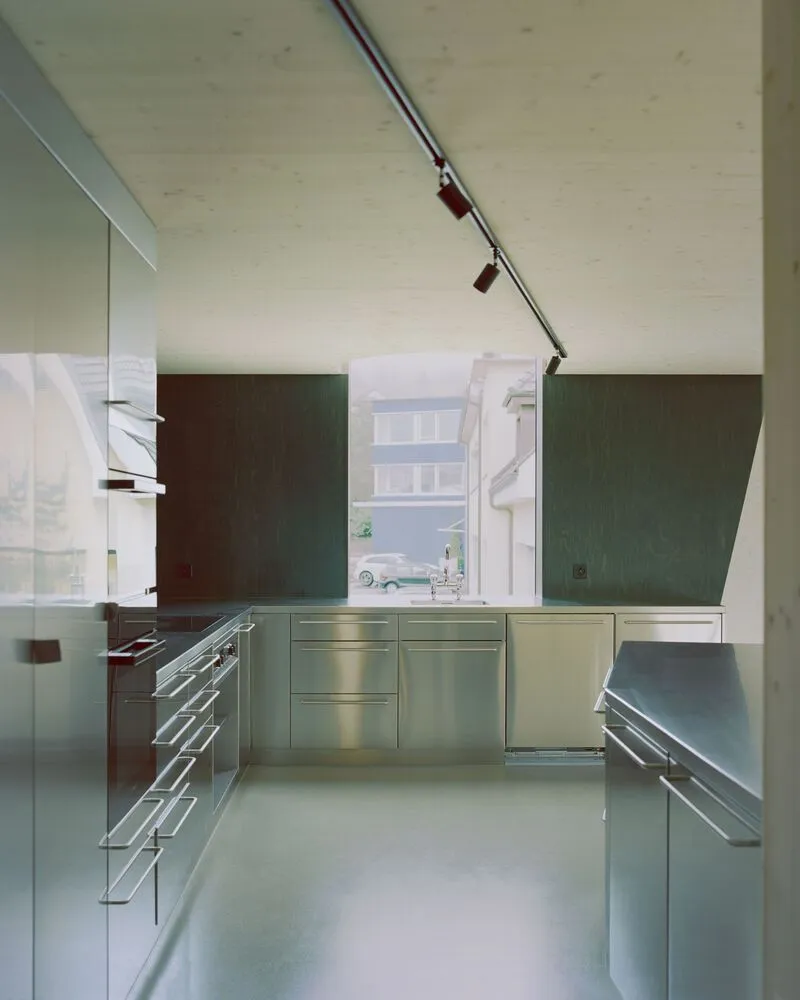
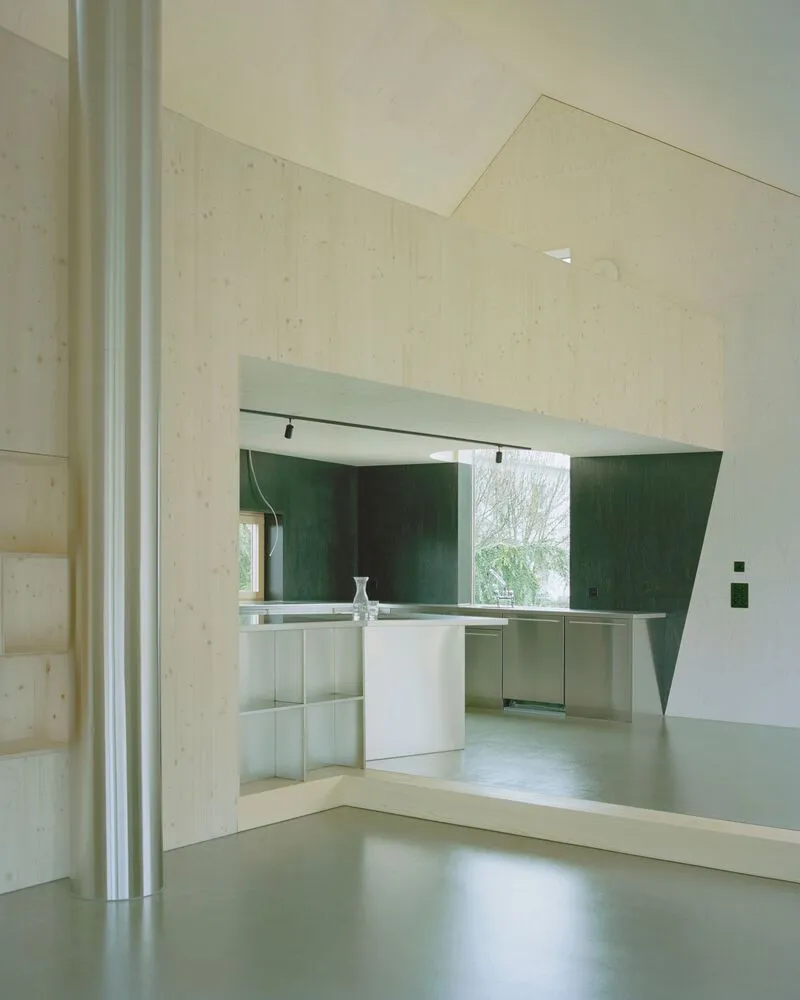
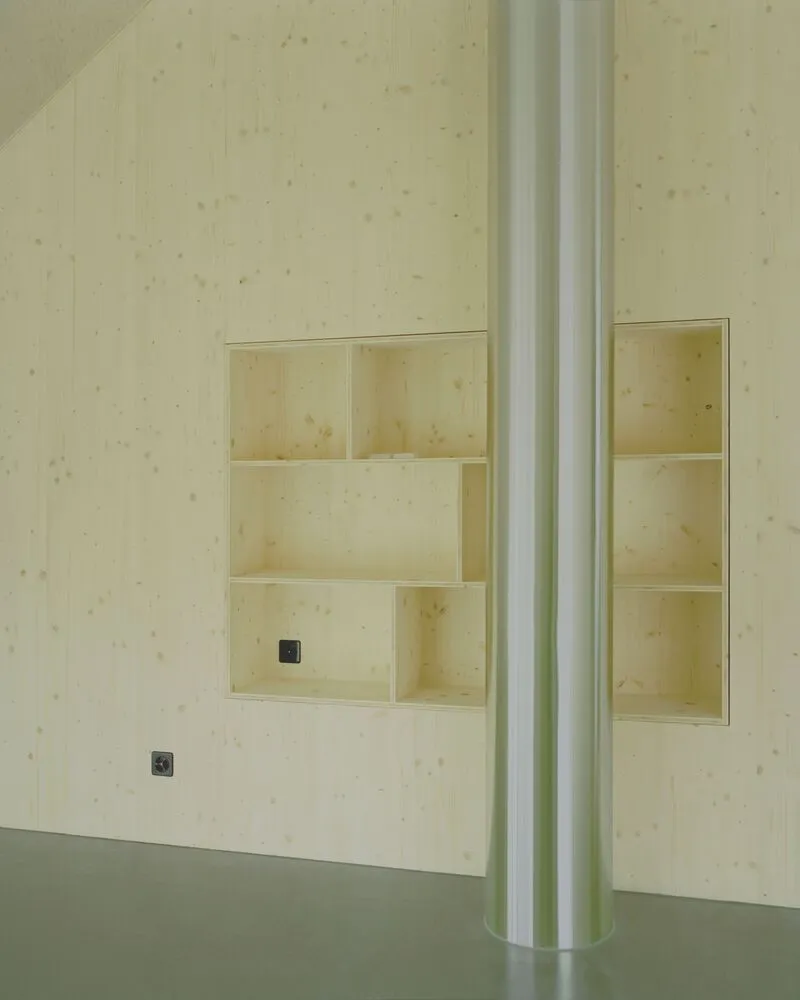
The kitchen anchors the open-plan volume with stainless steel cabinetry and an angled dark wood range hood that reads as a piece of furniture against the plywood ceiling. The material contrast is deliberate: warm ply above, cool metal below. A green tiled backsplash introduces color without competing with the exterior steel's red. Spalt uses glaze tints to differentiate zones, applying a darker tone on kitchen walls while keeping the living room surfaces pale and reflective.
Recessed plywood shelving niches and built-in window seats replace freestanding furniture wherever possible. The shelving in the hallway shows the same careful joinery, with precise reveals and shadow gaps that give the plywood panels a layered quality. Existing flooring was sanded and sealed with a gloss finish, a move that preserved the original material while lending it a contemporary sheen.
Thresholds, Light, and Interior Rhythm
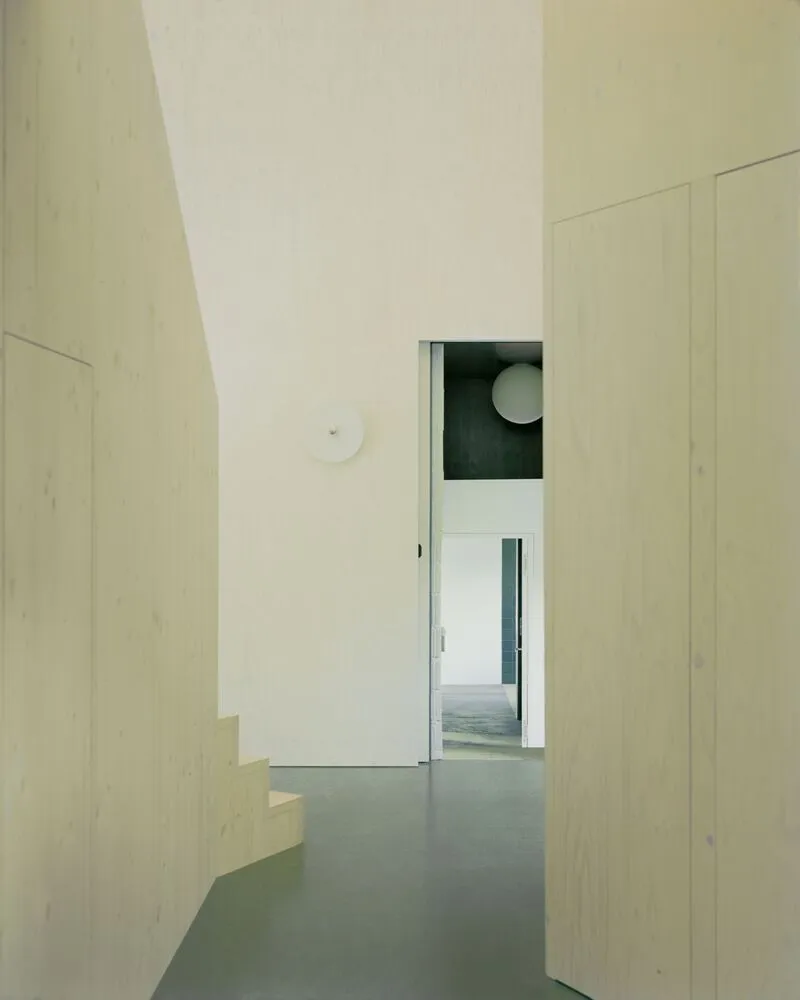
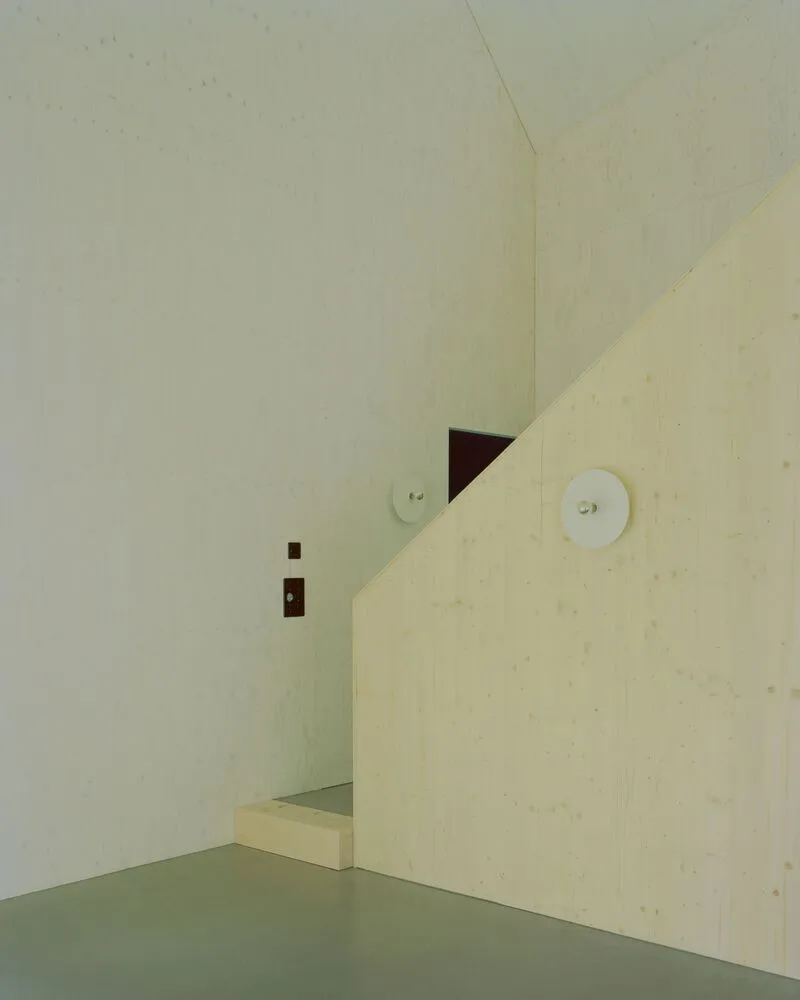
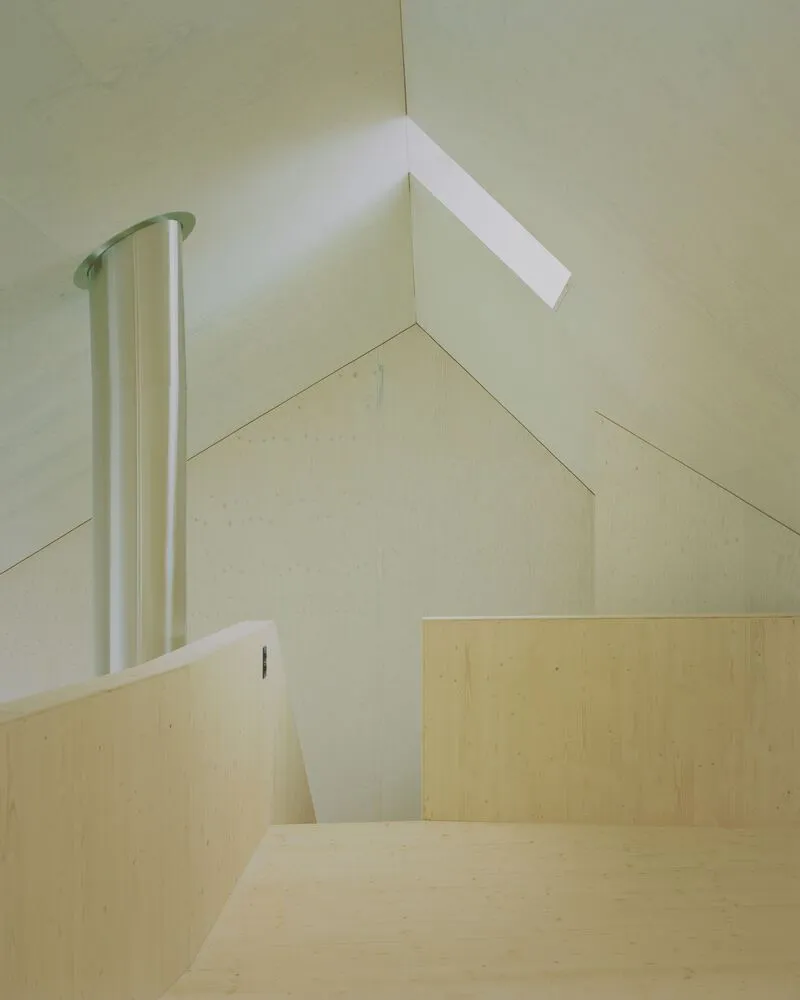
The interior circulates through a sequence of framed views. Doorways align to create enfilades through multiple rooms, while the pale plywood staircase rises toward a skylight that floods the landing with diffused light. A white fabric curtain at the landing softens the transition between public and private zones without the finality of a door. The effect is cinematic: every threshold offers a glimpse of the next space.
A plywood partition wall beneath the gable creates a dark threshold, a compressed passage that amplifies the sense of release when you step into the double-height living space beyond. A circular light fixture punctuates the wall like a porthole. These are small decisions, but they establish a rhythm of compression and expansion that makes the renovated upper flat feel significantly larger than its actual footprint.
Teal Bathrooms and Color Strategy
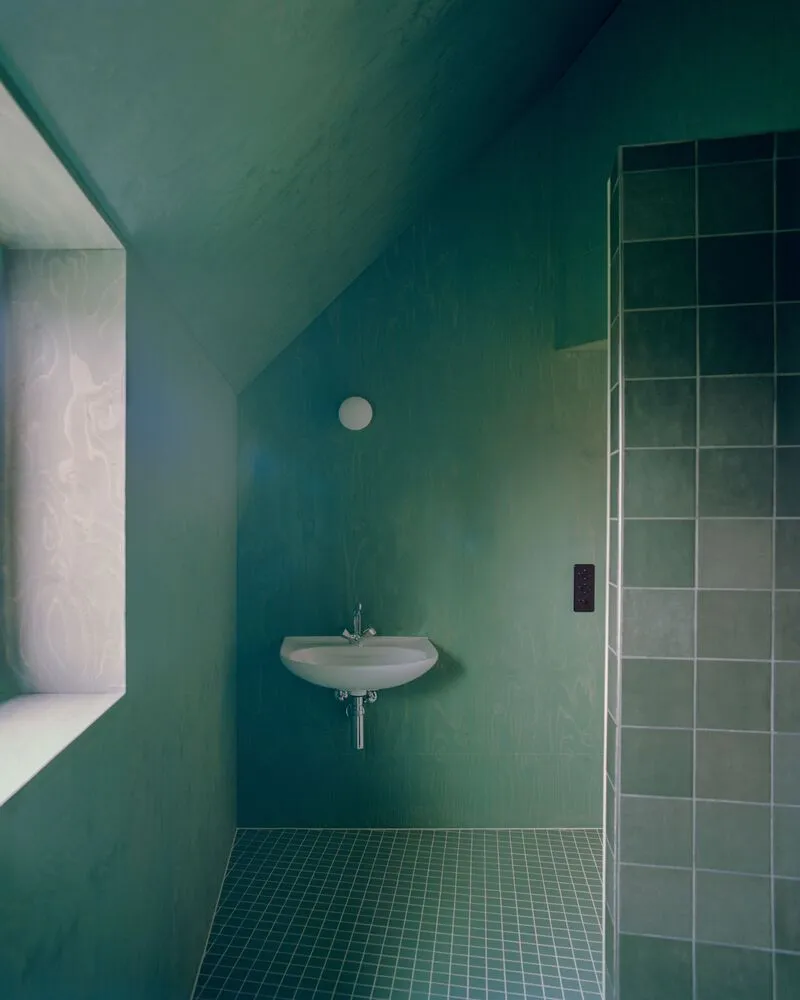
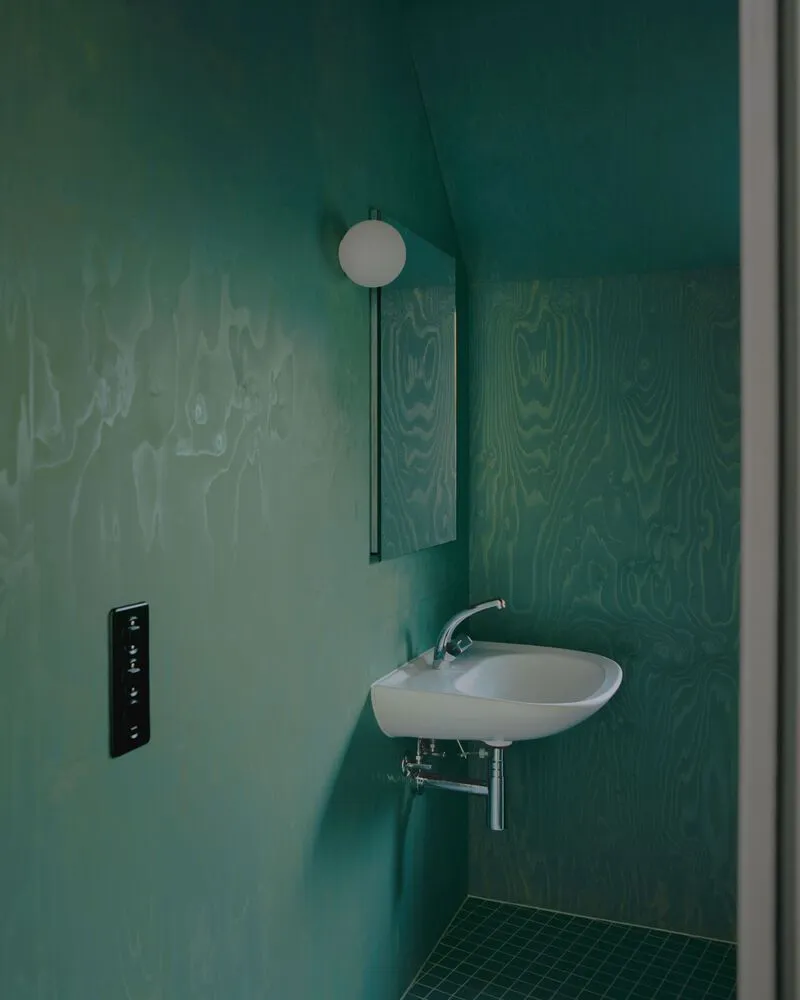
The bathrooms are the most chromatic rooms in the house. Green tiled surfaces wrap the walls and floor under sloped plywood ceilings, creating a jewel-box effect that contrasts sharply with the neutral living areas. A circular mirror and wall-mounted sink keep the fixtures minimal, allowing the tile color to dominate. The glazed shower enclosure tucks neatly under the eaves, using the pitched geometry as an asset rather than fighting it.
Spalt's color strategy operates on three registers: red steel outside, pale plywood in the living spaces, and teal glaze in the bathrooms. Each zone has its own material identity, which helps orient residents within what is ultimately a compact plan. The angled doorway from the plywood hallway into the tiled bathroom makes the transition feel intentional, almost theatrical.
Terrace, Garden, and the Forty-Year-Old Tree
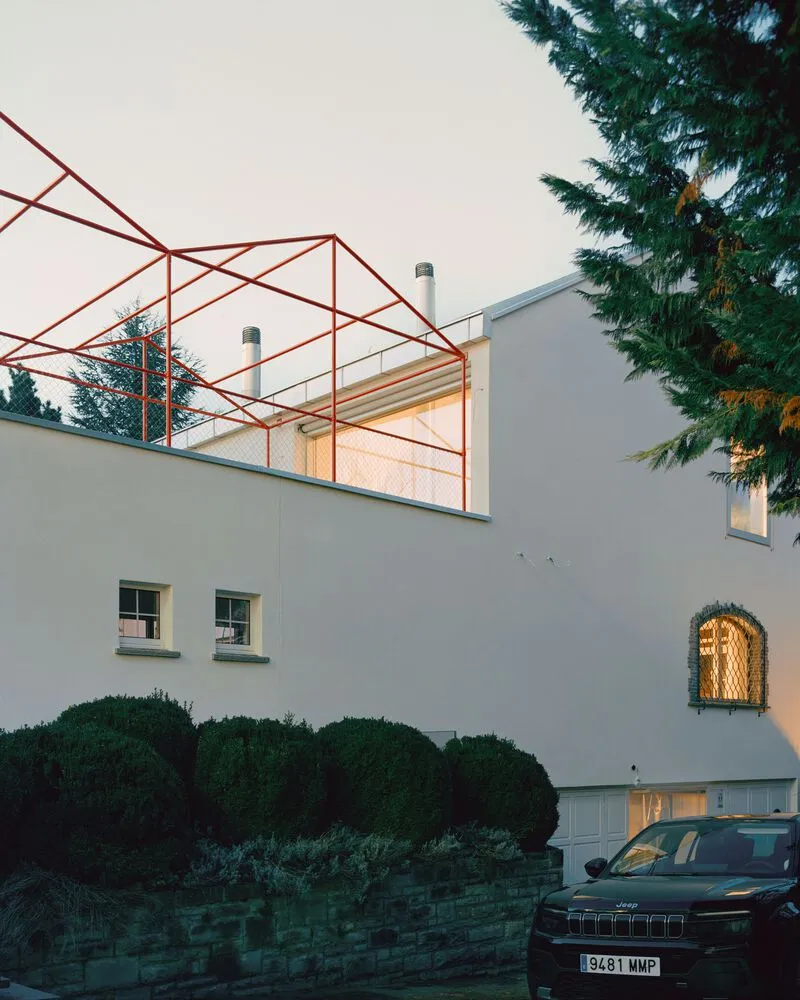
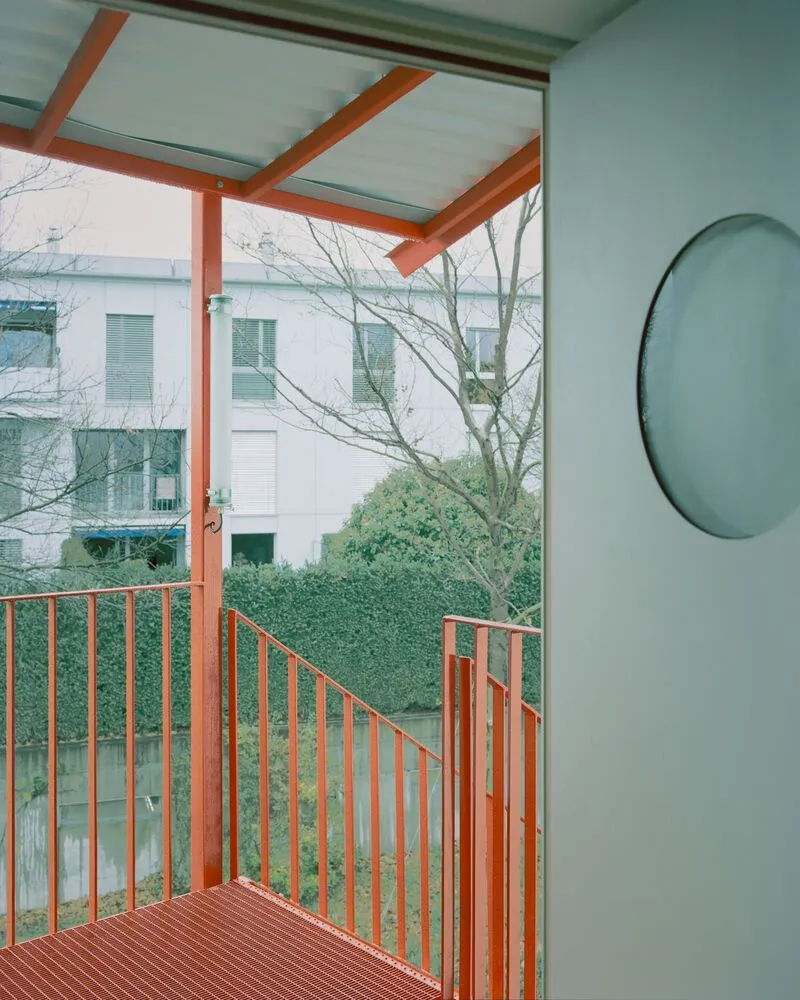
The rooftop terrace, created by flattening the pitched roof of an earlier single-storey extension, sits within the red steel pergola frame. At dusk, the open grid against the sky gives the terrace an almost stage-like quality. Below, the orange steel balcony with vertical slat railings offers a second outdoor room, this one closer to the tree canopy and the garden.
The forty-year-old tree was the design's fixed point. Rather than clearing the garden to gain terrace area, Spalt oriented the living space windows to frame the treetop and positioned the corner window seat to look directly into the neighboring gardens. The tree anchors the house in its site history. When the steel pergola's climbing plants mature, the boundary between built structure and garden will blur further, completing a slow transformation that the architect has designed for but cannot fully control.
Mezzanine Details and Upper Rooms
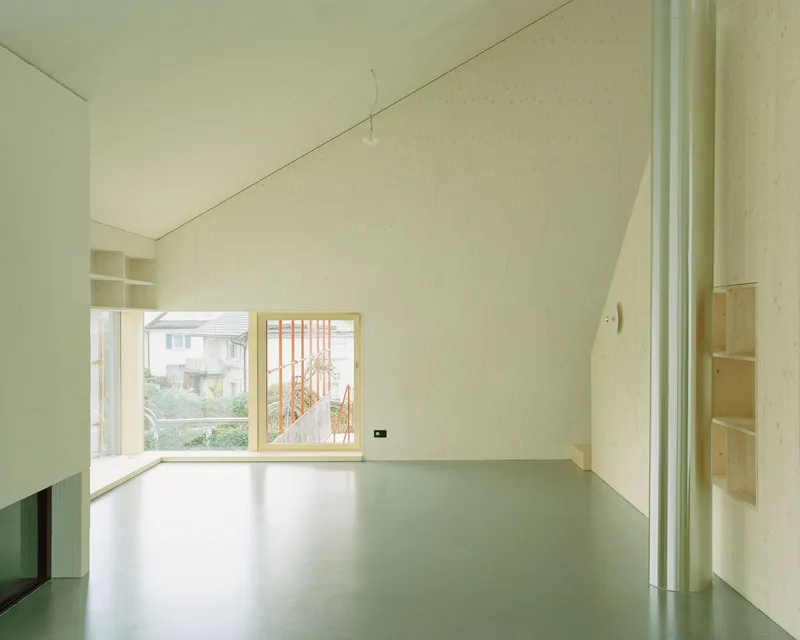
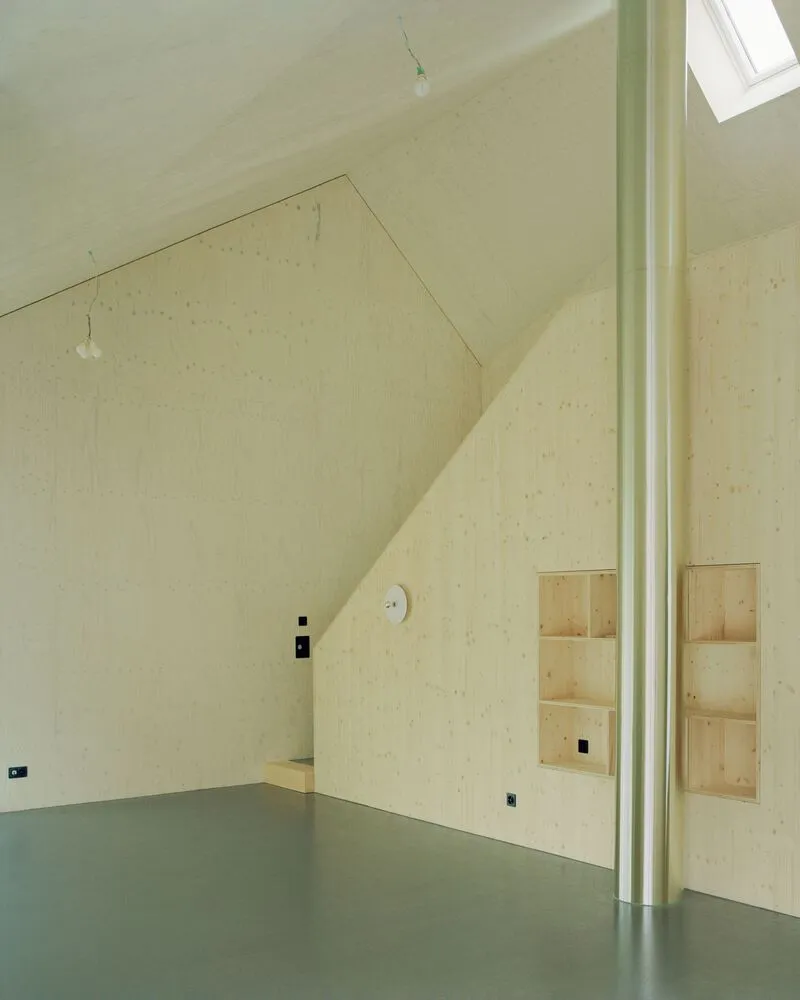
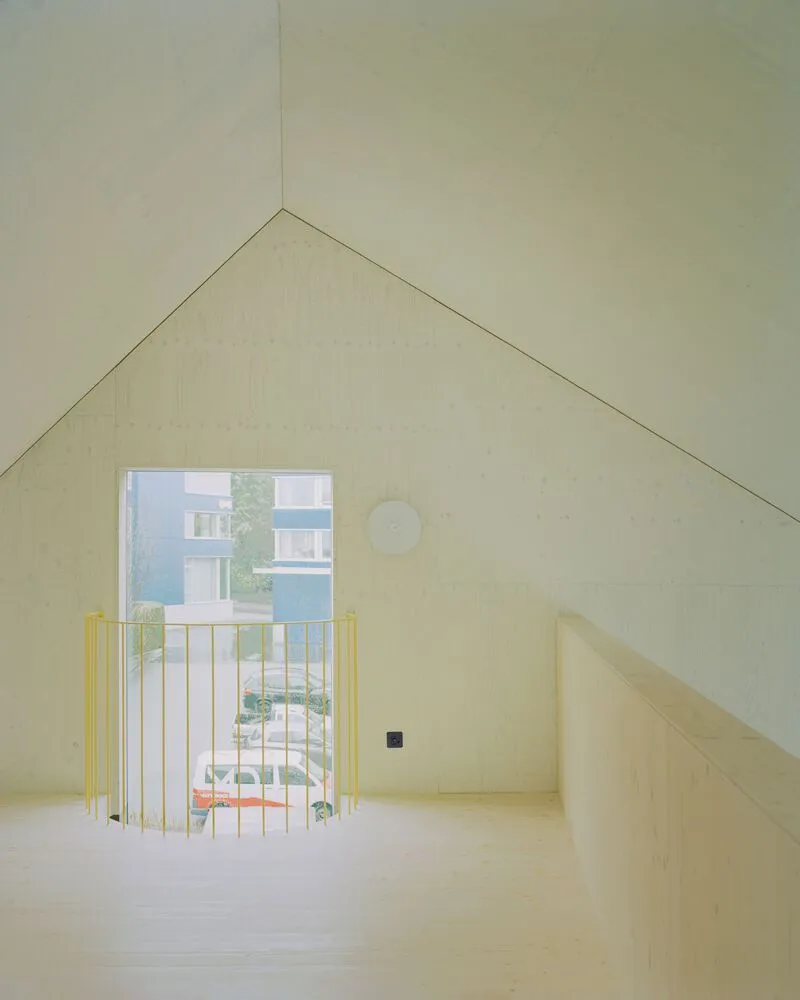
From the mezzanine, a sloped plywood ceiling compresses the space while a window overlooks the red exterior framework, collapsing interior and exterior into a single view. The pale green resin floor catches light from both the window and the skylight, giving the room a cool, even glow. Elsewhere on the upper floor, recessed niches in the plywood walls create display and storage without projecting into the room, preserving the clean lines that make the compact bedrooms feel generous.
The yellow metal railing at the glazed mezzanine door introduces a third accent color, quieter than the exterior red but consistent with the project's approach to using color as wayfinding. Each element that touches the boundary between inside and outside picks up a warm metallic tone, reinforcing the reading of the steel exoskeleton as a threshold zone rather than a simple facade.
Plans and Drawings
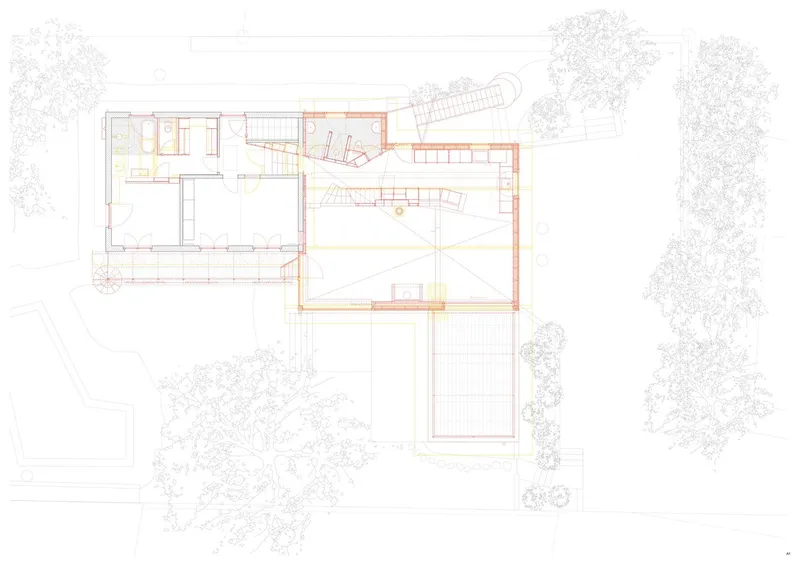
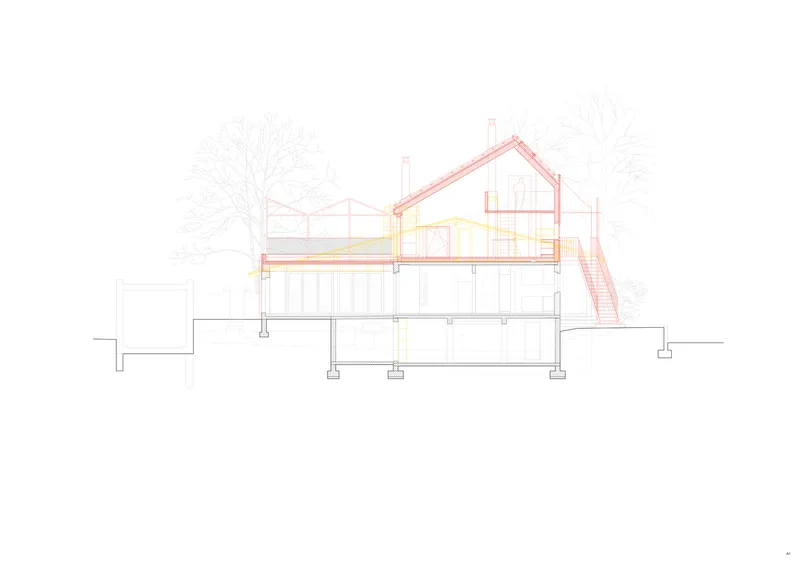
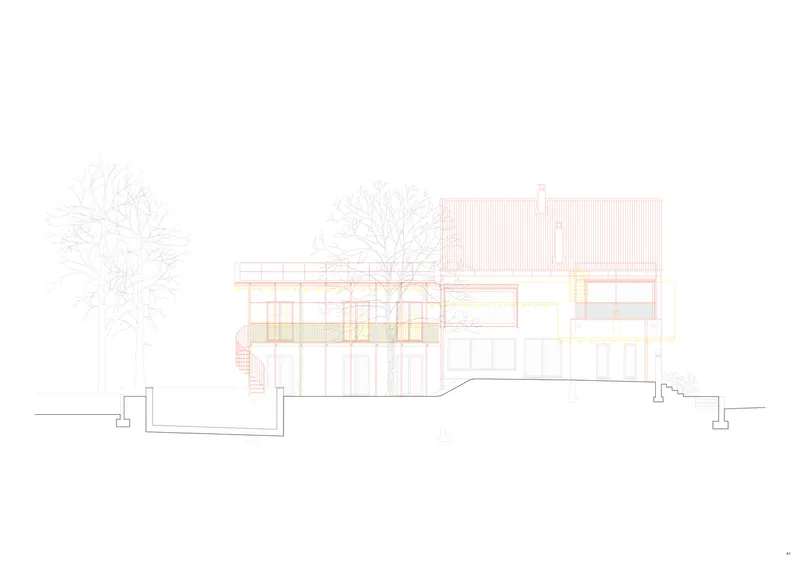
The floor plan reveals how the two connected volumes share a compact lot, with the external staircase tucked against the garden edge to preserve outdoor space. Surrounding trees are drawn with care, confirming their role as design elements rather than incidental context. The section drawing is the most telling: the gabled upper level floats above a basement supported by pilotis, and the mezzanine appears as a discrete platform within the double-height space. The elevation drawing shows the sloped site condition and the proportional relationship between the original two-storey volume and the terrace extension, making clear how little the building's overall mass has changed despite the radical internal rearrangement.
Why This Project Matters
Multi-generational housing is often discussed as a policy goal but rarely demonstrated as an architectural proposition. The N°7 Bretscha House makes the case that adapting existing structures for extended families doesn't require large budgets or dramatic formal gestures. What it requires is a clear reading of what already works, the discipline to leave it alone, and the confidence to intervene boldly where change is needed. The ground floor flat's near-untouched state is as important to the project's success as the new double-height volume above it.
Spalt's decision to externalize the new circulation and clad it in red steel is the project's defining risk. It could have tipped into self-conscious provocation, but the planting strategy gives it a second life, one that the architect has designed to exceed his control. A building that anticipates its own greening is a building that trusts time. In a discipline often obsessed with the photograph, that patience is worth noting.
N°7 Bretscha House by Dominic Spalt Architektur, Schaan, Liechtenstein, 2024. Photography by Willem Pab.
About the Studio
Share Your Own Work on uni.xyz
If projects like this are the kind of work you want to make, uni.xyz is a place to publish your own, find collaborators, and enter design competitions.



Popular Articles
Popular articles from the community

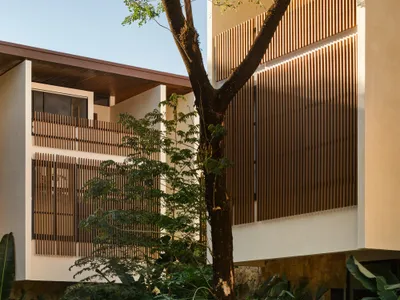
FAMM Arquitectura Organizes Ten Villas Around Courtyards and Jungle in Nosara, Costa Rica
El Molino pairs two elongated volumes with deep overhangs and timber louvers to build a compact coastal community five minutes from the beach.


Riyadh For All: Intergenerational Urban Design for Active Aging in Rabat
Riyadh For All reimagines urban design in Rabat with intergenerational co-living, adaptive courtyards, and Moroccan cultural exchange today.

AL-JANNAH: Sustainable Architecture and Permaculture for Afghan Widows
AL-JANNAH uses sustainable architecture and permaculture to create resilient oasis of housing, learning, work and renewal for Afghan widows.
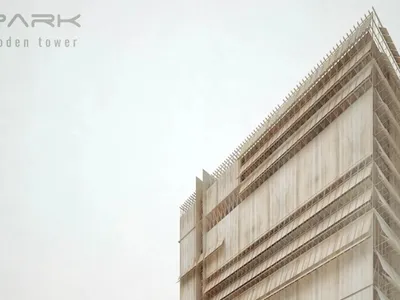
EW PARK: Sustainable Architecture Reimagines the Future of Urban Parking
EW PARK reimagines city parking as a modular wooden tower combining automation, solar energy, electric mobility, and adaptable urban design.


Similar Reads
You might also enjoy these articles


Hodi-Mandai Geram
Project Function: Preservation and revitalization of the Intangible heritage and socio-spatial identity of the Hodi by Housing, Cultural Memory Center, Sacred Grove, landscape, local tourism economy


Olio Towers: A Mid-Rise for Performers That Fuses Housing, Rehearsal, and Stage
Located blocks from Houston's Theater District, this modular tower stacks living units around a central performance atrium.

Oasis: Modular Green Housing Carved into Dhaka's Urban Fabric
A shortlisted Plugin Housing entry reclaims unauthorized settlements in Dhaka with stepped concrete volumes, green roofs, and ventilation-driven design.

Black Hole: A Floating Megastructure for the Post-Physical Era
Emiliano Mazzarotto envisions a spherical, self-scaling arena where e-sports, digital hotels, and holographic stadiums replace traditional public space.


Explore Architecture Competitions
Discover active competitions in this discipline



The International Standard for Design Portfolios


The Global Benchmark for Architecture Dissertation Awards


The Global Benchmark for Graduation Excellence


Challenge to reimagine the Iron Throne
Comments (0)
Please login or sign up to add comments
No comments yet. Be the first to comment!