
Multi Modal Transit Hub Ahmedabad: Infrastructure as Urban Landscape
A layered transportation nucleus that fuses metro, rail, and bus networks beneath domed volumes and elevated green corridors in Ahmedabad.


What happens when you stop treating a transit station as a building and start treating it as a piece of city? In Ahmedabad, where population growth is outpacing infrastructure at a staggering rate, Bhavya Gandhi proposes a multimodal transit hub that collapses metro rail, intercity and intracity bus networks, regional rail, pedestrian systems, and public landscape into a single coherent urban framework. The result is not a terminal you pass through but a destination that holds you, a civic anchor that generates economic and social life around the act of moving.
Sited within Ahmedabad's expanding metropolitan fabric, the hub is conceived as a gateway connecting satellite towns, economic corridors, and urban neighborhoods. The master plan layers commercial spaces, public amenities, administrative blocks, and landscaped open areas both vertically and horizontally to maximize land efficiency and keep the site activated throughout the day. Underground metro lines intersect railway platforms and bus rapid transit at calibrated depths, while elevated concourses, shaded walkways, and barrier-free routes prioritize the pedestrian above all else. The architectural ambition is clear: transit-oriented development that stitches fractured city fabric together rather than tearing it further apart.
A Cylindrical Tower Anchoring the Linear Fabric
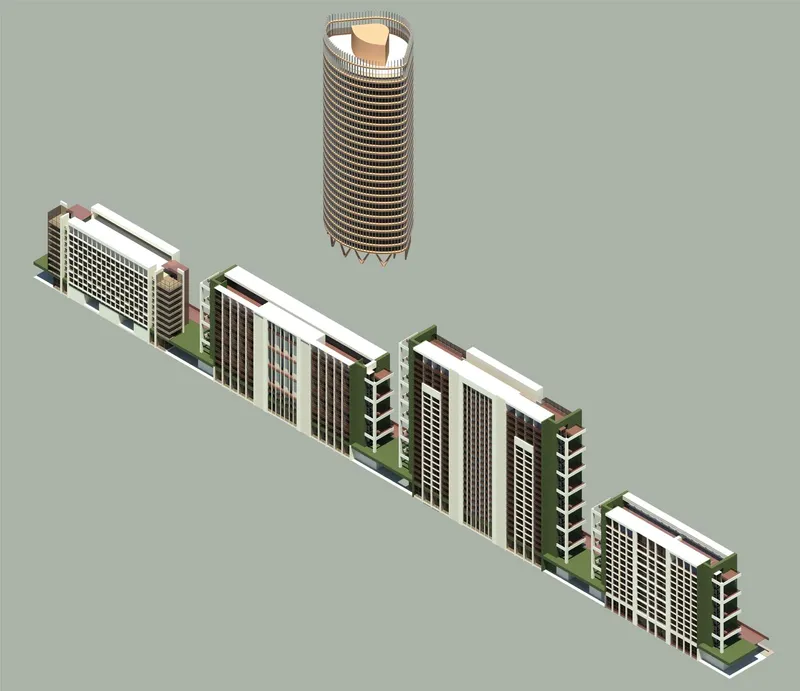
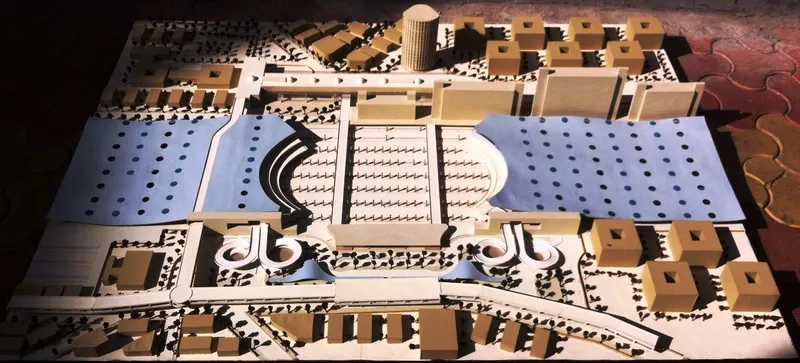
The axonometric drawing reveals the project's primary organizational move: a cylindrical tower volume acts as a vertical landmark at one end of a series of linear residential and mixed-use blocks, while green courtyards stretch between them. The physical model clarifies this relationship in three dimensions. A domed central volume, perforated at its plaza level, anchors the composition. Flanking wings extend outward, housing the layered transit and commercial programs. The geometry is deliberate. Curvilinear forms mark interchange nodes where passengers transition between modes, while the linear bars correspond to platform lengths and bus corridors. It is a plan driven by movement logic, not arbitrary shape-making.
The Domed Roof: Structural Ambition and Daylight Strategy
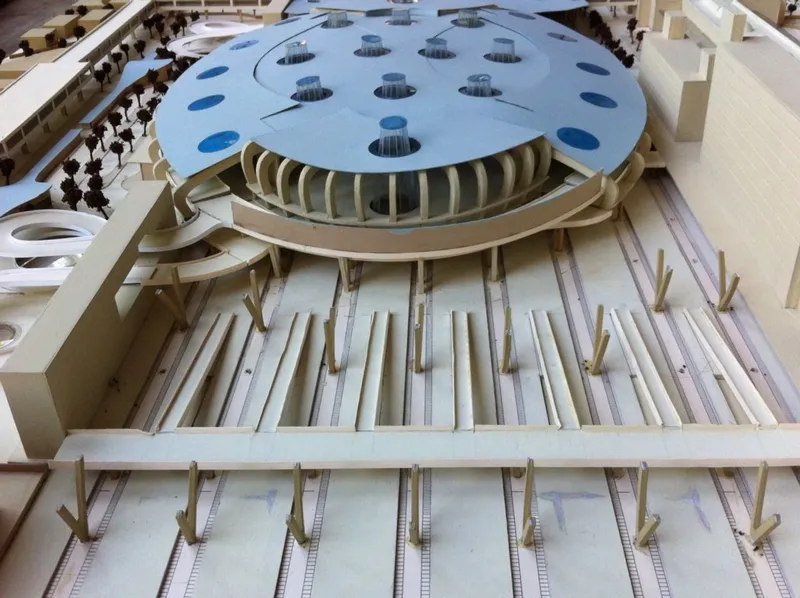
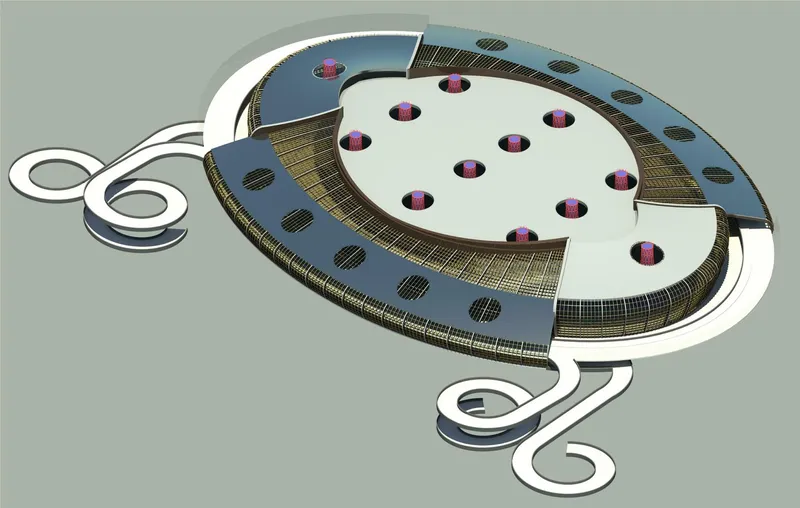
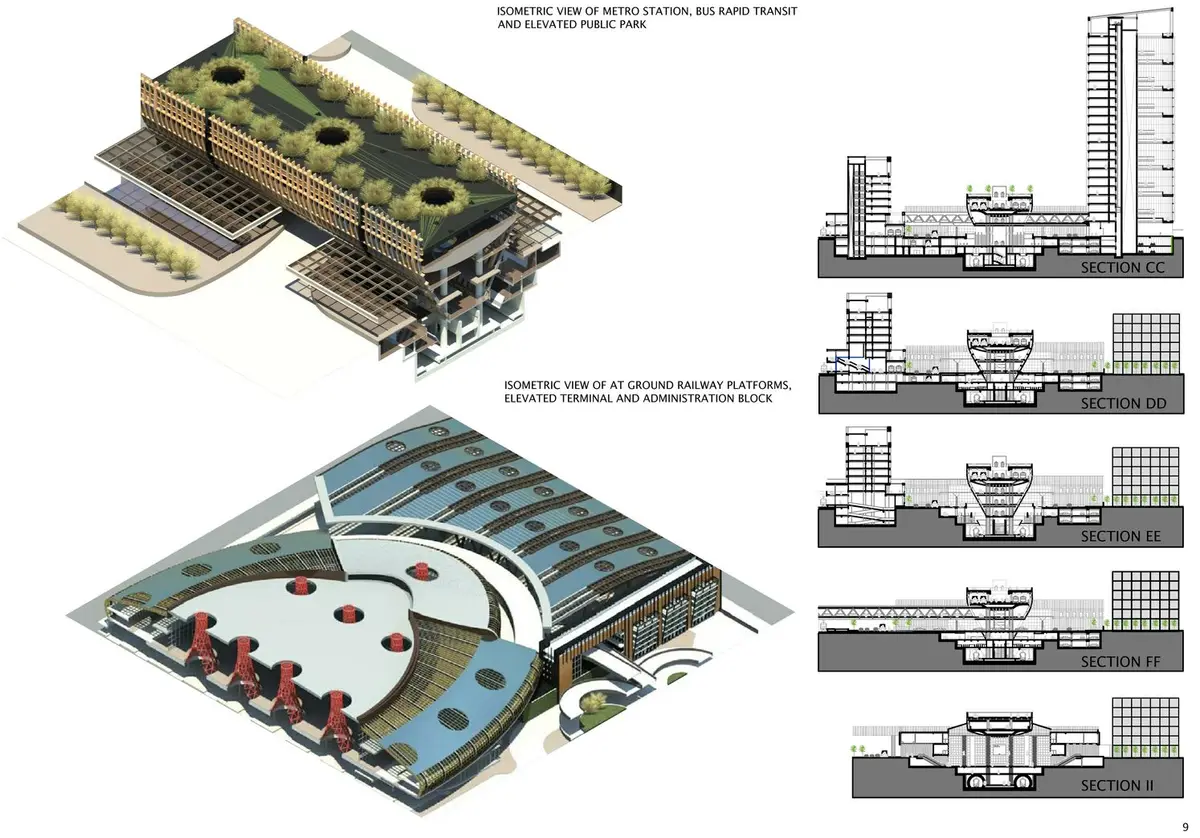
A close-up of the physical model isolates the central domed roof, exposing a radiating column structure that supports a ring of skylights. The design creates a large-span, column-free interior beneath, enhancing visibility across the concourse and giving passengers an unobstructed sightline to wayfinding cues. Skylights punctuate the dome in a controlled pattern, filtering Ahmedabad's intense sunlight into diffused overhead illumination. The accompanying axonometric of the circular building shows spiral approach paths feeding pedestrians into this volume from multiple directions, ensuring that arrival feels intuitive regardless of which transit mode a passenger is coming from.
Structurally, the dome is more than a formal gesture. Its geometry distributes loads efficiently to the perimeter, freeing the interior from intermediate supports that would obstruct crowd flow during peak hours. In a city where summer temperatures regularly exceed 40°C, the elevated roof also generates a stack-ventilation effect, drawing hot air upward and out through the skylight openings. Architecture and environmental performance are treated as the same problem.
Sectional Logic: Layering Transit Beneath Public Life
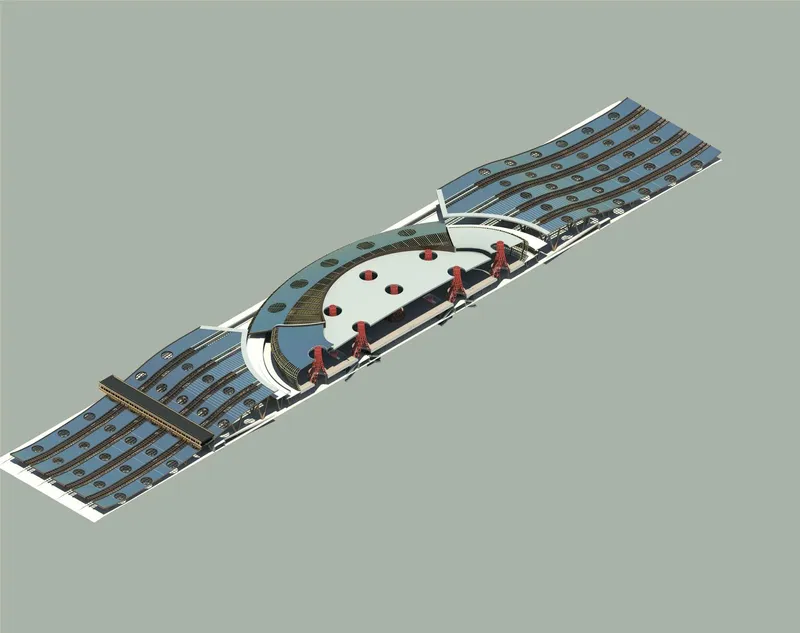
The sectional axonometric cuts through the domed volume to expose the interior arrangement: tiered seating and waiting areas fill the concourse level while skylights wash the space in natural light from above. Below, the section implies the underground metro platforms and service corridors that connect to regional rail. This vertical stacking is the project's most consequential design decision. By placing high-capacity rail underground and elevating the public concourse to ground and mezzanine levels, the hub minimizes horizontal walking distances between modes while reserving the most generous, daylit spaces for the people who use them. Vehicular drop-off zones and service access are segregated to the perimeter, keeping the pedestrian core free of conflict.
Green Corridors and the Urban Edge
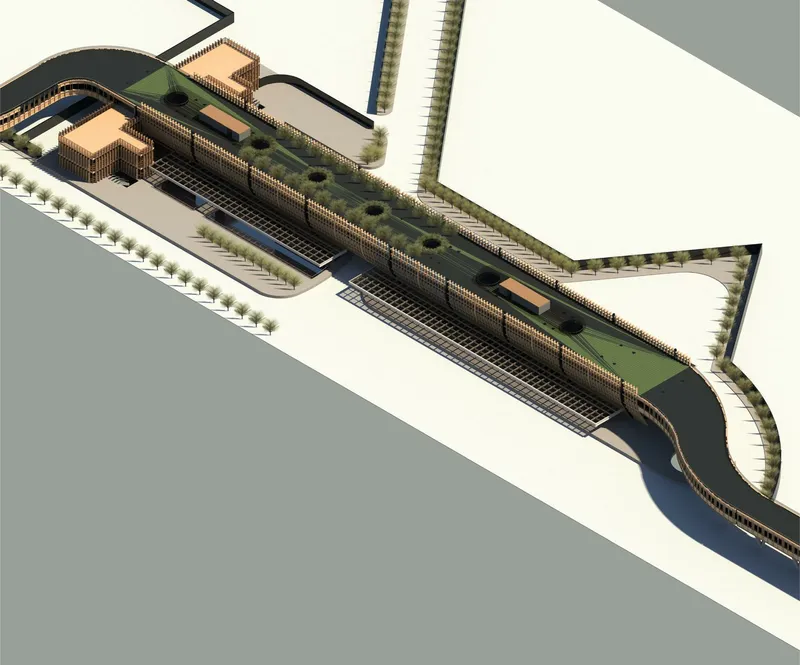
The final axonometric pulls back to show the full campus: linear buildings with planted green roofs extend from the curved tower, forming an elongated urban edge. These elevated green corridors are not decorative. They serve as visual buffers between the transit infrastructure and surrounding neighborhoods, as climatic moderators that reduce the heat-island effect on an otherwise hard-surfaced site, and as social gathering spaces that invite non-commuters into the complex. Landscaped roofs and public plazas inject ecological value into a program type that typically produces nothing but asphalt and concrete. The message is that transportation infrastructure can actively improve urban livability rather than degrade it.
Why This Project Matters
Indian cities are building transit infrastructure at an unprecedented pace, yet much of it remains siloed: metro systems that do not talk to bus networks, railway stations isolated from the neighborhoods they serve. Gandhi's proposal confronts this fragmentation head-on by designing the interchange itself as the primary architectural event. The clarity of the layered section, the intuitive wayfinding generated by the domed landmark, and the integration of mixed-use program around the transit core all point toward a model where mobility and urban life are inseparable.
What elevates the project beyond a competent infrastructure study is its insistence that large-scale transit architecture can also be generous public space. The green roofs, the daylit concourse, the spiral pedestrian approaches: these are not afterthoughts bolted onto an engineering diagram. They are integral to the spatial proposition. For Ahmedabad, a city racing to accommodate millions of new residents, this kind of thinking offers a template where growth and quality of life move in the same direction.
View the Full Project
About the Designers
Designer: Bhavya Gandhi
Enter a Design Competition on uni.xyz
uni.xyz runs architecture and design competitions year-round that reward proposals with spatial conviction and real site intelligence.
Project credits: Multi Modal Transit Hub, Ahmedabad by Bhavya Gandhi.


Popular Articles
Popular articles from the community


The Amber Palace Opera: A Geological Fiction Surfaces on Tallinn's Baltic Waterfront
Pierre Brillard reimagines a Baltic legend as a public landscape, opera house, and waterfront promenade rooted in Tallinn's coastal identity.

Opera by the Sea Estonia: Three Shells Dissolving Architecture into Tallinn's Coastline
A winning opera house proposal replaces monumental form with interconnected shells that blur the boundary between building, park and Baltic Sea.

Opera on the Sea: Driftwood Logic Shapes a Timber Opera House on Estonia's Coast
Trevor Orgill's opera house translates the entangled drift of floating timber into a civic building where wood, water, and music converge.

Singing Woman: An Opera House That Performs Before the Curtain Rises
Ovidiu Cristian Pavel's conceptual opera house translates Estonia's choral identity into a sculpted waterfront landmark facing the Baltic Sea.

Similar Reads
You might also enjoy these articles
Yenisei Monitoring Center: A Sun-and-Moon Sphere Anchors a Research Campus on Siberia's Great River
In Krasnoyarsk, shifting square blocks, a glazed central sphere and descending window rhythms turn river science into a public spectacle on the Yenisei.
Andretta Artist's Village: A Node-Based Masterplan That Lets the Hills Write the Plan
A cultural landscape strategy for Palampur's artist colony threads studios, residences and stages along a porous spine shaped by the Dhauladhar terrain.
Street Children Rehabilitation Center: A Brick Campus That Eases Children From Street to Safety
A low-rise courtyard campus where learning streets, uthans and shaded verandahs stage a gradual passage from street into protective, family-scale life.

The NEON Culture: A Field of Pavilions Built for the 24-Hour City
Smaran Alva spreads galleries, stages, clubs and markets across a varied site, treating light, sound and ramped movement as the real building materials.

Comments (0)
Please login or sign up to add comments
No comments yet. Be the first to comment!