
Nests
Realizing a mean to let the coexistence between man and the natural environment happen
Several studies show that the act of bird watching is deeply rooted in our brains from the times when we needed to hunt in order to eat and stay alive. Nowadays, humans tend to incline towards a friendlier way of treating other species and bird watching is an activity they practice to admire the complexity and beauty of other creatures while taking time to relax and harmonize with nature.
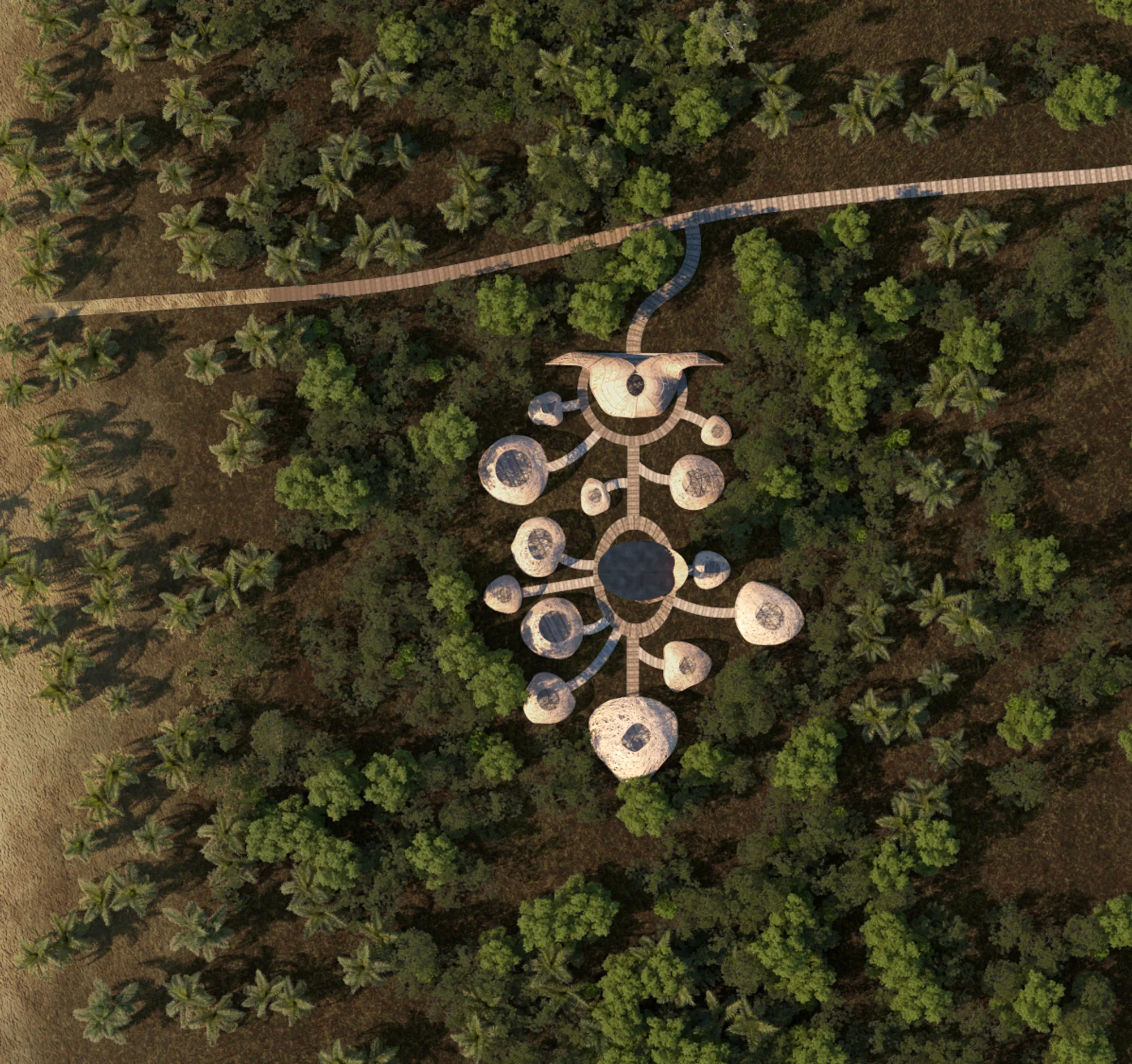
Our concept started from the idea of looking at the world through different eyes. We tried to create a scenario that would allow watching birds from oversized nests that fit the human form. Thus, by changing the scale of the nest, man would feel small in front of nature, which he would look at without disturbing.
The entrance to these nests is made through small cut-outs, which force you to adapt to the scale of the ensemble by bending down. The birds can be seen through other various cut-outs that allow the observation of different birds depending on the places where they spend most of their time. Thus, those that have their nest in the thickets can be seen from the lowest level, sitting on pillows, and those from the high vegetation can be seen through the pruning from the top. The birds in the tallest trees can be seen from the high tower in the middle of the ensemble. The front body has a different and closed shape from the other nests, because it has an informative function and acts at the same time as a visual and sound filter that has an aerodynamic shape representing a symbol of the project theme and an attractor.
The ensemble is placed mainly on the short axis of the site, directed towards North and South, while having a centered tower around which the other spaces are subordinated to. Thus, it is possible to watch birds from several points and in several ways.
The materials chosen for this project are all local, sustainable and environmentally friendly. Straw bales use agricultural waste, are fire resistant, they offer good thermal insulation, they are a good substitute for timber and, most importantly for our project, they have excellent soundproofing properties that bring us even closer to our purpose of not disturbing the birds. Bamboo is a versatile material of high cultural significance. It is light and very flexible and is much cheaper than steel. It is available in abundance from all over India and is easy to assemble. Also, engineered wood uses wood scraps and small trees to produce stronger structures than those that use natural logs. There are many constructive techniques and treatments: acetylation, placement of cord wood, “green” techniques, but also very aesthetic.
Numerous species of birds can be identified in the studied area, birds that, like us humans, tend to have their preferred spot in which they thrive. There are birds that spend most of their time on the beach and at sea such as birds of the sternidae and scolopacidae family, in the thicket area, such as ardeidae, or in tall trees surrounding the site, such as the accipitridae or phalacrocoracidae families. With patience and a bit of stealth, you will soon notice their habitual patterns and inclination towards these types of areas. Based on the differences and correlations between the species of birds, we created a safe space which places emphasis on the harmony with nature. Informations regarding their frequency of certain habitats are illustrated and explained in the first pavilion of the ensemble which guide you to the ideal points from which you can watch the respective species.
The target audience for this bird watching project are people of all ages. The noise made by children is partially canceled by the properties of the carefully chosen materials and the fact that adults have to crouch in order to get inside the nests allows for a 1 to 1 interaction no matter the age. What is important for people to keep in mind is that bird watching is quite challenging and requires patience and stealthy movement, but is a very rewarding process for the long run. Studies from numerous universities have revealed that people who practice bird watching tend to have more positive attitudes and decreased stress levels. Due to the fact that it is an activity that requires patience, it can tremendously increase one’s concentration and over all composure.
Therefore, our goals consisted in realizing a mean to let the coexistence between man and the natural environment happen, to combat destructive tourism, to subordinate our project to the natural habitat of the birds, to design a discreet non-destructive intervention, to create a platform with educational and informative character and also to make a place in which you can relax, explore and observe while having a viewpoint over a natural setting or while sitting below grass level.



Popular Articles
Popular articles from the community


Co-life: Sustainable Architecture for Age-Friendly Community Living
Co-life reimagines sustainable architecture for seniors through courtyards, rammed earth, shared gardens, and spaces designed for belonging.

The Earth Pod: 3D Printed Homes for Resilient Refugee Communities
The Earth Pod reimagines refugee housing through 3D printed homes made from clay, combining resilience, self-sufficiency, and rapid shelter.

The Musturak Paradise: Senior Living Architecture for a Connected Future in Temara, Morocco
The Musturak Paradise reimagines senior living architecture in Temara via private homes, social spaces, culture, community, and shared care.

Play: Fragments of Their World
Familiar architecture becomes modular playground design, creating safe spaces where displaced children can learn, connect, imagine and play.


Similar Reads
You might also enjoy these articles
The Rhythm of Seasons
A Farmers' Market Connecting Nature and the City

More Than a Building-Designing a Living System
More Than a Building-Designing a Living System
Base Beyond
DESERT COMPOUND ARID: TOURISM OF ABSENCE AND ABUNDANCE


Explore Natural Architecture Competitions
Discover active competitions in this discipline




Challenge to reimagine the Iron Throne


Photograph architecture without architects


Illustrate the lost glory of Angkor Wat - Render Challenge


Design challenge to reuse E-waste
Comments (0)
Please login or sign up to add comments
No comments yet. Be the first to comment!