
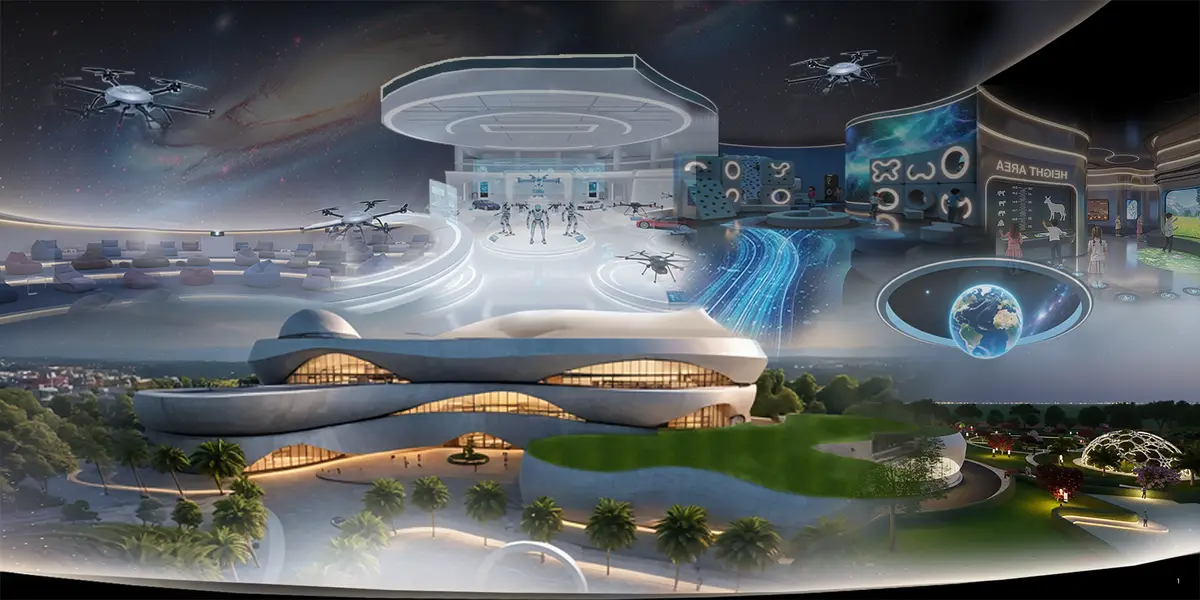
NextGen Museum, at Hyderabad, India
A Hub where Science, Tech and Imagination connects

The architectural concerns of the NextGen Museum revolve around the creation of a futuristic and iconic landmark that embodies innovation, sustainability, and immersive learning. The design seeks to move beyond the conventional boundaries of museum architecture by adopting dynamic, fluid, and parametric forms inspired by the possibilities of computational design, making the building itself a symbol of progress and human ingenuity. At its core, the project emphasizes the integration of technology not only within its exhibitions but also in the architecture, incorporating smart systems, AR/VR interfaces, and interactive digital installations that transform the museum into a living, evolving hub of knowledge. Sustainability forms another central concern, with the design striving to adopt green building strategies through the use of eco-friendly materials, renewable energy systems, passive cooling and lighting techniques, and efficient waste and water management practices. This ensures that the museum does not only reflect the future in its aesthetics but also in its environmental responsibility. The visitor experience is given equal importance, with spaces planned to be immersive, engaging, and accessible for diverse audiences. Clear circulation patterns, interactive galleries, kid-friendly zones, and universal design principles ensure inclusivity and comfort for all. Flexibility is another crucial consideration, as the museum is envisioned to adapt to the rapid evolution of science and technology; modular and reconfigurable exhibition spaces will allow for both permanent displays and temporary programs to coexist seamlessly. The architecture also responds to its cultural and urban context, positioning itself as a global icon while retaining a connection to local identity and the surrounding city fabric. Open plazas, landscaped public zones, and community areas create a fluid transition between the museum and the city, encouraging it to function as both a civic space and a cultural landmark. Structural innovation through advanced materials such as steel grid shells, composites, or 3D-printed components allows the building to embody futuristic expression while ensuring efficiency and durability. The thoughtful use of daylight, controlled through smart façades, and acoustically balanced interiors further enhance the comfort and experiential quality of the museum environment. Above all, safety, accessibility, and user comfort are prioritized, ensuring that the NextGen Museum becomes not only a showcase of science and technology but also a welcoming, inclusive, and sustainable space for exploration, collaboration, and imagination.
The architectural and conceptual strategies for the NextGen Museum are shaped around addressing the critical concerns of futuristic expression, sustainability, technological integration, visitor experience, and contextual relevance. To achieve a futuristic architectural identity, the design will employ parametric and computational tools that enable fluid, non-linear geometries symbolizing progress and innovation. Conceptually, the building form is imagined as a sculptural landmark that communicates dynamism and the limitless possibilities of science. Structural strategies such as space frameworks, tensile systems, and advanced lightweight composites will allow for the realization of these complex forms while ensuring efficiency and stability.
In terms of technological integration, the museum’s architecture will act as both a container and an active interface for innovation. Smart building systems—such as automated shading, responsive façades, and AI-controlled HVAC—will ensure comfort and energy efficiency, while exhibition areas will be designed with AR/VR zones, holographic displays, and interactive media walls. Flexible planning strategies, such as modular exhibition halls and movable partitions, will allow exhibits to evolve alongside emerging scientific advancements, ensuring the museum remains relevant in the future.
Sustainability is another cornerstone, addressed through a combination of passive and active design strategies. Building orientation will maximize natural daylight while minimizing heat gain through shading devices, double-skin façades, and high-performance glazing. Renewable energy systems like solar panels and geothermal cooling will supplement the building’s power needs. Additionally, strategies such as rainwater harvesting, grey-water recycling, and green roofs will support ecological balance, while the use of locally sourced, recyclable materials will reduce the project’s carbon footprint. Conceptually, sustainability is not treated as a background technical feature but as a core narrative of the museum’s identity—visitors will experience the building itself as a living example of environmental innovation.
For visitor experience, the strategy emphasizes immersion and inclusivity. The spatial journey will be curated to guide visitors through layers of exploration, beginning with open plazas and public landscapes that dissolve the threshold between city and museum. Inside, circulation pathways will be intuitive and interactive, with exhibition spaces designed to stimulate curiosity through multi-sensory engagement. Inclusive design strategies will ensure accessibility for all, incorporating tactile exhibits, audio guides, and barrier-free navigation. Special zones for children, collaborative labs, and interactive learning pods will enhance engagement across age groups and interests.
Conceptually, the project also prioritizes contextual integration and public realm activation. The museum is envisioned not as an isolated monument but as a civic hub, with landscaped forecourts, amphitheatres, and urban plazas encouraging public participation beyond formal exhibitions. The design will establish a dialogue with its surroundings, reflecting local identity while projecting a global vision of innovation. Lighting and acoustic strategies further enhance user comfort, with responsive skylights, programmable LEDs, and sound-balanced auditoriums ensuring both aesthetic appeal and functional excellence.
Ultimately, the architectural and conceptual strategies of the NextGen Museum aim to merge form, technology, and sustainability into a coherent design language. By doing so, the project aspires to create not only a futuristic science museum but also a transformative civic landmark that educates, inspires, and empowers future generations.
The architectural language of the NextGen Museum is envisioned as an expressive fusion of futuristic form, technological integration, and sustainable sensibility, creating a landmark that is both visually iconic and functionally innovative. The design aspires to break away from conventional rectilinear museum typologies and instead adopts a fluid, parametric vocabulary that communicates dynamism, adaptability, and the limitless possibilities of science and human imagination. Inspired by the principles of computational design, the building form emerges as a sculptural entity—organic yet futuristic—embodying the spirit of innovation through its seamless curves, dynamic surfaces, and structural boldness. This language establishes the museum itself as an exhibit of architectural ingenuity, not just a container for displays.
At a conceptual level, the architectural language draws heavily from the idea of “future as form”, wherein geometry, materials, and space are combined to symbolize progress and forward-thinking. The integration of advanced construction systems such as space frame structure shells, tensile structures, and lightweight composites reinforces the visual language of innovation while enabling the complex geometries to come alive.
Materiality plays a central role in shaping the architectural identity. A palette of reflective glass, steel, and composites contrasts with green roofs, landscaped courtyards, and eco-friendly finishes, establishing a balance between technological advancement and ecological sensitivity. This duality emphasizes the museum as both a futuristic icon and a sustainable prototype. Inside, the architectural language continues through open, flowing spaces, intuitive circulation, and modular exhibition zones. The interior dissolves traditional boundaries, creating immersive, interactive environments that encourage exploration and collaboration.

Popular Articles
Popular articles from the community


Lunar Spiral: Space Architecture Shaped by the Mathematics of the Universe
Lunar Spiral reimagines space architecture through Fibonacci geometry, lunar regolith, levitating habitats, and self-sustaining Moon living.

Play: Fragments of Their World
Familiar architecture becomes modular playground design, creating safe spaces where displaced children can learn, connect, imagine and play.

Co-life: Sustainable Architecture for Age-Friendly Community Living
Co-life reimagines sustainable architecture for seniors through courtyards, rammed earth, shared gardens, and spaces designed for belonging.

ALGAL REALM: A Bio-Integrated Lunar Habitat Design for Life Beyond Earth
ALGAL REALM reimagines lunar habitat design with algae-powered life support, 3D-printed regolith, and vertical living for a lunar future.

Similar Reads
You might also enjoy these articles
The Rhythm of Seasons
A Farmers' Market Connecting Nature and the City

More Than a Building-Designing a Living System
More Than a Building-Designing a Living System
Base Beyond
DESERT COMPOUND ARID: TOURISM OF ABSENCE AND ABUNDANCE


Comments (0)
Please login or sign up to add comments
No comments yet. Be the first to comment!