
Nikken Sekkei Channels Jinan's Spring Water Through 226,000 Square Meters of Office Interiors
Inside a 360-meter supertall in Shandong's capital, lobby and sky-floor interiors draw on the city's identity as China's Spring City.


Jinan is known as the Spring City. Its underground aquifers push water to the surface in hundreds of locations across the urban fabric, a geological fact that has shaped the city's literature, cuisine, and sense of self for centuries. When Nikken Sekkei took on the interior design of the Ping An Financial Center, the tallest of five landmark towers in the Lixia District CBD, the studio leaned into that identity with an unusual degree of commitment. The result is a 226,000-square-meter interior program where the dominant spatial motif is not corporate authority but the movement of water.
The 62-story, 360-meter tower was designed by KPF with structural engineering by Arup. It is part of a cluster of five buildings that together symbolize "mountains, springs, lakes, rivers, and cities," and this one draws the river card. Nikken Sekkei's scope covers the grand lobby, sky lobby, standard office floors, four levels of commercial public space, an underground themed retail street, and an exhibition center on the 27th floor. In each zone, the design language is derived from the ripple patterns of spring water and the Wei and Jin dynasty tradition of Qushui Liushang, a poetry banquet in which cups of wine floated along winding streams. It is a rich cultural thread, and the interiors pull it through with restraint rather than decoration.
Water in the Ceiling Plane
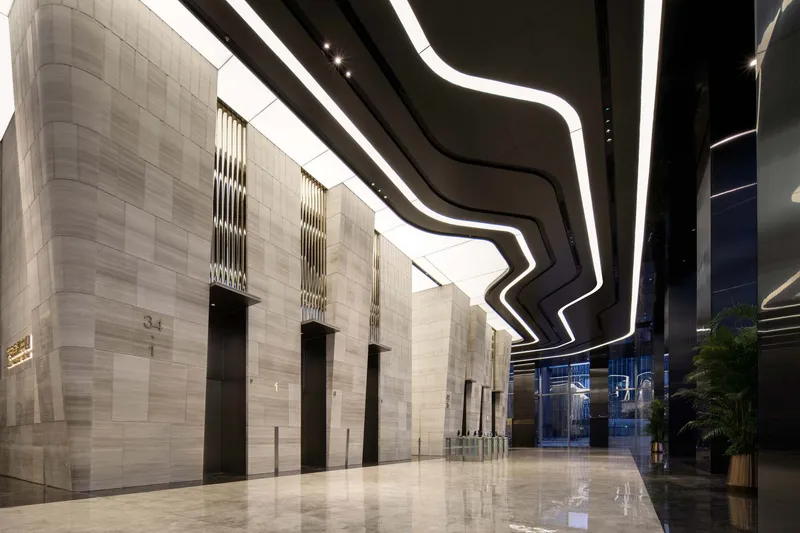
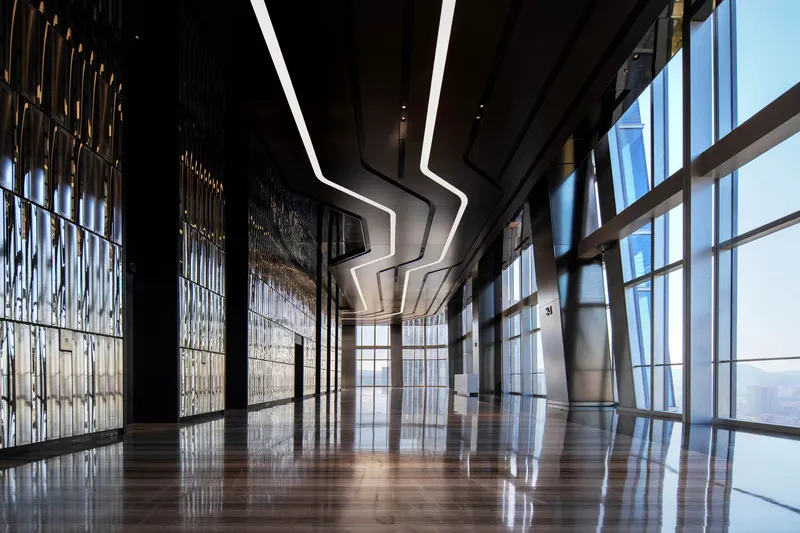
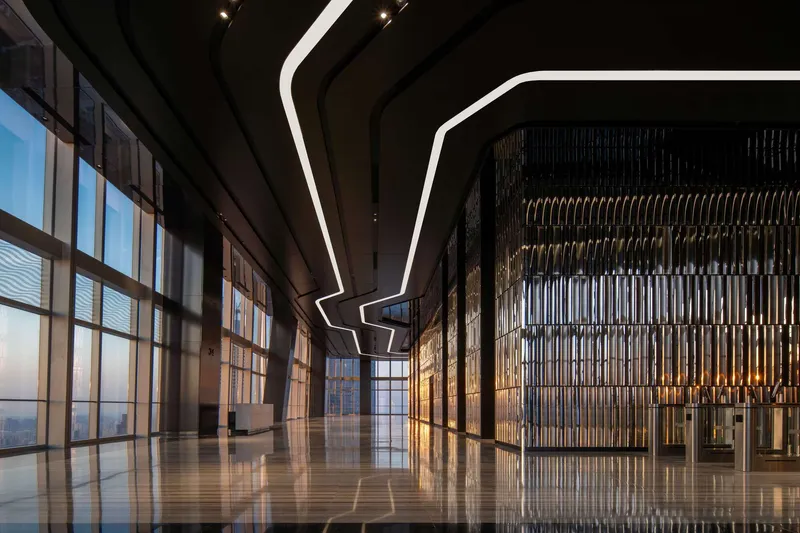
The most legible gesture in the public lobbies is the zigzag lighting trace that runs across ceilings. These angular, meandering lines are abstracted from flowing water, and they perform double duty: wayfinding devices that pull visitors through deep floor plates, and ambient light sources that reduce the visual weight of high ceilings. The pattern repeats at different scales on multiple floors, always reading as a single continuous river rather than a repeating motif.
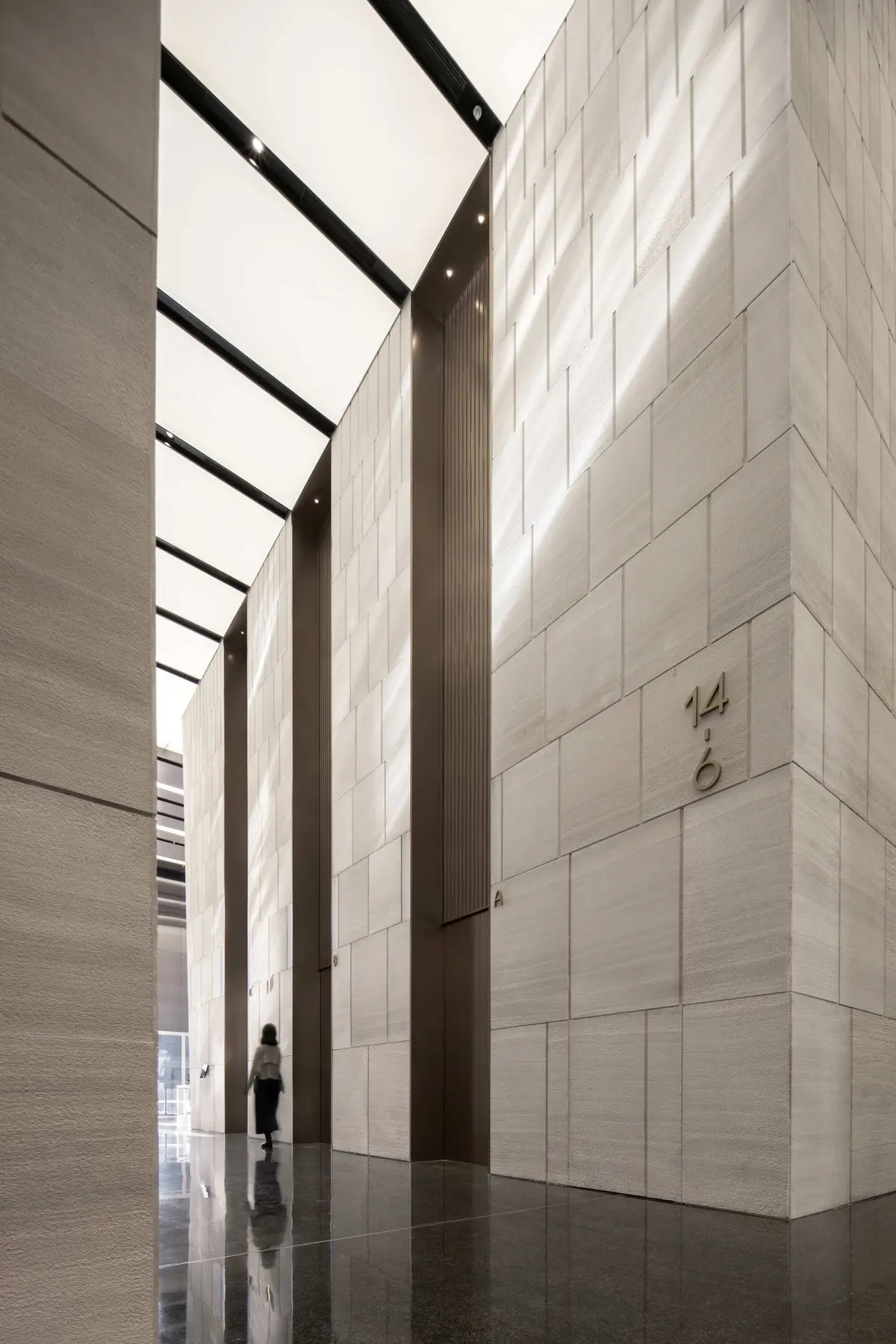
Pale stone wall panels and polished floors amplify the effect. Light bounces off hard surfaces and creates soft gradients that shift as you move through the space. The palette is intentionally quiet: white, warm gray, black columns. There is no accent color fighting for attention. The architecture does the talking through geometry and reflection.
Metal Screens as Curtains of Light
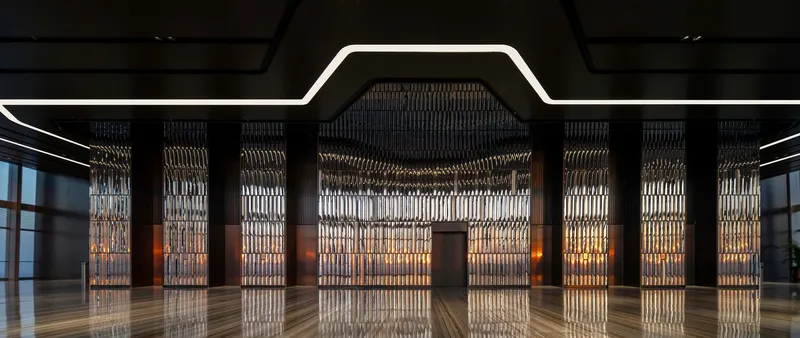
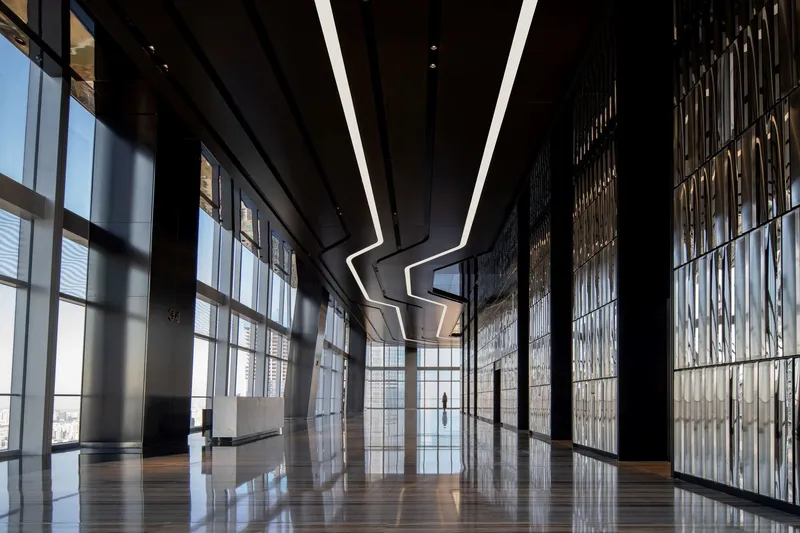
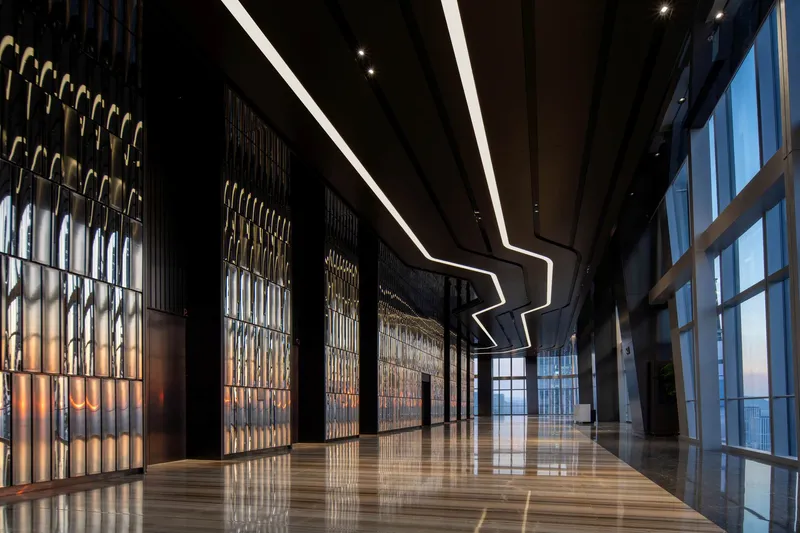
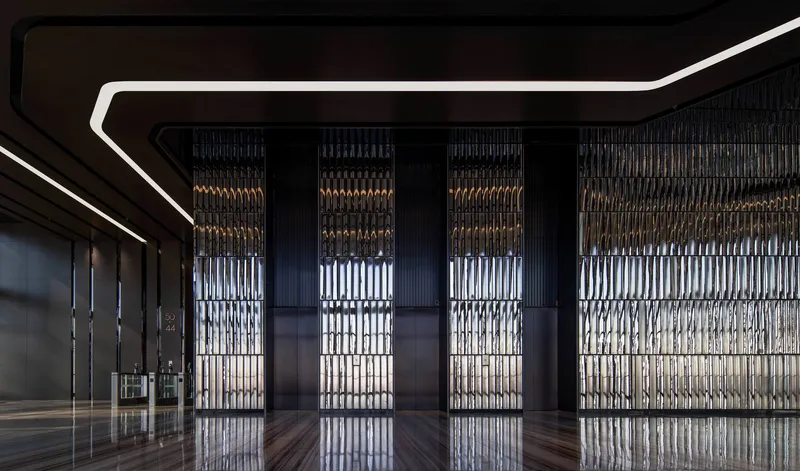
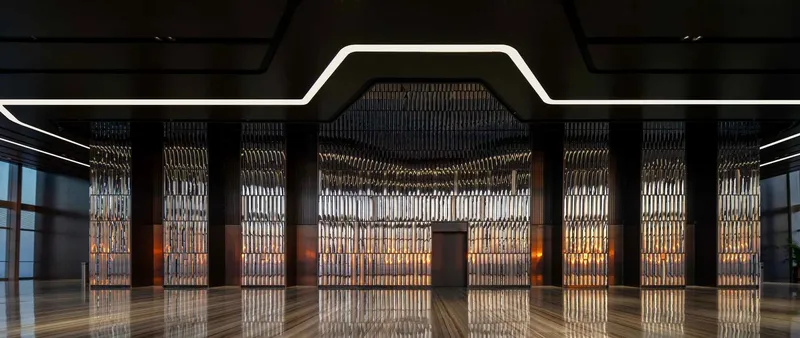
Backlit metal screens appear throughout the lobby and corridor levels, functioning as translucent partitions that filter views and control privacy without closing off sightlines. The screens use a patterned perforation that hints at rippling water without resorting to literal imagery. Framed between dark columns, they glow with a warm amber tone that contrasts with the cooler stone and glass of the surrounding envelope.
These elements do real spatial work. In a tower of this scale, the ground-floor lobbies can easily feel like transit corridors, spaces people pass through rather than inhabit. The screens slow the eye, creating layers of depth and visual texture that reward a second look. They also establish a threshold between the public plaza and the secured office zones above, a necessary boundary made generous rather than hostile.
The Vertical Dimension


Two of the most compelling spaces in the project are the tall atrium voids where Nikken Sekkei lets the building's height become visible from the inside. Pale stone block walls rise several stories, and a skylight at the top pours natural light down onto a polished floor. A single figure crossing the corridor below gives the clearest possible sense of scale. These are monumental rooms, but they avoid the cold grandeur that plagues many supertall lobbies because the material palette stays warm and the proportions remain legible.
The design team reportedly allowed ceiling heights to decrease slightly as the spaces narrow, while maintaining completed arcs in the ceiling profile. It is a subtle move that compresses and expands the spatial experience as you walk through, mimicking the way water accelerates through a narrow channel and slows in a pool.
Elevator Lobbies and Circulation Detailing
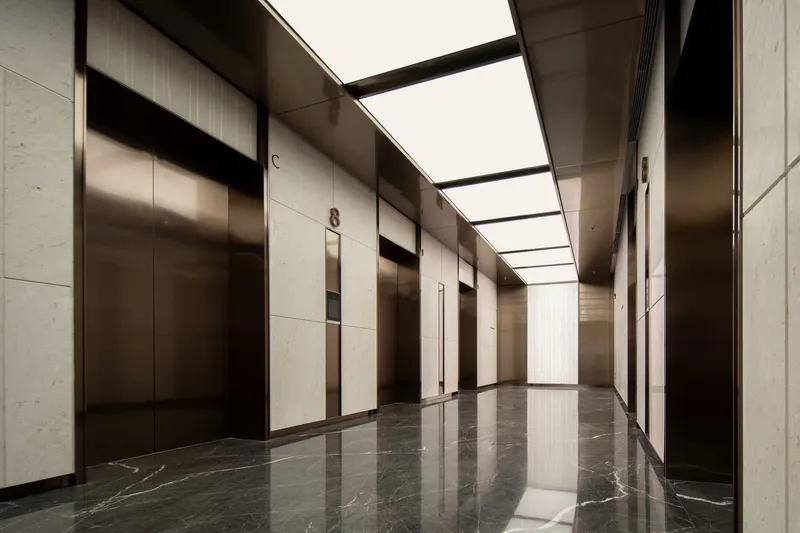
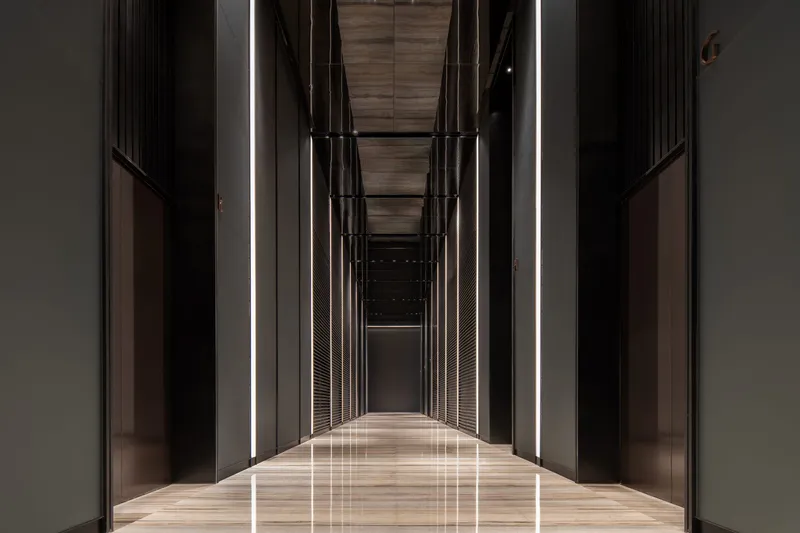
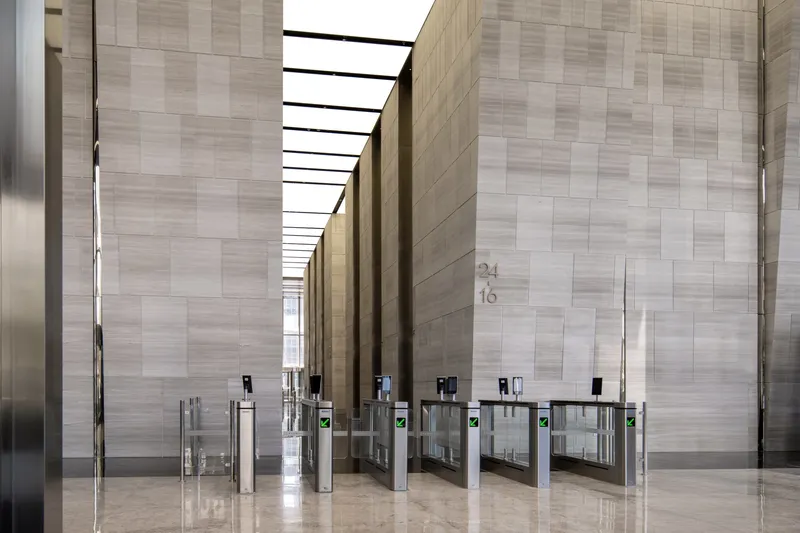
The elevator lobbies are where commercial office interiors typically collapse into generic finishes: stainless steel doors, suspended ceiling tiles, carpet tiles. Here, Nikken Sekkei maintains the language of the public floors. Bronze-framed elevator doors sit beneath backlit ceiling panels, and dark veined marble extends the material continuity from lobby to lift. Even the security turnstile zone, usually a no-man's-land of functional hardware, receives a linear skylight and stone tile walls that keep the spatial quality consistent.
Corridors on upper floors use dark metal panels with vertical cable detailing, a leaner version of the lobby's metal screens. Linear ceiling lights reflect off polished floors, extending the river metaphor into everyday circulation. The discipline here is worth noting: the design concept does not thin out as it climbs the tower.
Between Tower and City
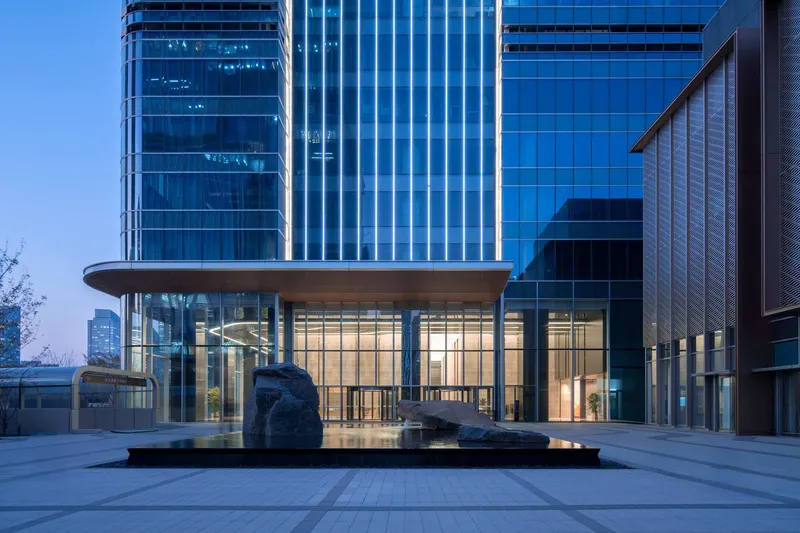
The exterior plaza, visible at dusk with rock sculptures set in a reflecting pool and a glass pavilion, establishes the transition from the CBD's streetscape to the tower's interior world. This is the moment where the water theme becomes literal: actual water, actual stone, actual sky. The glass pavilion serves as a lantern, signaling the underground commercial levels below and pulling pedestrians into the building's orbit.
From the upper corridors, floor-to-ceiling glass frames the city at twilight. The decorative metal screens and angular ceiling lights are visible in silhouette against the skyline, collapsing the distinction between interior ornament and urban backdrop. It is a strong composition, and it rewards the photographer's patience. More importantly, it tells occupants that the building is not a sealed capsule but a frame through which to see Jinan.
Underground Streets and Local Memory
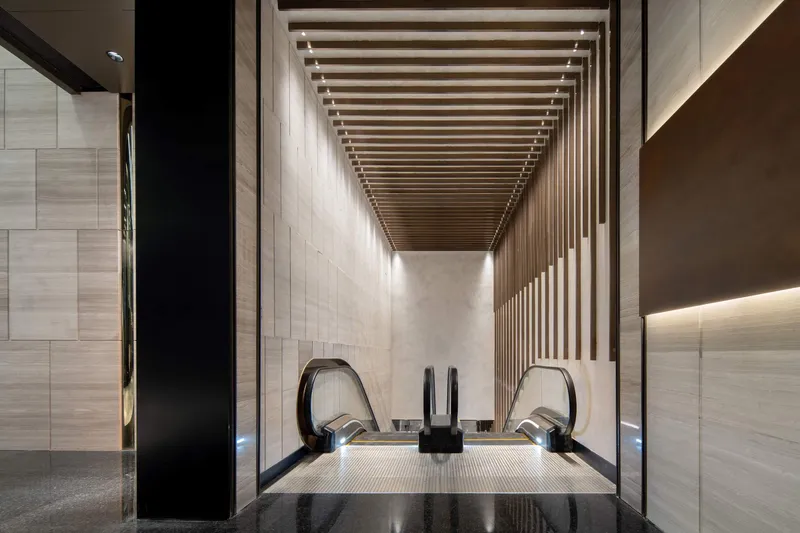
Below ground, the program shifts from corporate to cultural. Three themed streets recreate the character of Quancheng Road, Guyishi Street, and Qushuiting Street, historic Jinan thoroughfares described by the writer Lao She. Slatted timber ceilings with recessed lighting, stone walls, and escalators descending between material layers give this underground zone a warmer, more intimate register than the lobbies above. Vintage wall tiles, wooden lattice doors and windows, and references to plaques and lanterns from old street-vendor culture root the design in a specific local past.
Multi-color terrazzo flooring with a gradient from dark to light and black stone slabs further distinguish the underground retail from the office levels. The strategy is clear: the tower speaks the language of water in abstract, geometric terms, while the underground speaks the language of Jinan in material, tactile ones. Both register as authentic because both are specific.
Why This Project Matters
Supertall interiors are frequently afterthoughts. The engineering and envelope consume the budget and the attention, and interior designers are left to apply finishes that signal prestige without saying much else. Nikken Sekkei's work at the Ping An Financial Center pushes against that pattern by anchoring every spatial decision in a single, culturally grounded concept: water in motion. The consistency across 226,000 square meters, from underground retail streets to sky lobbies, is the real achievement. It is easy to tell a story at the front door. It is much harder to sustain it in the elevator lobby on the 40th floor.
The project also demonstrates that regional identity and corporate scale are not mutually exclusive. Jinan's springs, its literary traditions, and its street culture are not mere decoration here. They are the organizational logic of the interior. In a Chinese CBD landscape that too often defaults to a global-generic vocabulary, this approach matters. It suggests that the most effective way to make a 360-meter tower feel like it belongs somewhere is to fill it with the memory of what was already there.
Jinan Ping An Financial Center Interior Design, designed by Nikken Sekkei, Jinan, Shandong Province, China. 226,000 m². Completed 2024. Photography by Relight Photography.
About the Studio
Share Your Own Work on uni.xyz
If projects like this are the kind of work you want to make, uni.xyz is a place to publish your own, find collaborators, and enter design competitions.


Popular Articles
Popular articles from the community


graciastudio Turns a Viewless Tijuana Lot Inward Around a Courtyard of Concrete, Timber and Trees
In Tijuana, Jorge Gracia's GA2 House stacks a timber-clad private floor over exposed concrete and replaces a missing view with a planted interior patio.


Opera on the Sea: Driftwood Logic Shapes a Timber Opera House on Estonia's Coast
Trevor Orgill's opera house translates the entangled drift of floating timber into a civic building where wood, water, and music converge.

ETEH Reworks the Shared Spaces of São Domingos School in Brazil Around Timber, Color and Hanging Plants
At São Domingos School in Brazil, 436 m² of hall, refectory and library are recast with timber joinery, a yellow and blue code and trailing greenery.

Manzana Morphosis: Stretching Barcelona's Grid into a Living Landscape for 2050
A radical reworking of the Eixample manzana turns density into a tool for generous public space, vertical ecology, and environmental performance.

Similar Reads
You might also enjoy these articles

LAVA Architecten Gives Vocational Education a Sawtooth-Roofed Face on a Mechelen School Campus
In Mechelen, Belgium, a 2,053 m² STEM school on a 6×6 m grid turns workshops and classrooms into rooms that can be rearranged as teaching changes.

KEMA Studio Turns a Derelict Marvila Attic into a 60 m² Lighthouse Apartment Above Lisbon
In Lisbon's Marvila district, a rebuilt roof, four skylights and two plywood volumes turn an unlivable attic into a bright home facing the Tagus.

Pixel Gardens: One Repeated Module Stacked Into a Terraced Social Housing Tower for Famagusta
Salem Bader's shortlisted housing tower builds a vertical neighbourhood from one repeated module, offsetting units to carve terraces, light and air.

Bao Huynh Watercolor Atelier: A Serene Art Retreat in Hội An
Bao Huynh Watercolor Atelier in Hội An blends multifunctional art spaces, sustainable design, local materials, and family-friendly living in a serene environment.

Explore Built Environment Interiors Competitions
Discover active competitions in this discipline

Challenge to design luxury tourism on rails

VR headsets Storefront design competition

Bring back Drive In's

Designing a staircase for a client
Comments (0)
Please login or sign up to add comments
No comments yet. Be the first to comment!