
Nola Arquitetura Builds Brazil's Largest Laminated Wood Arch to Shelter Vintage Aircraft
A 50-meter free-span hangar in southern Brazil channels the spirit of early aviation with eucalyptus arches and galvanized steel.


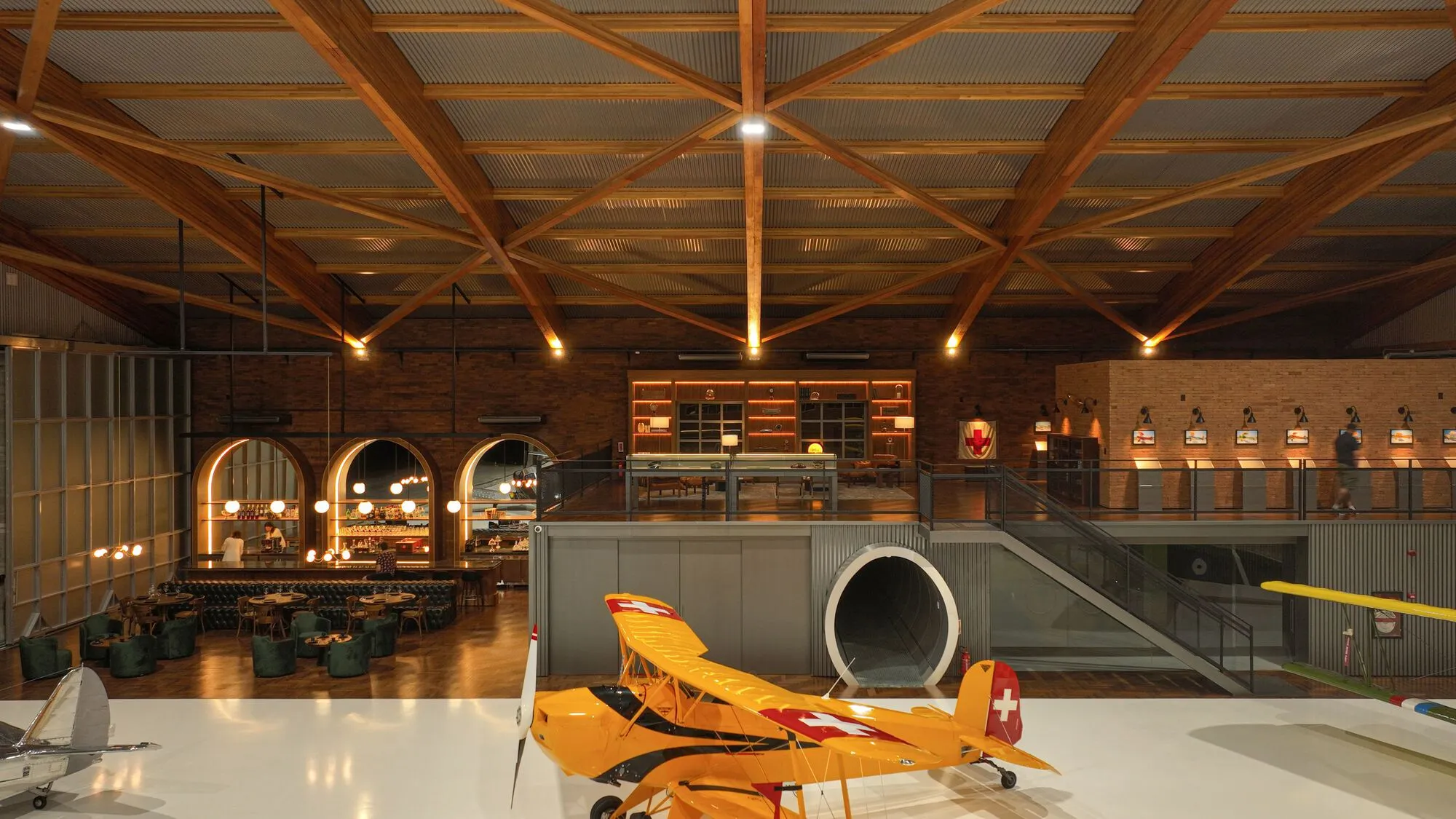
A private collector of historic aircraft from the 1930s through the 1970s wanted a building that felt like the hangars those planes once called home: timber frames, galvanized metal skin, the romance of early aviation infrastructure. Nola Arquitetura responded with a 1,883 square meter barrel-vaulted structure whose biarticulated arches of laminated eucalyptus span 50 meters without a single intermediate column. It is, by the studio's account, the largest glued laminated wood arch ever built in Brazil.
What makes the project genuinely compelling is the gap between its nostalgic brief and its engineering ambition. The client referenced vintage hangars visited abroad, but the site sits in a region hammered by cold fronts and cyclones. Nola's solution uses diagonal timber lattice bracing to handle compression loads under extreme wind, all while maintaining the visual lightness that makes the interior feel like the inside of a wooden ship. A mezzanine level carved into the upper volume turns the building into a museum without sacrificing the open floor the planes require.
A Roof That Works as Structure and Spectacle


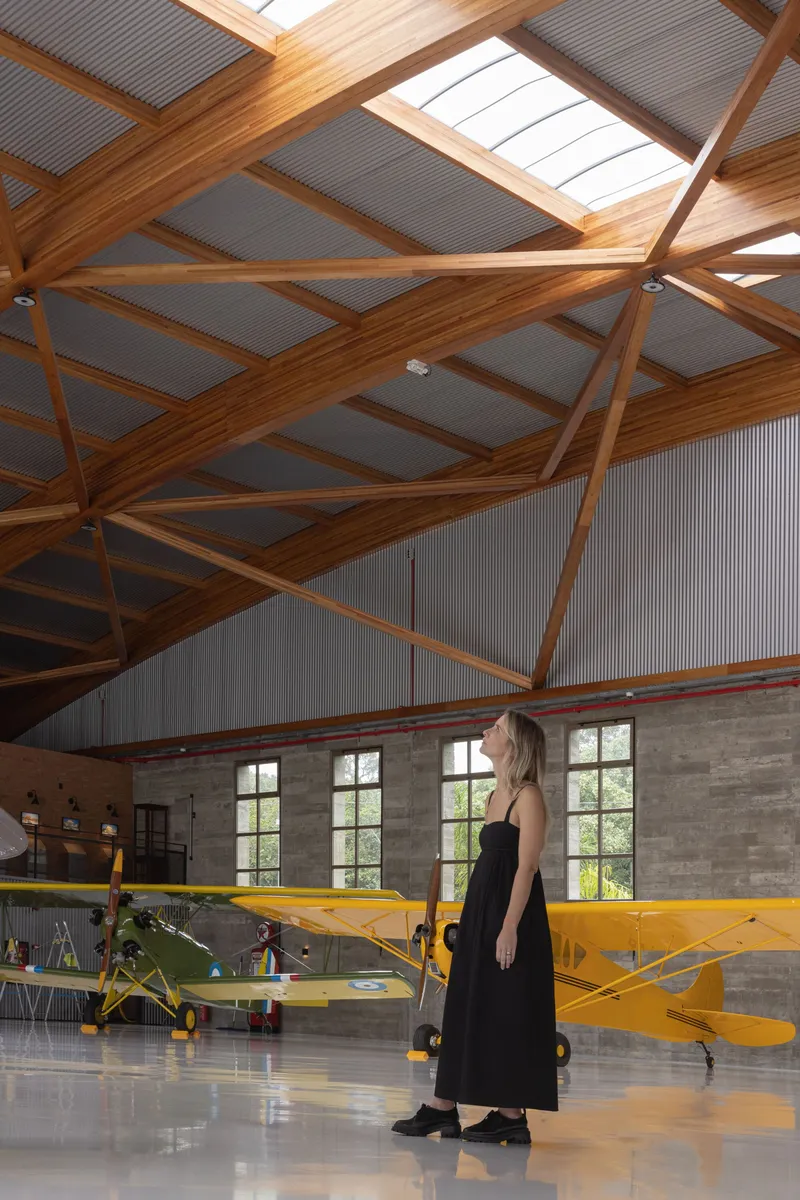
The arches have a cross-section of just 30 by 99 centimeters, which amounts to roughly two percent of the 50-meter span. That ratio is strikingly slender, and it reads that way from the interior. The laminated eucalyptus members are braced diagonally, forming a lattice that distributes wind and compression loads across the entire canopy. Between the trusses, corrugated metal panels and rectangular skylights alternate to wash the hangar floor in natural light.
The effect overhead is almost textile: a weave of timber and metal that catches light differently throughout the day. At clerestory level, glazed strips run along the vault's base, pulling in lateral daylight that makes the structure glow rather than loom. It is one of the rare large-span timber roofs that invites you to look up rather than simply keeping the rain off.
Concrete Anchors and the Logic of Height

Specific legislation on the site limits both total built area and maximum building height. The arched profile works within those constraints by concentrating height at the center, where the planes' tail assemblies need clearance, while the edges stay low. Concrete side pillars lift the arch's springing point just enough to raise ceiling height at the hangar's perimeter, creating room for the mezzanine level that wraps the interior walls.
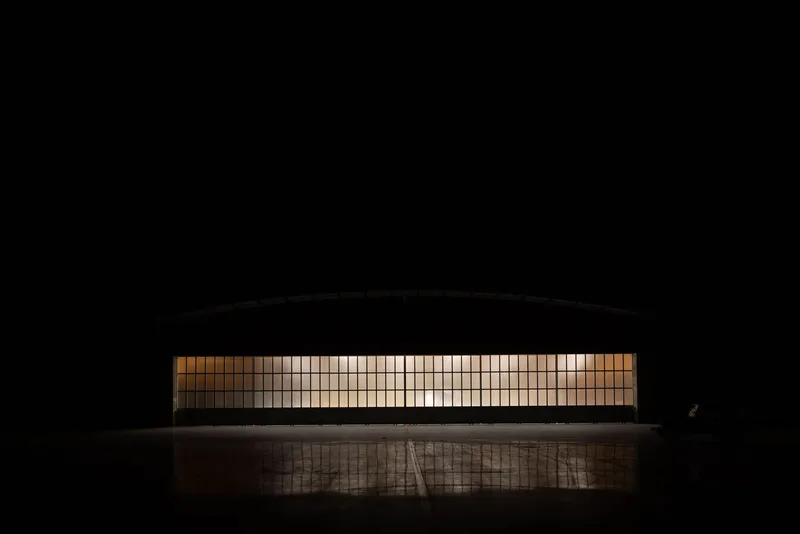
At night, the interplay between the translucent glass block facade and the concrete walls gives the building a lantern quality. The barrel vault recedes into shadow while the glazed openings broadcast warm light across the apron, a visual logic that recalls the way old airfield buildings announced themselves across flat terrain.
The Hangar Floor: Aircraft and Atmosphere

On the ground floor, polished concrete stretches wall to wall, hosting the aircraft collection alongside a vintage military vehicle, a bar, a playroom, and a car garage. A tunnel clad in ribbed metal connects the new hangar to a previously existing structure on the site, linking the two volumes without interrupting the new building's column-free interior.
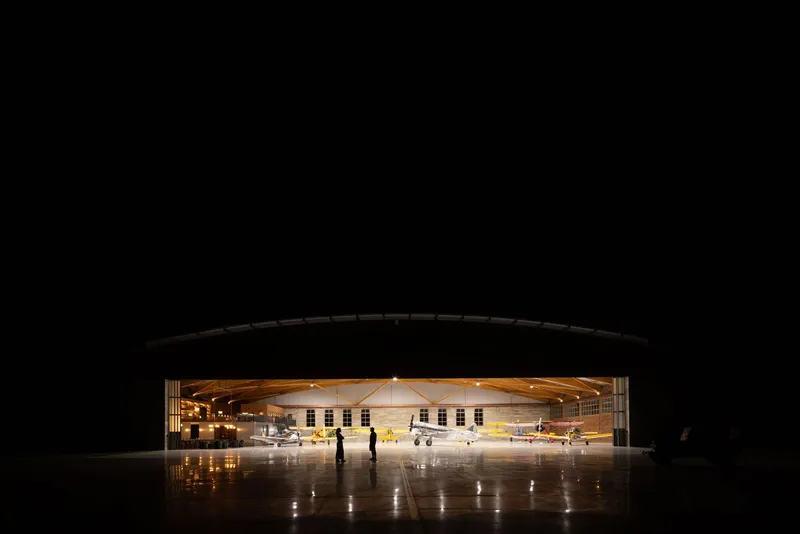
The 38.7-meter gate opening is the kind of dimension that sounds abstract until you see a yellow biplane parked in front of it. That width means the entire front wall can roll open, collapsing the boundary between hangar and airfield. At night with the door raised, the diagonal timber ceiling frames the planes like artifacts in a vitrine of enormous scale.
Mezzanine: The Museum Above the Machines

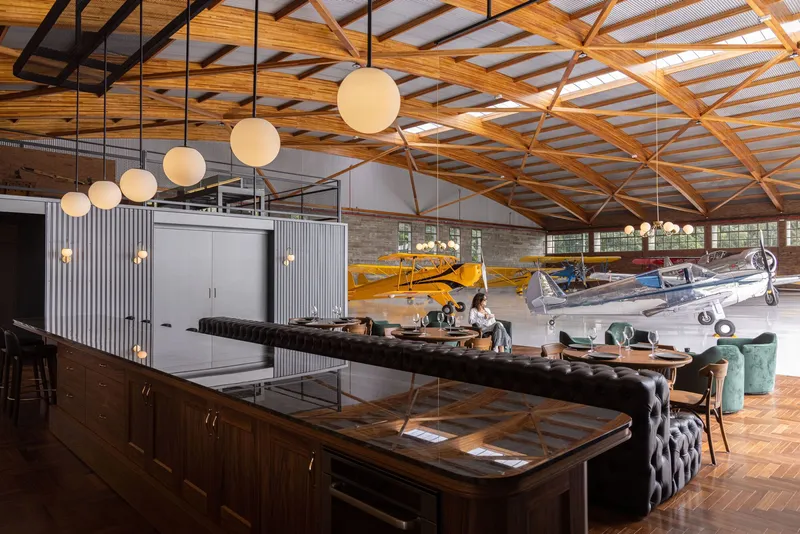

The mezzanine level houses the true museum program: a collection of aviation magazines, books, objects, and records documenting each aircraft's history. Corrugated metal partitions and herringbone timber flooring give the upper level a material warmth that contrasts with the utilitarian concrete below. Sawtooth skylights pull daylight into the lounge areas, creating reading nooks that feel residential in scale despite sitting inside a 50-meter-span industrial shell.
The decision to stack the museum above the collection is smart programming. Visitors look down at the aircraft while surrounded by their documentation, establishing a visual connection that a separate gallery building could never provide. The curved roof overhead remains the dominant spatial presence, so even at mezzanine level you never forget you are inside an aviation structure.
Material Language: Brick, Metal, and Timber

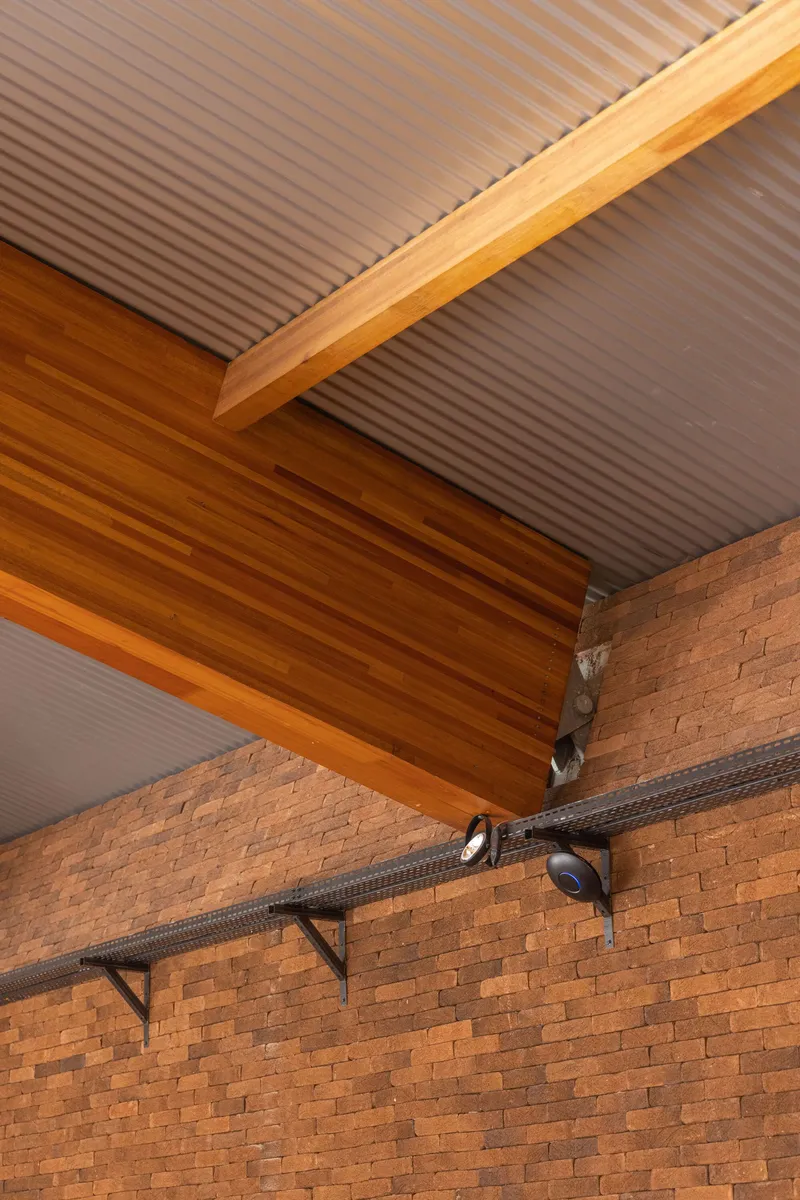

Exposed brick walls appear in the lounge and gallery spaces, grounding the interior in a material that reads as both historic and honest. Gooseneck sconces along the gallery corridor cast warm pools of light on the brick, while the herringbone timber floor underfoot adds a domestic register to the experience. The junction detail between laminated timber beams, corrugated metal ceiling panels, and brick walls below reveals a deliberate hierarchy: structure above, enclosure at eye level, finish at the floor.
The palette is restrained but never austere. Galvanized steel provides the industrial backbone, eucalyptus brings warmth and local identity, and brick offers a tactile surface that absorbs sound and ages gracefully. It is a material trio that the client's reference hangars would recognize, updated just enough to meet contemporary performance demands.
The Tunnel and Threshold Moments


The ribbed metal tunnel connecting the new and old hangars is a small piece of architecture that punches above its weight. Strip lighting runs along its curved walls, compressing the visitor's spatial experience before releasing them into the soaring vault of the main hangar. It is a cinematic sequence: tight, directional, then suddenly expansive.
At the other end of the building, the cafe and bar area uses arched timber portals to frame display shelving and a glazed curtain wall. The transition from full hangar volume to the intimate cafe threshold is handled through these portals, which echo the vault's geometry at a scale you can touch. It is a detail that links the grand structure to the human program without resorting to dropped ceilings or drywall enclosures.
Plans and Drawings


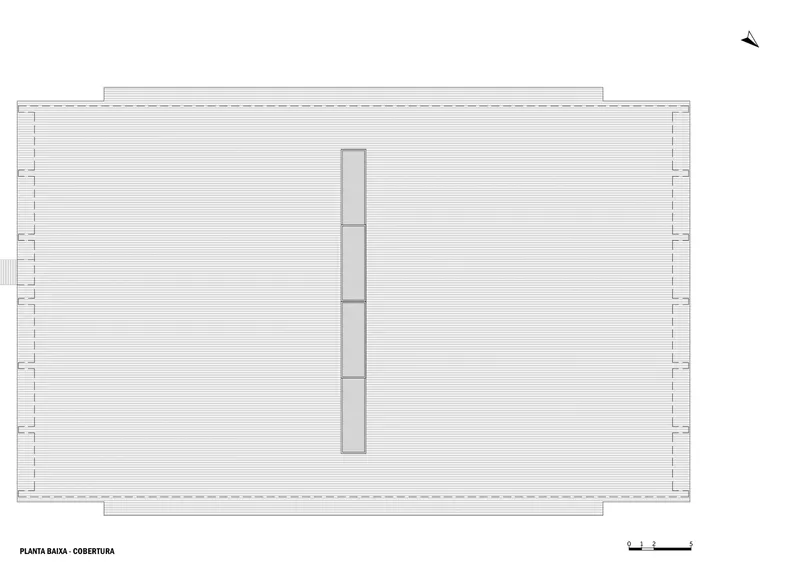


The ground floor plan confirms the column-free strategy: aircraft are parked freely across the open floor, with support rooms, a bar, and service areas tucked along the edges. The mezzanine plan shows the lounge and museum wrapping the perimeter while the central volume remains open to the hangar below. The roof structure plan reveals the diagonal bracing grid that gives the vault its stability, while the exploded axonometric drawing is especially instructive, layering the canopy, truss structure, skylight insertions, and interior floor in a clear vertical sequence.
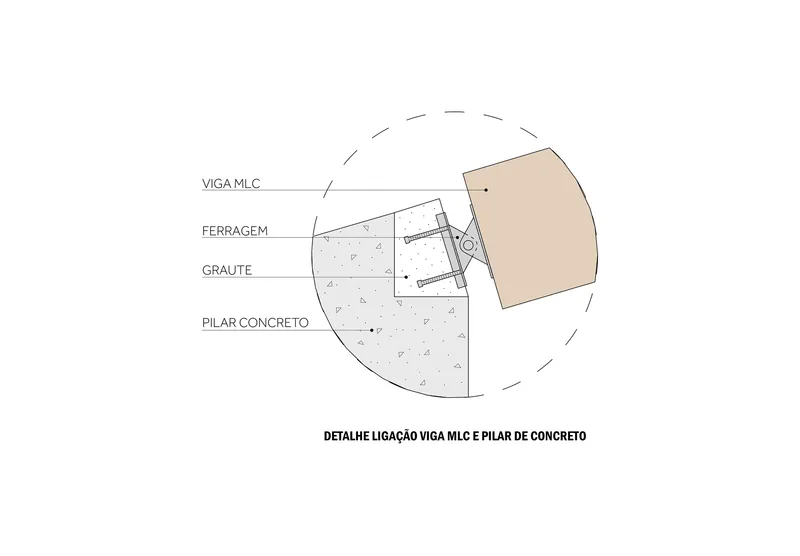
Section drawings make the arch's proportions legible. The vault springs from the concrete side pillars and rises to a peak that respects the site's height restrictions. The connection detail drawing, showing the steel clamp linking timber beam to concrete column base, is worth studying: it is the moment where the building's two primary materials negotiate their differences, and the resolution is clean and expressive.
Why This Project Matters
Large-span timber structures are increasingly common in European and North American architecture, but they remain rare in Brazil at this scale. Nola Arquitetura's use of laminated eucalyptus, a locally grown species, to achieve a 50-meter free span demonstrates that the technology is viable with regional resources. The building is not importing a Scandinavian timber aesthetic; it is adapting glulam engineering to a Brazilian material and climate, including cyclone-grade winds, and arriving at a form that feels native to its context.
Beyond the structural achievement, the Hangar Museum succeeds because it treats nostalgia as a design constraint rather than an excuse for pastiche. The client wanted a building that recalled the hangars of early aviation. Nola delivered that atmosphere through material honesty, spatial proportion, and structural expression rather than through decorative imitation. The result is a contemporary building that a pilot from 1940 might still recognize, and that is a harder thing to design than it sounds.
Hangar Museum by Nola Arquitetura, Brazil. 1,883 m². Completed 2022. Photography by Pablo Casals Aguirre.
About the Studio
Share Your Own Work on uni.xyz
If projects like this are the kind of work you want to make, uni.xyz is a place to publish your own, find collaborators, and enter design competitions.



Popular Articles
Popular articles from the community


Co-Life: Senior Housing Design That Reconnects Older Adults With the City
Co-Life reimagines senior housing design through healing gardens, shared streets, workshops, and a sustainable community across generations.

The Earth Pod: 3D Printed Homes for Resilient Refugee Communities
The Earth Pod reimagines refugee housing through 3D printed homes made from clay, combining resilience, self-sufficiency, and rapid shelter.

Riyadh For All: Intergenerational Urban Design for Active Aging in Rabat
Riyadh For All reimagines urban design in Rabat with intergenerational co-living, adaptive courtyards, and Moroccan cultural exchange today.
EW PARK: Sustainable Architecture Reimagines the Future of Urban Parking
EW PARK reimagines city parking as a modular wooden tower combining automation, solar energy, electric mobility, and adaptable urban design.


Similar Reads
You might also enjoy these articles

Bao Huynh Watercolor Atelier: A Serene Art Retreat in Hội An
Bao Huynh Watercolor Atelier in Hội An blends multifunctional art spaces, sustainable design, local materials, and family-friendly living in a serene environment.

Atelier Macri Concept Store Interior Design by CASE-REAL
Atelier Macri store features a "ko" counter, walnut wood details, cork displays, blending retail, gallery, and seamless customer experiences.

Manuel Vargas Izquierdo Stadium and High-Performance Sports Center: Architectural Excellence in Jalpa de Méndez
The Manuel Vargas Izquierdo Stadium blends sustainable design, inclusive sports facilities, and cultural-inspired architecture, revitalizing Jalpa de Méndez’s public spaces.

KAKR Buluh Awar Hall: Revitalizing Community and Ecology Through Bamboo Architecture
Community built bamboo hall revitalizes Buluh Awar village, empowering youth, restoring ecology, celebrating vernacular craftsmanship through sustainable architecture and culture.





Comments (0)
Please login or sign up to add comments
No comments yet. Be the first to comment!