
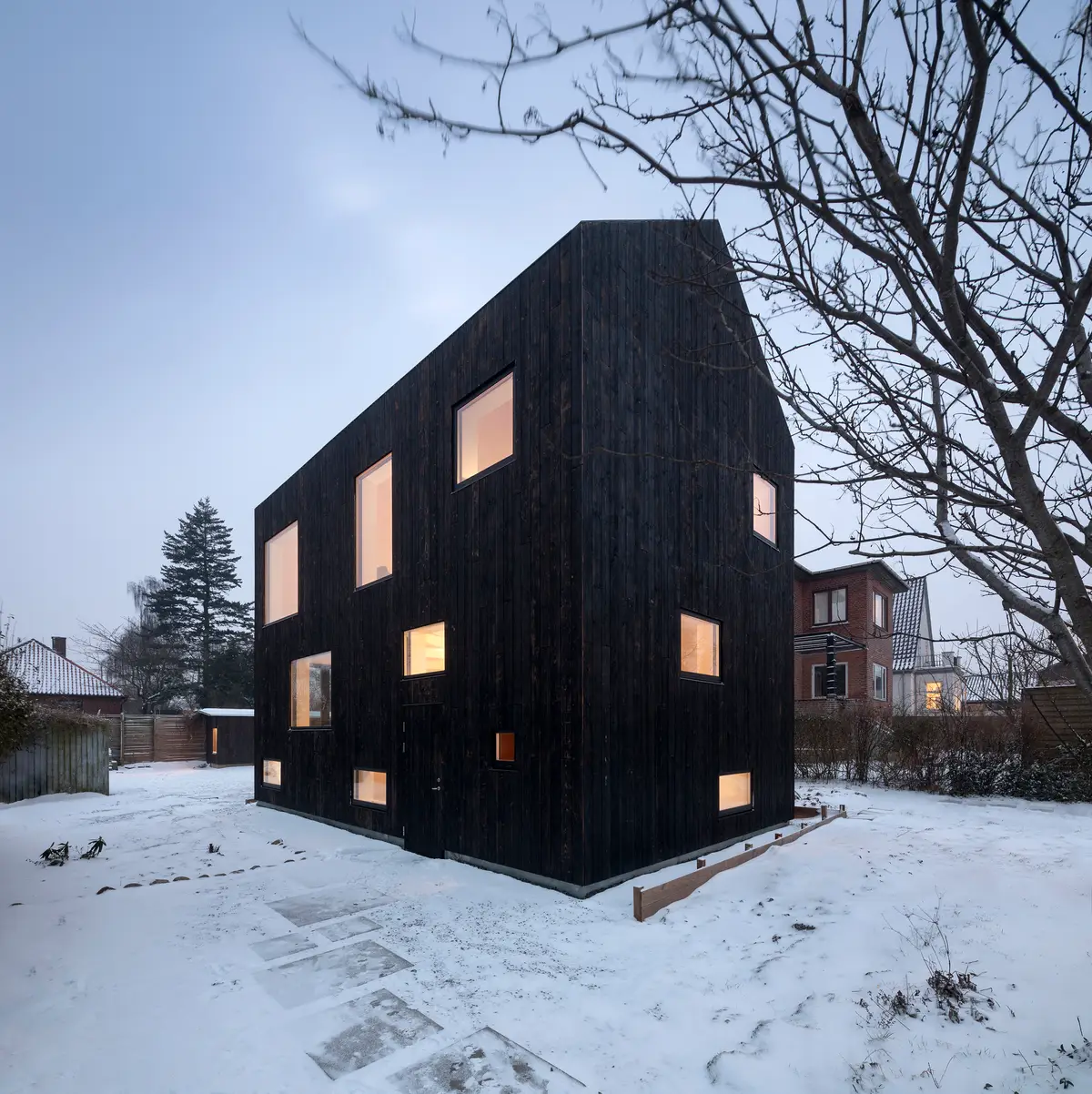
NORD Architects Builds a Climate-Conscious Timber House Disguised as a Danish Barn
Villa Wood brings cross-laminated timber, shou sugi ban cladding, and passive solar strategy to a Copenhagen suburb.


In the quiet suburb of Brønshøj, on a plot surrounded by conventional pitched-roof houses and brick facades, NORD Architects planted something that looks entirely familiar yet operates on a completely different premise. Villa Wood is a 180 square meter, three-story residence built almost entirely from cross-laminated timber, clad in charred douglas pine using the Japanese shou sugi ban technique, and designed from the start for eventual disassembly. The house doubles as the private residence of NORD partner Morten Rask Gregersen, which makes it less a client commission and more a laboratory for ideas the firm wants to prove in practice.
What makes Villa Wood genuinely interesting is not simply that it is a timber house. Timber houses are everywhere. It is the compounding logic: a gabled silhouette borrowed from regional barn typologies so the building reads as part of its neighborhood, a compact 60 square meter footprint stacked over three usable levels, CNC-machined CLT panels that allowed the structure to be assembled on site in days, and a passive solar orientation that pushes living spaces toward the southwest while tucking bedrooms to the north and east. Every decision reinforces the next. That discipline is rare in single-family residential work, where architects often treat sustainability as an additive layer rather than an organizational principle.
A Barn in Blackened Armor
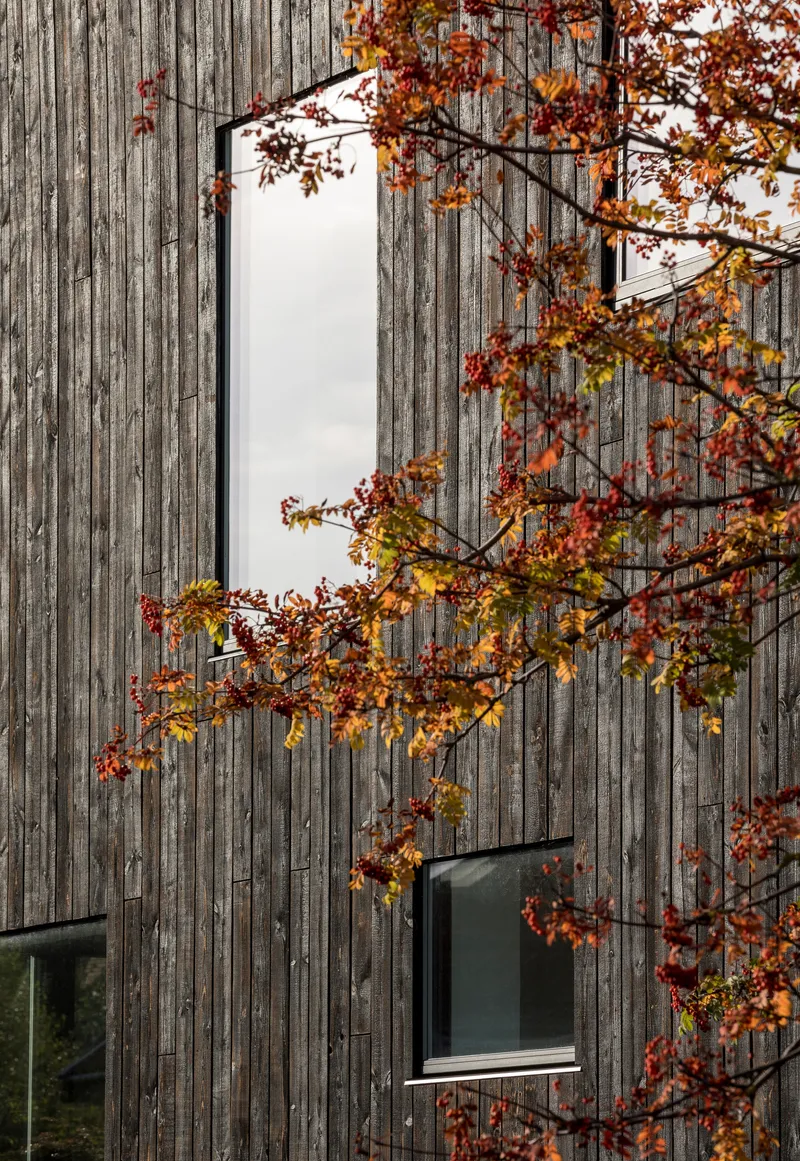
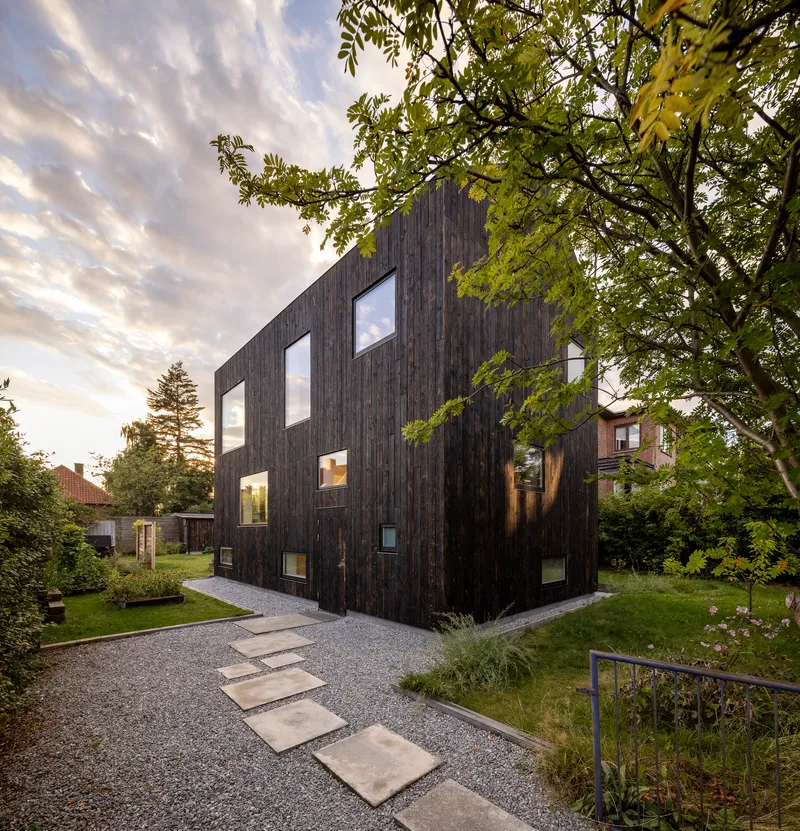
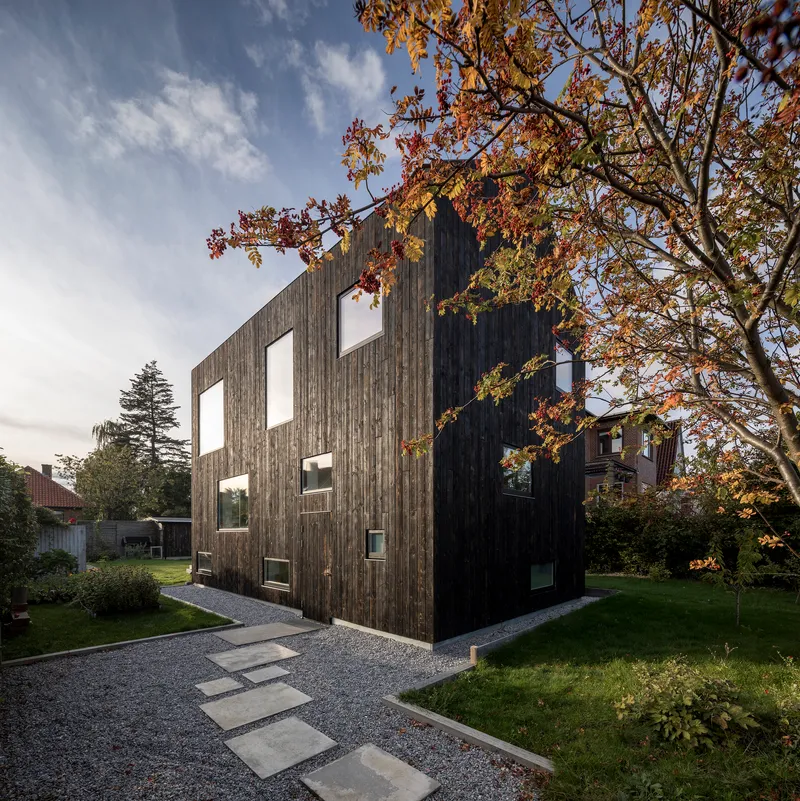
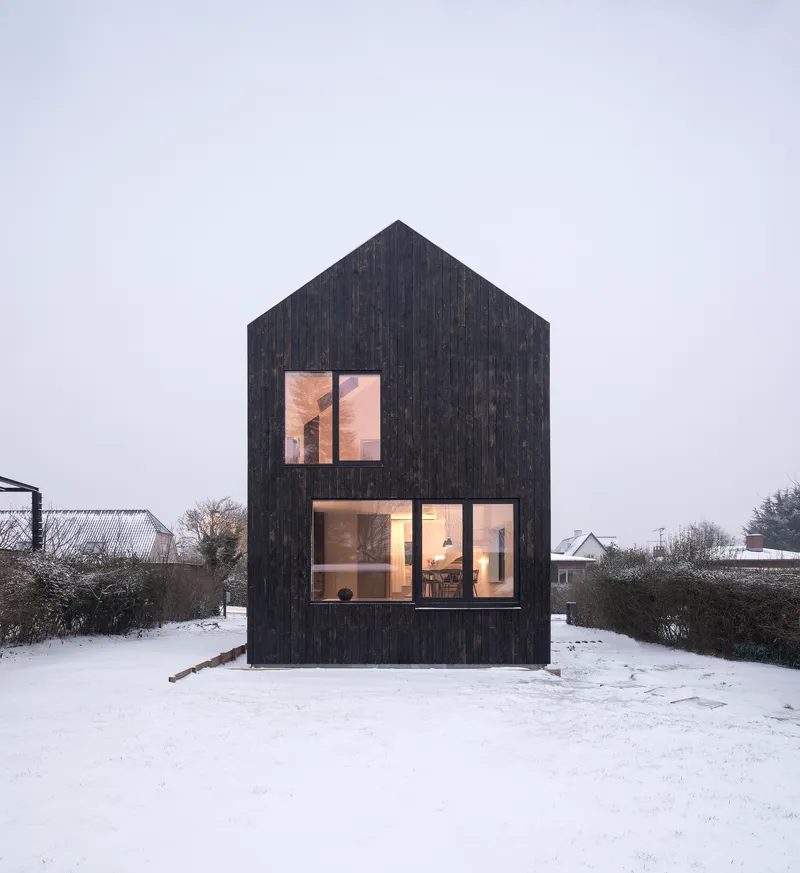
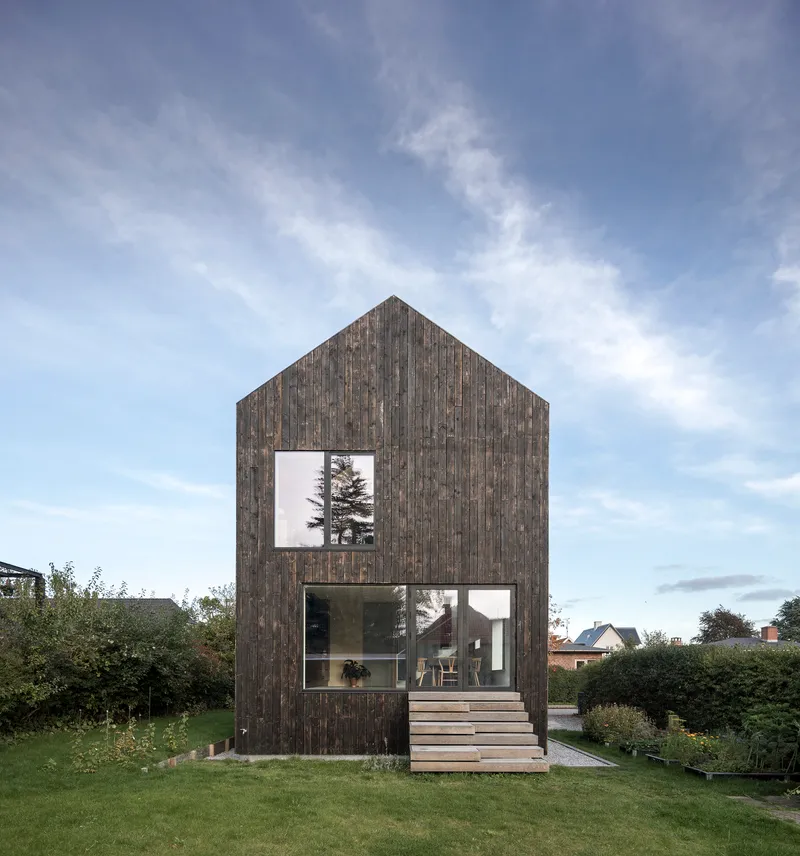
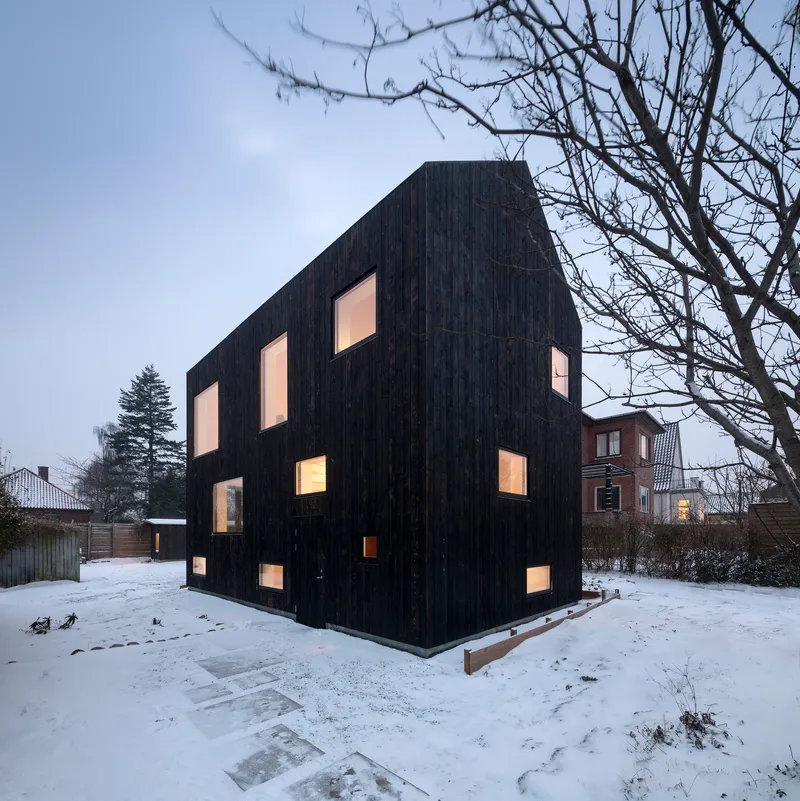
The charred douglas pine cladding is the first thing you notice and the last thing you forget. Shou sugi ban is a centuries-old Japanese technique that carbonizes the outer layer of wood to protect it from moisture, insects, and UV degradation. Applied to vertical boards over a gabled volume, the effect is simultaneously ancient and sharp. The dark surface absorbs the light around it, making the scattered window openings glow like controlled punctures. Against the autumn branches and brick neighbors of Brønshøj, Villa Wood reads as a quiet anomaly rather than an aggressive statement.
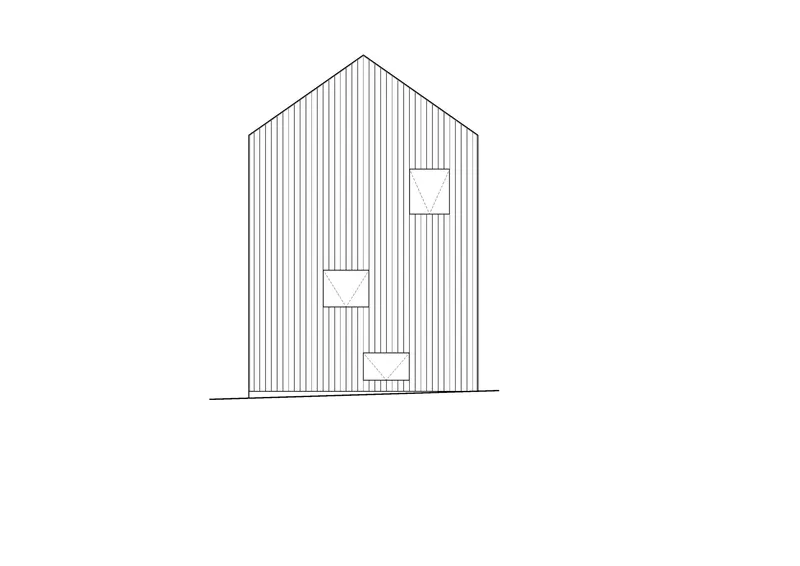
Window placement follows no grid. Openings are sized and positioned according to interior need: tall and narrow where a stairwell wants a sliver of daylight, wide and low where a living room reaches toward a terrace. The irregularity gives the facades a composed casualness, as if the house were not trying to perform but simply accommodating the life inside it.
Fitting the Neighborhood Without Mimicking It
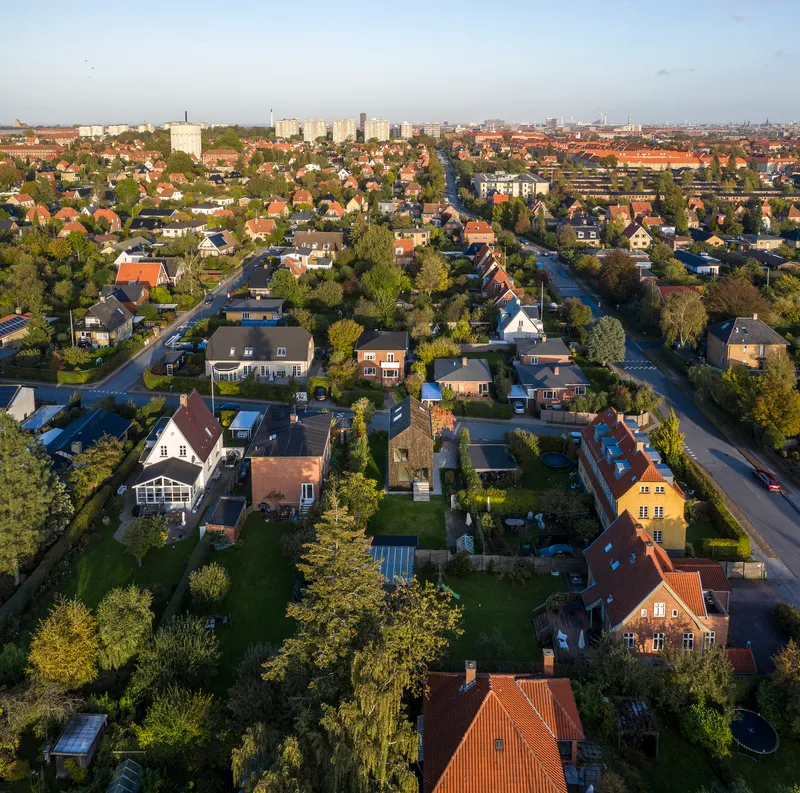
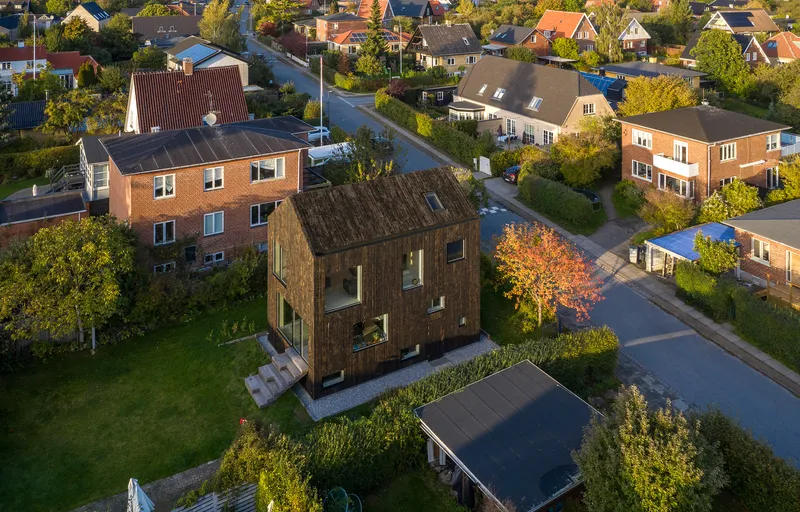
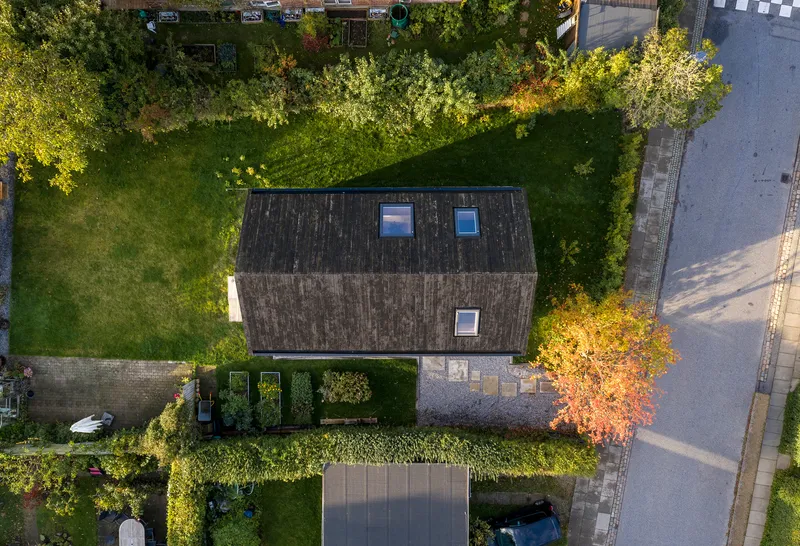
From the aerial view, Brønshøj is a textbook Copenhagen suburb: pitched roofs, garden plots, tree-lined streets. Villa Wood's gabled profile slots into this context with zero friction. The pitch, the proportions, the compact footprint all echo the surrounding building stock. But where the neighbors rely on brick and plaster, NORD's house is entirely timber, its blackened skin marking it as a different species within the same genus. It is a smart contextual move, grounded in the recognition that form can belong even when material does not.
The snow-covered shots reveal how well the house holds its own in harsh Nordic conditions. The dark cladding against white ground sharpens every edge. Large glazed openings on the gable end flood the interior with whatever low winter light the Danish sky can offer, a critical performance metric in a climate where darkness dominates half the year.
Stacking Life on 60 Square Meters
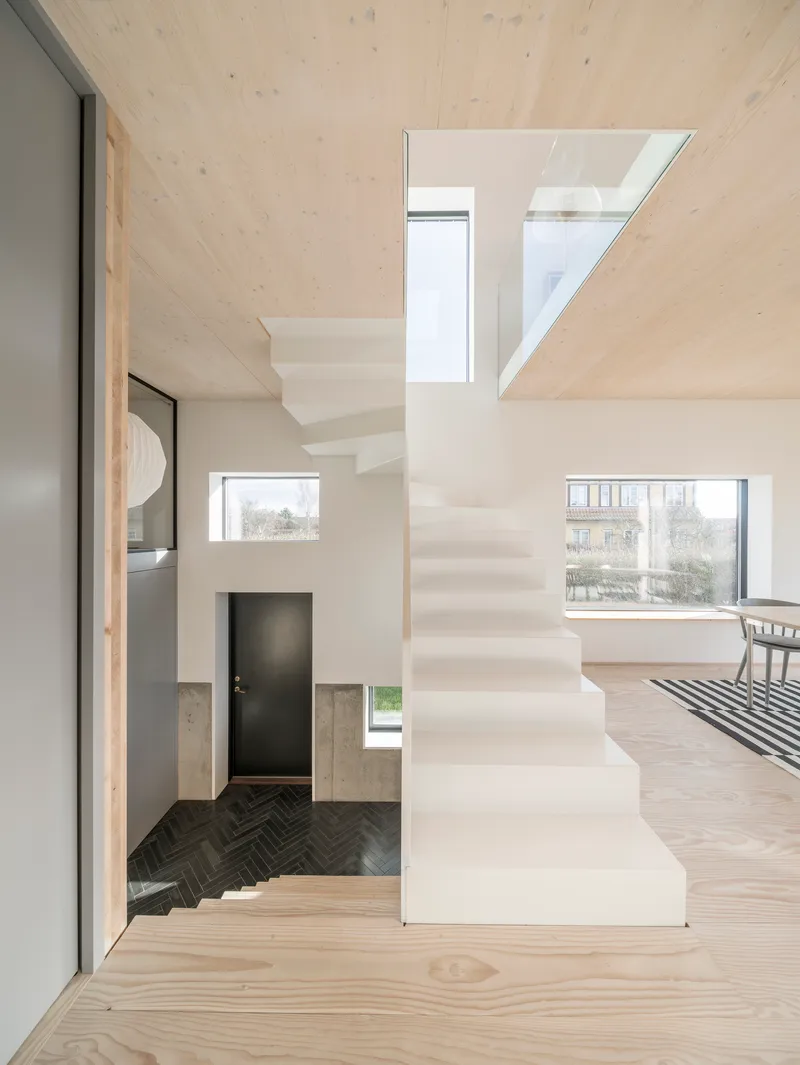
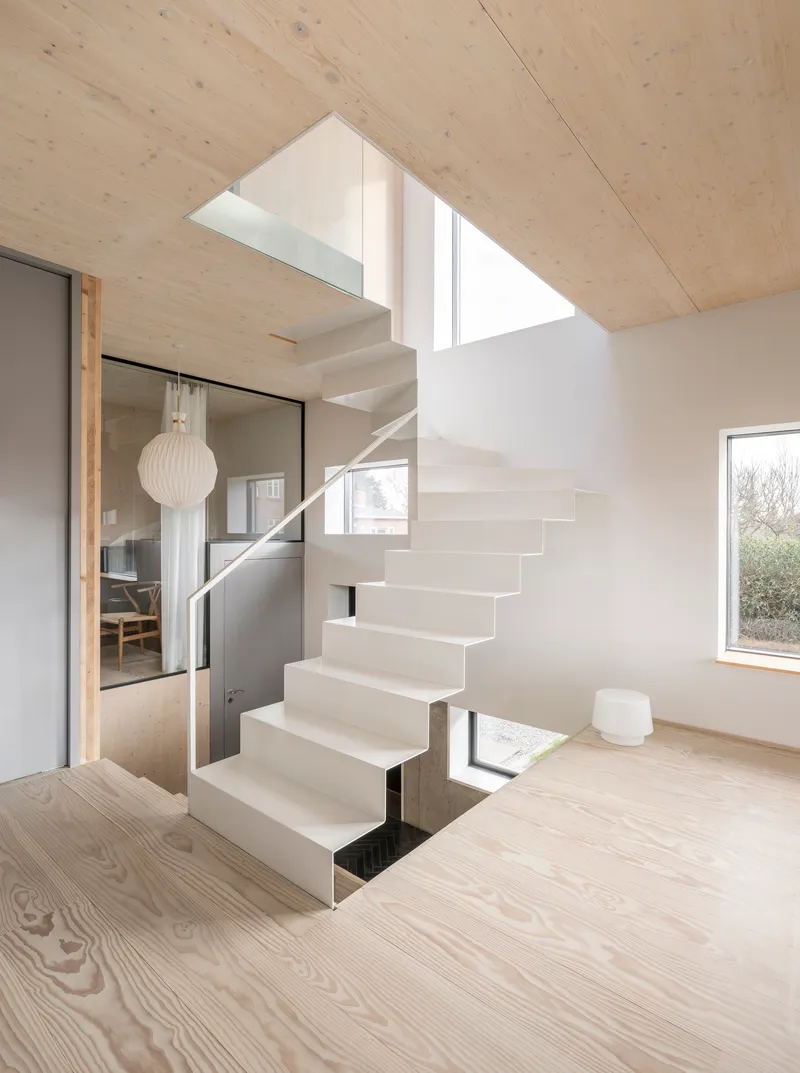
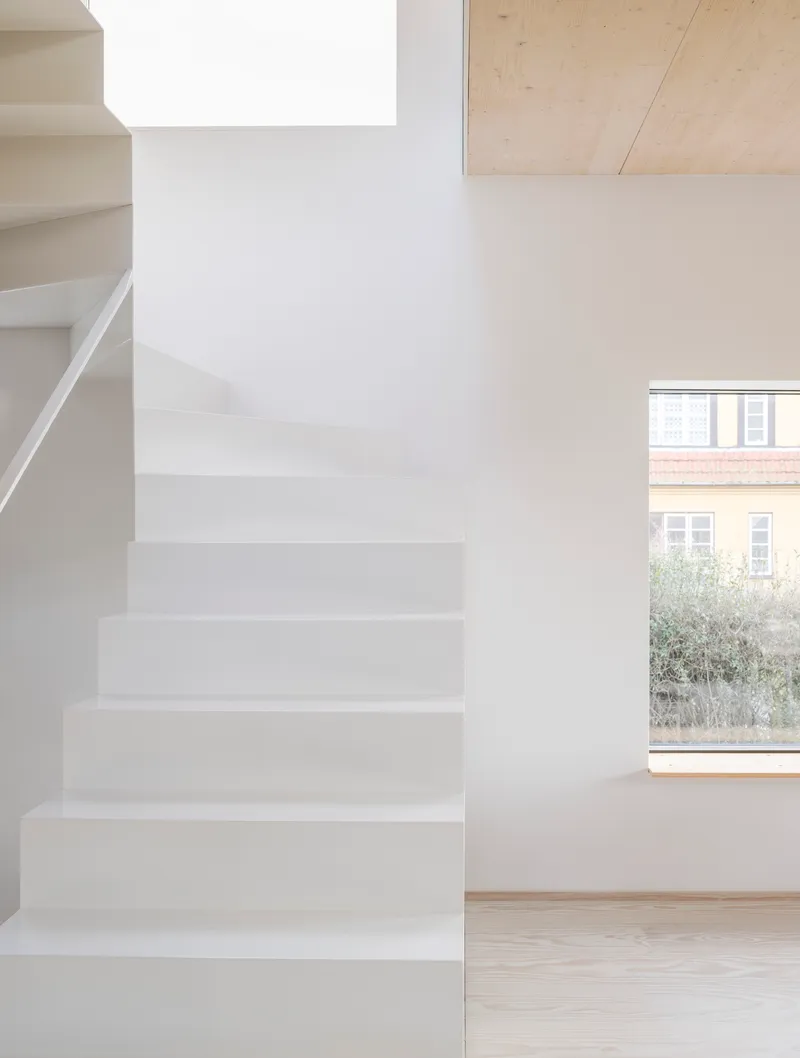
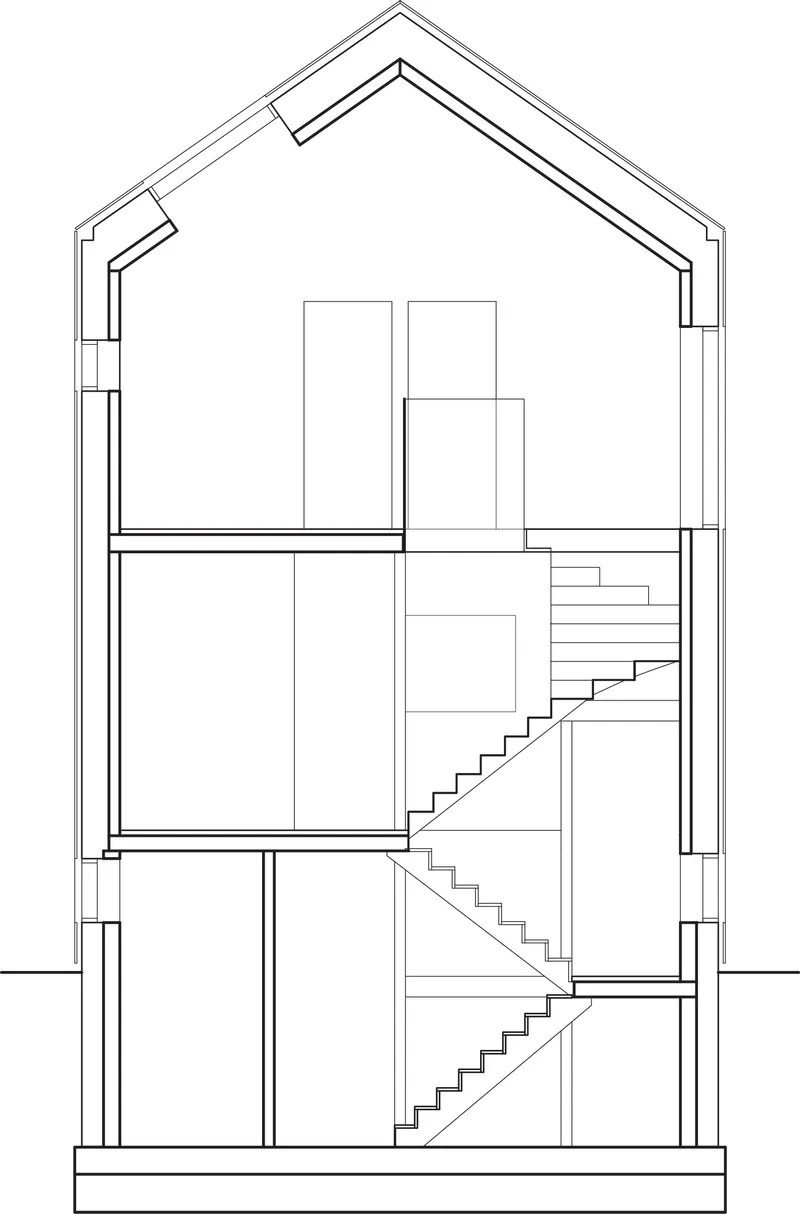
With only 60 square meters per floor, the section does most of the architectural work. A central staircase connects the high basement, ground floor, and upper floor while acting as a vertical light shaft. Skylights above the stair pull daylight deep into the plan, and a partial opening along the stairway enables natural ventilation through stack effect. The staircase itself is a clean white volume, its folded planes and metal handrail providing visual relief against the warm wood surfaces that define every other surface.
NORD placed the kitchen and dining area on the ground floor facing southwest, and the living room on the upper floor where it benefits from the pitched ceiling and longer views. Bedrooms sit on the north and east, receiving calmer, more diffuse light. The split-level arrangement means you are always moving between zones that feel distinct despite sharing a tight footprint. It is a house that feels larger than its numbers suggest, because the section never lets you see the whole interior at once.
Wood Inside and Out
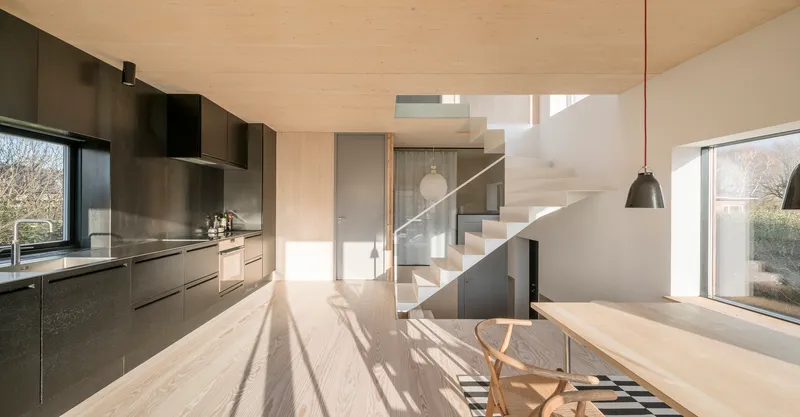
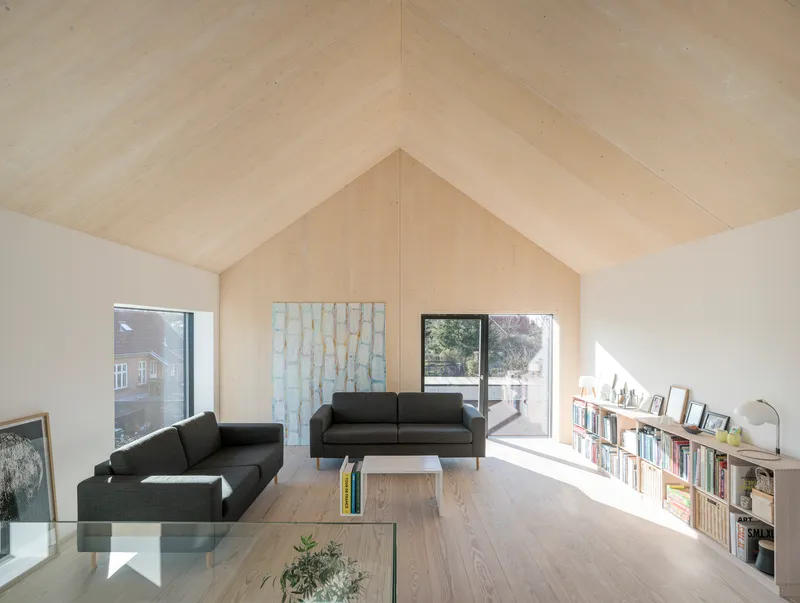
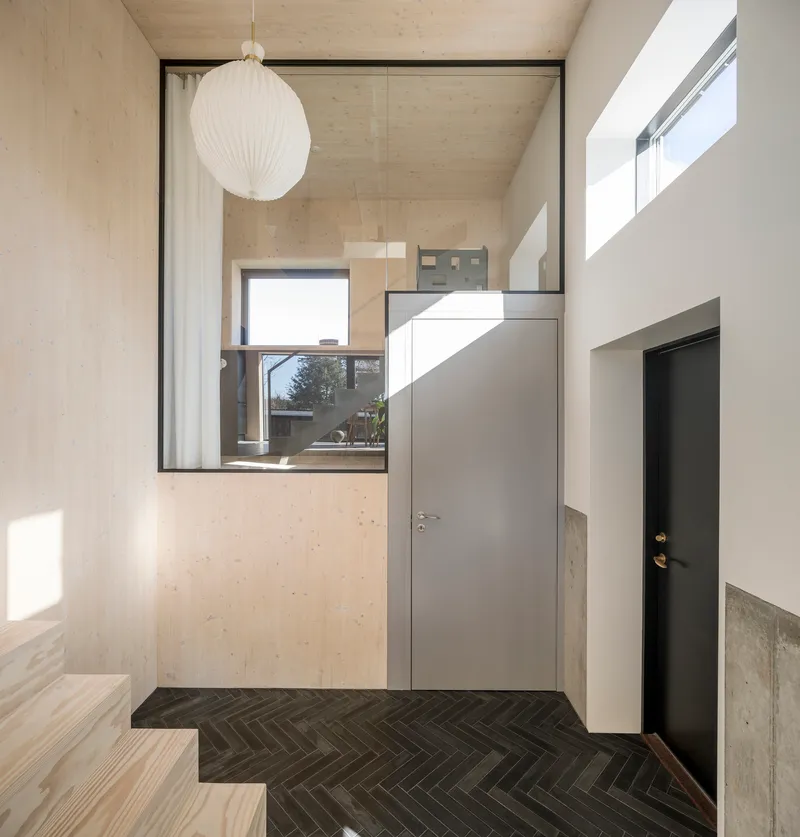
The interior treatment is deliberately minimal. CLT surfaces are finished with lye to lighten and protect the wood without concealing its grain. Plywood ceilings and walls create a warm, continuous envelope that reads as structure rather than decoration, because it is. The living room's vaulted ceiling follows the pitch of the roof, exposing the full geometry of the gable end while framing a terrace view through a generous opening.
Moments of material contrast are precise and intentional. Herringbone tile in the entry hall marks the threshold between exterior and interior. A poured concrete base appears at junction points, grounding the lighter wood above. The restrained palette, wood, white plaster, concrete, copper pipe, functions as a catalog of honest materials, each visible in its natural state.
Material Junctions and Construction Logic
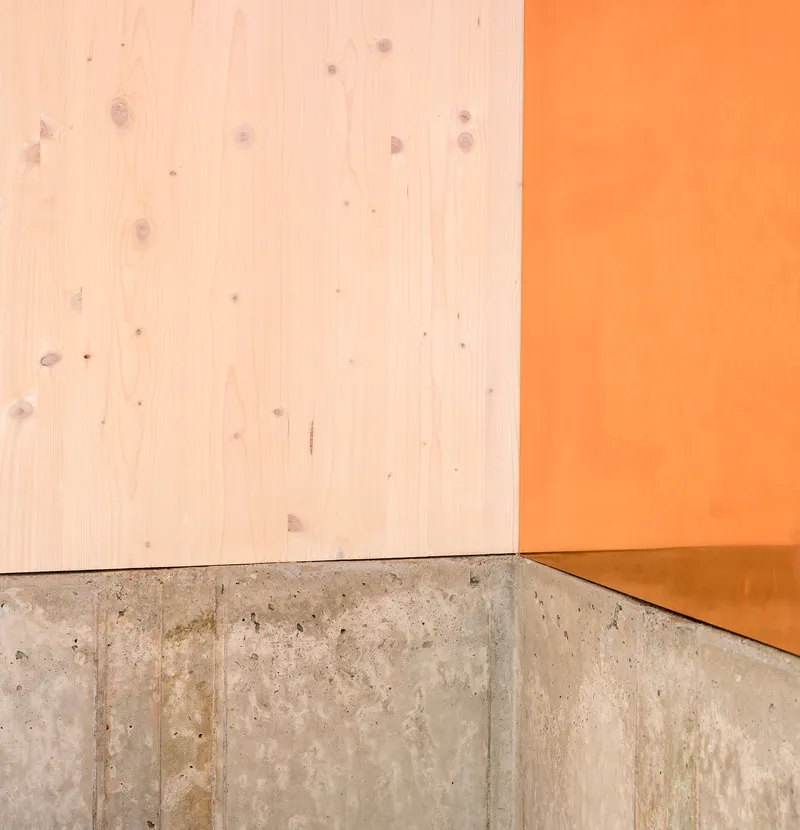
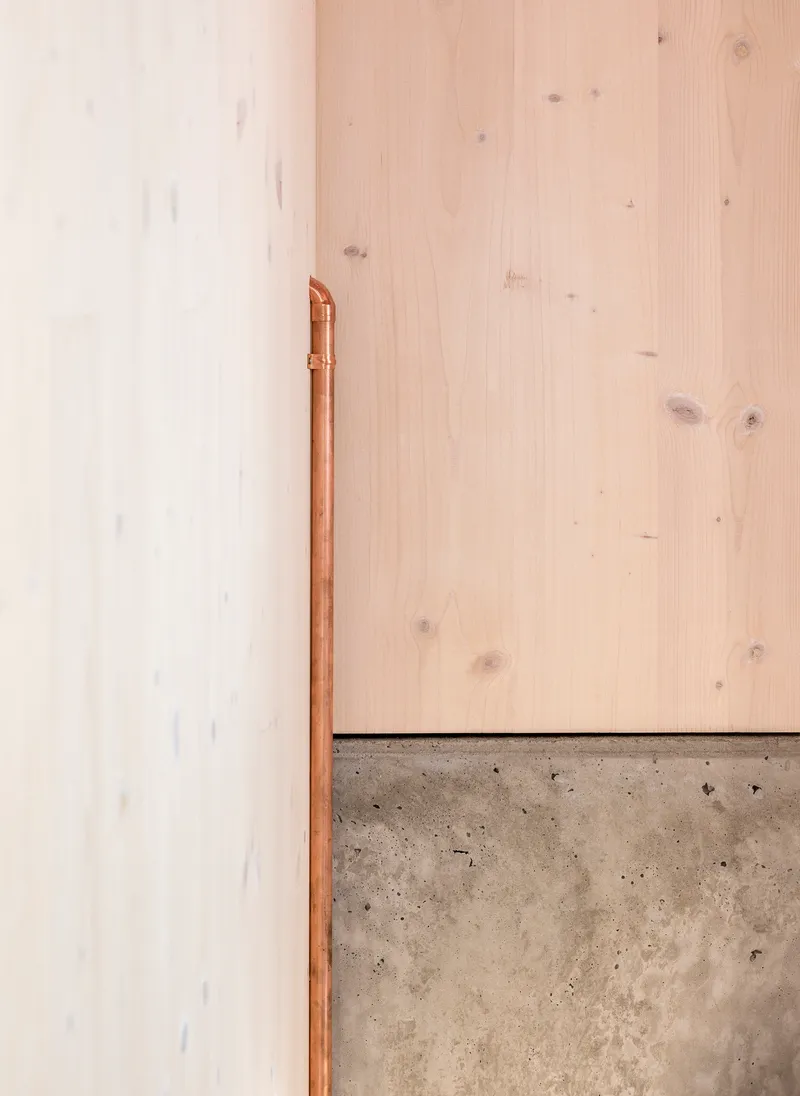
The close-up details reveal the craft behind the concept. Where light wood paneling meets an orange wall surface and poured concrete plinth, the joint is clean and legible. A copper pipe running vertically along a white wall above the concrete base suggests a building where every service run was coordinated with the structure, not fought against it. These are the details that separate a house designed for disassembly from one merely built of wood. If the elements are meant to come apart someday, every connection needs to be reversible, every layer distinguishable.
The garden facade confirms the overall discipline. Vertical cladding, an external timber stair, and the gabled roof form a composition that is spare without being severe. An evening sky behind the silhouette turns the house into a lantern, its scattered windows broadcasting warmth outward into the suburban darkness.
Passive Performance, Active Thinking
Villa Wood's sustainability is not a label applied after the fact. It is embedded in the orientation, the material selection, and the mechanical strategy. Large openings to the south and west harvest passive solar heat during the colder months. A heat exchanger recirculates energy, and underfloor heating on all three levels distributes warmth evenly through the compact volume. The CLT structure itself acts as a carbon sink, sequestering CO2 that would otherwise enter the atmosphere.
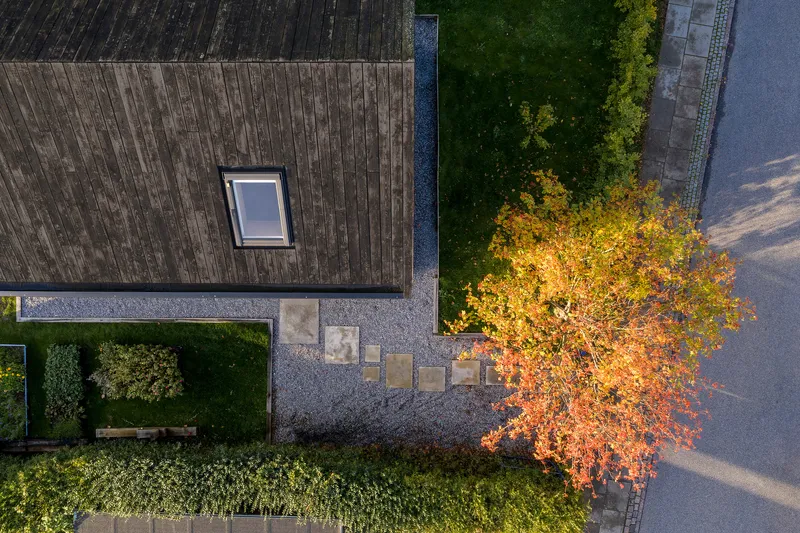
The overhead views show three skylights punctuating the pitched roof, feeding the central stairwell with zenithal light and reducing dependency on electric lighting during daytime. A gravel courtyard with stepping stones and a mature tree softens the boundary between house and street, creating an intermediate zone that is neither fully public nor fully private. It is a considered landscape move for a project that could easily have consumed its entire plot.
Plans and Drawings
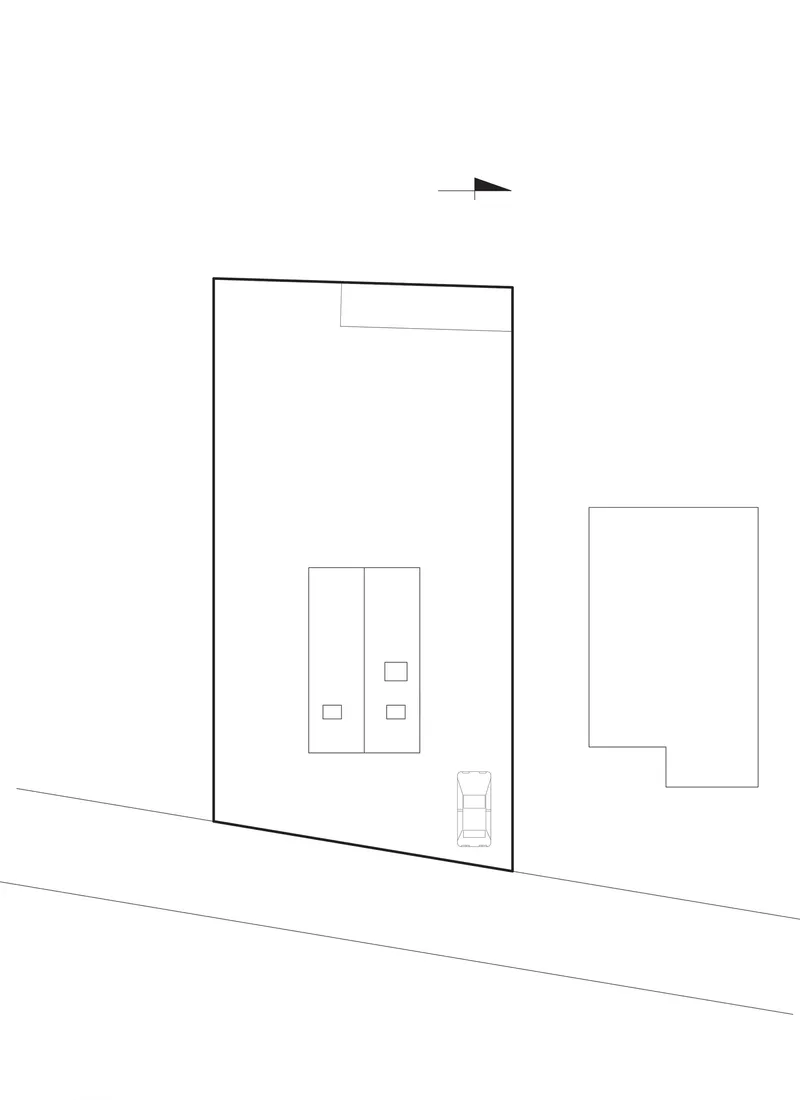
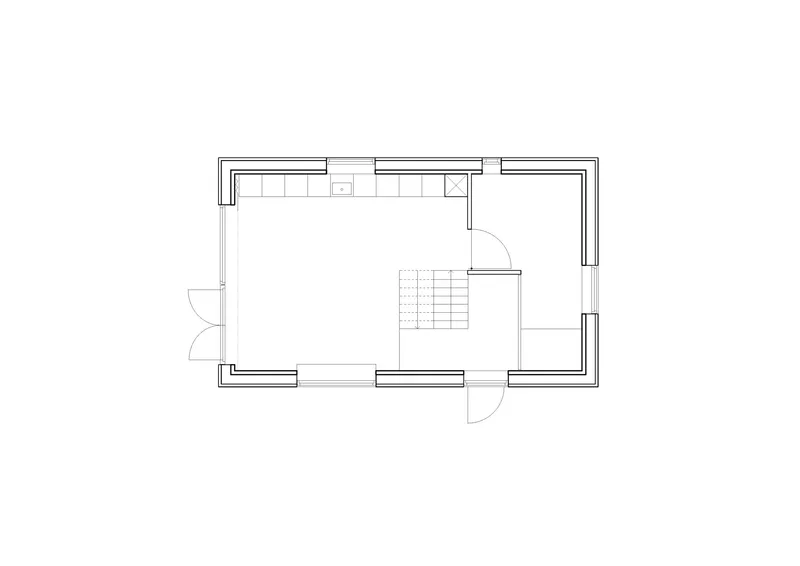
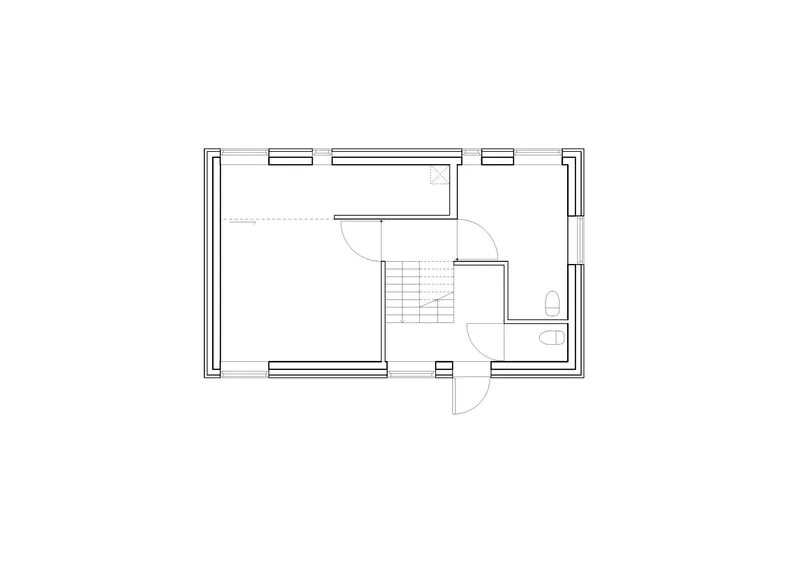
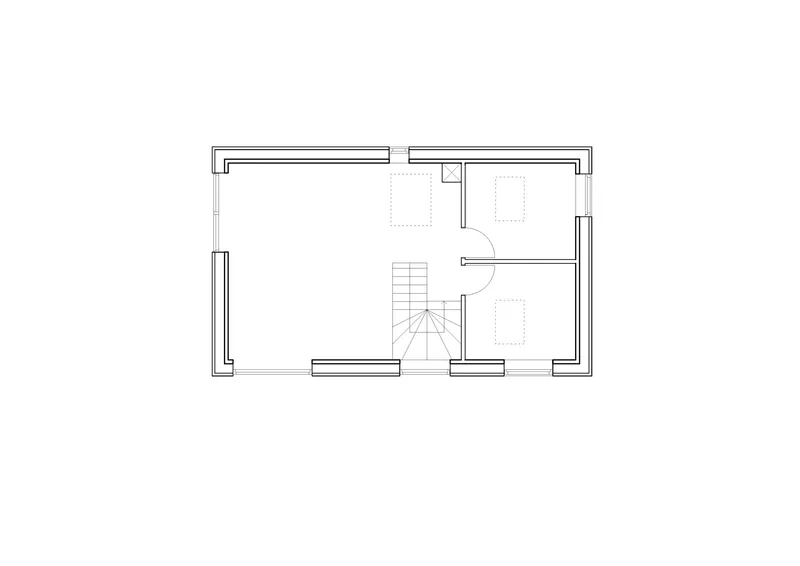
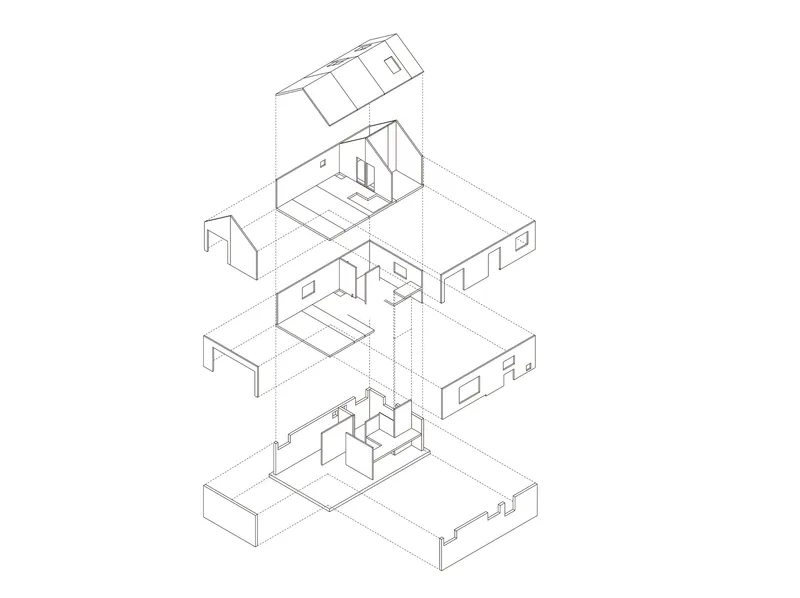
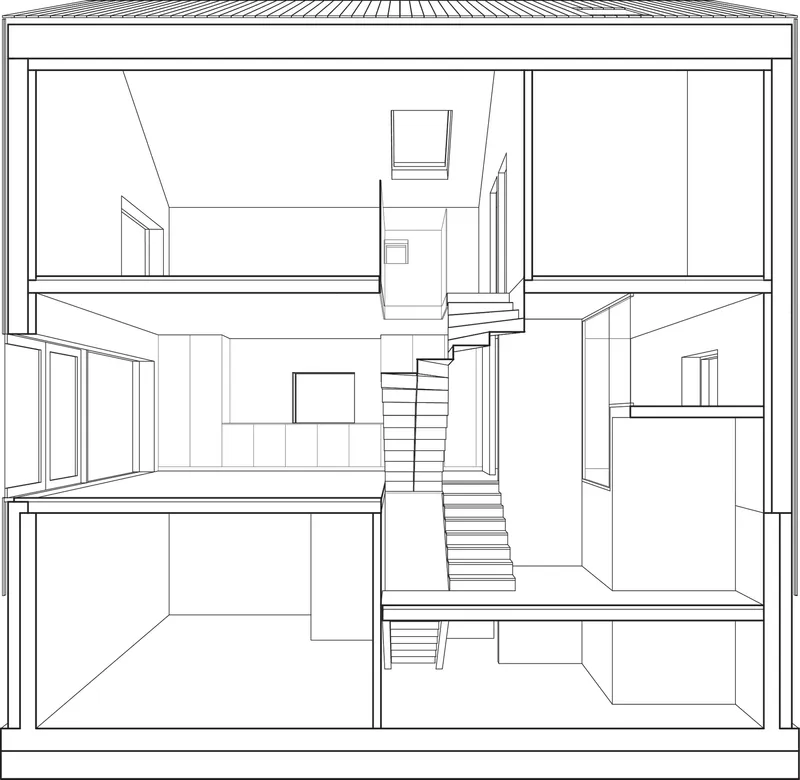
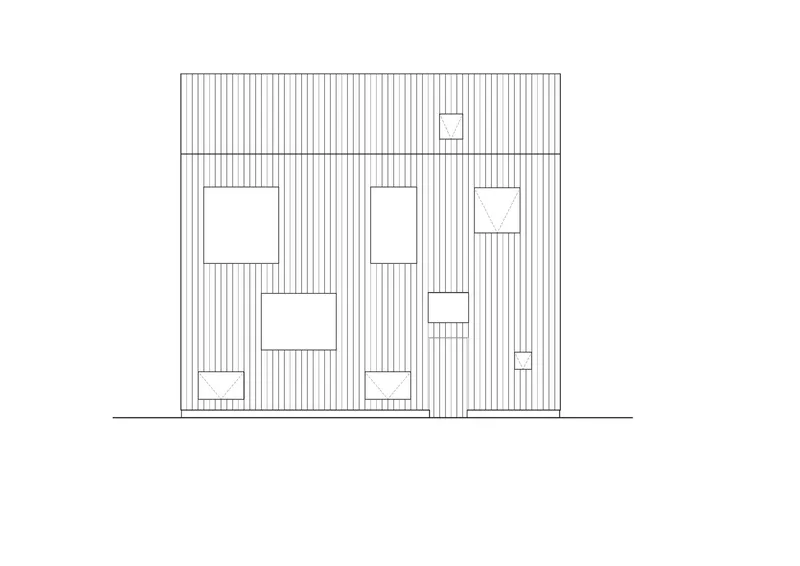
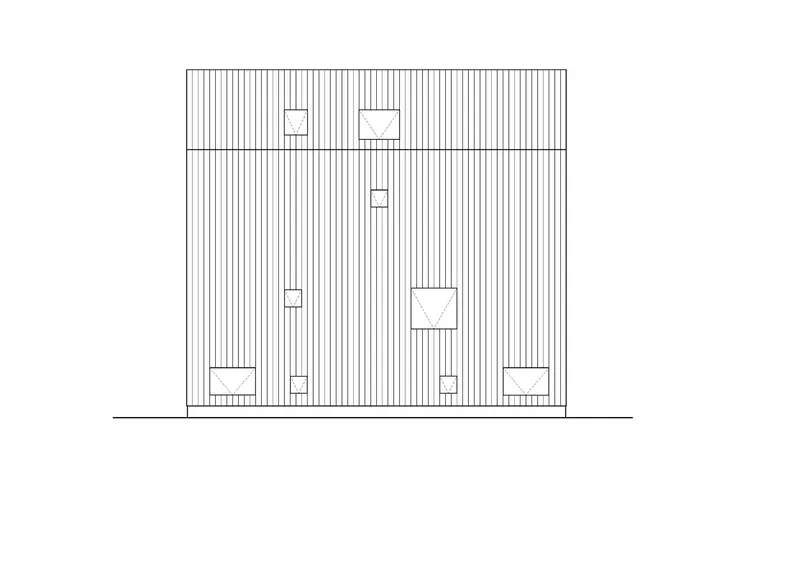
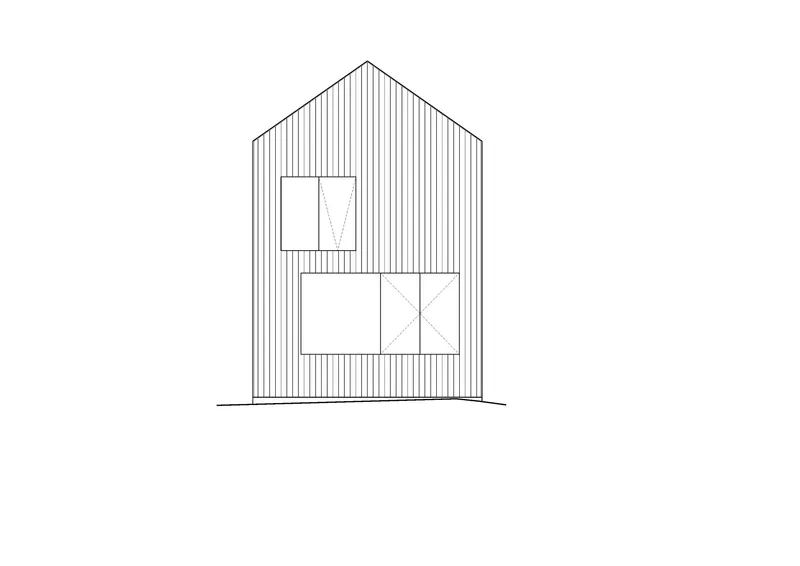
The drawings tell the full story of the stacking strategy. The site plan shows the compact footprint relative to neighboring buildings. Floor plans confirm the central staircase as the organizational spine, with rooms arranged around it in a pinwheel pattern that maximizes perimeter exposure on each level. The exploded axonometric is particularly revealing: it isolates each floor plate and shows how the stair connects distinct domestic zones, basement storage below, kitchen and dining at grade, living room and bedrooms above, into a continuous vertical sequence.
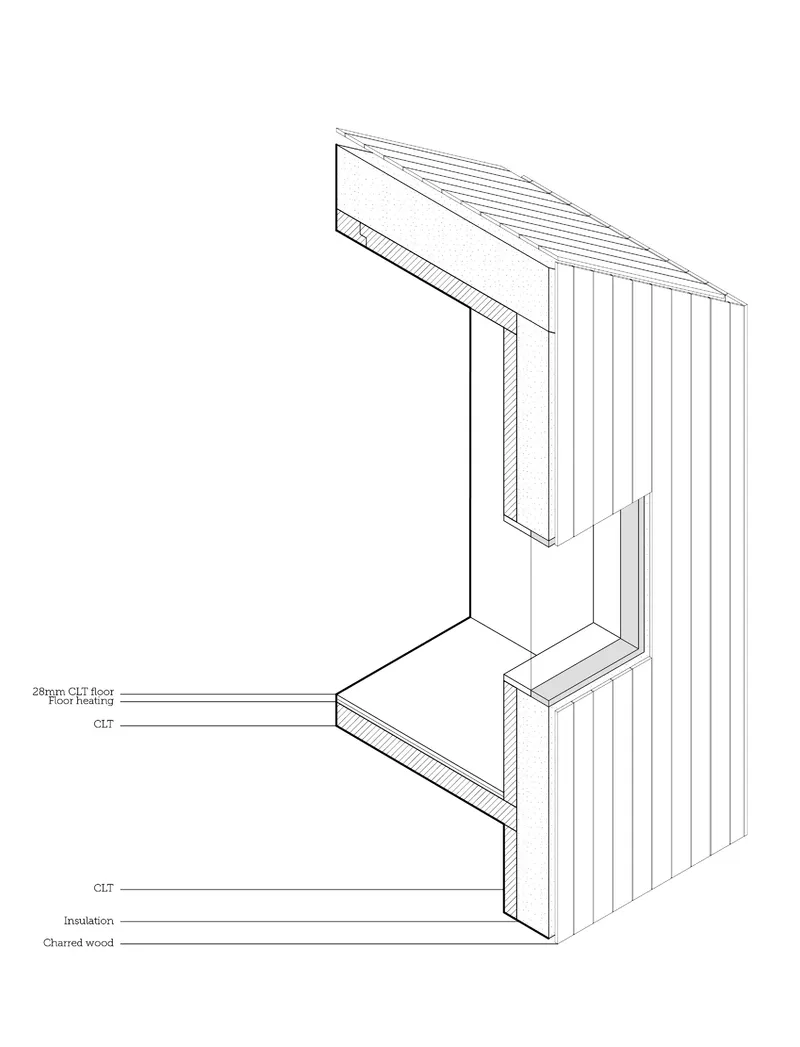
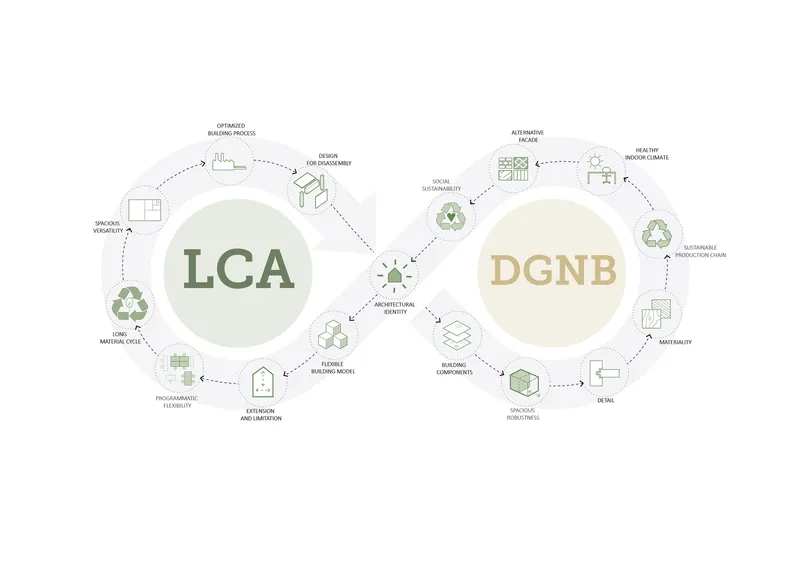
Sections through the house expose the split-level logic and the way the pitched roof creates a vaulted upper volume that would be impossible in a flat-roofed building of the same height. Elevation drawings document the asymmetric window distribution on each facade, confirming that the apparent casualness is actually choreographed. The detail drawing of the facade corner reveals the layered assembly: vertical cladding over a ventilated cavity, insulation, CLT panel, and interior finish. Every layer is distinct, every connection potentially reversible. The DGNB and LCA assessment diagram rounds out the technical picture, situating the house within a rigorous sustainability framework.
Why This Project Matters
Villa Wood matters because it refuses the false choice between contextual sensitivity and material innovation. It looks like a barn and performs like a prototype. NORD Architects did not need to invent a new form to advance a new construction method; they needed to demonstrate that mass-timber assembly, passive solar orientation, and design for disassembly can produce a house that a suburban neighborhood accepts without hesitation. That ordinariness is the project's radical proposition.
For architects working on the problem of residential carbon emissions, Villa Wood offers a transferable model. Its 60 square meter footprint could fit nearly any urban infill lot. Its CLT panels are CNC-machined and assembled in days, making the construction process replicable at scale. And its shou sugi ban cladding eliminates the need for chemical preservatives while giving the facade a lifespan measured in decades. When an architect builds their own house this carefully, it is worth paying attention. The ideas tested here will inevitably appear in their work for others.
Villa Wood by NORD Architects, located in Brønshøj, Copenhagen, Denmark. 180 m², completed 2019. Photography by Adam Mørk.
About the Studio
Share Your Own Work on uni.xyz
If projects like this are the kind of work you want to make, uni.xyz is a place to publish your own, find collaborators, and enter design competitions.


Popular Articles
Popular articles from the community


Tsunami Convergenics: Turning Catastrophic Ocean Forces into Underwater Housing Infrastructure
A speculative underwater settlement off the coast of Onagawa, Japan, treats tsunamis and typhoons as energy sources rather than threats.

Opera on the Sea: Driftwood Logic Shapes a Timber Opera House on Estonia's Coast
Trevor Orgill's opera house translates the entangled drift of floating timber into a civic building where wood, water, and music converge.

Extended Shell: Retrofitting Kolkata's Balconies as Living Urban Thresholds
A modular retrofit system recovers the social and environmental intelligence of Kolkata's historic verandas for contemporary Park Street residents.

Faces of the Soviet Avant-Garde: Turning Moscow's Street Names into an Open-Air Museum
A network of sculptural installations across a Moscow residential district transforms forgotten architect names into spatial encounters with cultural memor

Similar Reads
You might also enjoy these articles

Bao Huynh Watercolor Atelier: A Serene Art Retreat in Hội An
Bao Huynh Watercolor Atelier in Hội An blends multifunctional art spaces, sustainable design, local materials, and family-friendly living in a serene environment.

Atelier Macri Concept Store Interior Design by CASE-REAL
Atelier Macri store features a "ko" counter, walnut wood details, cork displays, blending retail, gallery, and seamless customer experiences.

Manuel Vargas Izquierdo Stadium and High-Performance Sports Center: Architectural Excellence in Jalpa de Méndez
The Manuel Vargas Izquierdo Stadium blends sustainable design, inclusive sports facilities, and cultural-inspired architecture, revitalizing Jalpa de Méndez’s public spaces.

KAKR Buluh Awar Hall: Revitalizing Community and Ecology Through Bamboo Architecture
Community built bamboo hall revitalizes Buluh Awar village, empowering youth, restoring ecology, celebrating vernacular craftsmanship through sustainable architecture and culture.


Comments (0)
Please login or sign up to add comments
No comments yet. Be the first to comment!