
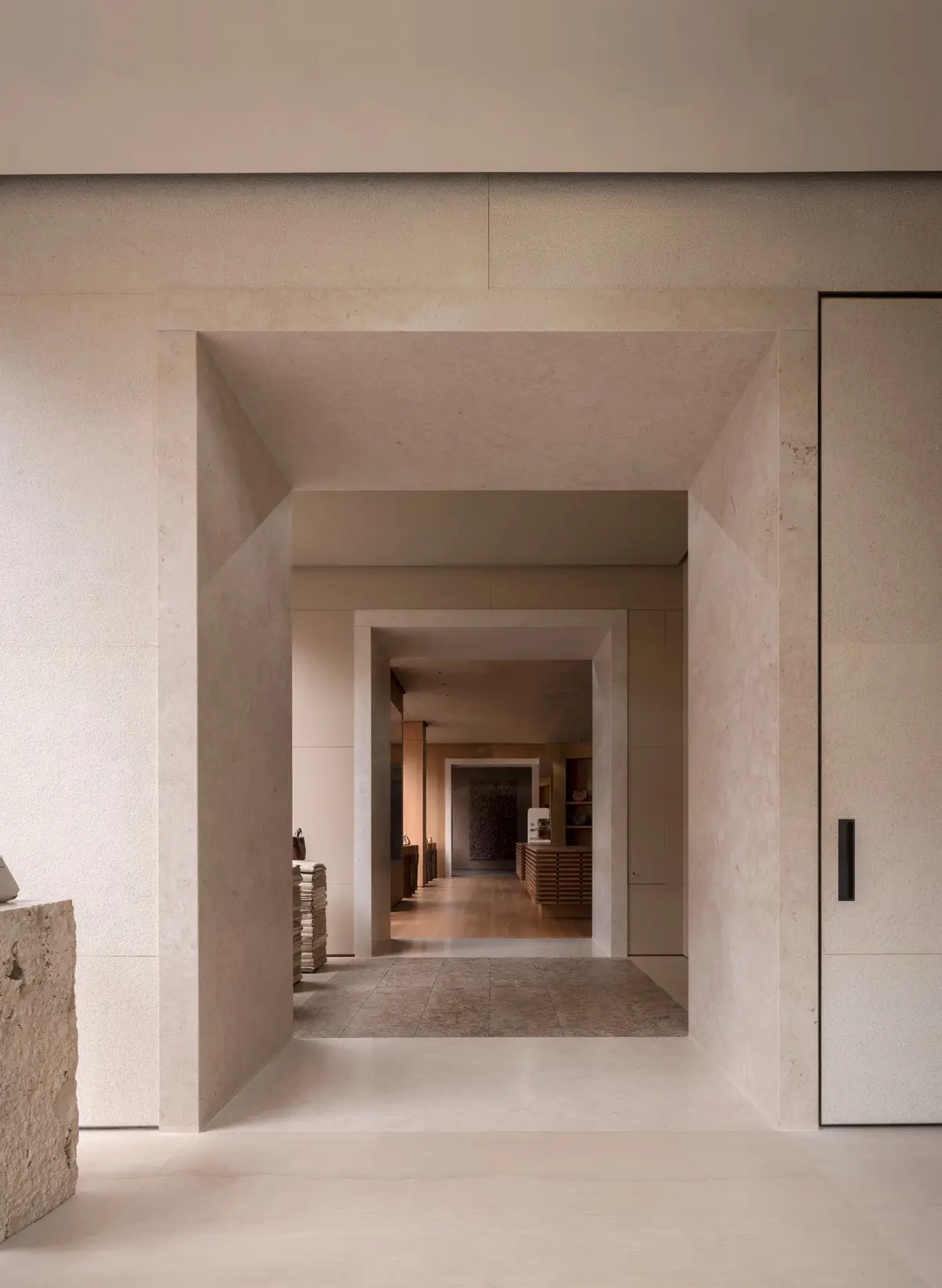
NORM Architects Unfolds a Milanese Flagship for Polène as Five Rooms of Raw Material
On Via Manzoni, a 343-square-meter enfilade of stone, leather, timber, clay, and textile rooms redefines luxury retail in Milan.


Luxury retail has a habit of defaulting to a single gesture: one hero material, one mood, one note. The new Polène flagship on the corner of Via Manzoni and Via Pisoni does the opposite. Designed by Copenhagen-based NORM Architects, the 343-square-meter store occupies the ground floor of a 1950s office building in Milan's Quadrilatero della Moda, directly opposite Armani/Libri. Rather than treating the elongated floor plate as a single open volume, the architects divided it into five distinct rooms, each governed by a single material family: stone, leather, timber, clay, and textile. The result is a retail interior that works more like a gallery promenade than a shop floor.
What makes this project genuinely interesting is the commitment to sequential experience. NORM borrowed the enfilade, a layout endemic to Milanese palazzo interiors, where rooms connect along a single axis and each threshold offers a framed view of the next. Here, that classical spatial device becomes a merchandising strategy and a sensory one. As visitors move deeper into the store, the palette shifts from light to dark, and each material evolves from raw to refined. It is an architecture of accumulation: you feel more the further you go.
The Threshold: Bronze, Stone, and a Milanese Disguise
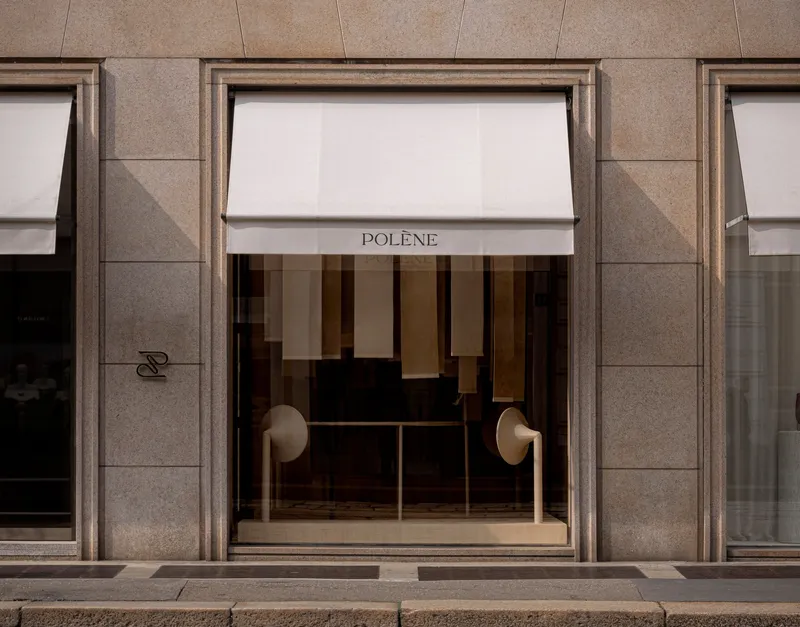


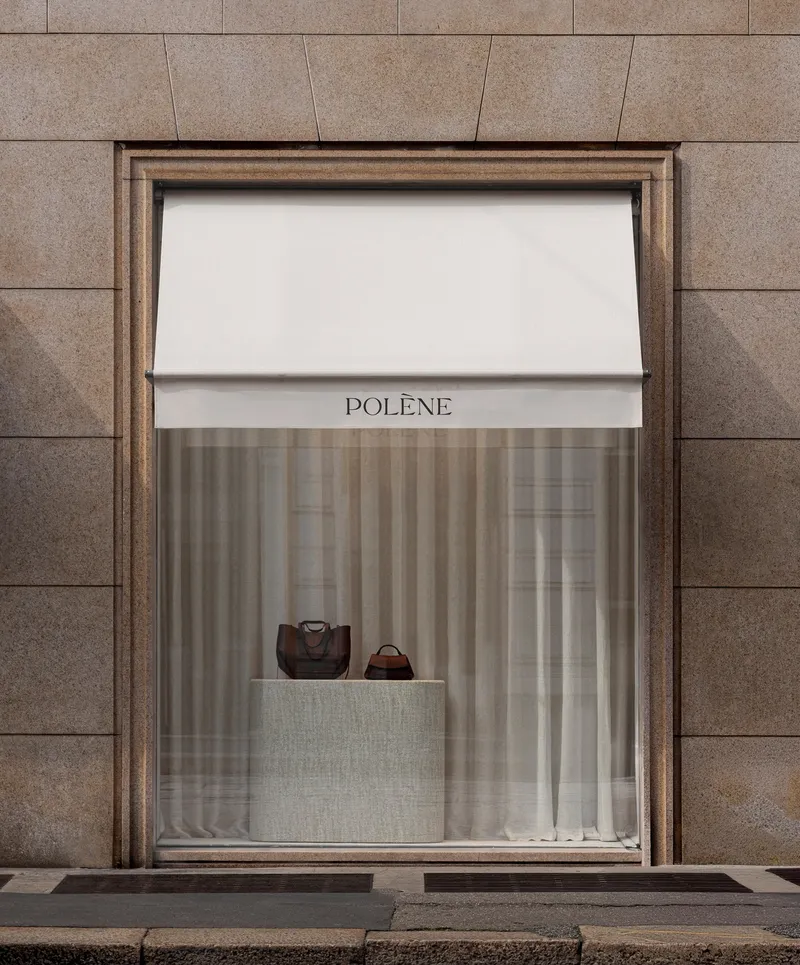
Milan's architectural tradition prizes restraint on the outside and richness within. NORM respects the contract. The storefront is almost deliberately quiet: bronze-framed glazing, white canvas awnings, and ashlar stone panels that blend into the building's cream stucco envelope. The corner condition is handled with two openings rather than one panoramic window, keeping the scale intimate and the proportions aligned with the existing fenestration of the 1950s block.
A passing tramcar, the ornamental balustrading above, the fabric awnings below: nothing signals spectacle. The entrance promises calm, not theater. That deliberate understatement is the first design move and arguably the most important. It sets expectations low enough that the interior sequence can genuinely surprise.
The Stone Room: Travertine and Limestone Set the Opening Chord
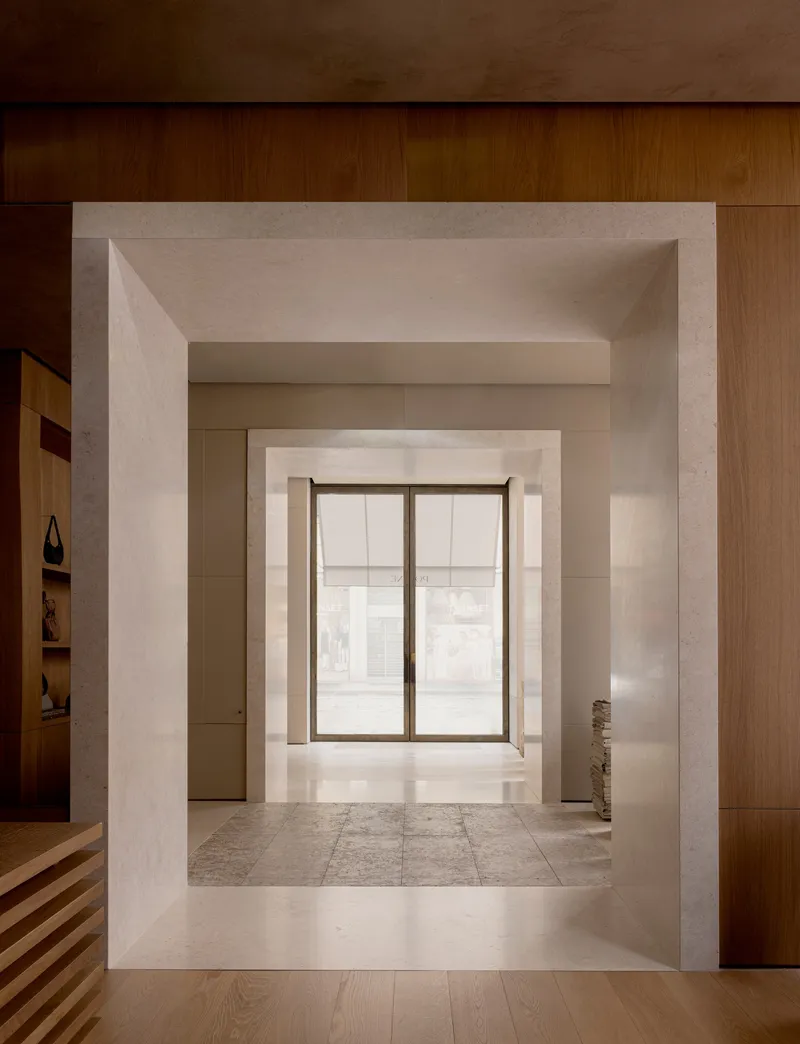
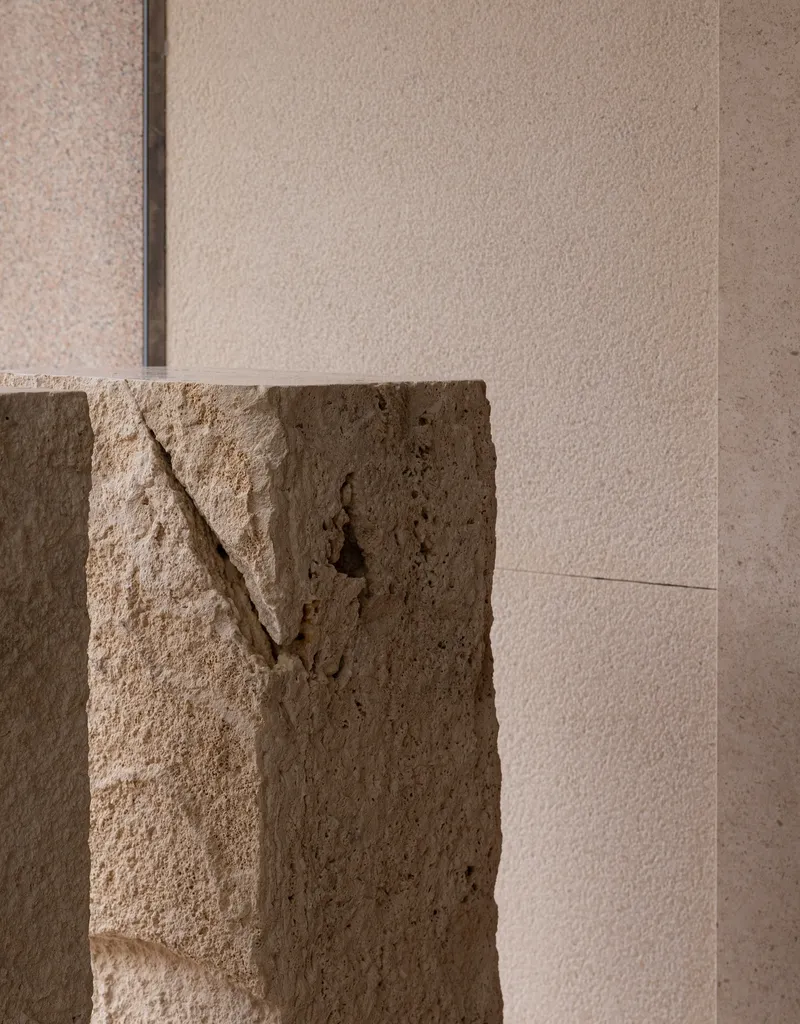

Step inside and the first room belongs to stone. Raw travertine blocks sit as plinths beneath ceramic vessels by Italian artist Clara Graziolino, while smooth limestone panels line the walls. The material duality is immediate: rough against polished, geological against architectural. Thick stone portals frame the view through to the next room, establishing the enfilade axis that will carry you through the entire plan.
The ceiling is kept deliberately low and uniform, with recessed linear lighting that washes the stone without dramatizing it. NORM lets the texture do the work. The detail where rough-cut travertine meets a honed limestone panel is handled with a clean butt joint, no shadow gap, no trim. It reads as two geological strata meeting in the same wall, which is exactly the kind of quiet bravery that makes material-led interiors succeed or fail.
The Enfilade as Retail Choreography

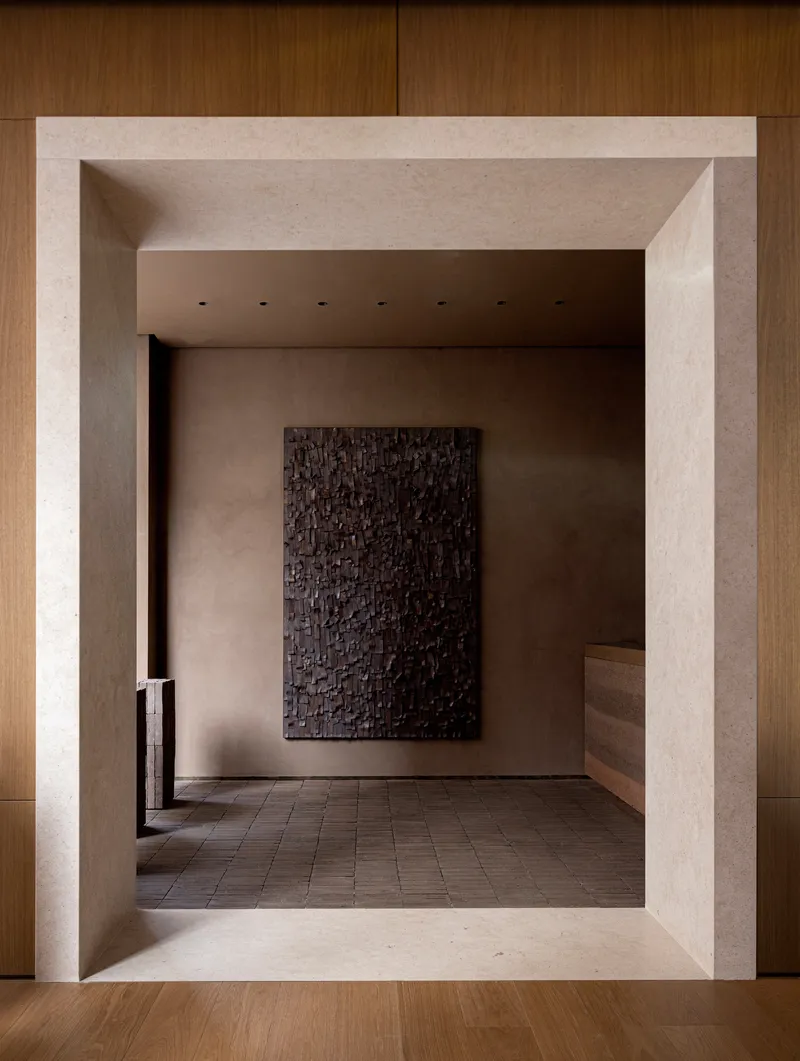

The enfilade is the structural idea of the entire project. Thick portal frames, carved from stone and finished in a warm limestone, create a rhythmic sequence of compressions and expansions. Standing at one end, the view telescopes through beveled thresholds, each opening revealing a slice of the room beyond. The effect is cinematic: depth, layering, anticipation.
It also solves a practical problem. An elongated ground-floor unit risks feeling like a corridor. By inserting these portals, NORM breaks the plan into legible rooms without ever closing the sightline. You always know where you are relative to the whole. The brass-edged door frames add a metallic warmth to the transitions, picking up the bronze of the exterior and threading a continuous material accent through the sequence.
Timber and Leather: Warmth Deepens in the Middle Rooms


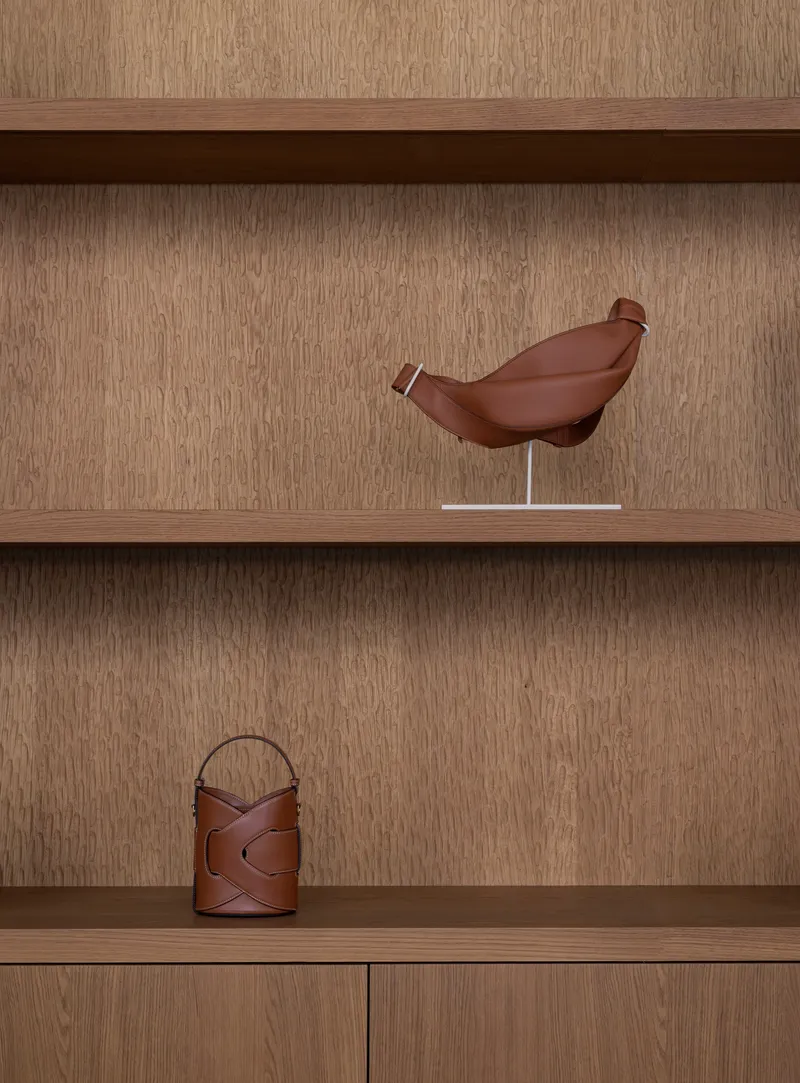
The timber room is the volumetric heart of the store. Oak surfaces wrap walls, floors, and furniture in a continuous grain. Display counters use a horizontal slat base that recalls traditional woodworking benches, while a curved shelving wall in oak veneer holds sculptural objects alongside Polène's leather goods. The merchandise and the architecture share a material sympathy: both are exercises in shaping natural surfaces.
In the leather room, the floor itself becomes compressed leather, and display plinths combine finished wood with raw bark. The bark pedestals are a sharp detail. They force a visual connection between the tree and the finished panel, between the animal hide and the polished handbag. NORM is consistently interested in showing material before and after human intervention, and the retail context gives that idea commercial relevance: you understand what you are buying because you see where it comes from.
Clay and Brick: The Back of House Becomes the Point
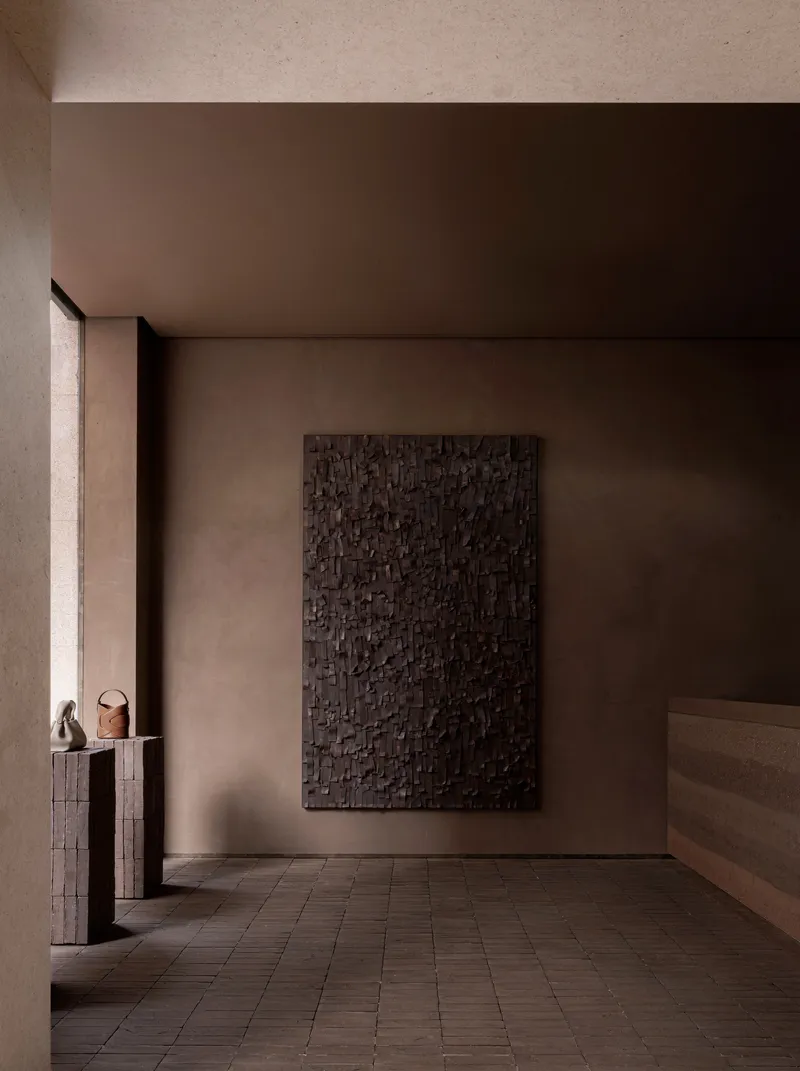


By the time you reach the clay room, the palette has darkened noticeably. Brick tile flooring, clay plaster walls, and a rammed earth counter ground the space in earth tones. A dark textured relief panel, almost geological in its layering, occupies one wall like a painting. The atmosphere shifts from gallery to workshop, or perhaps chapel.
A curved alcove with irregular beige tile mosaic adds a moment of decorative intensity. The terrazzo flooring at the transitions between rooms is handled with diagonal joints that feel deliberate rather than decorative, marking the threshold between material worlds. This room houses the payment area, and the rammed earth counter gives the transaction a certain gravity. You pay at a surface that took patience to build.
The Textile Room and the Art of Privacy
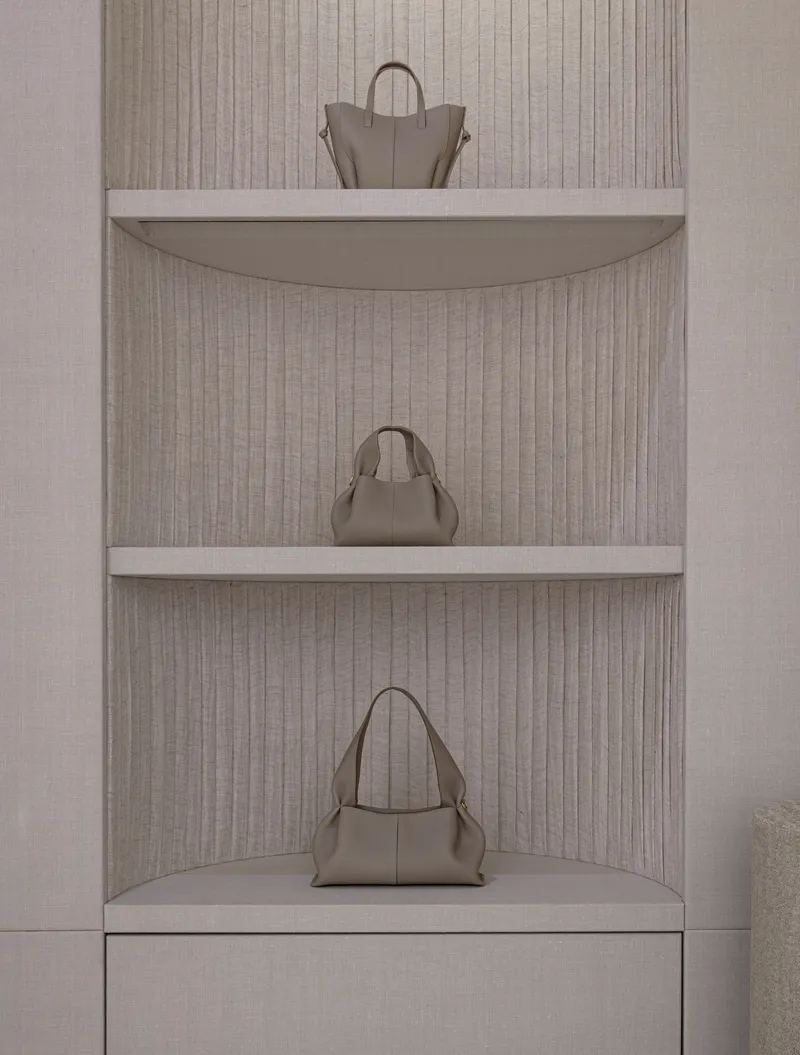


The final room is the VIP space, and it operates on different rules. Fabric-lined surfaces, linen curtains, and upholstered furniture replace the hard materials of the preceding rooms. A rounded sofa sits beneath textured wall panels with embossed lettering. The effect is hushed, even intimate, like stepping from a museum into a private library.
Curved corner shelving niches with fluted linen backing display handbags as though they were rare editions. The architecture here is no longer about geology or craft; it is about comfort and discretion. NORM understands that luxury eventually resolves into softness, and the sequential plan earns that resolution. The textile room would mean less if you hadn't first walked through stone.
Details That Earn Their Keep

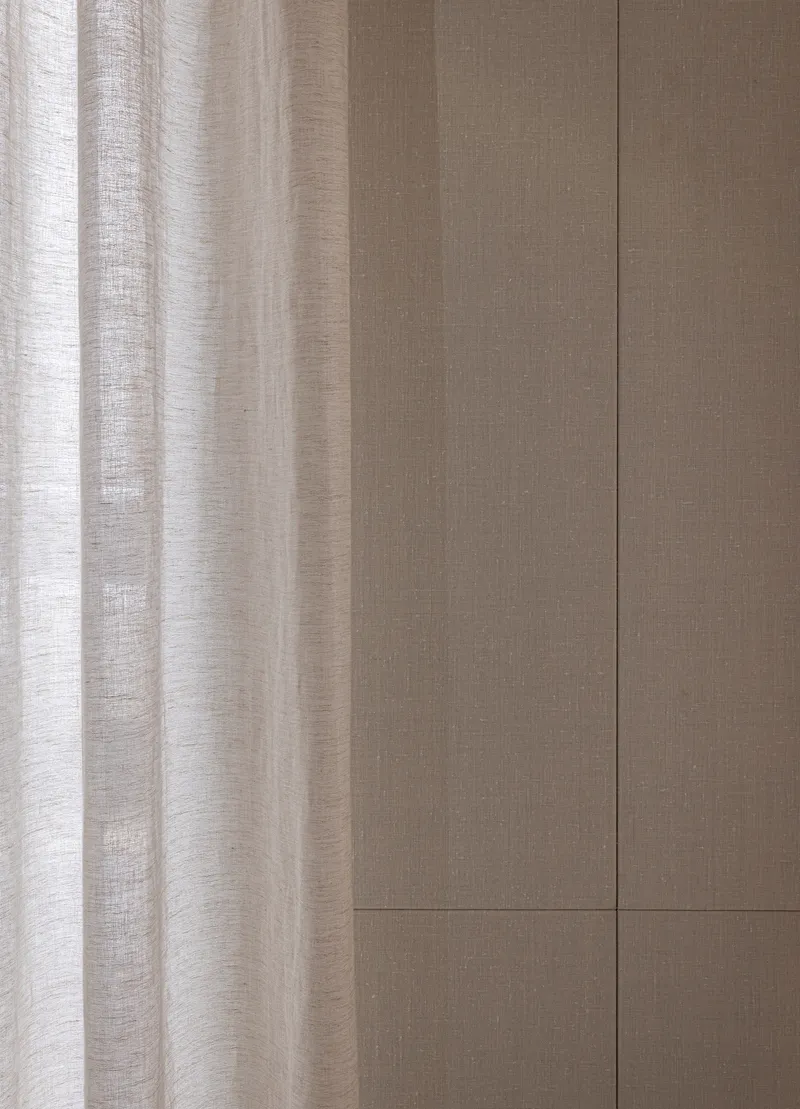

The project's credibility rests on its details. A dark wooden relief sculpture meets smooth taupe plaster with shadow precision. Grooved oak wall panels line up with horizontal joints so clean they could be cabinetry. A bronze doorbell plate with a brass button is set into textured fabric wall covering, its circular geometry echoing the hardware on Polène's bags without ever stating the connection outright.
These are not decorative flourishes. They are the moments where the concept of material evolution is tested at full scale. When a linen curtain meets a grooved oak panel in natural light, the two materials speak to each other across the gap between room identities. NORM trusts the viewer to notice, which is a form of respect that most retail interiors forgo in favor of louder gestures.
Quiet Niches and Ceramic Punctuation


Along the main axis, recessed niches with curved soffits punctuate the wall at intervals. Some hold ceramic vessels by Graziolino, whose work deliberately evokes the texture of leather. Others frame cylindrical pedestals with nothing on them, allowing the architecture to breathe. These alcoves function as visual pauses in the enfilade, moments where the eye can rest before the next room reveals itself.
The window displays facing Via Manzoni are handled with sheer curtains and bronze frames, filtering daylight into the stone room without dissolving the interior's controlled atmosphere. The curtain is doing double duty: it softens the commercial presence on the street while introducing natural light as a variable that changes through the day. Architecture that accommodates time is architecture that people return to.
Why This Project Matters
Retail architecture is often treated as a disposable category, something built to a brand cycle and dismantled when the next season arrives. The Polène flagship resists that by investing in materials and spatial ideas that belong to Milan's longer architectural memory. The enfilade is not a novelty; it is a tested format for organizing sequential experience. NORM's innovation is in assigning each room a single material identity and allowing the gradient from light to dark, raw to refined, to do the storytelling that graphic branding usually handles.
The store also makes a quiet argument about what luxury means in a physical space. It is not about surface polish or brand logos repeated at scale. It is about the shift from travertine to compressed leather to rammed earth beneath your feet. It is about thresholds thick enough to pause in. NORM Architects have given Polène a flagship that functions as a material primer, and that primer will outlast several seasons of handbag collections. That is, if the industry is paying attention, the real luxury.
Polène Flagship Store by NORM Architects. Milan, Italy. 343 square meters.
About the Studio
Share Your Own Work on uni.xyz
If projects like this are the kind of work you want to make, uni.xyz is a place to publish your own, find collaborators, and enter design competitions.


Popular Articles
Popular articles from the community


LT2A and OPEN Architectes Thread a Brick and Glass High School Through a Wooded Belgian Campus
In Braine-l'Alleud, a 3,000 m² wing for Collège Cardinal Mercier pairs pale brick with a glazed colonnade, deferring to a small chapel and a dense wood.

U.GA Architects Wraps an Oval Rooftop Pool in Curved Board-Formed Concrete on Busan's Jeollidan-gil
In Busan's Jeonpo-dong, a 454 m² mixed-use block stacks a neighborhood facility, guest rooms and an oval rooftop pool inside spiraling concrete walls.

Cube Design Draws an Ecological Corridor Between Two Shenzhen Hills with the Nankai Building
Beside Shenzhen's container docks, the Nankai Building pairs stacked balconies with a climbing green screen to connect two hillsides across its height.

Juan García Correa, John González and Claudia Rueda Sink a Circular Amphitheater into a Manizales Engineering Building
On the La Nubia campus in Manizales, Colombia, the S1 Building folds labs and offices into a hillside of ramped lawns that double as a campus route.

Similar Reads
You might also enjoy these articles


LAVA Architecten Gives Vocational Education a Sawtooth-Roofed Face on a Mechelen School Campus
In Mechelen, Belgium, a 2,053 m² STEM school on a 6×6 m grid turns workshops and classrooms into rooms that can be rearranged as teaching changes.

KEMA Studio Turns a Derelict Marvila Attic into a 60 m² Lighthouse Apartment Above Lisbon
In Lisbon's Marvila district, a rebuilt roof, four skylights and two plywood volumes turn an unlivable attic into a bright home facing the Tagus.

Pixel Gardens: One Repeated Module Stacked Into a Terraced Social Housing Tower for Famagusta
Salem Bader's shortlisted housing tower builds a vertical neighbourhood from one repeated module, offsetting units to carve terraces, light and air.

Bao Huynh Watercolor Atelier: A Serene Art Retreat in Hội An
Bao Huynh Watercolor Atelier in Hội An blends multifunctional art spaces, sustainable design, local materials, and family-friendly living in a serene environment.

Explore Shopfront Competitions
Discover active competitions in this discipline

VR headsets Storefront design competition

Bring back Drive In's
Comments (0)
Please login or sign up to add comments
No comments yet. Be the first to comment!