
Octavia Hill: Social Housing as Sculptural Form
Studioninedots shapes a 9,500 m² social housing block in Hoofddorp into an abstract, wedge-like centrepiece clad in pale green tile.


Social housing rarely gets to be the protagonist of a masterplan. More often it fills in the background, clad in whatever the budget allows, shaped by setback rules rather than formal ambition. Octavia Hill, the centrepiece of Hyde Park Hoofddorp, inverts that hierarchy. Designed by Studioninedots and completed in 2025, the 9,500 m² building is unapologetically sculptural: a wedge-shaped volume whose diagonal roofline and pale green skin give it the presence of a public institution rather than a residential block.
What makes the project genuinely interesting is how its formal assertiveness serves social rather than commercial ends. The stepping mass, the generous balconies, the carefully detailed entrances: all of these gestures are deployed for affordable housing residents. Studioninedots treats the programme as an opportunity to prove that collective living can be given the same care typically reserved for premium developments. Named after the Victorian housing reformer, the building carries that ethos into its materiality and massing.
A Wedge That Commands Attention
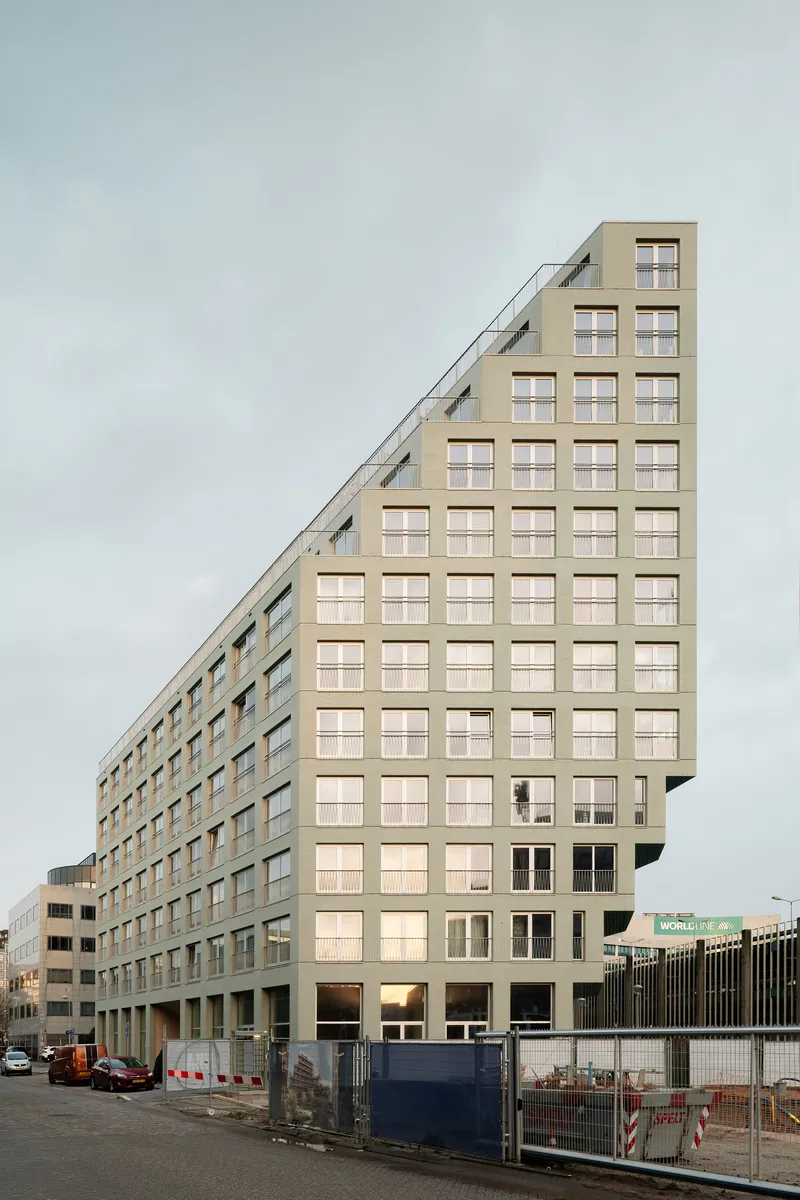
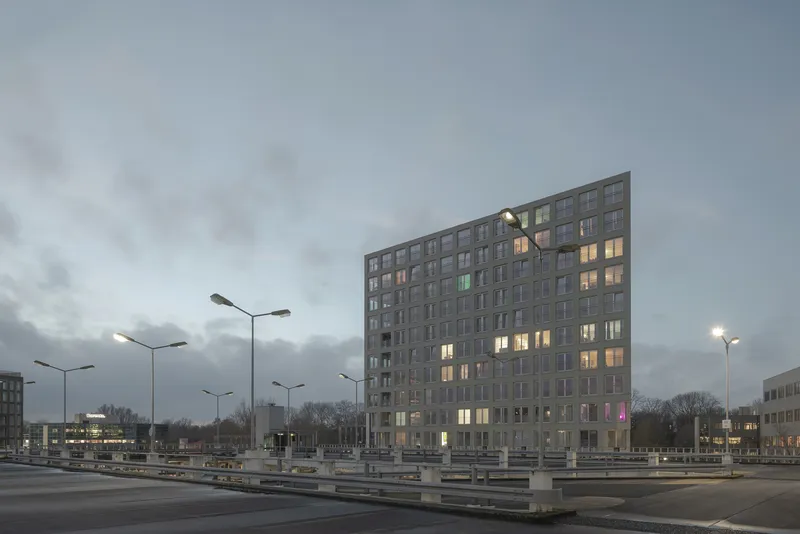
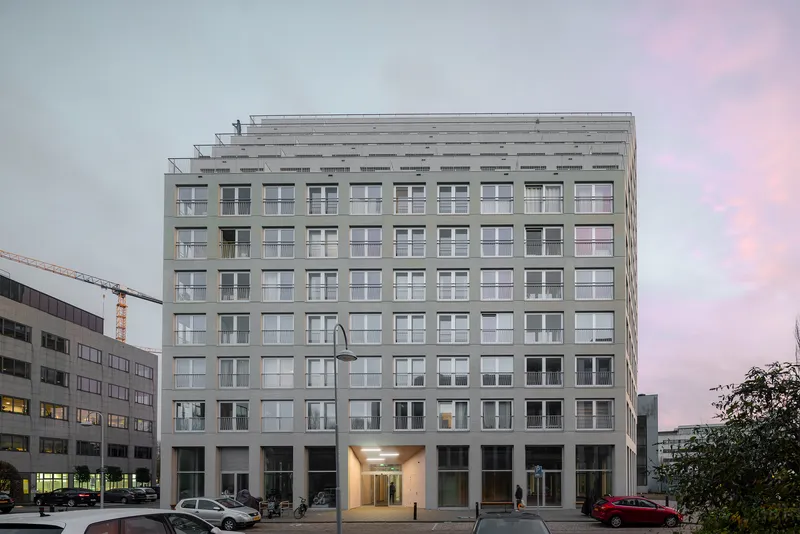
The building's most distinctive move is its sloping roofline, which steps diagonally from a taller mass down to a lower edge, giving the block a wedge-like silhouette visible from the adjacent highway and surrounding streets. At dusk, illuminated windows transform the volume into a lantern, its triangular profile cutting a sharp figure against the flat Dutch horizon. From the street, the rooftop pergola structure adds a lightweight crown to the otherwise solid mass, hinting at shared outdoor space above.
Seen from a distance, the massing reads as a single bold gesture. Up close, the stepping reveals itself as a series of distinct terraces and levels, each corresponding to a different apartment configuration. The diagonal is not decorative; it is the organising principle that allows the building to mediate between the scale of the surrounding blocks and the openness of the park.
Pale Green Skin, Deep Identity
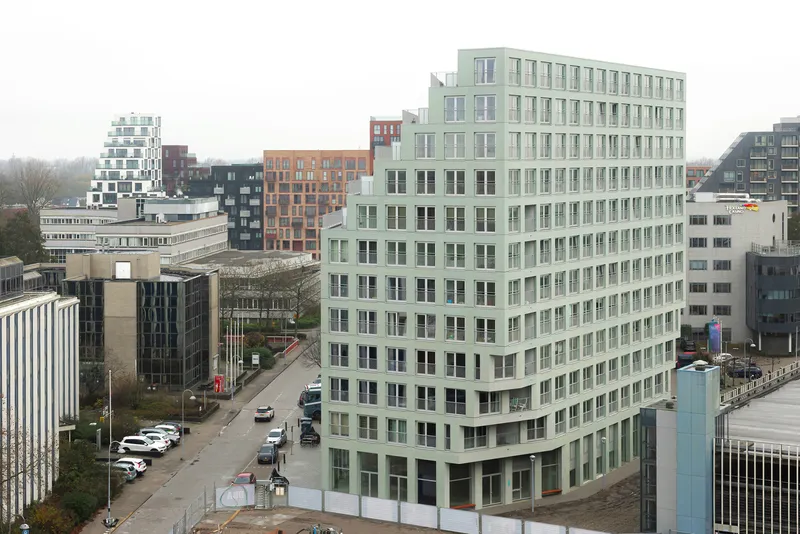
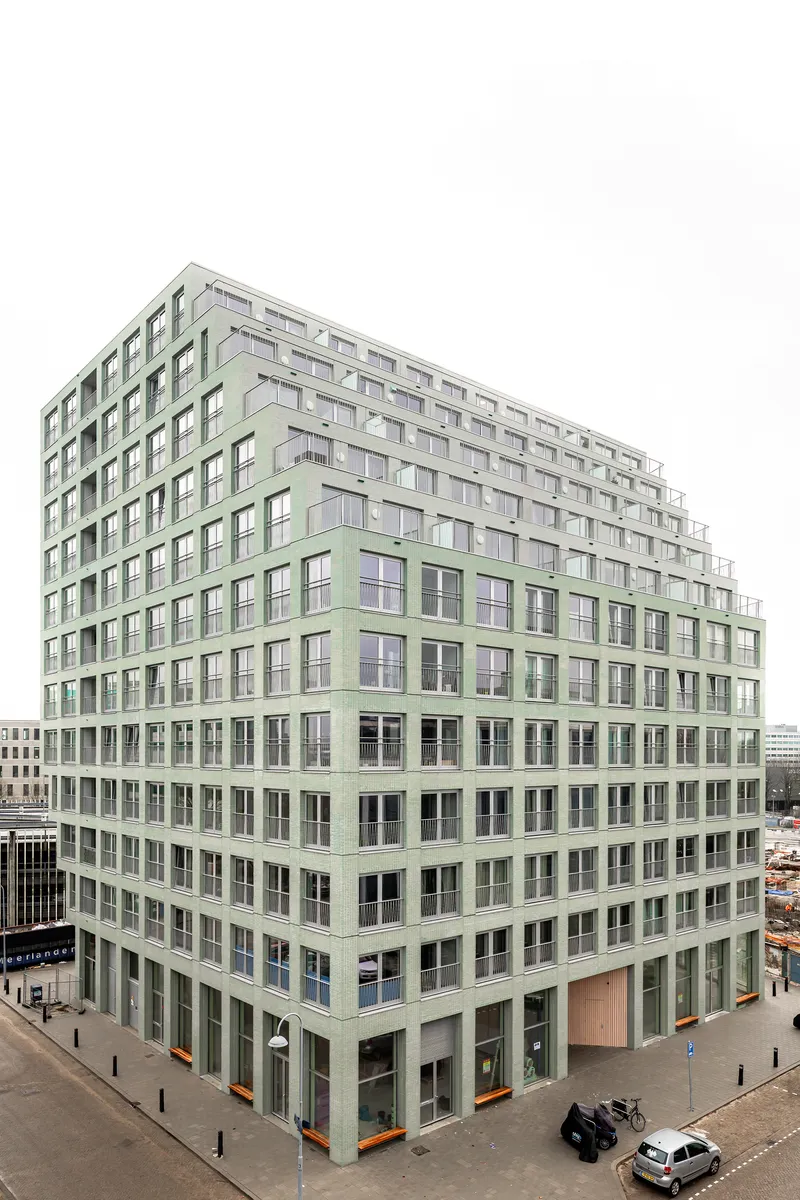
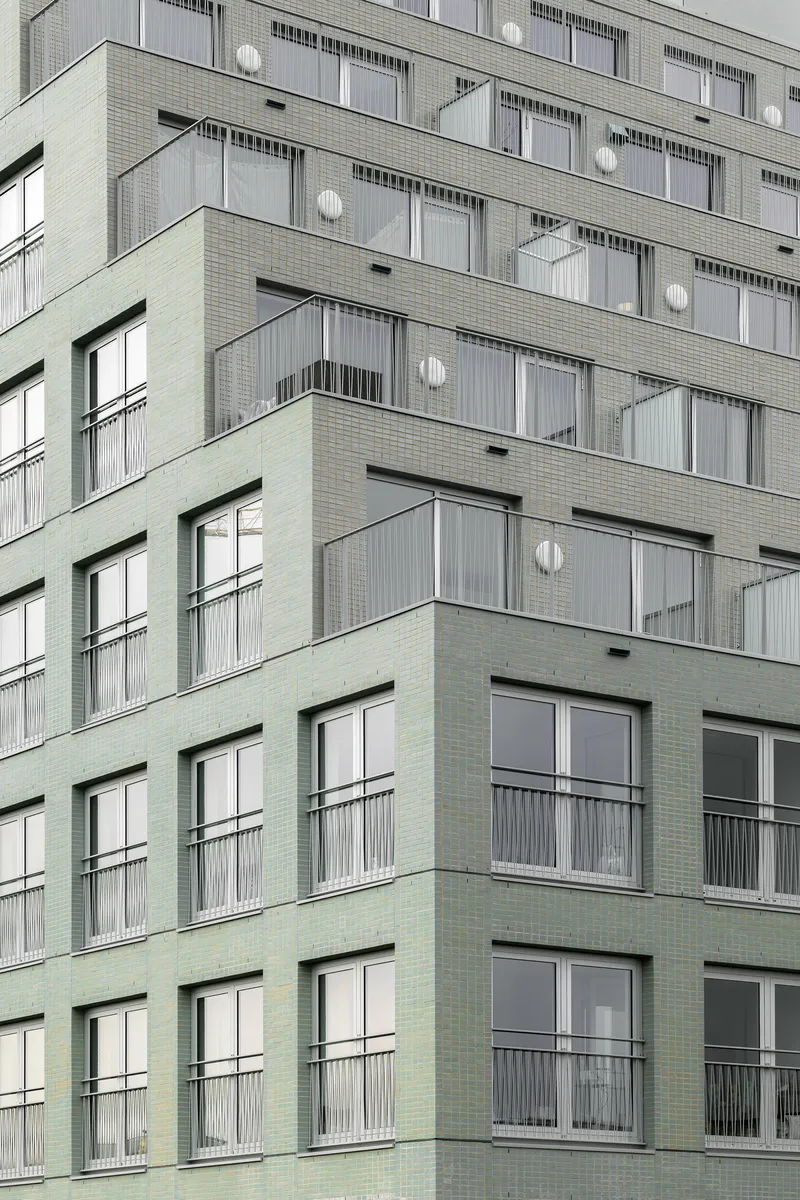
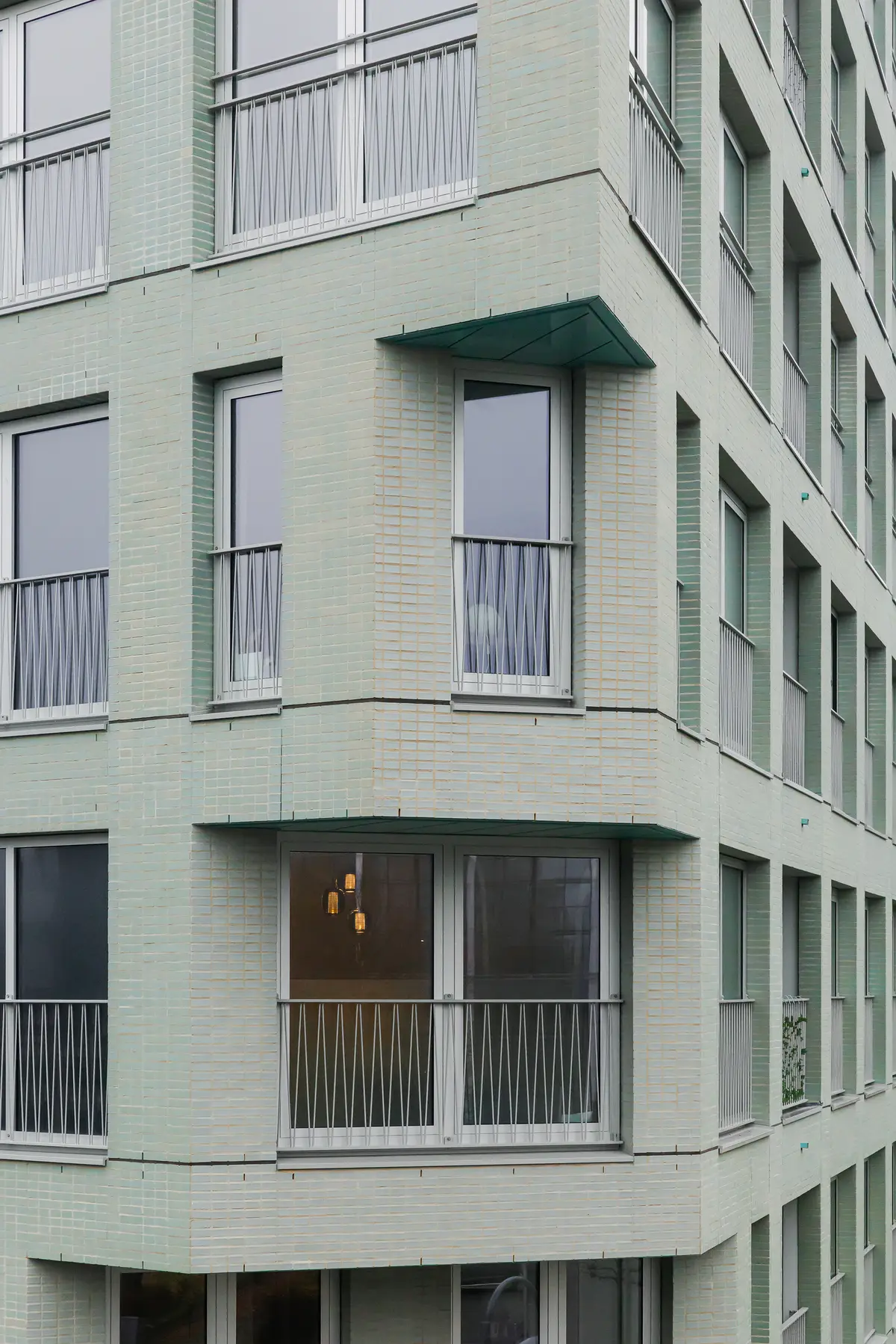
The facade cladding is a glazed pale green tile that reads differently depending on weather and light. Under overcast skies, which in Hoofddorp is most of the time, it appears almost grey-green, lending the block a quiet, institutional calm. In direct light, the glaze picks up warmth and the green intensifies. It is a material choice that refuses to be neutral without being loud, giving the building an identity distinct from the beige and grey palette of its neighbours.
Studioninedots varies the cladding rhythm by alternating green panels with sections of grey brick, creating a subtle patchwork across the facade. Floor-to-ceiling windows are set into deep reveals, and the interplay between flush tile and recessed openings gives the surface a tactile depth that photographs only partially capture. The regularity of the window grid prevents the facade from tipping into fussiness; it remains disciplined even as it accumulates detail.
Balconies as Rooms, Not Afterthoughts
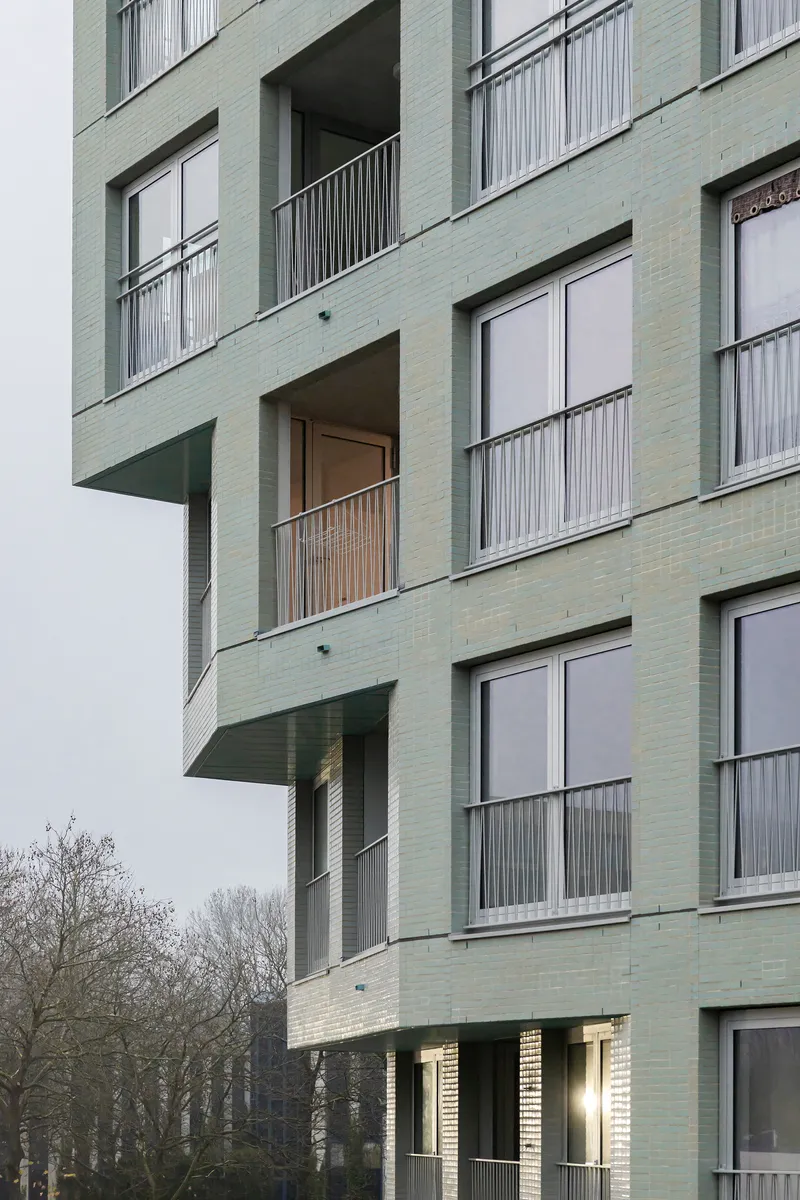
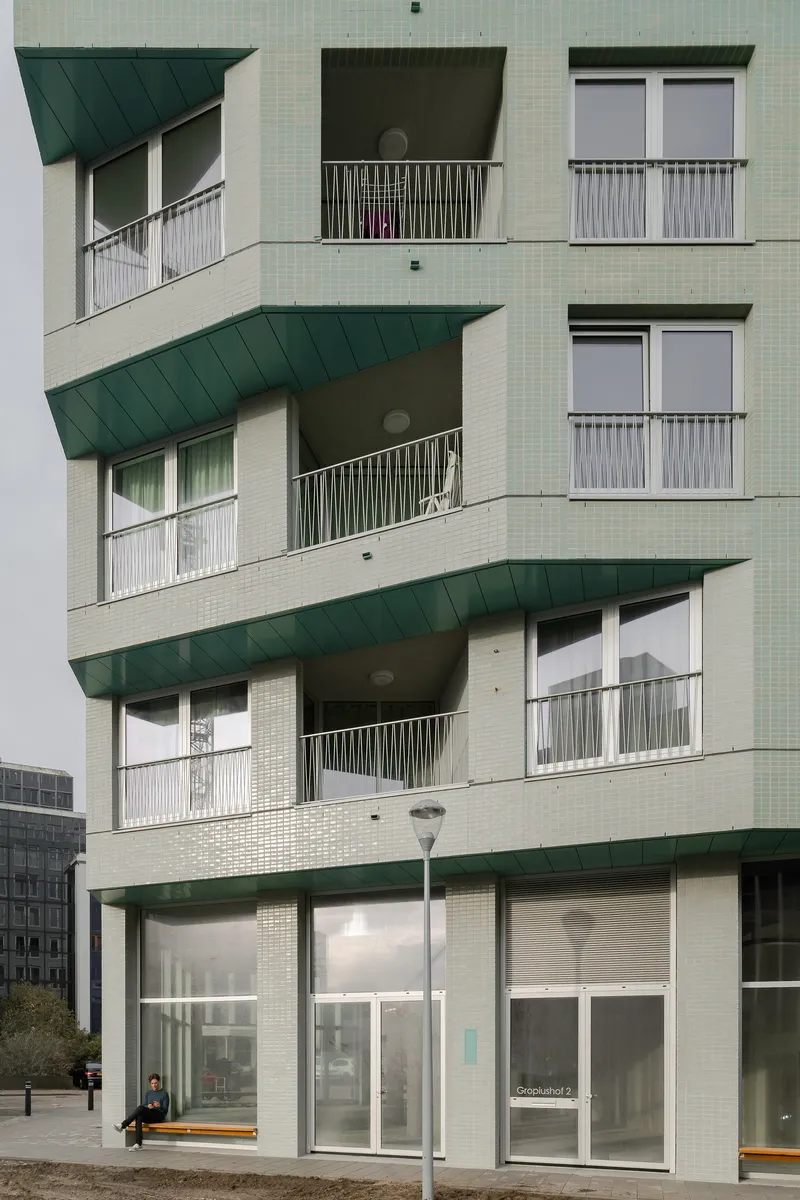
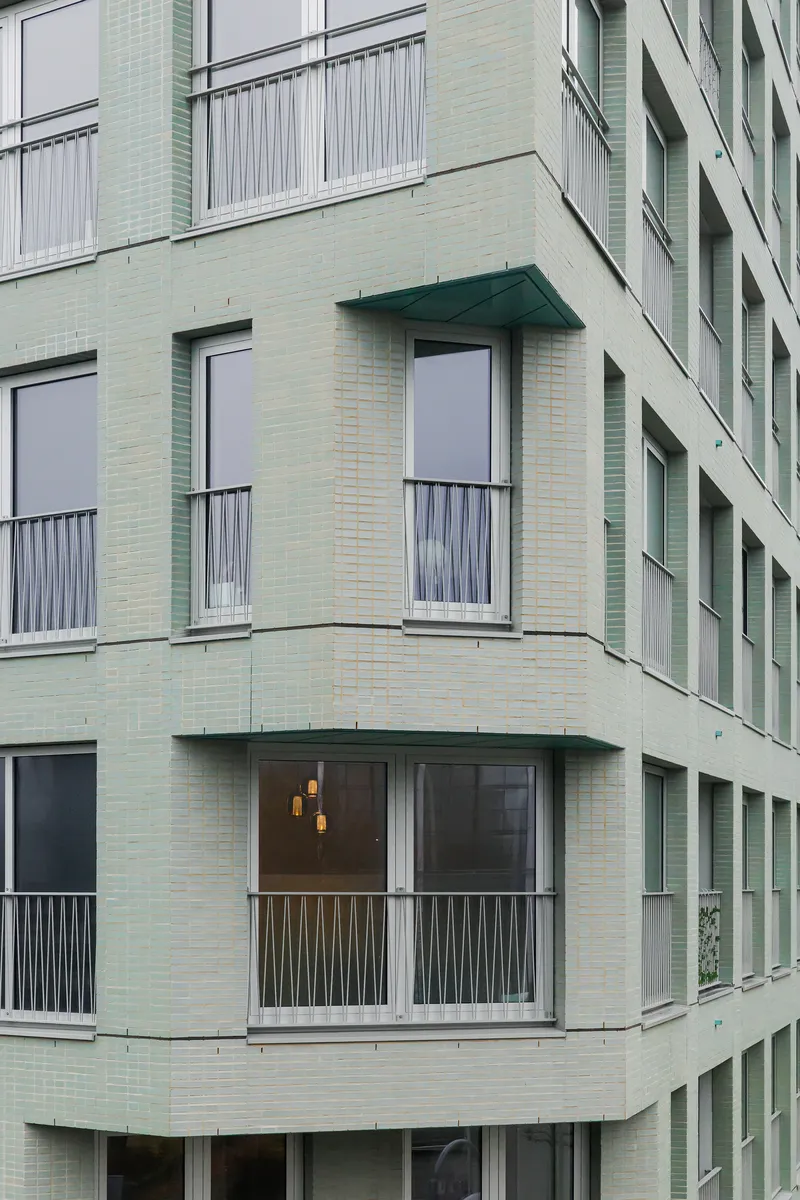
Too many housing projects treat balconies as regulatory requirements to be minimised. Here, they are treated as outdoor rooms. The stacked projections along the pale green facade are deep enough to furnish, fitted with sturdy metal railings and, on certain elevations, dark green canopies that offer shade and weather protection. The curved corner balconies wrapping the building's edges are particularly well resolved, their rounded profiles softening the overall geometry while providing residents with panoramic views.
The canopies deserve attention. They turn each balcony into a partially covered loggia, extending the usable season well into autumn. For a social housing project in the Netherlands, where outdoor space can be the difference between a livable apartment and a merely adequate one, this level of care is significant.
Threshold and Entry
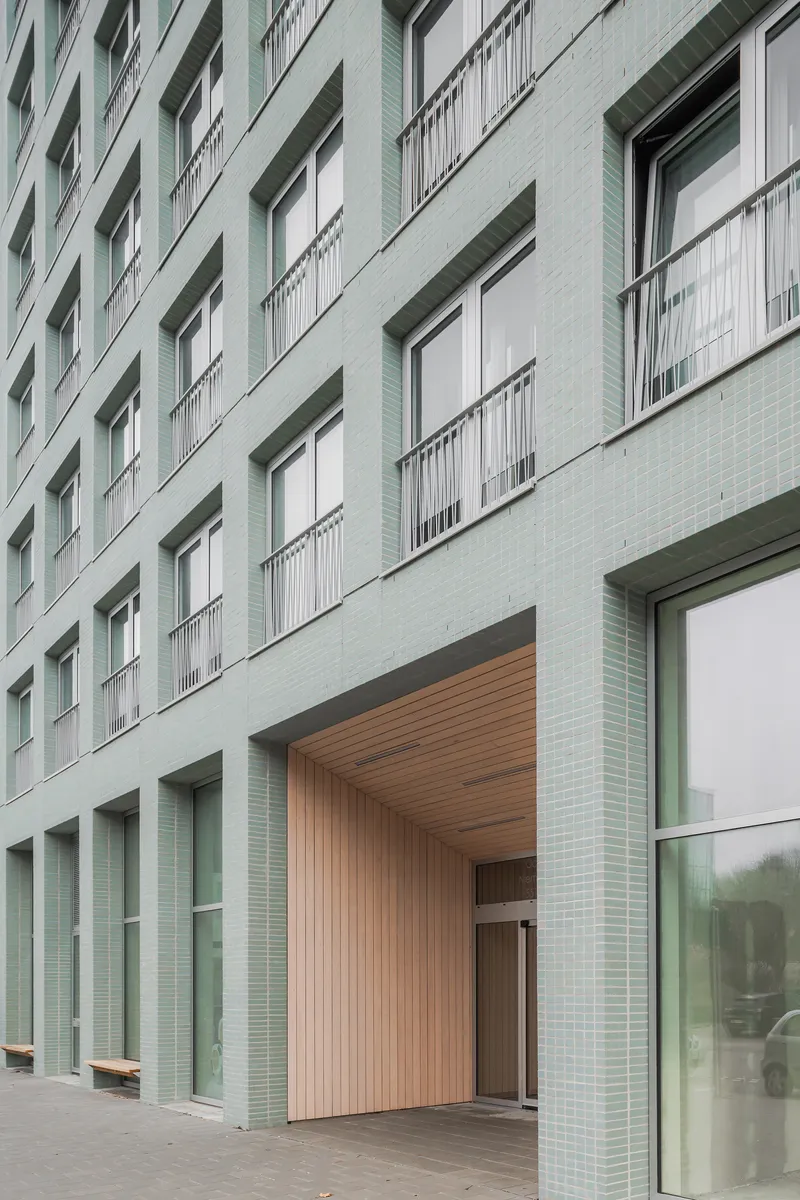
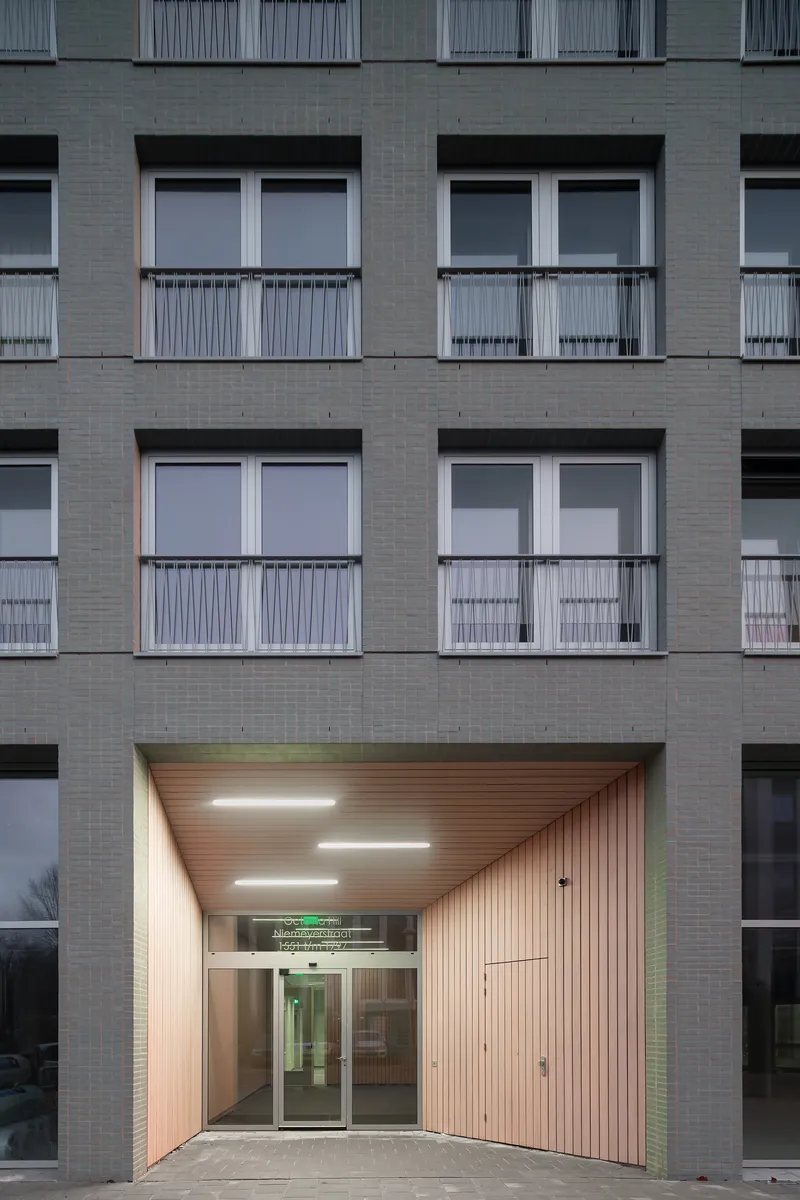
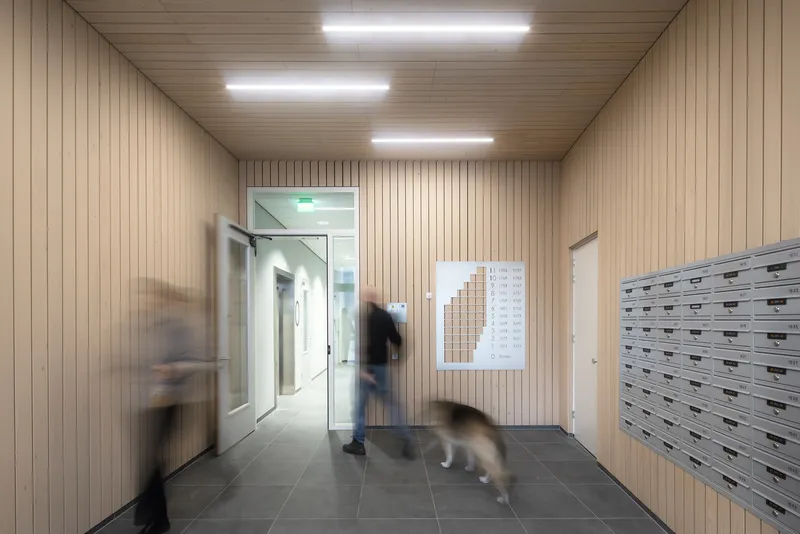
The entrances are among the project's strongest moments. Recessed into the tile facade, each entry is lined in warm timber, creating a material shift that signals the transition from public street to shared interior. The timber-clad soffits extend overhead, and recessed lighting washes the wood in a soft glow at dusk. The effect is welcoming without being precious, a threshold that dignifies the act of coming home.
Inside, the lobby continues the timber palette against a grey tile floor. Mailboxes line one wall, and a person caught in motion blur suggests the building is already inhabited, already lived in. The glass doors at the far end maintain visual continuity to the courtyard beyond. It is a simple sequence executed with unusual precision for the typology.
Courtyard and Corner Conditions
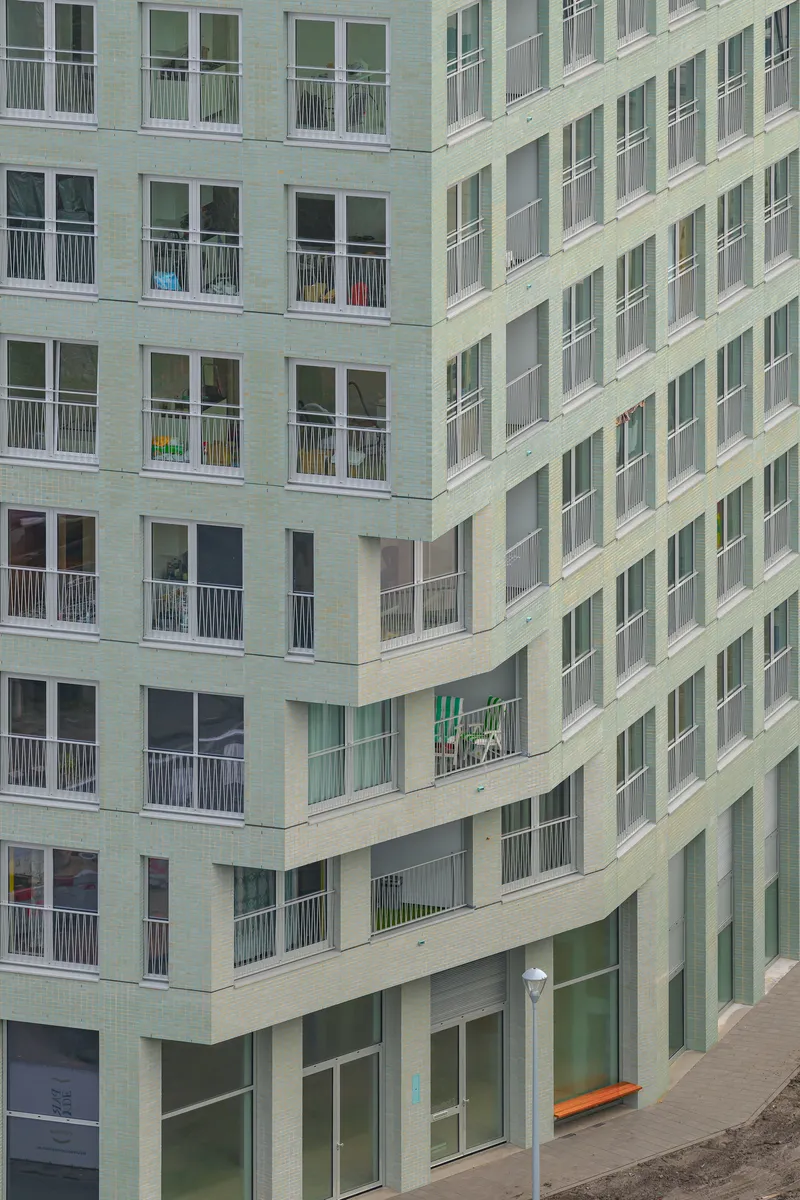
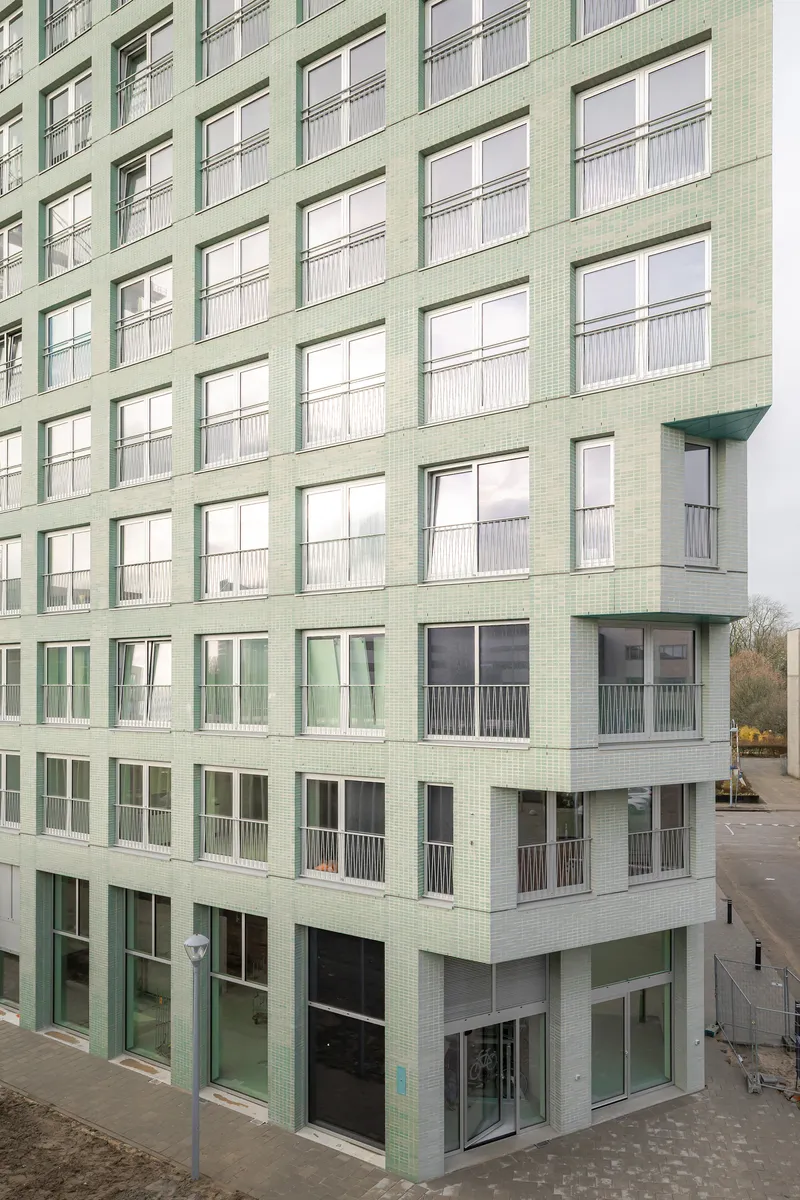
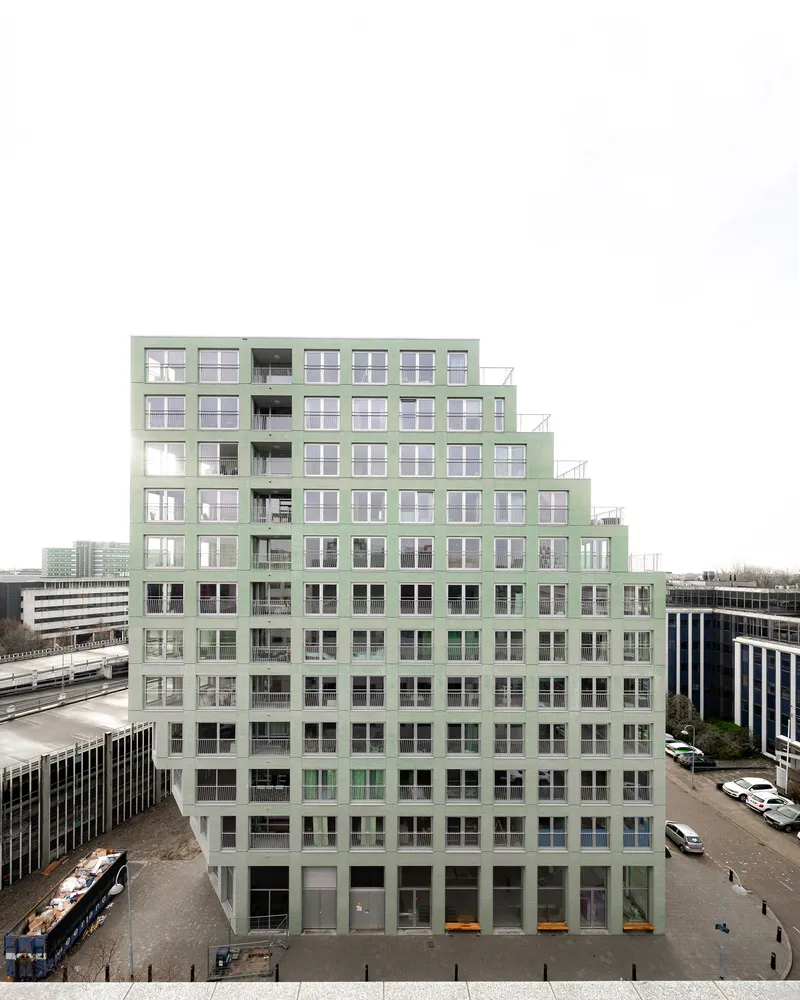
The courtyard side of the building reveals a quieter, more intimate character. Light green brick replaces the glazed tile of the street facade, and the recessed balconies face inward, overlooking shared ground-level space. The stepping mass creates varying degrees of enclosure across the courtyard, with taller portions providing shelter and lower sections allowing daylight to penetrate deep into the interior.
The corner conditions are handled with particular care. Rather than defaulting to a blank return wall, Studioninedots wraps the tile cladding and window rhythm continuously around each turn. Ground-floor glazing activates the base at key corners, introducing visual porosity where the building meets the street. The result is a block that engages all its edges, not just its primary facade.
The Domestic Detail
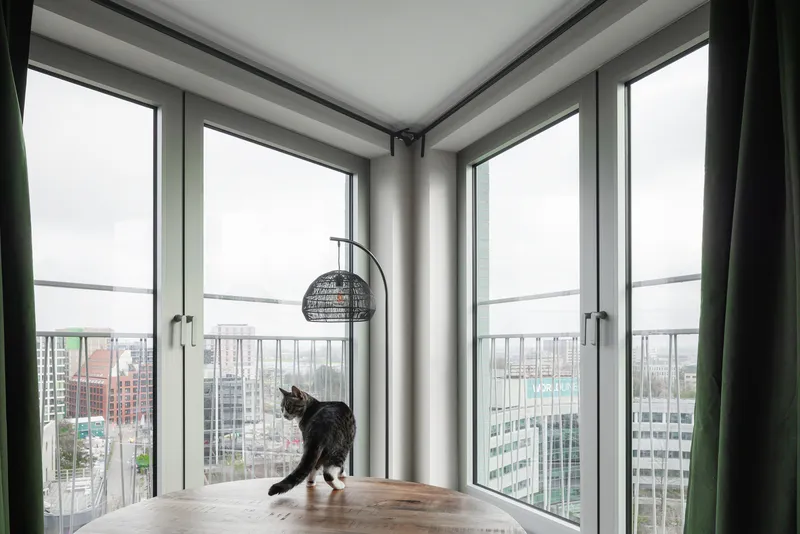
A cat on a windowsill, a wire pendant light overhead: image 3 captures the building in a state of occupation that no render can replicate. The corner window is generous, flooding the interior with light from two sides, and the deep reveal of the frame creates a natural perch. It is a small detail that speaks to the apartment planning: these are homes designed to be inhabited, with window proportions that encourage personalization.
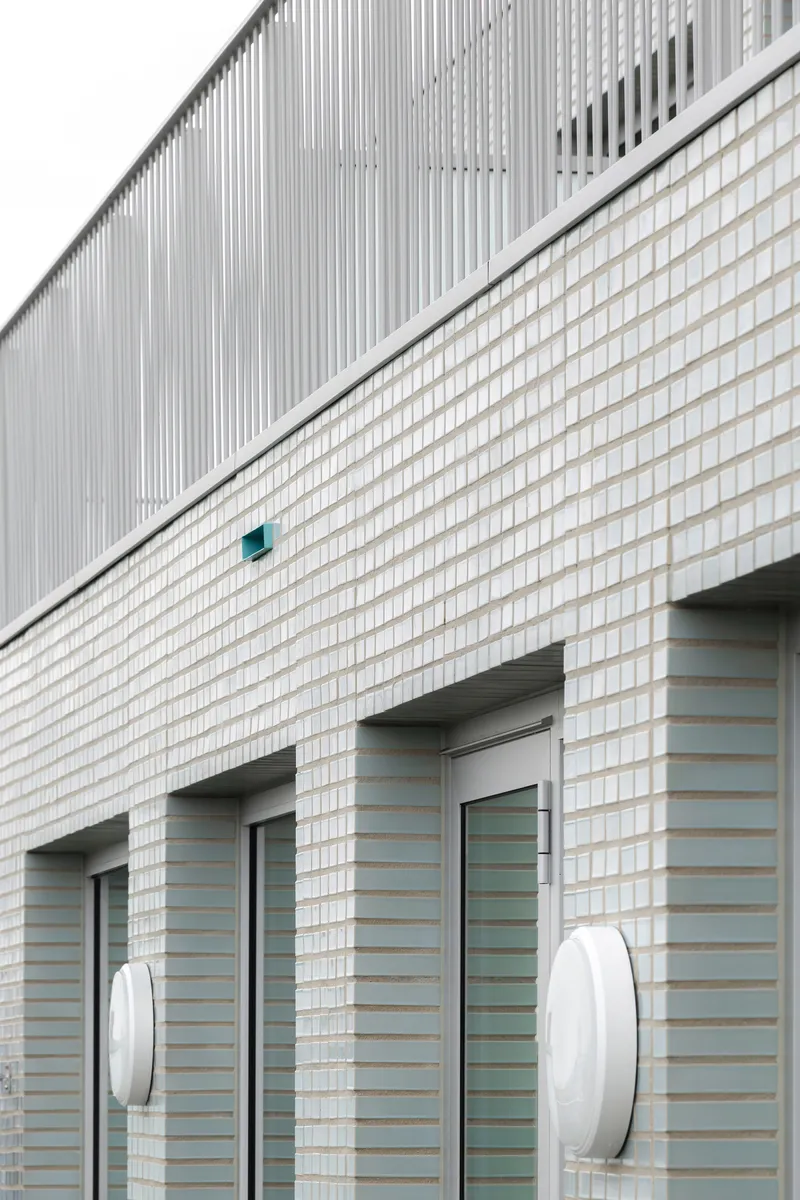
On the white brick facade, a diagonal division line separates material zones, while circular wall-mounted light fixtures punctuate the surface with an almost playful rhythm. Entrance openings at the base are cleanly cut into the brickwork, their proportions generous enough to avoid the mean, slot-like entries that plague many housing projects.
Plans and Drawings
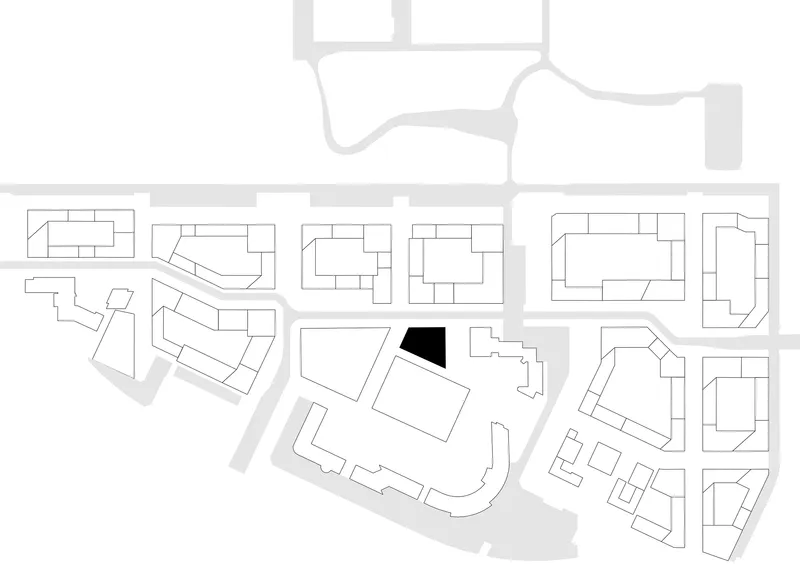
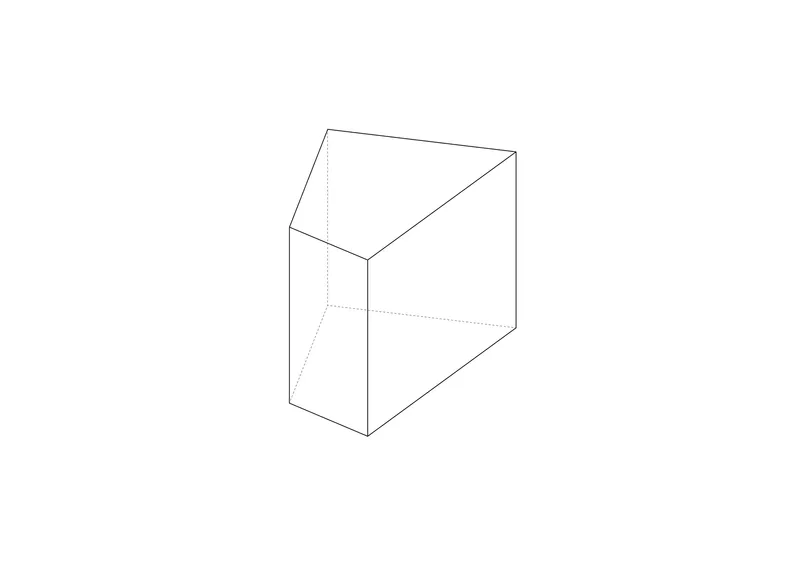
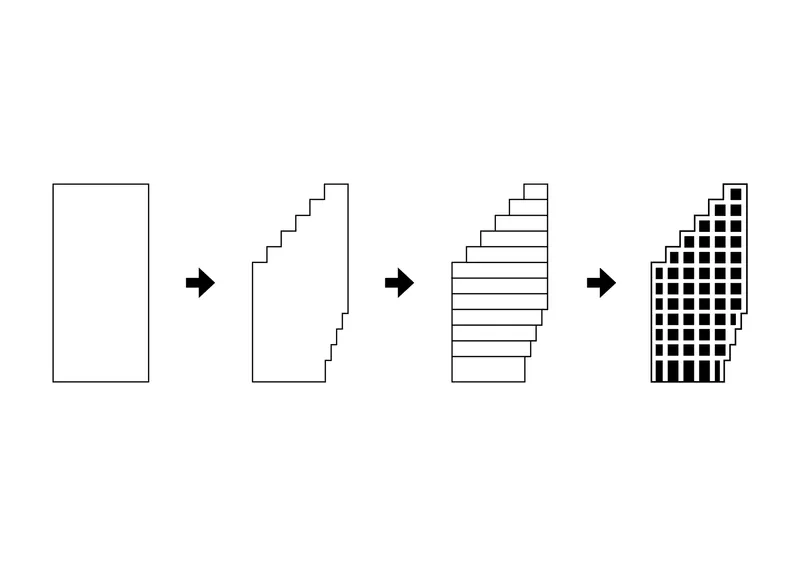
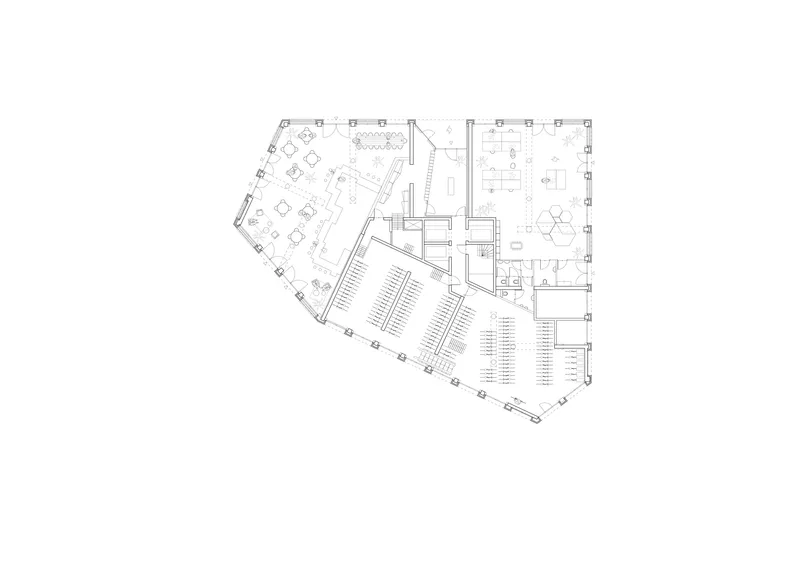
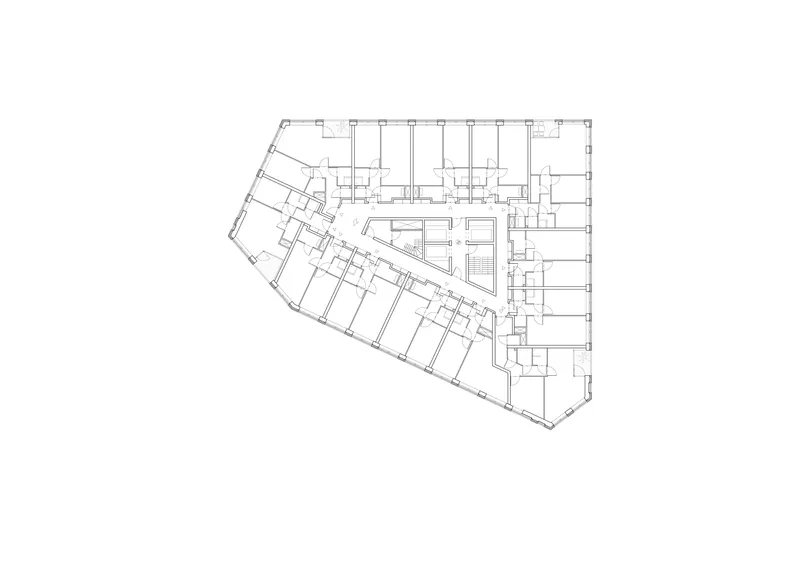
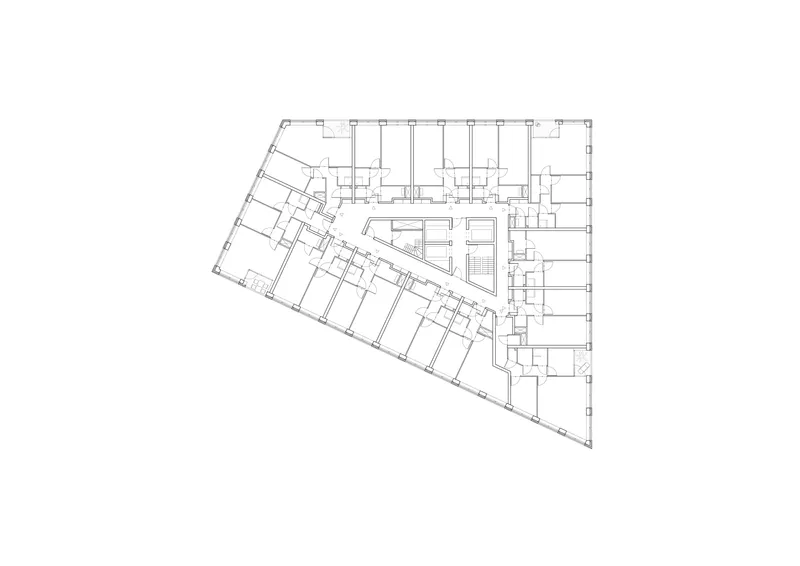
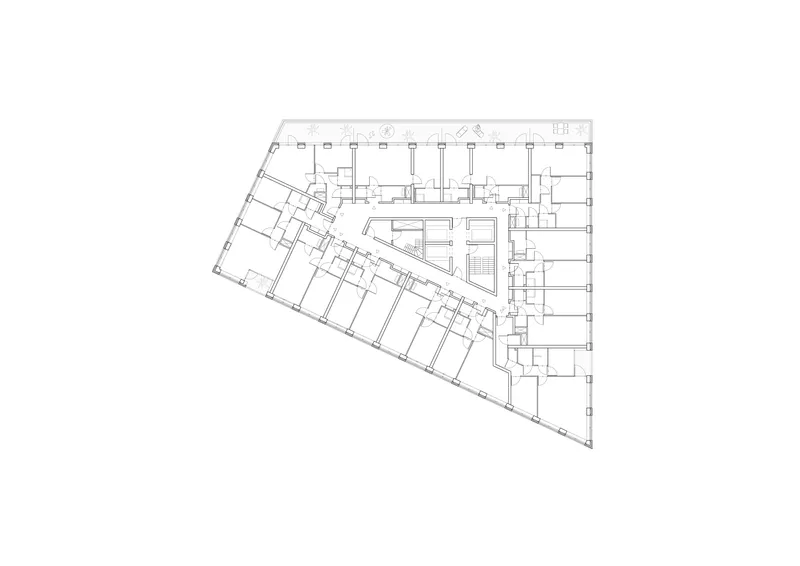
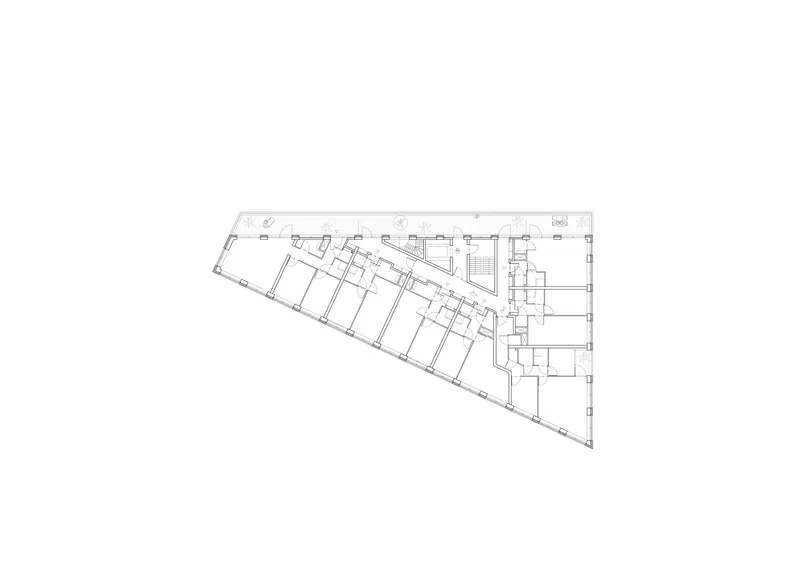
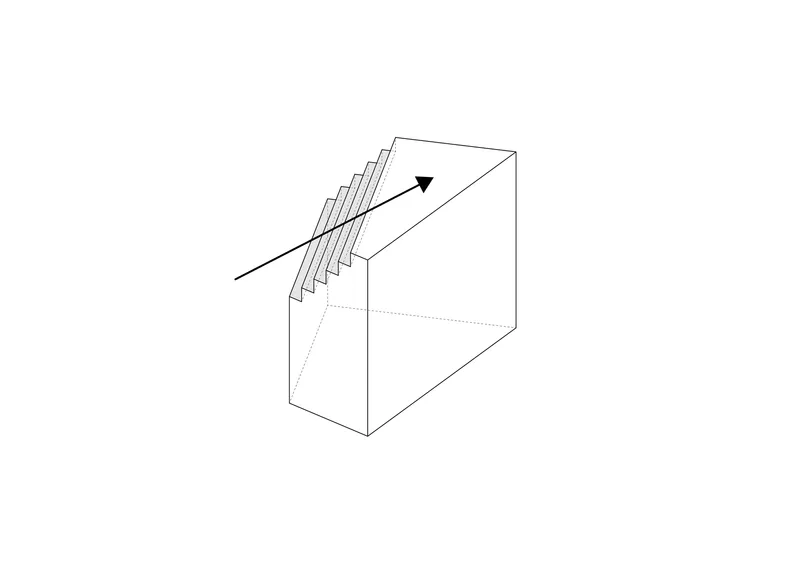
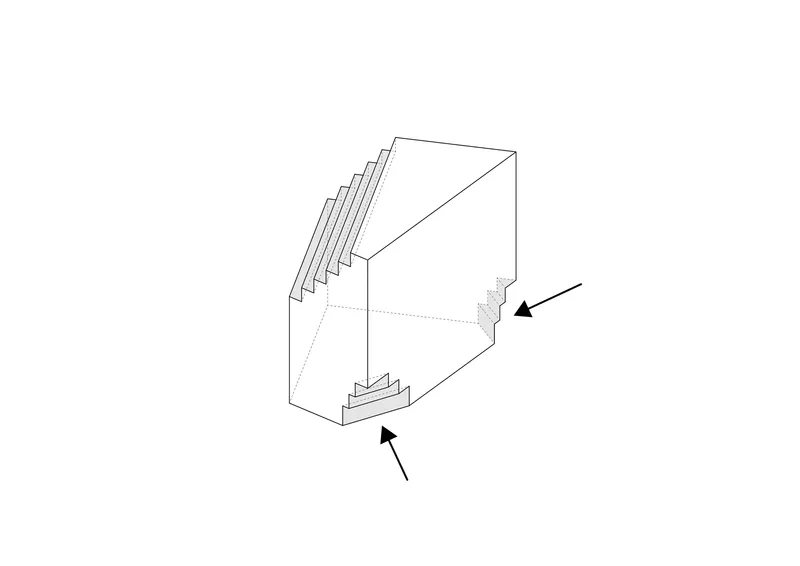
The site plan reveals the triangular footprint in context, showing how the building's angled perimeter negotiates the surrounding urban block structure. The axonometric confirms what the photos suggest: the wedge-shaped volume with its sloped roof is the primary formal move, and everything else follows from it. Floor plans at various levels show how the triangular geometry is resolved internally through diagonal corridors, angled wings of open-plan spaces, and strategically placed stair cores.
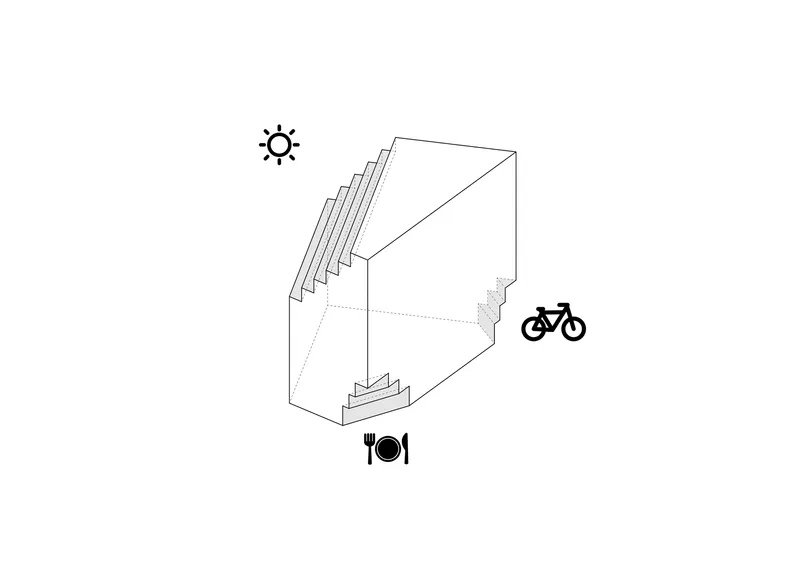
The isometric diagrams are particularly revealing. One shows a staircase ascending diagonally through a rectangular volume, illustrating the sectional logic of the stepping mass. Another annotates circulation and programme with simple icons for sun access, bicycle storage, and communal dining, suggesting that the formal ambition is grounded in practical considerations about how residents move through and use the building. The elevation sequence at the bottom strips the design process down to its essentials: a rectangle is transformed into a stepped facade with window openings, a diagram of architectural intent reduced to four frames.
Why This Project Matters
Octavia Hill matters because it refuses the premise that social housing must be architecturally invisible. Studioninedots has delivered a building with formal ambition, material specificity, and spatial generosity, all within a programme and budget category that typically suppresses these qualities. The pale green tile, the stepping mass, the timber-lined thresholds: none of these are extravagant moves, but together they constitute a building that treats its residents as deserving of considered design.
At a moment when housing discourse in the Netherlands is dominated by speed and quantity, this project is a reminder that quality and affordability are not mutually exclusive. The building's namesake, Octavia Hill, believed that the physical environment of housing directly shaped the wellbeing of its inhabitants. Studioninedots has taken that conviction and given it a contemporary, sculpturally confident form in the flatlands of Hoofddorp.
Octavia Hill by Studioninedots, Hoofddorp, The Netherlands. 9,500 m², completed 2025. Photography by Sebastian van Damme.
About the Studio
Share Your Own Work on uni.xyz
If projects like this are the kind of work you want to make, uni.xyz is a place to publish your own, find collaborators, and enter design competitions.


Popular Articles
Popular articles from the community


Faces of the Soviet Avant-Garde: Turning Moscow's Street Names into an Open-Air Museum
A network of sculptural installations across a Moscow residential district transforms forgotten architect names into spatial encounters with cultural memor

Manzana Morphosis: Stretching Barcelona's Grid into a Living Landscape for 2050
A radical reworking of the Eixample manzana turns density into a tool for generous public space, vertical ecology, and environmental performance.

Extended Shell: Retrofitting Kolkata's Balconies as Living Urban Thresholds
A modular retrofit system recovers the social and environmental intelligence of Kolkata's historic verandas for contemporary Park Street residents.

Singing Woman: An Opera House That Performs Before the Curtain Rises
Ovidiu Cristian Pavel's conceptual opera house translates Estonia's choral identity into a sculpted waterfront landmark facing the Baltic Sea.

Similar Reads
You might also enjoy these articles

Pixel Gardens: One Repeated Module Stacked Into a Terraced Social Housing Tower for Famagusta
Salem Bader's shortlisted housing tower builds a vertical neighbourhood from one repeated module, offsetting units to carve terraces, light and air.

Bao Huynh Watercolor Atelier: A Serene Art Retreat in Hội An
Bao Huynh Watercolor Atelier in Hội An blends multifunctional art spaces, sustainable design, local materials, and family-friendly living in a serene environment.

Atelier Macri Concept Store Interior Design by CASE-REAL
Atelier Macri store features a "ko" counter, walnut wood details, cork displays, blending retail, gallery, and seamless customer experiences.

Manuel Vargas Izquierdo Stadium and High-Performance Sports Center: Architectural Excellence in Jalpa de Méndez
The Manuel Vargas Izquierdo Stadium blends sustainable design, inclusive sports facilities, and cultural-inspired architecture, revitalizing Jalpa de Méndez’s public spaces.

Comments (0)
Please login or sign up to add comments
No comments yet. Be the first to comment!