
OYO Wraps Parking, Offices, and a Park into One Organic Volume for Agristo's New HQ
A BREEAM Excellent headquarters in Wielsbeke, Belgium, captures waste heat from its neighbor's ovens and fridges to condition 21,750 square meters.


How do you fit a car park, office floors for hundreds of employees, and a generous green campus onto a tight former industrial plot in rural West Flanders? OYO answered by refusing the question's premise. Rather than spreading the program across a campus of discrete volumes, the firm stacked everything into a single curvilinear mass on the old Unilin site in Wielsbeke, freeing the remainder of the ground for landscape. The result is a building that reads less like a corporate headquarters and more like a sculpted topography: parking at the base, offices above, terraces and planted facades wrapping the whole thing in a living skin.
What makes the 21,750 square meter Agristo Headquarters genuinely interesting is how deliberately it was designed to become something else. The lower parking levels are dimensioned and structured so they can convert to office space as the company grows and car dependency declines. That kind of planned obsolescence for a car park is still rare in European corporate architecture, and it turns a normally inert piece of infrastructure into a long-term spatial asset. The building earned BREEAM Excellent certification, but the real sustainability story is more specific: heat traps channel excess thermal energy from Agristo's adjacent industrial fridges and ovens into the new structure, and a concrete core activation system distributes it at low temperature through the ceilings.
Breaking the Box on a Tight Site
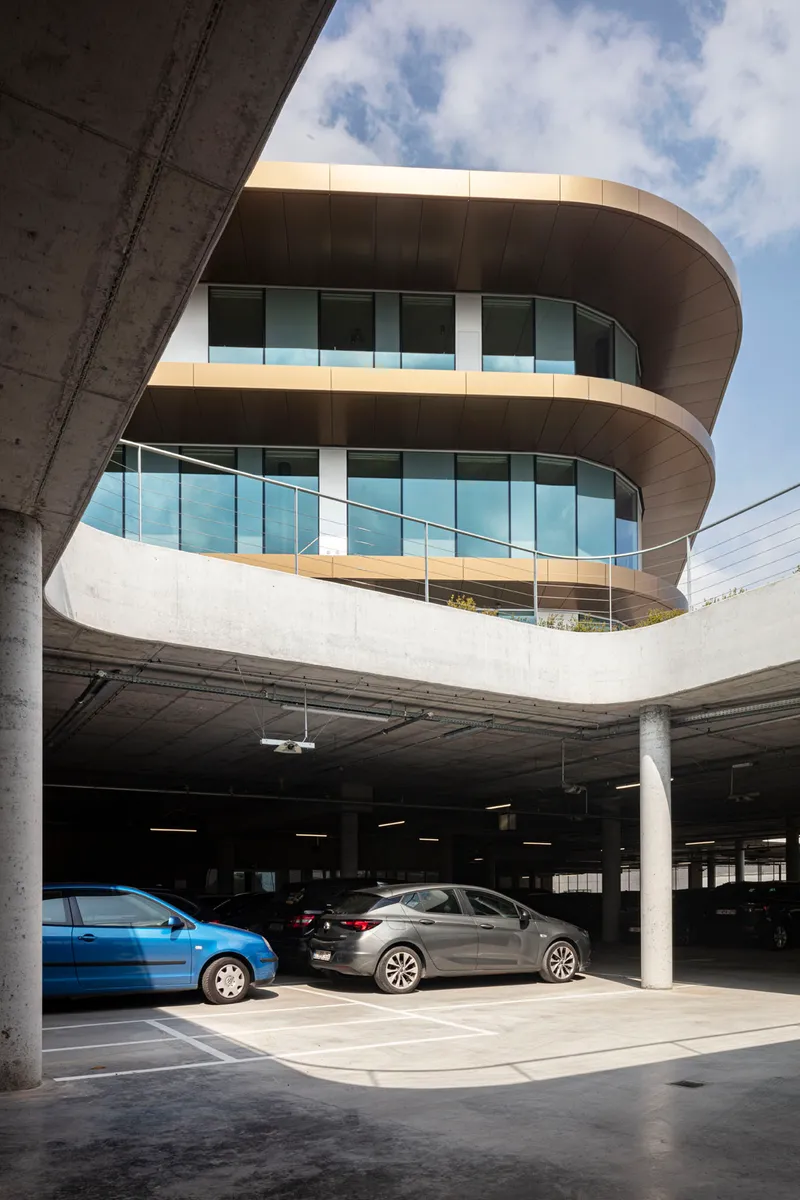
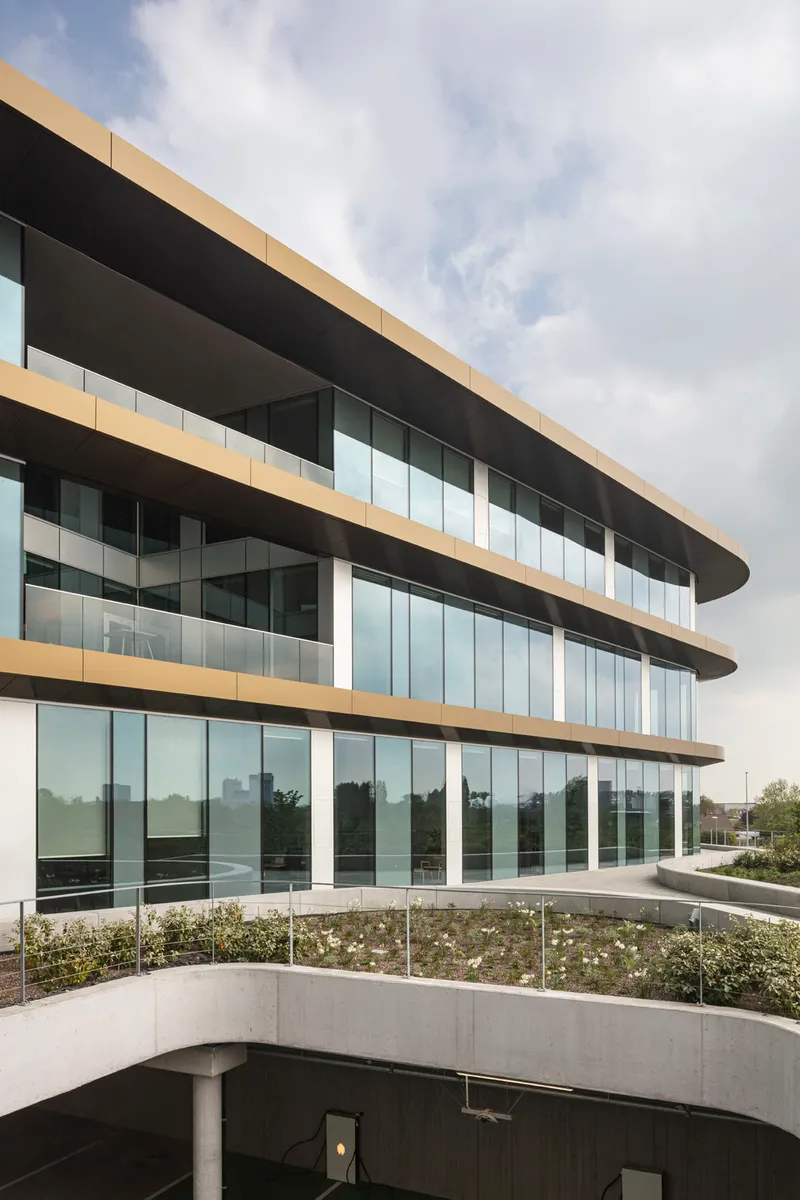
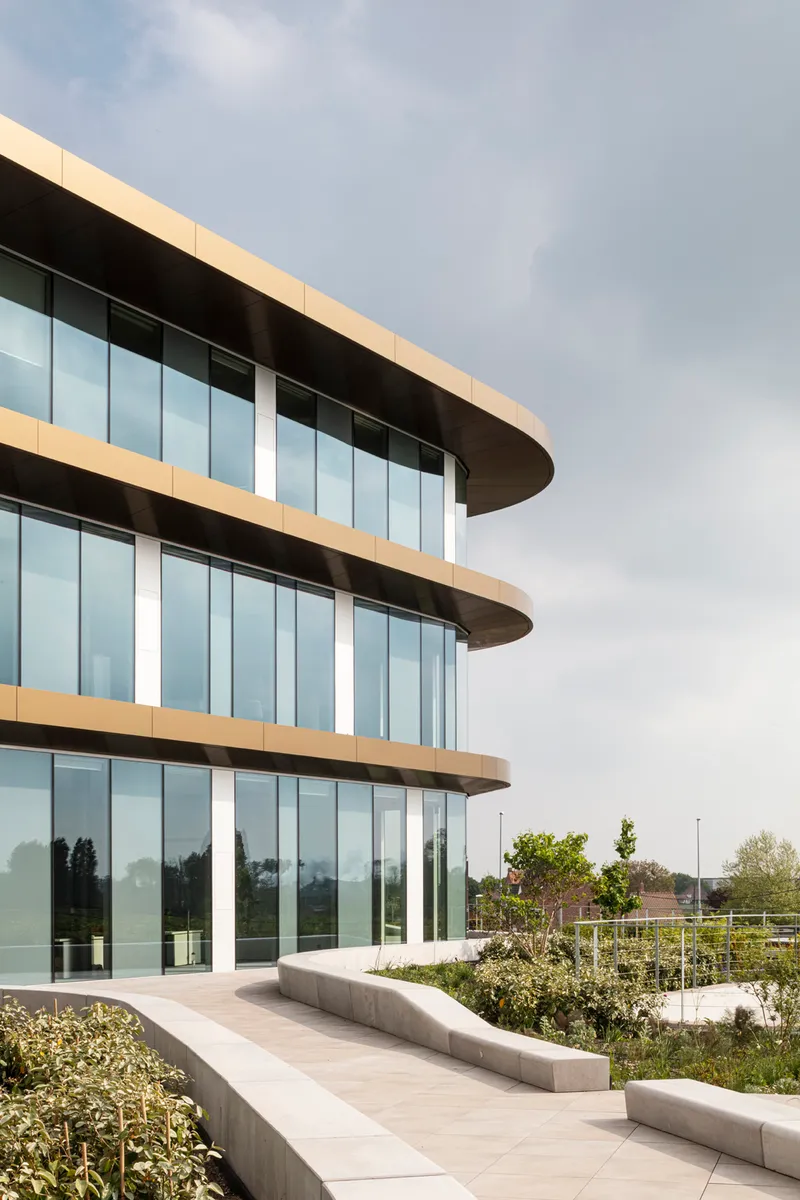
The building's footprint is angular, almost triangular, a direct response to the plot's geometry rather than any default rectilinear grid. OYO manipulated the volume to claim every usable square meter while pulling the massing back from edges where it matters: toward the fields, toward light, toward views that make a factory-adjacent site feel less industrial. The rounded glass facade rises above the exposed concrete parking plinth, and the contrast between the two is deliberate. The base is honest about what it is. The upper floors, wrapped in horizontal metal banding and planted terraces, signal a different register.
From ground level, the building presents a series of curved overhangs, planted beds, and screened entries that slow the approach. There is no monumental front door. You arrive through courtyards framed by young trees and metal screening, a sequence that trades corporate ceremony for something closer to a garden threshold.
The Atrium as Vertical Village
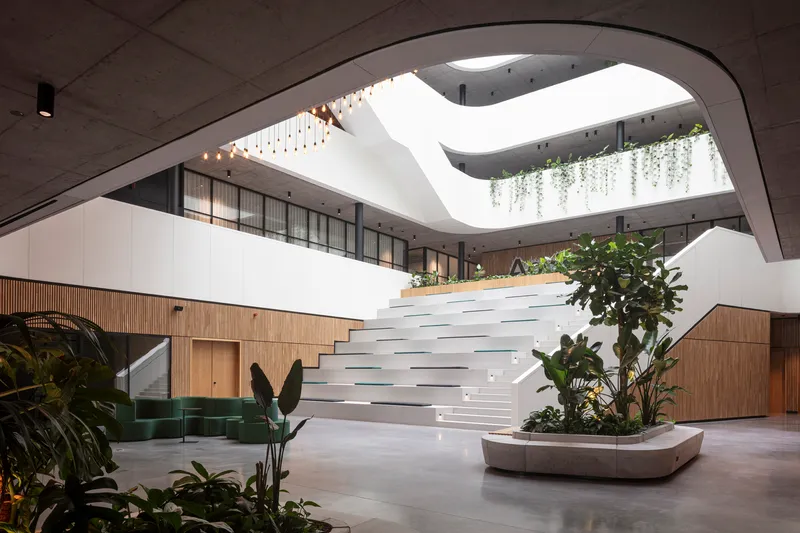
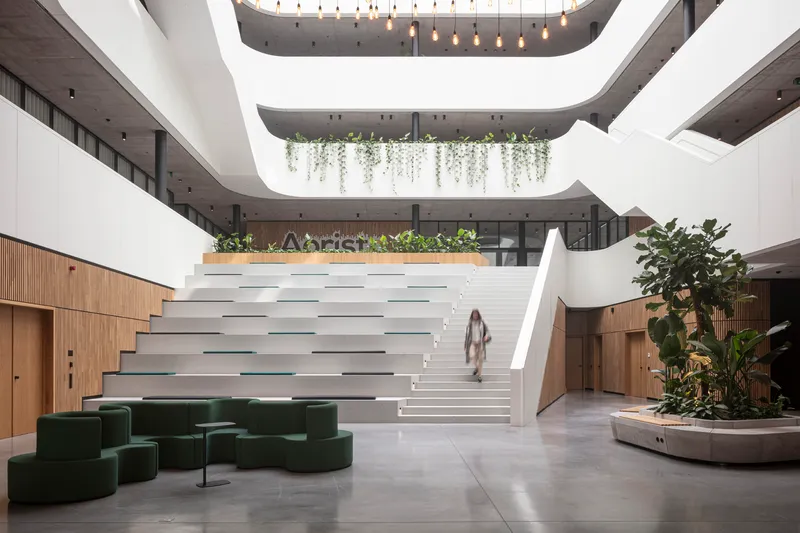
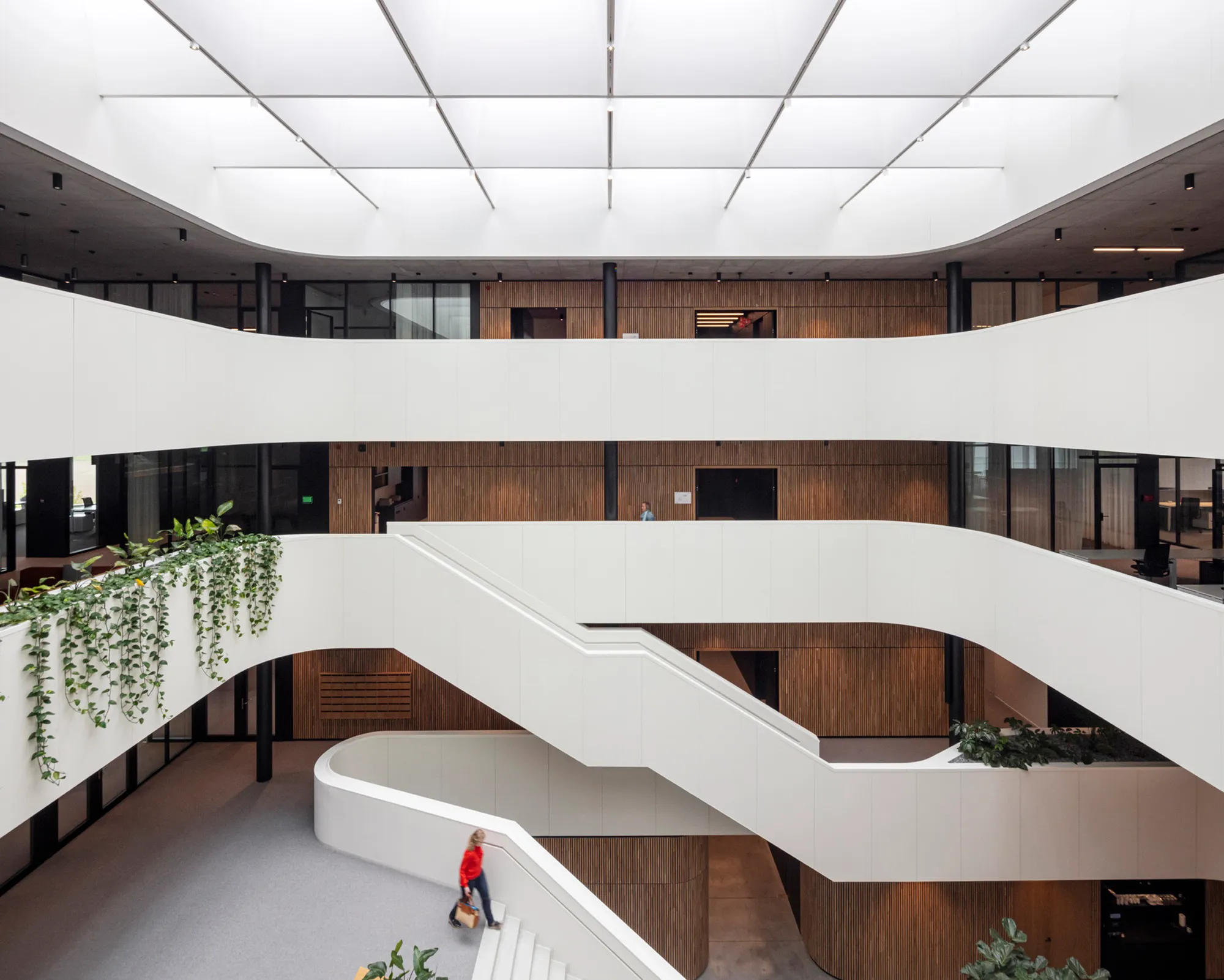
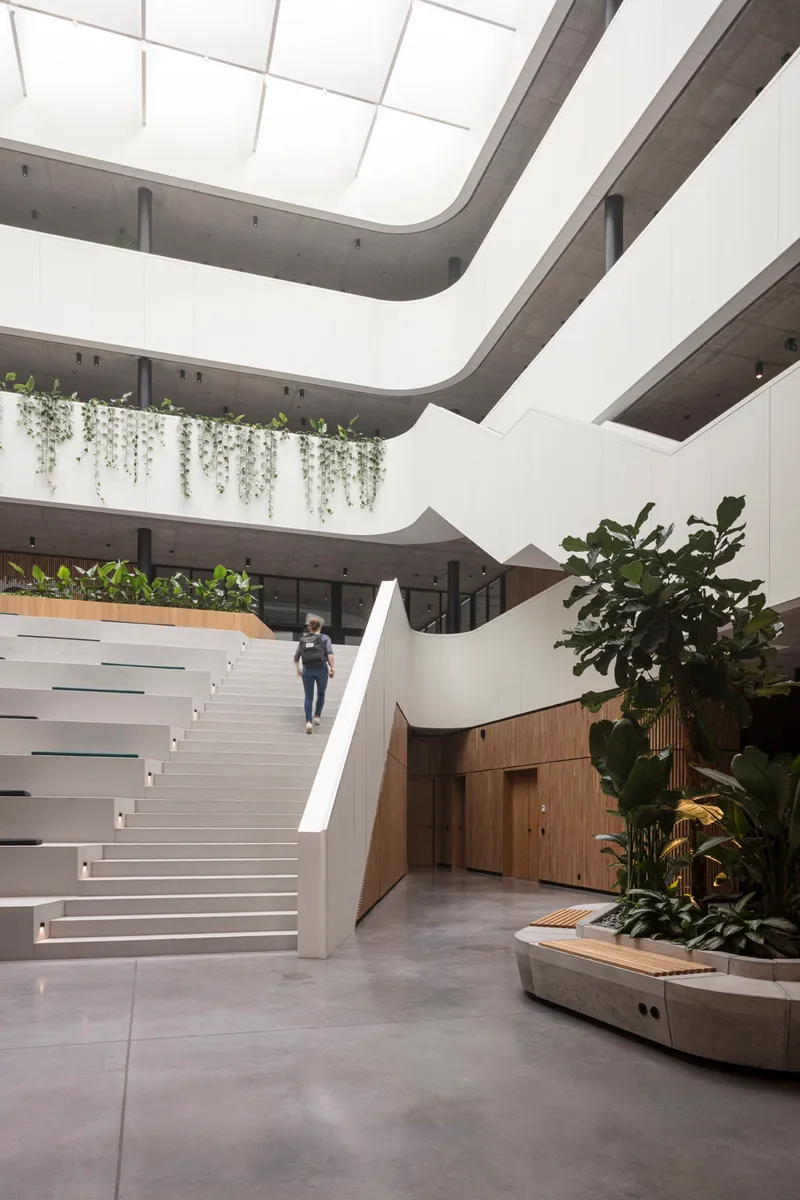
The central atrium is the organizational spine. A wide, sculptural white staircase spirals through multiple levels, flanked by curved balconies, trailing greenery, and timber-clad walls that warm what could otherwise be a cold concrete canyon. Skylights flood the void with daylight, which was a non-negotiable part of OYO's strategy: every employee should have access to natural light throughout the day, regardless of where they sit.
The atrium does double duty as the building's social infrastructure. Modular green seating clusters at the base, planted beds line the balcony edges, and the staircase itself is wide enough to encourage casual encounters rather than funneling people into elevators. It is the mechanism through which OYO forces cross-departmental contact, and it works precisely because it is not a corridor. People linger here.
Circulation and Encounter
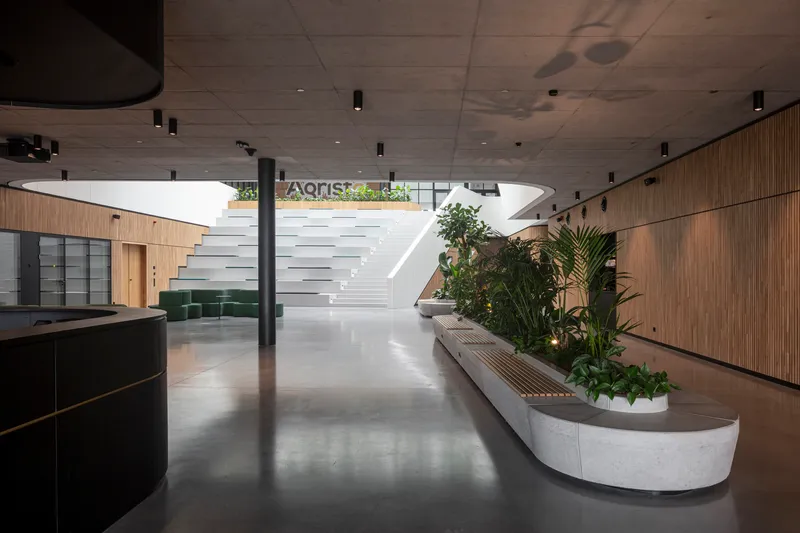
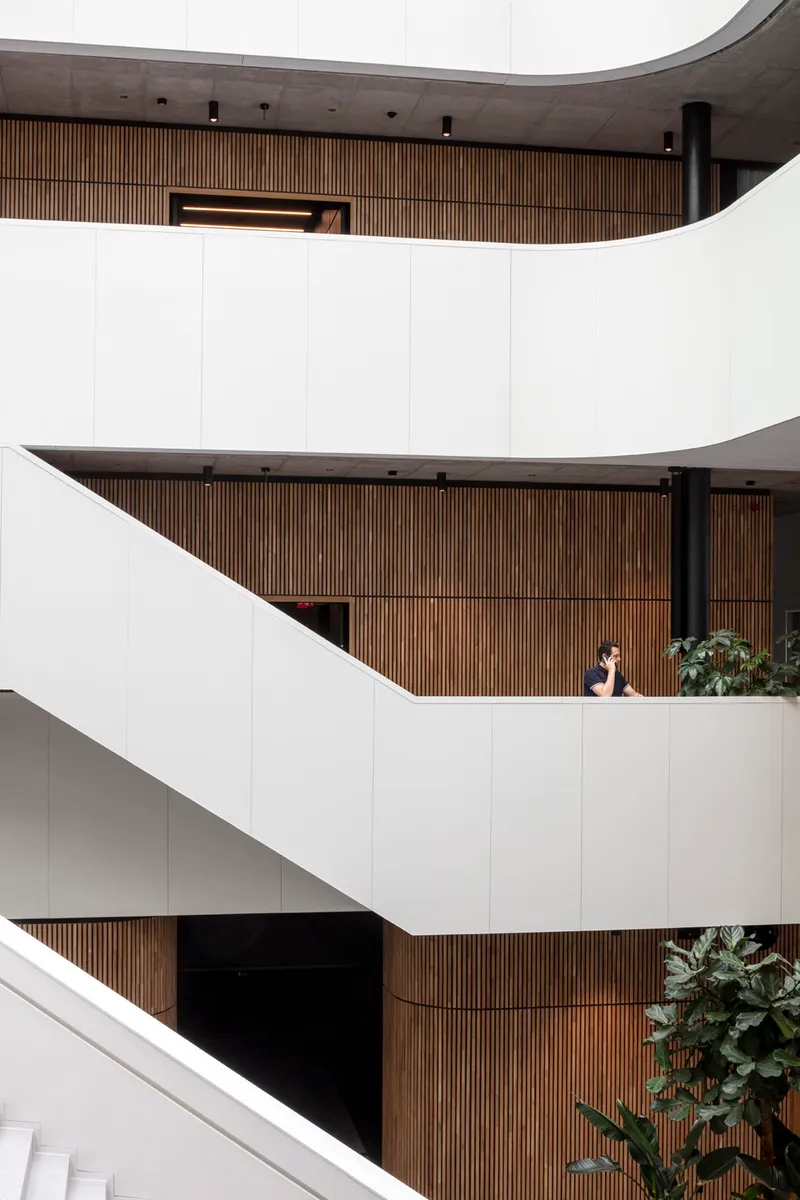
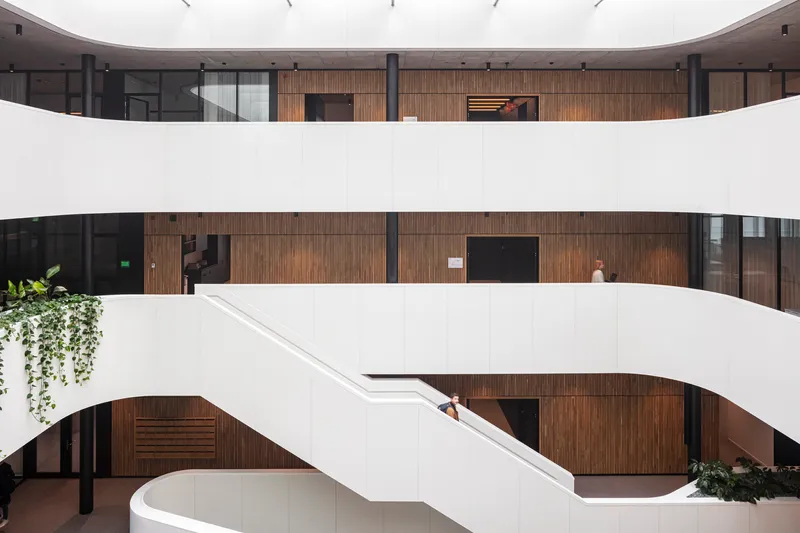
OYO distributed bars, cafes, focus rooms, collaboration stations, and break areas strategically across the floors rather than consolidating them on one level. The logic is simple: if your coffee is on a different floor than your desk, you will move through the building, and movement breeds interaction. The reception lobby with its floating staircase and curved planter beds establishes this principle from the moment you enter. You are invited to look up, to see activity on other levels, to feel the building's life around you.
Stacked white balconies with timber slat cladding create semi-outdoor thresholds where someone can sit with a laptop next to a potted plant and still feel connected to the atrium below. These are not token balconies. They are sized and furnished as genuine work zones, blurring the line between inside and terrace.
Material Warmth Against Concrete Logic
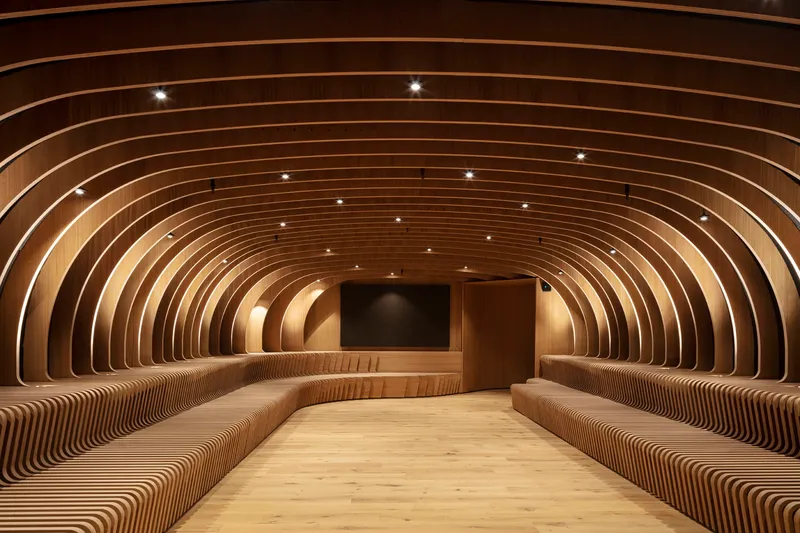
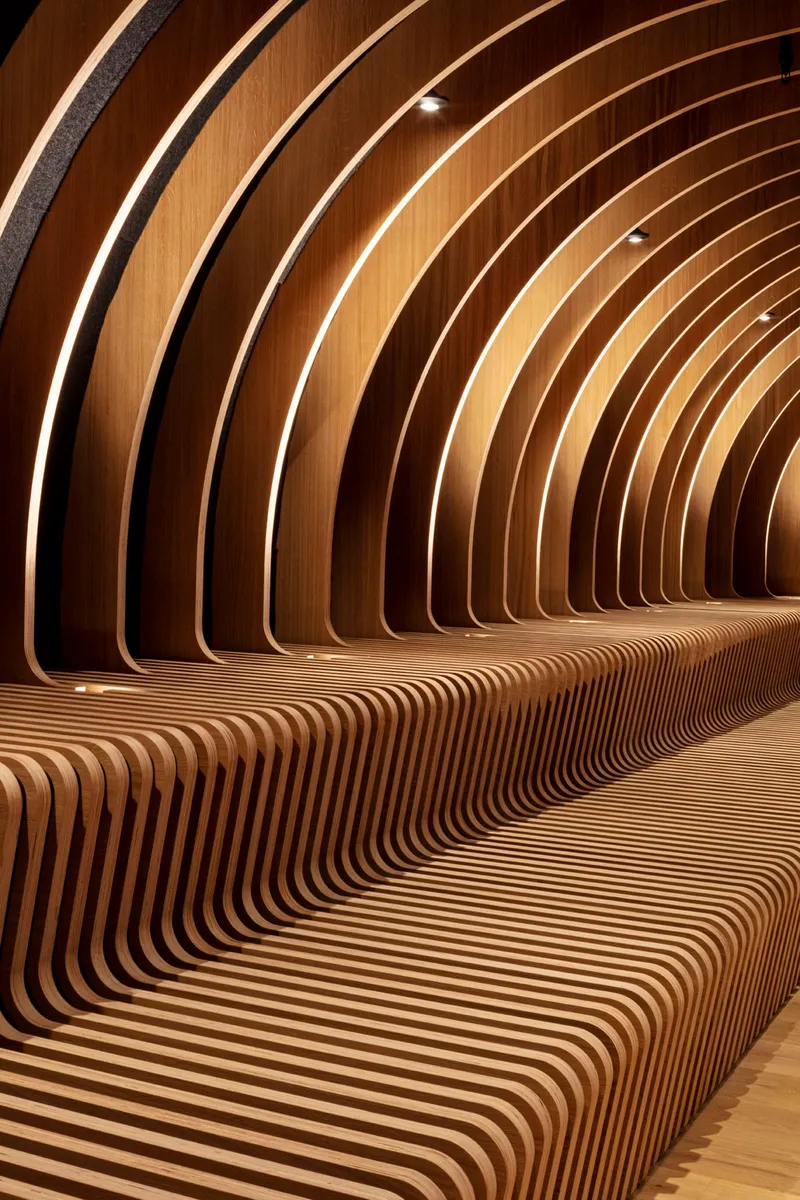
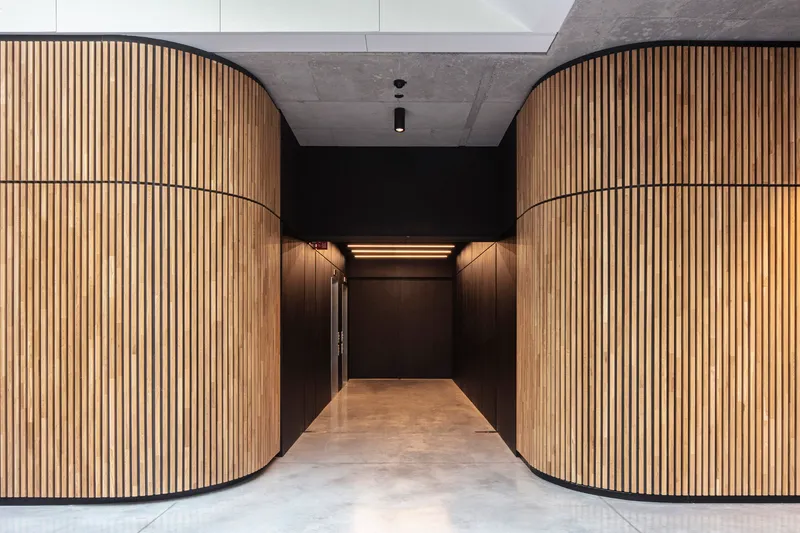
The material palette plays a careful game of contrast. Exposed concrete ceilings run overhead throughout, frank about the building's structural system and the core activation technology embedded within. Against that raw surface, OYO layered timber extensively: Decospan wood veneer panels, laminated ribs that curve to form both bench seating and wall surfaces, and slatted screens that modulate views along corridors. The arched timber rib enclosures are particularly striking. They create intimate, almost cave-like gathering spots that feel completely different from the open office zones just meters away.
Curved timber slat walls guide you through corridors toward dark-paneled elevator lobbies, and the effect is cinematic. These are not spaces you pass through mindlessly. The material transitions signal changes in program and mood, from collaborative openness to focused enclosure, without the building needing to rely on conventional doors and walls.
Workspaces and Gathering Rooms
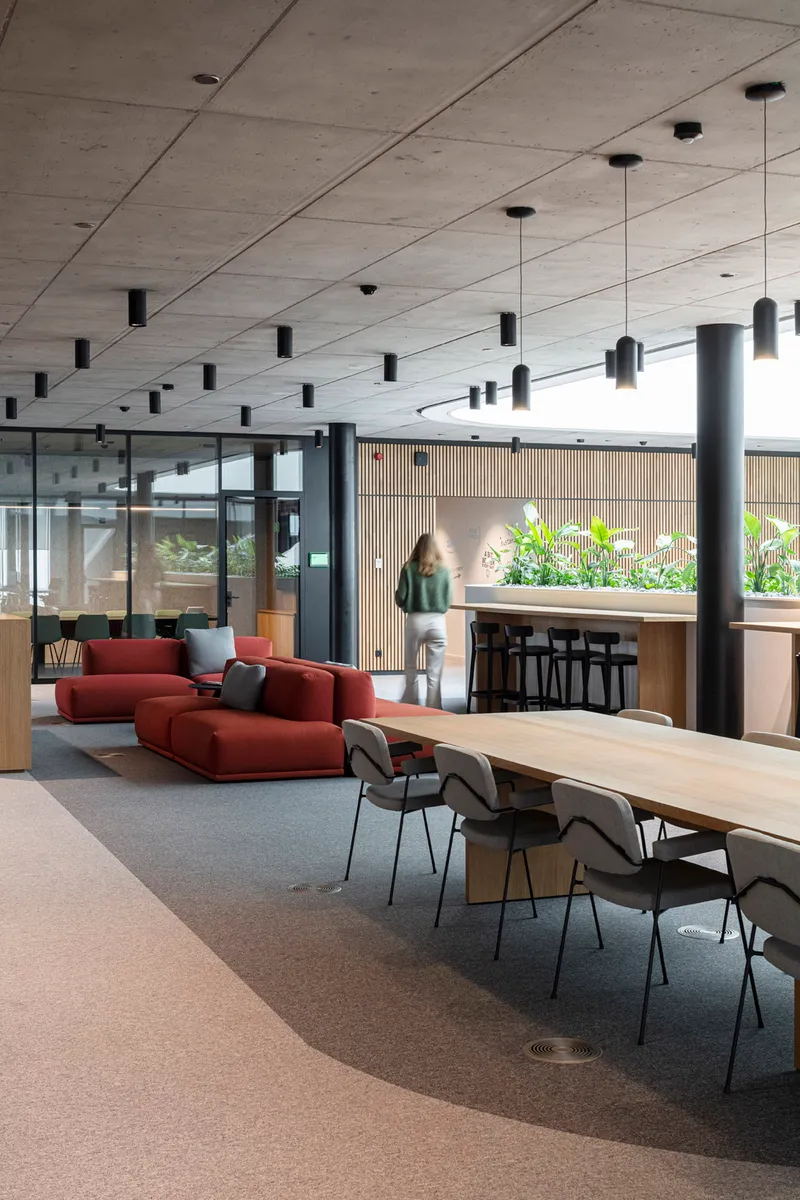
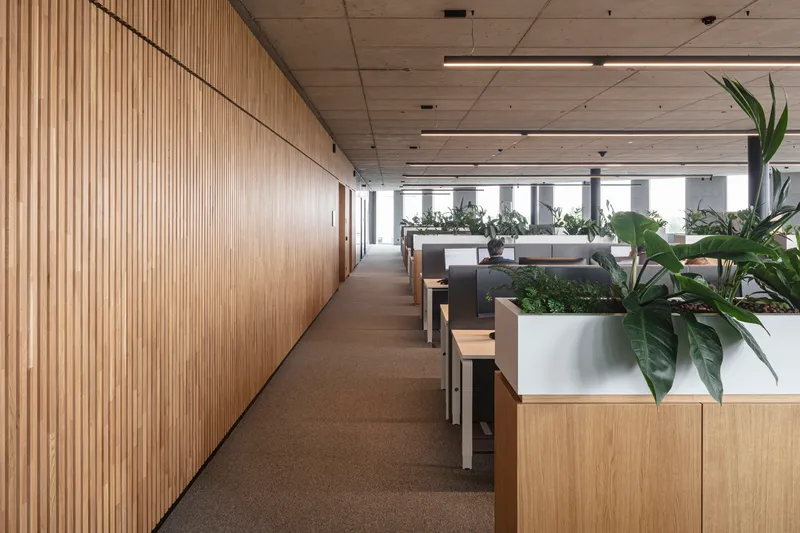
The open office corridors pair exposed concrete ceilings with timber slat partitions and planted dividers between workstations, a combination that avoids both the sterility of a typical open plan and the claustrophobia of a fully partitioned layout. Pendant lights drop at regular intervals, establishing rhythm without monotony. Communal dining tables occupy zones that double as informal meeting points during the day.
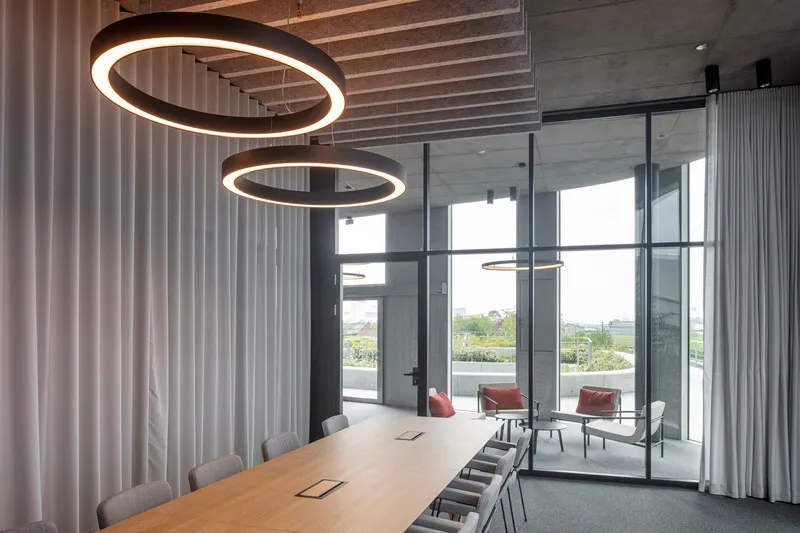
Conference rooms are generously glazed, opening onto terraces with views over the surrounding landscape. Twin circular pendant lights and timber tables establish a quieter, more focused register. Black steel-framed glass partitions with sheer curtains screen smaller meeting spaces from the main circulation, providing acoustic separation without visual isolation.
Flora Facades and Planted Thresholds
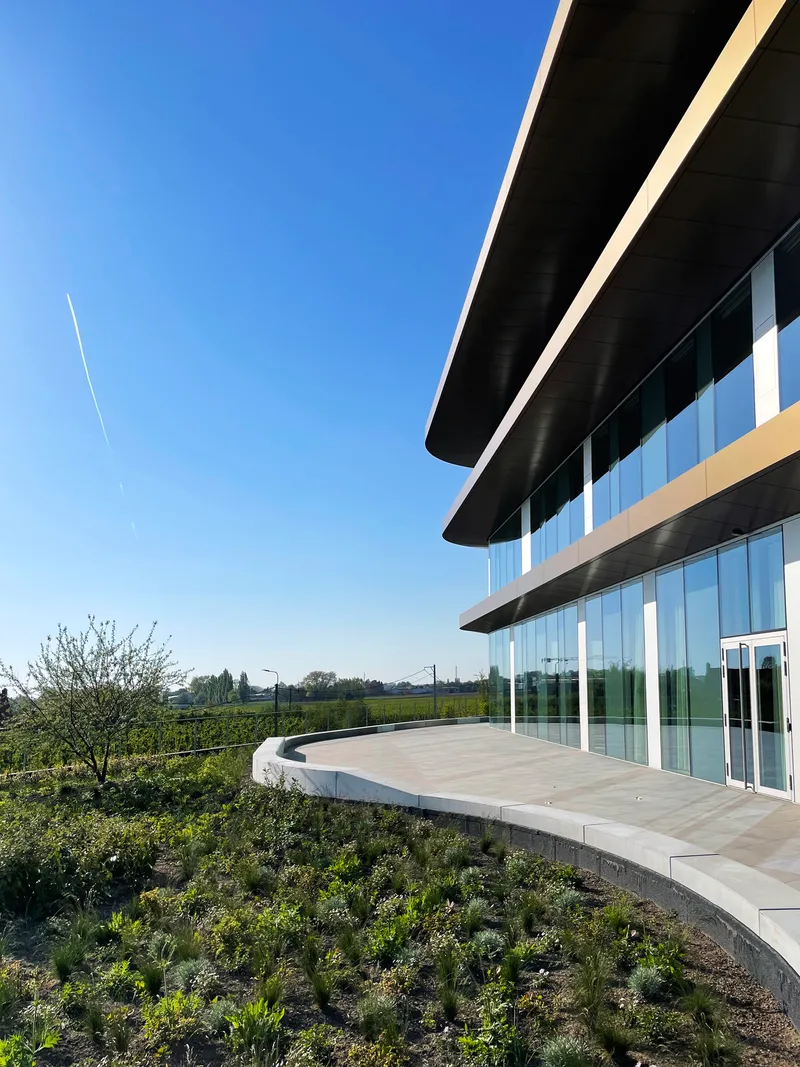
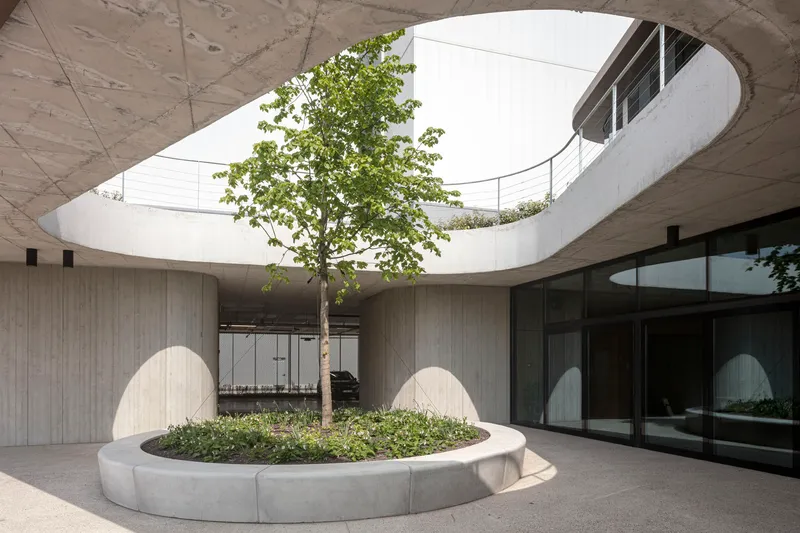
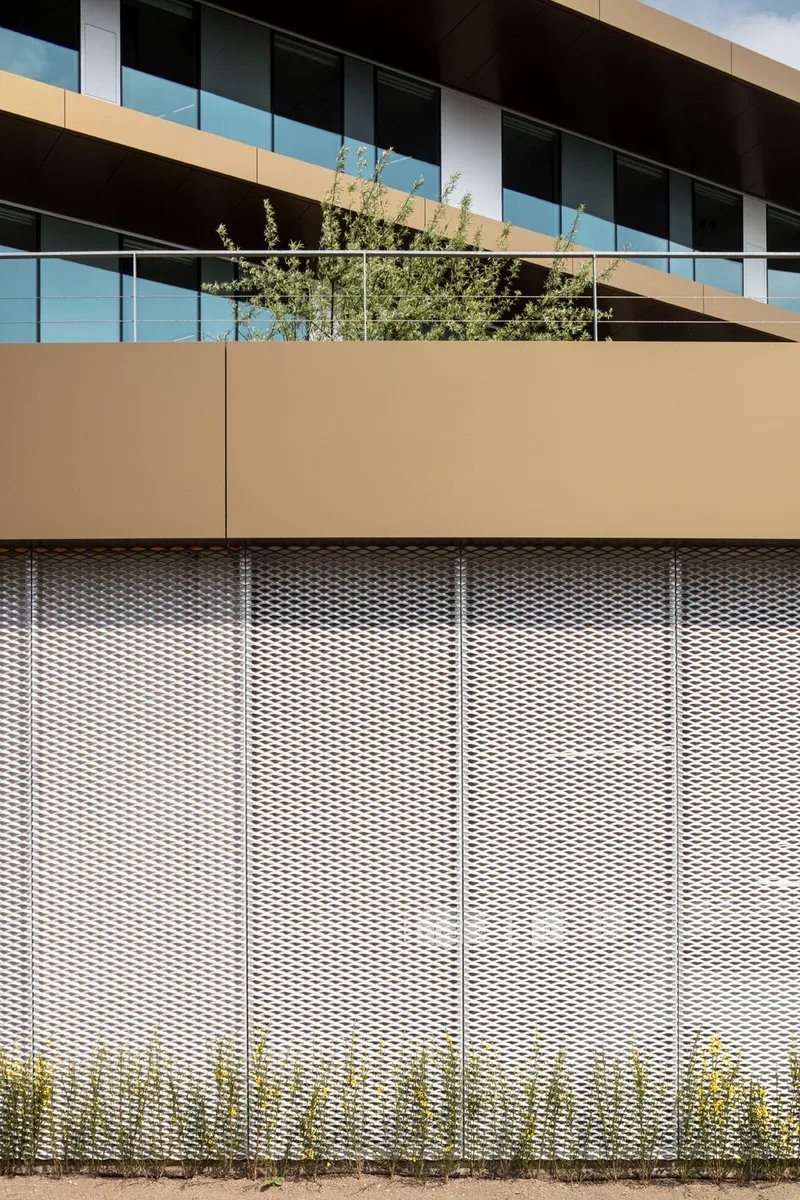
The planted terraces and flora facades are not decorative afterthoughts. They form a continuous environmental buffer that shields employees from direct sunlight, encourages biodiversity on a previously industrial site, and gives every floor access to outdoor space. The curved terrace decks extend toward open fields under expansive skies, and the native planting beds suggest a landscape strategy that will mature over decades rather than peaking on move-in day.
At ground level, circular courtyard planters with central trees punch through the concrete overhangs, pulling sky into what would otherwise be dark, covered zones. Expanded metal mesh screens below tan parapets create a layered threshold between building and landscape, with planted trees visible above the line, hinting at the terraces beyond.
Thresholds and Texture
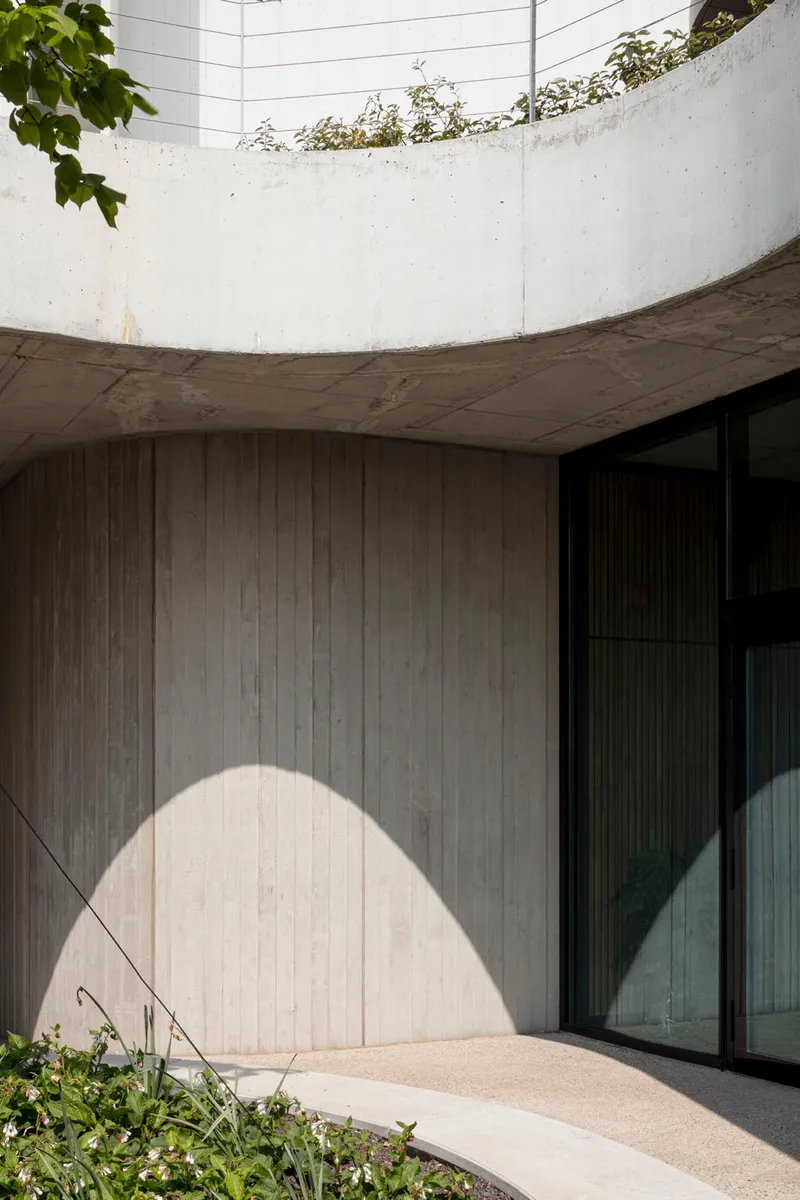
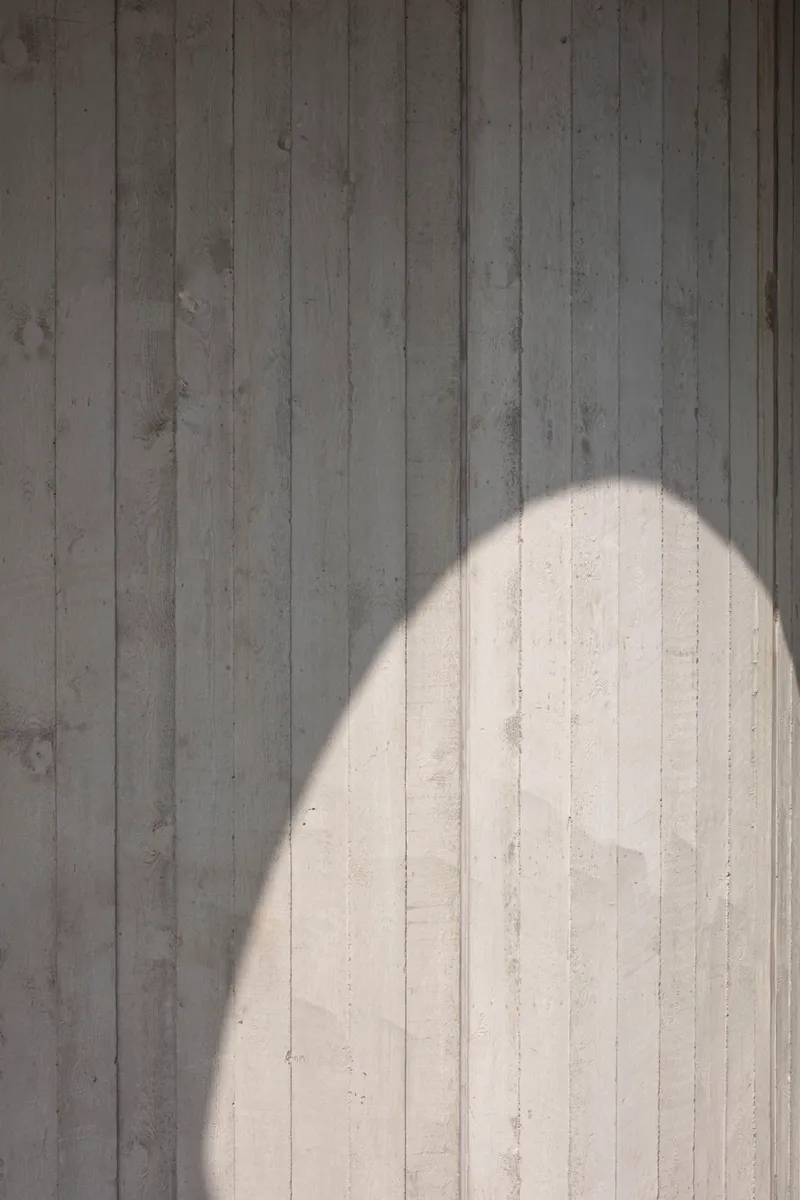
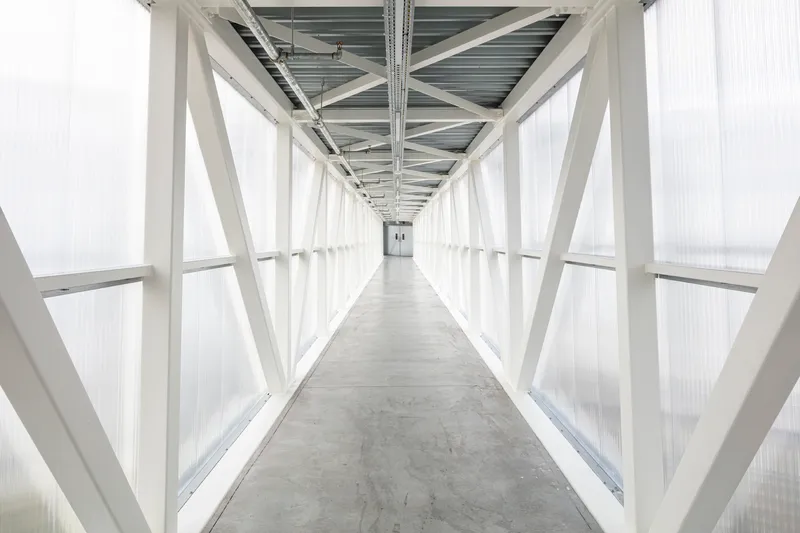
OYO paid close attention to the moments between inside and outside. Board-formed concrete walls cast arched shadows from overhead structures. Curved concrete soffits shade vertical timber walls beside planted beds. Enclosed corridors with white diagonal steel bracing and translucent polycarbonate cladding create luminous passages that feel suspended between the building's interior and the weather beyond. These interstitial zones give the building much of its character, the sense that you are always near air, light, and greenery even when you are technically indoors.
Plans and Drawings
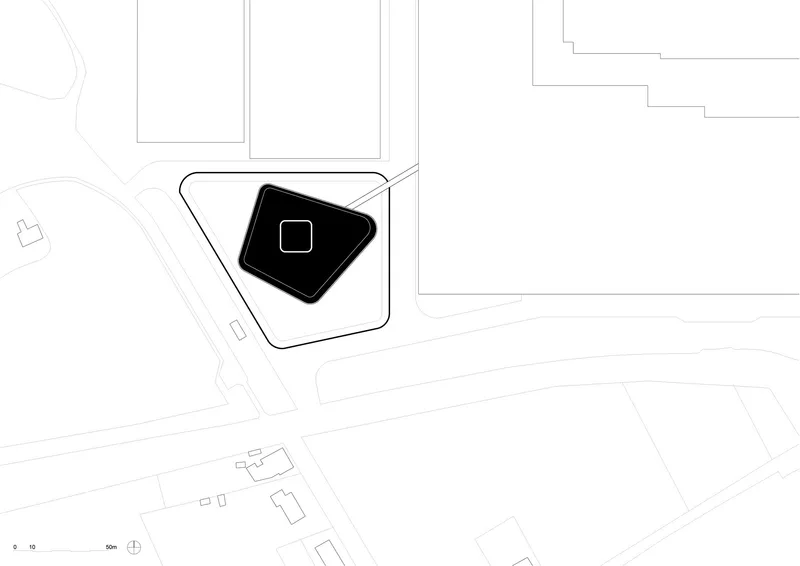
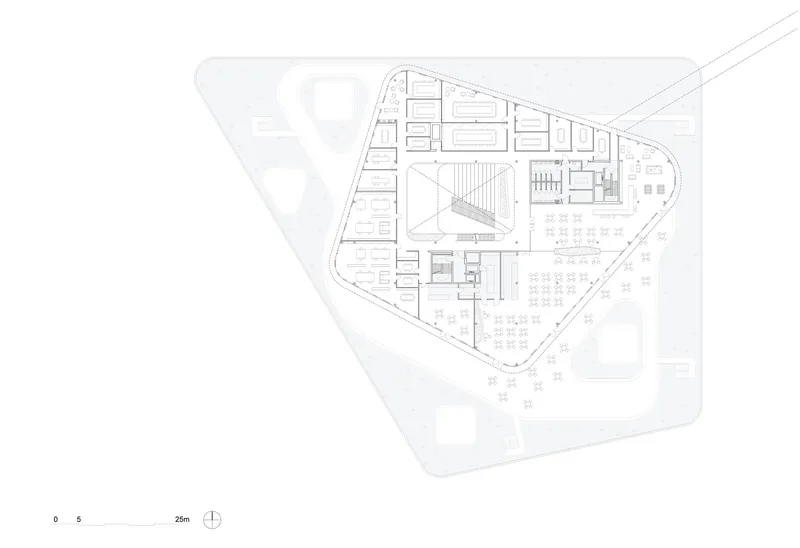
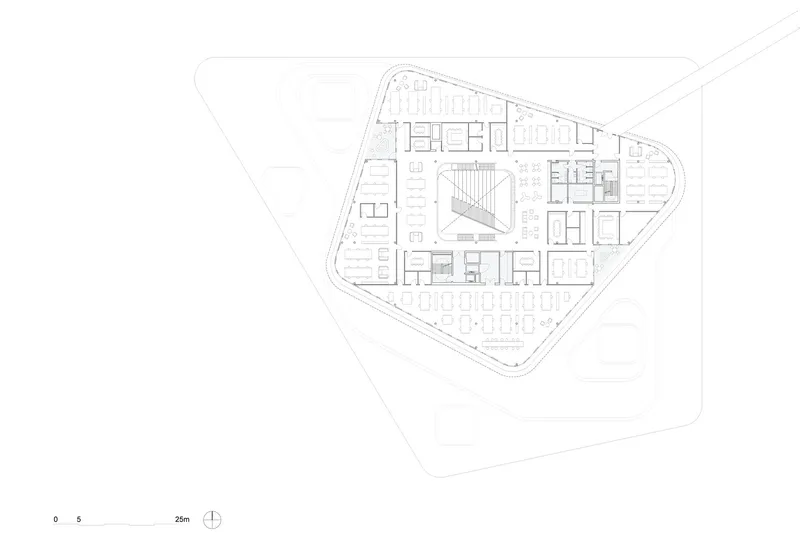
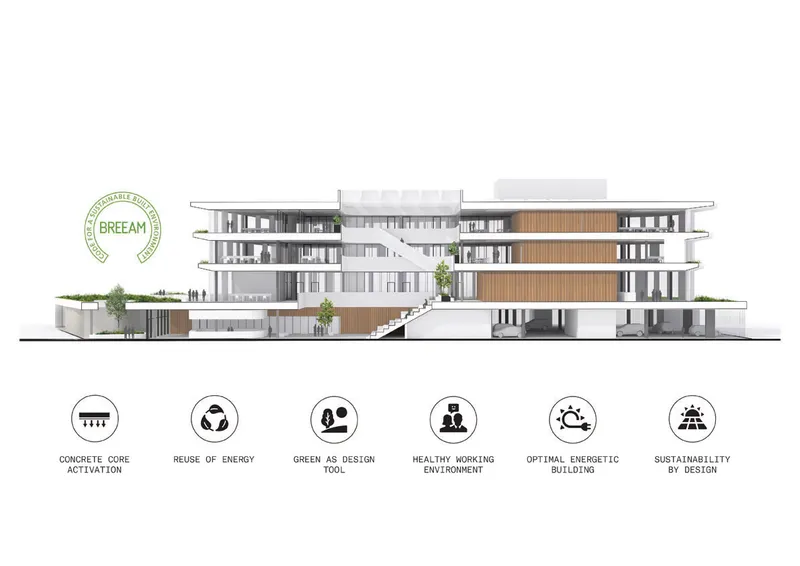
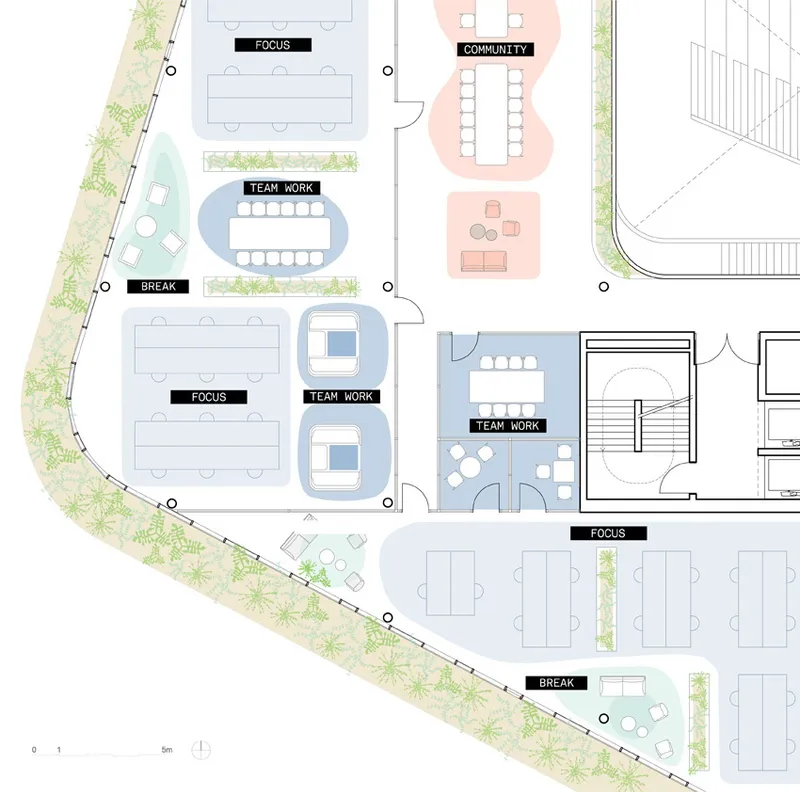
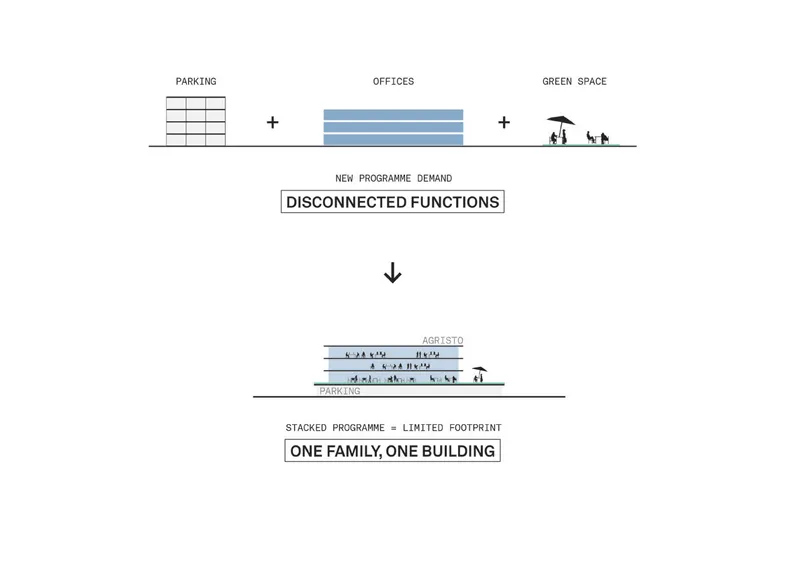
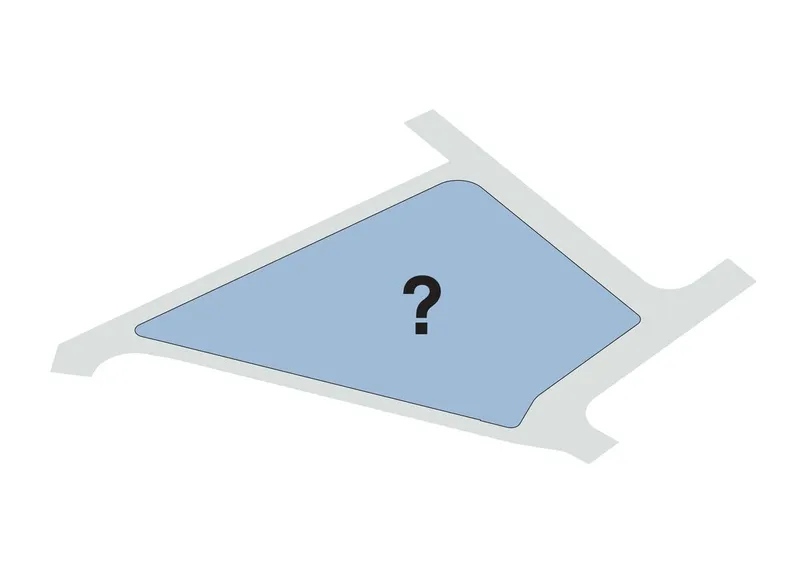
The site plan confirms the angular footprint with its central courtyard, a geometry that maximizes plot coverage while carving out protected outdoor space. Floor plans reveal how the triangular perimeter accommodates both open workstation zones and intimate planted buffers along the building's edges. The stacking diagram is perhaps the most telling drawing: it illustrates the conceptual leap from disconnected program elements (parking lot here, offices there, park somewhere else) to a single integrated volume where all three coexist vertically.
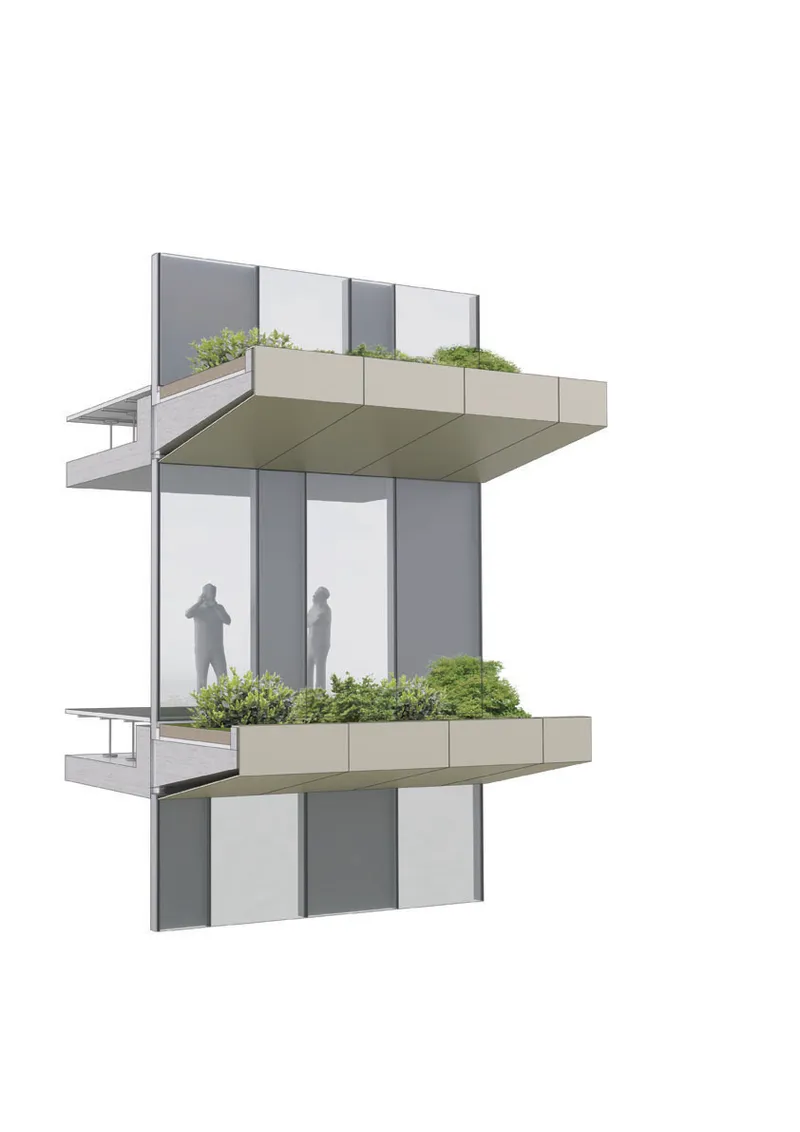
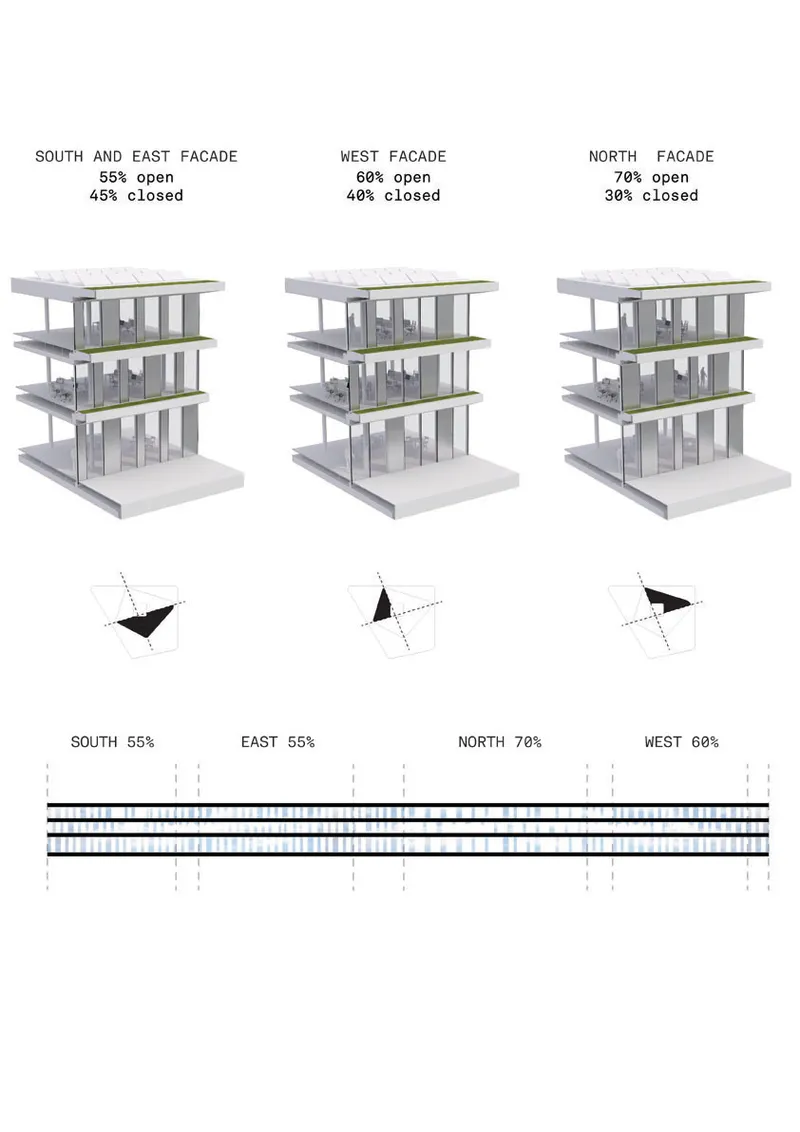
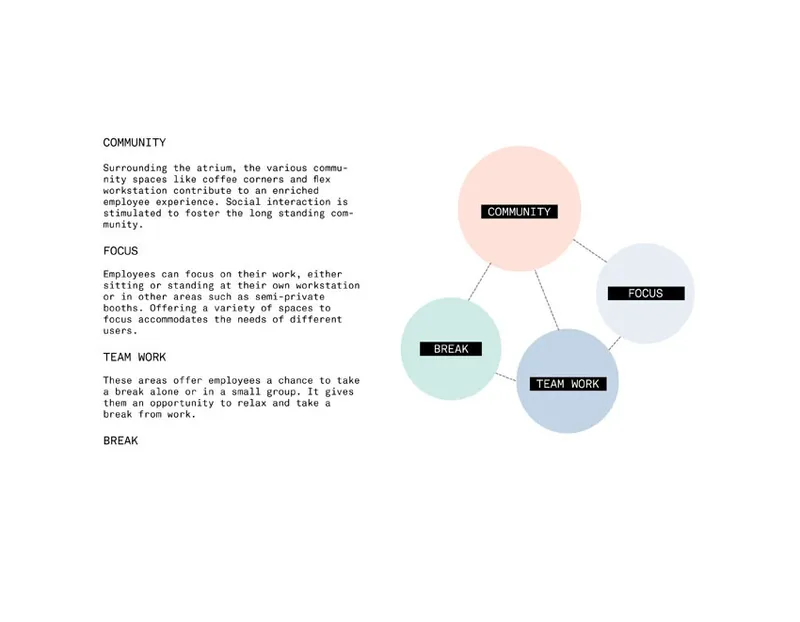
The facade study models are worth attention. They map varying percentages of open and closed surfaces across different orientations, evidence that the building's skin is calibrated to solar exposure rather than defaulted to a uniform curtain wall. The axonometric detail of a facade module shows how planted balconies and glazed panels are sandwiched between floors, making the green terraces a structural reality rather than an appliqué. The workplace diagram mapping community, focus, teamwork, and break zones confirms that the interior layout is programmatic rather than accidental.
Why This Project Matters
The Agristo Headquarters matters because it treats a corporate brief as an urban design problem. Instead of defaulting to the familiar formula of office block plus surface parking plus token landscaping, OYO compressed the entire program into a single structure that creates more ground than it consumes. The convertible parking levels and the thermal exchange with the adjacent factory suggest a building that was designed not for opening day but for a twenty-year horizon. That kind of thinking is still uncommon in corporate architecture outside major cities, and it is even rarer in a semi-rural Belgian context.
More broadly, the project demonstrates that organic form does not have to be arbitrary. Every curve here responds to site geometry, solar orientation, or programmatic logic. The building is strange looking, yes, but it earned its shape. For a family business that started locally and now operates globally, OYO delivered a headquarters that is specific to its site and its neighbor, rooted in the practical realities of West Flanders rather than imported from a generic playbook.
Agristo Headquarters by OYO, Wielsbeke, Belgium. 21,750 m². Completed 2021. Photography by Tim Van de Velde.
About the Studio
Share Your Own Work on uni.xyz
If projects like this are the kind of work you want to make, uni.xyz is a place to publish your own, find collaborators, and enter design competitions.




Popular Articles
Popular articles from the community


Conexión: Biophilic Design Reimagines High-Rise Living in Hong Kong
Conexión reimagines high-rise living in Hong Kong through biophilic design, green facades, shared spaces, daylight, water and nature within.

Co-life: Sustainable Architecture for Age-Friendly Community Living
Co-life reimagines sustainable architecture for seniors through courtyards, rammed earth, shared gardens, and spaces designed for belonging.

Co-Life: Senior Housing Design That Reconnects Older Adults With the City
Co-Life reimagines senior housing design through healing gardens, shared streets, workshops, and a sustainable community across generations.

Lunar Spiral: Space Architecture Shaped by the Mathematics of the Universe
Lunar Spiral reimagines space architecture through Fibonacci geometry, lunar regolith, levitating habitats, and self-sustaining Moon living.


Similar Reads
You might also enjoy these articles

Bao Huynh Watercolor Atelier: A Serene Art Retreat in Hội An
Bao Huynh Watercolor Atelier in Hội An blends multifunctional art spaces, sustainable design, local materials, and family-friendly living in a serene environment.

Atelier Macri Concept Store Interior Design by CASE-REAL
Atelier Macri store features a "ko" counter, walnut wood details, cork displays, blending retail, gallery, and seamless customer experiences.

Manuel Vargas Izquierdo Stadium and High-Performance Sports Center: Architectural Excellence in Jalpa de Méndez
The Manuel Vargas Izquierdo Stadium blends sustainable design, inclusive sports facilities, and cultural-inspired architecture, revitalizing Jalpa de Méndez’s public spaces.

KAKR Buluh Awar Hall: Revitalizing Community and Ecology Through Bamboo Architecture
Community built bamboo hall revitalizes Buluh Awar village, empowering youth, restoring ecology, celebrating vernacular craftsmanship through sustainable architecture and culture.





Comments (0)
Please login or sign up to add comments
No comments yet. Be the first to comment!