
PAU Architects Wraps a Canal-Side Hotel in Sa Đéc's Flower Village in Arches and Tropical Gardens
A 1,000-square-meter boutique hotel in Vietnam's Mekong Delta uses deep loggias and lush courtyards to blur the line between room and garden.


Sa Đéc, a small town in Vietnam's Đồng Tháp province, is famous for one thing above all else: flowers. Its nurseries supply much of southern Vietnam, and the landscape here is an almost absurdly fertile patchwork of blooms, waterways, and low-slung houses. It is not, historically, a destination that attracts ambitious hotel architecture. PAU Architects, led by Trung Nguyen and Huyen Nguyen, have seized on that gap with Sadec Garden Hotel, a 1,000-square-meter boutique property completed in 2025 that tries to belong to this landscape rather than merely occupy it.
What makes the project worth studying is the sheer discipline of its means. The hotel is built from a deliberately restrained palette: white stucco walls, corrugated metal roofing, terracotta and steel accents, patterned tile floors. Every significant move revolves around the arch, repeated at multiple scales across facades, canopies, corridors, and gates. Rather than reading as monotonous, the repetition gains power through variation. Arches frame canal views, filter light through planted beds, and create deep loggias that serve as the building's primary climate strategy. The result is a place that feels both rooted in the Mekong Delta's vernacular traditions and entirely its own.
A Facade of Stacked Loggias
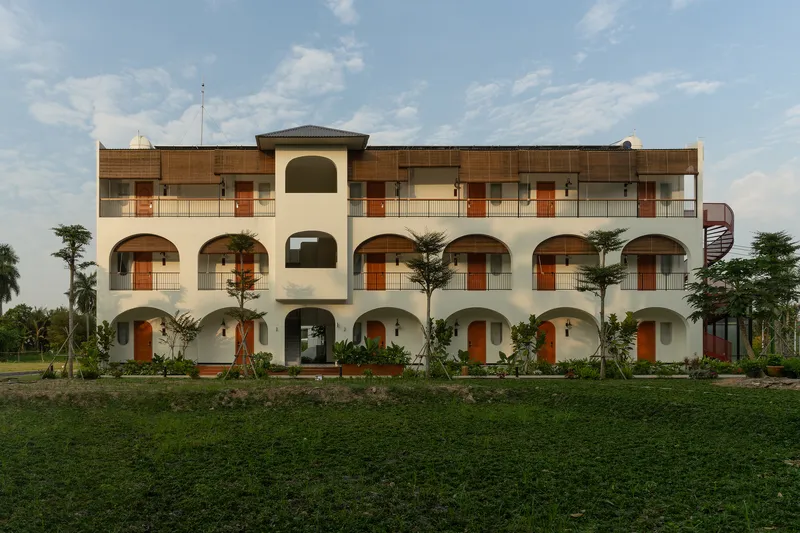
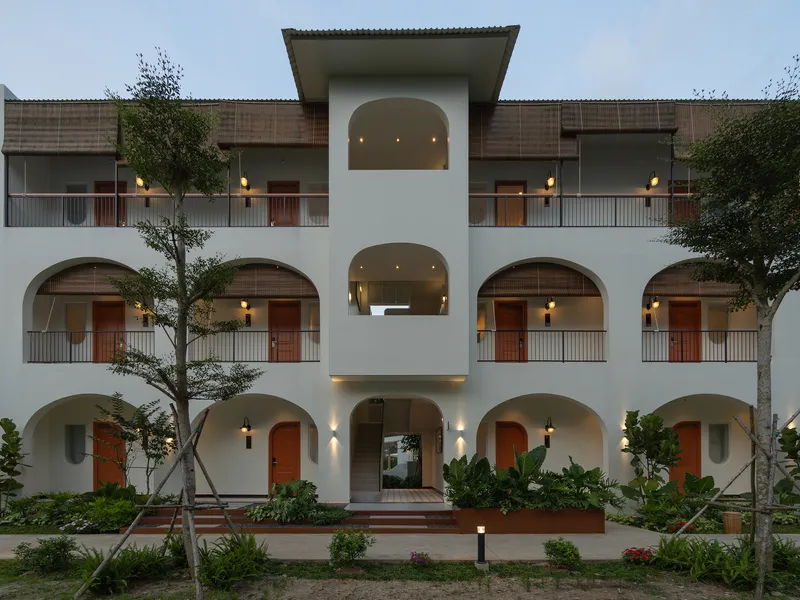
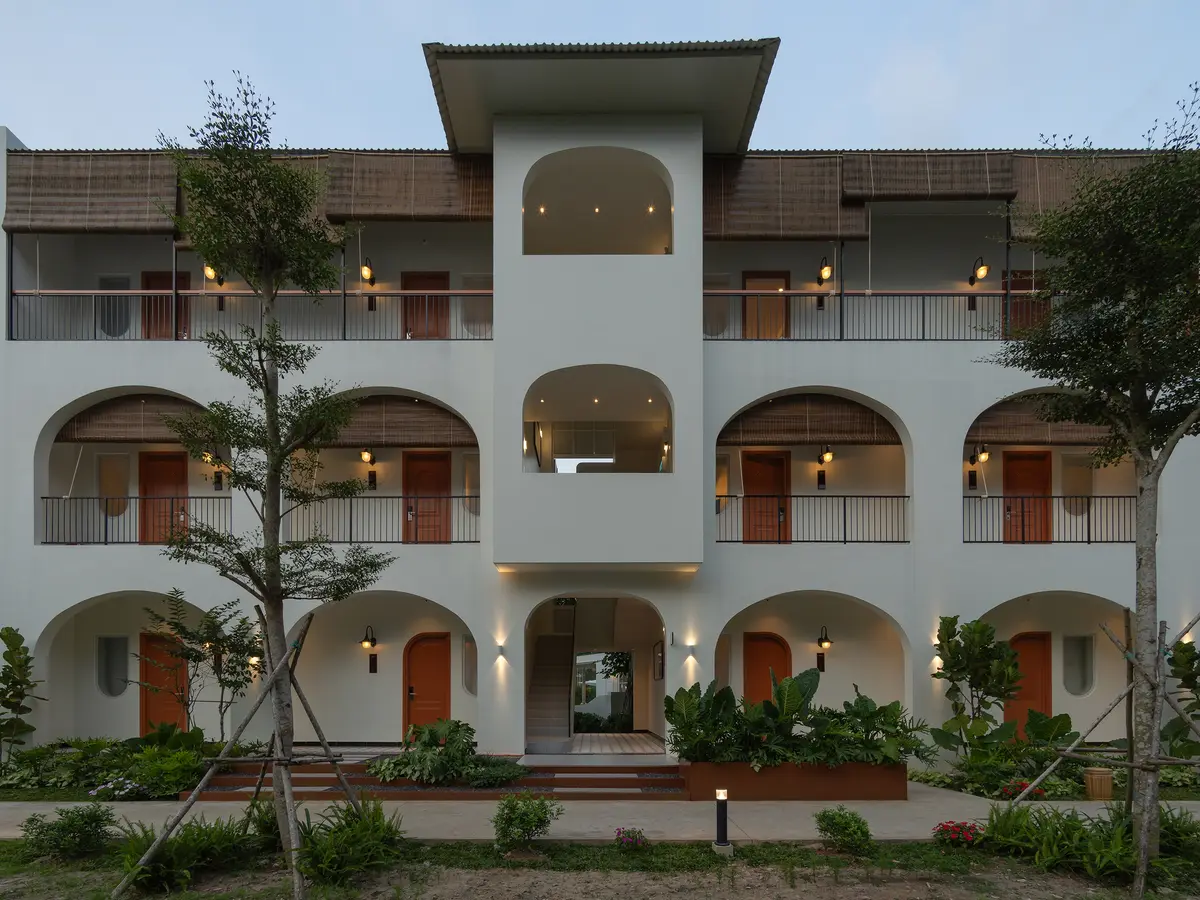
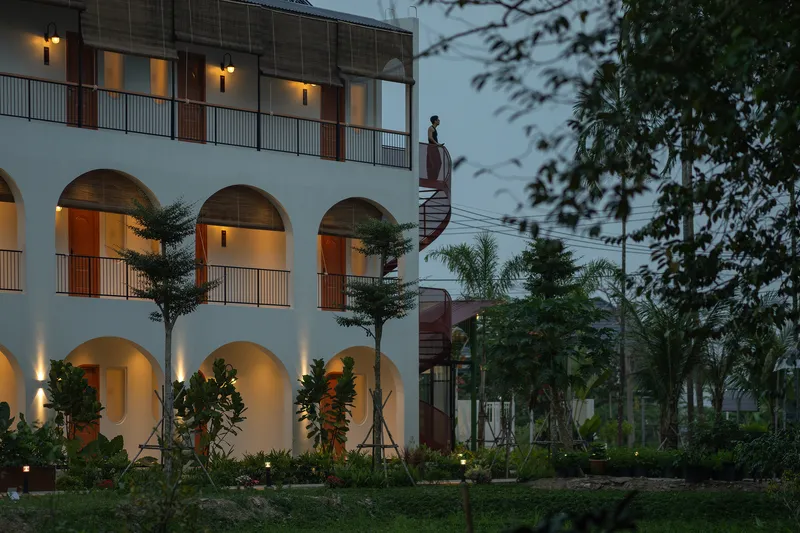
The hotel's principal elevation is a three-story grid of arched openings backed by timber-paneled balconies, rising behind a manicured grass lawn. At twilight the symmetry becomes almost theatrical: warm interior light spills through the arches, turning the facade into a lantern. During the day, the depth of those loggias does real environmental work, shading guest rooms from direct sun while still admitting generous daylight and cross-ventilation. The proportions recall colonial arcades common across Southeast Asia, but the detailing is contemporary and clean.
The composition is deliberately frontal and calm. There is no dramatic cantilever, no parametric flourish. The architects trust the rhythm of the arches and the softness of the surrounding palms to carry the composition. It works precisely because the landscape is so active; a quieter building allows the tropical vegetation to co-author the elevation.
The Red Spiral Stair as Vertical Event
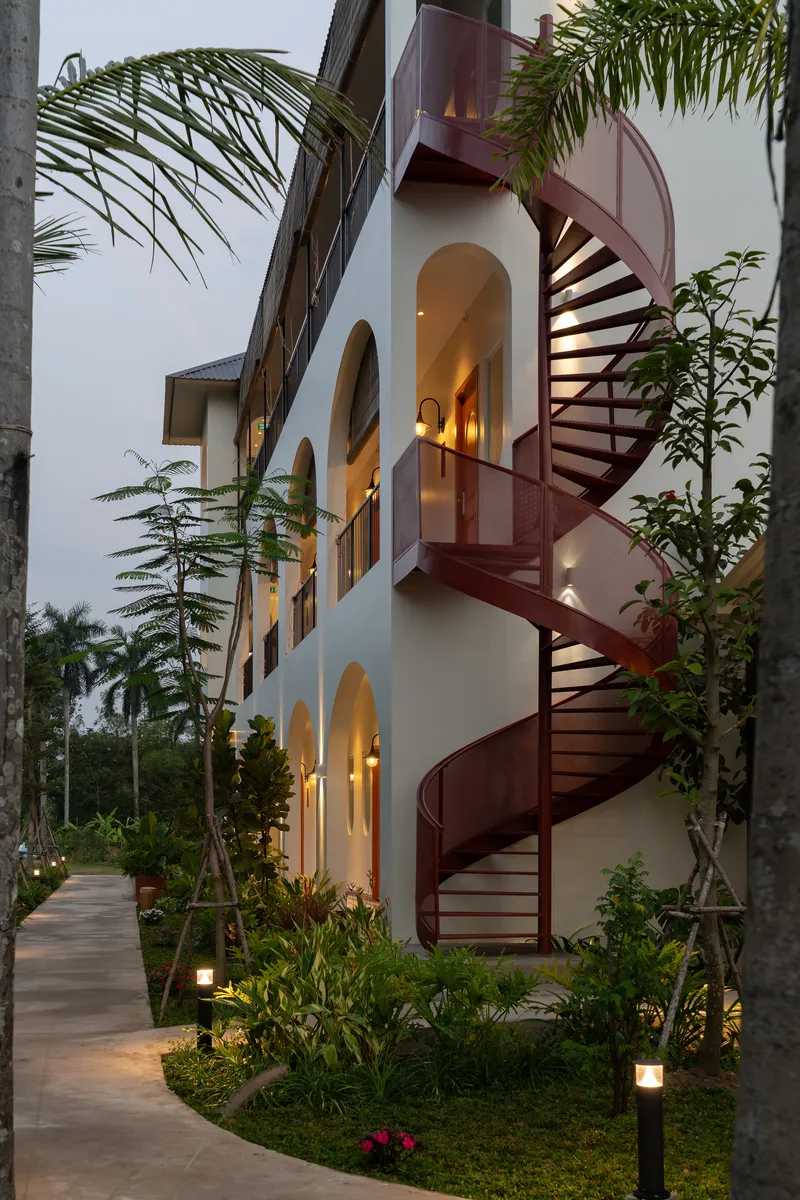
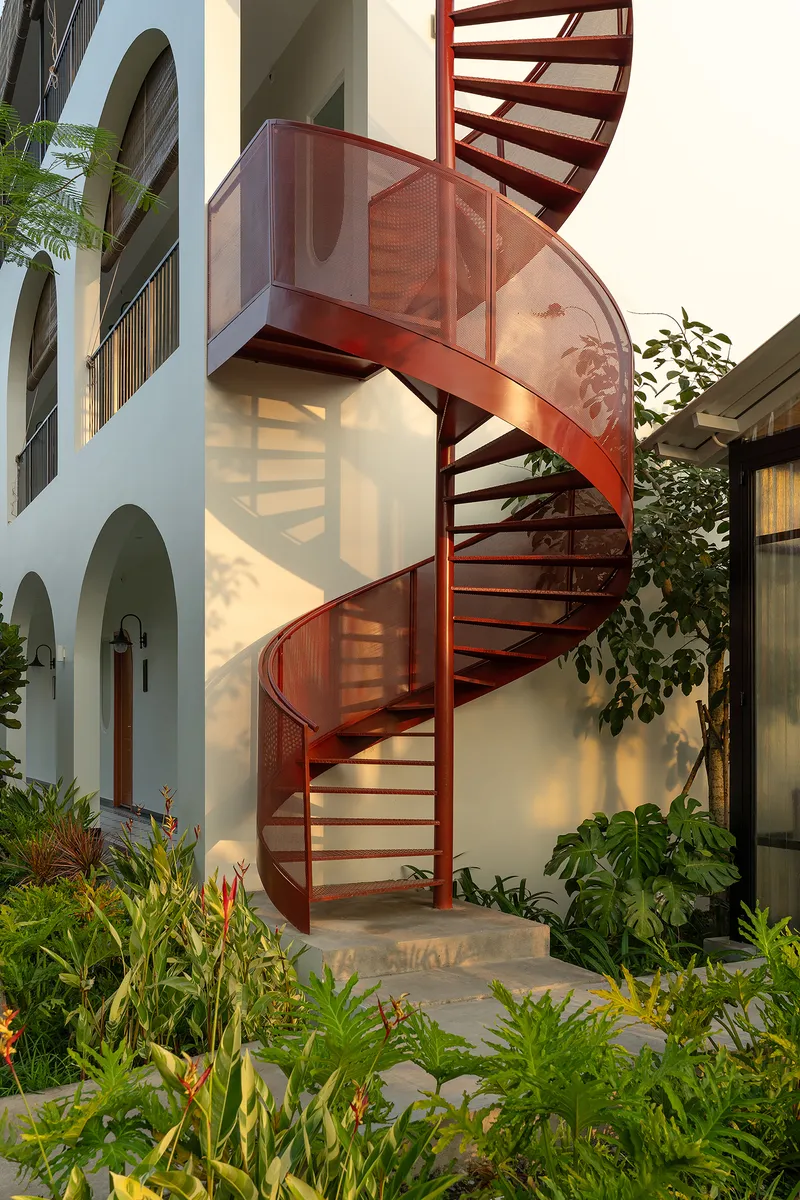
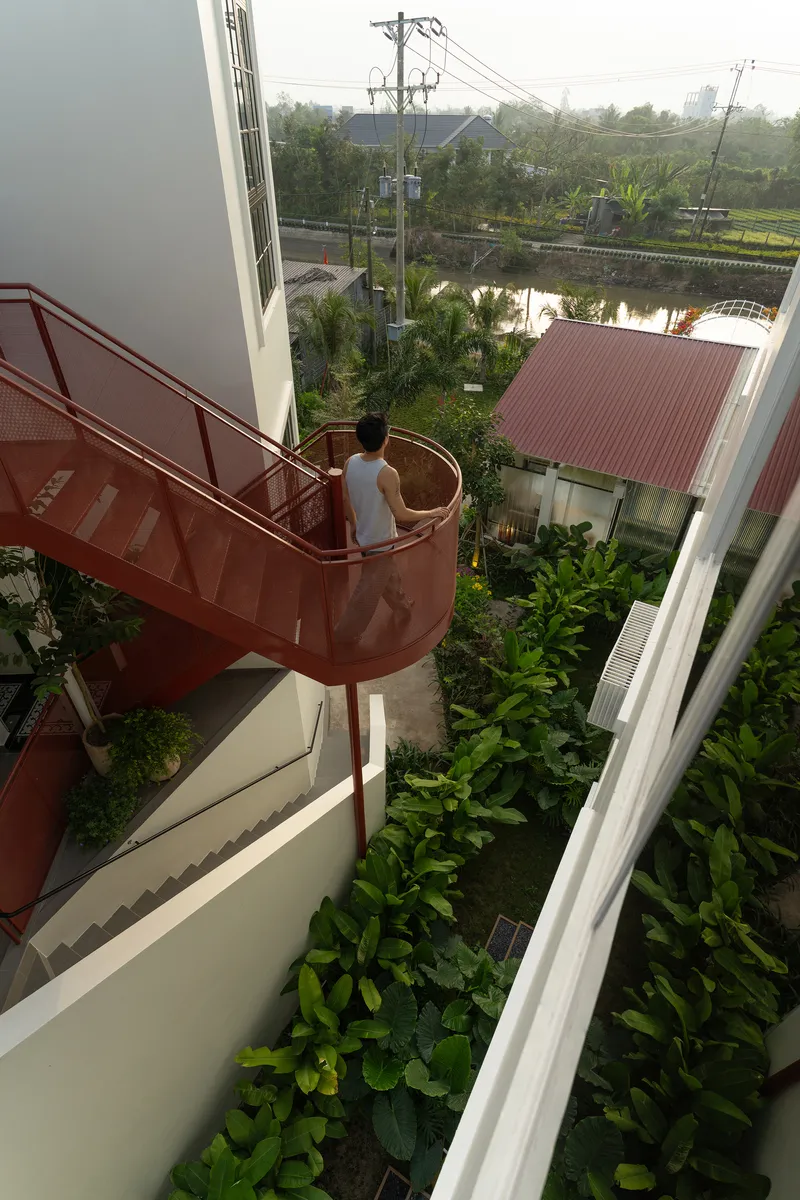
If the arched facades provide the hotel's composure, the exterior spiral staircase injects its energy. Finished in a strong terracotta red, the steel helix climbs three stories along the white stucco wall, turning circulation into spectacle. Its perforated landing platforms cast patterned shadows that shift throughout the day, and from the upper turns guests look down over corrugated rooftops, palm canopies, and a reflecting pond. It is a set piece, yes, but also a practical connector that links the hotel's staggered volumes without eating into interior floor area.
PAU Architects clearly understand that in a small hotel, the journey between rooms matters as much as the rooms themselves. The stair gives guests a reason to pause, look out, and reorient themselves within the garden. It is the one element in the project that announces itself loudly, and the contrast against the otherwise understated palette is well judged.
Courtyards, Canopies, and the Copper Stair
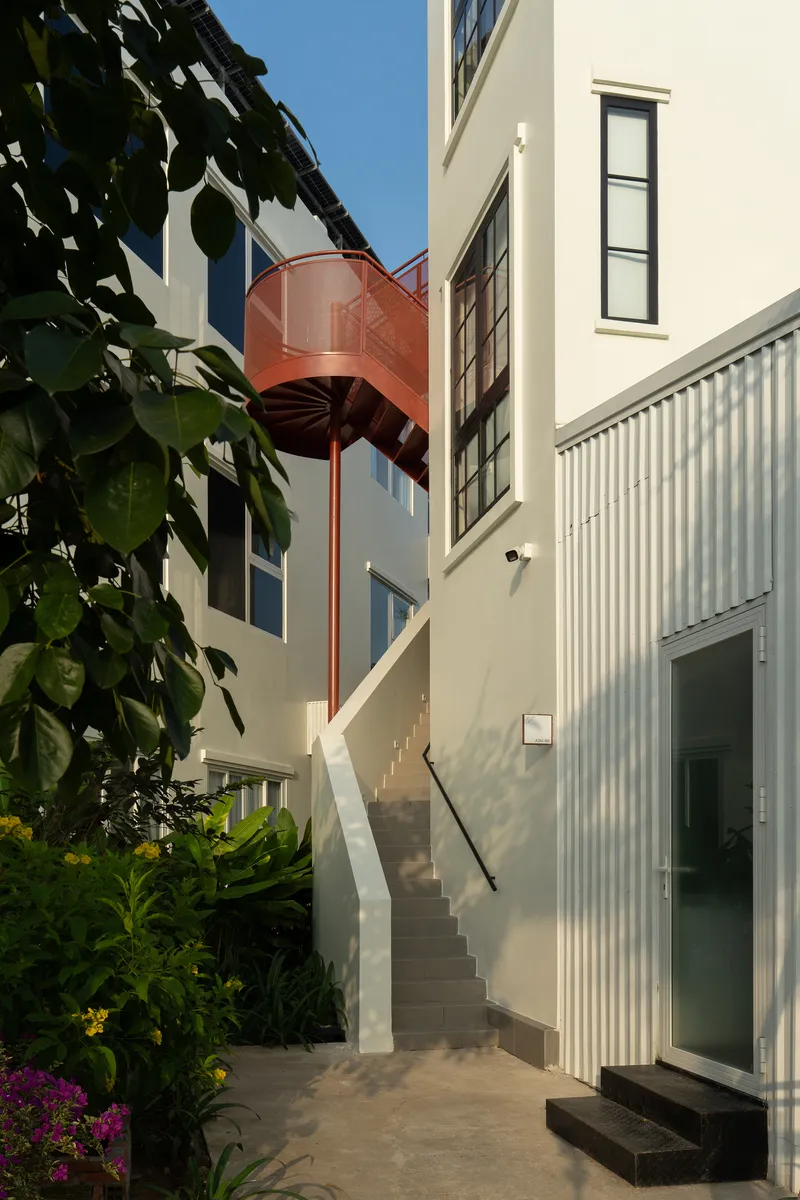
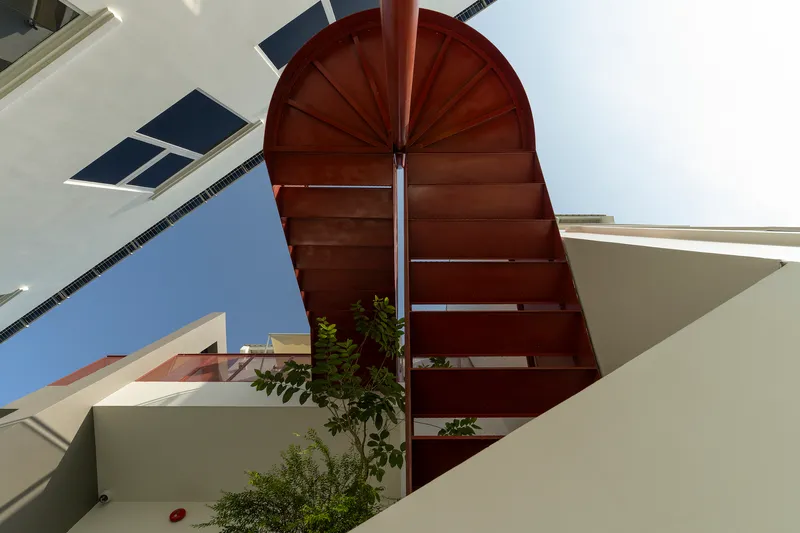
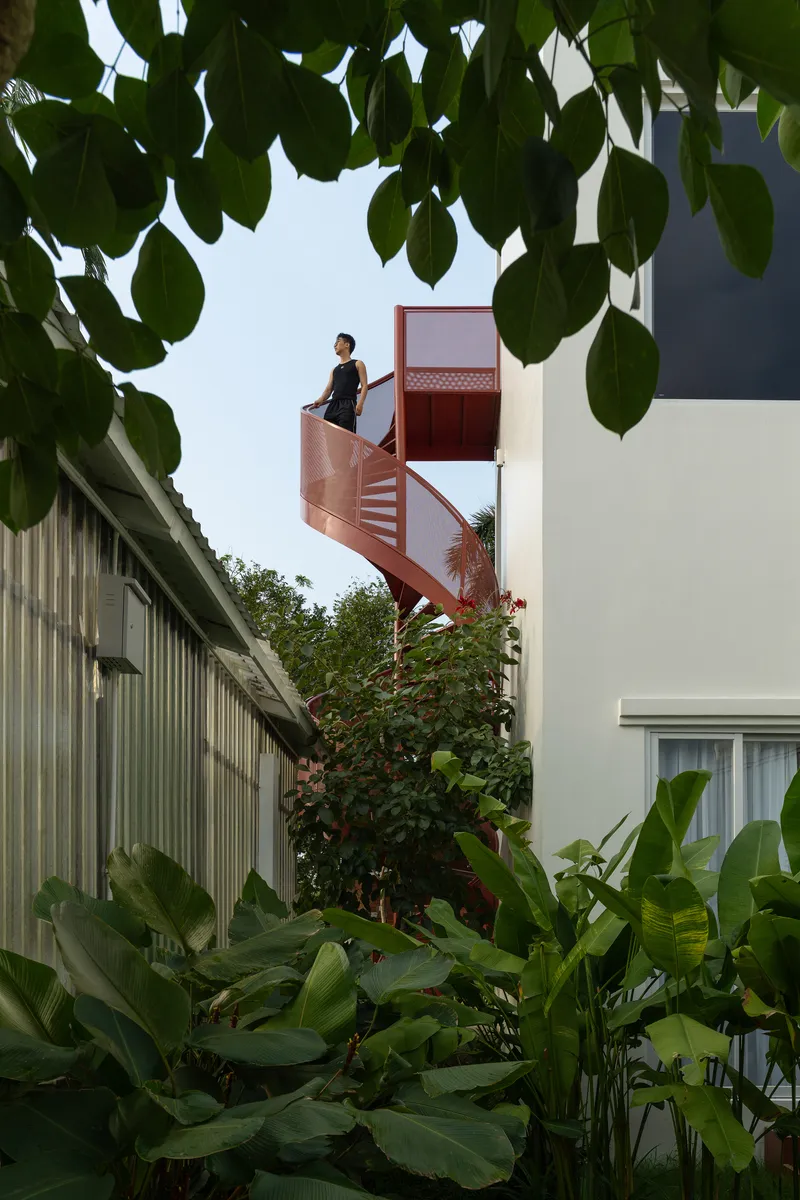
A second, smaller staircase operates in a completely different register. Here, an arched copper canopy shelters an open-air courtyard stair that threads between white rendered volumes, with tropical planting erupting through gaps in the paving below. Viewed from underneath, the canopy reads as a sculptural vault punctured by a central steel pole, framing patches of sky and foliage. It is the project's most photogenic moment, but it also solves a real problem: connecting the building's indoor and outdoor zones without an abrupt threshold.
The courtyards themselves are small but dense with planting. Banana palms, tropical shrubs, and young trees are packed into every available opening between building volumes. The effect is of architecture dissolving into garden at its edges, a strategy that owes something to traditional Mekong Delta houses where indoor and outdoor spaces are separated by little more than a change in floor level.
Entry Sequence: Tiles, Arches, and Filtered Light
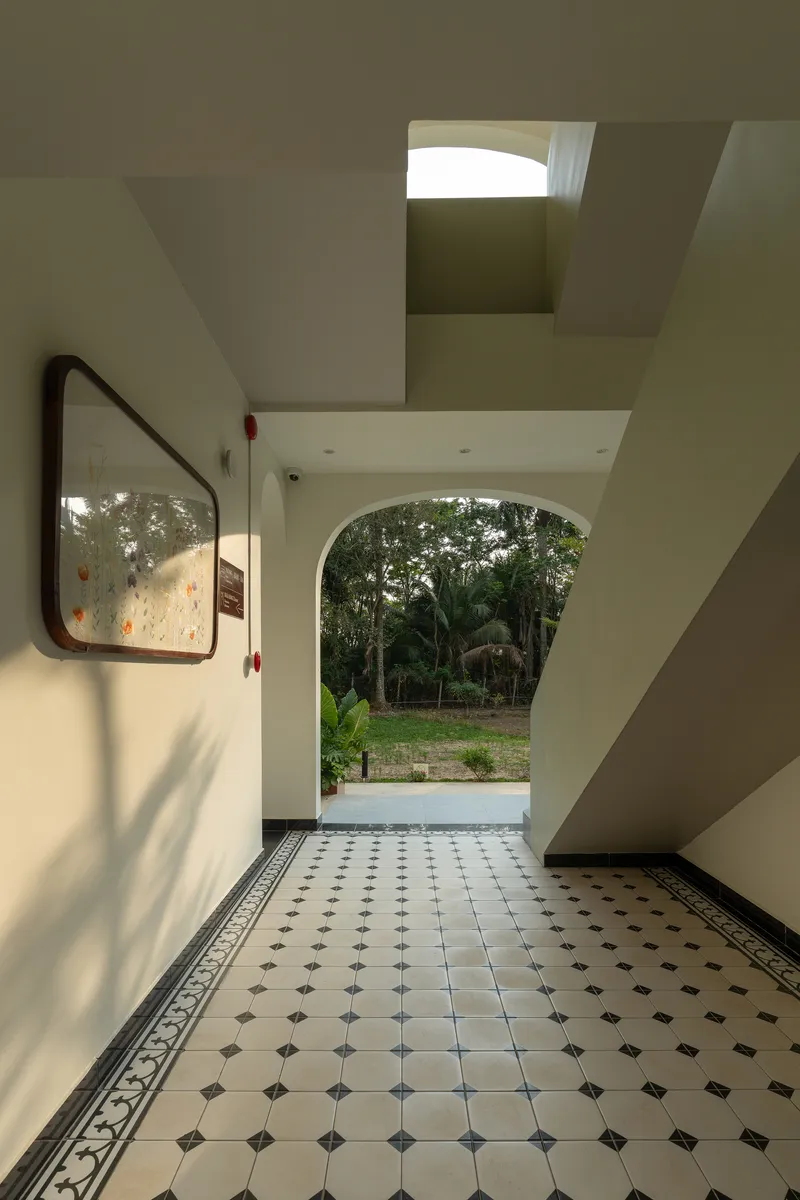
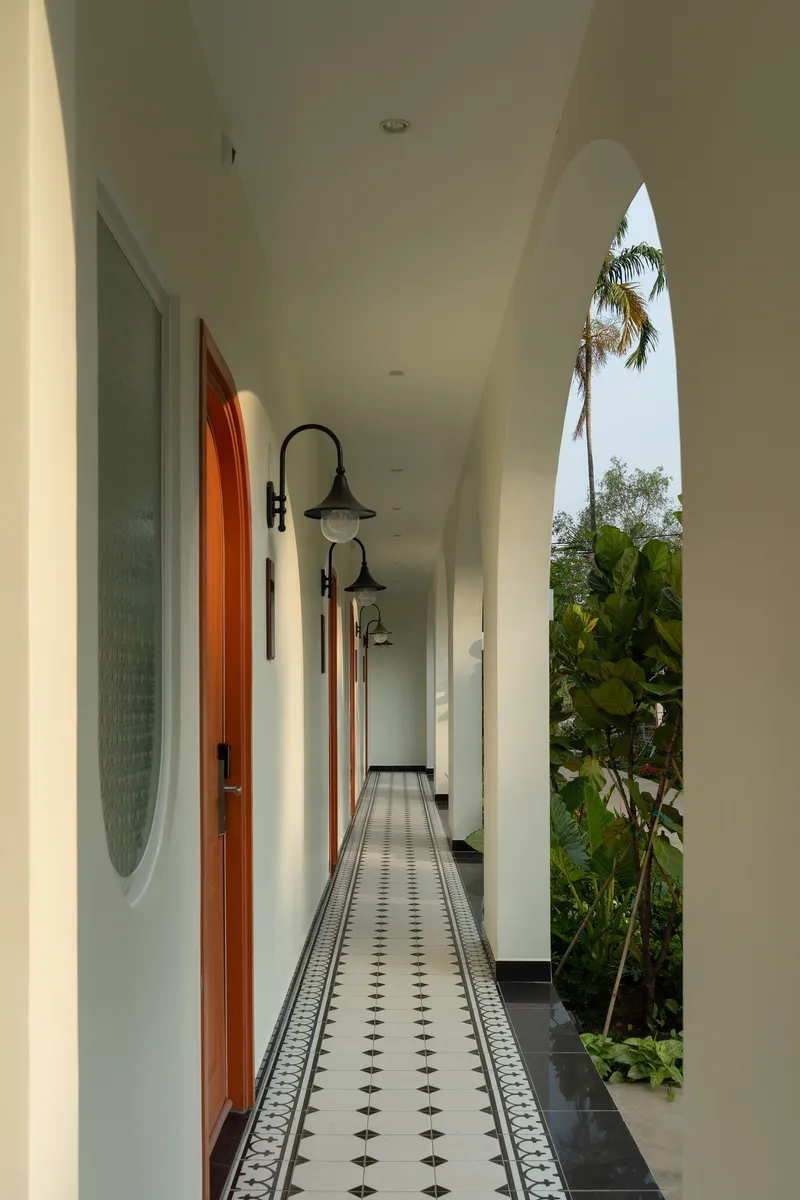
The ground-floor interiors reveal what happens when the arch motif migrates indoors. Entry halls and corridors are lined with patterned tile floors, geometric and boldly scaled, that anchor the gaze downward before an arched opening pulls it back toward the garden beyond. A skylight washes one corridor with diffuse overhead light, while a pointed arch in another passageway frames a dense screen of palm trees and banana plants. The effect is processional: each threshold rewards a pause.
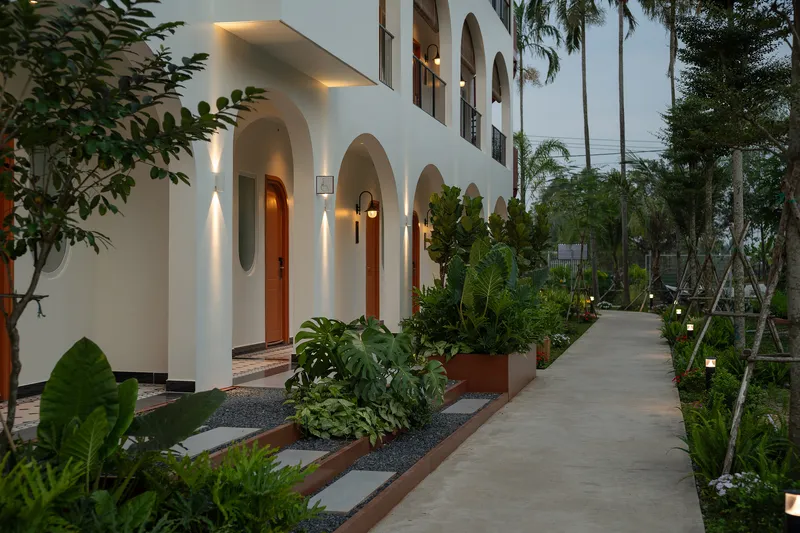
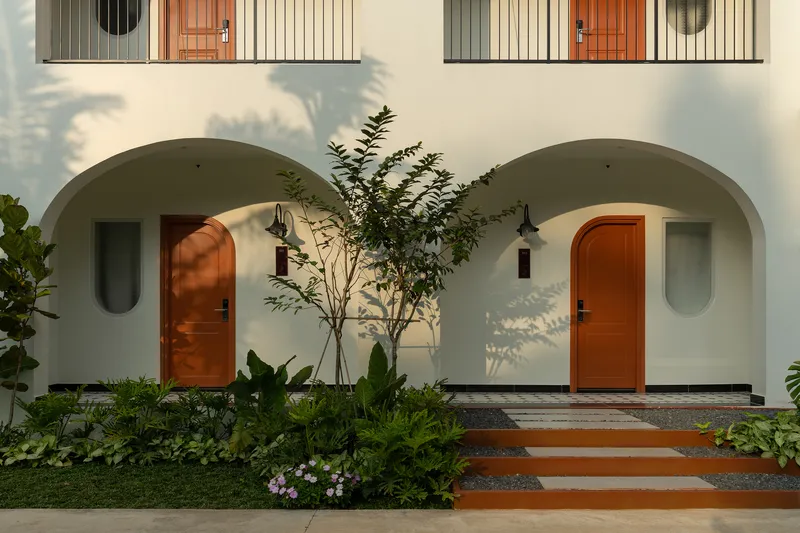
The paired arched entry alcoves on the facade, complete with timber doors and oval windows, reinforce the sense of crossing into a different world. The shadows they cast in the late afternoon are theatrical, long and curved, and they signal that this is a building designed to perform differently at every hour.
Pool, Dining, and the Leisure Layer
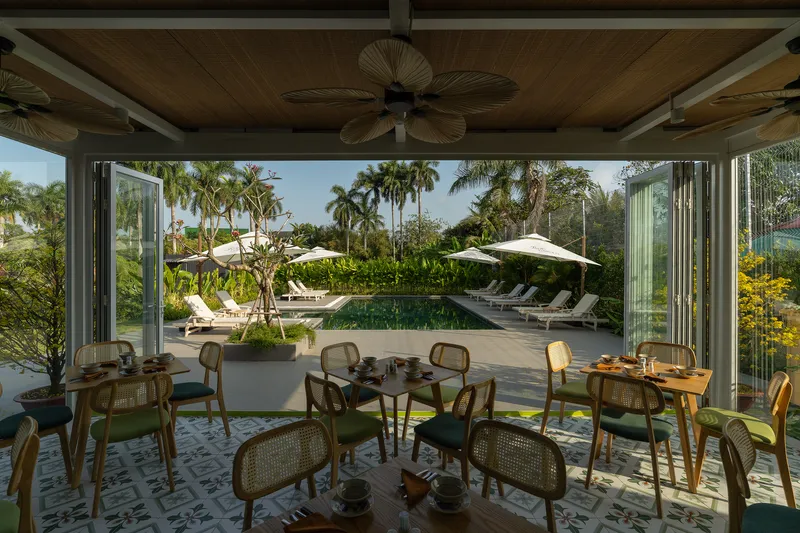
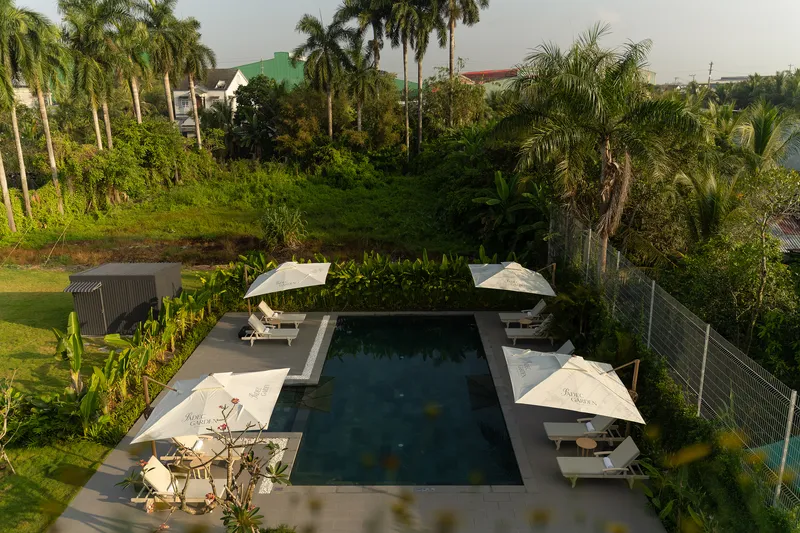
The hotel's communal program clusters around a rectangular swimming pool set within the tropical garden, flanked by white umbrellas and palm trees. An open-air dining room with folding glass walls looks directly onto the pool deck, collapsing the boundary between eating and lounging. Elevated views show the pool as a precise geometric incision in a sea of green, which is the right strategy for a project this small: the hard landscape is minimal, so it reads as precious rather than barren.
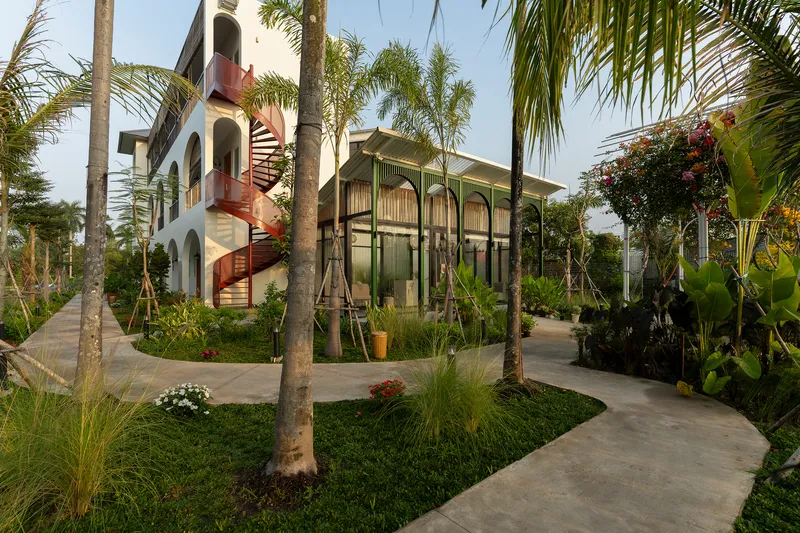
Winding garden pathways connect the leisure zone to the screened pavilion and the main residential block, passing through layers of palm canopy. The planting plan does real spatial work here, creating enclosure and sequence where the architecture alone could not.
Guest Rooms and the Canal Edge
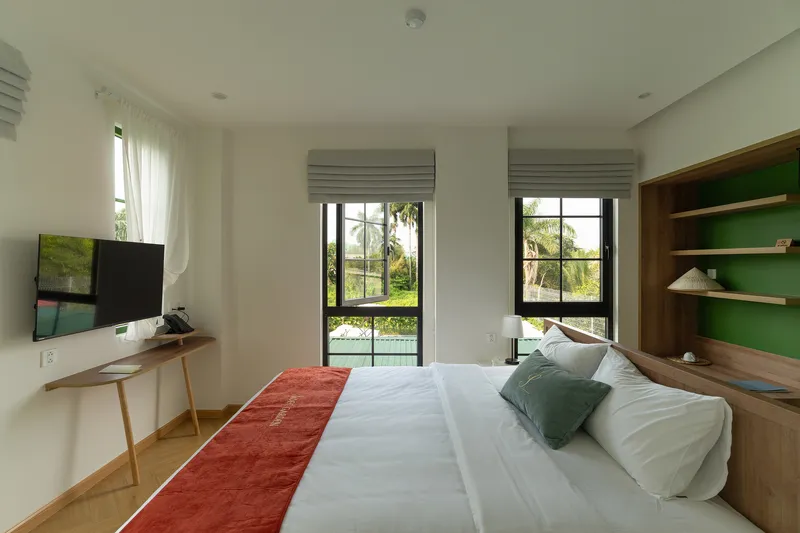
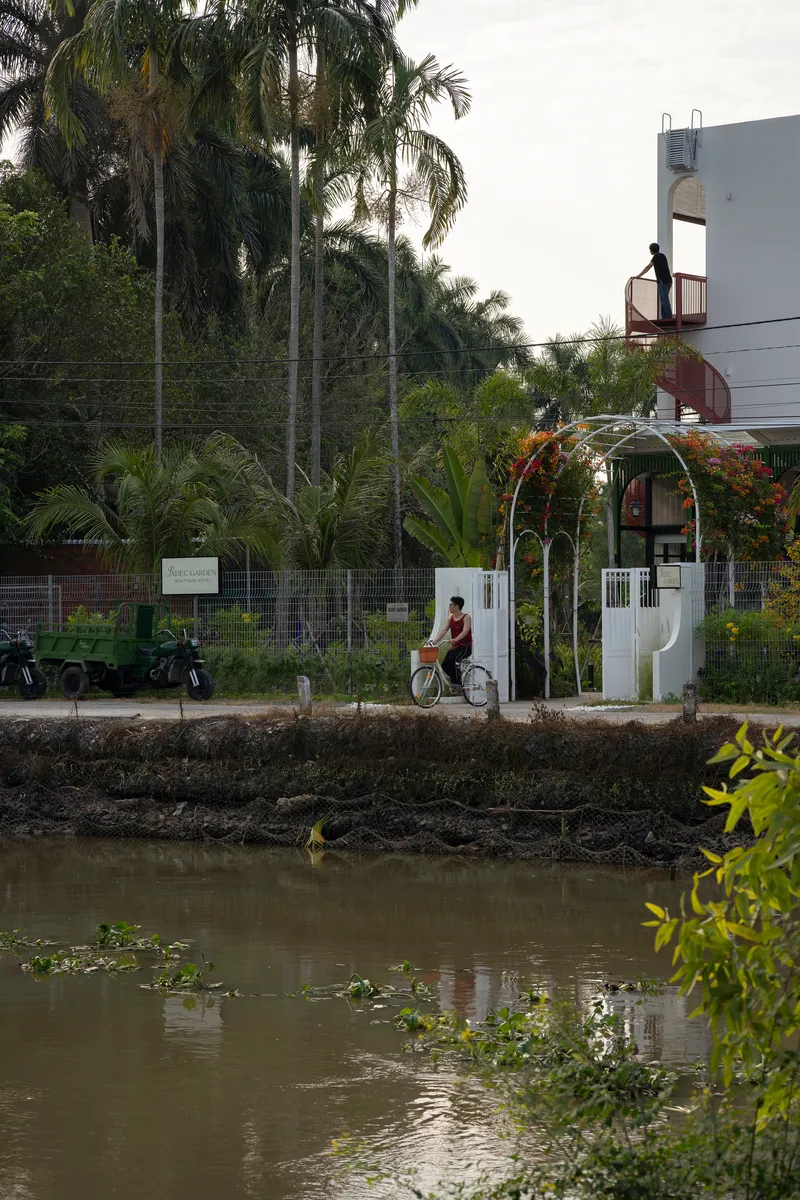
The guest rooms are deliberately modest. Pale timber shelving, black-framed windows, and views to palm trees outside compose a backdrop that defers to the garden. There is no attempt to dazzle with materials or finishes; the rooms exist to frame the landscape and to stay cool. From the street, the hotel announces itself through a white arched entry gate visible across a canal, with cyclists and boats passing in the foreground. That view matters, because it locks the project into the daily life of Sa Đéc rather than walling it off.
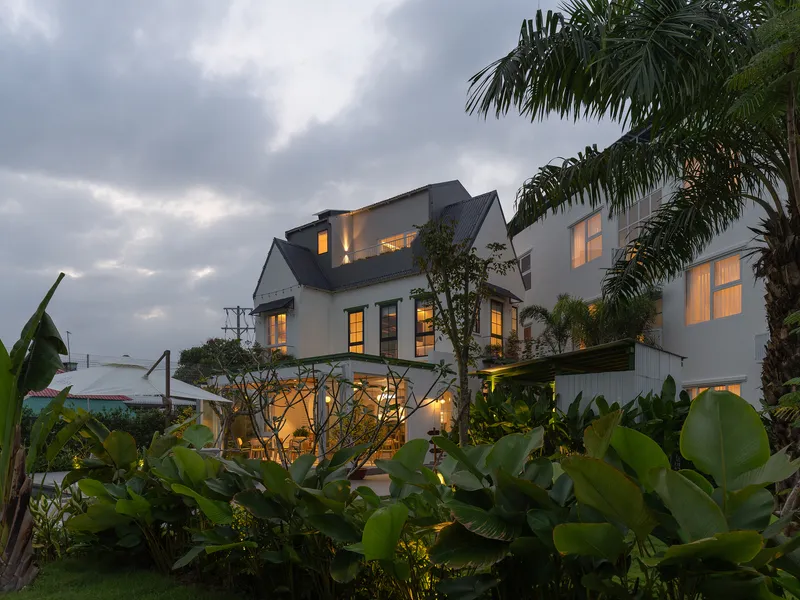
The rear elevation, seen from the canal side at dusk, reveals gabled rooflines and illuminated windows rising above a screen of banana plants. It is the least composed view of the building and perhaps the most honest: a small hotel settling into a fertile riverbank, lit from within.
Material Accents: Corrugated Metal and Arched Screens
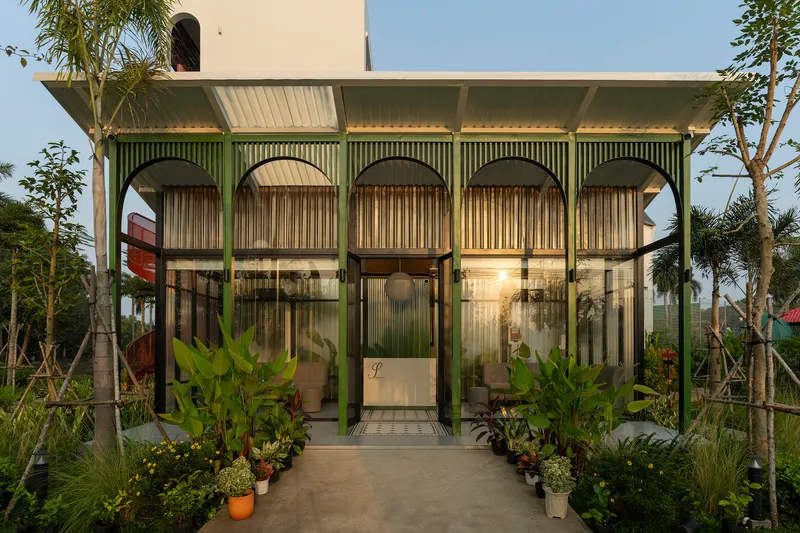
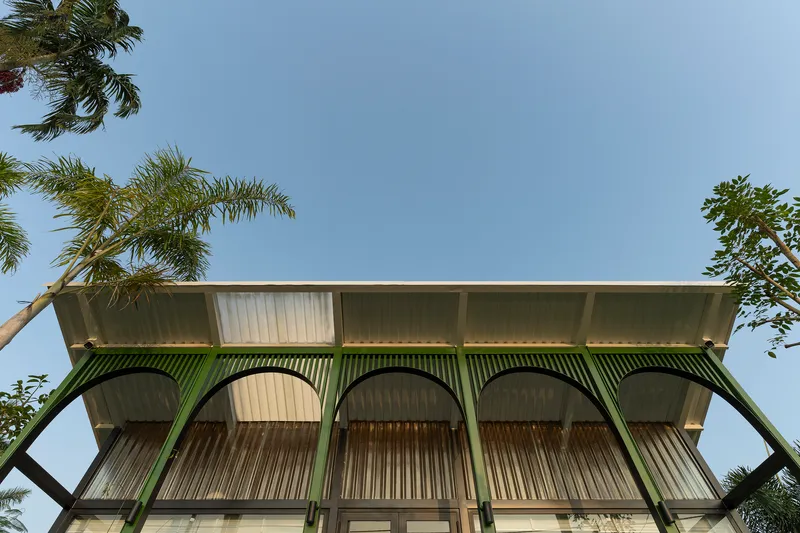
Corrugated metal shows up repeatedly across the project, as roofing, as facade screens, and as the structural skin of the entry pavilion. At the entry facade, arched corrugated panels are supported by green-painted steel ribs, a detail that reads as almost agricultural. It is an intelligent choice for a building in this climate: the material is cheap, lightweight, easy to replace, and it breathes. The green arched supports visible through palm fronds give the building a handmade quality that more polished finishes would erase.
At dusk, the courtyard elevation pulls everything together. Arched openings glow, the spiral stair tower anchors the composition, and the corrugated surfaces catch the last light. The palette is limited but the spatial variety is not. PAU Architects have gotten a lot of architecture out of very few moves.
Plans and Drawings
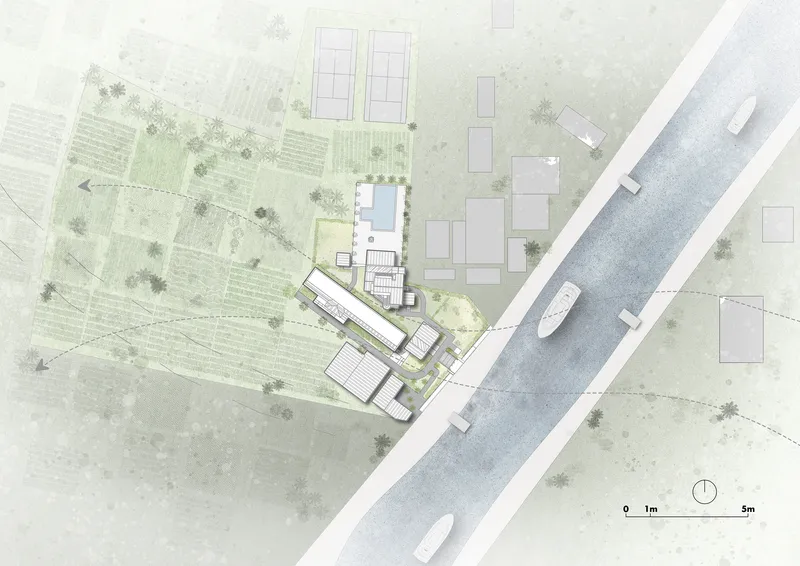
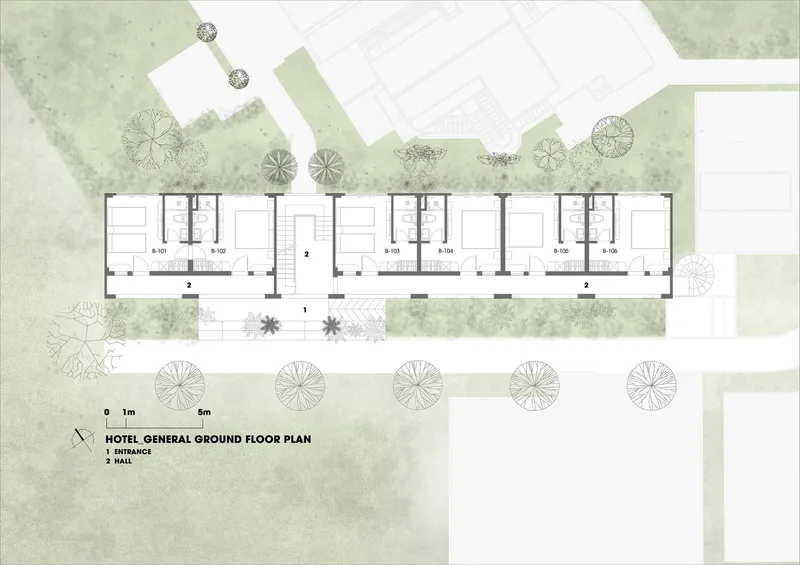
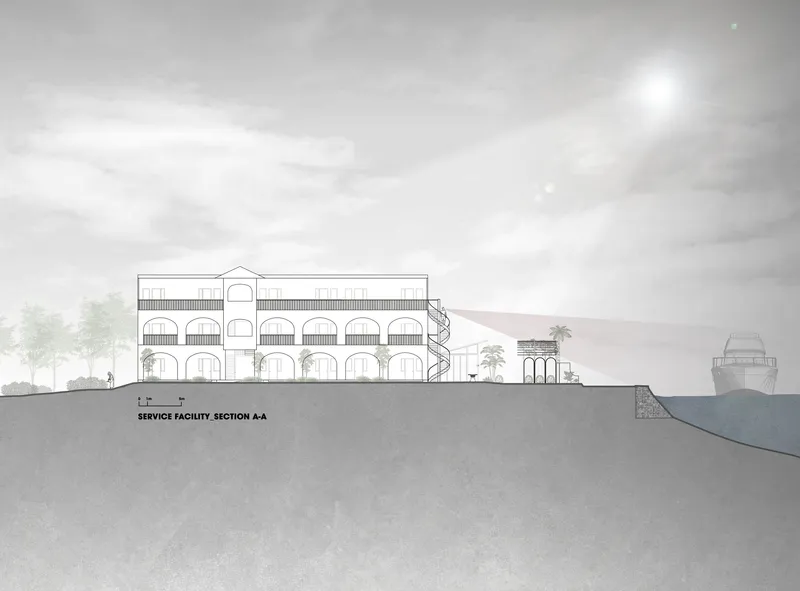
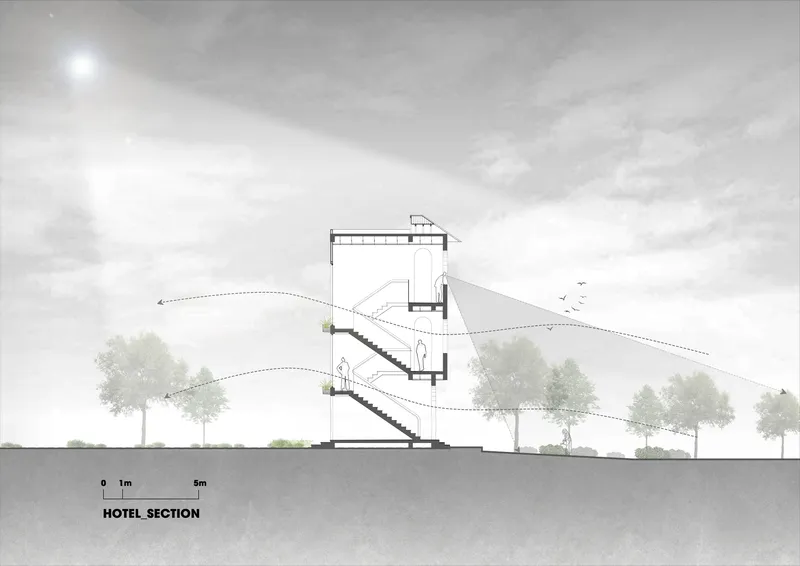
The site plan reveals the hotel's angled relationship to the adjacent waterway, with building volumes clustered tightly and gardens filling every interstitial gap. The ground floor plan shows a linear arrangement of rooms organized along a central corridor, punctuated by planted courtyards that break the mass and admit light. Sections confirm the three-story height and illustrate how arched openings are deployed at every level to modulate the relationship between interior and exterior.
What the drawings make clear is the project's compactness. At 1,000 square meters, this is a small building, and the architects have worked hard to make it feel generous through sectional variety and landscape integration rather than sheer footprint. The terracing of volumes toward the waterfront, visible in section, ensures that the canal edge remains open and planted rather than walled off.
Why This Project Matters
Vietnam's hospitality sector has produced no shortage of resort architecture in recent years, much of it concentrated along the central coast and aimed squarely at international tourists. Sadec Garden Hotel is interesting because it is none of those things. It is inland, small, and rooted in a town known for horticulture rather than nightlife. PAU Architects have responded not with spectacle but with patience: deep loggias, arched corridors, dense planting, and a material palette drawn from the agricultural vernacular of the Mekong Delta. The building earns its atmosphere through repetition and restraint.
The lesson here is that the arch, perhaps the oldest trick in the architectural playbook, still has spatial and environmental power when deployed with conviction. PAU Architects do not treat it as a stylistic gesture; they use it as a structural module, a shading device, and a framing tool, scaling it from a corridor opening to a full-facade rhythm. In a region where climate demands deep shade, generous airflow, and close contact with landscape, the arch turns out to be exactly the right instrument. Sadec Garden Hotel is proof that a modest budget and a limited vocabulary, wielded with care, can produce architecture that feels both inevitable and specific.
Sadec Garden Hotel, Sa Đéc, Đồng Tháp, Vietnam. Architects: PAU Architects. Lead architects: Trung Nguyen, Huyen Nguyen. Area: 1,000 m². Year completed: 2025.
About the Studio
Share Your Own Work on uni.xyz
If projects like this are the kind of work you want to make, uni.xyz is a place to publish your own, find collaborators, and enter design competitions.


Popular Articles
Popular articles from the community


Singing Woman: An Opera House That Performs Before the Curtain Rises
Ovidiu Cristian Pavel's conceptual opera house translates Estonia's choral identity into a sculpted waterfront landmark facing the Baltic Sea.

Manzana Morphosis: Stretching Barcelona's Grid into a Living Landscape for 2050
A radical reworking of the Eixample manzana turns density into a tool for generous public space, vertical ecology, and environmental performance.

The Amber Palace Opera: A Geological Fiction Surfaces on Tallinn's Baltic Waterfront
Pierre Brillard reimagines a Baltic legend as a public landscape, opera house, and waterfront promenade rooted in Tallinn's coastal identity.

Temporary Home for Dogs: A Reversed Zoo Rethinks Animal Shelter Architecture
In Bucharest, a sinuous corridor and freed landscape flip the logic of containment, designing a shelter that works to make itself unnecessary.

Similar Reads
You might also enjoy these articles

Pixel Gardens: One Repeated Module Stacked Into a Terraced Social Housing Tower for Famagusta
Salem Bader's shortlisted housing tower builds a vertical neighbourhood from one repeated module, offsetting units to carve terraces, light and air.

Bao Huynh Watercolor Atelier: A Serene Art Retreat in Hội An
Bao Huynh Watercolor Atelier in Hội An blends multifunctional art spaces, sustainable design, local materials, and family-friendly living in a serene environment.

Atelier Macri Concept Store Interior Design by CASE-REAL
Atelier Macri store features a "ko" counter, walnut wood details, cork displays, blending retail, gallery, and seamless customer experiences.

Manuel Vargas Izquierdo Stadium and High-Performance Sports Center: Architectural Excellence in Jalpa de Méndez
The Manuel Vargas Izquierdo Stadium blends sustainable design, inclusive sports facilities, and cultural-inspired architecture, revitalizing Jalpa de Méndez’s public spaces.

Comments (0)
Please login or sign up to add comments
No comments yet. Be the first to comment!