

Paul Le Quernec Shapes a Cloverleaf Daycare from Rammed Earth on a Former Military Site in France
Three undulating lobes of rammed earth and radial timber form a daycare center on a cleared garrison landscape in Verdun-sur-Garonne.


A former military site in Verdun-sur-Garonne, a small town on the Garonne between Toulouse and Montauban, offered Paul Le Quernec something unusual: an almost blank landscape, wiped clean of the rigid geometry you might expect from a garrison. The 1,750 m² Intercommunal Daycare Center that now occupies part of this terrain takes a very different posture from the barracks that once stood nearby. Its plan is a cloverleaf, three lobed volumes radiating from a shared center, each capped by a sweeping rammed earth roof that curves downward at its edges like a hat brim sheltering the ground below.
What makes the building genuinely compelling is not just its distinctive silhouette but the way its plan logic, material palette, and daylighting strategy reinforce a single idea: that a daycare should feel less like an institution and more like a sequence of intimate, sheltered spaces oriented around courtyards, light, and the ground. Le Quernec treats rammed earth not as a decorative surface but as a structural and climatic envelope, while radial timber ceilings inside create a sense of centrifugal energy that pulls children's attention toward the sky.
Rammed Earth as Roof and Wall
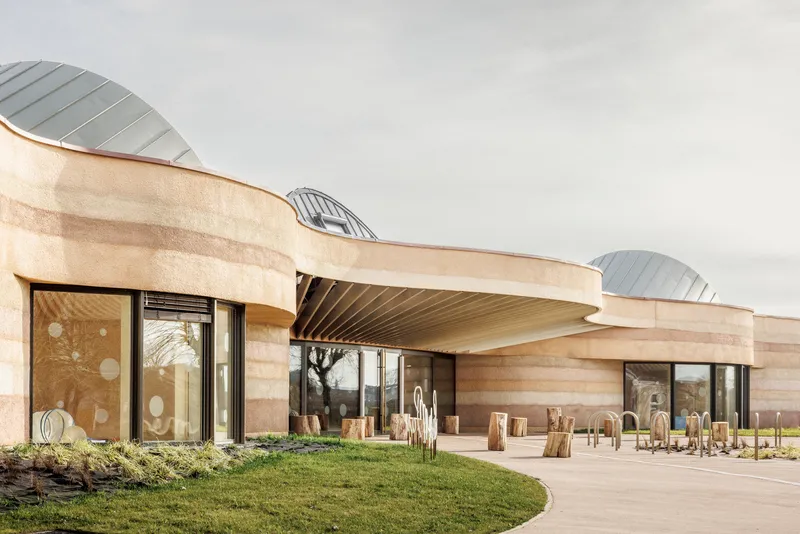
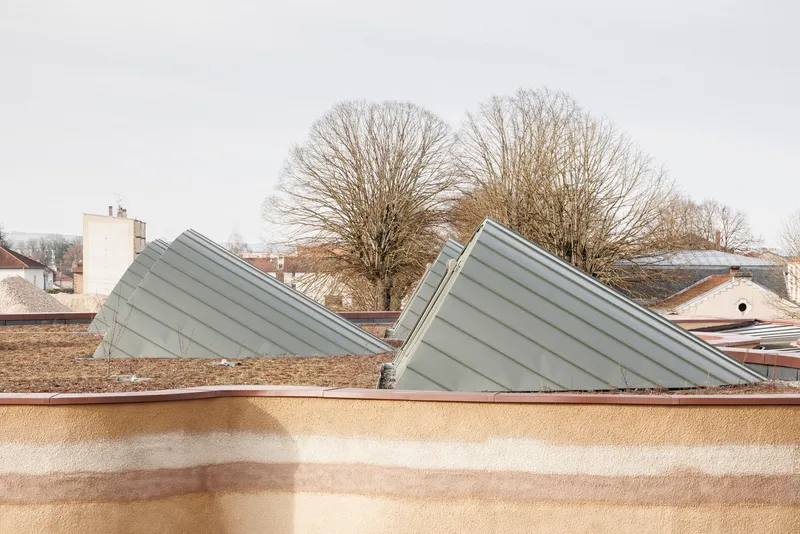
The building's most striking material decision is to extend rammed earth from the walls up and over the roof forms, so that each lobe reads as a continuous earthen mass rather than a conventional wall-plus-roof assembly. The horizontal striations of the compacted earth create a warm, geological surface that shifts in tone depending on moisture content and light. Viewed from a distance under overcast skies, the three undulating forms look almost landform-like, as if the terrain itself had lifted to create shelter.
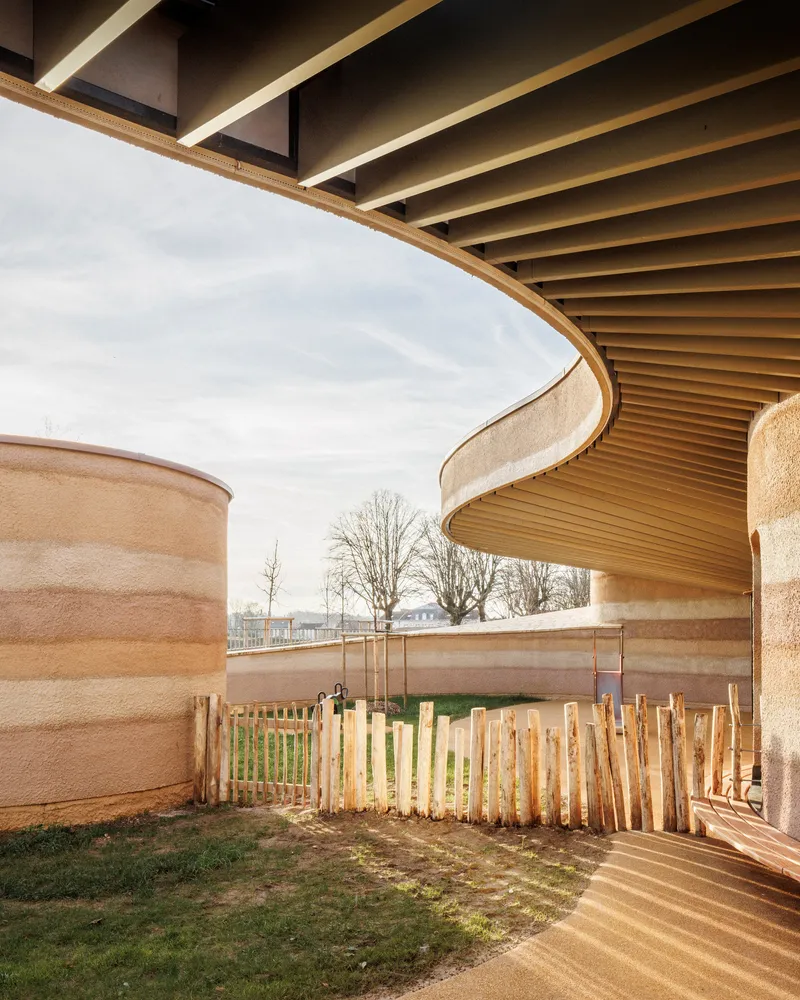
Tilted skylights punch through the earth roof at angular intervals, their white frames contrasting sharply with the raw material around them. These are not decorative gestures. They channel daylight deep into the plan's interior, compensating for the fact that the heavy, insulating earth envelope limits the amount of glazing on the roof plane. Beneath the overhangs, timber slat soffits wrap around the perimeter, creating covered outdoor zones that function as transitional spaces between garden and interior.
Radial Ceilings and Central Skylights


Step inside any of the three lobes and you look up into a radial timber ceiling that fans outward from a central oculus. The timber slats are closely spaced, creating a rhythmic pattern that draws the eye toward the skylight at the apex. The effect is something between a tent and a carousel, a sense of rotation and uplift that feels inherently playful without being cartoonish. Natural light drops through the central opening and washes across the timber, producing soft, diffused illumination that changes character throughout the day.
The playroom spaces beneath these ceilings are furnished with circular and organic seating elements, upholstered platforms and petal-shaped cushions that echo the curvilinear geometry overhead. Glazed sliding doors along the perimeter connect each room to its own outdoor courtyard, meaning children can move freely between interior and exterior without navigating corridors. The absence of rectilinear walls gives even the smallest spaces a generous, flowing quality.
Courtyards and Enclosed Landscapes


The cloverleaf plan creates pockets of outdoor space between its lobes, and Le Quernec treats these as distinct courtyards rather than leftover gaps. One circular yard, ringed by curved rammed earth walls and glazed doors, features artificial turf and a lone white sphere: a scaled-down landscape that belongs entirely to the children. The curved enclosure walls provide wind protection and visual privacy from the surrounding streets while keeping the sky fully open above.
At evening, the entrance canopy reveals its structural skeleton of exposed timber rafters fanning out beneath the curved earth shell, lit from within so the warm timber glow spills onto the ground. The transition from the open, flat site to this sheltered threshold is immediate and legible. You know where to go, and the building tells you why you are welcome.
Interior Detail and Atmosphere

Not every room in the building shares the same ceiling treatment. One interior features a pleated fabric ceiling that radiates from a central skylight in soft, textile folds, its warmth complemented by a red petal-shaped seating element on the floor. The contrast with the harder timber and earth palette elsewhere suggests that Le Quernec calibrated each space to a different sensory register: some rooms are about wood and structure, others about softness and absorption.
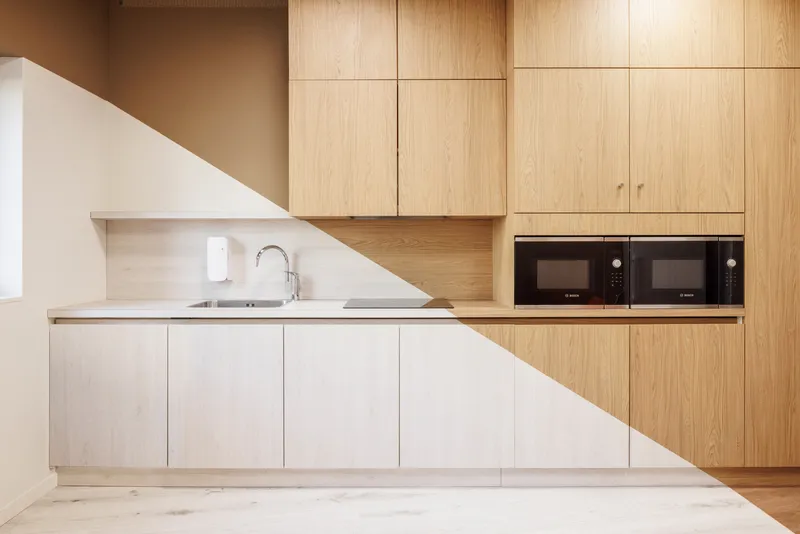
The kitchen, tucked into the plan with light oak cabinetry and white lower units, catches a diagonal shaft of sunlight from one of the angled skylights. It is a prosaic room elevated by the same daylighting strategy that governs the whole building. Even service spaces get good light, which is more than you can say for most institutional kitchens.
Plans and Drawings


The aerial site plan rendering confirms what the experience on the ground implies: the cloverleaf is not a pure geometric figure but a slightly asymmetric composition of three lobes, each sized differently and oriented to respond to the surrounding streets and landscape. The floor plan reveals how these lobes connect through a shared central core that handles circulation and services, while each radial room opens outward to its own courtyard or garden edge.
The section drawings are particularly revealing. The angled roof volumes rise and fall at different pitches, and the central circular form reads as a hinge around which the rest of the building pivots. Interior ceiling heights vary considerably, from low, sheltering edges at the perimeter to generous peaks at the skylight oculi. For a 1,750 m² single-story building, the spatial variety is remarkable.
Why This Project Matters
Daycare design too often defaults to bright colors, boxy rooms, and safety-driven blandness. Le Quernec's building rejects all three defaults. Its rammed earth envelope is thermally massive and visually rich without relying on applied decoration. Its radial plan gives children agency over their movement between indoor and outdoor spaces. And its skylights deliver constantly shifting natural light, the kind of environmental stimulus that no LED panel can replicate. Collaborating with consultants including Solares Bauen on sustainability and Ingemansson on acoustics, the architect built a team that could execute an ambitious material and environmental strategy at a modest civic scale.
The project also demonstrates that a small intercommunal facility in rural southwest France can carry real architectural ambition. The former military site gave Le Quernec an open canvas, and the cloverleaf plan makes a strong figure on that canvas without dominating it. We are likely to see this building cited frequently in discussions of early childhood architecture, and it deserves that attention. It proves that designing for very young children is not a lesser brief but one that, in the right hands, produces some of the most inventive spatial thinking in contemporary practice.
Intercommunal Daycare Center by Paul Le Quernec. Verdun-sur-Garonne, France. 1,750 m². Completed 2025. Photography by 11h45.
About the Studio
Share Your Own Work on uni.xyz
If projects like this are the kind of work you want to make, uni.xyz is a place to publish your own, find collaborators, and enter design competitions.


Popular Articles
Popular articles from the community


Singing Woman: An Opera House That Performs Before the Curtain Rises
Ovidiu Cristian Pavel's conceptual opera house translates Estonia's choral identity into a sculpted waterfront landmark facing the Baltic Sea.

Manzana Morphosis: Stretching Barcelona's Grid into a Living Landscape for 2050
A radical reworking of the Eixample manzana turns density into a tool for generous public space, vertical ecology, and environmental performance.

Temporary Home for Dogs: A Reversed Zoo Rethinks Animal Shelter Architecture
In Bucharest, a sinuous corridor and freed landscape flip the logic of containment, designing a shelter that works to make itself unnecessary.

Faces of the Soviet Avant-Garde: Turning Moscow's Street Names into an Open-Air Museum
A network of sculptural installations across a Moscow residential district transforms forgotten architect names into spatial encounters with cultural memor

Similar Reads
You might also enjoy these articles

Pixel Gardens: One Repeated Module Stacked Into a Terraced Social Housing Tower for Famagusta
Salem Bader's shortlisted housing tower builds a vertical neighbourhood from one repeated module, offsetting units to carve terraces, light and air.

Bao Huynh Watercolor Atelier: A Serene Art Retreat in Hội An
Bao Huynh Watercolor Atelier in Hội An blends multifunctional art spaces, sustainable design, local materials, and family-friendly living in a serene environment.

Atelier Macri Concept Store Interior Design by CASE-REAL
Atelier Macri store features a "ko" counter, walnut wood details, cork displays, blending retail, gallery, and seamless customer experiences.

Manuel Vargas Izquierdo Stadium and High-Performance Sports Center: Architectural Excellence in Jalpa de Méndez
The Manuel Vargas Izquierdo Stadium blends sustainable design, inclusive sports facilities, and cultural-inspired architecture, revitalizing Jalpa de Méndez’s public spaces.


Comments (0)
Please login or sign up to add comments
No comments yet. Be the first to comment!