

Peace Place: Rebuilding Aleppo Through Sunken Courtyards and Shared Knowledge
A subterranean civic complex in front of Aleppo's Citadel turns urban scars into spaces for dialogue, learning, and cultural exchange.


What does it take to design trust? In a city where war has fractured neighborhoods, displaced families, and erased centuries of shared ritual, the answer is not a monument. It is a sequence of lowered courtyards, a multi-level library spiraling around an ancient well motif, and a network of workshops where craft, memory, and civic life can slowly reconstitute themselves. Peace Place, sited directly in front of the Citadel of Aleppo, proposes architecture as a mechanism for coexistence, placing the act of exchange at the center of every spatial decision.
Designed by Alina Malih, the project reads the Old City's dense courtyard fabric and translates it into a sunken civic complex that accommodates a library, museum, refugee center, restoration workshops, classrooms, and public gathering spaces. Rather than rising above the skyline, the scheme drops its center below grade, carving protected voids that reference Syria's desert, water, greenery, and stone. The Citadel remains the dominant landmark; Peace Place works in deference to it, drawing its authority from depth rather than height.
Arched Vaults and a Library Built Around Movement

The collage above layers a sectional drawing of arched interior volumes, a photographic study of book-lined walls, and an aerial reading of the courtyard complex. Together, these fragments communicate the project's central spatial proposition: a vast, multi-level library whose arches, staircases, and platforms are themselves lined with books. The library operates simultaneously as a museum of local history, a quiet retreat for contemplation, and a symbolic container of shared knowledge. Malih draws a direct line from the Citadel's ancient spiral well to the project's own spiral stairwell, reimagined as an architectural bookshelf. Movement through the building becomes a narrative act, each step revealing another layer of text and memory.
By embedding learning into circulation, the project rejects the notion of the library as a sealed room. Knowledge spills into corridors, onto landings, and across open platforms. The arched vocabulary is not decorative nostalgia; it is structural and spatial, creating rhythmic bays that modulate light, sound, and view. The result is a space where a visitor reading at a balustrade can look down to a gathering in the sunken plaza or up to the silhouette of the Citadel.
A Masterplan Organized in Layers, Not Floors


The exploded axonometric and isometric courtyard drawings reveal a complex organized through interconnected layers rather than conventional stacked floors. The masterplan distributes its program across a water group symbolizing purification and continuity, an administrative zone for civic operations, classrooms, a café functioning as a social anchor, a museum preserving archaeological memory, restoration workshops safeguarding craftsmanship traditions, a refugee center, and a volunteer training center. Each element is carefully positioned to promote fluid movement and spontaneous social connection, with pathways threading between programmatic zones marked by circular icons.
What stands out is the refusal to isolate functions. The café sits close enough to the classrooms that a coffee break becomes a chance encounter with a workshop participant. The museum and restoration workshops share adjacency so that the preservation of artifacts and the teaching of preservation techniques happen within sight of each other. The refugee center is not tucked away at the periphery; it occupies the network, connected to the same courtyards and pathways that serve visitors, students, and residents. The architecture insists that support and dignity are not separate programs.
Exchange as Spatial Principle: Five Forms of Sharing

The concept diagram radiating human figures from a center illustrates the project's philosophical engine: exchange. Malih identifies five distinct forms. Knowledge sharing occurs in classrooms, meeting halls, and the central library. Exchange of memory happens through archaeological remnants discovered during construction, preserved and exhibited to tie the present to lost histories. Landscape exchange unfolds as each courtyard mirrors a different Syrian landscape, from desert to irrigated garden, encouraging visitors to understand cultural diversity through direct spatial experience. Skill exchange takes place in craft workshops teaching restoration, archaeology, and traditional arts. And the exchange of ideas finds its stage on open platforms: the meydan, discussion rooms, and performance spaces.
The cross sections flanking the diagram show how these exchanges are not metaphorical but physically organized. The sunken plaza, the library's overlapping levels, and the open courtyard zones each correspond to a specific mode of interaction. The architecture does not merely permit gathering; it choreographs proximity between people who, in the aftermath of conflict, might otherwise never share the same room.
Courtyards That Reconstruct a Syrian Landscape
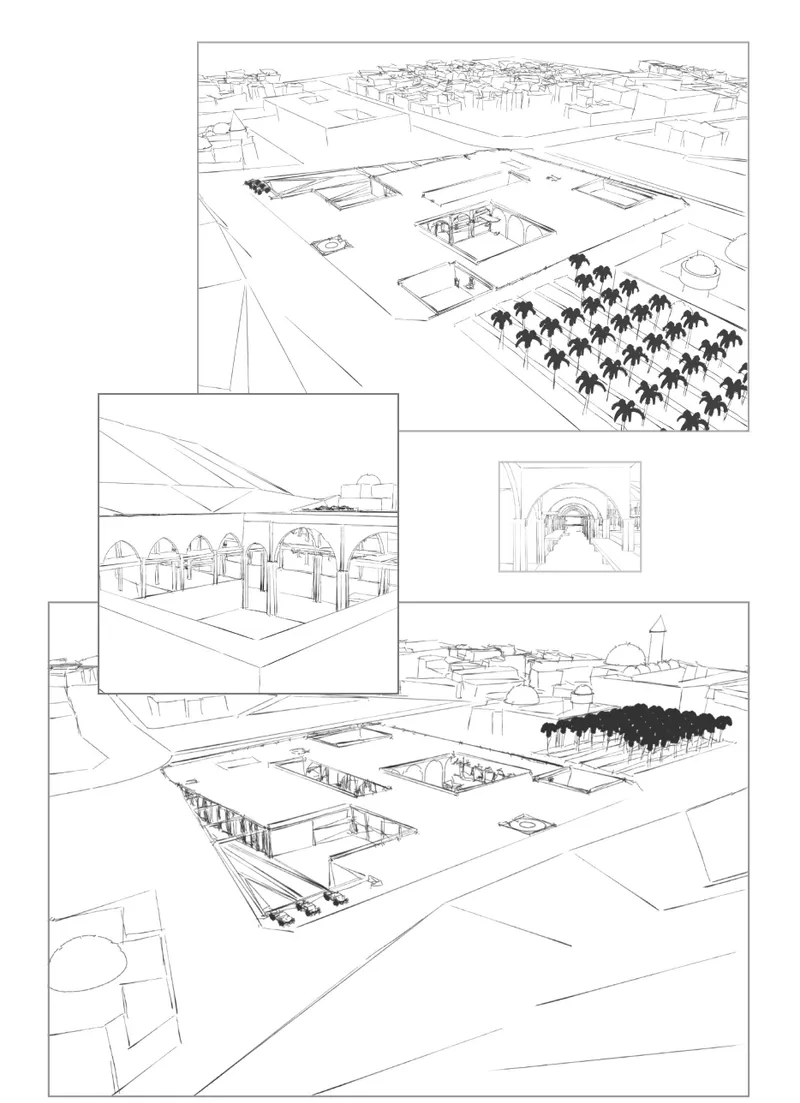
The perspective drawings show the courtyards in their intended state: planted groves beneath arched vaults, open to sky, surrounded by the layered textures of Aleppo's urban context. The lowered center creates a sunken plaza for gatherings and markets, a vantage point offering clear views of the Citadel, and a sanctuary-like environment insulated from the city's noise and trauma. Desert, water, greenery, and stone appear not as decoration but as symbolic layers of Syrian identity, each courtyard presenting a distinct landscape condition.
The grove courtyard is particularly telling. Trees planted below grade will grow upward into the city's sightlines over years and decades, making the project's timeline visible. Peace Place does not pretend to deliver reconciliation on opening day. It sets conditions for a slow accumulation of trust, shade, and shared use. The emptiness left by war becomes, in Malih's framing, a void filled not with concrete but with potential.
Why This Project Matters
Post-conflict reconstruction too often defaults to one of two extremes: the memorial that freezes a city in its wound, or the tabula rasa development that erases the wound entirely. Peace Place navigates between them by embedding civic function, cultural memory, and everyday social life into a single interconnected landscape. The decision to build down rather than up respects the Citadel's primacy while asserting that the most important reconstruction happens at ground level and below: in classrooms, in craft workshops, in the shared quiet of a library.
Alina Malih's project demonstrates that healing architecture is not about softness or sentiment. It is about adjacency, program, and the deliberate choreography of encounter. By placing a refugee center next to a volunteer training hub, a museum next to a restoration workshop, and a sunken plaza at the foot of a 5,000-year-old citadel, Peace Place argues that architecture's most radical act in a post-war city is simply this: making it possible for people to be in the same place again.
View the Full Project
About the Designers
Designer: Alina Malih
Enter a Design Competition on uni.xyz
uni.xyz runs architecture and design competitions year-round that reward proposals with spatial conviction and real site intelligence.
Project credits: Peace Place by Alina Malih.


Popular Articles
Popular articles from the community


Temporary Home for Dogs: A Reversed Zoo Rethinks Animal Shelter Architecture
In Bucharest, a sinuous corridor and freed landscape flip the logic of containment, designing a shelter that works to make itself unnecessary.

Opera by the Sea Estonia: Three Shells Dissolving Architecture into Tallinn's Coastline
A winning opera house proposal replaces monumental form with interconnected shells that blur the boundary between building, park and Baltic Sea.

Singing Woman: Contemporary Architecture Inspired by Estonia’s Voice and the Sea
Singing Woman turns Estonia’s song culture into flowing opera house architecture, blending public life, landscape, sea, and national memory.

Opera on the Sea: Driftwood Logic Shapes a Timber Opera House on Estonia's Coast
Trevor Orgill's opera house translates the entangled drift of floating timber into a civic building where wood, water, and music converge.

Similar Reads
You might also enjoy these articles
Sustainable Architecture Design: Embracing Nature and Modernity at Villa Solsidan
The article explores Villa Solsidan by AndrénFogelström, showcasing its sustainable architecture design and integration with the natural surroundings in Saltsjöbaden, Sweden.
Scientific and Educational Monitoring Center of the Yenisei, Krasnoyarsk
Architecture as an instrument for ecological research, education, and environmental awareness along Russia’s largest river.
Development of Andretta Artist’s Village, Palampur, Himachal Pradesh, India
Reimagining Andretta as a living cultural landscape where art, architecture, and community converge to shape a global creative village.
Street Children Rehabilitation Center: A Model of Social Architecture for Community Rehabilitation
An inclusive social architecture project that transforms streets into nurturing environments, restoring dignity, identity, and opportunity for vulnerable children.

Comments (0)
Please login or sign up to add comments
No comments yet. Be the first to comment!