

Pier One Dishui Lake by TM Studio
Pier One Dishui Lake transforms a functional pier into a sustainable, landscape-integrated waterfront, blending public spaces, greenery, and modern architectural design.


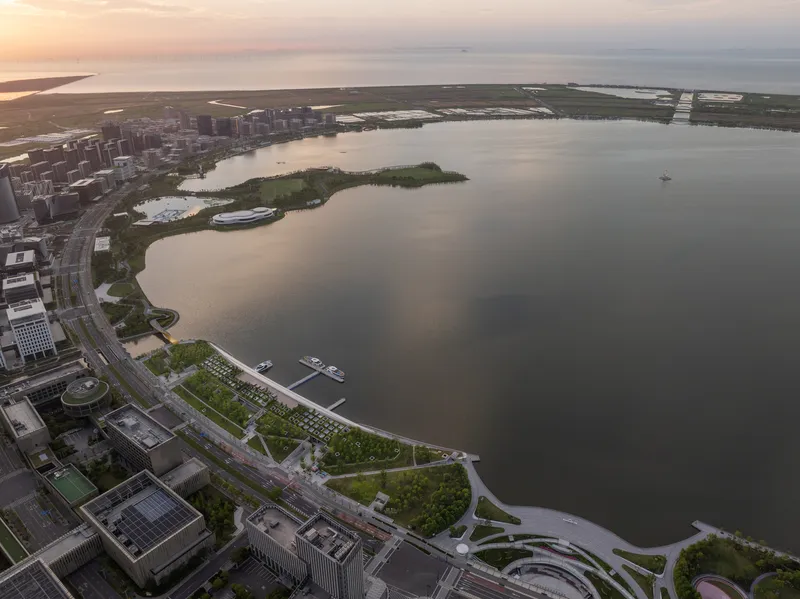
Pier One Dishui Lake is a remarkable example of modern waterfront architecture, located within the 80-meter green belt surrounding Dishui Lake in Lingang New Town, Shanghai. Designed by TM Studio and led by architect Tong Ming, the project transforms a functional pier into a vibrant public space that seamlessly integrates with its surrounding landscape. The site also connects directly to the Dishui Lake terminal station of Metro Line 16, making it an essential link between Lingang New Town and the heart of Shanghai.
The pier serves as a docking point for cruise ships and provides comprehensive tourist facilities. Rather than being a standalone structure, Pier One blends fully with the lake’s green belt, enhancing the natural environment while offering functional and recreational spaces for the public.PublicSpaceDesign

Landscape-Oriented Design
The design strategy emphasizes the integration of architecture and landscape. TM Studio avoided the conventional separation between pier buildings and green spaces by implementing a landscape-oriented approach. The pier and its surrounding environment are connected through a continuous flow of movement and activity, creating a waterfront experience that feels natural and engaging.
Multi-dimensional circulation lines guide visitors through the site, transforming the previously monotonous green belt into a dynamic public space. This approach ensures ecological continuity, supports leisure activities, and promotes interaction between people and nature.


Architectural Features
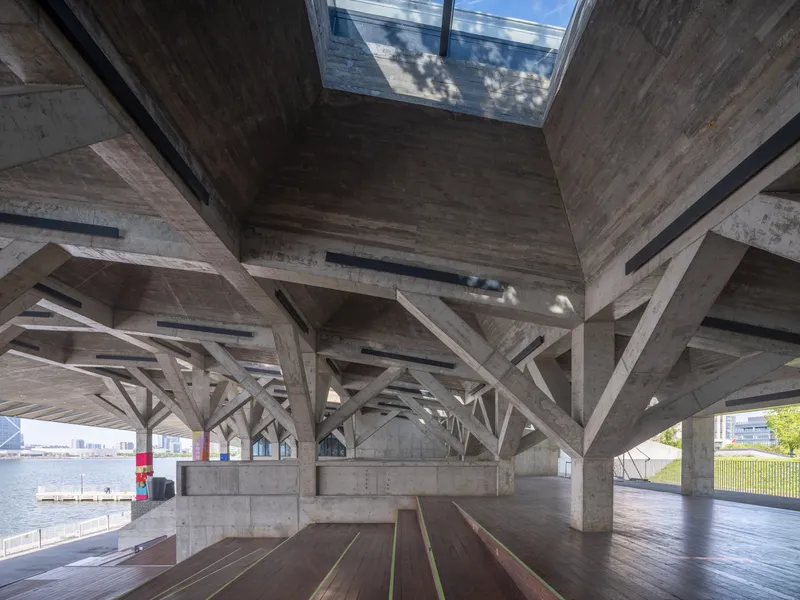
Pier One Dishui Lake features layered spatial arrangements, including wide steps, ramps, platforms, tree pools, and courtyards. A multi-hole arc-shaped green roof crowns the site, allowing light and shadow to interact with vegetation while creating an immersive spatial experience. Trees planted on the roof and around the pier further integrate the building into the landscape, blending structure with nature.
The architectural design allows the pier to function as more than a transportation hub. Its open spaces, terraces, and courtyards encourage recreational and social activities, while maintaining connectivity with the broader green belt and waterfront. The building itself becomes part of the landscape, promoting ecological awareness and sustainable urban living.


Public Engagement and Sustainability
By reimagining the pier as a multifunctional public space, the project encourages both daily activity and cultural events. Visitors can engage in leisure activities along the waterfront while enjoying the rich visual and spatial hierarchy created by the building’s design. This approach nurtures a sense of community, environmental responsibility, and connection to nature.


Popular Articles
Popular articles from the community


FCC Arquitectura Expands a Portuguese Granite House with a Board-Marked Concrete Wing
In Portugal, JV House pairs a cleaned-up whitewashed and granite dwelling with a timber-shuttered concrete extension, courtyards and a garden pool.

graciastudio Turns a Viewless Tijuana Lot Inward Around a Courtyard of Concrete, Timber and Trees
In Tijuana, Jorge Gracia's GA2 House stacks a timber-clad private floor over exposed concrete and replaces a missing view with a planted interior patio.


The Amber Palace Opera: A Geological Fiction Surfaces on Tallinn's Baltic Waterfront
Pierre Brillard reimagines a Baltic legend as a public landscape, opera house, and waterfront promenade rooted in Tallinn's coastal identity.

ETEH Reworks the Shared Spaces of São Domingos School in Brazil Around Timber, Color and Hanging Plants
At São Domingos School in Brazil, 436 m² of hall, refectory and library are recast with timber joinery, a yellow and blue code and trailing greenery.

Similar Reads
You might also enjoy these articles


Hodi-Mandai Geram
Project Function: Preservation and revitalization of the Intangible heritage and socio-spatial identity of the Hodi by Housing, Cultural Memory Center, Sacred Grove, landscape, local tourism economy


Olio Towers: A Mid-Rise for Performers That Fuses Housing, Rehearsal, and Stage
Located blocks from Houston's Theater District, this modular tower stacks living units around a central performance atrium.

Oasis: Modular Green Housing Carved into Dhaka's Urban Fabric
A shortlisted Plugin Housing entry reclaims unauthorized settlements in Dhaka with stepped concrete volumes, green roofs, and ventilation-driven design.

Black Hole: A Floating Megastructure for the Post-Physical Era
Emiliano Mazzarotto envisions a spherical, self-scaling arena where e-sports, digital hotels, and holographic stadiums replace traditional public space.

Explore Shanghai Competitions
Discover active competitions in this discipline

Challenge to design locus for the upliftment of human rights

Challenge to reimagine the Iron Throne

Photograph architecture without architects

Illustrate the lost glory of Angkor Wat - Render Challenge
Comments (0)
Please login or sign up to add comments
No comments yet. Be the first to comment!