

Pitagoras Group Resurrects a 1930s Cinema Theater in Guimarães as a Multi-Arts Campus
A 400-seat auditorium, three arts schools, and a luminous glass tower breathe new life into a derelict Art Deco landmark in northern Portugal.


Teatro Jordão opened in 1938 with 1,220 seats and the civic pride of a city that considered itself the birthplace of Portugal. By December 1993 it was dark, and it stayed dark for nearly three decades. The fact that Pitagoras Group was handed not only the theater but also the adjacent Auto Garagem Avenida, an Art Deco parking structure from the same era, made the brief simultaneously generous and treacherous: 11,400 square meters of granite, iron, and plaster, all in various stages of decay, all in a dense urban core where every rooftop is terracotta and every neighbor is watching.
What makes the result worth studying is the architects' refusal to play preservationist theater. They treated functional conversion as transformation, not embalming. New volumes are made formally and volumetrically autonomous from the existing granite shell, so the old building reads as a host rather than a hostage. The most visible gesture, a cylindrical translucent glass tower that rises above the roofline, announces that something entirely new is happening inside without pretending the old fabric never existed. The project won the Prémio Nacional de Reabilitação Urbana 2022 for social impact, and the reason is legible in every plan: what was once a single auditorium is now a School of Performing Arts, a School of Visual Arts, a School of Music, and a 400-seat multifunctional hall, all operating as autonomous entities under one inherited roof.
Before and After: Reading the Ruin
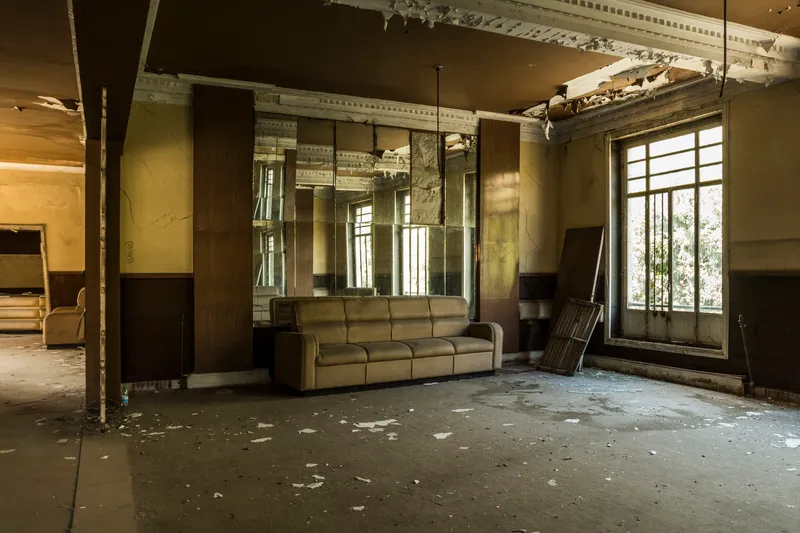
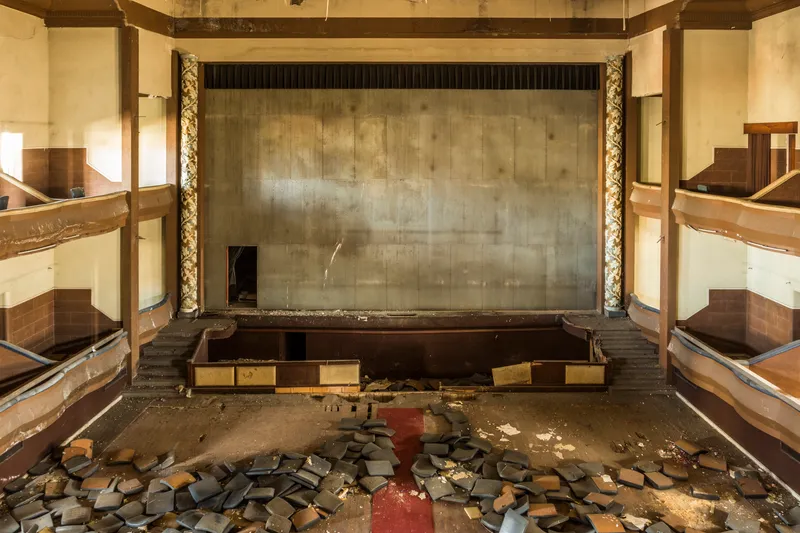
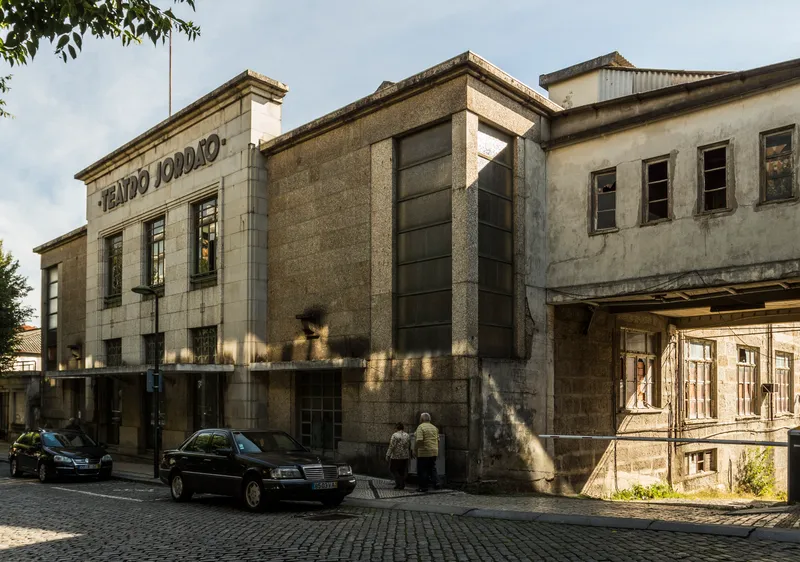
The archival images are essential context. The original auditorium, with its ornamental columns and tiered galleries, was a proper Cine-teatro: a hybrid cinema-theater format common in 1930s Portugal. By the time Pitagoras Group arrived, the plasterwork was peeling, the seating was gutted, and a lonely sofa sat beneath ceiling moldings that still carried echoes of their original geometry. Understanding the depth of neglect makes the current interiors feel less like renovation and more like excavation.
The street facade, limestone-clad and dignified, survived better than the interior. Pitagoras Group kept its proportions and material expression largely intact, which was the right call. The drama is reserved for what happens above and behind it.
The Glass Cylinder: A Lantern Above the Roofline
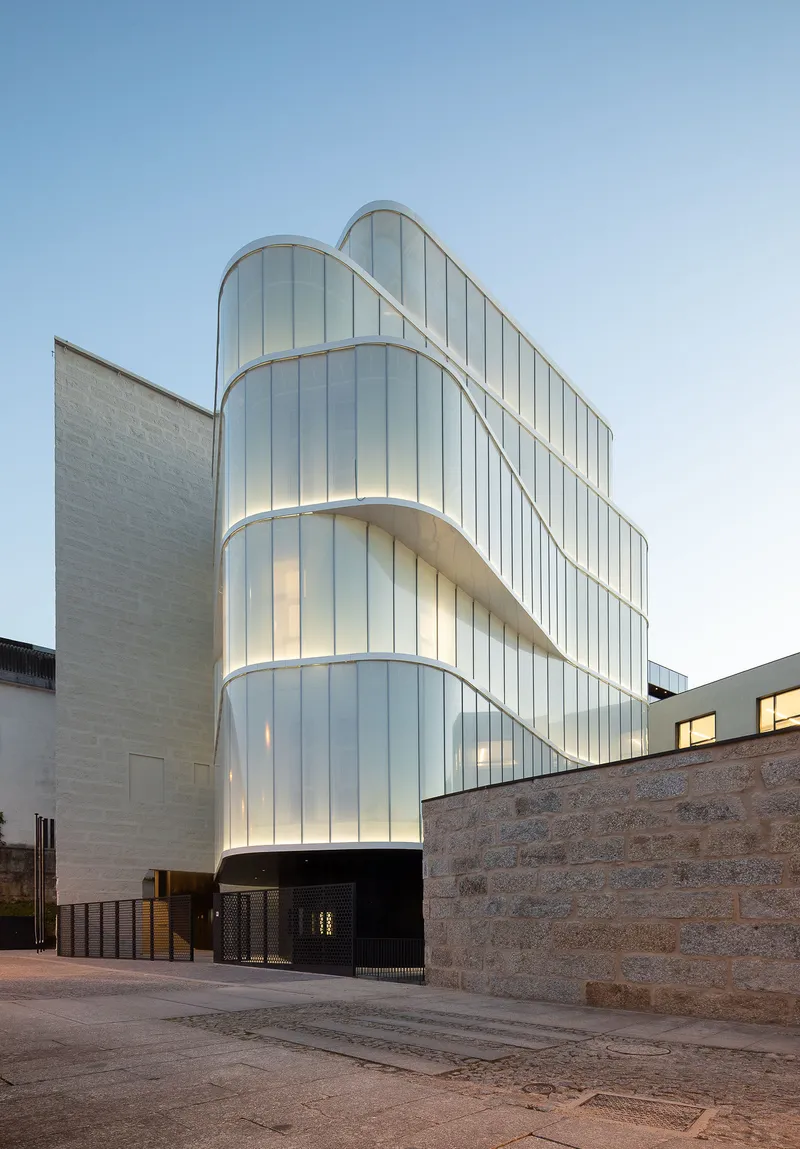
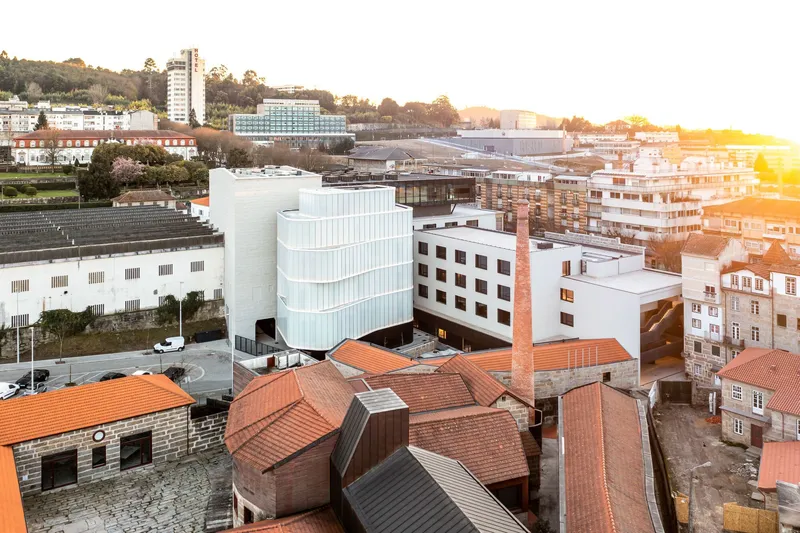
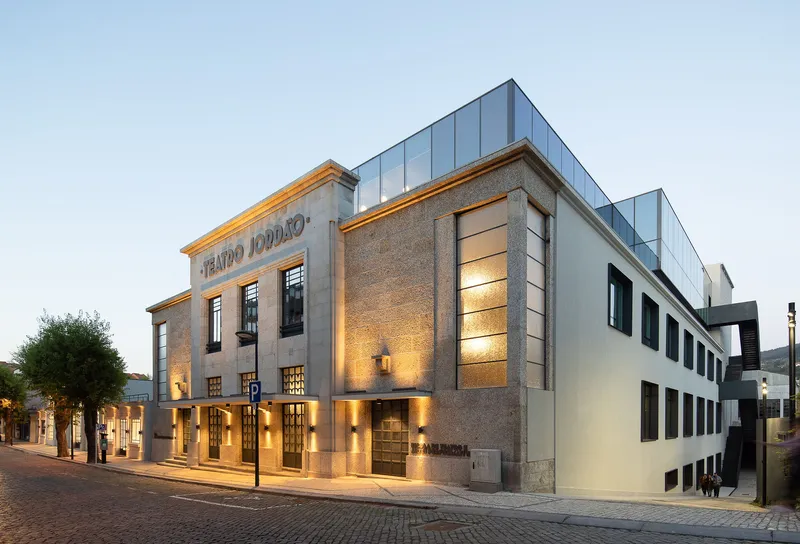
The most assertive move is the cylindrical glass volume that punches through the old roofscape. Clad in vertical fins that filter light and modulate transparency, it reads at dusk as a lantern, broadcasting the building's new cultural role across the surrounding neighborhood. At street level, it registers as a vertical glass addition rising above the stone and stucco facade, a material counterpoint that is deliberate rather than deferential.
The aerial view makes the urban logic clear. Guimarães is a city of tight blocks and pitched tile roofs. The cylinder does not compete with the medieval towers that define the skyline; instead it operates at a middle scale, tall enough to be a landmark for the arts campus, short enough to remain a neighbor. The formal autonomy Pitagoras Group insisted on is most legible here: old granite below, new glass above, with the junction handled cleanly rather than blurred.
Thresholds and Courtyards
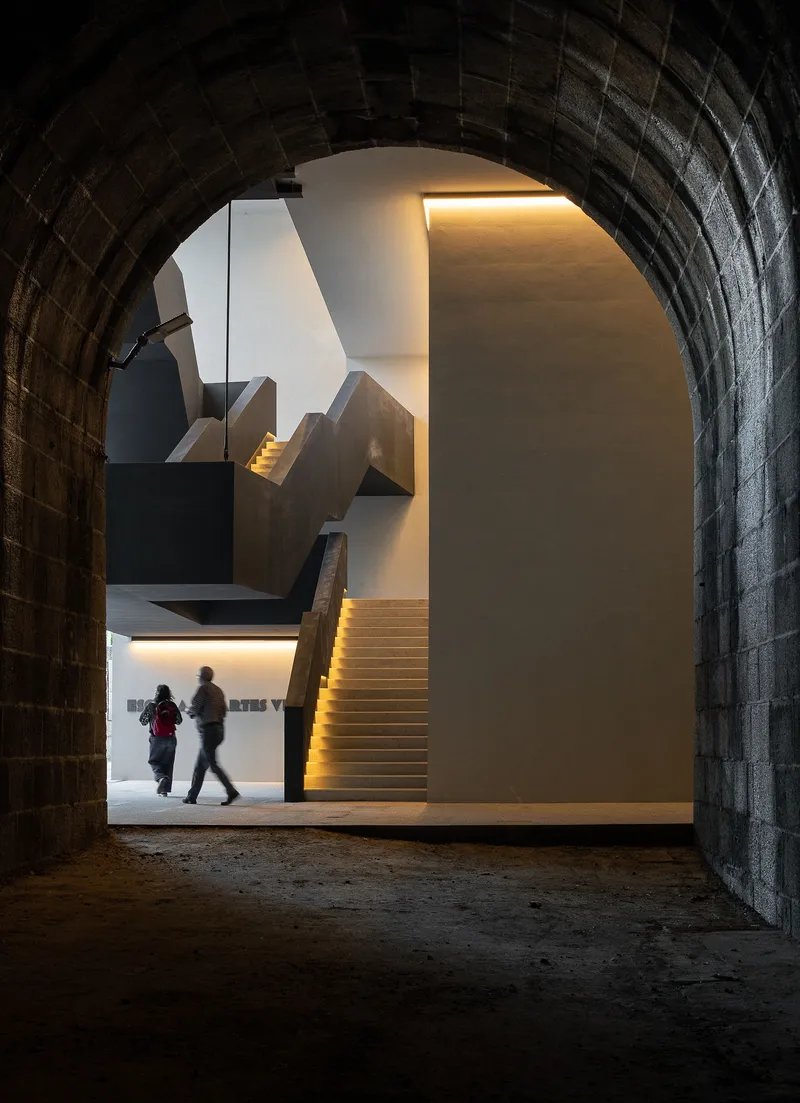
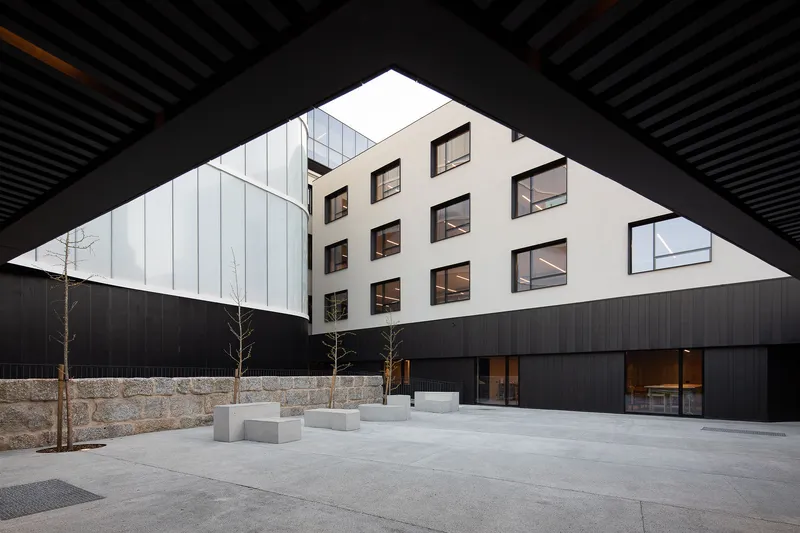
Entering the complex is a sequence rather than a single door. A barrel-vaulted granite passage, unmistakably original, leads toward an illuminated staircase; elsewhere, a covered courtyard framed by dark slatted ceilings and young trees offers a decompression space between street and school. These thresholds matter because the building now serves multiple institutions. Students of visual art, music, and performing arts each need distinct entrances and identities, yet they share a single urban address. The courtyards stitch the autonomous volumes together without merging them.
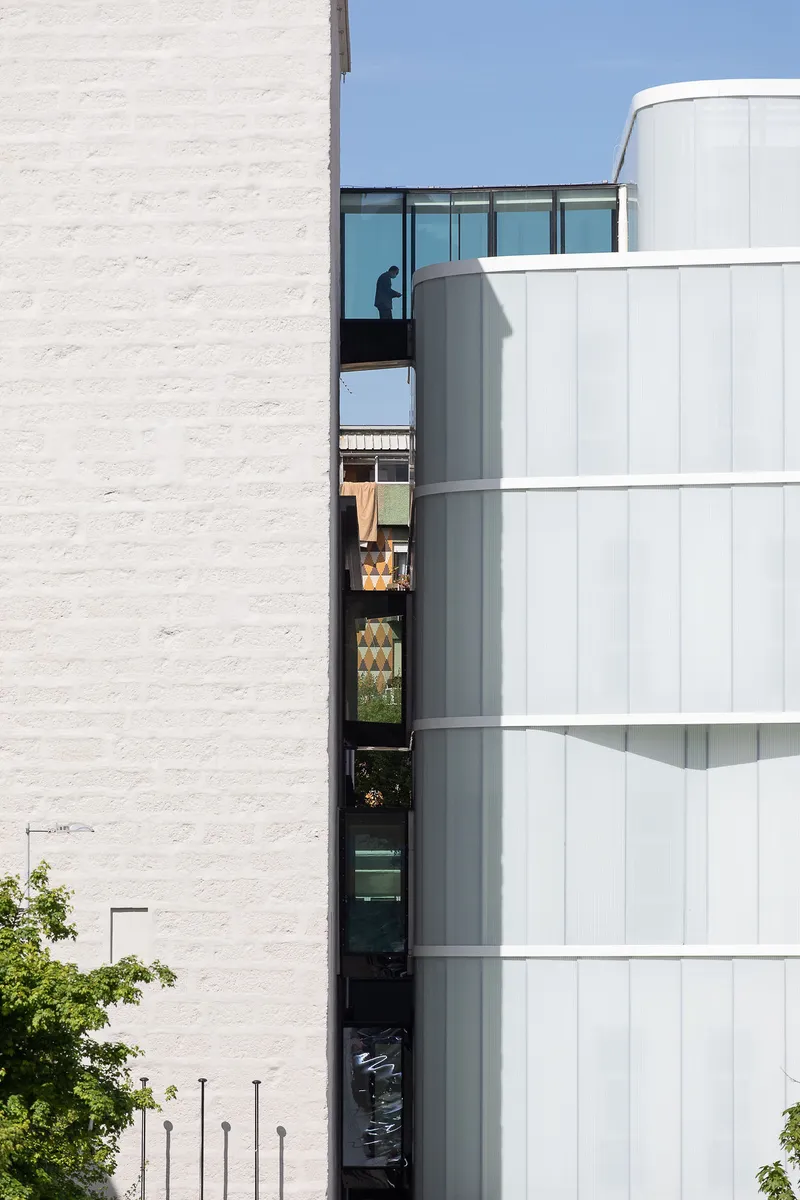
The narrow gap between the white brick wall and the cylindrical white-paneled facade captures the tightest moment in the plan: two buildings almost touching, separated by a sliver of sky and a balcony where someone can pause between classes. It is a residual space turned into a generous one, which is the definition of good rehabilitation.
The Auditorium: 400 Seats, Infinite Configurations
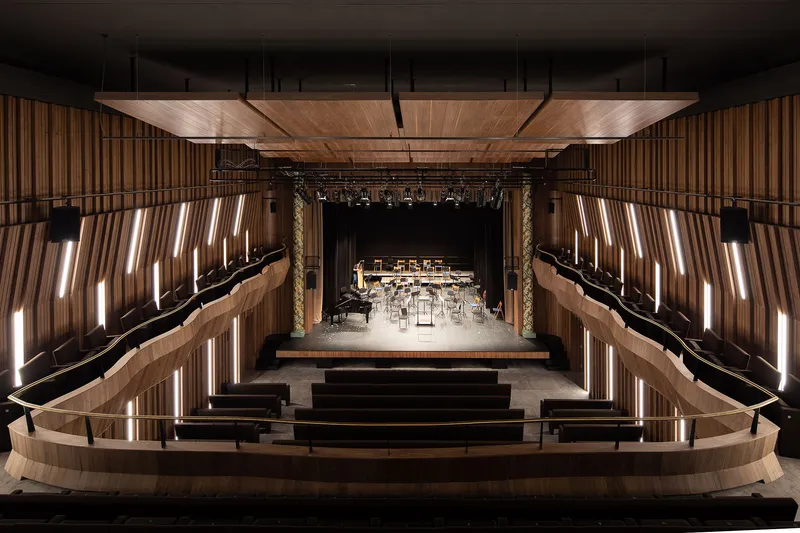
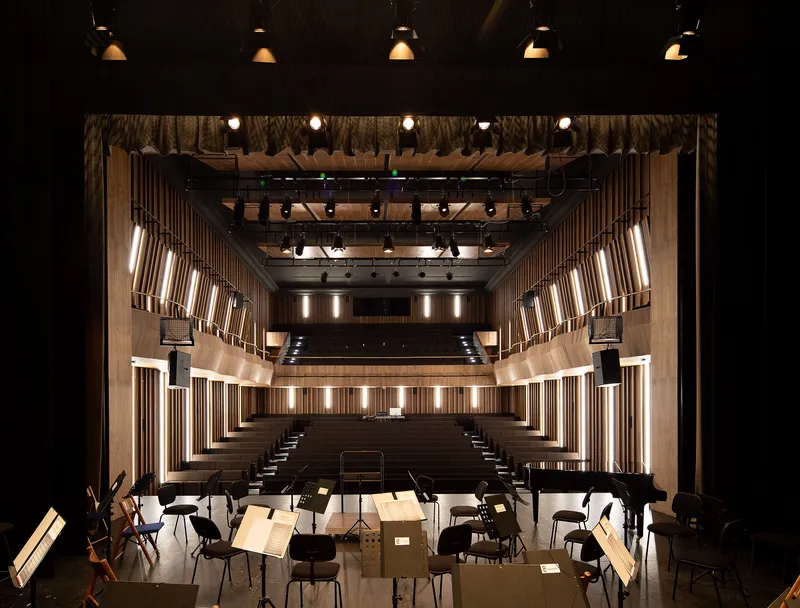
The new auditorium seats 400, a third of the original 1,220, and that reduction is entirely intentional. Where the 1938 Cine-teatro was a single-purpose volume, this hall is designed for reconfiguration: dance, music, congresses, and hybrid events. The curved timber balconies and vertical illuminated slats give the room warmth and acoustic complexity without resorting to the historicist ornament that defined the original. Exposed ceiling rigging keeps the technical infrastructure visible, a honest gesture that signals the room's flexibility.
From the stage, the tiered timber seating and vertical lit panels create a geometry that is both enveloping and airy. Acoustics were handled by Vasco Peixoto de Freitas, and the material palette, predominantly timber, was clearly selected as much for its sound absorption as for its visual character. The room reads as a serious performance space rather than a ceremonial one.
Material Dialogue: Timber, Granite, and Light
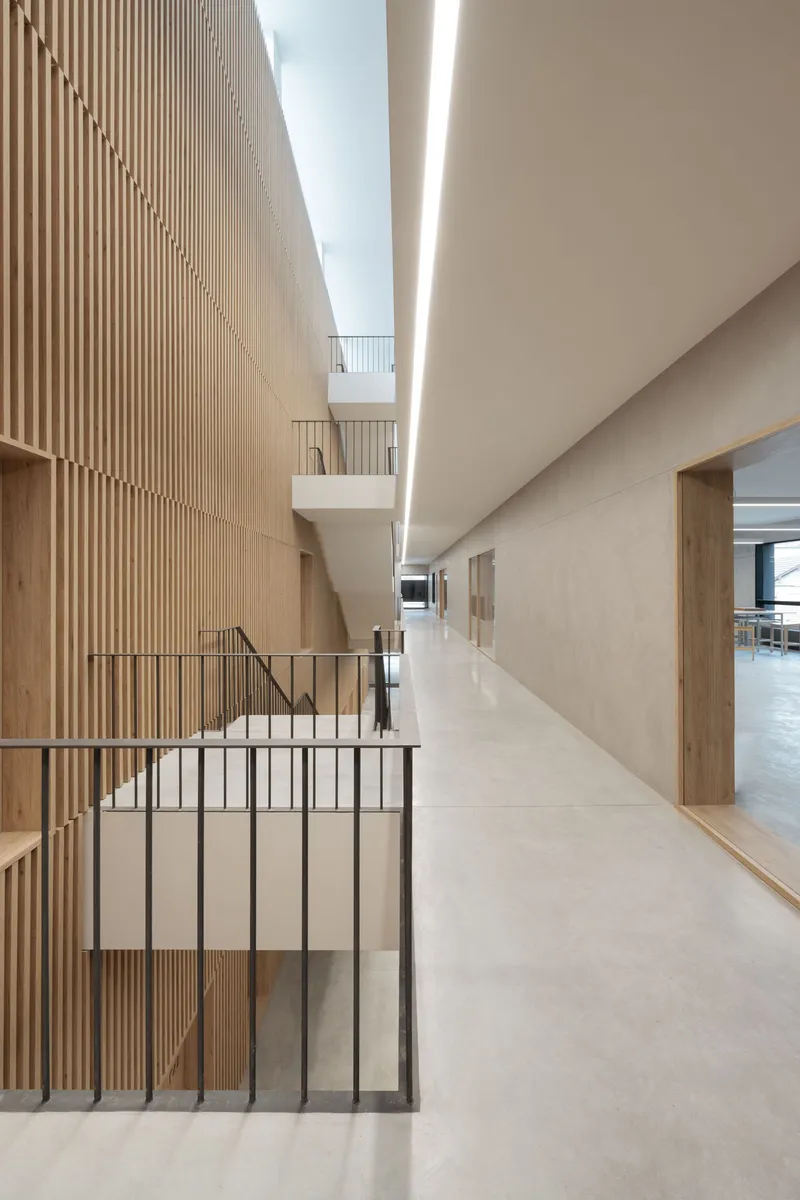
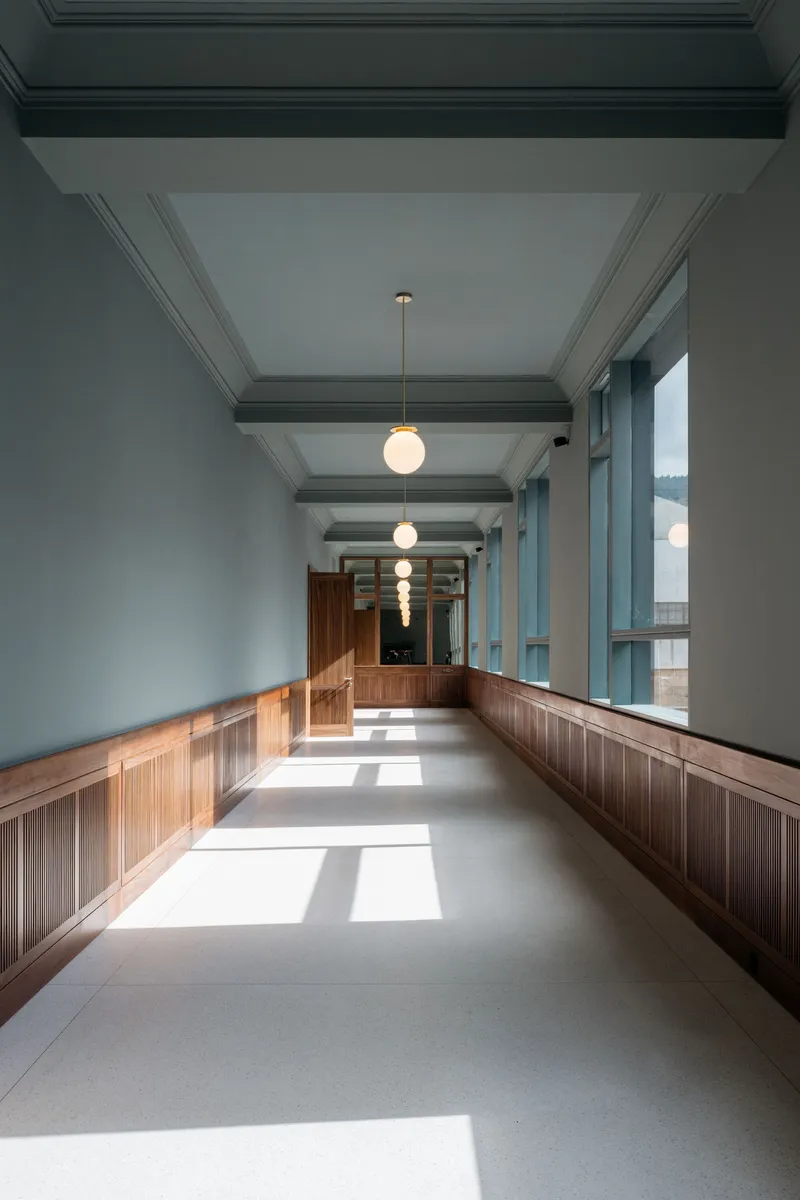
Pitagoras Group runs a consistent material argument through the interior: timber paneling for new interventions, granite and plaster for inherited surfaces. The corridor with vertical slat walls and a linear skylight above the stairwell is a textbook example of how to add contemporary detailing without erasing the spatial memory of an old building. Afternoon sunlight hits coffered ceilings and pendant lights in hallways that feel both warm and institutional, a balance that schools often fail to achieve.
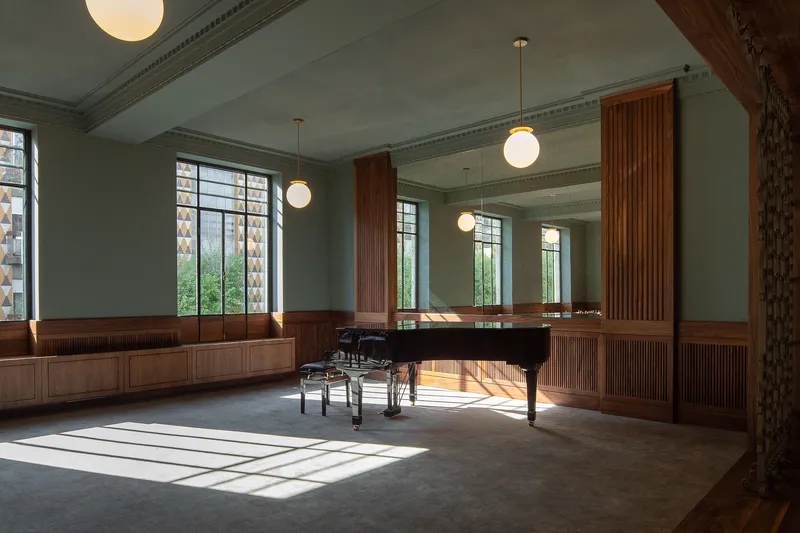
The music room with a grand piano, fluted wood paneling, and globe pendant lights may be the most photogenic space in the complex, but it also demonstrates the acoustic and material logic at work. The fluting is not decoration; it is surface modulation for sound diffusion. Light enters from one side, casting long afternoon shadows across the floor and confirming the room's orientation within the old shell.
Galleries, Corridors, and the In-Between
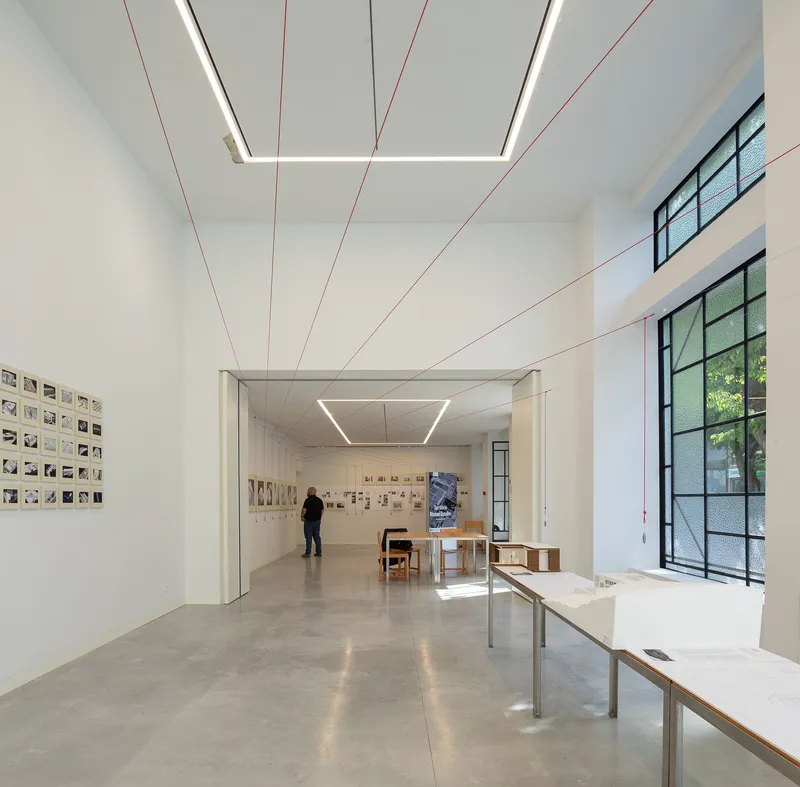
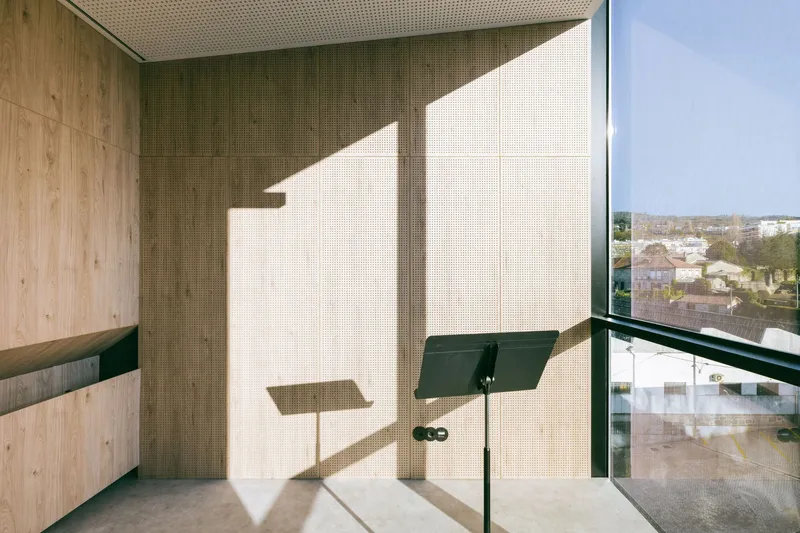
A gallery space with polished concrete floors and red tensioned cables hosts visual art exhibitions, its neutrality a deliberate counterpoint to the heavily textured corridors elsewhere. The timber-lined balcony with folding benches and a perforated ceiling captures angular morning light in a way that suggests it was designed as much for pause as for passage. Circulation in this building is never merely functional; it is pedagogical, offering students framed views of rooftops, courtyards, and each other.
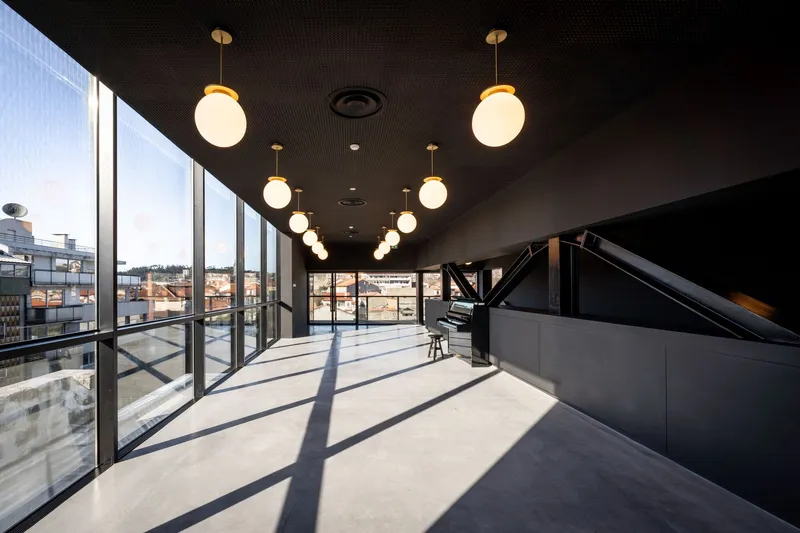
The upper-floor corridor with dark perforated ceilings and a glazed facade overlooking the city is the kind of space that turns a commute between classrooms into a moment of reflection. Globe pendant lights recur throughout, a simple unifying detail that gives the diverse spaces a shared identity without forcing uniformity.
New Volumes and Exterior Insertions
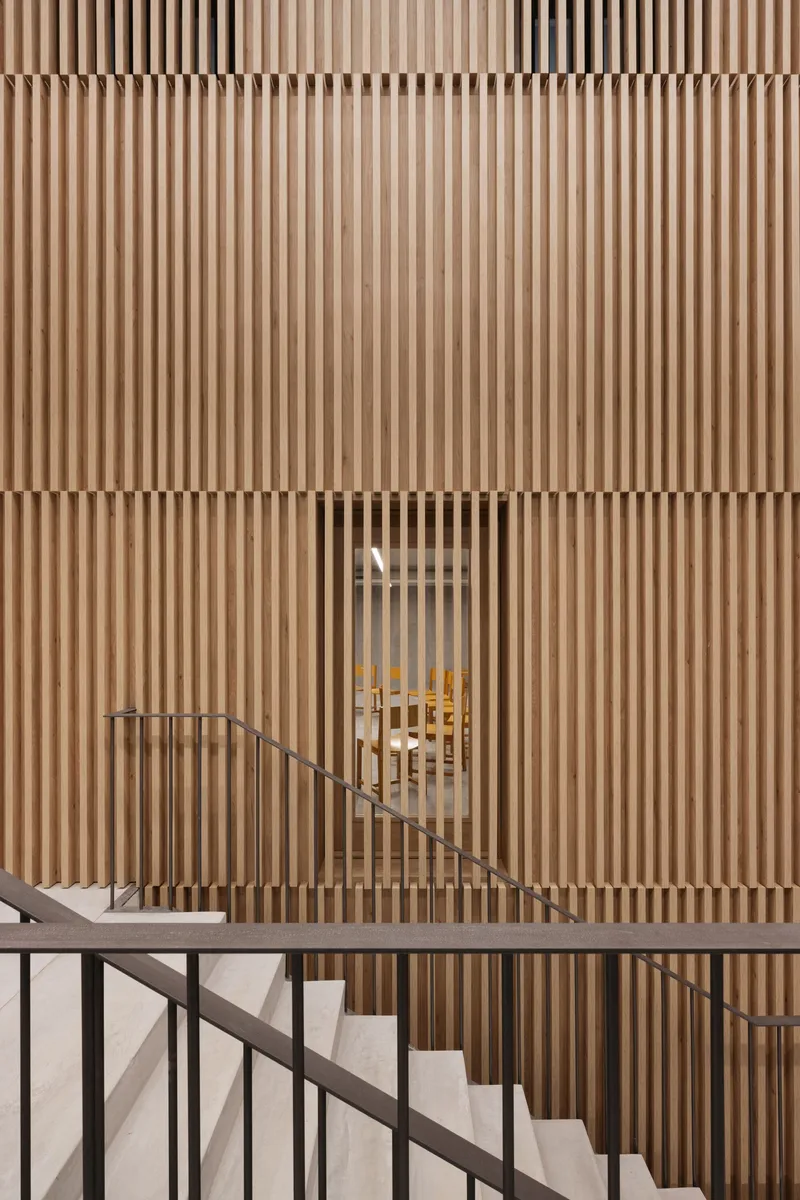
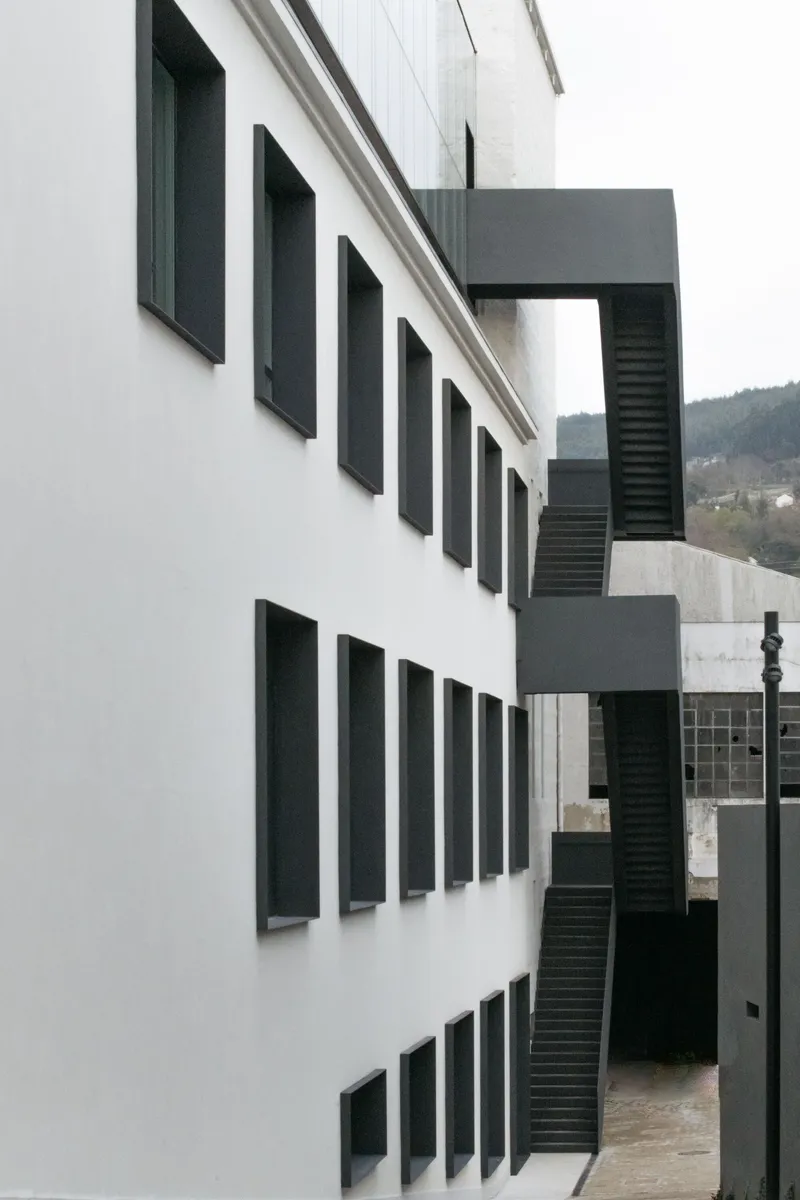
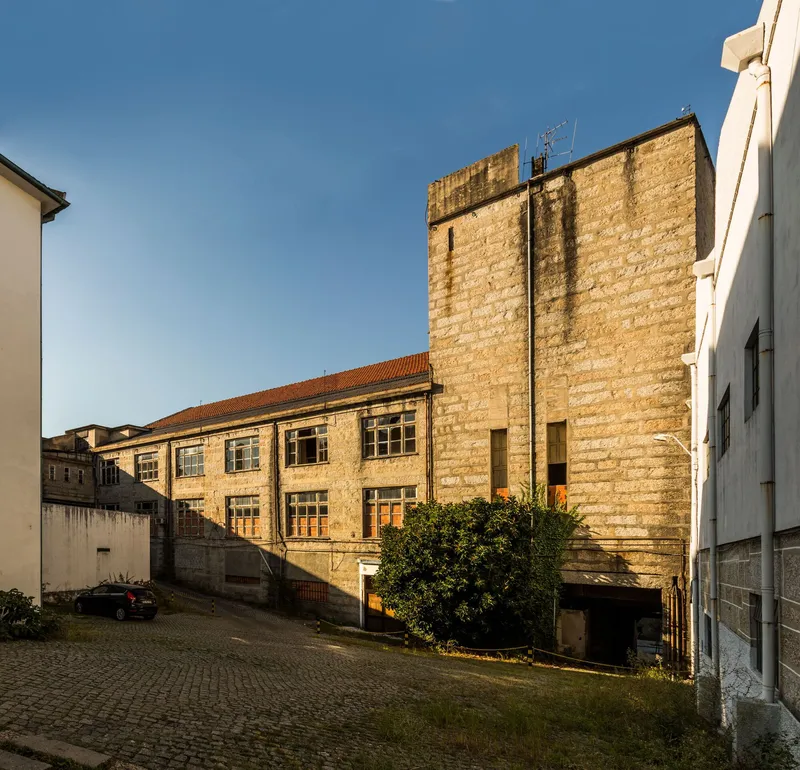
Where new construction is exposed to the street, it is deliberately plain. The white rendered facade with dark recessed windows and an external steel staircase speaks a different architectural language from the granite host, and that is the point. Pitagoras Group wanted legibility: you should always know whether you are in the old building or the new one. The courtyard view at golden hour, with its weathered stone buildings and tall tower, confirms that the complex is a village of parts rather than a monolith.
The vertical timber slat wall enclosing a staircase with metal railings and a brass handrail is a detail worth noting. Brass against timber against steel: three materials, three construction eras, each doing its own work. This is rehabilitation that respects layers rather than collapsing them.
Plans and Drawings
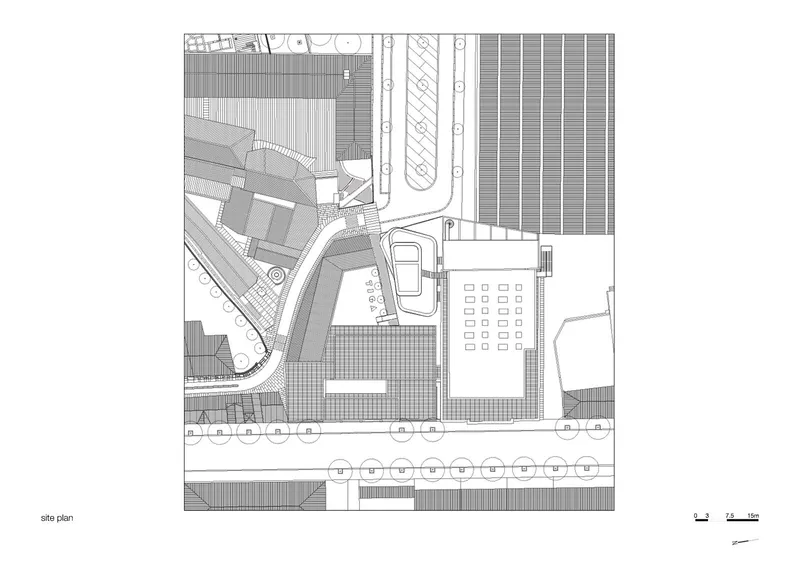
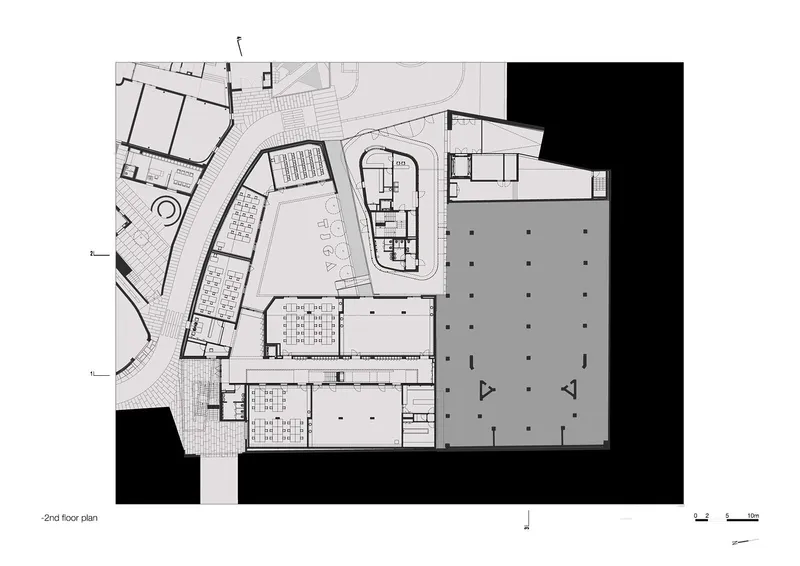
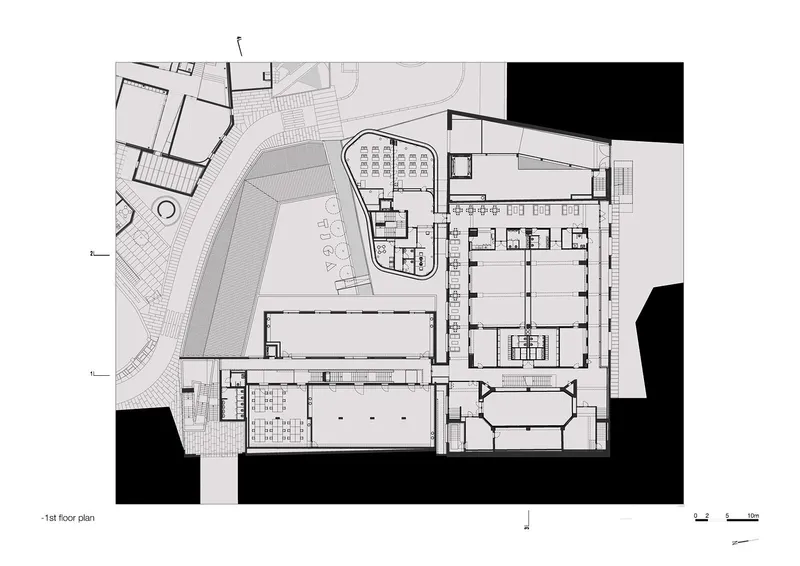
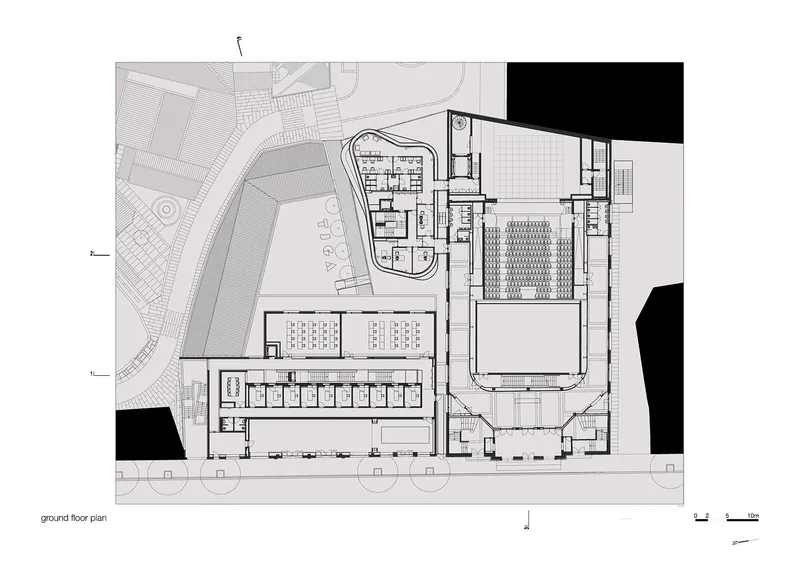
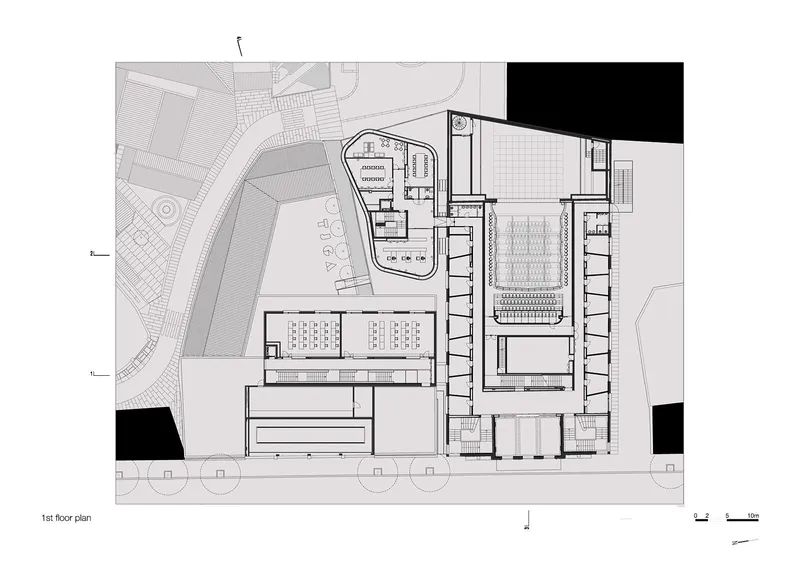
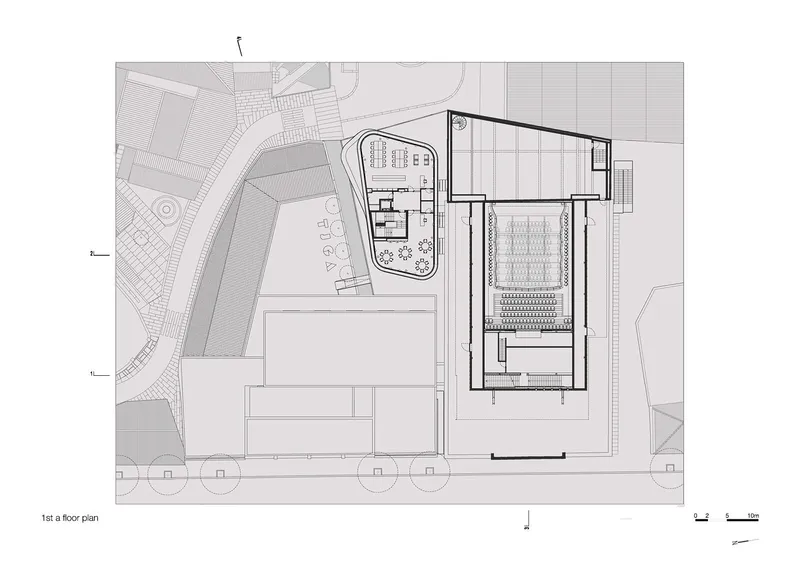
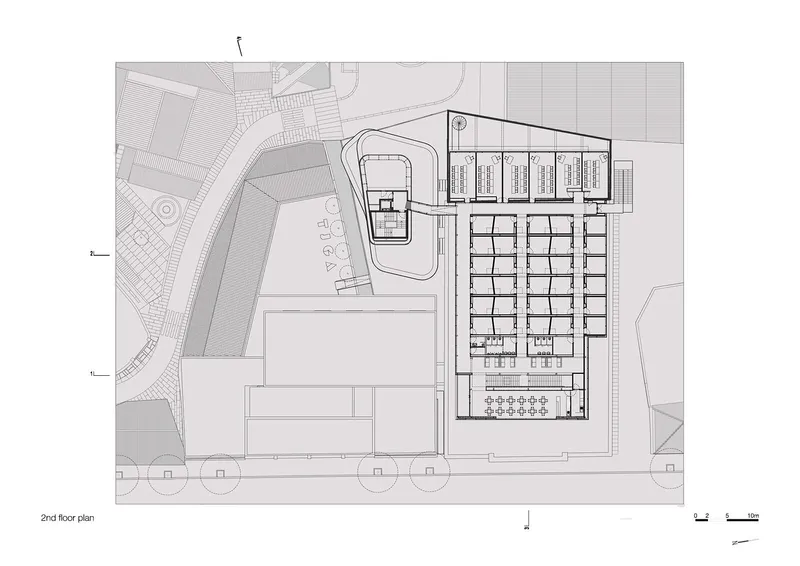
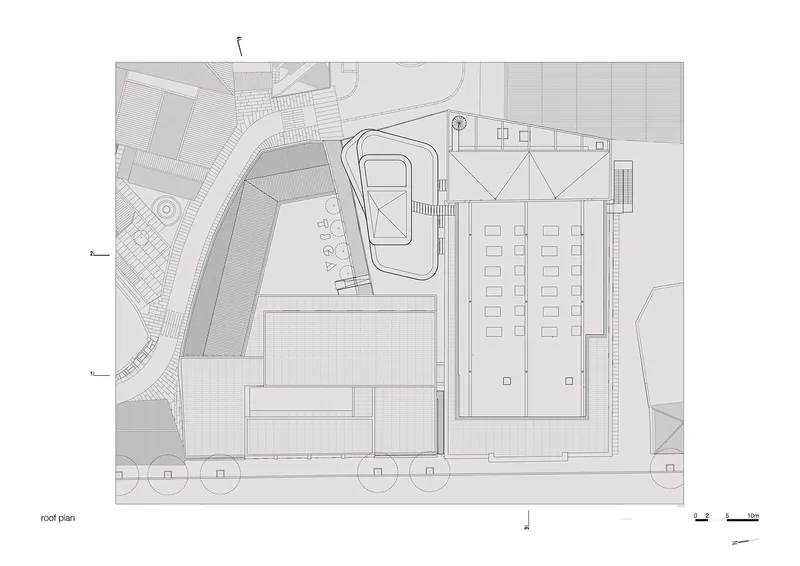
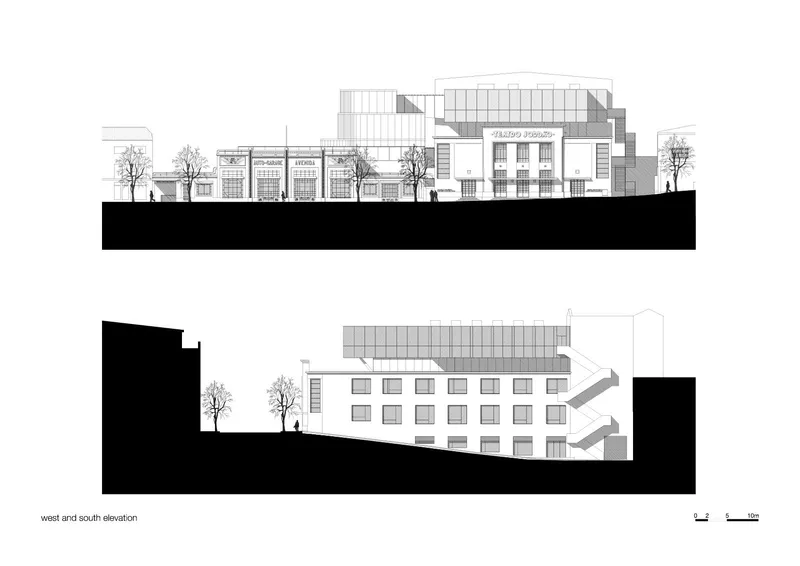
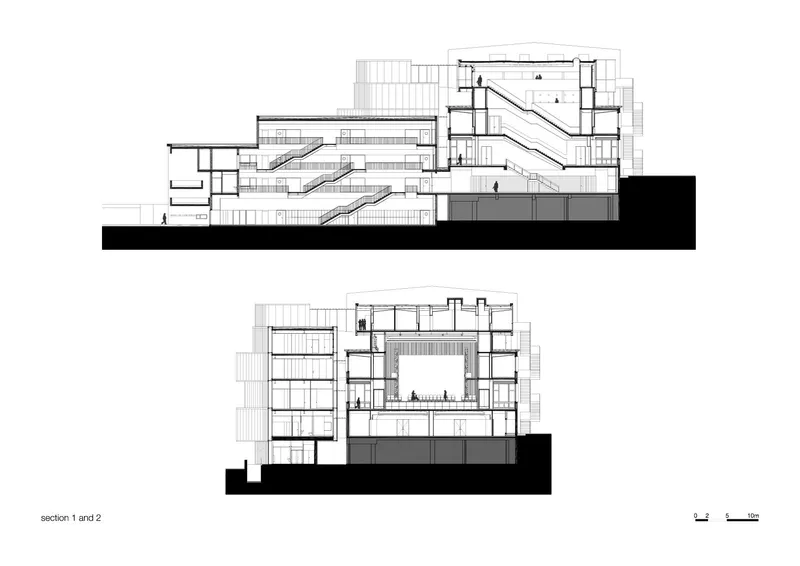
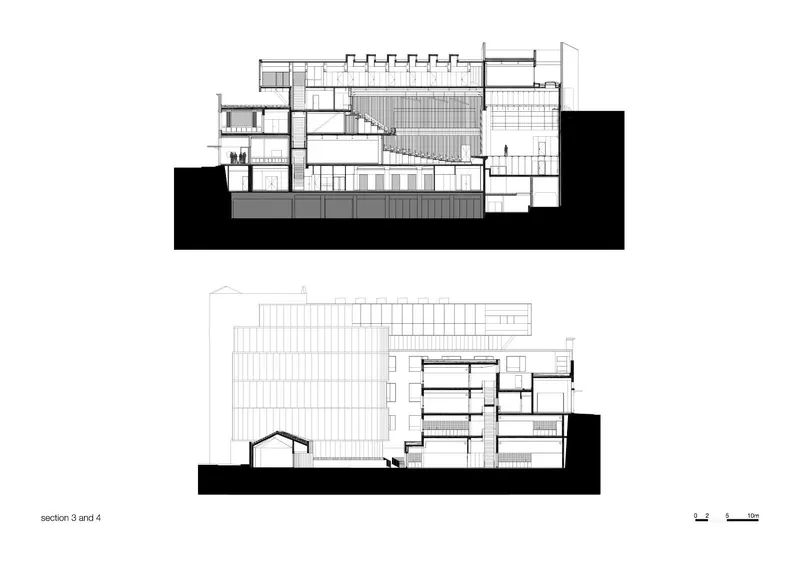
The plan sequence, from the subterranean level through the roof, reveals how the architects carved autonomous zones from the old footprint. The ground floor places the large performance hall at the center with seating rows and generous circulation zones wrapping around a courtyard. Upper floors distribute grids of classrooms along one wing while a curved courtyard pavilion occupies the adjacent volume. The site plan makes legible the building's relationship to the surrounding street grid, showing how carefully the new volumes were inserted into the existing fabric without consuming adjacent public space.
The section drawings are the most revealing documents. They show cascading interior staircases linking multiple floor levels, the full height of the auditorium volume, and the way the cylindrical glass tower connects to the stone base. The triangular skylight structure above the main hall, visible in the roof plan, explains the quality of light in the concert hall interiors. The elevations confirm the strategy of material contrast: stone and plaster at the pedestrian scale, glass and metal above.
Why This Project Matters
Rehabilitation projects in historic Portuguese cities tend to fall into two traps: either they freeze the old building in amber, producing a beautiful corpse, or they gut it so thoroughly that the original fabric becomes scenography. Pitagoras Group avoided both by treating the 1938 Teatro Jordão and Garagem Avenida as structures with residual capacity rather than relics requiring protection. The key decision was programmatic: splitting the complex into three schools and an auditorium guaranteed that every corner would be inhabited daily by students and teachers, not tourists and occasional concertgoers. Buildings survive when people need them.
The formal strategy of making new elements volumetrically autonomous from the granite host is not new, but it is executed here with unusual discipline. The glass cylinder, the white rendered volumes, and the timber interiors each announce their contemporaneity without shouting. In a city where heritage designation can become a straitjacket, this project demonstrates that transformation and respect are not opposites. Guimarães gained 11,400 square meters of living cultural infrastructure, and it lost nothing that still had breath in it.
Rehabilitation of the old Jordão Theater and Garage Avenida by Pitagoras Group. Guimarães, Portugal. 11,400 m². Completed 2022. Photography by Manuel Roque.
About the Studio
Share Your Own Work on uni.xyz
If projects like this are the kind of work you want to make, uni.xyz is a place to publish your own, find collaborators, and enter design competitions.


Popular Articles
Popular articles from the community


Opera on the Sea: Driftwood Logic Shapes a Timber Opera House on Estonia's Coast
Trevor Orgill's opera house translates the entangled drift of floating timber into a civic building where wood, water, and music converge.

Manzana Morphosis: Stretching Barcelona's Grid into a Living Landscape for 2050
A radical reworking of the Eixample manzana turns density into a tool for generous public space, vertical ecology, and environmental performance.

Singing Woman: Contemporary Architecture Inspired by Estonia’s Voice and the Sea
Singing Woman turns Estonia’s song culture into flowing opera house architecture, blending public life, landscape, sea, and national memory.
Extended Shell: Retrofitting Kolkata's Balconies as Living Urban Thresholds
A modular retrofit system recovers the social and environmental intelligence of Kolkata's historic verandas for contemporary Park Street residents.

Similar Reads
You might also enjoy these articles

Bao Huynh Watercolor Atelier: A Serene Art Retreat in Hội An
Bao Huynh Watercolor Atelier in Hội An blends multifunctional art spaces, sustainable design, local materials, and family-friendly living in a serene environment.

Atelier Macri Concept Store Interior Design by CASE-REAL
Atelier Macri store features a "ko" counter, walnut wood details, cork displays, blending retail, gallery, and seamless customer experiences.

Manuel Vargas Izquierdo Stadium and High-Performance Sports Center: Architectural Excellence in Jalpa de Méndez
The Manuel Vargas Izquierdo Stadium blends sustainable design, inclusive sports facilities, and cultural-inspired architecture, revitalizing Jalpa de Méndez’s public spaces.

KAKR Buluh Awar Hall: Revitalizing Community and Ecology Through Bamboo Architecture
Community built bamboo hall revitalizes Buluh Awar village, empowering youth, restoring ecology, celebrating vernacular craftsmanship through sustainable architecture and culture.

Explore Cultural Architecture Competitions
Discover active competitions in this discipline

Challenge to reimagine the Iron Throne

Photograph architecture without architects

Illustrate the lost glory of Angkor Wat - Render Challenge

Bring back Drive In's
Comments (0)
Please login or sign up to add comments
No comments yet. Be the first to comment!