
Sambhaji Garden Plaza: Tearing Down Walls to Rebuild Public Life in Pune
A modular shopping plaza replaces compound walls and passive gardens with permeable urban space along one of Pune's busiest corridors.


What happens when you rip out a compound wall that has severed a garden from the city it supposedly serves? In Pune's Shivajinagar district, a public garden sits behind barriers, surrounded by unorganized street vendors spilling onto JM Road, pedestrians dodging traffic, and a community with no designed space to gather. The Sambhaji Garden placemaking project by Ashish Kelkar answers that question with a modular public shopping plaza that dissolves the boundary between city sidewalk and green space, replacing passive landscape with a layered program of retail, leisure, and cultural exchange.
Shivajinagar is one of Pune's most historically layered neighborhoods, with schools, hospitals, museums, temples, and theatres all within walking distance. Colonial heritage structures sit alongside contemporary development, and the area draws a young, student-heavy crowd alongside families and office workers. Despite this density of activity, the garden site remains underutilized. Kelkar's proposal confronts three overlapping problems: a walled-off green space with no dynamic programming, vendor-driven congestion that turns sidewalks into obstacle courses, and the absence of a safe, multifunctional public gathering place. The design re-channels the energy already present on the street into an architecture that welcomes it.
A Staircase as Threshold: Moving Between Plaza Levels
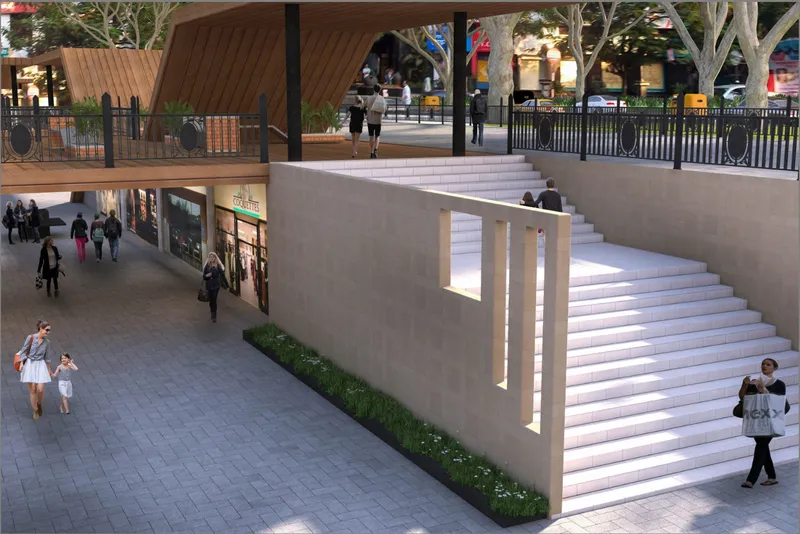
The wide staircase connecting two levels of the plaza works as more than vertical circulation. Illuminated vertical slots cut into the flanking concrete walls turn what could be a utilitarian connector into a spatial experience, drawing people upward with rhythm and light. The generosity of the stair width signals that this is a place to linger, not just pass through. It sets up the project's central ambition: every piece of infrastructure doubles as a moment of public engagement.
Open Pavilions and Integrated Planting Replace the Compound Wall
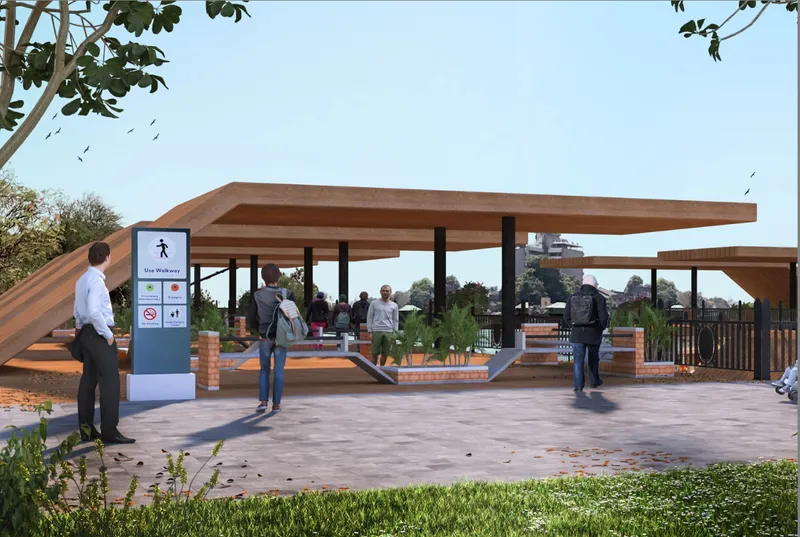

With the restrictive compound wall removed, the design aligns the garden edge with the existing footpath along JM Road, creating a seamless transition from sidewalk to plaza. Open timber pavilions with sloped roofs, supported by slender black columns, define zones without enclosing them. Tropical tree canopies overhead maintain the garden's character while sheltering shoppers and visitors below. The pavilion structure is deliberately porous: you see through it, walk through it, sit under it.
Planted beds are integrated directly into the timber decking and seating areas, with angular beams overhead providing shade and spatial definition. Trees are preserved through cut-outs in the plaza deck, a detail that prevents the project from reading as a wholesale replacement of the garden. The street furniture, built from recycled perforated powder-coated steel and exposed brickwork, reinforces a material language rooted in sustainability and the industrial textures already present in Pune's urban fabric.
An Undulating Roofscape Over Retail and Courtyards
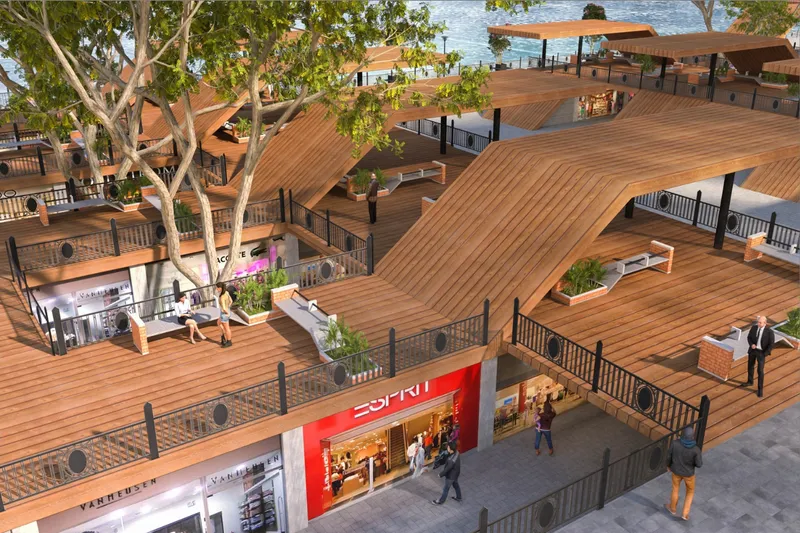
From above, the plaza reveals its organizational logic. Undulating timber roof planes cover retail storefronts and planted courtyards in a repeatable modular pattern that Kelkar designed for adaptability and future expansion. Shopping corridors align with pedestrian pathways, keeping commercial activity accessible without overwhelming the public space. The courtyards punctuate the retail fabric with greenery, ensuring that the plaza never reads as a mall but as a landscape with shops woven into it. The aerial perspective also shows how the design preserves the skyline, keeping built elements low and horizontal beneath the tree canopy.
Rooftop Terraces and Dusk Views Along JM Road
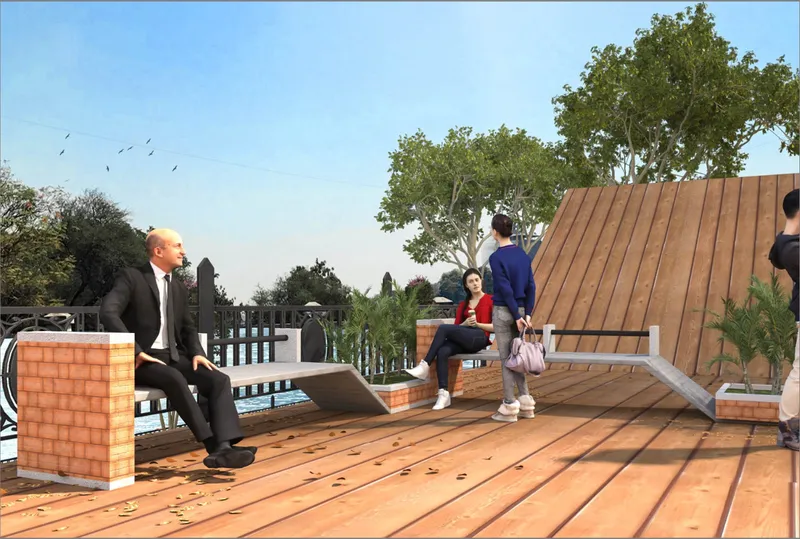
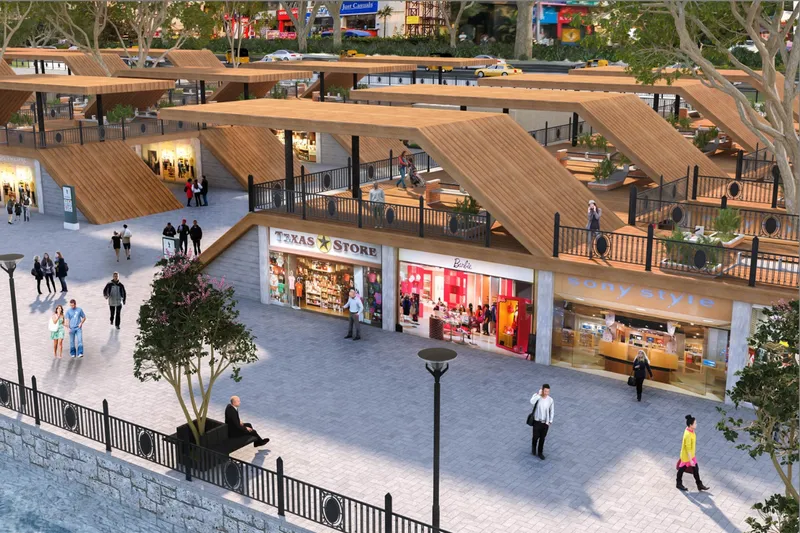
The rooftop terrace layer adds another dimension of public life. Timber decking, brick planters doubling as seating, and deciduous trees create an elevated garden that gives visitors distance from the street while keeping them connected visually to the city. At dusk, the retail plaza glows beneath its sloping timber roofs, shopfronts animated by foot traffic along elevated walkways. The project incorporates a jogging track alongside the nearby Mutha River, extending the plaza's influence beyond its footprint and linking wellness programming to the urban corridor.
What holds the project together is its refusal to treat retail, landscape, and public gathering as separate programs. The modular bench becomes a planter becomes a shopfront edge. The timber deck is simultaneously plaza surface, tree preservation strategy, and seating zone. Kelkar's design language treats flexibility not as an abstract principle but as a physical reality: every element is designed to serve multiple roles simultaneously.
Why This Project Matters
Indian cities are full of sites like Sambhaji Garden: public land with latent value, cut off from the life around it by walls, neglect, or institutional inertia. The typical response is either to leave them as they are or to replace them wholesale with commercial development. Kelkar's proposal charts a third path, one that absorbs the existing street market energy, preserves mature trees, and introduces retail and community programming without sacrificing the garden's identity as public green space. The design's modular logic means it could scale across similar sites in Pune and beyond.
The project also demonstrates that placemaking in the Indian context doesn't need to import foreign typologies. The material palette of exposed brick, powder-coated steel, and timber is local and economical. The program responds to how people already use the neighborhood: students gathering, vendors selling, families walking. By designing with those patterns rather than against them, the Sambhaji Garden plaza becomes not a disruption of the existing urban order but an architectural framework that gives it room to thrive.
View the Full Project
About the Designers
Designer: Ashish Kelkar
Enter a Design Competition on uni.xyz
uni.xyz runs architecture and design competitions year-round that reward proposals with spatial conviction and real site intelligence.
Project credits: Place Making Project at Sambhaji Garden in India, Maharashtra, Pune by Ashish Kelkar.


Popular Articles
Popular articles from the community


Cube Design Draws an Ecological Corridor Between Two Shenzhen Hills with the Nankai Building
Beside Shenzhen's container docks, the Nankai Building pairs stacked balconies with a climbing green screen to connect two hillsides across its height.

David Macias Steps a Doorless Stone and Plaster House Down a Tropical Colombian Hillside
In the humid hills of Colombia, Threshold House replaces the front door with an open void and terraces its 850 m² down the slope instead of fighting it.

Juan García Correa, John González and Claudia Rueda Sink a Circular Amphitheater into a Manizales Engineering Building
On the La Nubia campus in Manizales, Colombia, the S1 Building folds labs and offices into a hillside of ramped lawns that double as a campus route.

LT2A and OPEN Architectes Thread a Brick and Glass High School Through a Wooded Belgian Campus
In Braine-l'Alleud, a 3,000 m² wing for Collège Cardinal Mercier pairs pale brick with a glazed colonnade, deferring to a small chapel and a dense wood.

Similar Reads
You might also enjoy these articles


Aquadapt: An Underwater Habitat That Rewrites Its Rooms by the Hour
Curved modules ring the seabed while one shell shifts from breakfast room to cinema, farm and football pitch as residents' needs change.

Play: Fragments of Their World: Remembered Architecture Rebuilt as a Modular Playground for Refugee Camps
Tom Gardner abstracts domes, arches and towers from the homelands of displaced families into a kit of child-scaled play parts for camp settlements.
REBIRTH: A Circular Settlement Where Afghan Widows and Their Children Rebuild Life Together
A shortlisted Resile entry turns the circle into a protective ring of timber and brick, gathering homes, classrooms and gardens around a shared landscape.
The Main Dream: A Recycled Plastic Kit That Lets Refugee Children Build Their Own Playground
Thirty-centimetre interlocking cubes that connect on three axes turn play into construction, letting children author the spaces they occupy.

Explore Placemaking Competitions
Discover active competitions in this discipline

Design challenge to equip cities with modern furniture

Competition to design a workstation for architects
Comments (0)
Please login or sign up to add comments
No comments yet. Be the first to comment!