

Pocket Home
A tiny abode amidst the dense concrete jungle

There are many field limits for this project. It was quite challenging to create a living space in this long thin area that emerged as a result of faulty city planning. It took a lot of time to support architectural areas with circulation units, especially an area with a width of approximately 6 meters. It is aimed to use this area in the most efficient way during the project planning phase. In the meantime, it was tried not to compromise on vital and architectural requirements. At the same time, it was aimed to add additional spatial values while trying not to compromise them. With the use of green space in this project, it was aimed to add a new spirit to this cramped and lost place in the city. Firstly, the square units, which represent the maximum square meter, that is, 30 square meters, given to us and are the most basic shape, have been tried to make sense of the area and borders. In this way, limits such as sitting on the ground and height were better understood. As a solution, it was decided that a nested and interlocked structure would be a better solution for this area. This decision also pushed us to a discovery for geometry. In these trials, we aimed to optimize the space and use it in the most efficient way by creating different forms with wall angles. This gave us the flexibility to use the wall and furniture jointly or alternately. As a result of these trials, land was broken in the truncated octahedron geometry. The trademark of this geometry is that it works as a square at its base. In this way, it supports the idea of interlocked structure by not creating any space loss between the units. At the same time, it benefits the user and enriches the space by offering different experiences to the user in the interior. After unit types and plan arrangements, in this structure, which started as a large and overlapping mass, it was started to open spaces and create cracks for green space, social interaction, light and air circulation.
After unit types and plan arrangements, in this structure, which started as a large and overlapping mass, it was started to open spaces and create cracks for green space, social interaction, light and air circulation. The arrangement of these spaces and green areas was tried to be fed to the façade that receives as much light as possible.
The construction phase of the inner plan of the units is as follows, after we decided on the space optimization of the truncated octahedron geometry, we started to divide the capsule edges and manipulate it at the necessary moments in order to provide space optimization, after assigning a capsule to each of the basic functions. As a result, we have obtained two types of units. They both have single beds, the difference is that one has a single bed area, while the other has two. In addition, each unit has its own private inner gardens. These gardens are based on a façade where they can get the best light, and they are in the best position by taking advantage of the cracks. It is thought to provide better service to different user types with different unit types.
However, since the units consist of pallets added to the carrier, they are open to changes that may occur over time. In this regard, it is aimed not to lose the concept of flexibility. To explain the material selection better, aluminum steel structure was preferred for the main construction system. Here, it is planned that the light reflection effect of the steel can also provide a solution for this narrow and unlit space. Precast concrete panels with panel glass system were preferred for the parts that can be added or removed from the aforementioned structure for the units. The idea of creating a green area was not limited to the inner gardens, but was also embedded in the building itself. Since the areas between the units placed with the fill and empty logic provide access to the light, the green areas develop by wrapping the structure in time and become a part of the structure. Upon entering the area, it is noticed that none of the units are on the ground. Only the structure and shared amenities are located on the ground floor. This area is deliberately left blank to add another dimension and meaning to the space. Even if it is a limited and small space, this contrast is aimed in a large and spacious entrance.
When the current site is considered conceptually, the contemporary evolution of the city has been seen as a part of the design in the project process and it has been tried to respond to the needs in this direction.


Popular Articles
Popular articles from the community

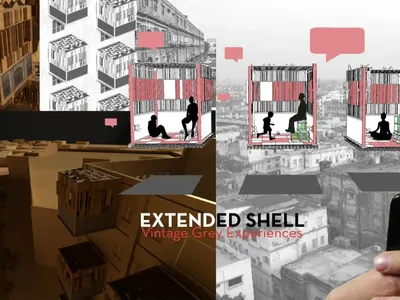
Extended Shell: Retrofitting Kolkata's Balconies as Living Urban Thresholds
A modular retrofit system recovers the social and environmental intelligence of Kolkata's historic verandas for contemporary Park Street residents.

Cloaked Colonization: A Mobile Underwater Habitat That Moves Like a Fish
Micah Abaya's shortlisted EHC Pacific entry reimagines ocean settlement as a dispersed network of self-sustaining architectural organisms.

Tsunami Convergenics: Turning Catastrophic Ocean Forces into Underwater Housing Infrastructure
A speculative underwater settlement off the coast of Onagawa, Japan, treats tsunamis and typhoons as energy sources rather than threats.

Temporary Home for Dogs: A Reversed Zoo Rethinks Animal Shelter Architecture
In Bucharest, a sinuous corridor and freed landscape flip the logic of containment, designing a shelter that works to make itself unnecessary.

Similar Reads
You might also enjoy these articles
The Rhythm of Seasons
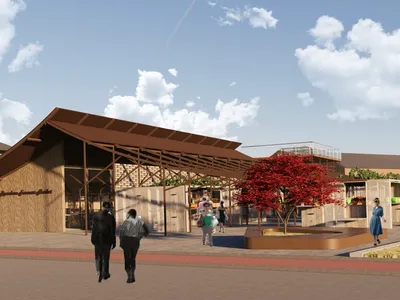
A Farmers' Market Connecting Nature and the City

More Than a Building-Designing a Living System
More Than a Building-Designing a Living System
Base Beyond
DESERT COMPOUND ARID: TOURISM OF ABSENCE AND ABUNDANCE

Comments (0)
Please login or sign up to add comments
No comments yet. Be the first to comment!