
PODS IN THE FOREST: Bharat Bhavan of the 21st Century
A visionary model of sustainable cultural architecture that reconnects art, landscape, and community through floating forest pods.

Project by Pratyush
Winner Entry of Bharat Bhavan 2020
The Bharat Bhavan of the 21st century is envisioned not as a monolithic structure confined to a single plot, but as a fluid network of architectural pods that breathe within the living forest. Instead of occupying land as an isolated institution, the project "PODS IN THE FOREST" proposes sustainable cultural architecture—a distributed system of elevated, hovering buildings that interweave with the existing cultural fabric of Vadodara.
The design strategically connects three vital civic anchors: the historic Sayaji Baug, the Baroda Museum, and the MSU Faculty of Fine Arts. By stitching these destinations together through a series of elevated pathways, plazas, and forest-hovering pods, the proposal transforms the precinct into a continuous cultural experience rather than a destination with fixed boundaries.
The result is an architecture that does not dominate nature but coexists with it—floating above the forest floor, touching lightly, and offering new vantage points to experience the landscape and the arts.
Site Context: A Cultural Triangle in Vadodara
Situated along the River Vishwamitri, the site forms a unique urban confluence between academic, cultural, and public recreational zones. The MSU Fine Arts precinct lies to the north, the Sayaji Baug gardens to the south, and the museum complex to the west. Traditionally, these institutions operate independently, creating distinct experiences.
The project reframes the entire area as a forest campus of cultural architecture, where nature becomes the binding medium. Instead of walking from one institution to another across busy roads or fragmented pathways, visitors move through plazas, bridges, and immersive pods that celebrate art, performance, and learning.
Concept Evolution: Floating Pods & The Red Tunnels
A Non-Object Within the Trees
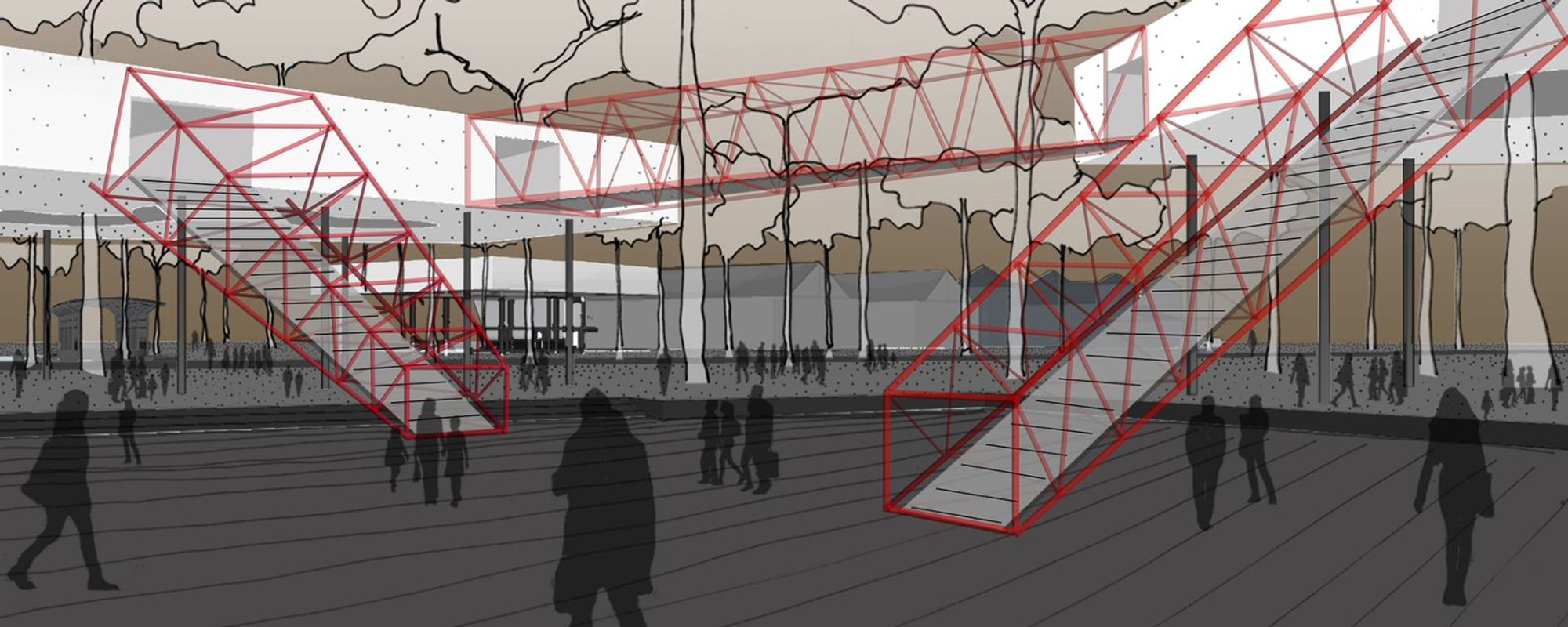
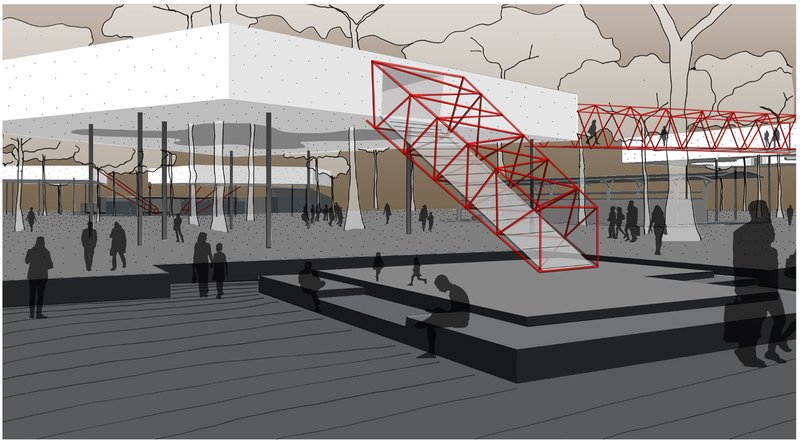
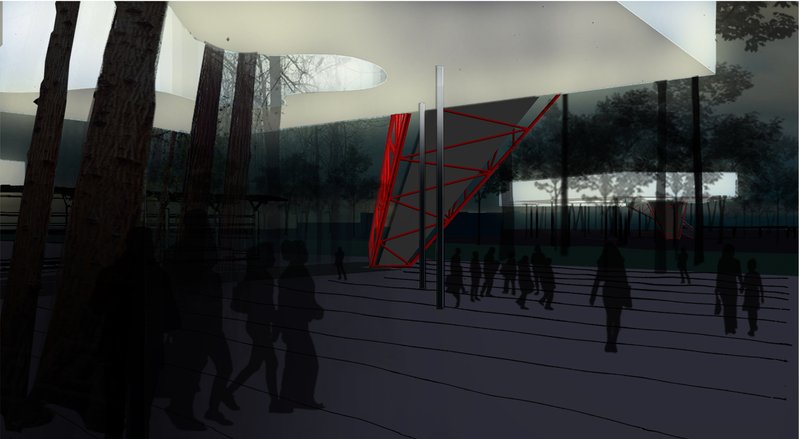
Early concept sketches illustrate the central idea: a non-object—a building designed not to assert mass but to dissolve into foliage. Pods hover at the tree canopy level, accessed through striking red lattice tunnels that pull visitors upward from the ground-level plazas.
These tunnels act as symbolic connectors between earth and sky—between the public realm and the elevated world of art and reflection. Their vibrant color contrasts the muted forest palette, making them instantly recognizable wayfinding devices.
Artist Plaza: A Social Heart
The Artist Plaza functions as a communal deck, inviting people from the university and the city to explore, create, gather, and reflect. Activities flow organically from open areas into the pods, with workshops, residencies, and interactive art experiences unfolding throughout the day.
Here, sustainable cultural architecture manifests through thoughtful integration: the plaza is open, breathable, minimally invasive, and designed around existing tree clusters.
Programmatic Distribution: Architecture as Network
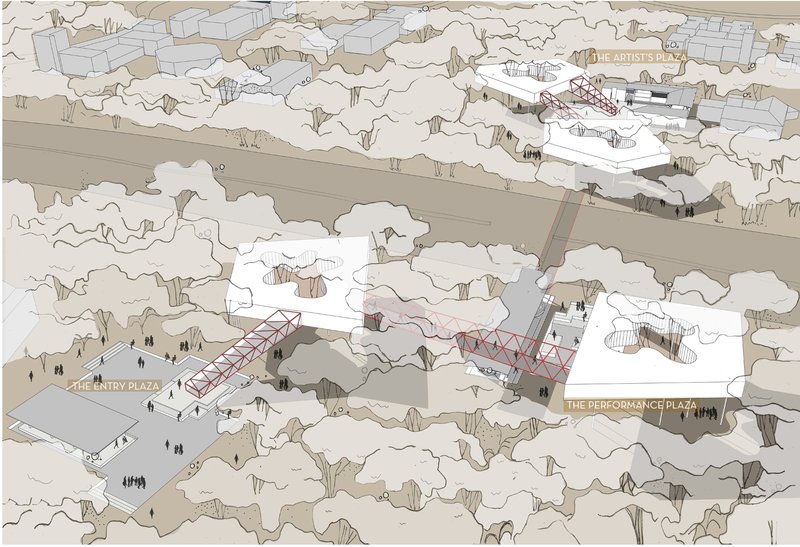
The intervention forms a chain of public experiences connected by bridges, tunnels, and courtyards. Each pod contributes a unique program, yet together they form a cohesive cultural ecosystem.
Pod 1 – Souvenir Shop & Food Court
A welcoming threshold offering amenities, it initiates the journey upward into the forested cultural realm.
Pod 2 – Art Gallery & Workshops
Designed for exhibitions and hands-on creativity, this pod hosts rotating displays and intimate learning sessions.
Performance Plaza & Amphitheatre
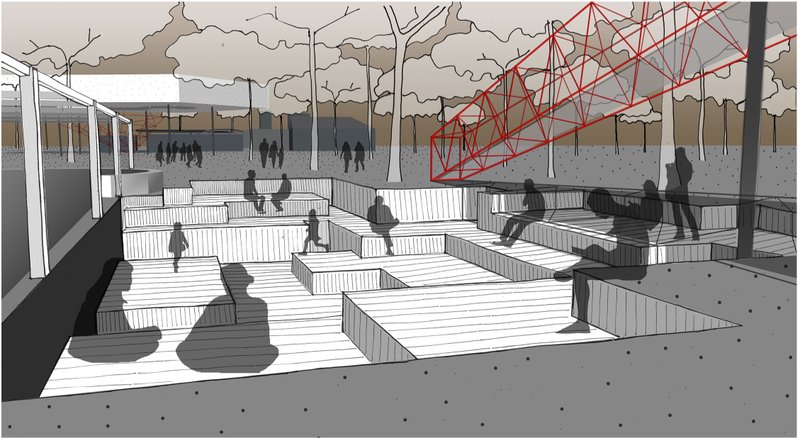
Where the forest becomes a stage—an open-air amphitheater carved lightly into the ground, creating a natural cultural landmark.
Pod 3 & Pod 4 – Galleries, Exhibition Spaces, and Workshops
Higher in the network, these pods deepen the engagement with the arts, offering flexible programs that evolve with the community’s needs.
Underground Tunnel – Immersive Exhibition Corridor
A contrasting experience: descending beneath the earth reveals a curated path of installations, soundscapes, and storytelling.
The resulting configuration is not a linear museum but a constellation—an experience that unfolds in multiple directions, at multiple heights.
Spatial Experience: Art Above the Forest Floor
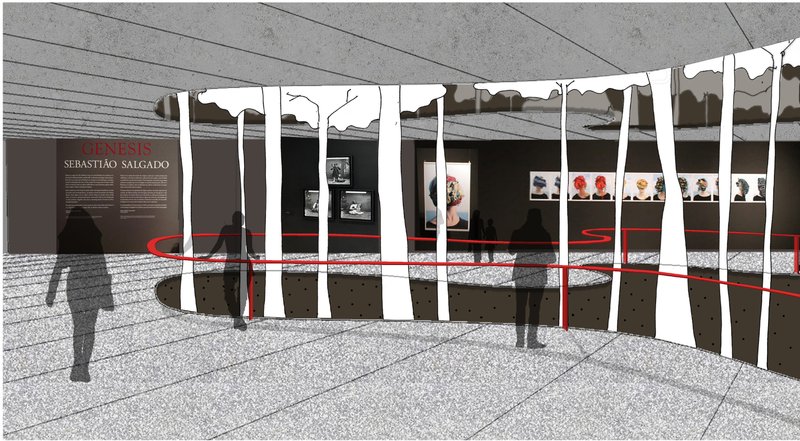
The axonometric views reveal how the architecture floats between the trees, creating elevated promenades where movement becomes performative. The pod roofs carry organic cut-outs that allow trees to pass through, blurring the boundary between built and natural environments. Light filters dramatically through the perforated walls of the pods, especially at night when they glow like lanterns suspended in the canopy.
This luminous quality is central to the design’s identity. At dusk, the red structural bridges illuminate gently, guiding visitors like pathways of light weaving through the woods.
Sections & Plans: Lightness as a Design Strategy
Sectional drawings demonstrate the building’s minimal ground impact. The pods rest lightly on slender supports, maintaining the ecological continuity of the site. Their interiors accommodate:
- Art installations
- Rotating exhibitions
- Workshops
- Artist-in-residence studios
- Public gathering spaces
Trees penetrate courtyards and skylight voids in the pods, reinforcing the project’s philosophy of coexisting rather than replacing.
The performance plaza, with its stepped seating emerging from the landscape, appears carved by natural topography. It is a democratic space—open, accessible, and resonant with sound and community energy.
Materiality & Atmosphere: Architecture That Breathes
Perforated concrete walls enable the pods to glow softly at night. During the day, this porous skin diffuses light, allowing shadows of leaves and branches to ripple across interior surfaces—turning nature into an ever-changing artwork.
At night, the pods become lightboxes—floating luminous forms guiding visitors through the darkened woods. This ethereal atmosphere reinforces the project’s ambition of creating a forest museum without walls, where architecture disappears into experience.
A Model for the Future of Sustainable Cultural Architecture
Pratyush’s winning proposal for Bharat Bhavan 2020 is more than a design concept—it is a paradigm shift. It demonstrates how sustainable cultural architecture can redefine civic experiences by:
- Minimizing land occupation
- Integrating with existing natural ecosystems
- Creating hybrid cultural-public landscapes
- Encouraging movement, exploration, and participation
- Extending the life of historic institutions through spatial connectivity
In an age where cities urgently need ecological sensitivity, public engagement, and cultural revitalization, this project becomes a forward-looking blueprint. It honors the legacy of Bharat Bhavan while projecting it into a future where art, community, and nature thrive together.
The Bharat Bhavan of the 21st century is not a building—it is a living framework. It floats, connects, glows, and invites. It transforms a city’s cultural district into an experiential forest campus. And in doing so, it redefines what a civic institution can be: not a destination, but a journey through light, nature, and imagination.
Through visionary design, contextual sensitivity, and ecological intelligence, the project embodies the very essence of sustainable cultural architecture—where creativity grows in harmony with the land it inhabits.


Popular Articles
Popular articles from the community

Split House: A Compact Urban Home Blending Privacy, Light, and Flexible Living in Japan
Compact Japanese home featuring DOMA space, flexible café potential, passive lighting, privacy zoning, and sustainable urban living design.

Free Architecture Competitions You Can Enter Right Now
No entry fees, real prizes. Here are the best free architecture competitions open for submissions in 2026.
Alton Cliff House: A Harmonious Retreat by f2a Architecture in Lake Country, Canada
Alton Cliff House blends corten steel, prefabrication, and sustainable design, creating a luxurious, energy-efficient retreat perched on Canadian cliffs.


The Ken Roberts Memorial Delineation Competition (Krob)
As the most senior architectural drawing competition currently in operation anywhere in the world, it draws hundreds of entries each year, awarding the very best submissions in a series of medium-based categories.

Similar Reads
You might also enjoy these articles
Digital Façade Design for our cities’ urban fronts
Prima Facie - Result Story
Protecting avian biodiversity: Bird observatories to help spread awareness & save rare bird species.
Results for ‘Fly’ - Landscape design competition out now
Connecting with nature: Forest interpretation center in Australia's Wollemi National Park
‘Asatti’ - Landscape design competition - Result story




Comments (0)
Please login or sign up to add comments
No comments yet. Be the first to comment!