

Powerhouse Company Floats a 5,880 Square Meter Office on Rotterdam's Rijnhaven
A timber-clad, solar-powered headquarters for the Global Center on Adaptation proves that climate-resilient architecture can also be inviting.


If climate adaptation is the mission, then the building housing that mission had better practice what it preaches. Powerhouse Company, led by Nanne de Ru, designed the Floating Office Rotterdam as the headquarters of the Global Center on Adaptation, and they made the most literal design decision possible: they put the whole thing on the water. Moored in the Rijnhaven port between residential towers and a post-industrial waterfront, the 5,880 square meter structure is one of the largest floating offices in the world, a timber-clad volume that rises and falls with the tides.
What makes this project genuinely interesting is not the novelty of a floating building. Houseboats are a Dutch tradition. What matters here is the ambition to scale that tradition into a serious workplace: three stories, conference rooms, a restaurant, and all the mechanical systems a modern office demands, all resting on a pontoon. The building had to be self-sufficient in energy, resilient against fluctuating water levels, and welcoming to the public. That last point is the hardest to pull off when your site is literally disconnected from the street, and Powerhouse Company's answer is a generous timber deck that doubles as a public swimming dock, café terrace, and kayak launch. The boundary between office and city dissolves at the waterline.
A Building That Reads the Water
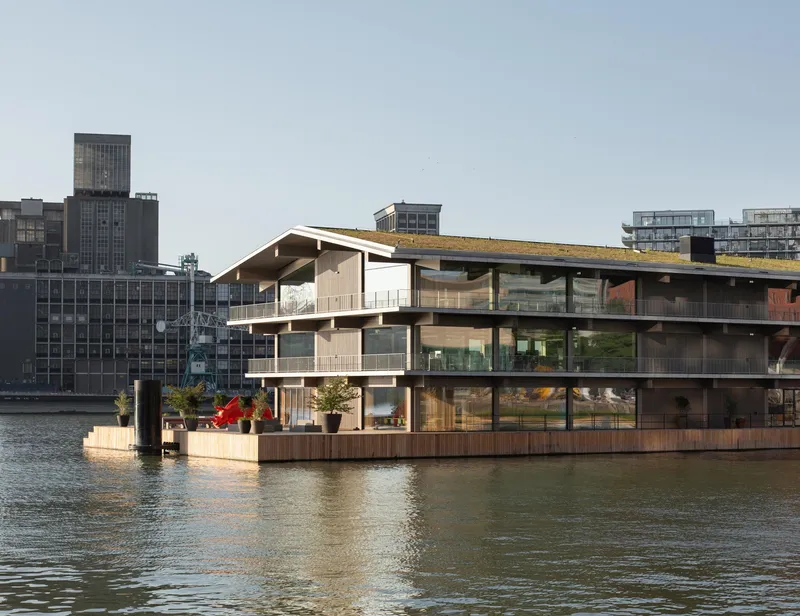
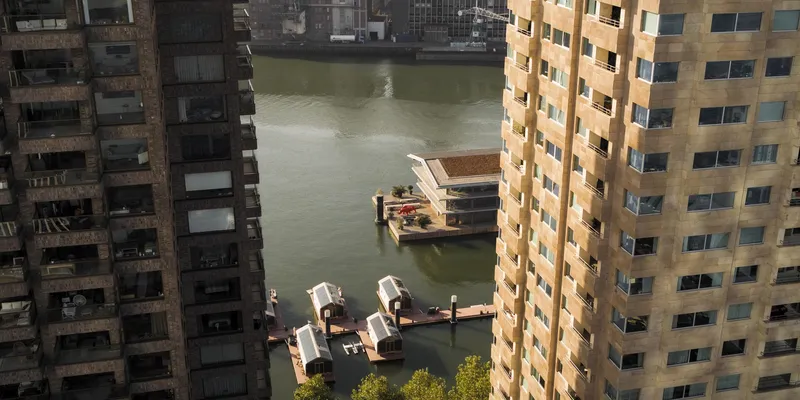

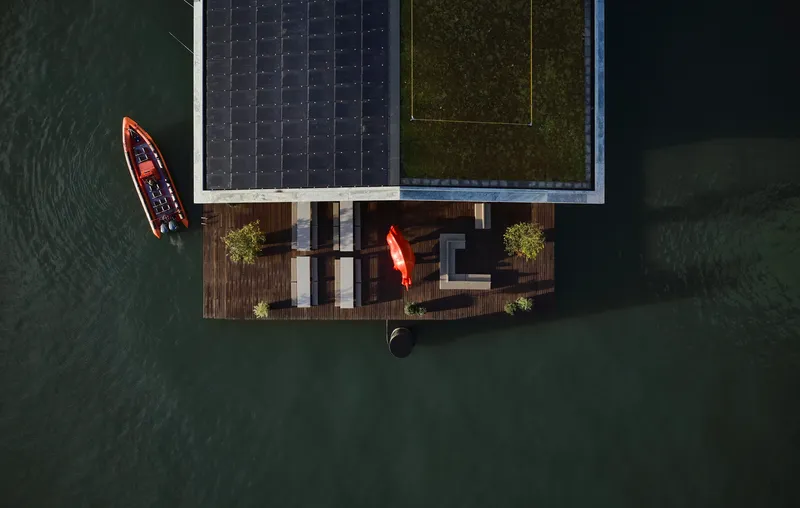
From the aerial view, the Floating Office reads as a quiet, linear bar dropped between apartment blocks, its green roof and solar array absorbing it into the waterway landscape rather than competing with it. At water level, the experience shifts entirely. The facade alternates between full-height glazing, vertical metal screening, and exposed concrete balconies, creating a rhythm that is industrial enough to belong in the port and warm enough to invite you aboard. Stacked cantilevered balconies give the elevation depth and shadow, an effect that changes dramatically depending on whether you catch the building under clear skies or the moody storm light Rotterdam is known for.
The choice of timber cladding is both aesthetic and performative. Wood signals warmth and approachability in a harbor dominated by steel and glass towers. More pragmatically, timber is light, which matters enormously when the entire structural load has to be carried by a floating platform. Every material decision here traces back to the buoyancy equation.
The Timber Deck as Urban Living Room
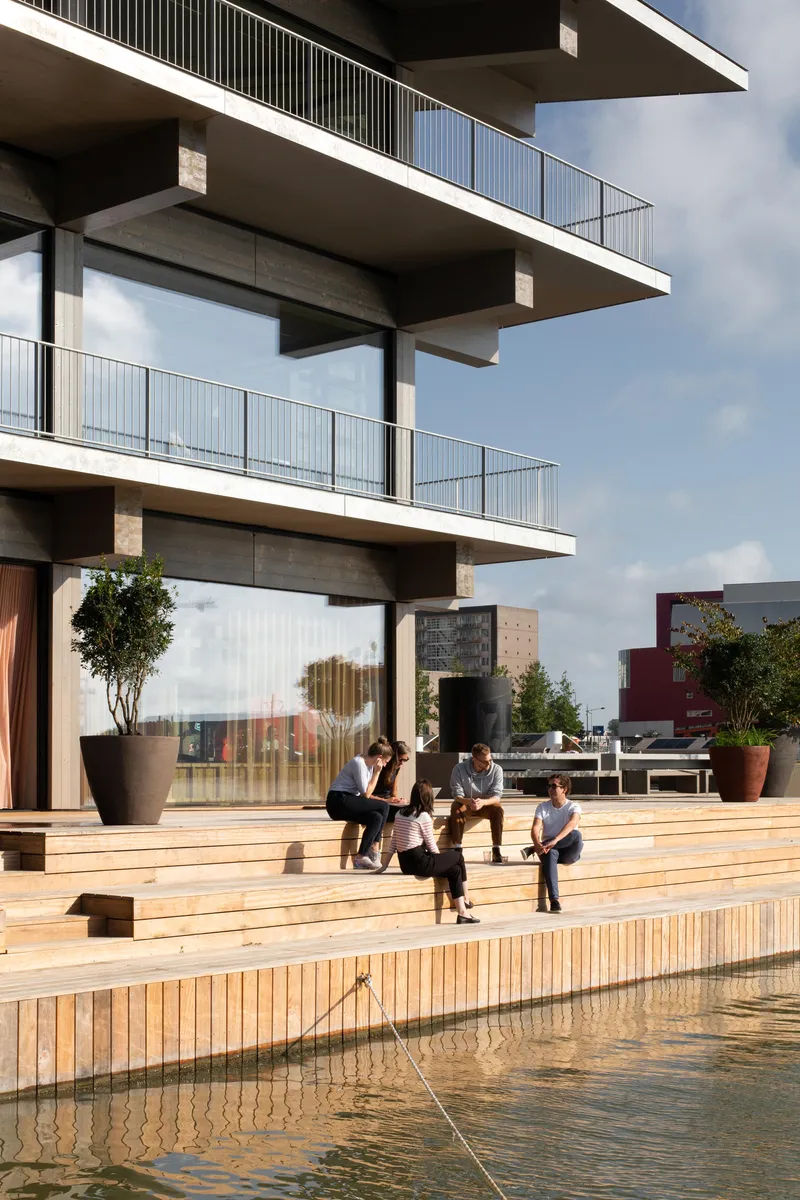
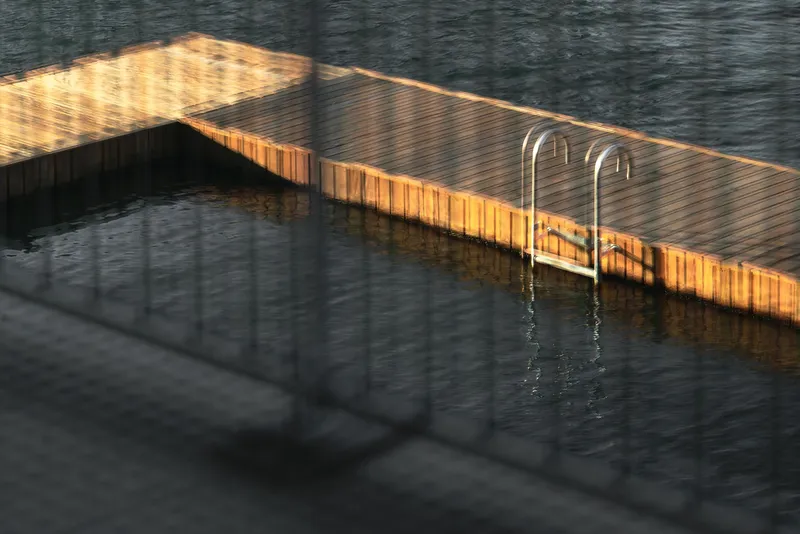
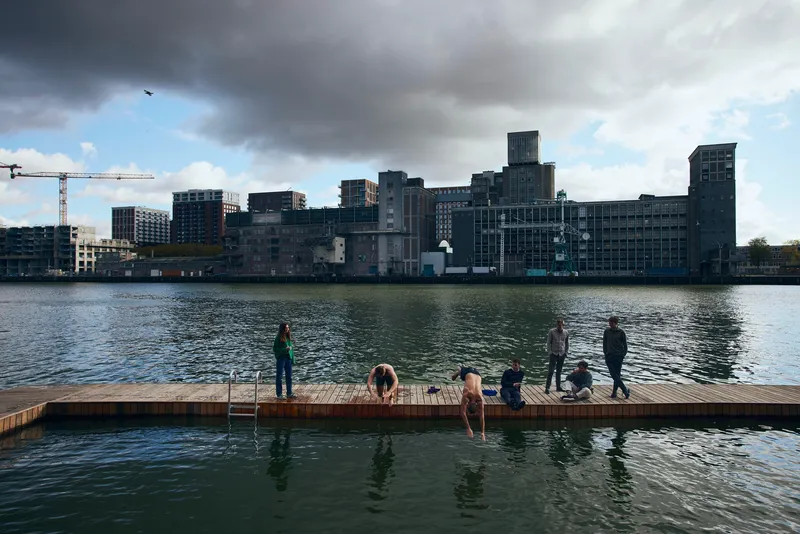
The most compelling public space in this project is not inside the building at all. It is the wide timber deck that wraps the perimeter, extending out to a swimming dock where metal ladders drop straight into the Rijnhaven. On a warm afternoon, office workers, residents from the neighboring towers, and kayakers converge on this platform. A dog, two swimmers, and a horizon of converted industrial sheds: this is the scene that makes the building matter beyond its headline credentials.
Too many office buildings treat their ground plane as a security perimeter. Here, the deck is porous and unguarded, furnished with potted trees, casual seating, and direct water access. The decision to make a climate adaptation headquarters also a neighborhood amenity is the smartest move in the project. It ties the institution to the city at the most visceral level: your feet on the planks, the water lapping below.
Interior Warmth Against the Harbor
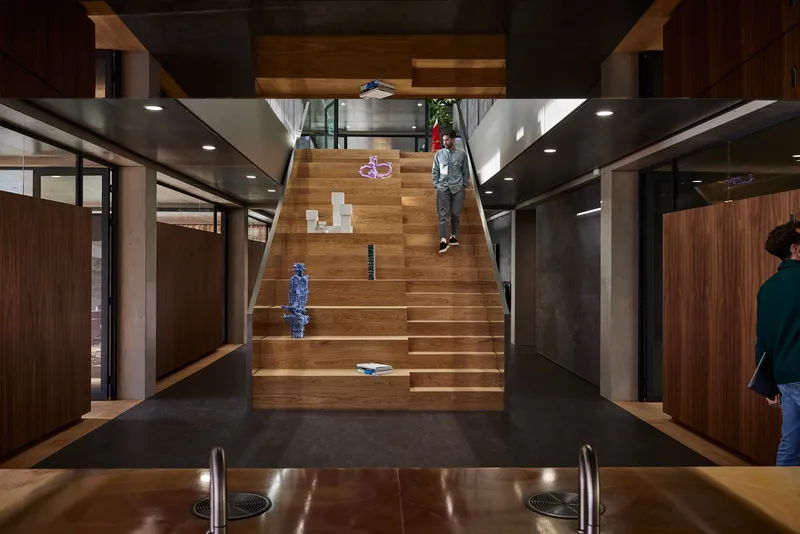
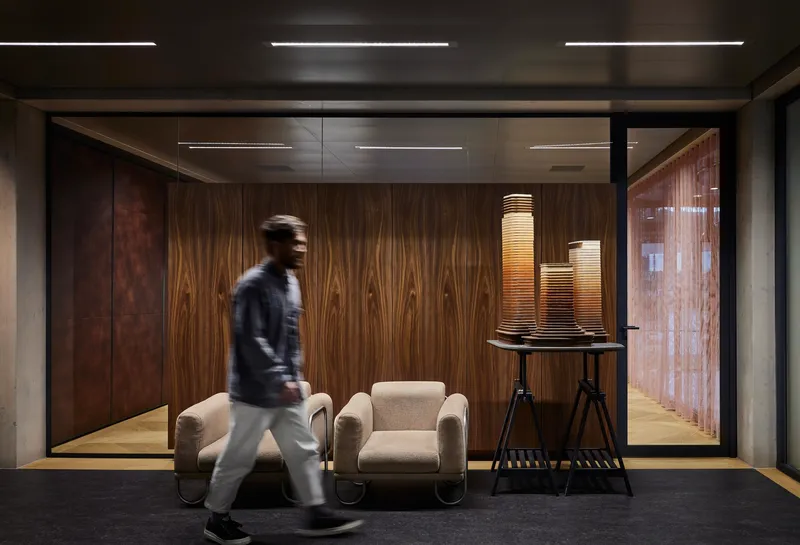
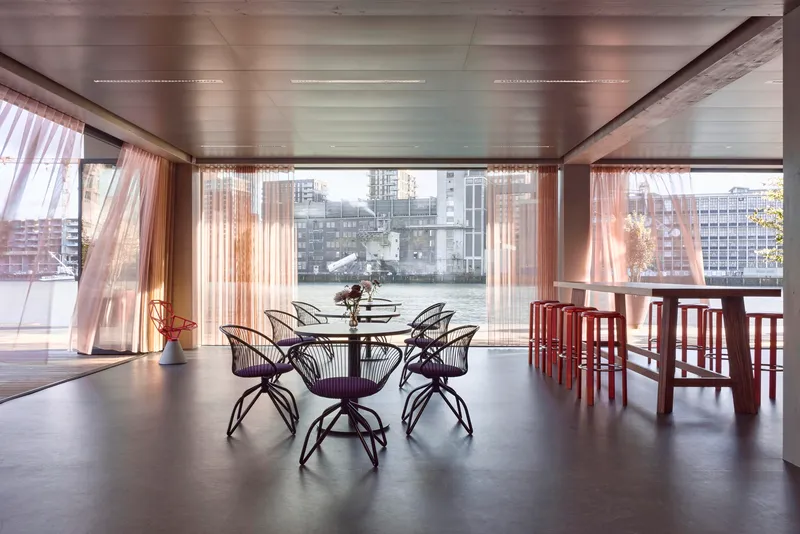
Inside, the palette stays consistent: timber stair treads, wood-paneled corridors, and warm upholstery. The central staircase, wide enough for a child to sit on comfortably, connects all three levels and acts as the social spine. Corridors are lined with glass partitions that keep the floor plate visually open without sacrificing acoustic separation. The dining area, with its floor-to-ceiling glazing overlooking the waterfront cityscape, is the kind of space that justifies working in an office rather than from home.
Powerhouse Company avoids the sterile minimalism that plagues many sustainable buildings. There is texture here: green veined marble at the reception, walnut veneer partitions, and sheer curtains that filter the sharp harbor light into something softer. The interiors feel like they belong to a boutique hotel as much as a policy institution, and that duality is deliberate. The building hosts visiting delegations, conferences, and public events, so it has to perform across registers.
Material Richness in the Common Spaces
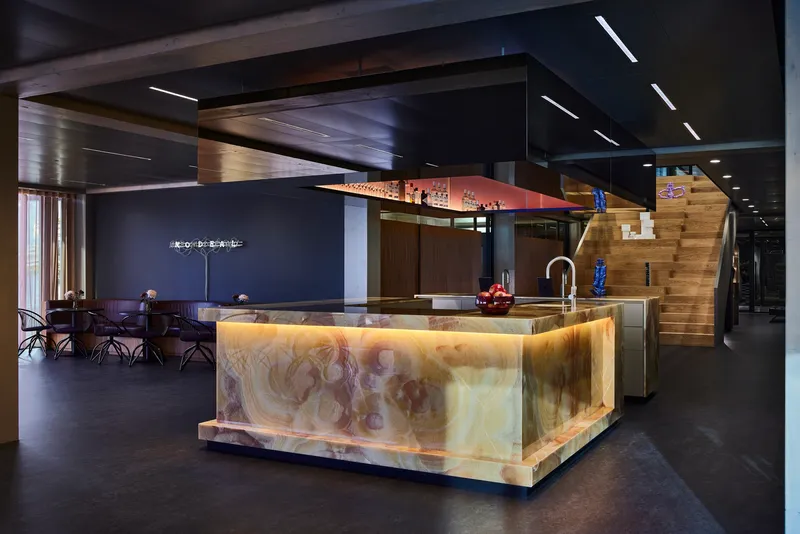

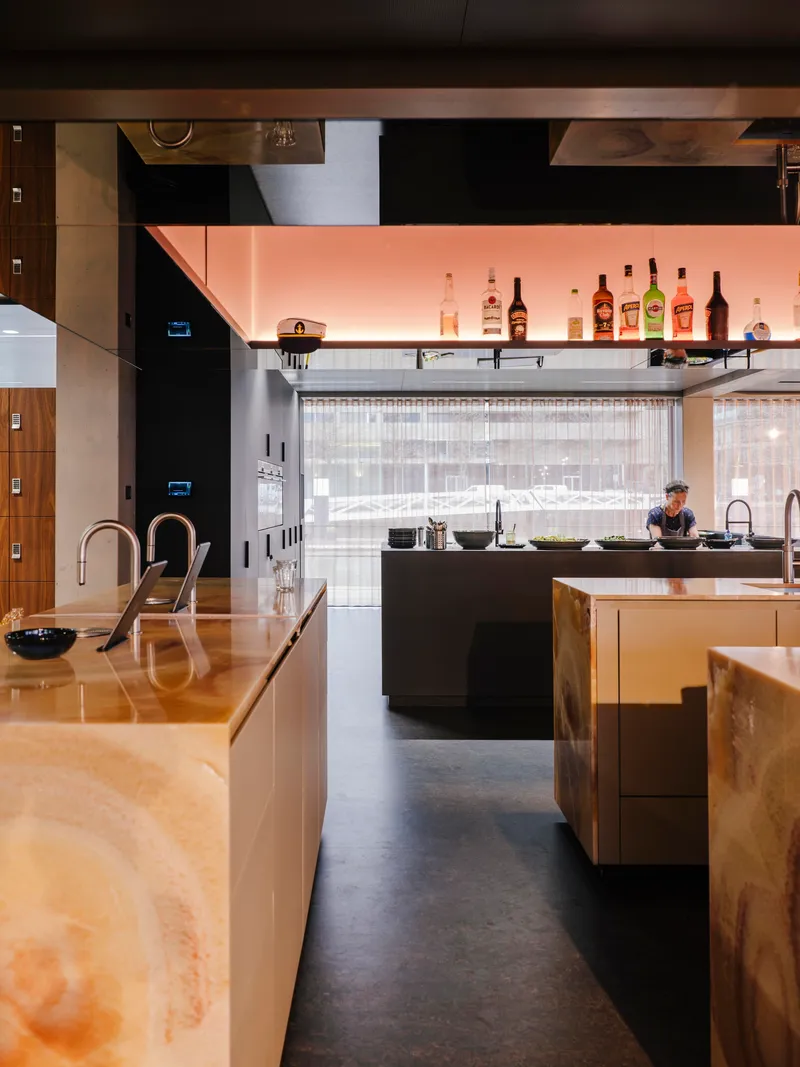
The restaurant and bar areas push the material vocabulary furthest. A backlit onyx kitchen island, polished to a mirror finish, anchors the food service zone beneath a black coffered ceiling. The onyx counters and bar shelving glow from within, creating a warm amber focal point that contrasts sharply with the cool grays of the harbor outside. A curved banquette in the lounge faces the waterfront through sheer curtains, giving these spaces a cinematic quality.
You could argue that onyx is a strange choice for a building that foregrounds sustainability. But the commitment to material quality in the public-facing spaces signals that climate-resilient design does not have to look austere. If anything, the richness of these interiors strengthens the argument: adaptation is not about deprivation, it is about building differently.
Conference Rooms and Working Spaces
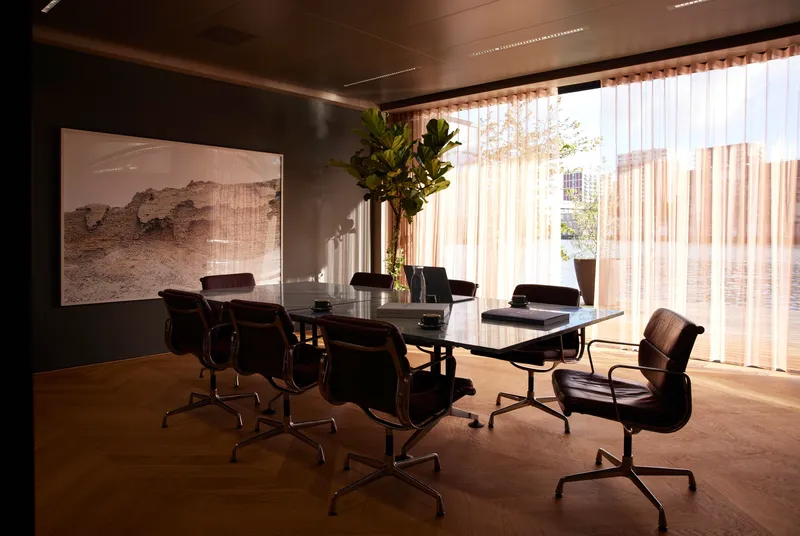
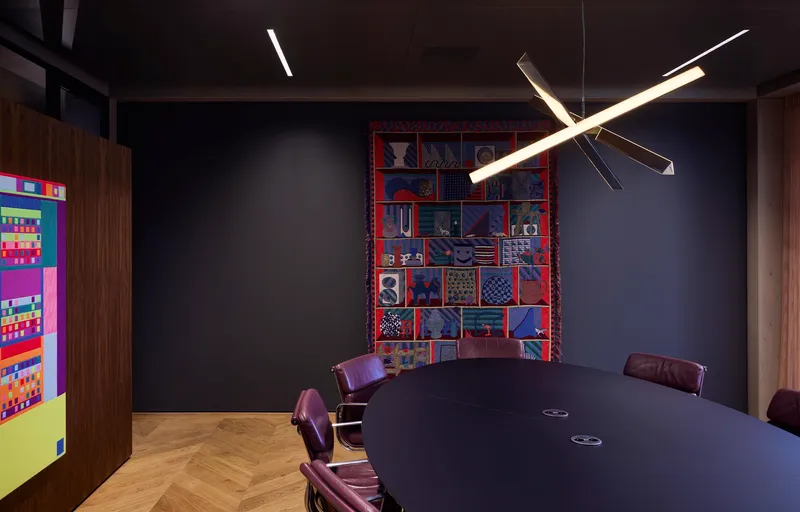
The conference rooms vary in character. One features dark walls, a round table, and a single suspended linear light fixture that gives it the focus of a war room. Another is flooded with daylight through floor-to-ceiling windows softened by sheer curtains. The variety matters because this is not a standard corporate tenant; the GCA hosts negotiations and workshops that require different atmospheres.
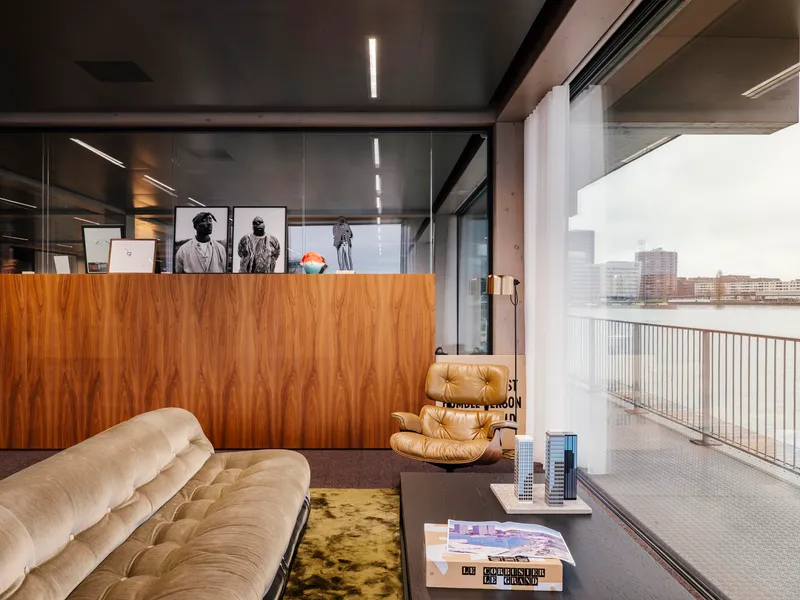
A walnut veneer partition and glass wall open one living space directly to the terrace and the water beyond. Working here, you are never more than a glance away from the element the building is designed to confront. That proximity is a quiet form of rhetoric: the harbor is not a backdrop, it is the reason you are here.
Between Inside and Outside
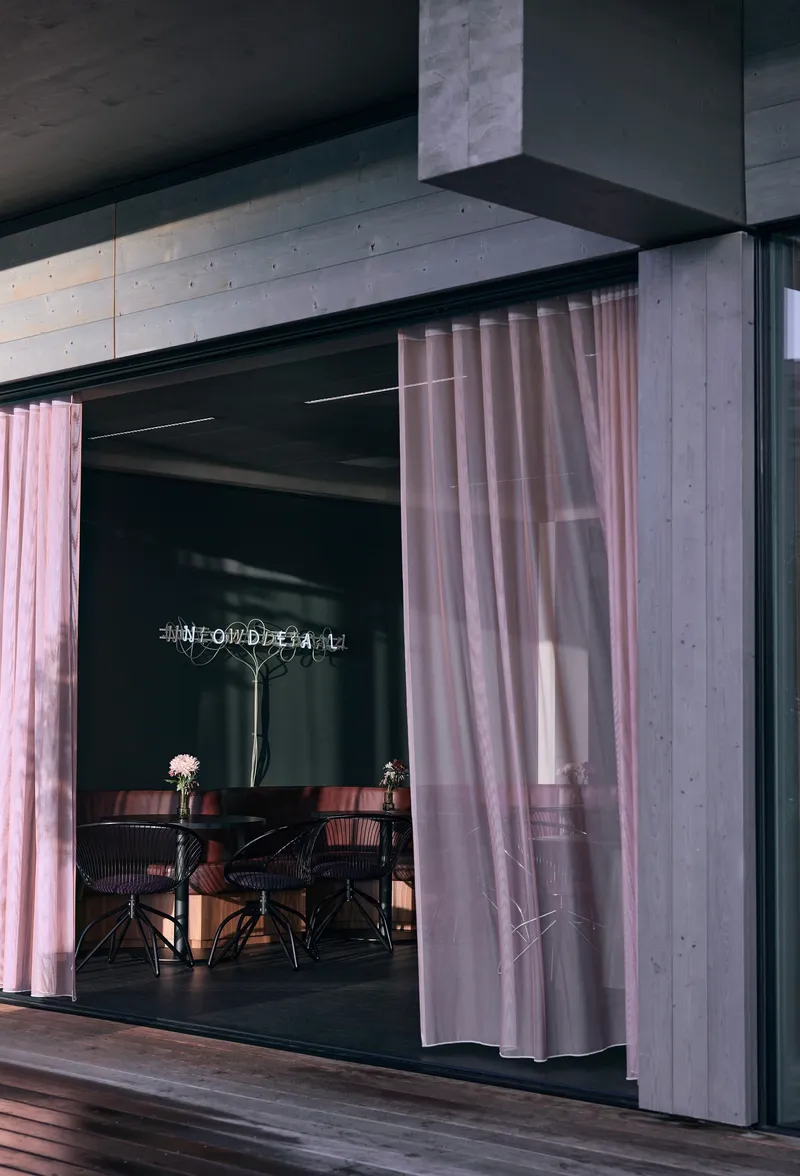
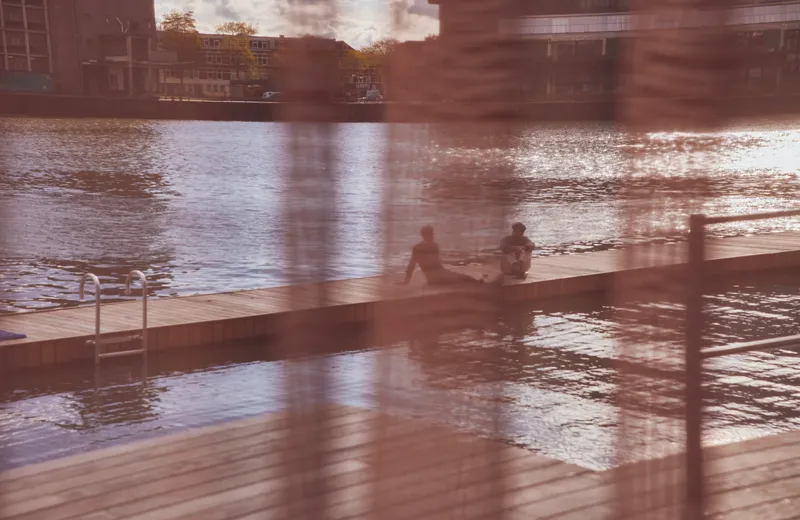
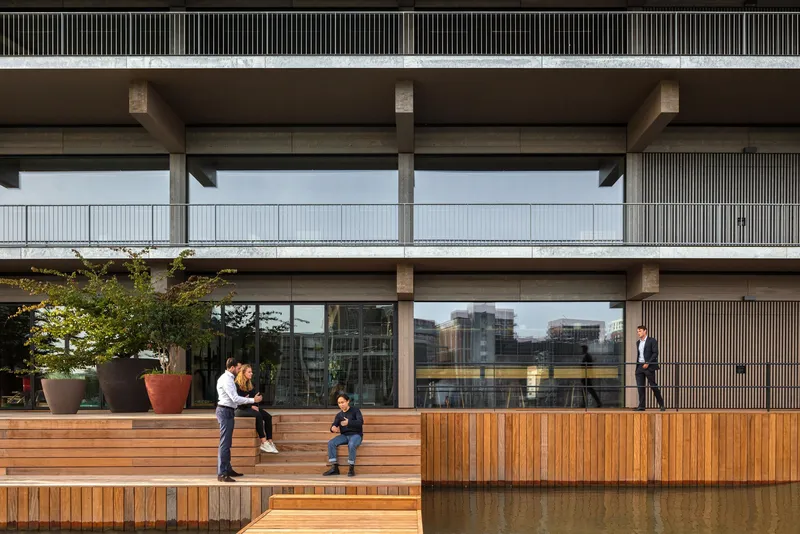
The threshold between interior and exterior is handled with unusual care. At dusk, pink curtains frame a view through a concrete soffit into a lit dining room, collapsing the distinction between the building and the dock. During the day, sheer curtains filter views of the swimming dock into hazy silhouettes. On the terrace, potted trees and seated residents face glass-walled units with vertical screening, a gradient from fully open to fully enclosed that gives occupants control over their exposure.
These in-between moments are where the architecture is most persuasive. A floating building could easily feel isolated, a capsule detached from its context. Instead, the layered edges, the curtains, the decks, and the open gangways keep the building porous. You hear the water. You feel the slight movement underfoot. The harbor is not kept at arm's length.
Balconies and Structural Expression

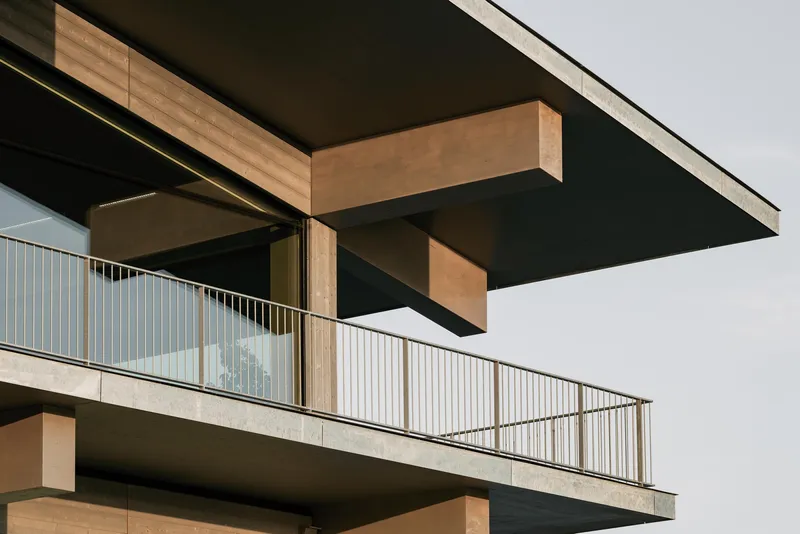
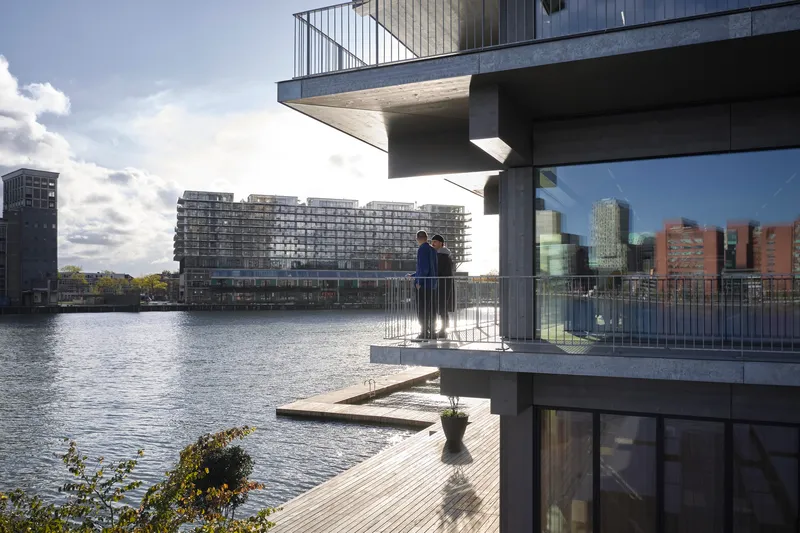
The cantilevered balconies are the building's most expressive structural gesture. Exposed concrete beams and timber soffits project outward, shaded by vertical metal railings that double as privacy screens. Two children mid-jump on the upper level, captured in one photograph, give these balconies a kinetic energy that the drawings alone cannot convey. These are not decorative appendages; they extend the usable floor area over the water and provide solar shading for the glazing below.
From the waterfront, the stacked overhangs give the building a layered profile that reads as a series of shelves rather than a single box. The effect recalls shipbuilding as much as office architecture, which feels right for a structure that will spend its life on the harbor.
Plans and Drawings
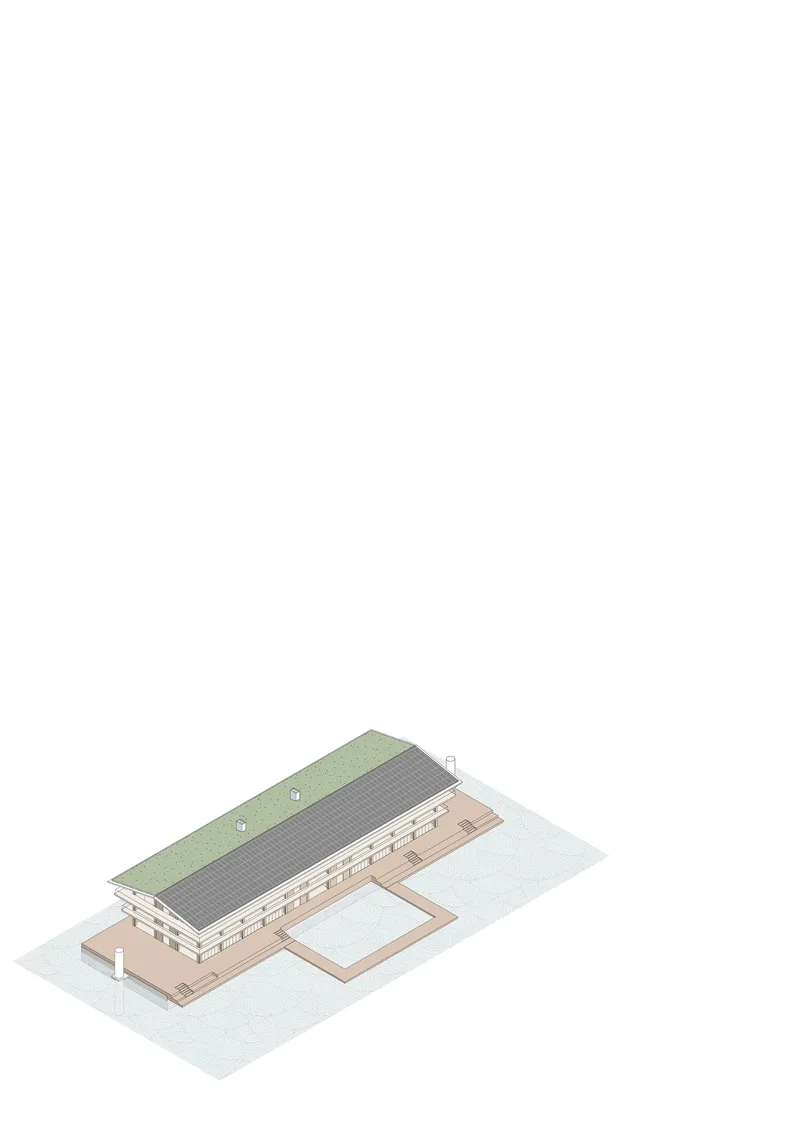
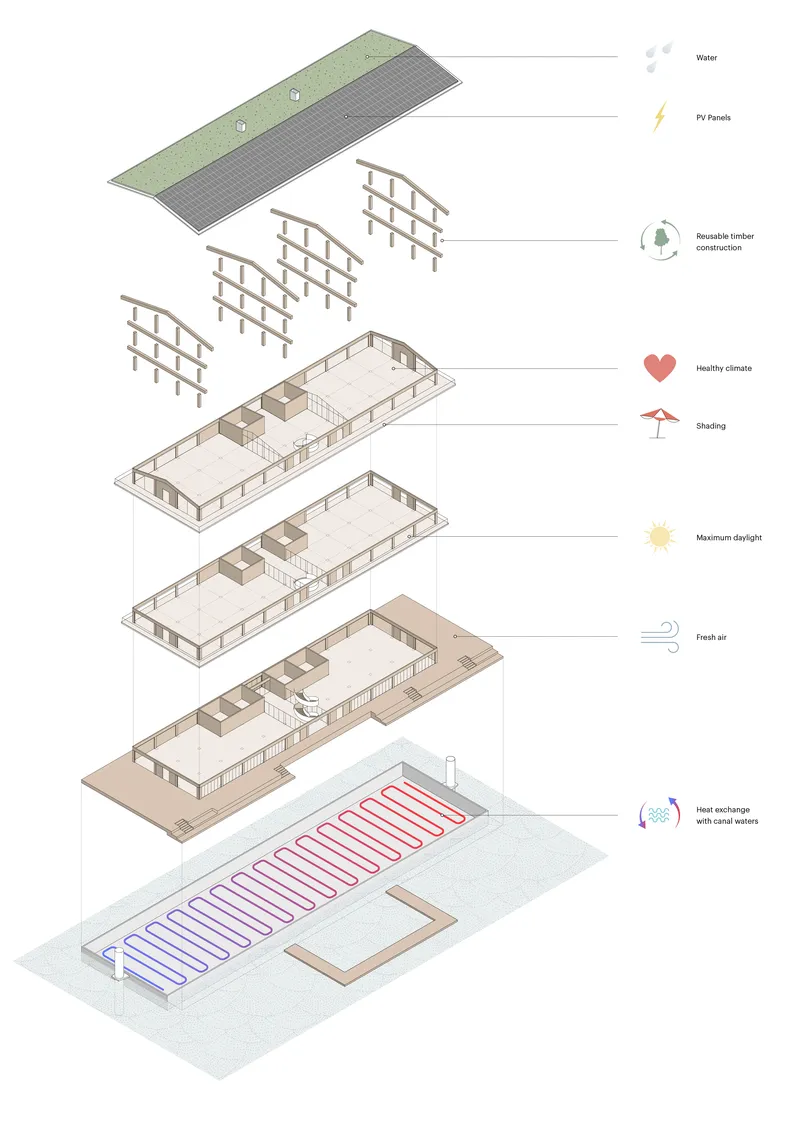
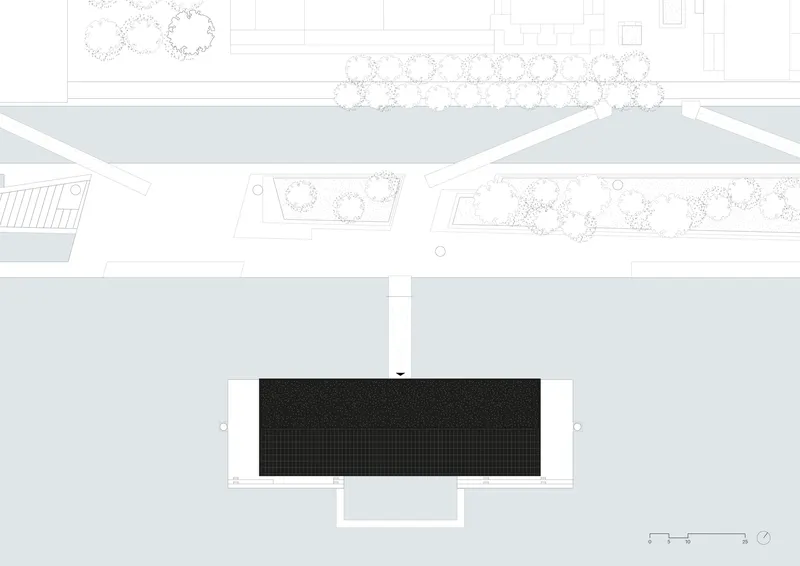
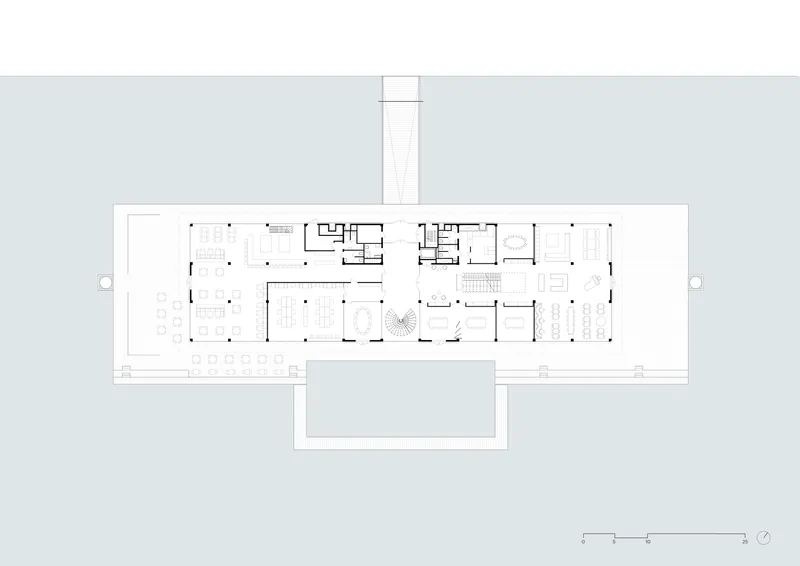
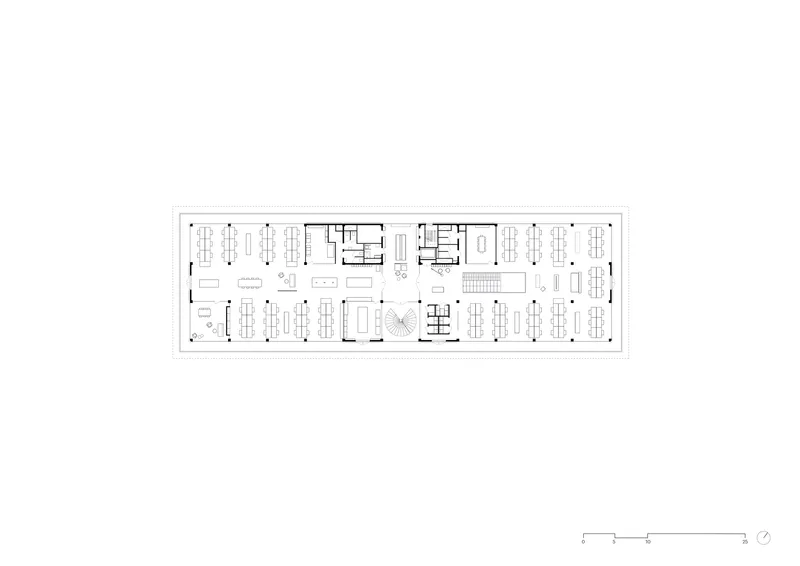
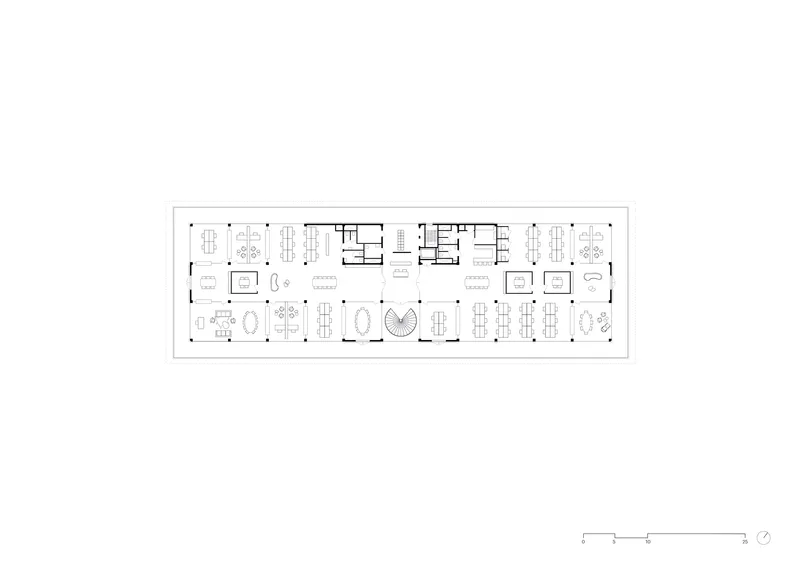
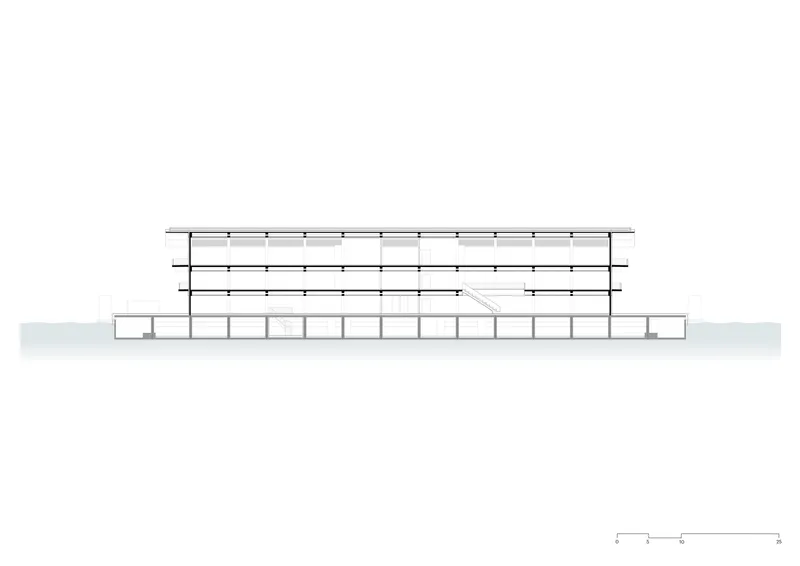
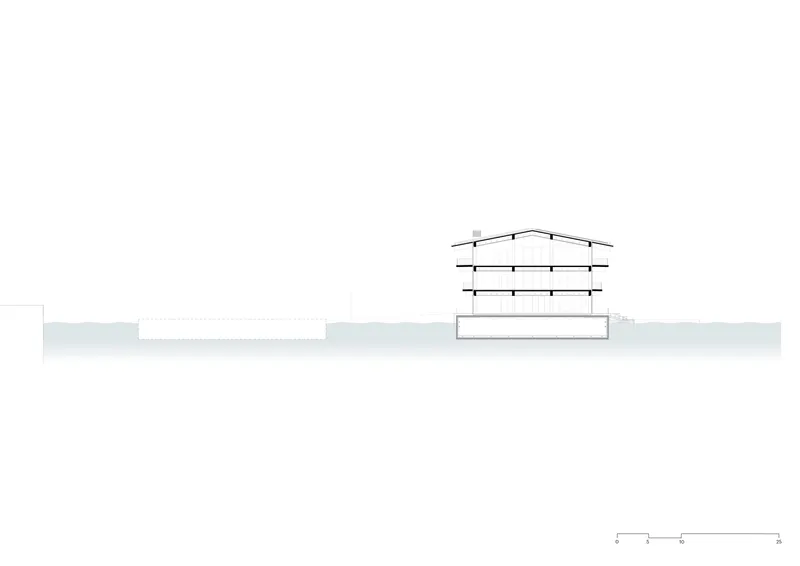
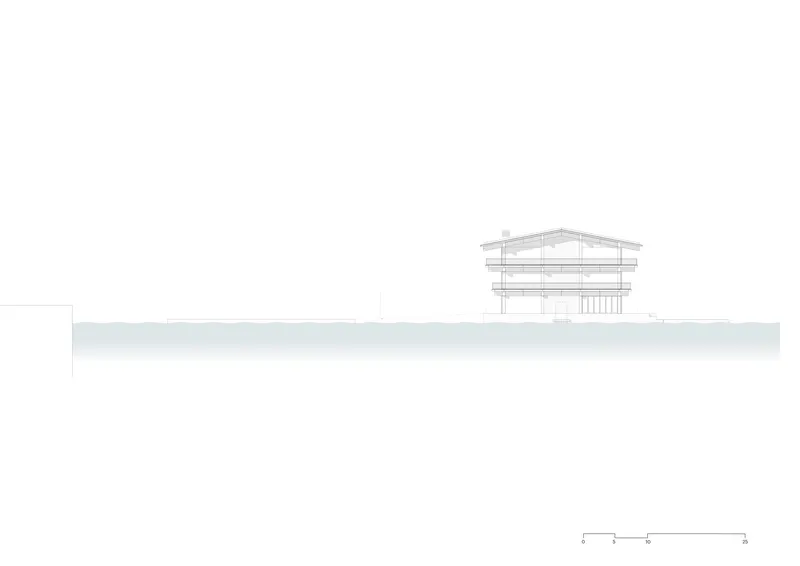
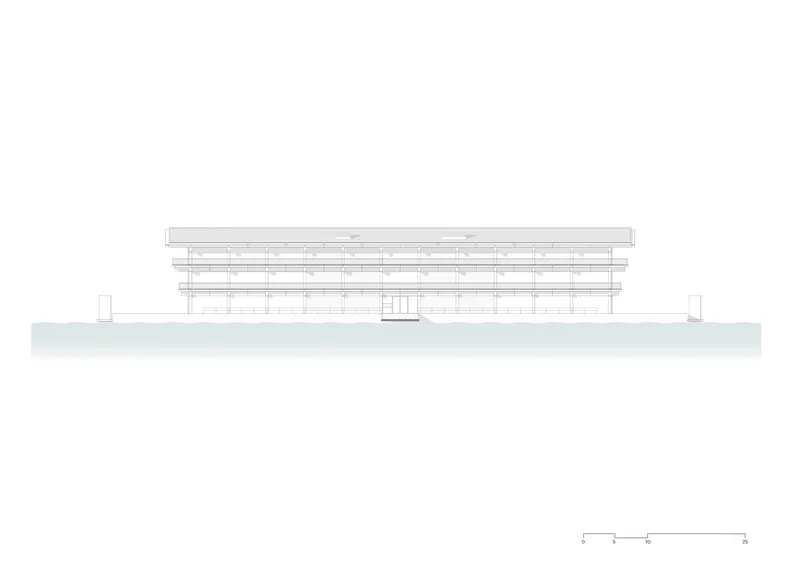
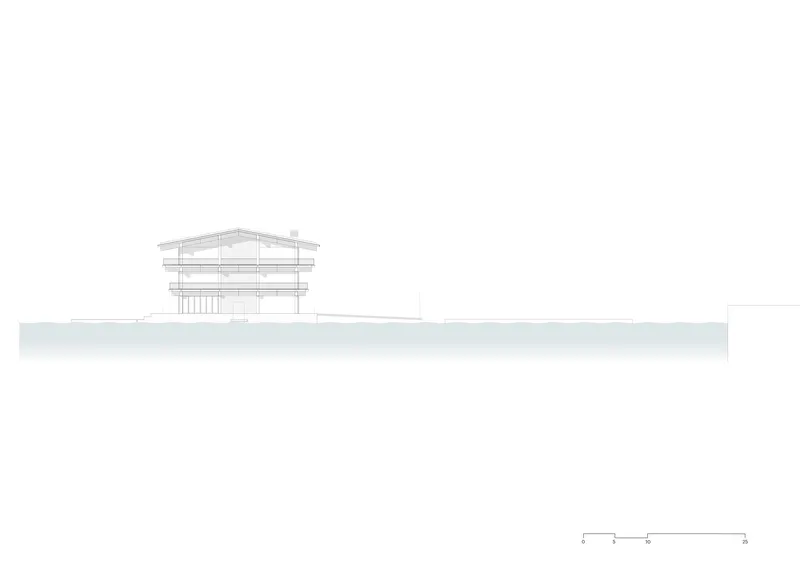
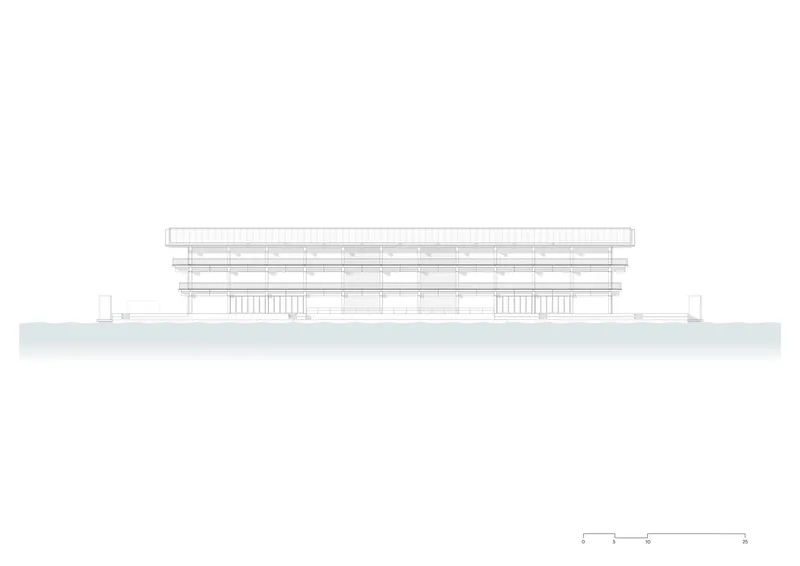
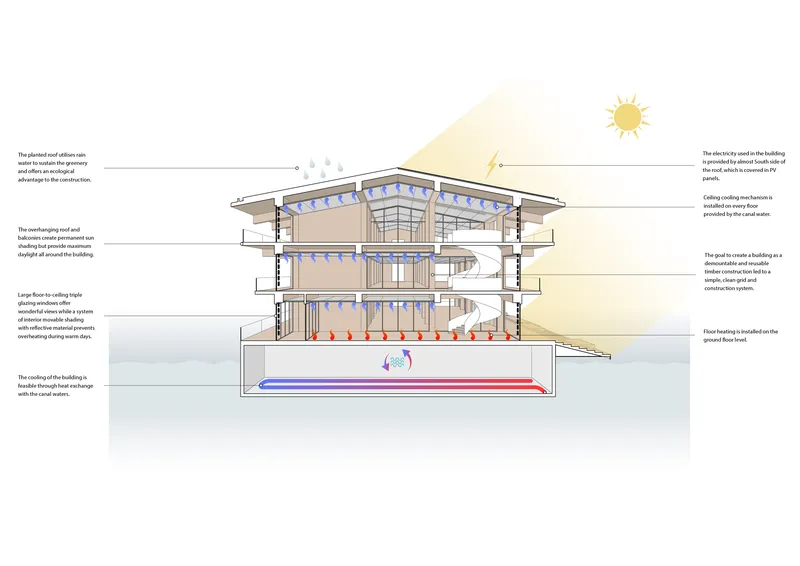
The exploded axonometric is the most revealing drawing in the set. It peels apart the building's layered systems from radiant floor heating at the bottom to photovoltaic roof panels at the top, making legible the energy strategy that keeps the building operationally carbon-neutral. The section drawing annotated with thermal performance diagrams confirms the passive heating and cooling approach: the green roof insulates, the water beneath acts as a thermal buffer, and the solar array generates more energy than the building consumes.
The floor plans reveal an elongated rectangular layout organized around a central courtyard and a circulation spine that keeps the deep floor plate naturally lit. Upper levels open into flexible workspace with a central circular feature, likely a meeting pod or skylight, that breaks the linearity. The site plan shows how the building sits parallel to the quay with tree-lined canal edges, anchoring it visually to the land even though it is physically detached.
Why This Project Matters
The Floating Office Rotterdam matters because it refuses the false choice between sustainability and hospitality. Climate-resilient buildings too often look like bunkers or science experiments. Powerhouse Company built something that people actually want to be in, a place where you can swim off the dock, eat lunch overlooking the harbor, and attend a policy workshop on rising sea levels all in the same afternoon. That integration of civic pleasure and environmental purpose is the real achievement here, not just the engineering of a floating platform.
It also matters as proof of concept. If a 5,880 square meter, energy-positive office can float in a working harbor and serve as a public amenity, the argument that floating architecture is limited to houseboats and temporary pavilions is over. Rotterdam has long positioned itself as a laboratory for water urbanism, and this building is the most convincing full-scale result to date. The question it raises for every other waterfront city is simple: if your climate plan does not include the water, what exactly are you adapting to?
Floating Office Rotterdam by Powerhouse Company (lead architect: Nanne de Ru). Rotterdam, The Netherlands. Completed 2021. 5,880 m². Photography by Marcel IJzerman, Mark Seelen | Seelen+, Sebastian van Damme, and Jordi Huisman.
About the Studio
Share Your Own Work on uni.xyz
If projects like this are the kind of work you want to make, uni.xyz is a place to publish your own, find collaborators, and enter design competitions.


Popular Articles
Popular articles from the community

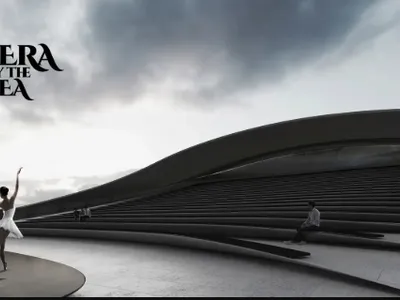
Opera by the Sea Estonia: Three Shells Dissolving Architecture into Tallinn's Coastline
A winning opera house proposal replaces monumental form with interconnected shells that blur the boundary between building, park and Baltic Sea.

Singing Woman: Contemporary Architecture Inspired by Estonia’s Voice and the Sea
Singing Woman turns Estonia’s song culture into flowing opera house architecture, blending public life, landscape, sea, and national memory.
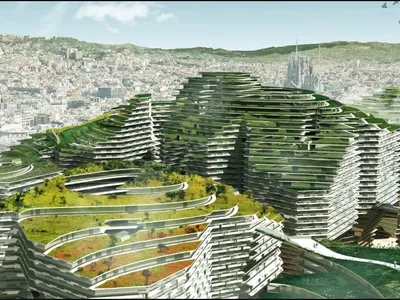
Manzana Morphosis: Stretching Barcelona's Grid into a Living Landscape for 2050
A radical reworking of the Eixample manzana turns density into a tool for generous public space, vertical ecology, and environmental performance.
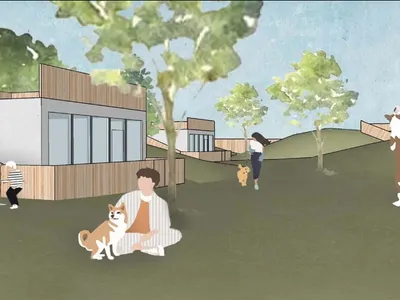
Temporary Home for Dogs: A Reversed Zoo Rethinks Animal Shelter Architecture
In Bucharest, a sinuous corridor and freed landscape flip the logic of containment, designing a shelter that works to make itself unnecessary.

Similar Reads
You might also enjoy these articles

Bao Huynh Watercolor Atelier: A Serene Art Retreat in Hội An
Bao Huynh Watercolor Atelier in Hội An blends multifunctional art spaces, sustainable design, local materials, and family-friendly living in a serene environment.

Atelier Macri Concept Store Interior Design by CASE-REAL
Atelier Macri store features a "ko" counter, walnut wood details, cork displays, blending retail, gallery, and seamless customer experiences.

Manuel Vargas Izquierdo Stadium and High-Performance Sports Center: Architectural Excellence in Jalpa de Méndez
The Manuel Vargas Izquierdo Stadium blends sustainable design, inclusive sports facilities, and cultural-inspired architecture, revitalizing Jalpa de Méndez’s public spaces.

KAKR Buluh Awar Hall: Revitalizing Community and Ecology Through Bamboo Architecture
Community built bamboo hall revitalizes Buluh Awar village, empowering youth, restoring ecology, celebrating vernacular craftsmanship through sustainable architecture and culture.

Comments (0)
Please login or sign up to add comments
No comments yet. Be the first to comment!