
PROJECT TITUS
Library

Engagement, learning, contributing, community, passion, accessibility, interaction, innovation, sinergy and creativity are some of the ideas people would expect to see in the learning process at any age. Even though this is a distant reality to most, it is important to look at the past in order to imagine and project a better future.
The renaissance, a cultural, intellectual and artistic period in European history made the transition from the Middle Ages to modernity. It covered the 15th and 16th centuries and was characterized by an effort to revive and surpass ideas and achievements of classical antiquity, and set forth the philosophy of learning. One of the main examples was “The School of Athens”, painted by Raphael. The depiction presents great names such as the philosophists Aristotle, Plato, Socrates, Heraclitus and Parmenides, the mathematicians Euclid, Ptolemy and Pythagoras, following the tradition of famous men frescoes of the roman period, although with a distinct composition, where men don't simply stand next to each other like scholars lineup, but they mix, engage and debate in the inquires that brought them to greatness. That means we not only see the scholars, but the activity of scholarship itself, despite gender, age and position in society heritage.
These values would only be preeminent in a society where people face each other as individuals which have the greatest potential together and, in this specific scenario, having the habit and comprehension of sharing and conquering ideas. In order to set this reality, architecture has a fundamental role, while proposing spaces which embrace those around and make them participants in its program.
Project Titus is a 4mx4mx10m Micro Library composed of steel frame structure and polycarbonate facade, whose circulation is wide on the ground floor, wherever it is implanted. Inside the volume, there are multiple modular niches (0.4mx0.4mx0.4m) composed of perforated metal sheets, in which, due to its lightweight, intends an easy reorganization by demand (i.e. internal or external permanence, workspace, layout for presentations and speeches, etc.). In order to set a free space on the ground, designed to suggest an area of dialogue and work, the project is separated in two: the ground floor where human relations are intensified; and the roof, where the knowledge storage is kept. The correlation between both happens due to a system of movable pulleys - which assists in reducing object's weight - with the same niches used on the sitting volumes, configuring a two meter high suspended bookshelves. The individual will be able to handle the interaction with each bookshelf, composed of different subjects (i.e. suspense, philosophy, arts, foreign literature, etc.), with an app whose purpose is to descend the user's desired niche.
Foremost, the renaissance was referenced to construct a concept of library, although it’s significant that the present and future context need to enter in the scope, such as for the technological and pandemic scenarios. The former was projected on the individual use of digital devices to interact with the storage and energy spots to serve on demand, such as with computers, mobile phones, 3D printers, projectors for presentations, etc; The latter was designed with the possibility of relocating individual modules to allow social distancing and a book storage which is used only when needed, which means lower contact with possible infected people.
In addition to those concepts, other elements play an important role in the interactions between the site and people, like the polycarbonate facade that, with an opacity gradient top to bottom in order to protect books from direct sunlight, metaphors the building as a flashlight at night periods in an effort to qualify the public space and draw attention to the building itself. The polycarbonate sheets compose 9/10m of the facade, owing to the chimney effect created by a layer of metal perforated sheets on the 10th meter, which allows hot windflow to pass through, but inhibits rain to get in due to the facts that the holes’ diameter is smaller than water's surface tension.
Also, it’s notable that the building consumes a considerable amount of energy in the power plugs, motors to pull bookshelves through pulleys, motors that contract the inferior section of the facade in closed periods, artificial lights and screens to interact with the niches. Therefore, it was considered a sustainable solar energy generation system, by using four photovoltaic panels to generate the power demand consumed by all.
Thus, resembling the strategy planned by apostle Paul to Titus, aiming for him to spread a message on the Island of Crete - a famous Harbour in the Mediterranean Sea, considering that each one who heard that message would spread it in the future at their own journey - the architecture of MicroLibraries set the goal to engage, teach, contribute, passionate, provide, interact, innovate, sinerge and create as if in a community, so that society, united, can build a better world.
composition, where
men don't simply stand next to each other like scholars lineup, but they mix, engage and debate in
the inquires that brought them to greatness. That means we not only see the scholars, but the
activity of scholarship itself, despite gender, age and position in society heritage.


Popular Articles
Popular articles from the community

A Contemporary Take on Iranian Residential Architecture
A modern interior design in Mashhad that reinterprets brick, light, and spatial flow to create a warm, contemporary residential architecture.
On the Brooks House by Monsoon Collective – A Contemporary Kerala Home Rooted in Tradition
Kerala home blending tradition and modernity with water-inspired design, brick architecture, courtyard planning, and sustainable rainwater harvesting strategies.
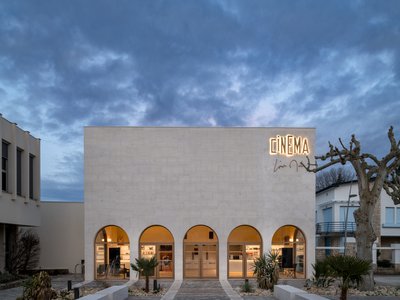
Louis Malle Cinema: A Limestone Cultural Landmark Revitalizing Community Life in Prayssac
Limestone cinema extension with public forecourt, blending heritage and modern design to create flexible cultural spaces and strengthen community interaction.
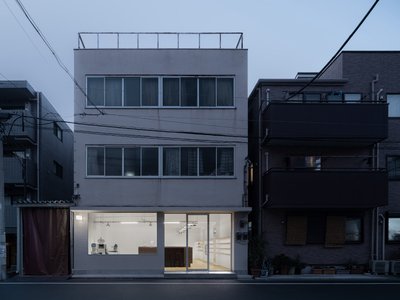
Atelier Macri Concept Store Interior Design by CASE-REAL
Atelier Macri store features a "ko" counter, walnut wood details, cork displays, blending retail, gallery, and seamless customer experiences.

Similar Reads
You might also enjoy these articles


The Ken Roberts Memorial Delineation Competition (Krob)
As the most senior architectural drawing competition currently in operation anywhere in the world, it draws hundreds of entries each year, awarding the very best submissions in a series of medium-based categories.
A Contemporary Take on Iranian Residential Architecture
A modern interior design in Mashhad that reinterprets brick, light, and spatial flow to create a warm, contemporary residential architecture.
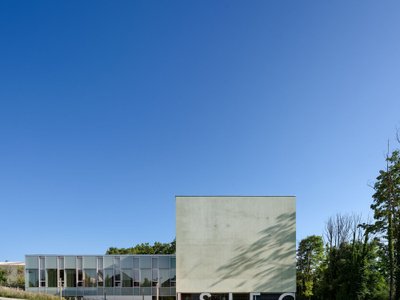
Franche-Comté Advanced School of Engineering by Dominique Coulon & associés, Besançon
A flexible engineering school immersed in woodland, combining concrete minimalism, adaptable spaces, and natural light to support evolving educational environments.


Waterfront Redevelopment and Urban Revitalization in Mumbai: Forging a New Dawn for Darukhana
A transformative waterfront redevelopment project reimagining Darukhana’s shipbreaking heritage into an inclusive urban future.


Explore Educational Building Competitions
Discover active competitions in this discipline




The Global Benchmark for Architecture Dissertation Awards


Challenge to design public laboratory
Comments (0)
Please login or sign up to add comments
No comments yet. Be the first to comment!